


























Auschwitz-Birkenau Memorial Visit from Kraków
A day at the site of the largest German Nazi death camp, and how to arrange the visit so that you can give it the attention it asks for.
Overview
This is not a sightseeing trip, and it shouldn't be planned like one. Auschwitz-Birkenau is a cemetery, the place where more than a million people, most of them Jews, were murdered by Nazi Germany, and today it is a Memorial and Museum run by the Polish state. Visitors come to learn and to remember. The practical choices on this page exist so that the logistics get out of the way and the visit can be what it should be.
Our Auschwitz guide explains the history of the two sites and what you see at each. Here we look at how to arrange the day.
With an educator or on your own
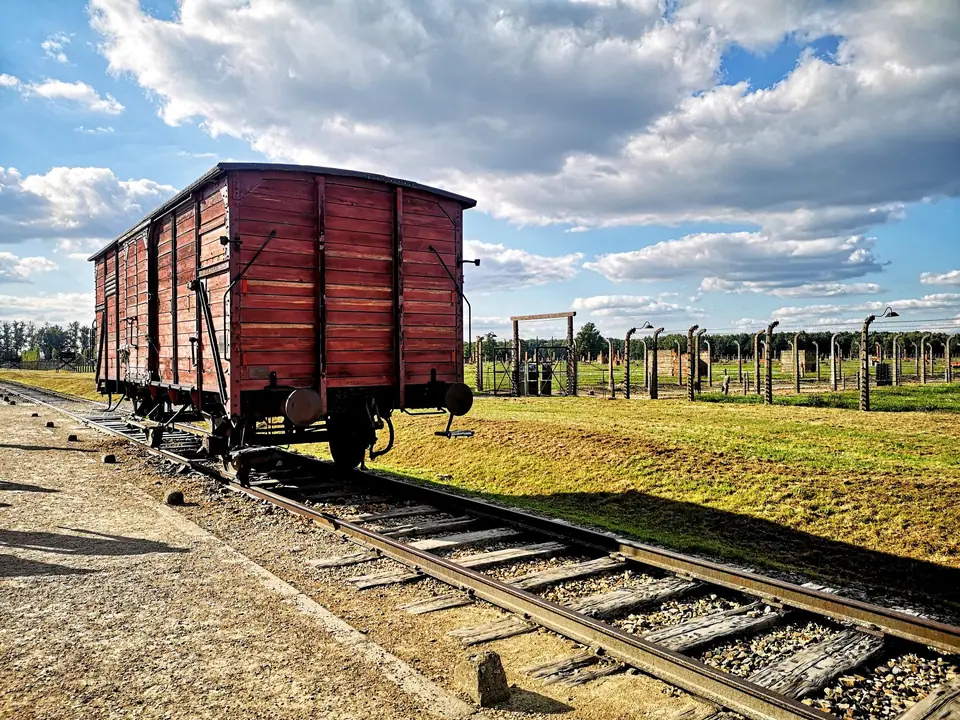
The Memorial runs guided tours led by its own educators, who are trained and authorised by the Museum and work in many languages. The standard tour covers both parts: Auschwitz I, the original camp, whose brick blocks now hold the main exhibitions, and Auschwitz II-Birkenau, about 3 km away, with the railway ramp, the ruins of the gas chambers and crematoria, and the barracks. A shuttle bus links the two.
For a first visit, we would choose the educator-guided tour, and we think most people should. The exhibitions are dense, the scale of Birkenau is hard to grasp, and an educator connects what you see to the people who suffered there in a way no sign does. Visiting without a guide is possible and free, but for most of the year unguided entry is only allowed in the late afternoon, which leaves less time than the site deserves. It suits returning visitors, people who have studied the history, and those who need to move through it more slowly, alone.
Organised tour from Kraków, or independent
Organised tours from Kraków bundle transport with a place on an educator-guided tour at the Memorial. They make sense if you'd rather not manage the booking system and the bus timetable yourself, and they suit people with limited time. Their drawback is the fixed schedule, and some tours rush on to the Wieliczka Salt Mine the same afternoon. We wouldn't combine the two. Travelling independently by bus or train to Oświęcim, covered in our getting there guide, takes a little more organisation but lets you arrive early and leave when you're ready.
Who should think carefully
The Memorial recommends visits for people aged 14 and over. Younger children are not banned, but the exhibitions include photographs, personal belongings of the victims and human hair, and parents should decide with care. Some visitors find the day overwhelming at any age. Plan nothing demanding for the evening.
How to Book
Every visitor needs an entry card, including those on a guided tour and those visiting alone. Cards are booked only online, on the Memorial's official site, visit.auschwitz.org; they are not issued at the entrance. Guided places open about three months ahead, free unguided cards close a week before the visit, and both sell out in summer and around school holidays, so book as soon as your dates are fixed.
- Entry cards are personal. Enter each visitor's name exactly as it appears on the passport or ID card they will bring, since staff can check it at the gate.
- Choose the language and tour type carefully. The standard guided tour is the usual choice; longer study visits are also offered, so check what is available in your language.
- If you book an organised tour, confirm that the price includes the Memorial's educator-guided entry and not only transport, and ask whose name the entry card is issued in.
- Read the cancellation and change rules on the booking page before paying for a guided tour. Changes are limited.
The Memorial asks visitors to arrive well before the tour starts, to allow for the security check.
Tips
- Travel light. Bags larger than the Memorial's size limit must go to a paid left-luggage room, if there is space.
- Bring ID that matches the name on your entry card.
- Dress for the weather and for the place. Much of the visit, especially at Birkenau, is outdoors on open ground. Our what to wear guide covers clothing that shows respect.
- Keep quiet, and think before you photograph. Photography is not allowed in some rooms, and signs mark them. Posed pictures, selfies and walking on the railway tracks for a photo are disrespectful.
- Eat before or after. There is little on site, and the visit is not a place for snacks.
- Give it its own day and leave the evening in Kraków free.
Reviews
Log in to write a review.
No reviews yet.
