























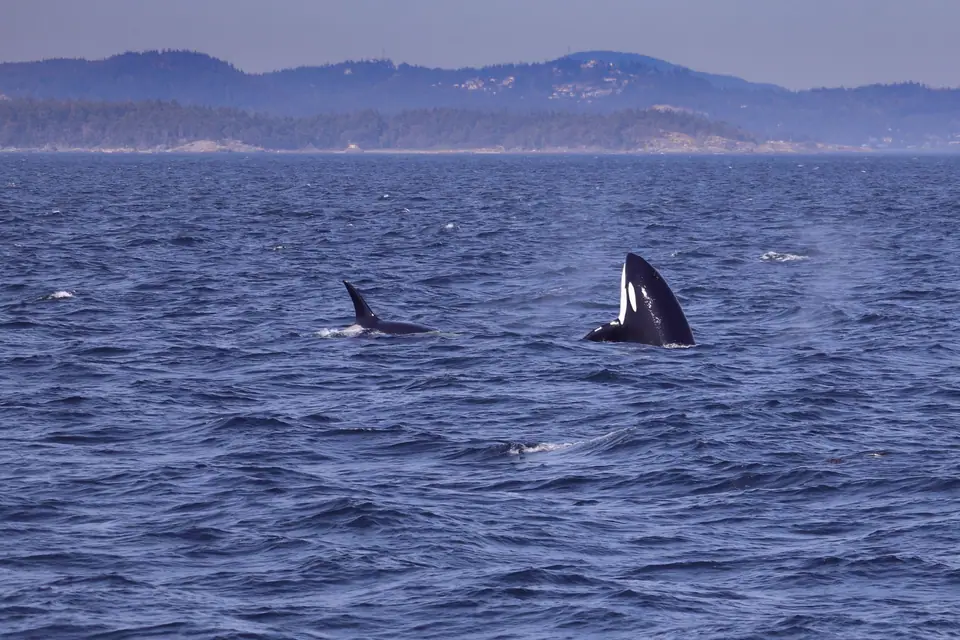
Whale Watching from Vancouver
A long run across the Strait of Georgia for orcas and humpbacks, and the choice of boat that decides how the day feels.
Overview
Vancouver is not really on the whales' doorstep. The animals feed out in the Strait of Georgia and around the Gulf Islands, so a trip from the city begins with a long, fast run across open water before anyone starts looking. That is the main thing to know before booking: this is a half day at sea, not a harbour cruise, and much of it is spent travelling.
What you get in return can be superb. The orcas seen most often here are Bigg's killer whales, which travel in small family groups and hunt seals and sea lions, so a sighting can turn into a chase. Humpbacks have come back to these waters in large numbers over the last two decades and feed here from late spring to autumn, sometimes lunging at the surface with their mouths open. Along the way there are harbour seals hauled out on the rocks, sea lions, porpoises, and bald eagles on the islands.
When to go
Most trips run from spring to autumn, roughly April to October. Humpbacks are most reliable from summer into October, and September, with its calmer weather and thinner crowds, is our favourite month on the water. Early spring and late autumn trips are rougher and colder. Operators share sightings with each other over the radio, and many rebook you for free if you see none, but no one can promise a particular species.
Open zodiac or covered boat?
Open zodiac-style boats carry a dozen or so passengers on bench seats, low to the water. They are faster, so they reach distant whales sooner, and the view at eye level is thrilling. You will be given a flotation suit, and you will get cold and probably wet. Operators generally don't take pregnant passengers, young children or people with back or neck problems on them.
Covered or semi-covered boats are larger, with an indoor cabin, a toilet and outside decks. They are slower but steadier, which suits families, older travellers and anyone prone to seasickness. Some companies switch between open and covered layouts by season.
For most first-timers we would pick the covered boat on a long trip and the zodiac only for a keen, dry-weather group.
The distance rules
Canadian law sets how close any boat may go. Since 1 June 2026 an interim order requires all vessels, including kayaks, to stay at least 1,000 metres from the endangered Southern Resident killer whales across southern BC waters, up from 400 metres, until at least 31 May 2027. Other orcas, including Bigg's, have a 200-metre limit, and humpbacks and other whales 100 metres (200 if resting or with a calf). Two sanctuary zones off Saturna and Pender islands are closed to boats in summer and autumn. In practice that means binoculars help, and a good crew will cut the engines and let the whales come past rather than chase them.
How to Book
Trips leave from Granville Island, from the downtown waterfront and from Steveston in Richmond, a fishing village near the airport. Steveston is closer to some of the feeding areas but a longer ride from downtown, so check whether transport is included. Departures from Granville Island are the easiest to reach, and our Granville Island guide covers the ferries there.
Choose an operator that belongs to a recognised whale watching association and follows its viewing guidelines. Before you pay, ask:
- open boat or covered, and whether that changes in your month
- how long the trip usually runs, and where they have been finding whales that week
- whether warm gear, snacks and a naturalist are included
- what happens if no whales are seen, and how weather cancellations are handled
- the minimum age, especially on open boats
Book a morning early in your stay so a cancellation for wind leaves room to try again.
Tips
- Dress warmer than the forecast. Even on a hot July day, a fast boat on the strait is cold. A hat and gloves are not overkill; see our what to wear guide.
- Sit low and central if you feel queasy. The run across the strait can be choppy, and tablets only help if taken before you board.
- Bring binoculars and a zoom lens. At 100 or 200 metres, a phone camera shows a speck.
- Eat before you go. Food on board is basic or absent.
- Sit where you can move. On covered boats, the outside decks at the back and bow are where the viewing happens; the cabin is for the long run out.
- Consider Victoria instead. If you are already going there, trips from its Inner Harbour reach the whales' waters sooner. Our day trips guide covers getting there.
Reviews
Log in to write a review.
No reviews yet.
You might also like

Mostar, Blagaj and Sarajevo from Montenegro
A long day trip from the coast, or two to three days to include a night in Mostar and Sarajevo · Montenegro

Cappadocia Balloon Watching and Horse Riding
About an hour at a viewpoint around sunrise, and one to two hours on horseback, usually in the late afternoon · Cappadocia

Wieliczka Salt Mine Tour
About 2 to 3 hours underground, plus the train or transfer from Kraków · Kraków

US Capitol Tour
About 1 to 2 hours: a short film and a guided walk of under an hour, plus security and time in the Visitor Center exhibits · Washington DC
