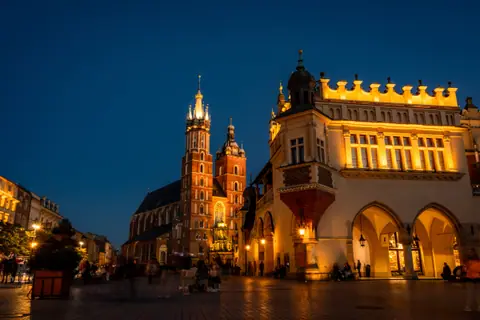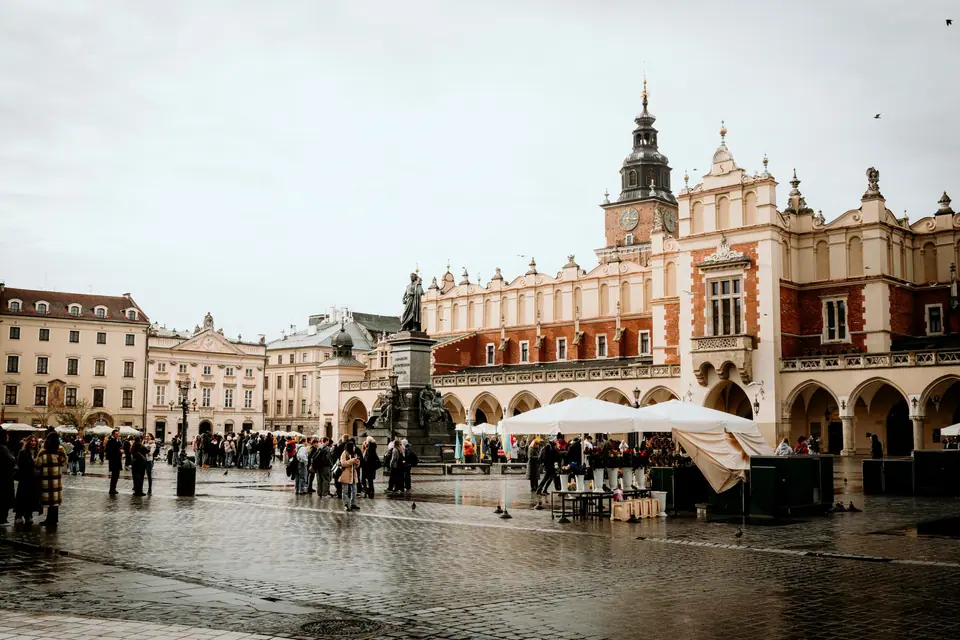
Krakow Old Town and Kazimierz Guide: Main Square, Wawel and the Jewish Quarter
How to explore Krakow's Old Town, Wawel Hill and the Jewish quarter of Kazimierz in the right order: the sights, the courtyards, the food and the practical details.
Krakow was the capital of Poland for five centuries, and it is the one major Polish city that came through the Second World War with its medieval centre almost untouched. The result is a place that feels unusually complete: a vast market square the size of a small town, a royal castle on a hill above the river, a university founded in the fourteenth century and a former Jewish quarter whose streets have been reborn as the most creative district in the city. All of it fits inside an easy walk.
The city is also cheerful and young. Students from the Jagiellonian University fill the cafes, cellar bars hide under almost every old house, and the mix of grand history and relaxed nightlife makes Krakow one of the easiest cities in Europe to enjoy. This guide explains how the Old Town, Wawel and Kazimierz fit together, which sights deserve your time, how to plan a day on foot, and what to eat and where to stay.
Poland's royal city at a glance
- How long? One day covers the Main Square and Wawel. Two days add Kazimierz and a slower pace. Three days leave room for a day trip.
- Where to start? On the Main Square early in the morning, before the crowds and the horse carriages arrive.
- The signature sight: the Main Square, with the Cloth Hall and the two uneven towers of St Mary's Basilica.
- The best free sights: the square, the Planty park that rings the Old Town, the exterior of Wawel and the lanes of Kazimierz.
- The classic evening: a late dinner of Polish food, then drinks in a cellar bar or a courtyard in Kazimierz.
- The biggest mistake: eating at the first restaurant with a menu in six languages on the Main Square.
- When to go: late spring and early autumn, covered in our best time to visit Krakow guide.
- Where to sleep: the Old Town for convenience, or Kazimierz for atmosphere. More in our Krakow where to stay guide.
The route that works: start at the Main Square, walk the Royal Route up to Wawel Hill, cross to Kazimierz for lunch and the afternoon, and return for dinner in the Old Town. Our Krakow 3-day itinerary shows how to combine it with the wider region, and the Old Town guide gives a shorter summary.
A ring of parkland around the medieval core
The Old Town is a rough oval, once enclosed by defensive walls. In the nineteenth century the walls were torn down and the moat filled in, and the space was turned into the Planty, a green belt of lawns, avenues and benches that encircles the old centre. Only a few fragments of the fortifications survive, including the Florian Gate and the round Barbican beside it. The Main Square lies in the centre of the oval, and the streets radiate from it in a neat medieval grid.
To the south, Wawel Hill rises above the Vistula river, and beyond it lies Kazimierz, once a separate town. The river bends round both, and the whole area is flat except for the hill, which makes it easy to explore on foot. Trams and a dense bus network serve the outer districts, but within the centre you will rarely need them.
The Planty is a pleasure in itself. Its tree-lined paths are about four kilometres in a circuit, divided into small gardens with benches, fountains and statues, and a walk around it takes a little over an hour at a gentle pace. It is lovely in spring when the cherry trees bloom and in autumn when the leaves turn, and it is a favourite with joggers, dog walkers and chess players. Enter at any of the gaps in the old walls and you can always step back out into the lanes.
The Main Square and the Cloth Hall
The Rynek Główny, the Main Square, is the largest medieval market square in Europe. Laid out in the thirteenth century, it measures about two hundred metres on each side, and it is surrounded by townhouses, churches and cafes. At its centre stands the Cloth Hall, Sukiennice, a long Renaissance arcade where merchants once traded cloth, spices and salt. Today its ground floor is lined with stalls selling amber, wooden boxes, embroidered linen and souvenirs, and the upper floor houses a gallery of nineteenth-century Polish painting.
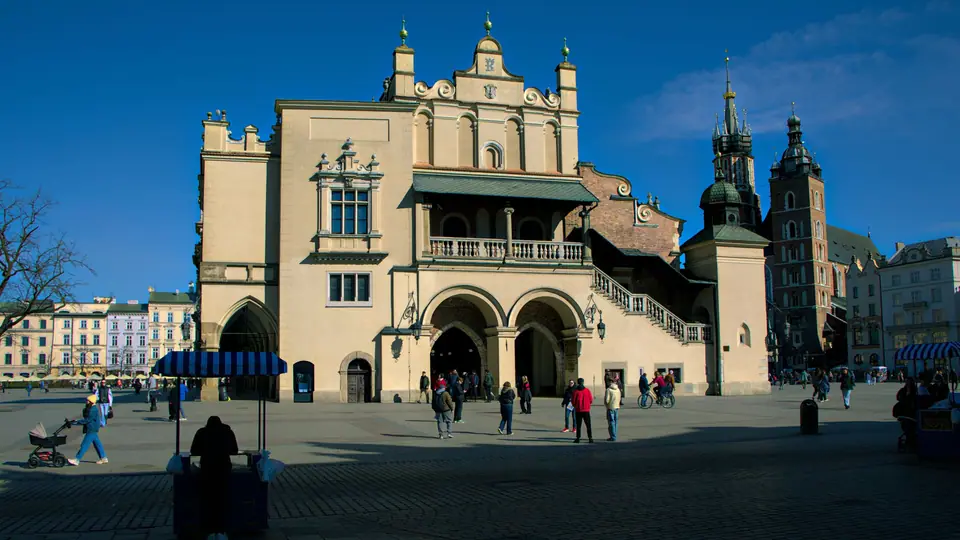
The square is a living room for the city. Flower sellers sit on the corners, buskers play, pigeons strut across the cobbles, and horse-drawn carriages wait for customers. It is lovely early in the morning and again in the evening, when the lights come on and the terraces fill. Beneath the square, the Rynek Underground museum uses a modern exhibition to show the medieval market stalls and streets that lie below the cobbles, and it is an excellent complement to a walk above ground.
St Mary's Basilica and its trumpeter
On the east side of the square, the brick Gothic church of St Mary is the city's best-loved landmark. Its two towers differ in height and shape, and legend says that two brothers built them and that one killed the other in a jealous rage. Inside, the church glows with a deep blue ceiling studded with gold stars, and its altarpiece, carved by the German sculptor Veit Stoss in the fifteenth century, is one of the greatest works of Gothic sculpture in Europe. Opened in stages, it unfolds like a book of carved scenes.
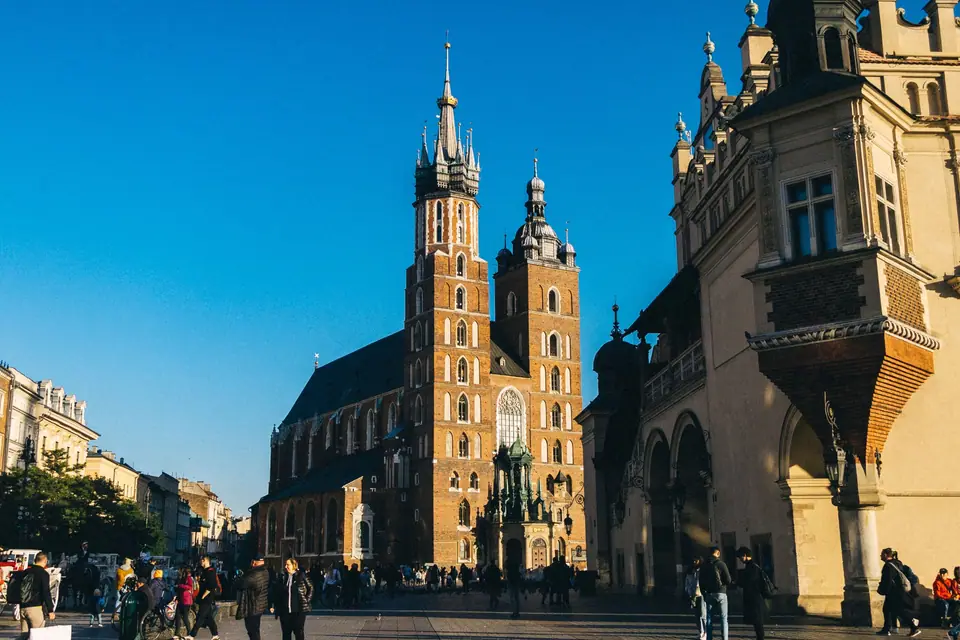
Every hour, a trumpeter plays a short melody from the taller tower, the Hejnał, which stops abruptly in the middle of a note. It commemorates a watchman who was shot in the throat by a Tatar arrow as he sounded the alarm in the thirteenth century. Crowds gather in the square to hear it, and it is a charming ritual. The church is a working parish, so respect the services and dress modestly. Entry for visitors is organised through a ticket office at the side, and it can be busy in summer.
The university and the scholars' street
Krakow's university, founded in 1364 and known as the Jagiellonian, is the second oldest in Central Europe. Its most beautiful building, the Collegium Maius, stands on Jagiellońska Street and has a Gothic courtyard with a cloister and an old clock that sets a procession of figures moving at set times of day. Inside, the museum displays medieval scientific instruments, including a globe from the early sixteenth century that is one of the first to show America. Among its students was Nicolaus Copernicus, who studied astronomy here before changing our view of the universe.
The surrounding streets, such as Świętej Anny, are lined with bookshops, student bars and lecture halls, and they are full of life term-time. A walk through here reveals a different, more intellectual side of the Old Town.
Mariacka Street and the small squares
Behind St Mary's, the Mariacka Street is a narrow, cobbled lane lined with amber shops, galleries and cafes, closed to traffic and decorated with window boxes. It leads to the little Mariacki Square, where the church's side entrance faces a row of terraces. Nearby, the Small Market Square, Mały Rynek, is a quiet triangle with a few cafes and a reputation for being calmer than the main one. These lanes offer a pleasant detour when the Main Square is packed, and in the evening they glow with lamplight.
Down the Royal Route to Wawel Hill
The Royal Route is the old coronation road, running from the Florian Gate through the Main Square and down Grodzka Street to Wawel. The walk takes about twenty minutes without stops, but there is plenty to see along the way. Look for the Collegium Maius, the oldest building of the Jagiellonian University, with a Gothic courtyard and a clock that sets mechanical figures in motion; the Church of Saints Peter and Paul with its row of apostle statues; and the small Romanesque church of St Andrew, which survived the Tatar sack of the city.
The street is lined with cafes, antique shops and restaurants, and a few lanes lead off to quiet courtyards. Allow time to stop for a coffee or a pastry. It is a pleasant, easy walk, and its mixture of fine architecture and everyday life explains why the Old Town is a World Heritage Site.
Wawel Castle and Cathedral
Wawel Hill has been the seat of Polish kings for a thousand years, and its castle and cathedral are the national shrine of the country. The cathedral, with its golden domed chapel, holds the tombs of kings and queens, and heroes and poets from the national story are buried in the crypts. The royal castle, rebuilt in the Renaissance style around an arcaded courtyard, contains state rooms, private apartments, a treasury and an armoury, and a famous collection of tapestries made for the kings.
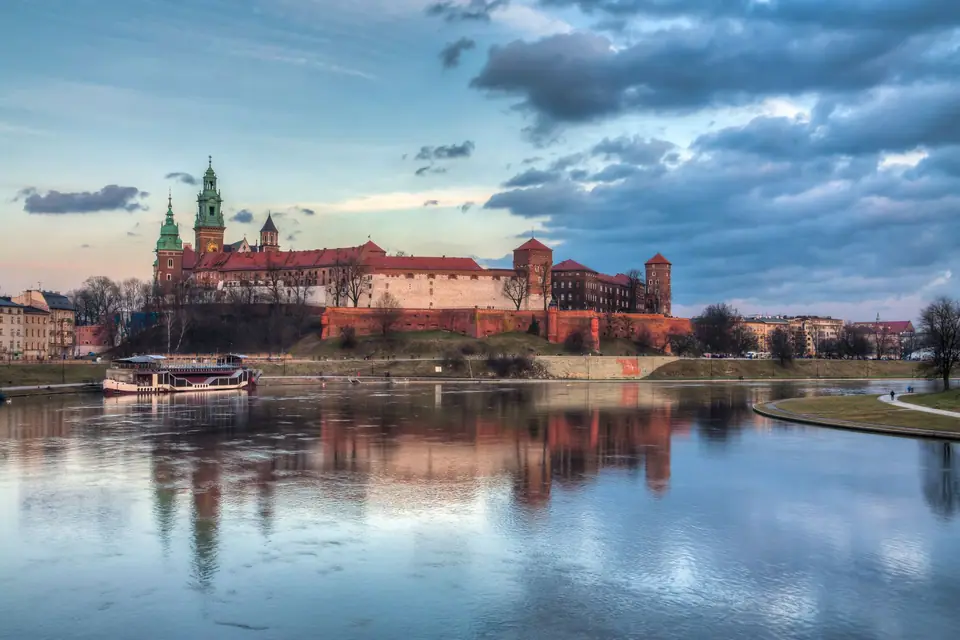
Entry to the different parts is by separate timed tickets, and the numbers allowed in each part are limited, so book ahead in high season. The grounds and the courtyard are free to walk around. At the foot of the hill, a stone sculpture of the dragon of Wawel breathes real fire every few minutes, a favourite with children. According to legend, a cobbler killed the dragon with a sheep stuffed with sulphur, and the beast's cave can be visited from the hillside.
Kazimierz: the old Jewish quarter
South of Wawel, Kazimierz was founded in the fourteenth century as a separate town and, from the sixteenth, became home to Krakow's Jewish community. For centuries it was one of the great centres of Jewish culture in Europe. Before the war, about sixty thousand Jews lived in Krakow, and the great majority were murdered during the Holocaust. After decades of neglect, Kazimierz has been revived, and it is now a lively district of synagogues, cafes, galleries and bars, as well as a place of memory.
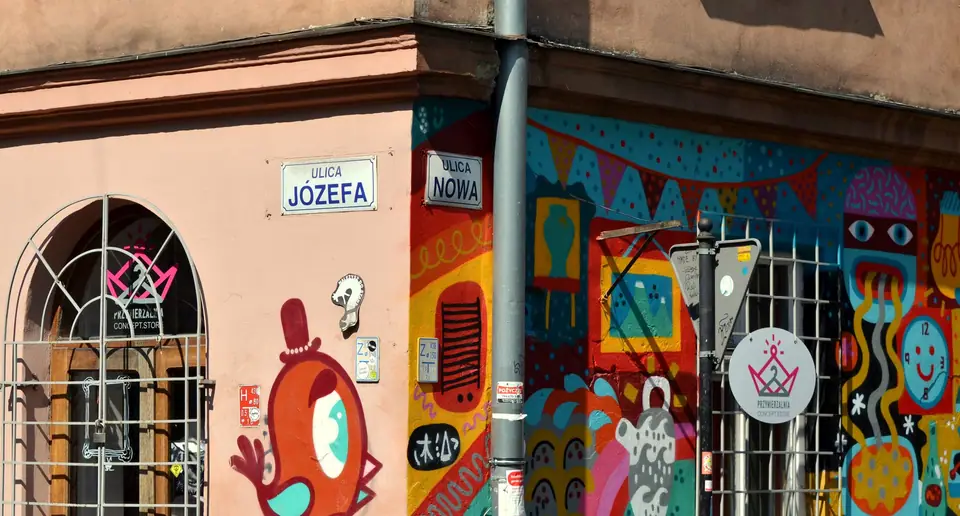
The Old Synagogue, the oldest surviving synagogue in Poland, now houses a museum of Jewish history and traditions. The Remuh Synagogue, still in use, is next to a historic cemetery with weathered tombstones. Plac Nowy, the central square, has a round market hall where stalls sell zapiekanki, long toasted baguettes with mushrooms and cheese, a beloved late-night snack. The best way to get to know Kazimierz is to wander its lanes, and the courtyards behind the main streets repay a curious look.
Across the river to Podgórze
A footbridge decorated with hanging sculptures of acrobats leads from Kazimierz across the Vistula to Podgórze, where the Jewish ghetto was created in 1941. Schindler's Factory, now a museum, tells the story of Krakow under Nazi occupation with a powerful and well-designed exhibition. The memorial of empty chairs in Ghetto Heroes Square, and the fragments of ghetto wall nearby, recall what happened here. It is a sobering but important visit, and a necessary counterpart to the cheerful old town.
Visits to the museum require timed tickets that sell out in busy months, so book ahead. If you are considering Auschwitz, our Auschwitz guide explains how to approach the visit, and the Auschwitz-Birkenau memorial tour covers the guided option.
A relaxed day from square to synagogue
- Early morning: have coffee on the Main Square and see the Cloth Hall before it fills.
- Mid-morning: visit St Mary's Basilica and listen for the trumpeter.
- Late morning: stroll the Royal Route and look into the university courtyard.
- Midday: explore Wawel Castle and the cathedral.
- Lunch: eat at a milk bar or a small restaurant near the river.
- Afternoon: walk into Kazimierz, visit the synagogues, and stop at Plac Nowy.
- Evening: dinner in the Old Town or Kazimierz, followed by a cellar bar.
The day is mostly flat, but busy in the middle. Wear comfortable shoes for the cobbles, and keep time for a long lunch.
Adding a second and third day
With extra time, add Schindler's Factory, the Czartoryski Museum with its Leonardo da Vinci painting, the Planty park, or a river walk below Wawel. A short tram ride takes you to the Nowa Huta district, a showcase of Communist-era planning, which is the subject of quirky guided tours in vintage cars. Our things to do in Krakow page lists more ideas. Day trips to the Wieliczka Salt Mine, described in the Wieliczka salt mine tour, and others in the Krakow day trips guide fill a third day well.
Coffee houses, tea rooms and a slower pace
Krakow takes its cafe culture seriously. Grand old coffee houses in the Old Town serve cakes under chandeliers, and in Kazimierz dozens of small, mismatched cafes occupy former Jewish prayer houses and shops, with candlelit tables and secondhand furniture. Specialty coffee has arrived in force, and you will find excellent flat whites in student cafes near the university. Tea houses offer a calmer alternative, with loose-leaf teas and homemade cakes. If you need a break between sights, sit in a courtyard cafe and watch the street.
Trams, trains and the airport link
Krakow is compact, and the Old Town is closed to most traffic. The main railway station is a short walk from the Florian Gate, and a train links the airport to the centre in about twenty minutes. Our how to get to Krakow guide covers flights from the UK, buses and trains from Warsaw. Inside the city, trams are cheap and frequent, and ride-hailing apps are an inexpensive alternative to street taxis. Validate your paper ticket in the machine on board, since inspectors carry out spot checks.
Where to rest your head
The Old Town puts you among the sights, and many small hotels occupy converted townhouses with courtyards. The trade-off is noise at weekends, especially around the Main Square and the lanes with bars. Kazimierz is more bohemian, with boutique hotels and guesthouses and a lively nightlife. For a quieter stay, look at the streets near the Planty park or in the Stradom district between the two. Our Krakow where to stay guide compares the areas.
Pierogi, milk bars and cellar cocktails
Polish food is hearty and generous. The classic dish is pierogi, dumplings filled with meat, cheese and potato, mushrooms or sweet fruit. Others to try are żurek, a sour rye soup served in a bread bowl, bigos, a hunter's stew of cabbage and meat, and gołąbki, stuffed cabbage rolls. On the street, buy an obwarzanek, a ring-shaped bread sprinkled with sesame or poppy seeds, or a zapiekanka in Kazimierz.
For a cheap and authentic lunch, look for a milk bar, a surviving relic of the Communist era, where locals queue for simple home-style dishes at the counter. The tourist restaurants around the Main Square charge more for less, so walk a few streets away. In the evening, Krakow's cellar bars serve flavoured vodkas, craft beer and cocktails in vaulted rooms, and tea houses and cafes offer a quieter alternative.
Amber, linen and other keepsakes
The Cloth Hall stalls are the traditional place to buy amber jewellery, carved wooden boxes, painted eggs, linen and leather goods. For finer quality, look in the shops along the Royal Route and in Kazimierz, where independent designers and antique dealers sell jewellery, ceramics and vintage posters. Polish vodka, honey and fruit liqueurs also make easy gifts. Be wary of cheap amber, which is often plastic, and ask about certificates for expensive pieces.
Cobbles, crowds and common sense
Krakow is one of the safest big cities in Europe, and violent crime against visitors is rare. Pickpockets work the crowded squares, trams and tourist sites, so keep your valuables in a front pocket. Late at night, avoid unlicensed taxis, and take care with the strong drinks sold in cellar bars. Watch your step on the cobbles, particularly when wet. Our what to wear in Krakow guide helps you pack for the changeable weather.
Behave respectfully at the Jewish sites and at Schindler's Factory, where photography may be restricted, and dress modestly in churches. A few words of Polish, such as dzień dobry and dziękuję, are warmly received.
Christmas markets and summer terraces
Krakow changes character with the seasons. In December, the Main Square hosts one of Europe's most atmospheric Christmas markets, with wooden stalls, mulled wine and a nativity scene competition. Spring brings flowers to the Planty, and summer fills the squares with terraces, festivals and the Jewish Culture Festival in Kazimierz. Autumn is mild and golden, and winter can be cold and snowy but magical. The smog that affects the city in winter deserves a mention if you are sensitive to air quality.
Beyond the Old Town
The region around Krakow has plenty to offer. The Wieliczka Salt Mine, with its underground chapels carved from salt, is the most popular excursion. The Tatra Mountains and the resort town of Zakopane are a few hours away, and the royal city of Wrocław and the capital, Warsaw, are reachable by train. Our Krakow day trips guide lists the options.
Planning the rest of your trip
Many visitors combine Krakow with Warsaw, Gdańsk or Prague. Our Krakow travel guide covers money, transport, etiquette and how many days to give the city.
Questions we hear from first-time visitors
Is one day enough for Krakow?
One day covers the Main Square and Wawel. Add a second for Kazimierz, Schindler's Factory and a slower pace.
Do I need to book Wawel Castle and Schindler's Factory?
Yes in high season. Both sell timed tickets, and popular slots go first.
Is Krakow cheap?
It is cheaper than most Western European cities, especially for food, drinks and public transport, though tourist spots near the Main Square charge more.
Can I use euros?
Poland uses the złoty. Cards are widely accepted, and cash machines are easy to find, but avoid exchange booths with poor rates.
Is the tap water safe?
Yes, though many people prefer bottled water for taste.
Is it appropriate to visit Auschwitz as a day trip?
Many visitors do. It is a serious and emotional visit, so plan a calm day around it and book a guided tour in advance.
For everything else, the pages linked above cover the practical details of your stay.