


























Quick Field Data
- UNESCO Inscription: Inscribed in 1987 (all six cultural criteria: i, ii, iii, iv, v, vi) as a Buddhist rock-cut sanctuary in Dunhuang, Gansu Province, China.
- Scale & Footprint: 735 total caves carved across five cliff levels above the Dachuan River, including 492 decorated southern sanctuary caves (487 known in the early 1900s plus 248 northern monk caves discovered between 1988 and 1995), preserving 45,000 to 46,000 square metres (490,000 square feet) of murals and over 2,000 (around 2,400) painted clay sculptures.
- Access & Ticketing: Strict daily visitor caps and mandatory digital orientation tours conducted by the Dunhuang Academy protect the fragile cave microclimates; check the official site well in advance to book rotational cave tickets.
- Arrival Logistics: Located 25 kilometres southeast of the Dunhuang oasis at the edge of the desert in Gansu Province, linked by desert highway, rail, and regional flights.
Carved into a two-kilometre sandstone and gravel-conglomerate cliff rising above the Dachuan River some 25 kilometres southeast of the Dunhuang oasis in Gansu Province, the Mogao Caves, known across China as the Thousand Buddha Grottoes, form the largest, longest-used, and most richly endowed repository of Buddhist art in the world. Established as a frontier garrison outpost in 111 BC by Han dynasty Emperor Wudi to guard the western frontier against the Xiongnu, Dunhuang ("blazing beacon") stood at the strategic fork where the northern and southern branches of the Silk Road met, funneling merchants, monks, envoys, and artistic traditions between Han China, Central Asia, India, Gandhara, Tibet, and the Turks steppe. According to Li Junxiu's Tang dynasty Fokan Ji (written under Empress Wu Zetian) and a stele inscription in Cave 332, the Buddhist monk Le Zun (Yuezun) witnessed a luminous vision of a thousand golden Buddhas across the cliff in 366 AD (with an alternative date of 353 recorded in the Shazhou Tujing), inspiring him and later monk Faliang to excavate the first meditation cells during the Former Liang dynasty. Over the next millennium across ten major dynasties until the 14th-century Yuan period, monks, local clans, military governors, women's lay societies, foreign rulers, and emperors funded hundreds of painted sanctuaries. Desert cliffs guard painted halls. Throughout China, the UNESCO World Heritage Atlas in 1987 under all six cultural criteria, Mogao preserves 492 decorated sanctuary caves along its southern cliff face alongside 248 plain northern living, meditation, and burial caves excavated between 1988 and 1995, bringing the total to 735 grottoes.
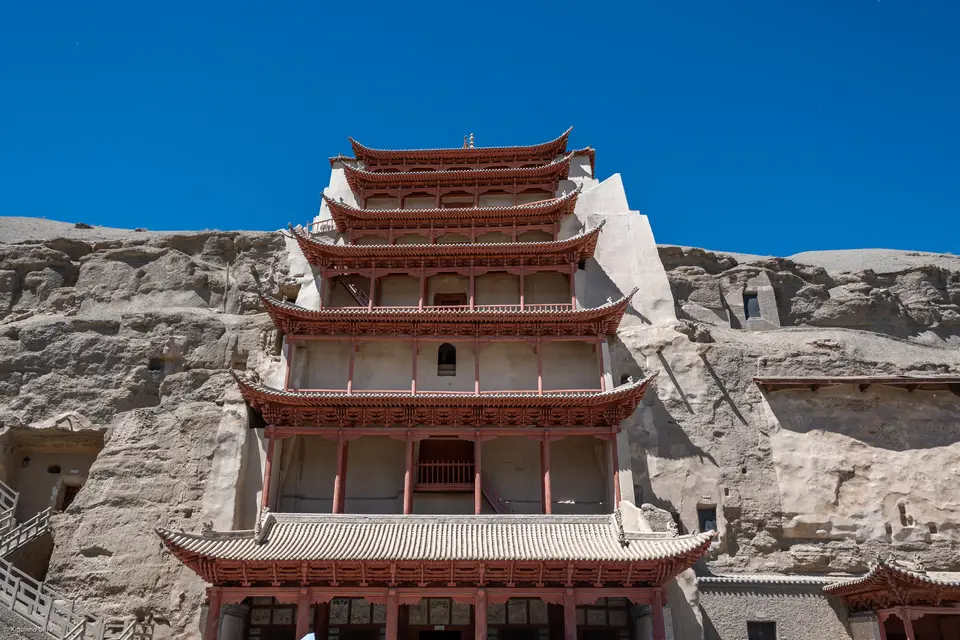
Unlike the hard limestone and sandstone of China's other great Buddhist sculptural sites at Longmen and Yungang, the Mogao cliff consists of soft gravel conglomerate unsuitable for direct stone carving. Architects therefore excavated rock-cut halls, ranging from early Indian chaitya caves with square central stupa pillars for circumambulation (parikrama) and vihara meditation cells to Chinese hall caves with truncated pyramidal "tent" ceilings or gabled roofs, and built timber frames padded with reeds, modelled in clay stucco, and finished with bright mineral pigments. Today the 492 southern grottoes contain approximately 45,000 to 46,000 square metres (400,000 to 490,000 square feet) of wall and ceiling murals and more than 2,000 (around 2,400) painted stucco sculptures, fronted by five surviving wooden cliff porches (two dating to the Song dynasty) and the prominent nine-storey wooden facade over Cave 96.
A Thousand Years of Murals, Giant Maitreyas, and Silk Road Cartography
Walking the multi-level cliff catwalks with a Dunhuang Academy scholar reveals a chronological gallery of East and Central Asian art spanning a thousand years: 7 caves from the Sixteen Kingdoms (366 to 439, led by Northern Liang Caves 268, 272, and 275 built between 419 and 439, which share stylistic traits with Kizil Cave 17), 10 each from the Northern Wei (439 to 534) and Western Wei (535 to 556), 15 from the Northern Zhou (557 to 580), 70 from the Sui dynasty (581 to 618), 44 Early Tang (618 to 704), 80 High Tang (705 to 780), 44 Middle Tang during the Tibetan occupation (781 to 847, when Tibetan khrom administration spared Dunhuang from Emperor Wuzong's 845 Buddhist persecution), 60 Late Tang (848 to 906) and 32 Five Dynasties (907 to 960) and 43 Song (960 to 1035) during the Guiyijun period ruled by the Zhang and Cao families, 82 from the Western Xia (1036 to 1226), and 10 from the Mongol Yuan dynasty (1227 to 1368). Early murals applied Indian chiaroscuro shading (whose lead pigments later oxidized dark) and depicted jataka and avadana parables alongside stencil-repeated Thousand Buddha rows and flying apsaras, before evolving during the Sui and Tang eras into monumental sutra illustrations, Pure Land Western Paradise scenes (such as Cave 220), and Tantric eleven-headed or thousand-armed Avalokitesvara (Guanyin) compositions.
Equally vivid are the secular and historical scenes embedded within the religious murals and colossal sculptures. Sui-dynasty Cave 302 portrays a camel pulling a covered trade cart along the Silk Road; Tang-dynasty Cave 23 depicts farmers working in the fields, while Cave 156 commemorates General Zhang Yichao's military procession after expelling Tibetan rule in 848, followed in later caves by oversized donor portraits of the Cao family and their Uyghur (Ganzhou and Qocho) and Khotanese Saka brides. In Song dynasty Cave 61, a sweeping mural of Mount Wutai provides an early masterpiece of Chinese cartography depicting mountains, rivers, walled cities, monasteries, roads, and merchant caravans. Monumental sculpture reaches its peak in the two Tang stone-core Maitreya Buddhas, the 35.5-metre giant Buddha of Cave 96 built in 695 under Empress Wu Zetian (housed inside a wooden building originally four storeys high, raised in 874 to 885 and 1898 to nine storeys) and the 27-metre southern Buddha built between 713 and 41, alongside the 15.6-metre reclining Buddha in Tibetan period Nirvana Cave 158.
Cave 17, the 1900 Library Discovery, and Visitor Rotation
On 25 June 1900, Taoist abbot Wang Yuanlu, who had been clearing drift sand from the lower grottoes, noticed cigarette smoke drawing through a crack in the corridor wall of Cave 16 and uncovered a walled-up side chamber: Cave 17, the Library Cave. Originally carved as a meditation retreat and memorial shrine with a portrait statue for the local monk Hongbian after his death in 862, the small room had been packed to a height of nearly ten feet (500 cubic feet) with around 50,000 documents (including 1,100 scroll bundles and 15,000 paper booklets dating from 406 to 1002), over a thousand silk and hemp paintings, woodblock prints (including prints commissioned in 947 by Cao Yuanzhong and the world's earliest dated printed book, the 868 AD Diamond Sutra), patched monk robes (kasaya), and valances before being sealed in the early 11th century, whether as a sacred waste repository or to hide the monastic archive from Karakhanid attacks on Khotan in 1006 or Western Xia advances in 1035. After Wang re-sealed the chamber in 1904, expeditions led by Hungarian-born British archaeologist Aurel Stein in 1907 (who acquired around 6,000 manuscript fragments alongside 7,000 complete scrolls), French sinologist Paul Pelliot in 1908 (nearly 10,000 documents, published in part by Luo Zhenyu in 1909 before the Beijing Ministry of Education retrieved remaining scrolls in 1910), Otani Kozui in 1911, and Sergei Oldenburg in 1914 dispersed the multilingual Chinese, Tibetan, Uyghur, Sanskrit, Sogdian, Khotanese, Avestan, Hebrew (selichah), and Christian Jingjiao texts to London, Paris, Beijing, and Berlin, later complemented by a Syrian and Uyghur Psalms manuscript found in northern Cave B53.
- Reserve Dunhuang Academy visitor centre and rotational cave tickets early: To prevent carbon dioxide and humidity from visitors' breath from damaging oxidized pigments, the Dunhuang Academy caps daily attendance and rotates which grottoes open; check the official site weeks ahead of travel.
- Start with the nine-storey pavilion of Cave 96 and the Library Cave: Make sure your guided cliff route includes the 35.5-metre Maitreya Buddha of Cave 96, the 15.6-metre reclining Buddha of Cave 158, and Hongbian's memorial shrine at Caves 16 and 17 where the 50,000 manuscripts were sealed shortly after 1002.
- Use the International Dunhuang Programme and digital archives: Pair your physical tour of the dimly lit grottoes with the Dunhuang Academy's high-resolution digital reconstructions and the International Dunhuang Programme to examine the 868 Diamond Sutra, the Dunhuang star map, and silk banners now held in Beijing, London, and Paris.
From Early-Twentieth-Century Damage to Scientific Digital Conservation
Following the dispersal of the Library Cave manuscripts, Mogao endured further trials when White Russian soldiers quartered in the caves in 1921 defaced murals, American art historian Langdon Warner peeled wall paintings and removed a statue in 1924, and Kuomintang troops stationed there in 1939 caused additional damage. The turning point arrived in 1941 after painter Wu Zuoren's 1940 visit, when artist Zhang Daqian spent two and a half years copying and publicising the murals (exhibited in 1943), prompting historian Xiang Da and official Yu Youren to establish the Research Institute of Dunhuang Art (now the Dunhuang Academy) in 1944, followed by Premier Zhou Enlai's 1956 restoration grant and the State Council's 1961 national monument declaration that protected the grottoes through the Cultural Revolution.
Since the 1980s and 1993, the Dunhuang Academy, working alongside partners such as the Getty Conservation Institute, has pioneered desert windbreak engineering, microclimate monitoring, and high-resolution digital archiving, completing photographic capture and panoramic roaming across 120 caves, digital processing for 40 grottoes, and three-dimensional modelling of 20 painted statues, alongside the interactive virtual desktop system. Stepping from the blinding desert sunlight into the cool, shadowy stillness of a 5th- or 8th-century grotto reveals how a thousand years of Silk Road faith, trade, and artistry survived in the cliffs of Dunhuang.
