Temple of Literature, Ba Dinh Monuments and Train Street
Confucian courtyards at the Temple of Literature, Ba Dinh civic monuments, the royal citadel and Train Street.
West of the Old Quarter, the tangle of merchant lanes opens into the civic district of Ba Dinh, where a thousand years of imperial rule, Confucian scholarship and modern Vietnamese history sit within a twenty-minute walking loop.
The Temple of Literature (Van Mieu - Quoc Tu Giam)
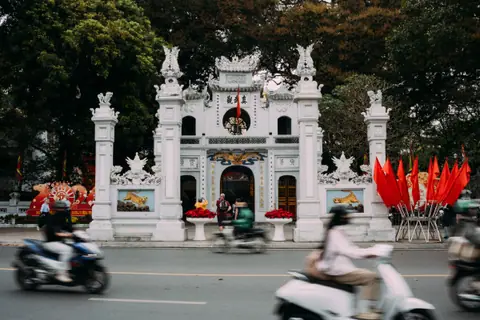
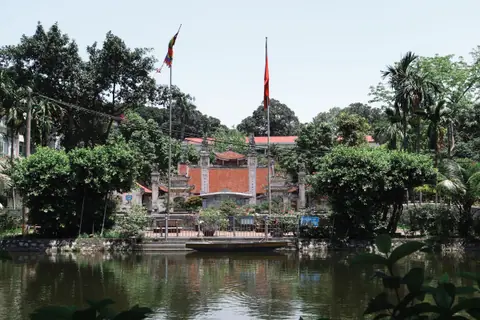
Founded in 1070 under Emperor Ly Thanh Tong and expanded six years later to house Vietnam's first national university (Quoc Tu Giam) for royal princes and mandarins, the Temple of Literature is one of the finest surviving examples of traditional northern architecture. The walled sanctuary unfolds south to north through five successive courtyards. Enter through the Great Middle Gate to see the wooden pavilion of the Khue Van Cac (Constellation of Literature), symbol of Hanoi and printed on the 100,000 VND banknote. In the third courtyard around the Well of Heavenly Clarity stand 82 carved blue-stone stelae resting on the backs of stone tortoises, inscribed with the names and birthplaces of scholars who passed the royal doctoral examinations between 1442 and 1779, before you reach the Great House of Ceremonies honouring Confucius and teacher Chu Van An.
Ho Chi Minh Mausoleum Complex, One Pillar Pagoda and Thang Long Citadel
Ten minutes north on foot lies grassy Ba Dinh Square, where Ho Chi Minh read Vietnam's Declaration of Independence in 1945. On its western edge stands the granite Ho Chi Minh Mausoleum; visitors queue in the morning with shoulders and knees covered (check the official schedule ahead, as the mausoleum closes on Mondays, Fridays and for autumn maintenance). Even when the interior hall is closed, the grounds reward a walk past the 1906 Presidential Palace to Ho Chi Minh's Stilt House beside a carp pond, the Ho Chi Minh Museum, and the One Pillar Pagoda (Chua Mot Cot), originally built in 1049 in the shape of a lotus blossom rising from a square pond. Five minutes east along Hoang Dieu Street, explore the UNESCO-listed Imperial Citadel of Thang Long, featuring the Doan Mon Gate, palace excavations and the underground D67 Command Bunker.
Hanoi Train Street safety and rules, plus West Lake
Running along Phung Hung and Le Duan streets between the Old Quarter and Ba Dinh is Hanoi Train Street, where the single-track railway squeezes between residential houses. Because of crowd safety rules, police barriers block casual walk-in entry along the tracks; to visit legally, wait at the barrier for a licensed resident cafe owner to escort you directly to an off-track terrace seat, and never stand on the rails. Afterwards, head north to the causeway between West Lake and Truc Bach Lake to see 6th-century Tran Quoc Pagoda, then refuel with Hanoi street food.
Traveller tips
Real advice from people who have been to Temple of Literature, Ba Dinh Monuments and Train Street. Every tip is read by our team before it goes live.
No tips yet. Been here? Yours could be the first.
Thank you! Your tip will appear here after a quick review.
More in Hanoi
Continue exploring Hanoi with related neighbourhood, food, and planning guides