Angkor Wat, Angkor Thom, the Bayon and Ta Prohm
How to experience Angkor Wat's bas-reliefs and Bakan tower, the Bayon in Angkor Thom, and jungle-wrapped Ta Prohm.
Three monuments form the heart of the Angkor Small Circuit and represent three distinct chapters of the Khmer Empire: early-twelfth-century Hindu Angkor Wat, late-twelfth-century Mahayana Buddhist Angkor Thom (centred on the Bayon), and the monastery of Ta Prohm left embraced by the forest.
Angkor Wat: sunrise, the bas-relief galleries and the Bakan
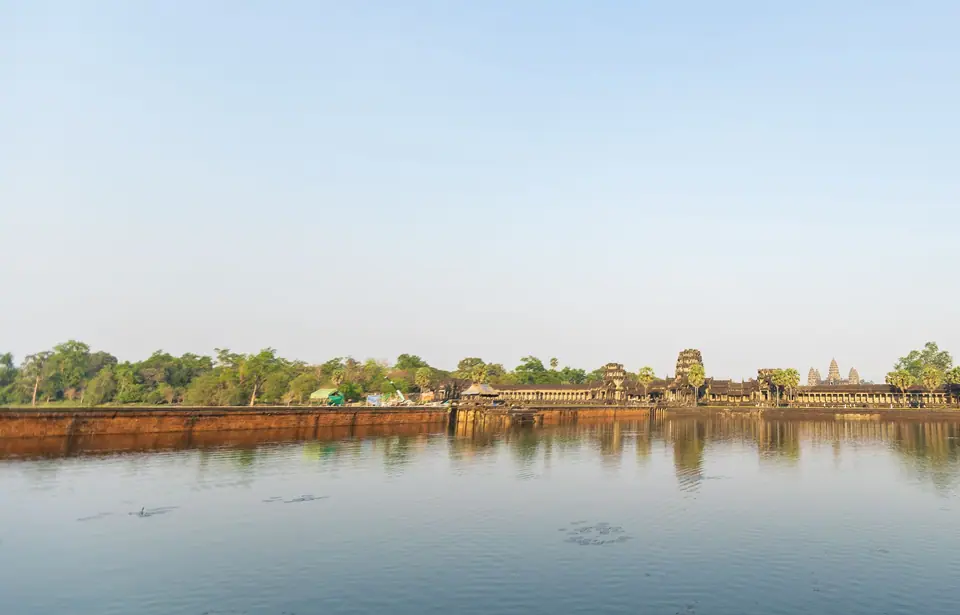
Built by King Suryavarman II over roughly thirty years as a state temple dedicated to Vishnu, Angkor Wat is the largest religious monument on earth and uniquely faces west. Cross the moat before dawn to stand beside the northern reflection pond as the five lotus-bud towers silhouette against the rising sun. Right after sunrise, examine two highlights before heat builds:
- The Third-Level Bas-Relief Galleries: eight hundred continuous metres of low-relief sandstone carvings. Walk anti-clockwise from the West Gallery through the Historic South Gallery (King Suryavarman II in royal procession) to the celebrated East Gallery's Churning of the Ocean of Milk, where eighty-eight asuras and ninety-two devas use the serpent Vasuki to churn the sea for the elixir of immortality.
- The Bakan (Central Sanctuary): climb the steep staircase (check the dress code and note that the Bakan closes on Buddhist holy days four times a lunar month) for sweeping views down the western causeway.
Angkor Thom, the Bayon and the Terrace of the Elephants
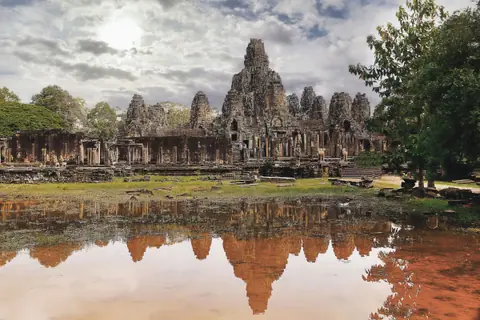
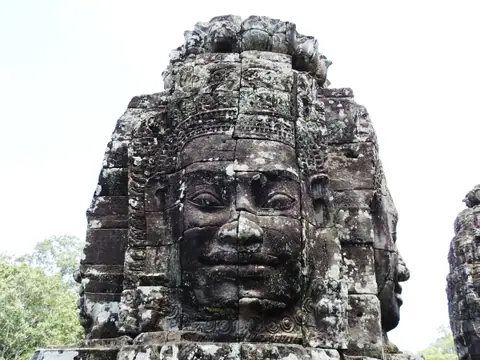
Two kilometres north of Angkor Wat lies Angkor Thom ("Great City"), a three-kilometre-square walled royal capital established by King Jayavarman VII. Enter across the South Gate causeway, where fifty-four stone gods and fifty-four demons haul the body of a nine-headed naga serpent. At the geometric centre stands the Bayon: a mountain of stone towers carved with more than two hundred serene, half-smiling faces. On its outer walls, lively bas-reliefs depict twelfth-century Khmer markets and naval battles. Walk north across the plaza to the pyramidal Baphuon and the 350-metre Terrace of the Elephants and Terrace of the Leper King.
Ta Prohm (the jungle monastery)
East of Angkor Thom stands Ta Prohm (1186), founded by Jayavarman VII as a Buddhist university in honour of his mother. Conservators left Ta Prohm largely as it was found: silvery, python-like roots of towering silk-cotton trees (Ceiba pentandra) and strangler figs grip the corbelled sandstone roofs and doorways in a delicate balance of stone and living timber.
Traveller tips
Real advice from people who have been to Angkor Wat, Angkor Thom, the Bayon and Ta Prohm. Every tip is read by our team before it goes live.
No tips yet. Been here? Yours could be the first.
Thank you! Your tip will appear here after a quick review.
More in Siem Reap
Continue exploring Siem Reap with related neighbourhood, food, and planning guides