























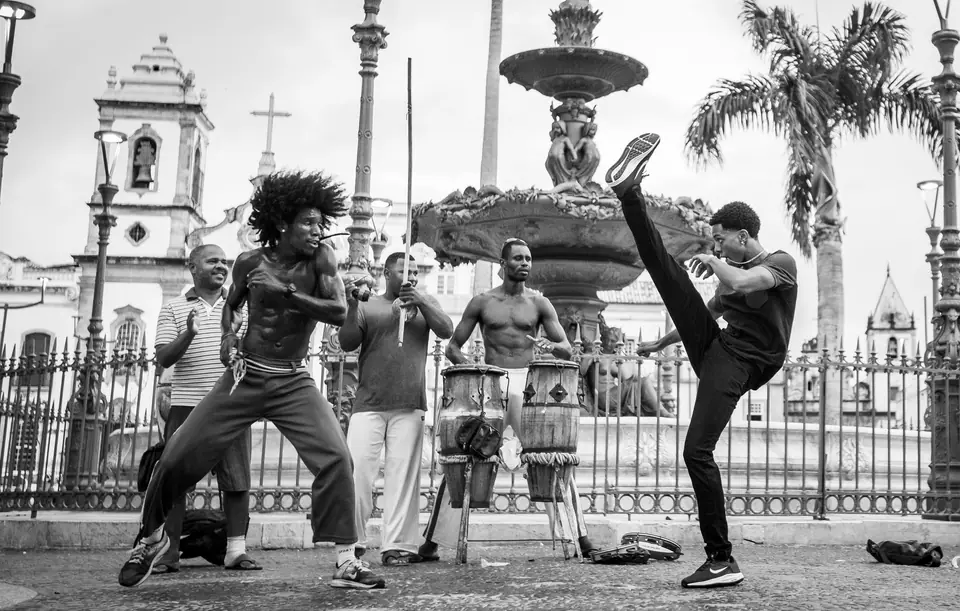
Capoeira Class in Salvador
The city where capoeira took its modern shape, and how to see it as a living practice rather than a street show for tips.
Overview
In Pelourinho you will see capoeira within an hour of arriving: two young men flipping and spinning on the square while a third holds out a hat. It is fun to watch and a small part of the story. Capoeira is a fight disguised as a game and a game disguised as a dance, created by enslaved Africans and their descendants in Brazil and still bound up with music, song and ritual. Salvador is where its two main modern schools were codified in the twentieth century, and UNESCO lists the roda, the circle in which it is played, as intangible cultural heritage. The real thing happens in academies, and visitors are usually welcome at them.
Watching or playing
There are two ways in, and they suit different people.
Watching a roda suits almost everyone. A roda is a session, not a performance: the players form a circle, the berimbau (a single-string bow with a gourd resonator) sets the rhythm and the tempo of the game, the others sing and clap, and pairs take turns inside. Nobody is playing for you, and that is what makes it absorbing. It suits anyone curious about Afro-Brazilian culture, and children who can sit still for a while.
Taking a class suits people who are reasonably fit and happy to look clumsy in front of strangers. A beginner class works on the ginga (the basic swaying step), a few kicks and escapes, and often the songs and instruments too. You will not play in a roda after one lesson, and you should not try. It is less suitable for anyone with knee or wrist problems, as much of the movement is low to the ground.
Angola or Regional?
Salvador is home to both main lineages. Capoeira Angola, associated with Mestre Pastinha, is slower, lower and more ritual, with a full bateria (band) of berimbaus, drums and percussion and long stretches of song. Capoeira Regional, developed by Mestre Bimba in the 1930s, is faster, more upright and more athletic, and closer to what most people picture. For watching, we would choose Angola: the music and the ritual are richer. For a first class, Regional is easier to get into.
Where it happens
The Forte de Santo Antônio Além do Carmo, the small fort at the end of the Rua Direita de Santo Antônio, has been restored as the Forte da Capoeira. Several academies run by traditional mestres share its rooms, and it has a small gallery on the history of the art. Other academies are scattered around Pelourinho and Santo Antônio. Our Pelourinho guide covers the old town around them. Skip the paid "capoeira shows" bundled into dinner packages; they are staged for visitors and tell you little.
How to Book
Most academies run evening classes and hold rodas on set days of the week, and many accept visitors for a single class. There is no central booking system. The simplest approach is to go to the Forte da Capoeira during the day, when the academies and gallery are usually open, and ask each academy about its class and roda days. Schedules change, and some groups travel, so confirm before you plan an evening around one.
For a class, expect to pay a drop-in fee to the academy, and ask whether it is for beginners or mixed levels. Some Angola groups are strict about clothing (often long trousers and a tucked-in shirt, sometimes shoes), while Regional classes are usually barefoot in white. Ask what to wear when you check the schedule.
Agencies and hotels also sell private lessons with an instructor, sometimes with an introduction to the berimbau. They cost more but suit anyone short of time. Ask which academy the teacher trains with.
Santo Antônio is quiet after dark. Take an Uber there and back rather than walking through empty streets, as our where to stay guide also advises.
Tips
- Ask before you film. Some mestres are happy with phones, others want none during the roda. A small contribution at the door or in the box is normal for spectators.
- Never walk across the circle, and don't step into the roda uninvited, even if you have trained at home. If you are a capoeirista, introduce yourself to the mestre before it starts and ask.
- Sit where you are put. The space near the bateria belongs to the musicians.
- Listen to the berimbau. When it changes rhythm, the game changes too. After a while you start to hear it.
- Tip the street players if you stop and photograph them. That is the deal.
- Plan the evening around it. An afternoon in Santo Antônio, a roda at dusk, then dinner by car in Rio Vermelho makes a good evening.
Reviews
Log in to write a review.
No reviews yet.
You might also like
Mostar, Blagaj and Sarajevo from Montenegro
A long day trip from the coast, or two to three days to include a night in Mostar and Sarajevo · Montenegro

Cappadocia Balloon Watching and Horse Riding
About an hour at a viewpoint around sunrise, and one to two hours on horseback, usually in the late afternoon · Cappadocia

Wieliczka Salt Mine Tour
About 2 to 3 hours underground, plus the train or transfer from Kraków · Kraków

Whale Watching from Vancouver
About 3 to 5 hours on the water, depending on how far the boat has to go to find whales · Vancouver
