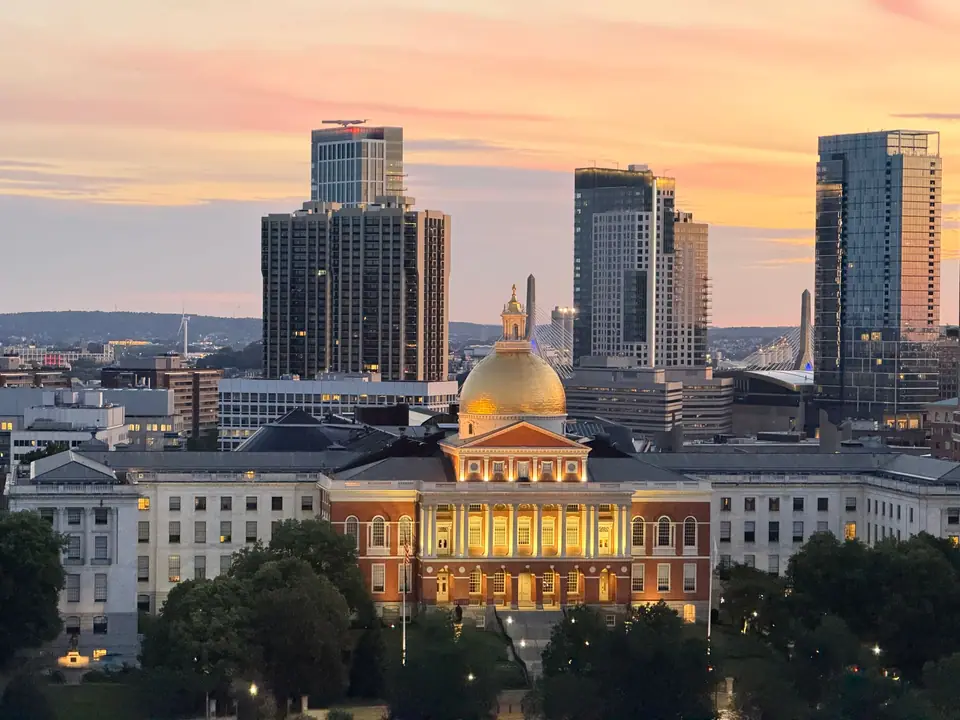
A detailed historical and architectural route along Boston’s red-brick Freedom Trail, gas-lit Beacon Hill, Victorian Back Bay, the Emerald Necklace, and Harvard in Cambridge.
Puritan Shawmut, Revolutionary Meeting Houses and Back Bay Land Reclamation
Known to the Massachusett people as Shawmut for its freshwater springs, the hilly peninsula overlooking Boston Harbor was settled by English Puritans led by John Winthrop in 1630. Within six years colonists established Boston Common (America's oldest public park), Boston Latin School, and Harvard College across the Charles River. In the 1760s and 1770s, protests at the Old South Meeting House, the Old State House, and Griffin's Wharf sparked the American Revolution.
In the nineteenth century, Boston expanded more than threefold by filling the tidal flats around the Shawmut Peninsula to create the French Second Empire boulevards of Back Bay, linked by Frederick Law Olmsted's Emerald Necklace parks and McKim, Mead & White's 1895 Boston Public Library.
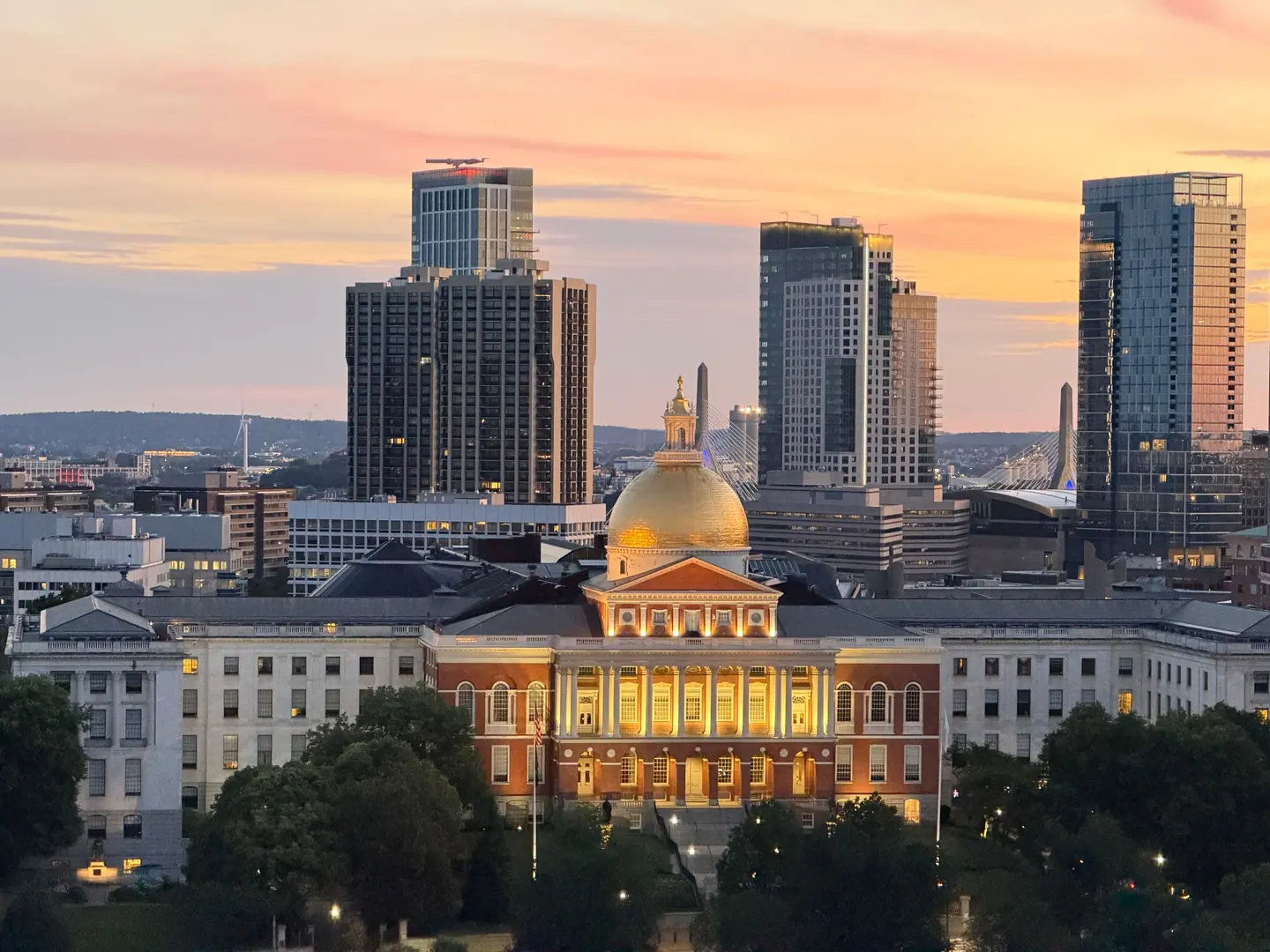
Boston Common, Downtown Freedom Trail & Faneuil Hall
Boston Common, Robert Gould Shaw Memorial, Massachusetts State House, Park Street Church, Granary Burying Ground, King’s Chapel, Old City Hall, Old South Meeting House, Old State House, and Faneuil Hall Quincy Market
Boston Common
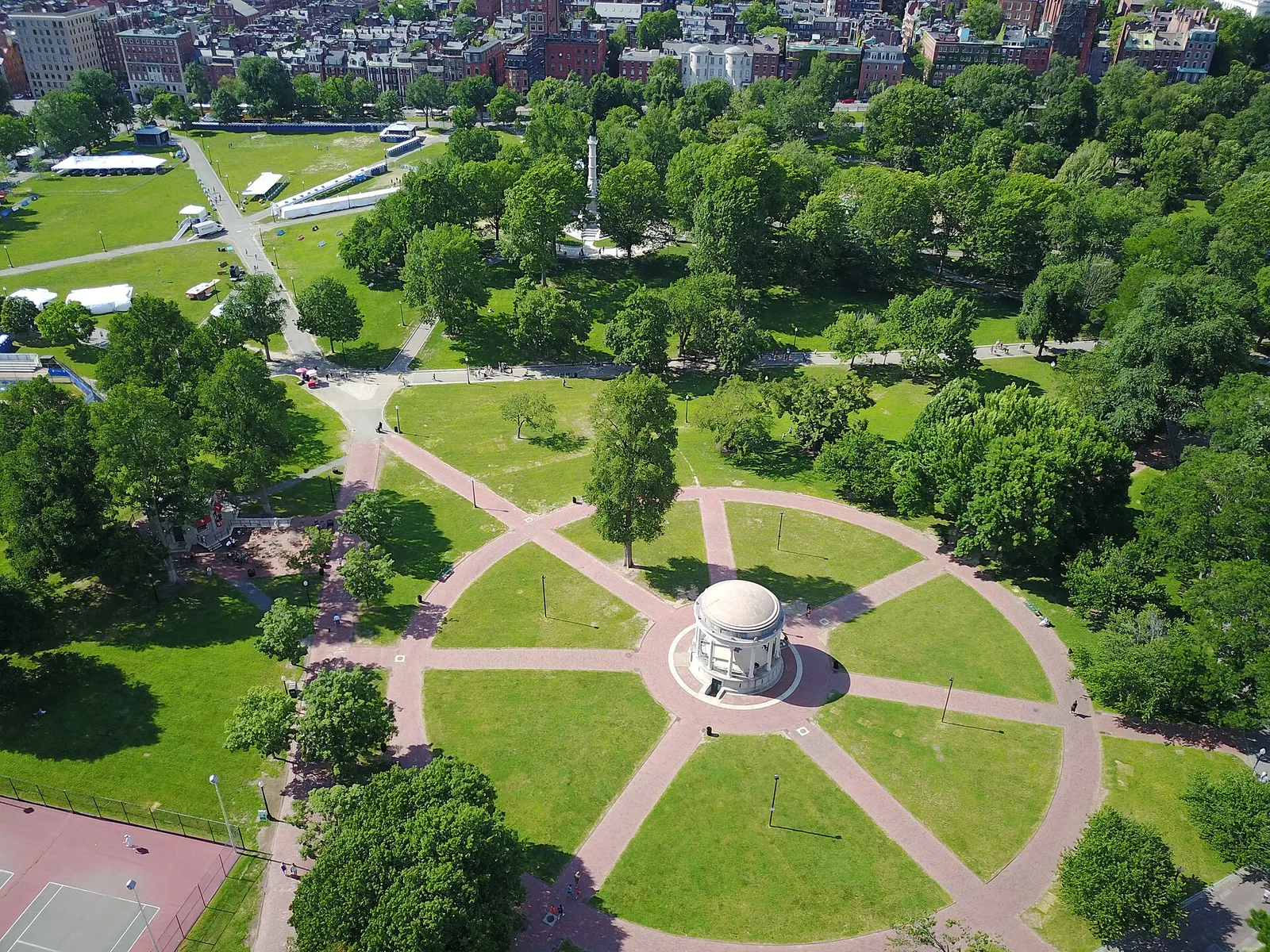
Dating back to 1634, this central parkland has served as colonial pasture, execution site and British military encampment. We find open green spaces, historic walkways and the Central Burying Ground across its rolling acreage. It anchors the southern terminus of the historic trail through the city centre.
Robert Gould Shaw Memorial
Sculpted by Augustus Saint-Gaudens, this bronze bas-relief commemorates Colonel Shaw and the first African American regiment recruited in the North during the American Civil War. The composition reveals remarkable individual portraiture and details of military equipment. It stands prominently on Beacon Street opposite the state capitol.
Massachusetts State House
Designed by architect Charles Bulfinch and completed in 1798, this landmark serves as the seat of Massachusetts state government. The exterior showcases classic Federal symmetry, red brickwork and a 23-carat gold leaf dome. Inside, decorative murals and historic legislative chambers reflect centuries of democratic debate.
Park Street Church
Erected in 1809 on the site of the town grain storage building, this church became a prominent focal point for social reform and abolitionist movements. William Lloyd Garrison delivered his first major anti-slavery address from the pulpit here in 1829. Its 217-foot steeple long defined the central city skyline.
Granary Burying Ground
Founded in 1660, this burial ground contains approximately two thousand markers and the remains of notable revolutionaries, including Samuel Adams, John Hancock and Paul Revere. A tall central obelisk honours Benjamin Franklin's parents. Visitors can inspect carved slate gravestones decorated with winged skulls and hour-glasses.
King's Chapel
Constructed from dark Quincy granite in 1754, this church was the first Anglican parish established in Massachusetts Bay Colony. The interior features tall box pews, Corinthian columns and a historic bell recast by Paul Revere. The structure later transitioned into the first Unitarian congregation in the United States.
King's Chapel Burying Ground
Dating to 1630, this cramped cemetery was established on land that originally belonged to early settler Isaac Johnson. It contains the tombs of Massachusetts Bay Colony Governor John Winthrop and Mayflower passenger Mary Chilton. Intricately carved colonial gravestones depict traditional Puritan iconography and seventeenth-century epitaphs.
Site of the First Public School
A colourful mosaic and plaque embedded in the pavement along School Street mark the 1635 foundation of the Boston Latin School. Five signers of the United States Declaration of Independence, including Benjamin Franklin and Samuel Adams, studied here. The institution established the earliest roots of public education in British North America.
Old City Hall
Completed in 1865, this building represents one of the earliest American municipal examples of Second Empire architecture, characterised by a distinctive mansard roof. The courtyard features Richard Saltonstall Greenough's bronze statue of Benjamin Franklin alongside a donkey sculpture honouring local political heritage. The site now houses offices and dining.
Old Corner Bookstore
Constructed in 1718 as an apothecary shop, this gambrel-roofed brick edifice became the headquarters of publisher Ticknor and Fields in the mid-nineteenth century. Writers such as Ralph Waldo Emerson, Nathaniel Hawthorne and Charles Dickens regularly gathered here. It stands today as downtown's oldest commercial structure, preserved against urban redevelopment.
Old South Meeting House
Built in 1729, this spacious Georgian meeting house was the largest building in colonial Boston, accommodating thousands of agitated citizens. On 16 December 1773, thousands rallied within these walls before marching to Griffin's Wharf to dump tea into the harbour. The interior includes wooden box pews and historical exhibits.
Old State House
Built in 1713, this red brick civic hall served as the seat of the Massachusetts royal government until the American Revolution. The Declaration of Independence was read aloud from its east balcony to the public in July 1776. Sculptures of the British lion and unicorn still adorn the eastern gable apex.
Boston Massacre Site
Located on a traffic island outside the Old State House, a circular ring of cobblestones marks the site of the confrontation on 5 March 1770. British soldiers fired into a civilian crowd, killing five colonists, including Crispus Attucks. The incident escalated colonial grievances and propelled the American independence movement.
Faneuil Hall
Donated to the town in 1742 by merchant Peter Faneuil, this landmark marketplace provided a platform for speeches by Samuel Adams and other revolutionaries. Expanded by Charles Bulfinch in 1806, it retains its classical meeting hall on the upper floor. Shem Drowne's gilded copper grasshopper weathervane surmounts the cupola.
Quincy Market
Architect Alexander Parris designed this two-storey Greek Revival pavilion, which opened in 1826 to expand wholesale food trading near the harbour. Constructed of Quincy granite, it features monumental Roman Doric porticoes at both ends and a central copper dome. It currently operates as an active dining corridor.
North Market
Built alongside the central market hall in the 1820s, this elongated red brick warehouse terrace provided dry goods storage for harbour merchants. The unified facades reflect late Federal and Greek Revival municipal planning under Mayor Josiah Quincy. Today, it accommodates shops and cafes along an open pedestrian passage.
South Market
Mirroring its northern twin, South Market was constructed between 1824 and 1826 to complete the unified tripartite market district. The continuous uniform facade of brick and granite lintels exemplifies orderly early industrial warehouse architecture. Paved outdoor concourses now host street performers, seasonal craft vendors and retail spaces.
Samuel Adams Statue
Sculpted by Anne Whitney and unveiled in 1880, this bronze statue portrays revolutionary organiser Samuel Adams with arms defiantly folded. Positioned directly in front of Faneuil Hall, the figure stands upon a polished granite pedestal. It commemorates Adams demanding the removal of British troops from Boston following the 1770 massacre.
Boston City Hall
Completed in 1968 by Kallmann McKinnell and Knowles, this concrete edifice stands as an internationally documented example of Brutalist public architecture. Its cantilevered cast-concrete volumes differentiate executive offices from public service spaces. It overlooks Government Center Plaza, directly across Congress Street from historic colonial halls.
Custom House Tower
Originally built in 1847 with a Greek Revival Doric rotunda, this federal property was dramatically enlarged in 1915 with a 496-foot classical clock tower. Designed by Peabody and Stearns, it stood as the tallest building in the city for decades. Its four-sided illuminated clock overlooks the downtown harbour district.
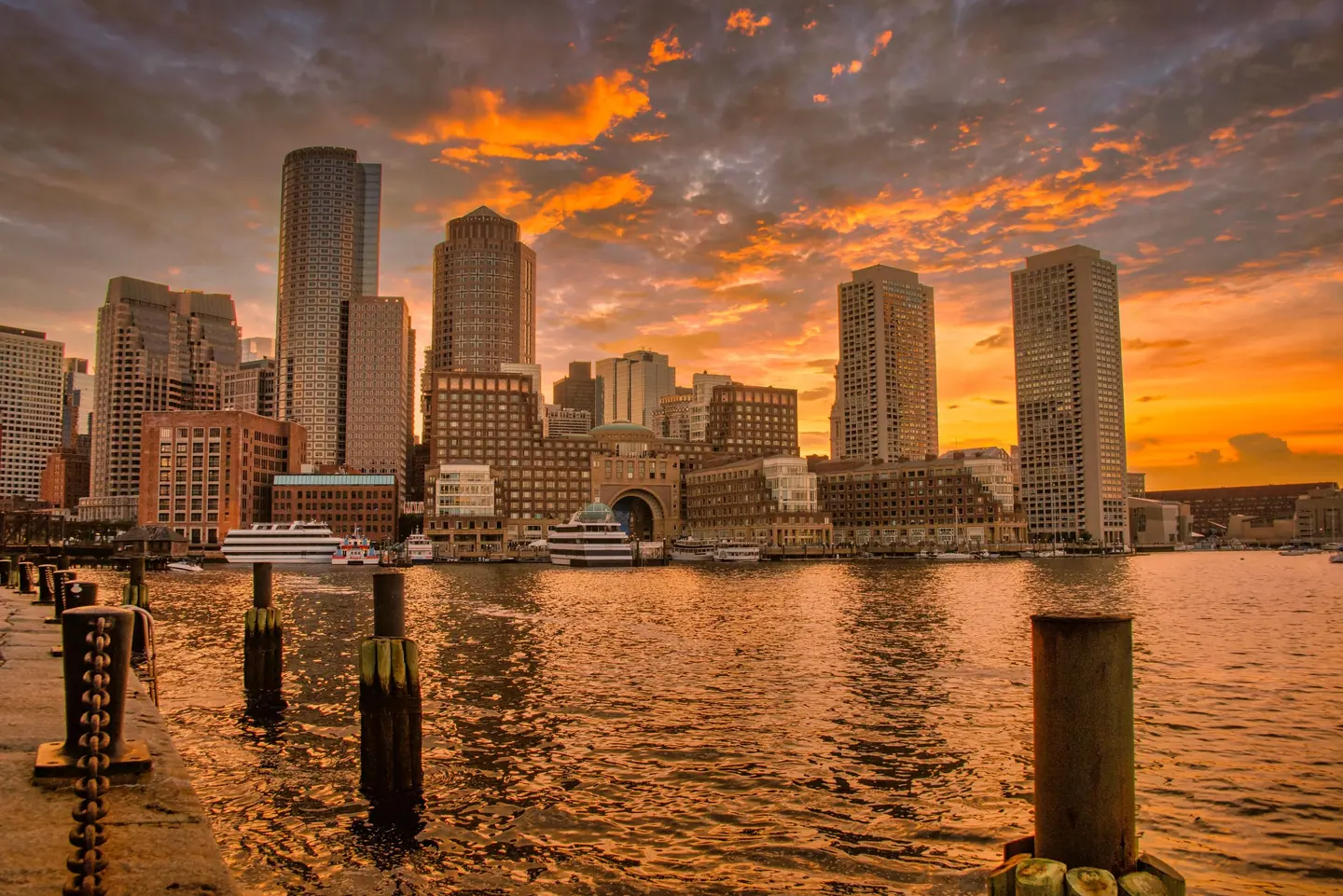
North End, Paul Revere House, Charlestown & Waterfront
Paul Revere House, Old North Church, Copp’s Hill Burying Ground, USS Constitution Old Ironsides, Bunker Hill Monument, Christopher Columbus Waterfront Park, New England Aquarium, and Boston Tea Party Ships
Paul Revere House
Constructed around 1680, this timber-framed townhouse served as the residence of the American patriot Paul Revere during the revolution. Visitors can view original post-medieval architectural features, alongside family furnishings, silver pieces, and informative displays regarding his renowned midnight ride to Lexington.
Old North Church
Founded in 1723, this Georgian brick building is officially named Christ Church in the City of Boston. It gained renown in 1775 when two lanterns hung in the steeple warned patriots of British movements across the Charles River, and it retains high box pews and brass chandeliers inside.
Copp's Hill Burying Ground
Dating back to 1659, this prominent cemetery was the second burial site founded on the Shawmut Peninsula. It houses the graves of notable colonial ministers, merchants, and early African American residents, while offering elevated views across the harbour toward the naval shipyards of Charlestown.
Skinny House
Reputedly built following the American Civil War due to an inheritance dispute between brothers, this four-storey home measures roughly ten feet across at its widest point. The structure stands as a curious testament to urban density and family rivalry in the traditional streetscape of the North End.
St. Stephen's Church
Completed in 1804, this classical edifice is the sole surviving Charles Bulfinch church in Boston. Originally built as a Congregational meeting house before being acquired by the Roman Catholic Archdiocese, it features balanced proportions, a distinctive domed belfry, and simple yet elegant interior woodwork.
Pierce/Hichborn House
Constructed around 1711 for boatbuilder Moses Pierce, this dwelling stands adjacent to the Paul Revere House on North Square. It is one of the earliest remaining brick structures in Boston, notable for its symmetrical facade, steep pitch, and well-preserved Georgian interior finishes.
Mariners' House
Built in 1847 by the Boston Port Society, this Greek Revival brick hostel was established to provide safe, affordable lodging for sailors. Located on historic North Square, the building continues its charitable mission today, preserving early maritime heritage, decorative ironwork, and historical nautical artefacts.
Christopher Columbus Waterfront Park
Opened in the 1970s, this public park links the historic North End with the urban shoreline of Boston Harbour. Visitors walk along wide brick promenades beneath arched trellises covered in vines, enjoying open views of incoming water taxis, working docks, and regional boat charters.
Long Wharf
Originally constructed in 1710, this substantial pier extended hundreds of feet into the sea and formed the focal point of the colonial maritime empire. Today, historical stone warehouses still occupy the dock, which now acts as the primary departure terminal for harbour cruises and passenger ferries.
New England Aquarium
Operating since 1969, this waterfront institution centres on the Giant Ocean Tank, a four-storey cylindrical coral reef habitat surrounded by a spiralling walkway. The modern concrete complex also features expansive colonies of penguins, harbour seals in an outdoor plaza, and regional educational exhibits.
Rowes Wharf
Completed in 1987, this grand development replaced historic shipping slips with a towering stone archway linking the harbour to the financial district. The complex contains public ferry docks, public promenades, and maritime offices, making it an imposing landmark for travellers arriving by sea.
Boston Tea Party Ships and Museum
Positioned over the Fort Point Channel on Congress Street Bridge, this maritime attraction features full-scale replicas of eighteenth century cargo vessels. Visitors explore interactive historical exhibits, examine the rare Robinson Tea Chest, and observe re-enactments detailing the defiant political protest that preceded the Revolutionary War.
Charlestown Navy Yard
This former United States Navy base covers thirty acres of maritime industrial heritage, including early dry docks, ropewalk facilities, and granite workshops. As part of Boston National Historical Park, it preserves the shipwright traditions that built and repaired major warships throughout multiple centuries.
USS Constitution
Launched in 1797, this three-masted wooden heavy frigate earned the moniker Old Ironsides during the War of 1812 when cannonballs bounced off its thick live oak hull. Active navy crew members provide tours across the spar and gun decks, explaining naval artillery and early American military history.
USS Constitution Museum
Housed within restored nineteenth century shipyard Building 22, this museum complements the warship berthed nearby. Exhibits showcase sea journals, sailor tools, scale models, and interactive displays that detail the timber harvesting, hull construction, and naval battles of the legendary frigate.
USS Cassin Young
Named after a Medal of Honor recipient who died at Guadalcanal, this warship survived multiple kamikaze strikes in the Pacific theatre. Berthed inside Dry Dock 1, it allows visitors to explore the combat information centre, crew bunks, and artillery mounts typical of mid-twentieth century naval vessels.
Bunker Hill Monument
Erected between 1825 and 1843 on Breed's Hill, this 221-foot obelisk commemorates the first major armed conflict of the American Revolutionary War. Constructed from Quincy granite transported via an early pioneer railway, the monument features an interior spiral staircase leading to panoramic summit views.
Bunker Hill Museum
Located in the former Charlestown branch library directly across from the monument grounds, this brick museum details the June 1775 engagement. Its galleries house battle dioramas, historic British uniforms, early town records, and an extensive collection of period cannonballs.
Warren Tavern
Built in 1780 during the rebuilding of Charlestown after British troops burnt the town, this timber building was named for revolutionary leader General Joseph Warren. With low beamed ceilings and rough woodwork, it is widely recognised for hosting early patrons like Paul Revere and George Washington.
Charlestown Bridge
Positioned over the waters separating the North End from Charlestown, this bridge marks the location of North America's first major toll bridge built in 1786. Modern crossings provide key walking links on the Freedom Trail, with expansive perspectives across Boston Harbour and the adjacent naval docks.
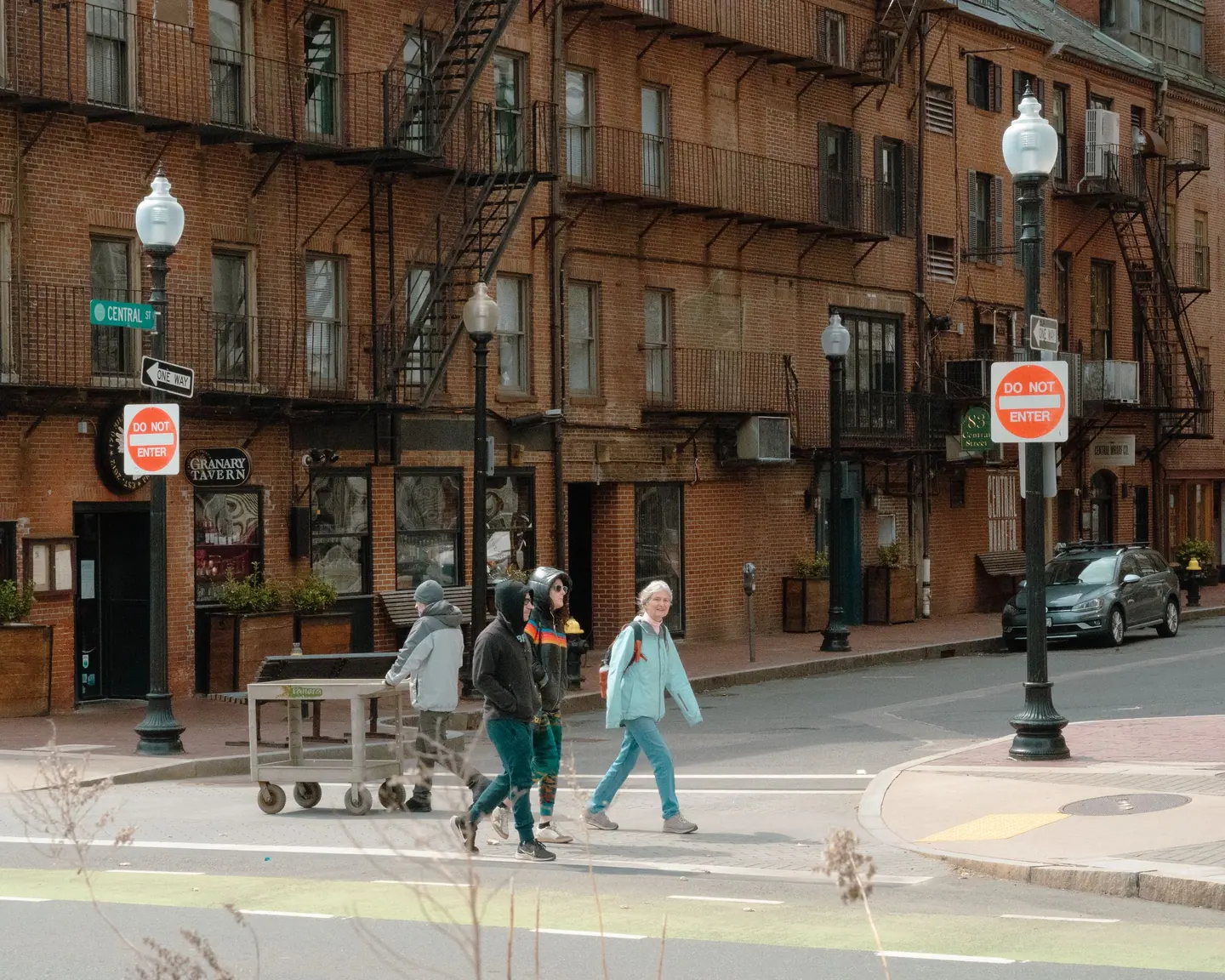
Beacon Hill Gas Lamps, Acorn Street & Charles River Esplanade
Boston Athenæum, Louisburg Square, Acorn Street, Nichols House Museum, African Meeting House Black Heritage Trail, Harrison Gray Otis House, Charles Street, and Hatch Memorial Shell Esplanade
Boston Athenæum
Founded in 1807, this private membership library occupies an elegant neoclassical building designed by Edward Clarke Cabot on Beacon Street. The interior features leather armchairs, tall book stacks, and fine art collections including casts of classical sculptures. Visitors can admire views of the historic cemetery through the large rear windows on the first floor.
Acorn Street
This preserved nineteenth-century alleyway retains its original rounded river-stone paving, laid down when coachmen and artisans inhabited the slope. Row houses built in the Federal style flank the lane, accented by wrought-iron boot scrapers, polished brass knockers, and working gas lanterns. We observe the authentic textures of historic urban infrastructure intact on this gentle incline.
Louisburg Square
Planned in the 1830s, this tranquil enclosure represents one of the finest residential addresses in Massachusetts. Symmetrical Greek Revival townhouses with bowed brick fronts frame a private central garden adorned with statues of Columbus and Aristides. The enclave retains an exclusive character governed by a historic association of neighbouring proprietors.
Nichols House Museum
Constructed in 1804 on Mount Vernon Street, this four-storey townhouse preserves the domestic lifestyle of landscape architect and suffragist Rose Standish Nichols. The rooms display period furnishings, Flemish tapestries, and wood carvings collected over generations of resident intellectuals. It offers an authentic glimpse into the daily life of Beacon Hill families during the early twentieth century.
African Meeting House
Erected in 1806 by free African American artisans on the north slope of the hill, this brick sanctuary served as a religious centre and abolitionist headquarters. William Lloyd Garrison founded the New England Anti-Slavery Society within these walls in 1832. The restored interior features original pews, high arched windows, and curved timber galleries upstairs.
Museum of African American History
Centred on the African Meeting House and the neighbouring Abiel Smith School, this museum preserves the narrative of northern abolitionists and civic leaders. Exhibits highlight the legal fight for integrated public schools in the nineteenth century. Visitors can examine primary documents, photographic archives, and educational artefacts inside the nation's first purpose-built public school for Black children.
Abiel Smith School
Constructed in 1835 on Joy Street through a bequest by merchant Abiel Smith, this brick structure housed primary classrooms for the city's Black children until 1855. Its completion marked an early milestone in municipal public education, despite segregation debates that ultimately ended segregated schooling in the commonwealth. The building now hosts rotating historical exhibitions.
Harrison Gray Otis House
Completed in 1796 for a prominent lawyer and politician, this brick mansion represents the quintessential early American Federal residence. Now the headquarters of Historic New England, the house contains meticulously restored period interiors with vivid paint colours and imported wallpaper. Look for the Palladian window and the classical door surround that exemplify Bulfinch's early architectural manner.
Charles Street
Running along the flat of the hill, Charles Street provides the primary retail district for the neighbourhood, populated by independent booksellers and antique merchants. Red-brick pavements and wrought-iron streetlights border facades dating from the early nineteenth century. Walking northward, travellers pass traditional hardware stores and cafes occupying former carriage houses and commercial blocks.
Hatch Memorial Shell
Constructed in 1940 to replace an earlier temporary wooden structure, this acoustic shell features a terrazzo stage lined with concentric bands of warm teak wood. The exterior is faced with fine granite and inscribed with names of renowned composers along its base. It serves as the open-air performance venue for the Boston Pops orchestral concerts.
Charles River Esplanade
Designed primarily by Arthur Shurcliff in the early twentieth century, this narrow parkland reclaimed tidal mudflats into a park with tree-lined promenades and lagoons. We encounter runners, rowers, and cyclists moving between stone footbridges and docks along the river edge. The landscaped green space offers unobstructed views across the water toward the Cambridge skyline.
Community Boating
Founded in 1946 along the Esplanade lagoon, this cooperative boating centre pioneered affordable public access to sailing on urban waters. A fleet of small dinghies and kayaks departs daily from the wooden docks opposite Beacon Hill. The boathouse remains an active hub for river recreation against the backdrop of the Longfellow Bridge.
Arthur Fiedler Memorial
Designed by sculptor Ralph Helmick in 1984, this memorial consists of dozens of stacked layers of polished granite that form a colossal head of the long-serving Boston Pops conductor. The structure sits on an island along the Esplanade lagoon, surrounded by weeping willows. Visitors can step directly inside the hollow profile to examine the stonework construction.
Longfellow Bridge
Opened in 1906, this bridge carries motor traffic and rapid transit trains over the Charles River between Boston and Cambridge. Its central stone piers are capped with four distinctive carved granite towers resembling salt and pepper shakers. The bridge offers broad vistas over the Back Bay riverfront and Beacon Hill's western waterfront edge.
Massachusetts State House
Designed by Charles Bulfinch and completed in 1798 on land once owned by John Hancock, this imposing red-brick statehouse commands the crest of the hill. The copper dome was originally sheathed by Paul Revere and subsequently gilded in twenty-three-carat gold leaf. Grand Corinthian columns front the marble terrace overlooking the northern lawn of Boston Common.
Robert Gould Shaw Memorial
Dedicated in 1897 directly opposite the State House, this high-relief bronze sculpture commemorates Colonel Shaw and the first all-Black volunteer regiment in the Union Army. Sculptor Augustus Saint-Gaudens spent nearly fourteen years perfecting the individual portraits of the infantry soldiers. The memorial rests in a neoclassic marble surround designed by architect Charles Follen McKim.
Chestnut Street
Chestnut Street exemplifies the architectural development of the hill from the 1800s to the 1830s, displaying pristine examples of Federal and early Greek Revival residences. Notable homes feature fanlight entrance doors, purple-tinted window glass, and intricate iron balconies. It offers a quieter alternative for walking past conserved nineteenth-century residences beneath mature elm trees.
Mount Vernon Street
Henry James described this sweeping corridor as the most respectable street in America, reflecting its concentration of expansive private residences. Unlike narrower neighbouring ways, it was laid out with broad front setbacks and manicured gardens. Notable landmarks include the Stephen Higginson House and several freestanding Federal mansions dating to the early 1800s.
Cobblestone Court
Situated off Phillips and West Cedar Streets, this quiet residential close showcases the compact urban planning typical of nineteenth-century housing on the hill. Whitewashed brick stables and former carriage houses now serve as private residences clustered around an interior lane. Gas lamps provide soft illumination against the brick facades and wooden stable doors.
Otis House, 85 Mount Vernon Street
Constructed in 1800, this is the second of three mansions Charles Bulfinch designed for politician Harrison Gray Otis within the city. The residence breaks from the attached row-house format, set back behind a lawn with a curving carriage drive. Its balanced facade features recessed brick arches, classical stone lintels, and an entrance portico supported by delicate columns.
Public Garden, Back Bay, Copley Square & Fenway
Boston Public Garden Swan Boats, Make Way for Ducklings, Commonwealth Avenue Mall, Gibson House Museum, Trinity Church Boston, Boston Public Library McKim Building, Old South Church, Fenway Park, Museum of Fine Arts Boston, and Isabella Stewart Gardner Museum
Boston Public Garden
Established in 1839 on reclaimed tidal marshes, this formal Victorian retreat contrasts sharply with the utilitarian pastures of Boston Common. Meandering paths wind past exotic specimen trees, ornate floral beds and a tranquil central lagoon. Visitors can admire classical cast iron fencing, the historic suspension bridge and celebrated commemorative monuments.
Swan Boats
Operating since 1877, these graceful passenger catamarans were conceived by shipbuilder Robert Paget, who drew inspiration from the opera Lohengrin. Drivers pedal a concealed paddlewheel while passengers sit comfortably beneath colourful awnings. The vessels remain a beloved fixture of warm weather strolls across the ornamental lagoon.
Make Way for Ducklings Statues
Sculpted by Nancy Schön in 1987, this delightful bronze installation depicts Mrs Mallard leading her eight ducklings along the cobbled pathway. The figures honour the beloved 1941 children's picture book set within the park. Locals frequently dress the birds in seasonal outfits, making them a charming focal point for families.
George Washington Statue
Commanding the western entrance facing Arlington Street, this heroic equestrian bronze was designed by master sculptor Thomas Ball and unveiled in 1869. Cast in Chicopee, Massachusetts, it depicts the first president on horseback, raising his hat in solemn greeting. Its towering granite pedestal elevates the composition above the tree lined avenues.
Ether Monument
Erected in 1868, this red granite and marble monument commemorates the first public demonstration of modern surgical anaesthesia at neighbouring Massachusetts General Hospital. Designed by architect William Robert Ware, it features the Good Samaritan sculpted by John Quincy Adams Ward atop carved bas reliefs. It deliberately avoids naming individual claimants to the contentious invention.
Arlington Street Church
Designed by Arthur Gilman and completed in 1861, this brownstone sanctuary was the first major building constructed in the newly filled Back Bay district. Inspired by London's St Martin in the Fields, it boasts an elegant Corinthian portico and soaring steeple. Inside, the sanctuary preserves sixteen magnificent stained glass windows produced by Louis Comfort Tiffany.
Commonwealth Avenue Mall
Modelled on the grand boulevards of Haussmann's Paris, this thirty two acre parkway bisects Back Bay beneath a dense canopy of sweetgum and elm trees. Conceived by Arthur Gilman, the pedestrian spine features nine memorial statues honours figures such as William Lloyd Garrison and Leif Erikson. Rows of preserved Victorian brownstones flank both sides.
Gibson House Museum
Constructed in 1859 for widow Catherine Hammond Gibson, this Italianate brownstone survives virtually untouched with its original domestic interiors and furnishings. The museum offers visitors rare access to period wallpaper, imported French clocks, Victorian scullery kitchens and family portraits. It provides singular insight into the social customs of Boston's Gilded Age elite.
Trinity Church
Completed in 1877 under the direction of architect Henry Hobson Richardson, this Episcopal sanctuary established the bold Richardsonian Romanesque style throughout North America. The heavy granite and sandstone structure rests on thousands of submerged wooden piles beneath Copley Square. Inside, visitors can examine lavish murals by John La Farge and masterful stained glass.
Boston Public Library McKim Building
Designed by Charles Follen McKim and opened in 1895, this civic palace stands as a monument to democratic education. Notable highlights include Bates Hall with its green reading lamps, a central courtyard modelled after a Roman palazzo, and murals painted by John Singer Sargent and Edwin Austin Abbey. Sculptures by Augustus Saint Gaudens flank the entrance.
Old South Church
Constructed between 1870 and 1875 by architects Cummings and Sears, this United Church of Christ sanctuary reflects colourful Italian Gothic styling. Polychromatic masonry, copper cresting and a soaring campanile dominate its exterior appearance. The interior features rich cherry wood carvings, intricate vaulting and historic connections to the congregation that originally gathered at the Old South Meeting House.
John Hancock Tower
Designed by Henry N. Cobb of I. M. Pei and Partners, this sleek sixty storey monolith was completed in 1976 and remains the tallest building in New England. Its rhomboid shape and reflective blue glass reflect neighbouring historic landmarks, particularly Trinity Church. The minimalist tower offers a dramatic counterpoint to the surrounding Victorian urban fabric.
Copley Square
Named after painter John Singleton Copley, this public square serves as the cultural heart of Back Bay. Redesigned several times, it is anchored by Trinity Church, the Boston Public Library and Old South Church. A bronze statue of Copley and the Boston Marathon finish line marker draw travellers and residents throughout the year.
The First Church of Christ, Scientist
This expansive Christian Science headquarters incorporates an original 1894 Romanesque church alongside a monumental neoclassical extension completed in 1906. Its dome rises over two hundred feet above a vast public plaza and reflecting pool redesigned by I. M. Pei. Within the neighbouring publishing society building, visitors can view the famous Mapparium stained glass walk through globe.
The Mapparium
Located inside the Mary Baker Eddy Library, this three dimensional sphere of illuminated stained glass was designed by Chester Lindsay Churchill and constructed in 1935. A glass footbridge allows visitors to step directly inside the world as it was politically mapped before the Second World War. The spherical surface creates curious whispering gallery acoustics.
Symphony Hall
Constructed in 1900 by the firm McKim, Mead and White, Symphony Hall was among the first auditoriums designed using scientific acoustic principles developed by Wallace Clement Sabine. The shoebox hall features statues of Greek and Roman figures set into its classical clerestory walls. It remains the permanent home of the Boston Symphony Orchestra and Boston Pops.
Fenway Park
Home to the Boston Red Sox, Fenway Park is the oldest active ballpark in Major League Baseball. Opened in 1912, it preserves rare quirks of early stadium design, including the famous Green Monster wall in left field and a manually operated scoreboard. Guided tours allow sports enthusiasts to examine its preserved wooden seats and roof deck views.
Museum of Fine Arts, Boston
Founded in 1870 and relocated to its grand neoclassical Huntington Avenue palace in 1909, this vast institution holds over 450,000 works of art. Notable collections include ancient Egyptian artefacts, French Impressionist masterworks, Japanese art and American decorative arts. Modern wings designed by I. M. Pei and Foster and Partners have greatly expanded its exhibition spaces.
Isabella Stewart Gardner Museum
Philanthropist Isabella Stewart Gardner constructed this evocative palazzo in 1903 to house her comprehensive art collection, mandating that the arrangement remain unaltered. Centred on an interior courtyard filled with seasonal flowers and ancient sculptures, the galleries feature works by Titian, Rembrandt and Sargent. Empty frames still hang on the walls following a notorious 1990 art theft.
Back Bay Fens
Engineered in the late nineteenth century by landscape architect Frederick Law Olmsted, this park served as the anchor piece of Boston's Emerald Necklace park system. Designed to regulate tidal water flow, it blends civil engineering with naturalistic planting. The park today contains scenic stone bridges, the historic Fenway Victory Gardens, and a manicured public rose garden.
Cambridge, Harvard Yard, MIT & Seaport District
MIT Great Dome, Stata Center, Harvard Yard, Widener Library, Harvard Art Museums, Longfellow House Brattle Street, Mount Auburn Cemetery, and Institute of Contemporary Art Boston Seaport
Harvard Yard
Enclosed by wrought iron fences, this leafy quadrangle serves as the traditional centre of Harvard University. Lined with eighteenth-century red-brick dormitories and majestic elm trees, the grounds contain the famous bronze statue of John Harvard. We admire Massachusetts Hall, erected in 1720, which stands as the oldest surviving academic building on the premises.
Widener Library
Built in 1915 to commemorate Titanic victim Harry Elkins Widener, this imposing brick and limestone edifice anchors the southern flank of Tercentenary Theatre. Its monumental flight of stone stairs leads to a colonnade of twelve Corinthian pillars. Inside, visitors encounter vast reading rooms, elaborate wood panelling, and millions of volumes stored across multi-tier subterranean book stacks.
Memorial Church of Harvard University
Dedicated in 1932, this stately church faces Widener Library across Tercentenary Theatre. Constructed from red brick with a prominent white steeple rising above the treetops, it honours Harvard graduates who perished in the First World War. The interior features serene white galleries, fine organ cases, and stone tablets inscribed with fallen service members' names.
Harvard Art Museums
Reopened in 2014, this cultural complex unites the Fogg, Busch-Reisinger, and Arthur M. Sackler museums beneath a striking glass roof engineered by architect Renzo Piano. The light-filled central courtyard draws inspiration from a Renaissance piazza in Montepulciano. Galleries display works spanning antiquity to modern times, including early Italian panel paintings, European masterworks, and Asian ceramics.
Memorial Hall
Completed in 1877, this striking High Victorian Gothic building honours Harvard alumni who fought for the Union during the American Civil War. Its polychromatic roof tiles, heavy tracery, and tall clock tower dominate the surrounding Cambridge streets. Within, Annenberg Hall features vaulted wooden ceilings and stained glass windows crafted by John La Farge and Louis Comfort Tiffany.
Harvard Museum of Natural History
Established in 1998, this institution brings together collections from Harvard's comparative zoology, mineralogical, and botanical research departments. The Victorian-era brick structure displays extensive fossil specimens, dinosaur skeletons, and glittering geological ores. Its greatest claim to fame remains the Ware Collection of Blaschka Glass Models of Plants, displaying thousands of meticulously detailed, botanically accurate glass flowers.
Longfellow House Washington's Headquarters
Constructed in 1759 on Brattle Street, this yellow clapboard Georgian mansion served as General George Washington's headquarters during the Siege of Boston in 1775. Decades later, it became the beloved home of nineteenth-century poet Henry Wadsworth Longfellow. Maintained as a National Historic Site, the residence preserves original furnishings, literary archives, and a period colonial revival garden.
Mount Auburn Cemetery
Founded in 1831, this tranquil site pioneered the rural garden cemetery movement across North America. Spanning rolling hills, tranquil ponds, and mature arboreal collections, the grounds blend horticultural design with memorial sculpture. Visitors frequently climb Washington Tower, a granite structure that provides elevated panoramas of the Charles River and the downtown Boston skyline.
Christ Church, Cambridge
Erected in 1761, Christ Church is the oldest surviving house of worship in Cambridge. Renowned colonial architect Peter Harrison designed the wooden structure in an understated Georgian style, featuring classical pediments and round-arched windows. During the American Revolutionary War, the building briefly served as barracks for colonial troops, and bullet marks remain visible near the entrance.
Cambridge Common
Dating to 1630, this open public greensward lies immediately west of Harvard Yard. It served as a major muster ground for George Washington's Continental Army during the initial months of the Revolutionary War. Today, stone pathways wind past several memorials, including bronze relief plaques and three British cannons captured during the military campaign to liberate Boston.
MIT Great Dome
Designed by architect William Welles Bosworth and completed in 1916, Building 10 forms the architectural centrepiece of the Massachusetts Institute of Technology. Crowning the limestone facade, the massive Great Dome was modelled on the Pantheon in Rome. It overlooks Killian Court and the Charles River, standing as an enduring symbol of technical education and scientific research.
Ray and Maria Stata Center
Opened in 2004, this deconstructivist academic complex houses computer science and artificial intelligence laboratories on the MIT campus. Renowned architect Frank Gehry created the dynamic facade from colliding brick, polished aluminium, and angular glass towers. Inside, curious sightseers discover transparent meeting rooms, experimental robotics facilities, and irregular communal areas that encourage spontaneous intellectual collaboration.
MIT Museum
Situated in the heart of Kendall Square, the museum showcases MIT's rich history of technological innovation. Interactive galleries present collections ranging from early computing machinery and holograms to contemporary marine robotics and artificial intelligence developments. Rotating displays highlight scientific experiments conducted by resident scholars, providing an illuminating look at engineering achievements that transformed modern society.
MIT Chapel
Dedicated in 1955, this windowless brick cylinder represents a masterpiece of mid-century religious architecture by Finnish-American architect Eero Saarinen. The interior features undulating brick walls surrounded by an exterior dry moat that reflects natural light through low water arches. Suspended above the plain marble altar, a shimmering metal screen by sculptor Harry Bertoia catches gentle illumination from above.
Kresge Auditorium
Standing opposite the MIT Chapel, this modernist concert hall opened in 1955 as an experiment in structural geometry. The innovative roof consists of a reinforced thin-shell concrete dome that touches the ground at only three supporting points. Designed by Eero Saarinen, the bright interior houses an acoustically calibrated concert auditorium that hosts university ceremonies, musical concerts, and scientific symposia.
Institute of Contemporary Art, Boston
Perched directly over Boston Harbor in the Seaport District, this dramatic museum was designed by architects Diller Scofidio + Renfro. Opened in 2006, the building features an extraordinary upper gallery that cantilevers boldly towards the sea. Inside, expansive glass-walled corridors frame maritime views while modern galleries host cutting-edge visual art, photographic installations, and international multimedia exhibitions.
Boston Children's Museum
Established in 1913, this venerable educational museum occupies a restored brick and timber industrial warehouse on the Fort Point Channel. Outdoors stands the landmark Hood Milk Bottle, a giant roadside refreshment stand dating to 1930. The interior contains three storeys of hands-on exhibits, including an authentic Japanese house from Kyoto and an engineered climbing maze.
Boston Tea Party Ships and Museum
Floating upon the waters of the Fort Point Channel, this living history site commemorates the famous revolutionary protest of 1773. The complex includes full-scale wooden replicas of period eighteenth-century sailing vessels, namely the Eleanor and the Beaver. Visitors explore authentic cabin interiors, watch interactive historical re-enactments, and inspect the Robinson Half Chest, the only known surviving tea container from that historic night.
Boston Fish Pier
Completed in 1914, this substantial concrete and brick pier remains a hub for New England's maritime industry. Two stately neoclassical brick buildings frame the dock, which continues to service commercial trawlers unloading fresh catches of Atlantic groundfish. Strolling the outer perimeter gives travellers an authentic glimpse into the daily labour, refrigerated storage networks, and traditions of Boston's historic fishing fleet.
Northern Avenue Bridge
Constructed in 1908, this classic steel truss swing bridge once carried rail and vehicular traffic between downtown Boston and the industrial maritime docks. Engineered with a central rotating swing span to permit maritime passage, the bridge showcases early twentieth-century American industrial technology. Though closed to transport in modern times, it remains an admired maritime landmark anchoring the mouth of Fort Point Channel.
Crossing the Charles River Between Boston and Cambridge
Our main Boston guide covers airport arrivals, neighbourhood bases and multi-day pacing to complement this walk; see also our full collection of city route guides.