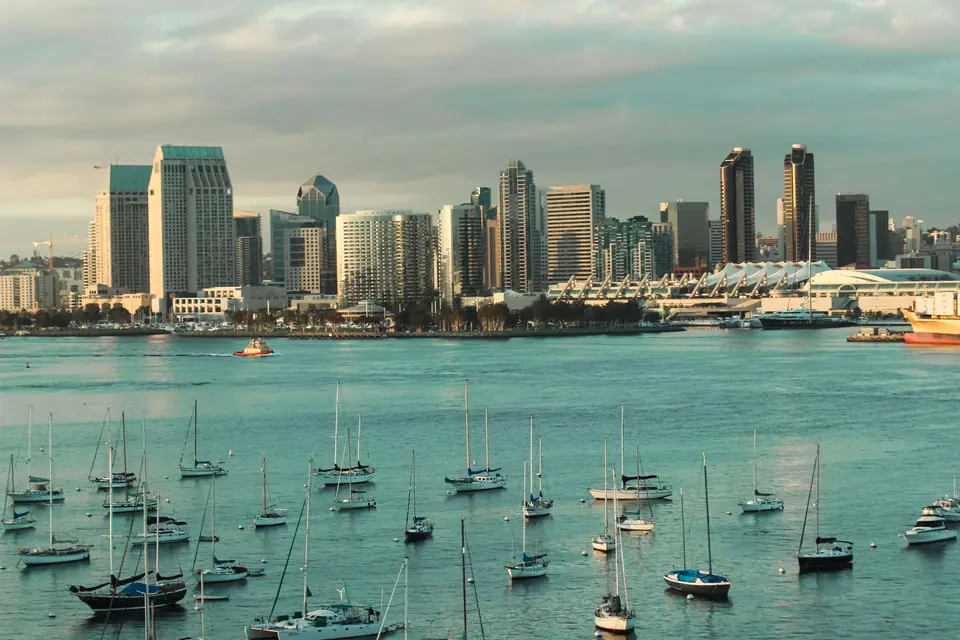
Trace Alta California's maritime cradle across Spanish mission outposts, Victorian brick commercial streets, and sunlit Pacific promenades.
From Kumeyaay Tidewaters to the 1915 Panama-California Exposition
Long before European landfall, the Kumeyaay people inhabited the coastal terraces and fertile river valleys surrounding San Diego Bay, sustaining rich maritime trade networks. Spanish navigator Juan Rodríguez Cabrillo claimed the headland in 1542, but permanent colonisation arrived only in 1769 when Franciscan friar Junípero Serra established Alta California's first Spanish mission atop Presidio Hill. The settlement subsequently shifted downslope into Old Town, where adobes and timber verandas reflected both Mexican rule and the eventual transition into an American frontier port after 1848.
The arrival of the railway transformed Alonzo Horton's New Town into an energetic maritime metropolis defined by Victorian brick commercial blocks throughout the Gaslamp Quarter. San Diego’s architectural identity was permanently redefined during the 1915 Panama-California Exposition in Balboa Park, where master architect Bertram Goodhue unveiled grand Spanish Colonial Revival arcades, Churrigueresque towers, and lush subtropical landscapes that still define Southern California's civic aesthetic today.
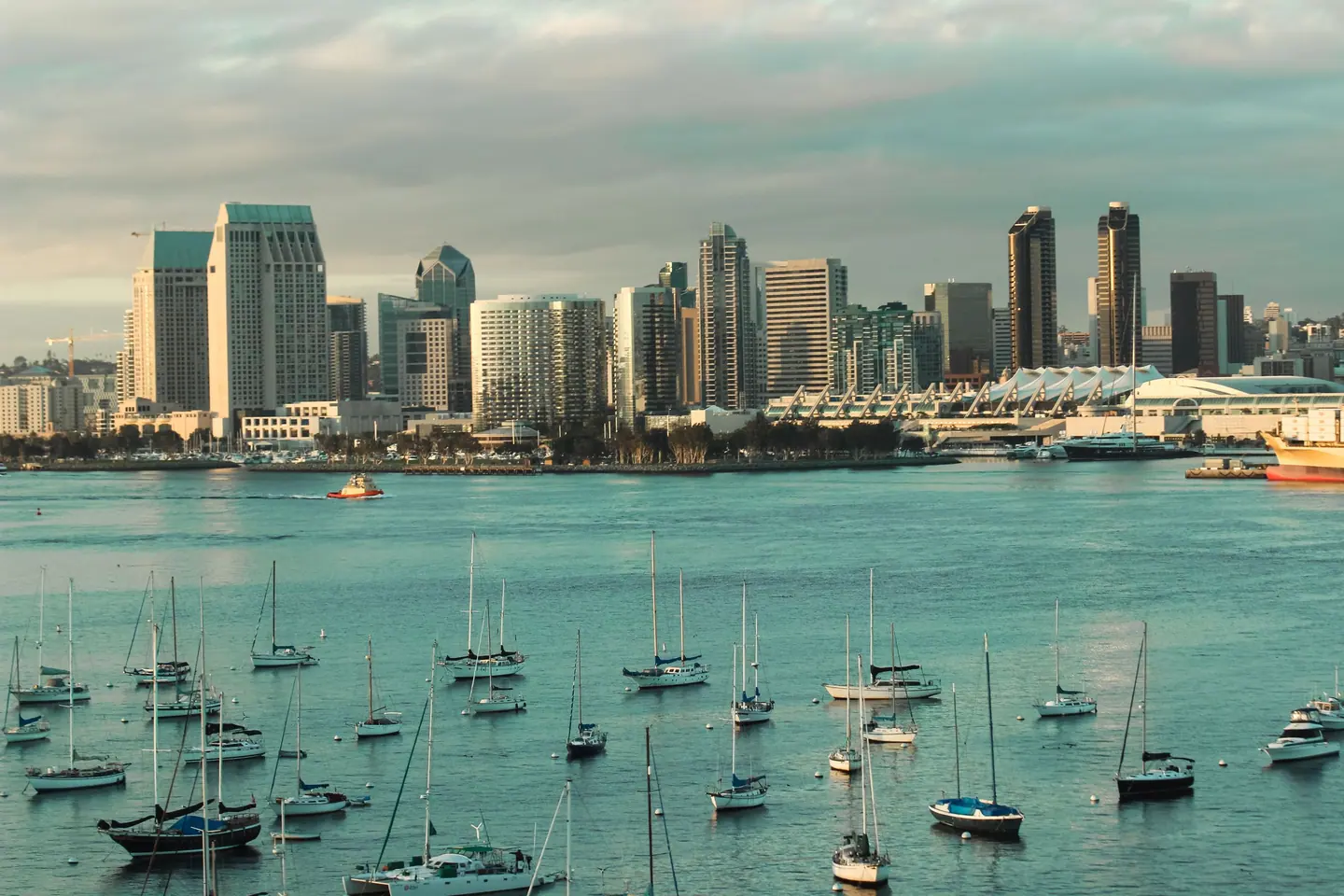
Gaslamp Quarter and the Maritime Waterfront
Stroll amidst ornate Victorian cast-iron facades, converted mercantile warehouses, and historic piers framing the deep-water bay.
William Heath Davis House
Shipped around Cape Horn in 1850, this timber dwelling represents the oldest surviving structure in downtown San Diego. We can observe classic American saltbox architecture, simple clapboard siding, and period furnishings that chronicle early attempts to establish New Town near the bay.
Louis Bank of Commerce
Constructed in 1888 from granite and pressed brick, this four-storey masterpiece was the city's first granite building. Look up to admire the twin domed towers and intricate cast-iron detailing that housed an oyster bar frequented by Wyatt Earp during the town's frontier boom.
Yuma Building
Erected in 1888 by Captain Wilcox, this striking brick edifice exemplifies the Victorian Romanesque Revival style prevalent in the district. The facade displays contrasting stone lintels, arched window bays, and ornamental parapets that once anchored the neighbourhood's late-nineteenth-century trade.
Keating Building
Commissioned in 1890 as a prestigious office block, this five-storey building features heavy Richardsonian Romanesque arches and carved sandstone accents. We can inspect the smooth red-brick exterior and bold rounded corner bays, which introduced early modern office conveniences to the city centre.
Llewelyn Building
Built in 1887, this handsome commercial edifice illustrates the rapid architectural transformation of Fifth Avenue during the railway boom. Its symmetrical facade retains original brickwork, arched upper windows, and simple pediments typical of Victorian mercantile warehouses serving the maritime trade.
Backesto Building
Completed in 1873 and later expanded, this dual-fronted structure dominates the corner of Fifth and Market. It showcases refined Classical Revival elements, including cast-iron columns, tall display bays, and decorative relief mouldings that originally housed prominent retail emporiums.
Spencer-Ogden Building
Dating from the late 1880s, this two-storey property was home to dry goods merchants and later gentlemen's clubs. The exterior displays handsome ironwork, fluted columns, and decorative cornices that reflect the period when Fifth Avenue served as the town's principal shopping artery.
Old City Hall
Constructed in 1874 and heightened in 1887, this four-storey landmark features arched windows and deep bracketed eaves inspired by Florentine palazzos. It served as the municipal seat and police headquarters, marking the transition from frontier settlement to formal civic centre.
Cole Block
Erected in 1892, the Cole Block presents an eclectic Victorian facade detailed with projecting oriel windows and decorative brick bands. Its ground floor provided street-level retail space, while the upper levels served as lodging for railway passengers and dockworkers.
Marston Building
Built in 1881, this handsome structure initially housed the department store of George Marston, one of San Diego's most influential civic patrons. We can view the tall Italianate window crowns, iron lintels, and timber cornices that established high retail standards downtown.
San Diego Chinese Historical Museum
Housed within a converted 1927 Chinese mission building, this museum preserves the narrative of the city's once-extensive Chinatown and fishing settlements. The adjacent tranquil garden contains authentic Chinese slate, carved statues, and a traditional pond reflecting the Pacific community's endurance.
USS Midway Museum
Commissioned in 1945, this vessel served as the largest warship in the world for a decade. Moored at Navy Pier, it features an expansive four-acre flight deck, restored crew quarters, bridge navigation stations, and dozens of naval aircraft illustrating Pacific maritime operations.
Star of India
Launched in 1863 as Euterpe, this full-rigged vessel is the world's oldest active sailing ship. We can admire her hand-riveted iron hull, towering masts, and original timber deck fittings, which survived voyages hauling jute and emigrants across harsh southern oceans.
Steam Ferry Berkeley
Built in 1898, this double-ended ferry assisted in the evacuation of San Francisco after the 1906 earthquake. Her upper passenger deck exhibits stained glass windows, carved wooden panelling, and a fully operational triple-expansion steam engine visible from the lower gallery.
HMS Surprise
Built in 1970 as the HMS Rose and later refitted, this three-masted wooden warship recreates the Nelson-era maritime experience. Visitors can explore the cannon-lined gun deck, complex hemp rigging, and officers' wardroom constructed according to Admiralty shipyard plans.
USS Dolphin
Entering service in 1968, this diesel-electric vessel performed scientific trials and holds the record for the deepest dive by a conventional submarine. The interior reveals compact crew quarters, sonar instrumentation, and thick steel pressure bulkheads engineered to withstand profound ocean depths.
Medea
Launched in 1904 on the River Clyde, this vessel represents luxury leisure cruising during the late British Empire. Her appointments include warm teak deckhouses, polished brass fixtures, and a compound steam engine that saw service in both World Wars under French and British naval flags.
Pantoja Park
Designed by William Heath Davis during the founding of New Town, this square retains its historic layout bordered by mature Moreton Bay fig trees. A bronze statue commemorates Benito Juárez, surrounded by open lawns that provided early settlers with relief from the nearby historic docks.
San Diego Santa Fe Depot
Built in 1915 for the Panama-California Exposition, this grand transport terminal replaced an older Victorian station. We can inspect twin tiled domes, carved beam redwood ceilings, and colourful ceramic tiles that welcomed transcontinental rail travellers arriving at the Pacific shore.
Tuna Harbor Park
Set against the bay, this open pier area honours San Diego's twentieth-century role as the world tuna capital. Memorials, open docks, and naval sculptures line the waterfront promenade, providing views across Coronado Island and the active deep-water shipping channel.

Balboa Park and the El Prado Arcades
Venture through the monumental Spanish Colonial Revival colonnades, courtyard gardens, and museum pavilions designed for the 1915 exposition.
Cabrillo Bridge
Engineered for the 1915 Panama California Exposition, this historic concrete cantilever bridge crosses Cabrillo Canyon to form the western approach to El Prado. Designed by Frank P. Allen Jr., its towering arches evoke ancient Roman aqueducts. Visitors strolling across enjoy panoramic perspectives over the freeway below and the grand California Building ahead.
California Quadrangle and Museum of Us
Architect Bertram Goodhue conceived this complex as the grand gateway for the 1915 exposition, combining Plateresque and Churrigueresque stone ornamentation. The museum inside examines human history, indigenous cultures, and cross cultural connections across the Americas. Visitors can admire the rich sculptural reliefs adorning the facade, depicting key explorers and Spanish colonial figures.
California Building and California Tower
Rising prominently above the park skyline, this structure blends Spanish Renaissance and Baroque church designs with a vivid blue and yellow tiled dome. Its two hundred foot bell tower features a carillon that rings across the grounds on the quarter hour. Ascending the tower rewards climbers with views stretching to the Pacific Ocean.
Alcazar Garden
Modelled after the gardens of the Alcazar of Seville, this tranquil plot was redesigned by Richard Requa for the 1935 California Pacific International Exposition. Boxwood hedges enclose colourful seasonal floral displays, framed by decorative Moorish tiles and twin turquoise fountains. Shaded pergolas flanking the garden provide quiet vantage points of the California Tower.
House of Charm and Mingei International Museum
Originally known as the Indian Arts Building in 1915, this arcade lined hall exhibits traditional and contemporary folk art from cultures across the globe. The building features an elegant central courtyard, sculpted plaster pediments, and historic arcades facing the central plaza. Inside, dynamic galleries showcase textiles, ceramics, and handcrafted everyday implements.
Plaza de Panama
This expansive public square served as the ceremonial nexus of both the 1915 and 1935 international expositions. Ringed by colonnaded walkways and Spanish Baroque facades, the square incorporates a central fountain, seasonal umbrella tables, and historic street lamps. It functions as a natural gathering point for pedestrians traversing between the park museums.
The San Diego Museum of Art
Opened in 1926 and designed by William Templeton Johnson, the museum facade draws direct inspiration from the University of Salamanca in Spain. Life sized statues of Spanish painters Velazquez, Murillo, and Zurbaran flank the ornate entrance portal. Within the galleries, the permanent collection contains prominent Spanish masterworks, Renaissance paintings, and modern works.
Timken Museum of Art
Designed by modern master John Mock and opened in 1965, this bronze and travertine building offers a striking mid century contrast to neighbouring Spanish Colonial pavilions. The collection features exceptional European Old Masters, American masterworks, and a remarkable selection of Russian religious icons. Natural light filters softly into the intimate interior exhibition rooms.
House of Hospitality
Rebuilt meticulously in the 1990s to replicate its 1915 exposition splendour, this structure displays detailed plaster moldings and classic Churrigueresque window surrounds. Its interior courtyard mirrors the courtyard of the Casa del Rey Moro in Ronda, complete with historic tiles and a central fountain statue. Today it hosts the central park visitors centre.
El Prado Arcades
These continuous barrel vaulted loggias provide pedestrian passage along the central boulevard, shielding walkers from summer heat while connecting exposition buildings. The rhythmic archways feature rustic paving, hanging mission style iron lanterns, and framed views of interior courtyards. They form the signature architectural motif defining the pedestrian promenade through Balboa Park.
Botanical Building and Lily Pond
Built in 1915, this lath structure ranks among the largest wood lath domes constructed anywhere in the world. The long reflecting pond out front features floating water lilies and sacred lotus blossoms, mirroring the grand facade. Inside, a sheltered tropical microclimate nurtures extensive collections of cycads, orchids, ferns, and exotic palms.
Casa del Prado
Serving initially as the Food Products Building in 1915, this site was reconstructed in 1971 to preserve its elaborate plasterwork. The southern portal features deeply carved Baroque details, including figures of Spanish monks, explorers, and heraldic crests. A sunlit interior courtyard lined with tile benches provides rehearsal space for civic youth performing arts groups.
Casa de Balboa
Rebuilt following a devastating 1978 fire, this building mirrors the Commerce and Industries Building from the 1915 exposition. Classical arches, high relief cornices, and detailed plaster finials define its exterior perimeter along El Prado. Inside, visitors discover the Museum of Photographic Arts, the San Diego History Center, and an extensive model railroad museum.
Spreckels Organ Pavilion
Gifted to the city by brothers John and Adolph Spreckels in 1914, this outdoor music venue features thousands of pipes within an Italian Renaissance pavilion. A curving semi circular colonnade embraces the extensive open bench seating area. Regular free civic concerts continue an unbroken tradition of public music recitals spanning over a century.
San Diego Natural History Museum
Founded in 1874 and situated in a classic revival structure designed by William Templeton Johnson in 1933, this institution explores the biodiversity of southern California and Baja California. The facade complements El Prado with subtle classical proportions and stone trim. Four floors of displays showcase regional fossils, dinosaur reconstructions, and native desert habitats.
Fleet Science Center
Opening in 1973 at the eastern terminus of El Prado, this educational complex was the first to combine an interactive science museum with an IMAX dome theatre. The exterior plaza features the historic outdoor kinetic sculpture and fountain titled Night and Day. Inside, dozens of hands-on physical science exhibits invite direct experimentation.
Bea Evenson Fountain and Plaza de Balboa
Positioned between the Natural History Museum and the Fleet Science Center, this broad circular plaza forms the eastern anchor of El Prado. The massive central fountain, named after community conservation advocate Bea Evenson, shoots water plumes skyward against the coastal breezes. Shaded benches around the rim provide rest for walkers completing the promenade.
Zoro Garden
Constructed as a rocky grotto for a nudist colony exhibit during the 1935 exposition, this sunken depression has since been converted into a dedicated butterfly sanctuary. Native nectar plants, sheltered stone microclimates, and small pools attract local swallowtails and monarch butterflies. Stone steps descend into this quiet enclosure tucked away from the main thoroughfare.
Japanese Friendship Garden
Expressing San Diego's sister city relationship with Yokohama, this expansive garden incorporates classical Japanese landscaping techniques adapted to the local coastal terrain. Stepped stone paths weave past koi ponds, bonsai exhibitions, stone lanterns, and dry Zen landscape gardens. A lower canyon extension features hundreds of cherry blossom trees that bloom in early spring.
Moreton Bay Fig Tree
Planted prior to the 1915 exposition, this Australian native ficus has grown into one of the largest trees in North America. Its enormous canopy spans over one hundred feet, supported by a massive network of aerial roots and wooden ground buttresses. An elevated wooden viewing platform protects the delicate root system while letting observers inspect the immense trunk.
Old Town and Presidio Hill
Discover the adobe homes, early civic plazas, and foundational mission sites where California's Spanish colonial era commenced.
Presidio Park
Perched above the river valley, this grassy hill marks the initial Spanish settlement of Alta California established in 1769. While the original military fort walls have weathered into mounds, the park contains commemorative memorials, archaeological earthworks, and panoramic views across the river plain toward the Pacific coastline.
Junípero Serra Museum
Designed by architect William Templeton Johnson and erected in 1929, this Mission Revival landmark resembles an early Spanish church with its white stucco tower. Inside, travellers can study regional collections of early colonial artefacts, architectural fragments, and displays documenting the interactions between indigenous Kumeyaay and Spanish settlers.
Old Town San Diego State Historic Park
Formed to protect the urban core of San Diego between 1821 and 1872, this state park encompasses historic adobe compounds, wooden commercial shops, and the central plaza. Visitors can observe living history demonstrations, heritage gardens, and preserved nineteenth-century interiors that showcase life under Mexican and early American administration.
La Casa de Estudillo
Built between 1827 and 1829 by Captain José María Estudillo, this large adobe structure represents one of the finest extant examples of Mexican domestic architecture in California. Its thirteen rooms enclose a traditional courtyard planted with native flora, featuring an elevated cupola that once permitted views over neighbouring bullfights.
Casa de Machado y Stewart
Constructed in the 1830s by corporal José Manuel Machado, this smaller adobe dwelling reflects the lifestyle of ordinary working-class families during the Mexican era. The adjoining outdoor grounds display period kitchen gardens, heirloom vegetables, and traditional cooking ovens constructed from clay and river stones.
Whaley House
Completed in 1857 using locally fired bricks, this Greek Revival building served alternately as a family residence, a general store, a public theatre, and the county courthouse. Travellers can examine period furnishings, decorative iron balconies, and courtroom records preserved within its mid-nineteenth-century halls.
Casa de Machado y Silvas
Built in the early 1840s for the Machado family, this single-storey adobe structure showcases thick sun-dried brick walls and heavy timber roof framing. In subsequent decades it operated as a popular commercial restaurant, boarding house, and saloon, reflecting the rapid transformation of the surrounding plaza district.
Casa de Carrillo
Erected around 1821 by Francisco María Ruiz for Joaquín Carrillo, this structure is celebrated as the earliest surviving residence constructed at the base of Presidio Hill. Located beside a modern municipal golf course, its whitewashed adobe walls remain a testament to early domestic sprawl beyond the garrison perimeter.
Cosmopolitan Hotel
Starting in 1827 as a single-storey adobe home for local magnate Juan Bandini, this building was later expanded in 1869 with a second timber storey and wraparound veranda. It represents a transition from Mexican domestic compound to Victorian hostelry, featuring period-accurate hospitality spaces and antique architectural fittings.
El Campo Santo Cemetery
Consecrated as a Catholic cemetery in 1849, this burial ground contains the remains of Mexican Californios, Native Americans, and early Anglo settlers. A number of historic graves were paved over by municipal street construction in 1889, though circular brass markers along modern pavements commemorate those original subterranean resting sites.
Mason Street School
Built in 1865, this modest cedar-clad structure was the first purpose-built public schoolhouse in San Diego County. Inside, rows of wooden desks, slate boards, and historical primers illustrate the teaching methods employed by early civic educator Mary Chase Walker during the post-Civil War era.
Old Town Plaza
This open green lawn served as the civic centre of Mexican San Diego, used for public rallies, military drills, religious processions, and civic fiestas. Bordered by foundational adobe residences and historic hotels, the plaza features a prominent flagpole marking where the American flag was first raised in 1846.
San Diego Union Museum
Occupying a prefabricated timber structure shipped from Maine around Cape Horn in 1851, this small office produced the first issue of the San Diego Union newspaper in 1868. Visitors can view hand-operated printing presses, lead type cases, and nineteenth-century editorial desks configured exactly as they were during publishing days.
Seeley Stable Museum
This wooden barn recreates the extensive staging operation operated by Albert Seeley, who ran horse-drawn passenger coaches between San Diego and Los Angeles in the 1870s. The interior houses an impressive collection of horse-drawn vehicles, overland stagecoaches, saddles, and regional transit ephemera from the frontier era.
Mormon Battalion Historic Site
Dedicated to the five hundred volunteers who completed a gruelling two-thousand-mile infantry march from Iowa during the Mexican-American War, this facility interprets their 1847 arrival. Interactive exhibitions present original artefacts, military gear, and demonstrations of historic trades including brickmaking and gold panning.
Church of the Immaculate Conception
Begun in 1868 under the direction of Father Antonio Ubach, this Spanish-style brick church was finally completed and dedicated in 1919 after decades of interrupted construction. The interior contains historical church bells, altars, and devotional objects originally salvaged from the initial chapel at Presidio Hill.
Black Hawk Livery and Blacksmith
This workshop reconstruction illustrates the metalworking industry essential to nineteenth-century transit and agriculture in the developing township. Artisans in period clothing regularly work the coal-fired forge and anvil, shaping iron implements and explaining the mechanics of wheelwrighting and horse shoeing.
Casa de Pedrorena
Erected in 1869 by Miguel de Pedrorena, this residence represents one of the final traditional adobe structures built around the historic town square. Combining thick adobe brick walls with Americanized milled wood framing, it illustrates the architectural adaptation taking place across Southern California during the late nineteenth century.
Sheriff's Museum and Educational Center
Covering the history of the San Diego County Sheriff's Department from its establishment in 1850 onward, this collection includes period jail cells, early badges, firearms, and vintage transport. Exhibits highlight the transition from frontier justice and county posses to modern civil peacekeeping institutions.
Heritage County Park
Occupying almost eight acres along the eastern boundary of Old Town, this park was created to rescue threatened Victorian buildings from demolition across San Diego. Seven restored structures, including the 1889 Temple Beth Israel and several ornate Queen Anne homes, now form an open-air precinct of nineteenth-century domestic design.
Point Loma and Cabrillo Headland
Ascend rugged coastal bluffs crowned by a historic lighthouse, offering panoramic views spanning the Pacific Ocean and bay entrance.
Cabrillo National Monument
Dedicated in 1913, this federal park memorialises the 1542 landing of Juan Rodriguez Cabrillo on the California coast. Visitors can explore a substantial visitor centre containing navigational artefacts, interpretive films, and sweeping outdoor viewing platforms overlooking San Diego Bay and Coronado. The headland provides an excellent vantage point for seasonal whale watching.
Old Point Loma Light
First illuminated in 1855, this Cape Cod style stone cottage sits 129 metres above sea level. Frequent low coastal fog repeatedly obscured the original beam, leading authorities to extinguish it in 1891. The building now displays faithfully restored Victorian domestic quarters and maritime instruments that illustrate the daily life of early lighthouse keepers.
New Point Loma Light
Constructed in 1891 at the base of the bluffs, this 30-metre pyramidal steel tower replaced the high-elevation lighthouse to bypass low marine layer fog. It continues to guide naval vessels into the harbour under the supervision of the United States Coast Guard. Several adjoining keeper quarters from the late nineteenth century remain preserved on site.
Fort Rosecrans National Cemetery
Established in the late nineteenth century on grounds formerly used by the United States Army, this burial ground overlooks both the Pacific Ocean and San Diego harbour. Neatly arranged white granite markers trace the crest of Point Loma, honouring veterans dating back to the Mexican-American War. Notable monuments include memorial plaques dedicated to the victims of the USS Bennington disaster.
Fort Rosecrans
Named after Union General William Rosecrans, this military reservation guarded the entrance to San Diego Bay from 1898 through the Second World War. Massive reinforced concrete gun batteries and subterranean command bunkers were carved directly into the slopes. Many preserved historic quarters and red-roofed administrative buildings now serve modern naval operations.
Battery Point Loma
Constructed between 1941 and 1943, this military bunker sheltered twin six-inch rapid-fire guns designed to protect San Diego harbour from enemy naval bombardment. Thick reinforced concrete walls and heavy steel blast doors shielded ammunition magazines and power generators. Today, the preserved structure offers a tangible look into mid-twentieth-century Pacific coast harbour defence strategies.
Point Loma Tide Pools
Located on the western boundary of the headland, these rocky terraces expose intricate intertidal marine habitats during low tides. Layers of sedimentary rock showcase fossilised marine deposits formed over millions of years alongside sculpted surge channels. Visitors frequently observe sea anemones, shore crabs, and small fish sheltered within the coastal marine reserve.
Juan Rodriguez Cabrillo Statue
Carved by sculptor Alvaro de Bree and gifted by the Portuguese government in 1939, this four-metre sandstone monument portrays the explorer looking eastward across the harbour. It occupies an open promontory that highlights the maritime geography of southern California. Interpretive plaques flank the statue, explaining the historical context of the initial Spanish expedition.
Bayside Trail
This unpaved historic route descends the sheltered eastern slope of Point Loma, winding through fragile coastal sage scrub habitats. Originally constructed during the Second World War to access searchlight stations, the trail offers clear views of Naval Air Station North Island. Remnants of concrete military bunkers and historic telephone poles punctuate the natural landscape along the descent.
USS Bennington Monument
Erected in 1908 within Fort Rosecrans National Cemetery, this 23-metre granite obelisk memorialises the 66 sailors killed when the gunboat USS Bennington suffered a catastrophic boiler explosion in San Diego Bay. The shaft serves as a landmark visible across the peninsula ridge. Surrounding graves include several recipients of the Medal of Honour honoured for valour during the catastrophe.
Ballast Point
This low finger of land provided an anchorage for Juan Rodriguez Cabrillo in 1542 and later served as the location of Fort Guijarros, an eighteenth-century Spanish fortress. Merchant sailing vessels historically gathered rounded cobbles here for ship ballast, lending the location its enduring name. The area now rests within the perimeter of Naval Base Point Loma.
Fort Guijarros
Erected in 1797 by the Spanish colonial administration, this fortification featured cannon batteries built of earth, timber, and local cobblestones to protect the entrance of San Diego Bay. In 1803, the battery traded cannon fire with the American brigantine Lelia Byrd during a smuggling dispute. Archaeological excavations have uncovered ceramic sherds, cannon balls, and structural wall footings.
Liberty Station
Spanning over one hundred hectares, this former naval training facility trained sailors from 1923 until the mid-1990s. Designed in the Spanish Colonial Revival style by architect Bertram Goodhue, the complex features arcaded walkways, decorative stucco walls, and red clay tile roofs. The transformed district now accommodates civic museums, artists' studios, artisan markets, and landscaped public squares.
Command Center at Liberty Station
Constructed in the 1920s, Building 200 historically served as the headquarters for the commanding officer of the naval training installation. Its symmetric facade, arched entry portals, and manicured courtyards represent quintessential interwar Californian naval design. Today, the facility houses historical exhibitions, community galleries, and educational archives open to the public.
Sunset Cliffs Natural Park
Stretching along the western shoreline of Point Loma, this 28-hectare park features sea caves, natural arches, and eroded sandstone formations. Geologists study the exposed Cretaceous-age rock strata, which reveal intricate sedimentation patterns and marine fossils. Walking paths trace the cliff edges, providing unobstructed ocean viewpoints where visitors observe pelicans, dolphins, and winter grey whales.
Lomaland
Established in 1897 by Katherine Tingley as the headquarters of the Universal Brotherhood and Theosophical Society, this estate featured domed architecture, Greek open-air theatres, and lush orchards. The site later became the campus of Point Loma Nazarene University. Surviving historic structures include the Mayson Wooden House and remnants of the earliest Greek amphitheatre constructed in North America.
Point Loma Nazarene University Greek Amphitheatre
Constructed in 1901 by the Theosophical community, this stone outdoor auditorium is recognised as the first permanent Greek-style theatre in the United States. Tiered concrete benches descend toward a proscenium framed by dramatic open sea views. The structure continues to host academic ceremonies, lectures, and cultural performances, preserving its classical design and natural coastal acoustic qualities.
Shelter Island
Constructed from harbour dredging spoils in the 1950s, this strip of land was developed to support recreational yachting and hospitality. The island showcases mid-century modern tiki-style architecture alongside maritime public art. Visitors can walk the waterside promenade to view private marinas, mega-yachts, and panoramic vistas of downtown San Diego and the naval docks.
Yokohama Friendship Bell
Presented to San Diego by the citizens of Yokohama in 1958, this massive bronze bell celebrates the transpacific sister-city relationship between the two ports. It rests inside a traditional Japanese wooden pagoda set on a landscaped point at the tip of Shelter Island. The surrounding area features commemorative inscriptions and peaceful stone paths overlooking bay channels.
Tunaman's Memorial
Dedicated in 1986 and created by sculptor Franco Vianello, this six-metre bronze monument portrays commercial fishermen hauling a loaded tuna net. It commemorates the Portuguese, Italian, and Mexican immigrants whose labour made Point Loma the tuna capital of the world for much of the twentieth century. Plaques around the plinth list local fishermen lost at sea.
La Jolla Cove and Coastal Terraces
Wander past sandstone sea arches, tidal coves, and modernist cliffside villas overlooking pristine marine sanctuaries.
La Jolla Cove
Carved into the coastal bluffs, this sheltered cove anchors a marine ecological reserve where commercial fishing remains forbidden. Sea lions frequently haul themselves out across the rocky shelves, while swimmers navigate kelp forests visible from the perimeter balustrades. The surrounding coastal walk features early twentieth-century wooden pavilions overlooking the Pacific Ocean.
Children's Pool La Jolla
Philanthropist Ellen Browning Scripps funded this curving concrete barrier in 1931 to provide a tranquil bathing pool for local children. Over subsequent decades, accumulating sands altered tidal currents, transforming the enclave into an established pupping ground for harbour seals. Visitors walk atop the robust sea wall to observe these marine mammals resting on the sand below.
Sunny Jim Cave
Mining engineer Gustav Schultz excavated this subterranean passageway in 1902, chipping through the cliff face over two years. Entry is gained through a rustic curio shop, leading visitors down 145 wooden steps into a sea cavern. The cave mouth frames an ocean silhouette said to resemble a popular cartoon character of the era.
Museum of Contemporary Art San Diego
Occupying a prime coastal plot, this institution originated within a 1915 residence designed by pioneering architect Irving Gill. Later expansions by Venturi, Scott Brown and Annabelle Selldorf incorporated crisp concrete pavilions and expansive viewing terraces directly facing the Pacific. Inside, galleries present extensive collections of post-war conceptual art, painting, and regional photography.
Ellen Browning Scripps Park
Spreading across a broad marine terrace, this grassy parkland was bequeathed to the municipality in the early twentieth century. Monterey cypresses, Torrey pines, and exotic palms line the gentle slopes, shaped by prevailing maritime gusts. Paved promenades skirt the perimeter, offering travellers unobstructed views of coastal sea arches and tidal headlands.
Scripps Pier
Completed in 1988 to replace an earlier timber jetty from 1916, the Ellen Browning Scripps Memorial Pier serves oceanographic research. It projects over three hundred metres past the surf line, carrying seawater intake pipes and environmental sensors that supply nearby scientific laboratories. Though access is restricted, walkers can examine its sturdy concrete pillars from the shoreline.
Salk Institute for Biological Studies
Commissioned by polio vaccine developer Jonas Salk, this scientific campus opened in 1965 and remains an acclaimed landmark of modern architecture. Twin laboratory wings of pozzolanic concrete flank a central travertine courtyard cut through by a single water channel. The minimalist plaza directs the eye straight towards the open horizon of the Pacific Ocean.
La Jolla Woman's Club
Constructed in 1914, this civic building demonstrates Irving Gill's early mastery of tilt-slab concrete construction. Its severe, unornamented white walls are relieved by shaded arcades, pergolas, and recessed arched windows set amid mature gardens. The interior retains original timber floors and simple gathering spaces that continue to serve community functions.
La Jolla Recreation Center
Dedicated in 1915, this civic facility was another prominent collaboration between Ellen Browning Scripps and architect Irving Gill. The structure features simple geometric forms, concrete construction, and wide verandas designed to foster civic recreation. It remains an active public sports hub, bordered by children's play areas and shaded perimeter benches.
La Jolla Tide Pools
Located south of the Children's Pool, these eroded sandstone benches reveal dozens of saltwater pockets when the tide recedes. Travellers walk carefully across the slippery strata to inspect sea anemones, shore crabs, and small fish trapped in shallow basins. Natural fissures along the rock line also act as blowholes during periods of vigorous coastal swell.
The Bishop's School
Established in 1909 as an Episcopal academy for girls, this school grounds showcase buildings by both Irving Gill and Carleton Winslow. Gilman Hall and St Elizabeth's Chapel present smooth plaster surfaces, arcaded corridors, and bell towers set around verdant quadrangles. The campus represents an important early hub of academic development on the peninsula.
Red Roost and Red Rest Cottages
Erected in 1894, these single-storey redwood board-and-batten structures are among the oldest surviving vacation residences in the coastal village. Designed in a simple vernacular style, they represent the transitional era when artists and seasonal visitors lived in modest shoreline camps. They stand opposite the public park, recalling the area's pre-urban character.
St. James by-the-Sea Episcopal Church
Built between 1928 and 1930, this stone-and-stucco sanctuary replaced an earlier timber chapel from the turn of the century. Designed by Louis Gill, nephew of Irving Gill, it incorporates elements of the Spanish Colonial style alongside a prominent replica of the tower at Campoamor in Spain. Its tranquil interior features timber beam ceilings and stained glass.
Windansea Beach
Recognised globally for its steep, shore-breaking reef waves, this beach has served as a central pillar of California surf culture since the 1930s. A simple palm-thatched shack, first constructed by local surfers in 1946 and regularly rebuilt after storms, sits atop the sandstone headland. The fractured rocky shelves offer dramatic views of crashing surf.
Birch Aquarium
Operating as the interpretive showcase for the Scripps Institution of Oceanography, this cliff-top centre displays regional and tropical marine ecosystems. Exhibits include a giant kelp forest tank, interactive oceanography galleries, and an outdoor terrace with touch pools looking out across the Pacific. The facility documents local marine research programmes dating back more than a century.
Mount Soledad National Veterans Memorial
Rising 250 metres above the coastal plain, Mount Soledad affords sweeping 360-degree vistas stretching from Mexico to coastal orange groves. A nine-metre concrete cross, dedicated in 1954, anchors a circular veterans memorial bordered by black granite walls bearing thousands of engraved plaques. The summit provides an excellent vantage point to understand the coastal topography of La Jolla.
Shell Beach
Located just north of the Children's Pool, this modest pocket of sand lies beneath sheer sedimentary bluffs. Reached by a concrete stairway, the strand is covered with polished shell fragments, pebbles, and tide pools exposed at low water. Offshore reefs attract sea birds, while harbour seals often swim through the gentle surf line.
La Jolla Shores Park
This expansive crescent of sand offers gentle beach-entry access to the San Diego-La Jolla Underwater Park. Kayakers and divers frequently launch from the water's edge to reach nearby submarine canyons and kelp beds inhabited by leopard sharks. A grassy public promenade with picnic benches and palms extends along the landward margin.
Athenaeum Music & Arts Library
One of only a handful of remaining non-profit membership libraries in the United States, this cultural institution traces its roots to 1899. The Spanish-influenced building contains extensive collections of sheet music, art volumes, and rare artists' books, while hosting regular chamber concerts in its intimate auditorium. Rotating visual arts exhibitions occupy several light-filled gallery rooms.
Torrey Pines Gliderport
Established in 1928 atop 100-metre coastal palisades, this aviation site has witnessed key developments in modern soaring, hang gliding, and paragliding. Steady ocean winds deflect upwards against the sandstone bluffs, creating persistent thermal lift exploited by pilots daily. Observers gather along the edge to watch launches and take in views across the ocean.
Navigating Coastal Mesas and Waterfront Esplanades
Pair this route with the practical neighbourhood breakdowns, climate charts and transport advice in our San Diego travel overview, alongside additional mapped city walks.