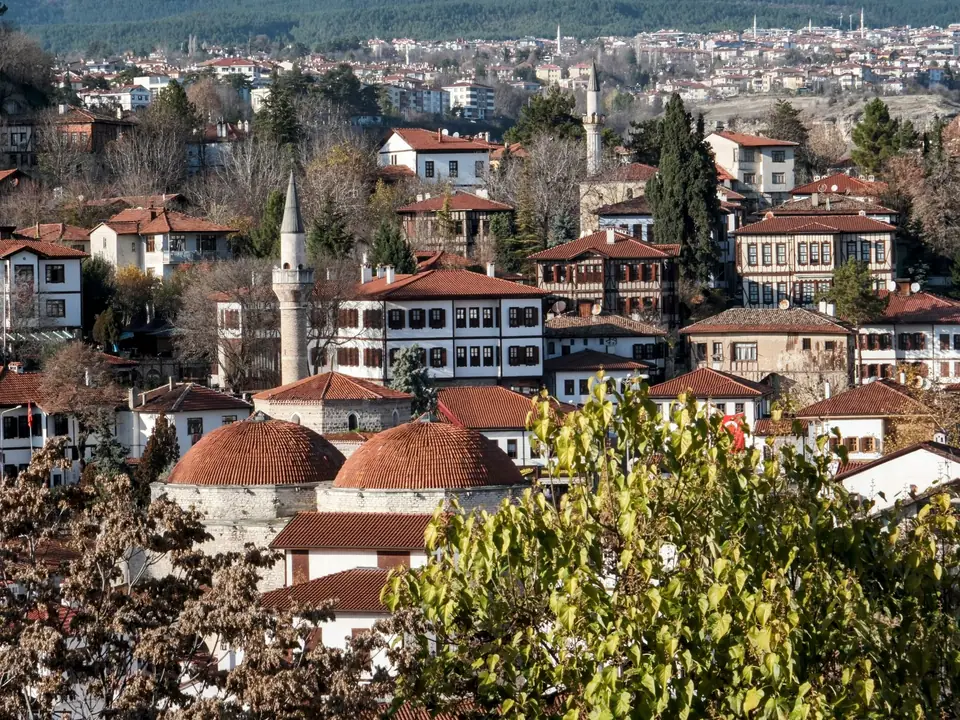
A detailed UNESCO route across the first capital of the Ottoman Empire at the foot of Mount Uludağ: early sultanic külliyes, Silk Road caravanserais, Cumalıkızık, and İznik.
Bithynian Prusa and the First Sultanic Complexes of the Ottoman Empire
Founded around 188 BC by King Prusias I of Bithynia on the counsel of Carthaginian general Hannibal at the northern foot of Mysian Olympus (Mount Uludağ), Prusa was prized throughout Roman and Byzantine antiquity for the mineral thermal springs of Çekirge. In 1326 Orhan Gazi captured the citadel after a siege begun by his father Osman I, making Bursa (Hüdavendigâr) the first monumental capital of the Ottoman Empire.
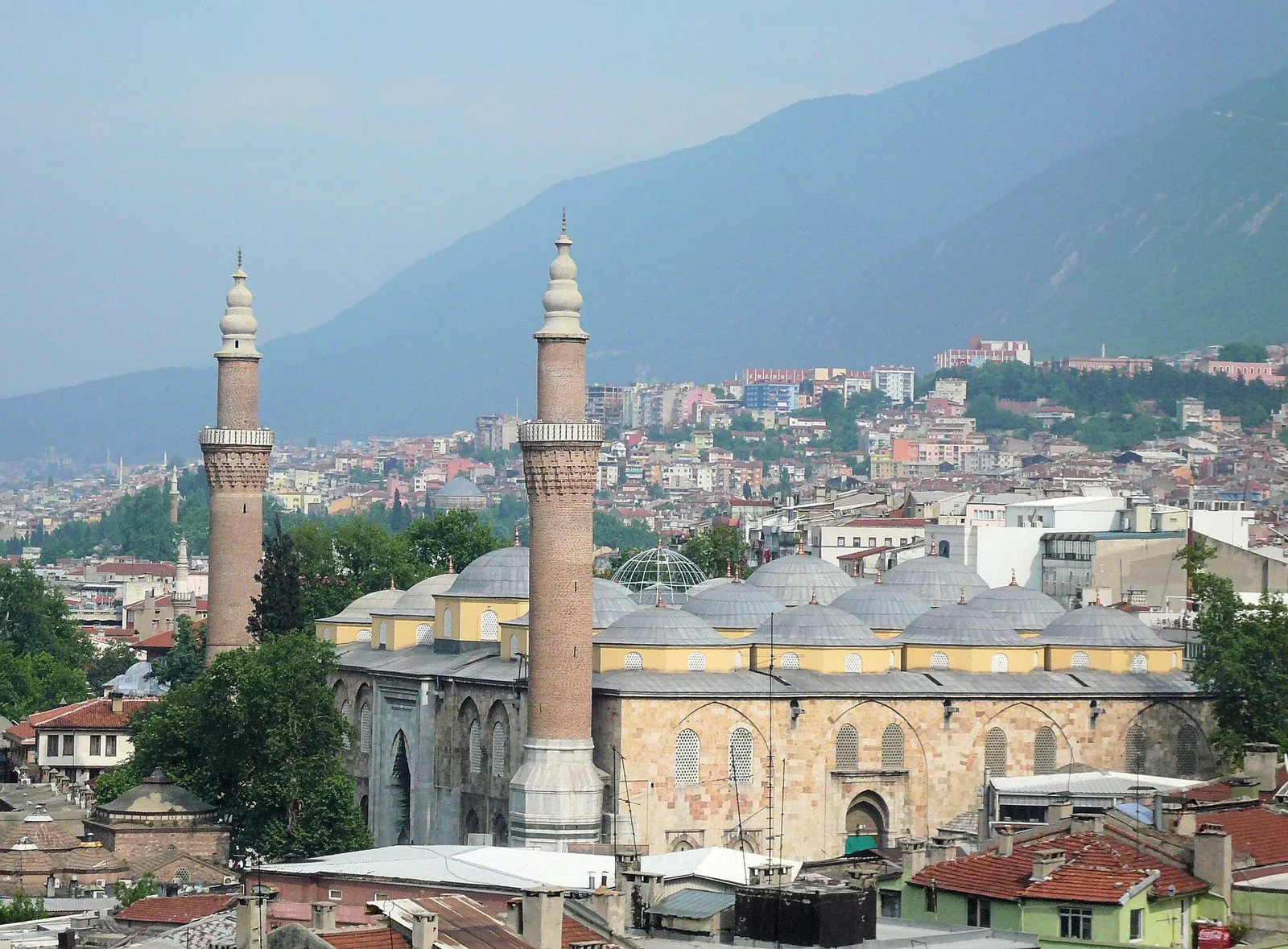
Between 1326 and 1453, early Ottoman sultans Orhan, Murad I, Bayezid I, Çelebi Mehmed, and Murad II pioneered the urban külliye system, founding self-sustaining charitable complexes of mosques, madrasas, soup kitchens, and baths funded by the downtown silk caravanserais around Koza Han and the 20-domed Ulu Cami.
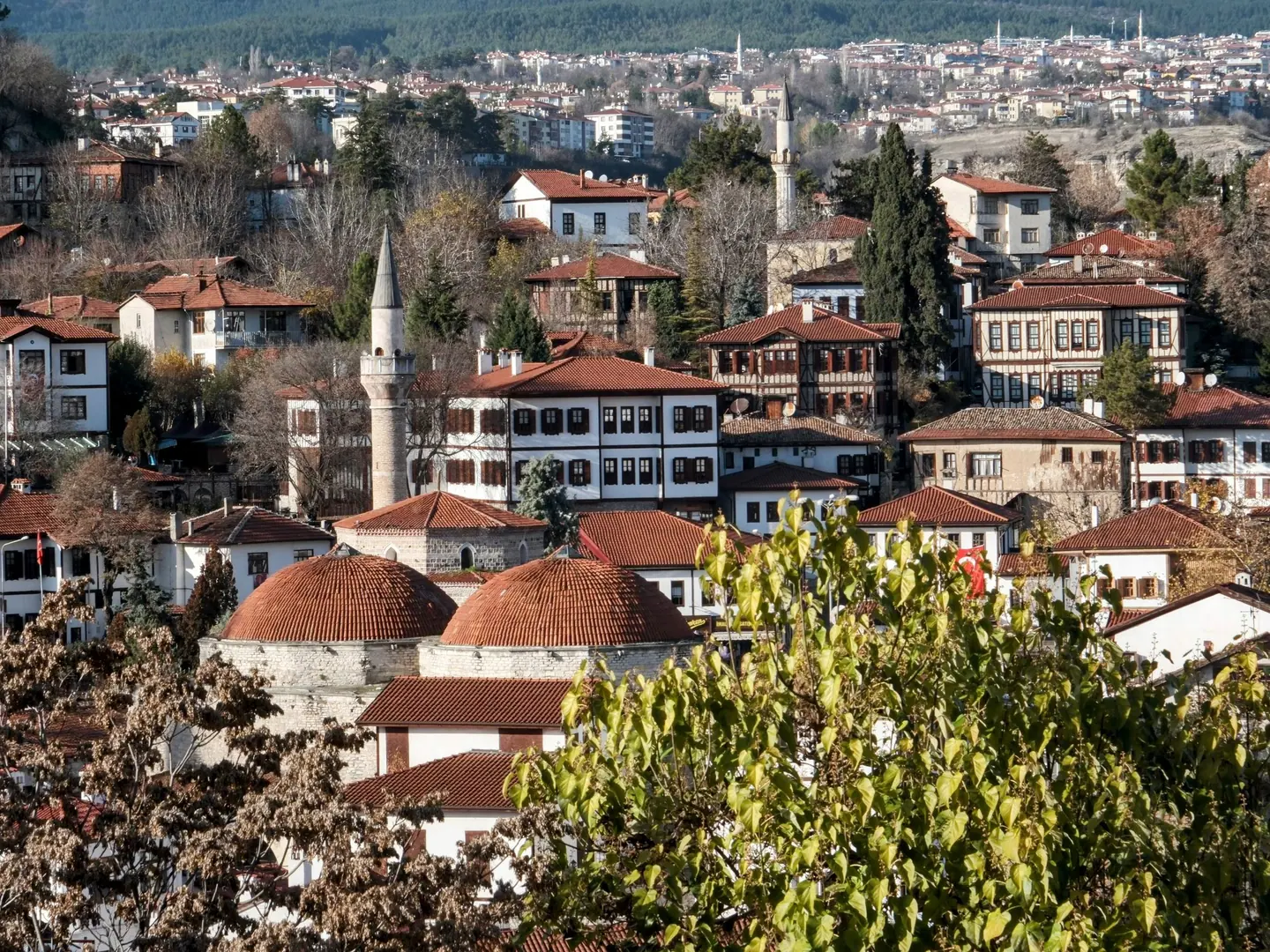
Ulu Cami, Koza Han & Historic Silk Road Hans District
Bursa Grand Mosque Ulu Cami 20 Domes & Fountain, Koza Han Silk Caravanserai (1491), Orhan Gazi Mosque, Emir Han, Fidan Han, Pirinç Han, Tuz Pazarı, Uzun Çarşı, Kayhan Bazaar, and Irgandı Bridge (1442 Artisan Shop Bridge)
Bursa Grand Mosque (Ulu Cami)
Commissioned by Sultan Bayezid I following his victory at the Battle of Nicopolis, this imperial sanctuary was completed in 1400. Inside, travellers can admire an exquisite ablution fountain positioned beneath an open central skylight, alongside dozens of historic calligraphic inscriptions painted onto massive stone piers.
Koza Han
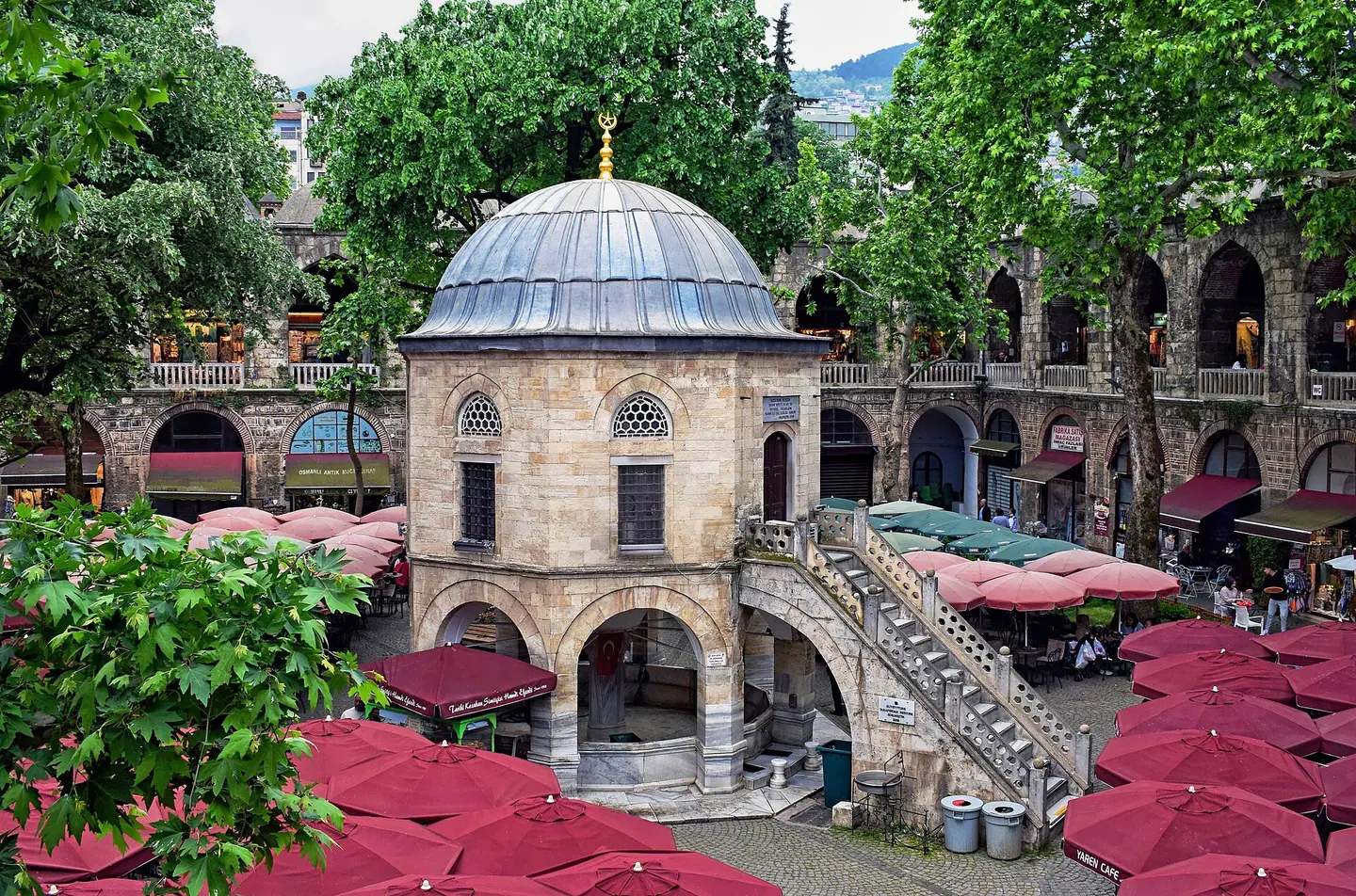
Built in 1491 by architect Abdul ula bin Pulad Sah to finance the Sultan Bayezid II complex in Istanbul, this two-storey stone inn long anchored the regional cocoon trade. Its expansive central courtyard contains an elevated octagonal mescit prayer hall supported by marble piers above an open water fountain.
Orhan Gazi Mosque
Dating to 1339, this house of worship represents one of the earliest examples of the inverted T-plan architectural style developed under early Ottoman rule. Visitors should examine its alternating courses of brick and ashlar masonry, together with intricate brick decorative patterns and surviving exterior stonework on the main portico.
Emir Han
Commissioned by Orhan Gazi in the 1330s, this complex stands as the oldest surviving commercial caravanserai in the city. The courtyard retains its original perimeter arcades and shaded central plane trees, where merchants historically unloaded raw silks, grains, and dry goods from regional trade routes.
Fidan Han
Constructed in the 1470s by Grand Vizier Mahmud Pasha, this rectangular structure features upper and lower arcades enclosing a leafy stone-paved interior. Travellers can observe the brick-and-rubble construction techniques characteristic of the early classical period and a modest twelve-sided fountain situated in the open square.
Pirinç Han
Commissioned by Sultan Bayezid II, this merchant lodge was built to generate revenue for his pious foundations in Istanbul. The rugged stone courtyard, partially restored following twentieth-century street widening projects, now accommodates pleasant cafes, bookshops, and quiet craft workshops across two vaulted levels.
Geyve Han
Erected during the reign of Sultan Mehmed I, this square-plan caravanserai was funded by the architect of the Green Mosque. Its stout ashlar walls, vaulted ground-floor storage rooms, and arcaded upper galleries demonstrate the functional domestic architecture developed to protect passing Silk Road caravans.
Tuz Pazarı
Operating since the fourteenth century, this lively market street initially served as the primary distribution depot for salt brought from the coast. Today, the pedestrian lanes display barrels of regional Gemlik olives, fresh cheeses, herbs, and produce supplied directly by rural farming communities surrounding Mount Uludağ.
Uzun Çarşı
Originating in the fifteenth century, this long retail arcade connects the Grand Mosque to neighbouring merchant inns along a central east-west axis. The sheltered walkway remains a principal retail route, housing traditional tailors, textile vendors, and shops selling woven homewares under a continuous vaulted ceiling.
Bedesten
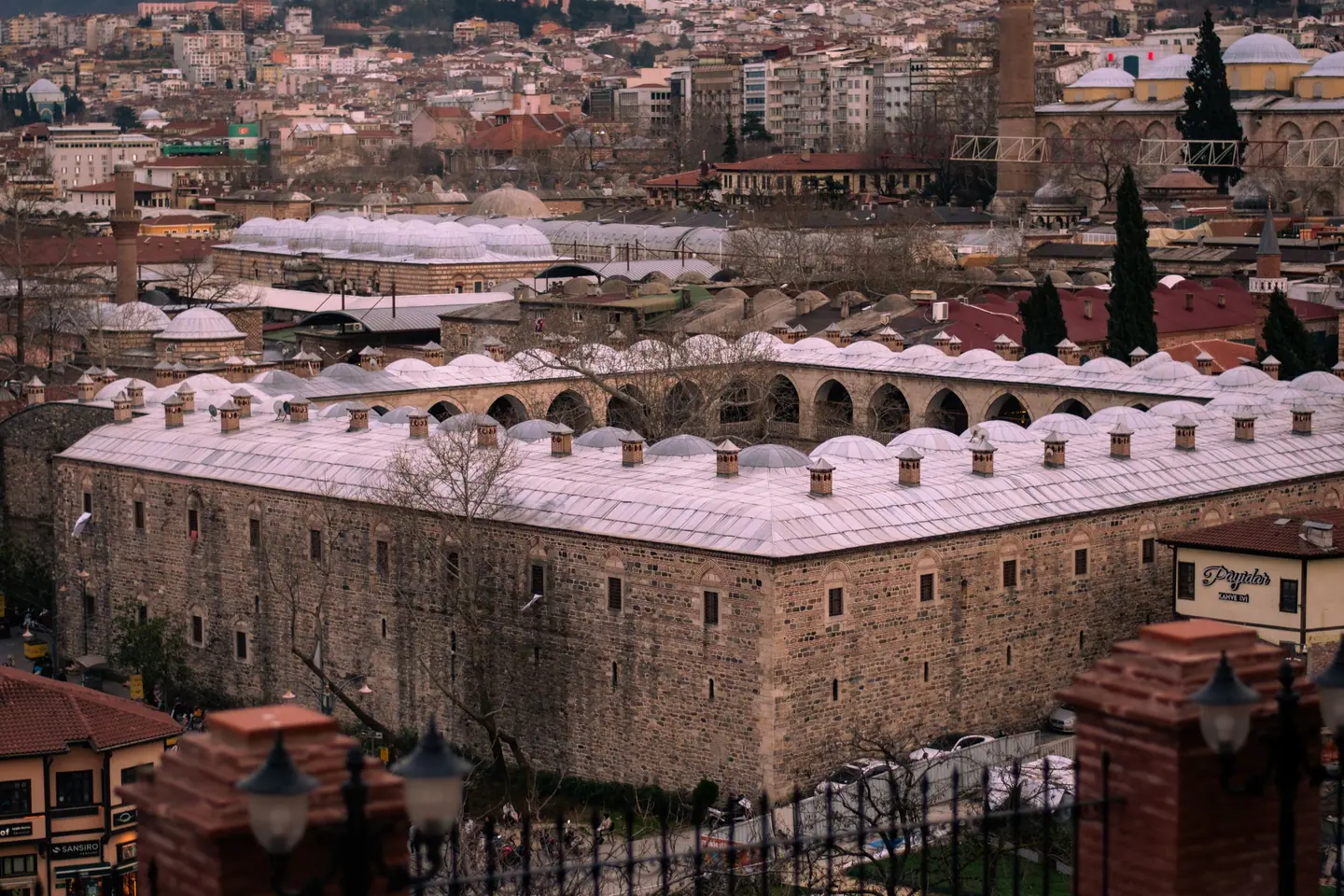
Ordered by Sultan Bayezid I at the end of the fourteenth century, this stout masonry hall functioned as the secure nucleus of the commercial quarter. Its heavy stone exterior, iron-studded doors, and fourteen interior domes protected gold merchants and silk traders against fire, theft, and civic unrest.
Bakırcılar Çarşısı
Situated adjacent to Ulu Cami, this narrow lane has housed metalsmiths since the rise of the Ottoman capital. Visitors can hear artisans hammering raw copper into pots, pans, Turkish coffee pots, and decorative trays, continuing artisan metalworking practices that have survived here for several centuries.
Kayhan Bazaar
Located slightly east of the primary commercial core, this historic market street developed around a fifteenth-century mosque and bathhouse. The stone-lined street is celebrated for its deep association with traditional Iskender kebabs and cantık flatbreads, prepared inside timber-fronted cookhouses that have traded for generations.
Irgandı Bridge
Erected in 1442 by the merchant Hacı Muslihiddin across the Gökdere ravine, this structure represents one of very few surviving bridge-bazaars in Europe. The single stone arch supports an enclosed row of yellow-fronted studios, where painters, woodcarvers, and calligraphers produce handcrafted wares directly above the river gorge.
Bursa City Museum
Housed within the former governorate building completed in 1926 by architect Kemalettin Bey, this institution illustrates six millennia of regional history. Exhibits include detailed dioramas of traditional craft quarters, displays of imperial silk production, and artifacts tracing the city's growth from prehistoric times into an industrial centre.
Tofaş Museum of Anatolian Carriages
Occupying a restored silk-winding factory within the historic Umurbey quarter, this museum traces vehicle manufacturing across Anatolia through several centuries. Visitors can study preserved horse-drawn carts, ornate imperial carriages, and early automotive models, all set within landscaped gardens featuring ancient mulberry trees.
Eski Aynalı Çarşı
Constructed in 1339 as the bathhouse section of the Orhan Gazi religious complex, this masonry building was repurposed into a commercial arcade during the nineteenth century. Its characteristic bathing domes and pierced daylight oculi now shelter independent antique dealers specialising in vintage jewellery, textiles, and Ottoman curios.
Kapan Han
Established during the reign of Sultan Murad I, this commercial depot was where municipal officials weighed bulk commodities to assess customs duties. While altered by modern commercial developments, segments of its heavy stone walls and vaulted storage units can still be identified along the interior bazaar walkways.
Tahtakale Bazaar
Positioned just south of the Grand Mosque beneath the castle hill, this historic market has served local residents since the late middle ages. Stalls and small storefronts sell seasonal fruits, mountain herbs, wicker baskets, and agricultural implements, preserving the practical flavour of a traditional Anatolian town exchange.
Şengül Hamam
Constructed during the reign of Sultan Murad II, this classical double bathhouse provided ablution facilities for merchants and workers across the central bazaar. The structure exhibits fine Ottoman brickwork, tiled domes, and marble-clad warm rooms that demonstrate the vital sanitation infrastructure supporting early trade networks.
Heykel Square
Created in the early Republican era, this focal public open space links the historic Silk Road markets with modern administrative quarters. At its centre stands Pietro Canonica's celebrated 1931 bronze equestrian sculpture of Mustafa Kemal Atatürk, overlooking Atatürk Caddesi and surrounding historic administrative buildings.
Tophane Citadel, Osman & Orhan Tombs & Balibey Han
Saltanat Kapı Imperial Gate, Tombs of Osman Gazi and Orhan Gazi, Tophane Clock Tower Panorama, Şehadet Mosque, Bey Palace Site, Balibey Han Three-Storey Caravanserai, Kavaklı Mosque, and Üftade Mosque
Tomb of Osman Gazi
Resting within the hilltop gardens of Tophane Park, this octagonal mausoleum stands on the foundations of the Byzantine Saint Elias chapel. The original structure collapsed in the severe 1855 earthquake and was rebuilt under Sultan Abdulaziz in 1863. Visitors can inspect the velvet-draped cenotaph decorated with mother-of-pearl alongside ceremonial armour.
Tomb of Orhan Gazi
Directly facing his father's resting place, Orhan Gazi lies beneath a square domed pavilion constructed over the ruins of a Byzantine monastery. The interior displays original floor mosaics from the earlier church, preserved beneath protective glass walkways. The chamber also contains nineteen additional sarcophagi belonging to family members, including Nilüfer Hatun.
Tophane Clock Tower
Erected in 1905 to commemorate the silver jubilee of Sultan Abdulhamid II, this square stone tower rises thirty-three metres above the valley floor. Built from cut ashlar, it features round-arched windows and an upper gallery that served historically as a fire lookout post. Four round clock faces point towards the cardinal directions.
Saltanat Kapı
Also known as the Imperial Gate, this imposing entrance formed the primary portal through the fortress walls defending the medieval citadel. Rebuilt using historical plans and surviving masonry, the double-towered gate features heavy timber doors reinforced with iron studs. The crenellated battlements provide views along the restored western perimeter walls.
Balibey Han
Commissioned in the late fifteenth century by Bali Bey, a vizier under Sultan Bayezid II, this stone caravansary possesses an unusual three-level design built directly into the hill slope. Sixty-four vaulted chambers open onto central arcaded galleries around a cobbled courtyard. Today the restored complex accommodates local craftspeople, potters and traditional shadow puppet workshops.
Şehadet Mosque
Constructed in 1365 inside the citadel, this place of worship demonstrates the early Ottoman multi-unit layout with twin domes supported by massive pillars. The structure suffered devastation during the 1855 earthquake and was faithfully reconstructed using alternating bands of brick and cut stone. The adjacent open square occupies the former parade ground of the fortress.
Bursa Bey Palace Site
This archaeological area contains the buried foundations of the initial administrative seat of the Ottoman sultans, established following the 1326 conquest. Though largely obscured by later military barracks, recent excavations have revealed stone hypocausts, water cisterns and perimeter retaining walls. Informational panels explain the layout of the medieval council halls and private apartments.
Yer Kapı
Positioned on the southern flank of the ancient fortress, Yer Kapı protected the residential quarters of the upper town. The surviving stone archway incorporates Roman and Byzantine spolia, including carved marble relief slabs embedded into the mortar. Visitors can trace the adjoining curtain wall as it winds along the cliff edge.
Üftade Mosque and Complex
Perched on the southern edge of the citadel district, this religious complex commemorates Mehmed Muhyiddin Üftade, an influential sixteenth-century saint and poet. The mosque features timber-framed construction, an elegant wooden ceiling and painted calligraphic medallions. The adjoining mausoleum houses Üftade's tomb, attracting pilgrims who come to inspect personal relics including garments and manuscripts.
Kavaklı Mosque
Constructed during the reign of Sultan Orhan, this modest stone sanctuary takes its name from the ancient trees shading the surrounding courtyard. The interior possesses a single square prayer hall crowned by a hemispherical dome on pendentive arches. A slender cylindrical minaret, rebuilt after seismic damage, rises above the tile roofs of the quarter.
Zindan Kapı
Anchoring the western walls of the citadel, Zindan Kapı functioned as the primary defensive bastion and state prison during Roman, Byzantine and Ottoman rule. Following comprehensive restoration, the stone chambers now operate as an art gallery and historical museum. Glass flooring allows travellers to look down into subterranean detention cells.
Tahtakale Market
Spreading immediately east of the fortress bluffs, Tahtakale has supplied fresh agricultural produce to the city for centuries. The pedestrianised streets are lined with timber shopfronts selling regional cheeses, olives, cured meats and seasonal fruit from the Uludağ slopes. Open-air tea gardens fill the central square beneath plane trees.
Alaaddin Mosque
Commissioned in 1326 by Alaeddin Bey, the brother of Orhan Gazi, this building is recognised as the first mosque constructed by the Ottomans after taking the city. The rectangular prayer space employs reused Byzantine marble capitals on the exterior portico columns. The clean ashlar masonry reflects early transition architecture from Seljuk traditions.
Fetih Kapı
Also designated the Su Kapısı or Water Gate, this northern defensive opening marks the point where Ottoman forces entered the surrendered Byzantine stronghold in 1326. The preserved gateway displays massive masonry blocks alongside arrow slits and defensive machicolations. A bronze commemorative plaque recounts the terms of surrender agreed with the Byzantine governor.
Gürsu House
Located within the narrow lanes of the Kaleiçi quarter, this three-storey residence exemplifies nineteenth-century domestic architecture of the local merchant class. The structure features cantilevered upper floors supported by curved wooden brackets, ornate window grilles and lime-washed mudbrick infill. The ground level preserves flagstone courtyards designed for domestic storage and stable use.
Muradiye Complex
Located west of the citadel ridge, this tranquil park contains twelve historic mausoleums alongside a central fifteenth-century mosque and medrese. The royal tombs house princes, consorts and Sultan Murad II himself, whose sarcophagus rests open to the rain beneath an oculus. The interiors are renowned for intricate İznik wall tiles.
Bursa Museum of Turkish and Islamic Art
Housed within the medrese building of the Green Complex, this institution exhibits carved wooden doors, metalwork, tomb steles and calligraphy dating from the twelfth to twentieth centuries. The vaulted classrooms surround a central courtyard containing a marble fountain. Displays also include illuminated Qurans, handwoven silk carpets and Ottoman dervish regalia.
Bursa City Museum
Occupying a three-storey neoclassical government building designed by architect Kemaleddin in 1926, this museum details Bursa's development from prehistory through the Ottoman era. Basement galleries recreate a nineteenth-century trade bazaar complete with traditional coppersmith, saddle-maker and silk-weaver workshops. The upper rooms document local folklore and industrial history.
Bursa Archaeological Museum
Situated in Kültürpark, this collection showcases artefacts unearthed across the Bithynia region from the Middle Palaeolithic period onwards. The exhibition includes bronze surgical instruments, Roman marble statuary, terracotta sarcophagi and Greek pottery discovered during local rescue digs. The garden displays inscribed milestones and decorative architectural pediments.
Irgandı Bridge
Spanning the Gökdere ravine, this stone structure was constructed in 1442 and remains one of only four inhabited bridges in the world. Yellow-painted artisan workshops line both sides of the roadway, housing traditional miniature painters, calligraphers, marbling artists and woodcarvers. Vaulted masonry rooms underneath originally served as storage vaults for travelling merchants.
Yeşil (Green) Complex, Emir Sultan & Yıldırım Külliye
Yeşil Mosque Green Mosque Turquoise Tiles, Yeşil Türbe Green Tomb of Mehmed I, Yeşil Madrasa Turkish and Islamic Arts Museum, Panorama 1326 Conquest Museum, Emir Sultan Mosque and Tomb, and Yıldırım Bayezid Külliye (1395)
Yeşil Mosque
Commissioned by Sultan Mehmed I and completed in 1419, this marble sanctuary represents the culmination of the inverted T-plan architectural style. The interior is decorated with Iznik tilework, carved calligraphic friezes and fine woodwork executed by the master craftsmen of Tabriz. We observe exquisite muqarnas vaults flanking the central prayer hall.
Yeşil Türbe
Standing prominently on a terrace opposite the mosque, this octagonal mausoleum holds the remains of Sultan Mehmed I and several of his children. Its exterior is covered in bright turquoise tiles replaced following an earthquake in 1855, while the interior retains original fifteenth-century glazed panels. The lavishly adorned ceramic mihrab ranks among the finest in Ottoman art.
Yeşil Madrasa
Built between 1414 and 1424 by architect Haci Ivaz Pasha, this open-courtyard madrasa served as the educational foundation of the Green Complex. Its domed student cells now accommodate regional ethnographic artefacts, antique carpets, silver items and Ottoman weapons. We can study centuries of Islamic calligraphy and ceramics displayed along the vaulted colonnades.
Yeşil Hamam
Erected in the early fifteenth century to serve both worshippers and scholars, this stone and brick bathhouse features distinct male and female sections. The domes are pierced with circular glass oculi that illuminate the marble steam rooms below. The structure exemplifies classical early Ottoman plumbing systems and traditional hypocaust heating technology.
Yeşil Imaret
Positioned within the perimeter of the royal complex, this public kitchen provided daily sustenance to poor residents, theological students and travellers. Constructed with thick masonry walls and broad chimneys, the building supported charitable programmes initiated by Mehmed I. Today the restored halls demonstrate how early Ottoman religious foundations maintained large-scale civic welfare.
Emir Sultan Mosque
Dedicated to the fourteenth-century Sufi scholar and saint Semseddin Mehmed Ali el-Huseyni, this complex crowns a hill east of the city centre. Rebuilt in the Ottoman Baroque style after an 1804 earthquake, the current building features a wide domed hall, rococo woodwork and a tranquil peristyle courtyard. It remains a major spiritual focal point for visitors across Turkey.
Emir Sultan Tomb
Located adjacent to the mosque courtyard, this domed sepulchre holds the wooden catafalque of Emir Sultan and his wife Hundi Hatun, daughter of Sultan Bayezid I. Pilgrims gather here to offer prayers beside gilded railings and velvet-draped cenotaphs. The interior walls display inscribed calligraphic roundels honouring prominent Islamic figures and spiritual lineages.
Emir Sultan Fountain and Courtyard
The entrance courtyard of the Emir Sultan Complex centres on an expansive polygon fountain enclosed by wooden colonnades. Planted with ancient plane trees, the elevated stone platform offers sweeping vistas over the eastern neighbourhoods of Bursa. The site reflects eighteenth-century imperial renovations carried out under Sultan Selim III.
Emir Sultan Cemetery
Cascading down the steep slopes behind the sanctuary, this burial ground has served as a final resting place for Ottoman notables, scholars and Sufis for over five centuries. The carved marble headstones feature distinctive turbans, floral reliefs and poetical epitaphs in Ottoman Turkish script. Cypress trees shade the winding pathways traversing this peaceful hillside.
Panorama 1326 Bursa Conquest Museum
This modern historical institution features a 360-degree domed mural that illustrates the day the Ottoman ruler Orhan Gazi entered the Byzantine city. The massive painted canopy incorporates thousands of detailed figures, pack animals and medieval architecture alongside actual three-dimensional terrain models. Lower galleries display temporary art exhibitions and archaeological dioramas illustrating early city development.
Yıldırım Bayezid Mosque
Erected between 1391 and 1395 by Sultan Bayezid I, this massive ashlar stone structure crowns a commanding ridge northeast of the historic centre. The layout features two grand central domes flanked by arched side rooms historically reserved for itinerant dervishes. The facade portico demonstrates some of the earliest pointed Ottoman arches rendered entirely in dressed limestone.
Yıldırım Bayezid Tomb
Built by Bayezid's son Suleyman Celebi in 1406, this square domed structure houses the sarcophagus of Sultan Bayezid I following his death in Timurid captivity. The building features an open three-bay front portico supported by marble columns, a design that served as a prototype for future imperial mausoleums. Elaborate calligraphic friezes encircle the tomb interior.
Yıldırım Madrasa
Positioned just south of the mosque, this early Ottoman madrasa departed from Seljuk tradition by introducing a tiered U-shaped courtyard framed by twenty vaulted study rooms. Built into a steep hill slope, the open court steps down through multiple terraces toward an imposing domed lecture hall. The complex today operates as an eye hospital after extensive preservation work.
Yıldırım Hamam
Situated downhill from the main sanctuary, this historical bath complex supplied rental revenues that sustained the adjacent hospital and madrasa. The masonry features alternating bands of red brick and cut stone beneath ribbed domes containing small daylight apertures. Although altered by later restorations, the building preserves its original layout of warm and hot chambers.
Yıldırım Darüşşifa
Founded around 1399 by Sultan Bayezid I, this compound ranks as the earliest recorded imperial hospital in the Ottoman realm. Its long rectangular courtyard is bordered by vaulted treatment rooms and doctors' quarters where physicians administered herbal medicines and surgical operations. The restored stone facility offers valuable insight into medieval Islamic clinical education and municipal healthcare.
Irgandı Bridge
Built in 1442 across the Gokdere ravine, this covered bridge represents one of only four surviving inhabited bridges in the world. Reconstructed following military damage and earthquakes, the yellow-painted shops line both sides of the paved pedestrian pathway. We encounter master craftsmen engaged in traditional woodcarving, miniature painting and regional mother-of-pearl inlay inside these small rooms.
Setbaşı Bridge
Spanning the Gokdere stream between downtown markets and the Green Mosque neighbourhood, this solid stone bridge has served as a strategic transport artery since Ottoman antiquity. Heavily fortified during past civil conflicts, it now anchors a public junction lined with cafes and reading rooms. The bridge marks the geographical transition from old commercial bazaars to imperial residential quarters.
Mahkeme Hamamı
Constructed in 1475 near the local sharia courthouse, this vaulted stone structure served local merchants and residents for centuries. The building features an ashlar facade and multiple domes that channel natural light into its spacious reception hall. Today, the municipal government uses the preserved interior for educational workshops, art exhibitions and public lectures.
Davutpaşa Mosque
Commissioned in 1485 by Grand Vizier Davud Pasha during the reign of Bayezid II, this single-domed mosque anchors an old residential neighbourhood. Its construction uses brick and stone masonry with fine relief bands along the eaves. An adjoining cemetery contains centuries of traditional carved tombstones belonging to Ottoman administrative figures and local tradesmen.
Hoca Taşkın Mosque
Founded in 1472, this smaller neighbourhood mosque displays standard early Ottoman single-unit architecture with a timber-framed porch and low dome. The building stands on ancient stone foundations and features a minaret detailed with brickwork patterns. Its quiet courtyard contains a traditional marble fountain that has served local residents across several generations.
Muradiye Royal Tombs, Hüdavendigâr & Çekirge Thermal Baths
Muradiye Complex Mosque & 12 Imperial Tombs (Tomb of Cem Sultan & Şehzade Mustafa), Ottoman House Museum, Bursa Archaeological Museum, Karagöz Shadow Puppet Museum, Eski Kaplıca Justinian Thermal Bath, Yeni Kaplıca, and Hüdavendigâr Murad I Mosque-Madrasa
Muradiye Mosque
Commissioned by Sultan Murad II between 1425 and 1426, this grand mosque features an inverted T-plan typical of early Ottoman architecture. Inside, we observe finely glazed turquoise tiles, delicate calligraphy, and raised prayer platforms. The portico outside showcases carved marble columns salvaged from Byzantine structures, anchoring the tranquil garden ensemble.
Tomb of Murad II
Constructed according to the sultan's humble testamentary wishes, the tomb of Murad II features an unadorned dirt grave beneath a central opening that allows rain to fall directly upon it. Corinthian spolia capitals support a surrounding arcade topped by an elegant dome. The simplicity provides a deliberate contrast to subsequent royal interments nearby.
Tomb of Cem Sultan
Originally built for Prince Mustafa, eldest son of Mehmed the Conqueror, this octagonal structure later received the body of his exiled brother, Cem Sultan. The interior features brilliant Iznik hexagonal tiles glazed in turquoise and dark cobalt with gilded accents. Elaborate floral arabesques and Qur'anic bands cover the plaster walls reaching into the dome.
Tomb of Şehzade Mustafa
Commissioned in 1573 by Sultan Selim II, this tomb honours his elder half-brother Şehzade Mustafa, executed on their father's orders in 1553. The square chamber showcases sixteen-century Iznik tiles with vivid underglaze floral designs alongside intricate calligraphic friezes. Four raised sarcophagi commemorate Mustafa and closely associated family members resting together.
Tomb of Gülşah Hatun
Dating to the late fifteenth century, this modest square mausoleum honours Gülşah Hatun, a consort of Sultan Mehmed II. The building displays straightforward brick and fieldstone masonry topped with an octagonal drum and tiled dome. Interior plasterwork preserves subtle geometric mouldings and traces of hand-painted decorative calligraphy around the windows.
Tomb of Mükrime Hatun
Situated in the northern sector of the royal cemetery, this compact tomb holds the remains of Mükrime Hatun, mother of Prince Korkut. The square masonry building displays alternating courses of dressed stone and red brick typical of classical Bursa craft. Inside, the single cenotaph rests beneath restored plaster vaults illuminated by deep-set arched windows.
Tomb of Şehzade Mahmud
Built in 1506, this octagonal mausoleum honours Prince Mahmud, who served as provincial governor in Manisa before his premature demise. The interior displays turquoise, deep blue, and gold tiles across its lower register, complemented by painted plasterwork above. The building represents the pinnacle of transition between early and classical imperial tomb architecture.
Tomb of Şehzade Ahmed
Erected in 1513, this stone monument preserves the memory of Prince Ahmed, who was executed during the succession struggle against Sultan Selim I. The interior contains four sarcophagi surrounded by decorative ceramic dados and restrained plaster details. Its lead-sheathed dome and cut-stone facades overlook the central avenue of the garden complex.
Muradiye Madrasa
Constructed alongside Murad II's mosque, this classical madrasa surrounds a rectangular courtyard with an arched portico and student study cells. The masonry reveals careful brick geometric patterning, culminating in an elevated main lecture hall topped by a broad dome. The complex now hosts exhibits dedicated to Islamic calligraphy and historic illuminated manuscripts.
Ottoman House Museum
Standing opposite the Muradiye Complex, this timber-frame residence provides rare insight into domestic Ottoman lifestyle during the seventeenth century. Built on the site of Murad II's earlier palace, the house features overhanging upper storeys, carved cedar ceilings, and mother-of-pearl cabinets. Traditional seating arrangements and period furnishings illustrate daily family life across two residential floors.
Muradiye Turkish Bath
Originally functioning as the public hammam funding the Muradiye foundation, this stone structure demonstrates early Ottoman thermal engineering. The design incorporates a dressing vestibule, warm room, and central hot hall beneath several perforated domes. Converted into an artisan centre, it preserves original water channels and pierced brick masonry along its exterior.
Bursa Archaeological Museum
Located within Kültür Park, this modern institution houses antiquity collections tracing north-western Anatolia from the prehistoric era through Roman dominance. Visitors can observe bronze burial urns, stone inscriptions, and finely sculpted marble sarcophagi recovered from sites around Bithynia. Outdoor lapidary gardens showcase Roman milestones and architectural remnants excavated across the wider province.
Karagöz Museum
Situated on Çekirge Avenue opposite the traditional memorial monument of Karagöz and Hacivat, this specialised museum explores traditional Turkish puppetry. Galleries display ornate camel-hide puppets, historic scripts, and original stage lanterns once used in palace and public performances. A dedicated theatre presents regular demonstrations explaining the mechanics behind classical Ottoman comedic storytelling.
Monument to Karagöz and Hacivat
According to local tradition, Karagöz and Hacivat were construction workers executed by Sultan Orhan because their witty banter delayed work on the royal mosque. This roadside monument and symbolic tomb, erected in the mid-twentieth century, features carved relief portraits of the duo. It serves as a cultural landmark marking the entrance to the Çekirge thermal district.
Eski Kaplıca
Erected in 1385 by Sultan Murad I, this bath incorporates parts of the earlier Byzantine imperial baths dedicated to Justinian. Natural hot mineral waters feed into an enormous circular pool beneath a central dome supported by salvaged marble columns. The building exemplifies the direct continuity between Greco-Roman bathing tradition and early Ottoman public architecture.
Yeni Kaplıca
Commissioned in 1552 by Suleiman the Magnificent's Grand Vizier Rüstem Pasha, this extensive thermal facility occupies an elevated vantage on the slopes below Çekirge. The bath contains a vast central domed hall with decorative niches and marble dressing chambers fed by natural sulfurous springs. It remains one of the best-preserved functioning imperial hammams in Anatolia.
Hüdavendigâr Mosque
Built between 1365 and 1385 by Sultan Murad I Hüdavendigâr, this monument combines an inverted T-plan mosque on the ground level with a madrasa on the upper floor. The exterior displays alternating red brick and ashlar courses reminiscent of Byzantine construction methods, accented by blind arches. An elaborate central courtyard contains an internal fountain below soaring barrel vaults.
Tomb of Murad I
Situated across the street from his mosque-madrasa, this square domed structure preserves the remains of Sultan Murad I following his death in 1389. While his internal organs remained buried on the Kosovo battlefield, his body was transported here for royal burial. Rebuilt after an earthquake in 1855, the mausoleum features a dignified sarcophagus draped in velvet embroidery.
Hüdavendigâr Imaret and Cultural Centre
Built during the reign of Murad I as an auxiliary building to the neighbouring mosque, this stone imaret provided free sustenance to travellers and scholars. The building features low brick domes, wide arched portals, and thick fieldstone walls that have survived multiple seismic events. Following extensive restoration, it houses cultural gatherings, educational workshops, and municipal historical lectures.
Kükürtlü Bath
Originating as an imperial bath for Sultan Murad I, this twin-sectioned thermal structure stands near the border between Çekirge and Kükürtlü neighbourhoods. Renovations undertaken by Sultan Bayezid II expanded the building into separate men's and women's complexes fed directly by bubbling mineral springs. The interior showcases classic brick vaults, octagonal basins, and centuries of preserved Ottoman stone floor tiles.
Cumalıkızık, Uludağ, Mudanya, Gölyazı & Ancient Nicaea (İznik)
Cumalıkızık 700-Year Ottoman Village, Uludağ Teleferik & Bakacak View, Mudanya Armistice House & Tirilye (Zeytinbağı), Gölyazı Ancient Apollonia on Lake Uluabat, İznik Hagia Sophia Mosque (Council of Nicaea 325/787), İznik Green Mosque, and Lefke Gate
Cumalıkızık Village
Established in the early fourteenth century as an agricultural estate supporting the early Ottoman state, the settlement preserves 270 historic vernacular houses. Cobbled alleys slope sharply downhill to channel rainwater, lined with rubble-stone and timber-frame dwellings painted in vivid pastel shades. UNESCO inscribed the village alongside central Bursa monuments in 2014.
Cumalıkızık Ethnography Museum
Housed within an authentic village residence, this municipal museum exhibits household implements, agricultural tools, hand-woven textiles and historical clothing donated by local families. The interior demonstrates how extended households lived across distinct seasons, retaining original wooden storage chests and masonry hearths. It provides practical context to the surrounding conservation area.
Uludağ Teleferik
Operating since 1963 and rebuilt as a continuous gondola system in 2014, this aerial ropeway covers nine kilometres between Teferrüç station and the ski resorts of the high plateau. The journey ascends more than 1,400 metres, transitioning through dense deciduous woodland to alpine pine forests. Stations along the route provide trail access across the national park.
Bakacak Viewpoint
Perched on a sheer cliff edge along the northern ridge of Mount Uludağ, Bakacak stands 1,720 metres above sea level. Evliya Çelebi documented this panoramic vantage in his seventeenth-century travelogues as a place where watchmen observed approaching messengers. On cloudless days, the platform offers uninterrupted views across the city, the plain and the Sea of Marmara.
Mudanya Armistice House
Constructed in the late nineteenth century as a private timber mansion on the waterfront, this building hosted the October 1922 negotiations that ended the Greco-Turkish War. Delegations led by İsmet İnönü drew the lines that secured eastern Thrace for the new republic. Today the museum preserves the original conference rooms, diplomatic furnishings and historic photographs.
Tirilye Church of Saint Stephen
Erected around 709 AD and dedicated to Saint Stephen, this cross-in-square church features an imposing central dome resting on reused Roman capitals. After the 1560s Ottoman conversion, builders added a carved minaret and wooden mihrab while preserving the original Byzantine masonry. Visitors can examine exposed column capitals and remnants of early brick ornamentation inside.
Dündar House
Originally consecrated as the Church of Saint John the Baptist, this brick structure was later adapted into private residential apartments during the Ottoman period. The primary stone portal retains ornate carved lintels and classical arches from the Comnenian era. Its hybrid structural fabric illustrates the gradual adaptation of Byzantine ecclesiastical sites into everyday domestic spaces.
Taş Mektep
Built between 1909 and 1912 under the direction of Metropolitan Chrysostomos of Smyrna, this four-storey ashlar masonry school served the town's Greek Orthodox population. The facade exhibits classical symmetry, triangular pediments and broad pilasters influenced by European civic architecture. Restored by the local municipality, the building now hosts cultural exhibitions and community archives.
Gölyazı Ancient Apollonia
Occupying a rounded promontory in Lake Uluabat, Gölyazı rests directly upon the ruins of Apollonia ad Rhyndacum, founded during antiquity. Seasonal water rises often submerge the perimeter alleys, requiring fishermen to navigate canals using traditional wooden rowboats. Defensive walls from the Roman and Byzantine periods remain visible along the waterfront perimeter.
Weeping Plane Tree
Positioned at the entrance to the Gölyazı peninsula, this massive Platanus orientalis is estimated to be over seven centuries old. A natural spring emerges beneath its twisted hollow trunk, exuding water that gave rise to the tree's popular name. The surrounding public space has served as an informal town assembly point since late Ottoman times.
Church of Saint Panteleimon
Constructed in 1903 during the late Ottoman period, this stone basilica features three naves, arched clerestory windows and an external barrel-vaulted entrance portico. Following decades of dereliction after the 1923 population exchange, municipal authorities undertook a comprehensive restoration to stabilize the timber roof and masonry. It now accommodates temporary art displays and civic lectures.
Hagia Sophia Mosque of İznik
Built during the reign of Justinian in the sixth century, this central basilica hosted the Second Council of Nicaea in 787, which resolved the first iconoclastic dispute. Orhan Ghazi converted the complex into a mosque following the Ottoman capture of Nicaea in 1331, adding a minaret and bathhouse. Fragmentary floor mosaics and painted wall frescoes survive inside.
İznik Green Mosque
Commissioned by the Ottoman grand vizier Çandarlı Kara Halil Hayreddin Pasha between 1378 and 1391, this mosque exemplifies pre-classical Ottoman architecture. The exterior features dressed marble blocks, while the single-domed prayer hall opens from a triple-bay portico supported by antique columns. Its cylindrical brick minaret is surfaced with intricate geometric compositions of green, turquoise and cobalt glazed tiles.
Nilüfer Hatun Soup Kitchen
Erected in 1388 by Sultan Murad I to honour his mother, Nilüfer Hatun, this complex features inverted-T plan architecture constructed from alternating rows of brick and cut stone. The building originally functioned as an imaret providing free sustenance to dervishes and travellers. Today it exhibits Hellenistic sarcophagi, Roman architectural fragments and celebrated ceramic wasters from local kilns.
Lefke Gate
Forming the eastern gateway through the five-kilometre circuit of Roman and Byzantine city walls, the Lefke Gate consists of three successive defensive passages. The outer arch contains reused marble friezes and inscriptions honouring Roman emperors from the second century AD. Adjacent stone aqueduct arches carried fresh water into the fortified settlement from eastern hillside springs.
Istanbul Gate
Dating to the third century, the Istanbul Gate guarded the northern imperial road toward Nicomedia and Constantinople. The entrance integrates a triumphal arch dedicated to Emperors Vespasian and Hadrian, complete with carved stone reliefs depicting theatrical masks and combat shields. Its multi-layered stone and brick ramparts reveal centuries of defensive reinforcement by Byzantine and Seljuk engineers.
Roman Theatre of Nicaea
Constructed under Emperor Trajan around 112 AD, as documented in letters between Pliny the Younger and the emperor, this theatre accommodated approximately 10,000 spectators. Unlike typical Greek hillside theatres, it was raised on vaulted substructures on flat terrain near the lake shore. Continuing excavations reveal intricate subterranean service corridors, royal box platforms and remnants of early Byzantine pottery kilns.
İznik Tile Kilns Excavation
Located near the central district, these excavated earth pits reveal the underground combustion chambers of early Ottoman ceramic workshops. During the fifteenth to seventeenth centuries, master artisans fired fritware vessels and underglaze tiles that adorned imperial mosques across the empire. The preserved structures display vitrified brick walls, discarded biscuit-ware fragments and layers of glaze production debris.
Süleyman Pasha Madrasa
Founded in the mid-fourteenth century by Süleyman Pasha, eldest son of Sultan Orhan, this structure is regarded as the earliest extant Ottoman educational building. The layout utilizes an open central courtyard bordered on three sides by eleven domed student cells and an elevated vaulted lecture hall. The restored spaces now house cooperative artisan studios where traditional ceramic methods are demonstrated.
İznik Lake Waterfront Promenade
Stretching along the western edge of the fortified town, this promenade borders the fifth largest freshwater lake in Turkey. The clear waters shallowly conceal the submerged ruins of a fourth-century basilica discovered during aerial surveys in 2014, thought to honour Saint Neophytos. Shaded parklands provide sweeping views toward the surrounding limestone ridges and olive groves.
Linking Bursa’s Hans District with Cumalıkızık and Lake İznik
Before setting out, check local transit connections, museum booking notes and monthly weather data in our Bursa city guide, and compare other walking itineraries.