A detailed Baltic Sea archipelago and architecture route through Helsinki: Carl Ludvig Engel’s neoclassical Senate Square, National Romantic granite castles, Alvar Aalto icons, and Suomenlinna.
Sea Fortress of Sveaborg, Engel’s Pastel Capital and Nordic Modernism
Founded in 1550 by Swedish King Gustav Vasa at the rapids of the Vantaa River and relocated in 1640 to the rocky Vironniemi peninsula on the Gulf of Finland, Helsinki was transformed in 1748 when Sweden began building the six-island bastion fortress of Sveaborg (Suomenlinna) off its harbour. After Finland became an autonomous Grand Duchy in 1809, Helsinki was proclaimed capital in 1812 and rebuilt from the ashes of an 1808 fire by German architect Carl Ludvig Engel in luminous pastel Empire style around Senate Square.
At the dawn of the twentieth century, Finnish architects Eliel Saarinen, Lars Sonck, and later Alvar Aalto pioneered National Romantic granite Jugendstil and Nordic Functionalism, continued today by Oodi Central Library and Amos Rex.
Senate Square, Tori Quarters & Katajanokka Peninsula
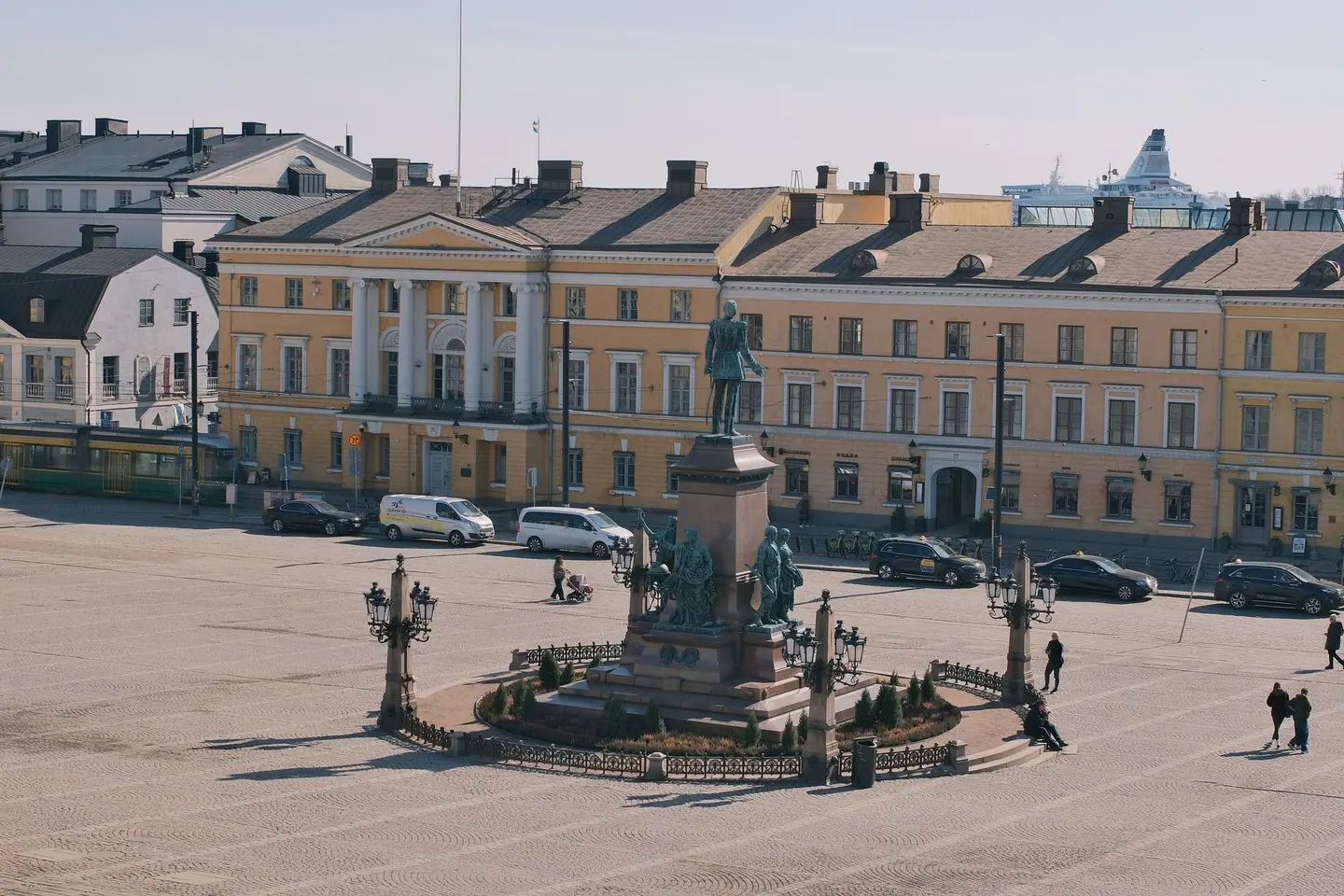
Senate Square, Helsinki Cathedral Tuomiokirkko, Government Palace, University of Helsinki Main Building, National Library of Finland Rotunda by Carl Ludvig Engel, Sederholm House (1757), Market Square Kauppatori, Old Market Hall, and Uspenski Cathedral on Katajanokka
Senate Square
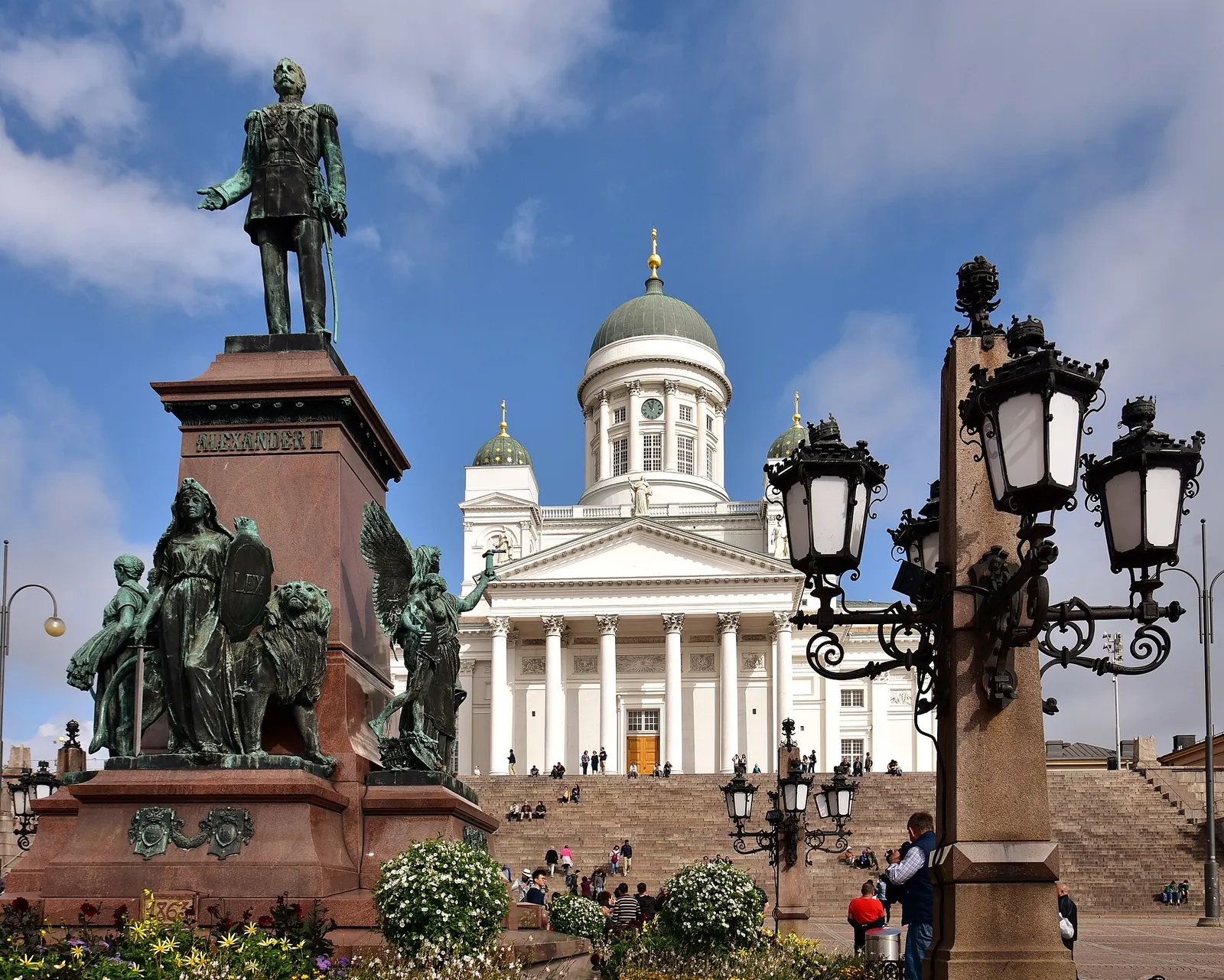
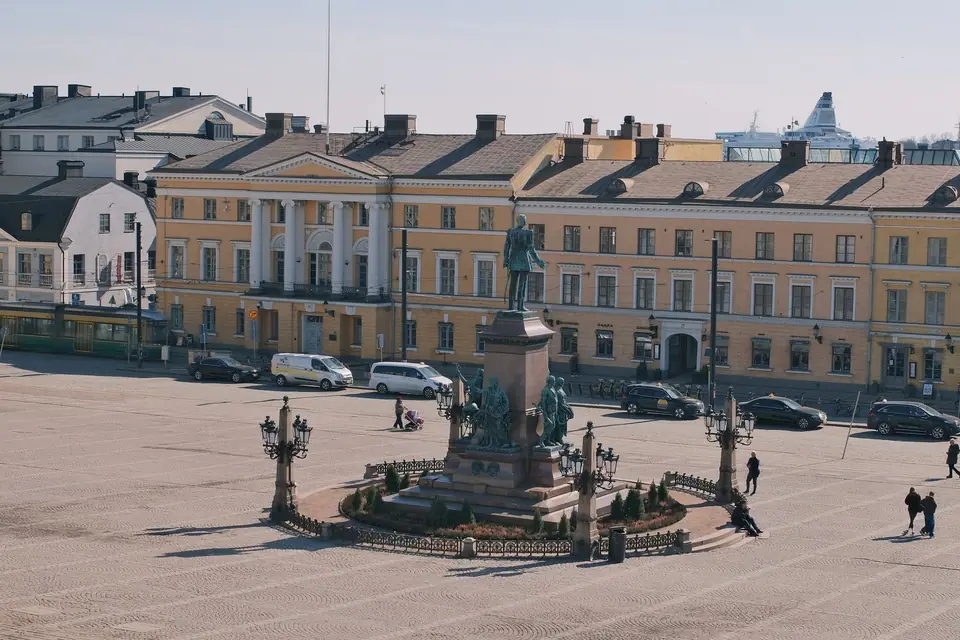
Designed in the early nineteenth century after Helsinki became the capital of the Grand Duchy of Finland, this monumental square showcases harmonious neoclassical architecture. Carl Ludvig Engel unified the precinct with matching proportions and pale yellow facades. Visitors can observe the central statue of Tsar Alexander II, erected in 1894 as a tribute to Finnish constitutional autonomy.
Helsinki Cathedral
Rising above Senate Square on a high granite plinth, this landmark church was completed in 1852 as St Nicholas Church. Engel conceived the Greek cross floor plan, while Ernst Bernhard Lohrmann later added four small corner domes and zinc statues of the Twelve Apostles on the roofline. Inside, the austere hall contains statues of Martin Luther, Philipp Melanchthon and Mikael Agricola.
Government Palace
Completed in 1822 to house the Imperial Senate of Finland, this monumental building anchors the eastern flank of Senate Square. Engel incorporated Corinthian columns and a central clock tower facing the square. It was the site of the 1904 assassination of Governor-General Nikolay Bobrikov by Finnish nationalist Eugen Schauman on the main second-floor landing.
University of Helsinki Main Building
Constructed between 1828 and 1832 to replace the university complex in Turku following a devastating fire, this stately building defines the western perimeter of the square. Engel designed its exterior with Ionic columns to counterbalance the Corinthian order of the Government Palace opposite. The interior festive hall was meticulously reconstructed following extensive bomb damage during the Second World War.
National Library of Finland
Dating to 1840, this cultural repository designed by Carl Ludvig Engel represents one of the finest public libraries in Northern Europe. The famous circular Rotunda addition, designed by Gustaf Nyström and completed in 1906, features six gallery levels supported by decorative iron columns beneath a glass dome. It holds an extensive collection of Imperial Russian prints and historic Scandinavian manuscripts.
Statue of Alexander II
Unveiled in 1894, this bronze monument by Walter Runeberg honours the Emperor who confirmed Finland's separate constitution and elevated Finnish to an official language. Alexander II is depicted wearing the uniform of a Finnish guards officer. The granite pedestal features allegorical bronze figures representing Law, Peace, Light and Labour, reflecting Finland's legal status within the Russian Empire.
Sederholm House
Built in 1757 for the wealthy merchant and shipowner Johan Sederholm, this two-storey rendered stone dwelling survived the devastating fire of 1808. Located at the corner of Senate Square and Aleksanterinkatu, it represents rare pre-Russian architecture in the city. The interior now houses Helsinki City Museum exhibitions illustrating eighteenth-century domestic trade, merchant family life and local civic history.
Bock House
Originally constructed in the 1760s for merchant Gustaf Johan Bock, this building was extensively remodelled by Carl Ludvig Engel between 1816 and 1819. Engel added a prominent balcony and triangular pediment to create a dignified residence for the Governor-General of Finland. It later served as the municipal town hall throughout the late nineteenth and early twentieth centuries.
House of the Nobility
Designed by architect Georg Theodor Chiewitz and completed in 1862, this imposing red-brick building stands just east of Senate Square. It served as the parliamentary meeting chamber for the noble estate until the electoral reform of 1906 created a unicameral parliament. The grand main hall retains heraldic shields and coats of arms representing all enrolled Finnish noble lineages.
Bank of Finland
Completed in 1883 to the neoclassical designs of German architect Ludwig Bohnstedt, this building serves as the national monetary headquarters. In the square outside stands Emil Wikström's 1923 bronze statue of Johan Vilhelm Snellman, the statesman who introduced the Finnish markka currency in 1860. The pedestal still displays bomb splinters from a Soviet air raid in February 1944.
House of the Estates
Completed in 1891 by architect Gustaf Nyström, this grand building hosted the clergy, burghers and peasants of the Diet of Finland until 1906. The facade features a colonnaded pediment adorned with Emil Wikström's bronze relief depicting Tsar Alexander I confirming Finnish rights at the Diet of Porvoo. Today, the palace hosts high-level government negotiations and state academic conferences.
Market Square Kauppatori
Bordering the South Harbour at the southern end of the Tori Quarters, this open square has served as the municipal waterfront marketplace since the early nineteenth century. Traditional stalls trade in Baltic herring, seasonal berries and craft goods directly off wooden fishing boats. The square serves as the departure point for municipal passenger ferries crossing the archipelago towards Suomenlinna fortress.
Old Market Hall
Designed by Gustaf Nyström and opened in 1889, this is the oldest indoor trading hall in Finland. The long brick structure was erected to enhance food hygiene and regulate the storage of perishables near the harbour. Today, timber merchant stalls inside offer smoked fish, reindeer charcuterie, local cheeses and rye breads beneath decorative carved ceiling trusses.
Havis Amanda
Sculpted in Paris by Ville Vallgren and erected beside Market Square in 1908, this bronze fountain portrays a sea nymph emerging from the waves. Surrounded by four spouting sea lions, the figure was intended to symbolise the rebirth of Helsinki from the Baltic Sea. The statue serves as the focal point for traditional student gatherings during the annual May Day festivities.
Tsarina's Stone
Erected in 1835 in the centre of Market Square, this monument was designed by Carl Ludvig Engel and remains the oldest public monument in Helsinki. The red granite obelisk is topped by a bronze globe and a double-headed Russian eagle. Pulled down during the Russian Revolution in 1917, the eagle was safely recovered and restored to the monument in 1971.
Helsinki City Hall
Originally designed by Carl Ludvig Engel as the Hotel Seurahuone in 1833, this building anchored the civic face of Market Square. In the 1960s, architect Aarno Ruusuvuori completely restructured the interior, creating modern modernist office spaces while preserving Engel's neoclassical colonnaded facade. The public foyer regularly hosts civic exhibitions and public council meetings overlooking the busy harbour.
Presidential Palace
Originally constructed in 1814 as a private salt merchant's residence, the property was redesigned by Engel in the 1840s to serve as the imperial palace for visiting Russian tsars. After Finnish independence, it became the official residence of the President of Finland. Today it hosts state banquets, diplomatic receptions and the annual Independence Day gala inside its preserved Hall of State.
Uspenski Cathedral
Completed in 1868 on a rocky outcrop overlooking Katajanokka, this is the largest Eastern Orthodox church in Western Europe. Designed by Russian architect Aleksei Gornostaev, it was built using red clay bricks salvaged from the ruined Bomarsund fortress in Åland. The exterior features thirteen green onion domes with gilded crosses, while the interior houses a rich collection of historic icons.
Katajanokka Casino
Completed in 1913 to designs by architect A. Nyberg, this white pavilion originally served as an exclusive officers' casino for the Imperial Russian Navy stationed in Helsinki. Following Finnish independence in 1917, the building was transferred to the Finnish Naval Officers' Association. It retains its historic ceremonial dining halls, arched windows and coastal gardens overlooking the waters of Pohjoissatama.
Luotsikatu Art Nouveau Quarter
Developed between 1898 and 1905, Luotsikatu street forms the heart of one of Europe's best-preserved Art Nouveau residential ensembles. Leading architects, including the firm Gesellius, Lindgren, Saarinen, designed distinctive apartment blocks characterised by steep gables, asymmetric oriel windows, and rough-hewn granite foundations. Facades throughout the street are ornamented with stone carvings of native Finnish flora, bears and mythological motifs.
Esplanadi, Ateneum, Central Railway Station & Kluuvi
Havis Amanda Fountain, Esplanadi Park & Kappeli, Presidential Palace, Ateneum Art Museum, Helsinki Central Railway Station by Eliel Saarinen, Kaisaniemi Botanic Garden Glasshouses, Kiasma Contemporary Art Museum, Amos Rex Lasipalatsi, and Kamppi Chapel of Silence
Havis Amanda
Sculpted in Paris by Ville Vallgren in 1906, this bronze sea nymph was unveiled at Market Square in 1908. The figure rises from water surrounded by four sea lions and spraying fish. Local university students gather here annually on May Day eve to wash and cap the statue.
Esplanadi Park
Designed by architect Carl Ludvig Engel, this central urban park opened in 1818 to connect the city centre with the harbour. Flanked by rows of linden trees, it serves as a central public walkway. Strollers encounter historic statues, outdoor seating, and regular summer musical performances.
Restaurant Kappeli
Built in 1867 to designs by Hampus Dalström, this pavilion replaced an earlier wooden pastry stall. The structure features decorative cast iron ornamentation and generous glass verandas overlooking Esplanadi Park. Inside, the walls display works by prominent Finnish artists who frequented the venue in the late nineteenth century.
Presidential Palace
Originally constructed in 1820 as a merchant house by Pehr Granstedt, the building was transformed into an imperial palace by Carl Ludvig Engel. It later became the official residence of the President of Finland. The austere neoclassical facade looks out directly over the harbour market stalls.
Ateneum Art Museum
Designed by Theodor Höijer and completed in 1887, this neo-Renaissance museum anchors Railway Square. The facade features relief medallions of famous artists and sculptures by Carl Eneas Sjöstrand. Within its galleries hangs the country's most significant collection of Golden Age paintings and historical sculptures.
Helsinki Central Railway Station
Completed in 1919, this railway terminal represents a milestone in early modern Nordic architecture. The exterior is faced with Finnish granite and dominated by a towering clock tower. Visitors immediately recognise the entrance, guarded by pairs of colossal stone figures holding spherical lamps.
Kaisaniemi Botanic Garden Glasshouses
Managed by the University of Helsinki, this scientific garden was established at its present site in 1829. The centrepiece is the Palm House, built in 1889 under the direction of architect Gustaf Nyström. Visitors wander through interconnected wrought-iron glasshouses displaying giant water lilies and desert succulents.
Kiasma Contemporary Art Museum
Designed by American architect Steven Holl, Kiasma opened in 1998 to house the national contemporary art collection. Its curved zinc-clad structure was created to intertwine natural daylight with the gallery spaces inside. The interior features sweeping ramps, quiet viewing corners, and fluid exhibition halls.
Amos Rex and Lasipalatsi
Lasipalatsi, constructed in 1936 for the planned Olympic Games, represents functionalist design with its cinema and streamlined pavilions. In 2018, the site was revitalised with the addition of the underground Amos Rex art museum. Above ground, gentle concrete domes puncture the public square, serving as popular urban climbing mounds.
Kamppi Chapel
Constructed in 2012 by K2S Architects, this minimalist chapel is situated on Narinkka Square. The windowless, curved outer shell is formed from bent spruce slats treated with pigmented wax. Inside, alder wood walls diffuse soft ceiling daylight, creating a peaceful space for quiet contemplation.
Helsinki City Hall
Carl Ludvig Engel designed this building in 1833 as the Hotel Seurahuone, an upscale social venue. It became the official City Hall in 1913, later undergoing an extensive modernist interior rebuild by Aarno Ruusuvuori in the 1960s. The classical facade overlooks Market Square, while the public lobby presents municipal exhibitions.
Statue of Johan Ludvig Runeberg
Cast by the poet's son, Walter Runeberg, this monument was erected at the centre of Esplanadi Park in 1885. The plinth is wrapped by a maiden draped in bearskin, personifying the Finnish nation holding a tablet with the national anthem. The sculpture remains an important symbol of cultural identity.
Swedish Theatre
The theatre occupies a commanding position where Mannerheimintie meets the Esplanadi. Originally built in 1866 by Nikolai Benois, the building received a streamlined functionalist facelift in 1935 directed by Eero Saarinen and Jarl Eklund. It remains the primary home for Swedish-language performing arts in the capital.
Old Student House
Designed by Axel Hampus Dalström and opened in 1870, this neo-Renaissance building served as the primary clubhouse for university students. The facade features statues from Finnish mythology, including characters from the Kalevala carved by Robert Stigell. The grand interior hall has hosted intellectual debates, political rallies, and cultural banquets for generations.
The Three Smiths Statue
Unveiled in 1932, this bronze sculpture by Felix Nylund depicts three naked blacksmiths hammering iron on an anvil. It stands in Three Smiths Square along Aleksanterinkatu, outside the Old Student House. The base still bears shrapnel damage from aerial bombing during the Second World War.
National Theatre
Built in 1902 to designs by Onni Tarjanne, this theatre was founded to promote Finnish-language dramatic arts. Constructed from native granite and soapstone, the building displays castle-like corner towers, tiled red roofs, and arched windows. It commands the northern boundary of Railway Square directly opposite the main train terminal.
Aleksis Kivi Memorial
Positioned in the middle of Railway Square facing the National Theatre, this bronze monument honours author Aleksis Kivi. Sculpted by Wäinö Aaltonen, it was dedicated in 1939 after decades of planning. The seated figure is portrayed in deep, pensive reflection above bas-reliefs illustrating scenes from his famous novel Seven Brothers.
Kluuvi Church
Erected during the early twentieth century, this brick place of worship was constructed to serve the capital's Methodist community. Tucked away on Vuorikatu, its understated entrance opens into a simple ecclesiastical hall. The church offers regular choral services and quiet prayer away from the commercial streets of Kluuvi.
Mannerheim Museum of Contemporary Railway Heritage
Laid out on reclaimed land from Kluuvinlahti bay, Railway Square functions as an open transit hub and public forum. Bordered by the Ateneum, the National Theatre, and the Central Station, it provides open views across major architectural styles. During winter, the central section frequently transforms into an outdoor ice-skating rink.
Fazer Cafe Kluuvikatu
Opened by chocolatier Karl Fazer on Kluuvikatu, this location began as a French-Russian pastry shop in 1891. The building was later transformed in 1930 with a sleek Art Deco interior designed by Gösta Juslén. Patrons enter beneath a classic neon sign to see polished marble counters, original woodwork, and glass skylights.
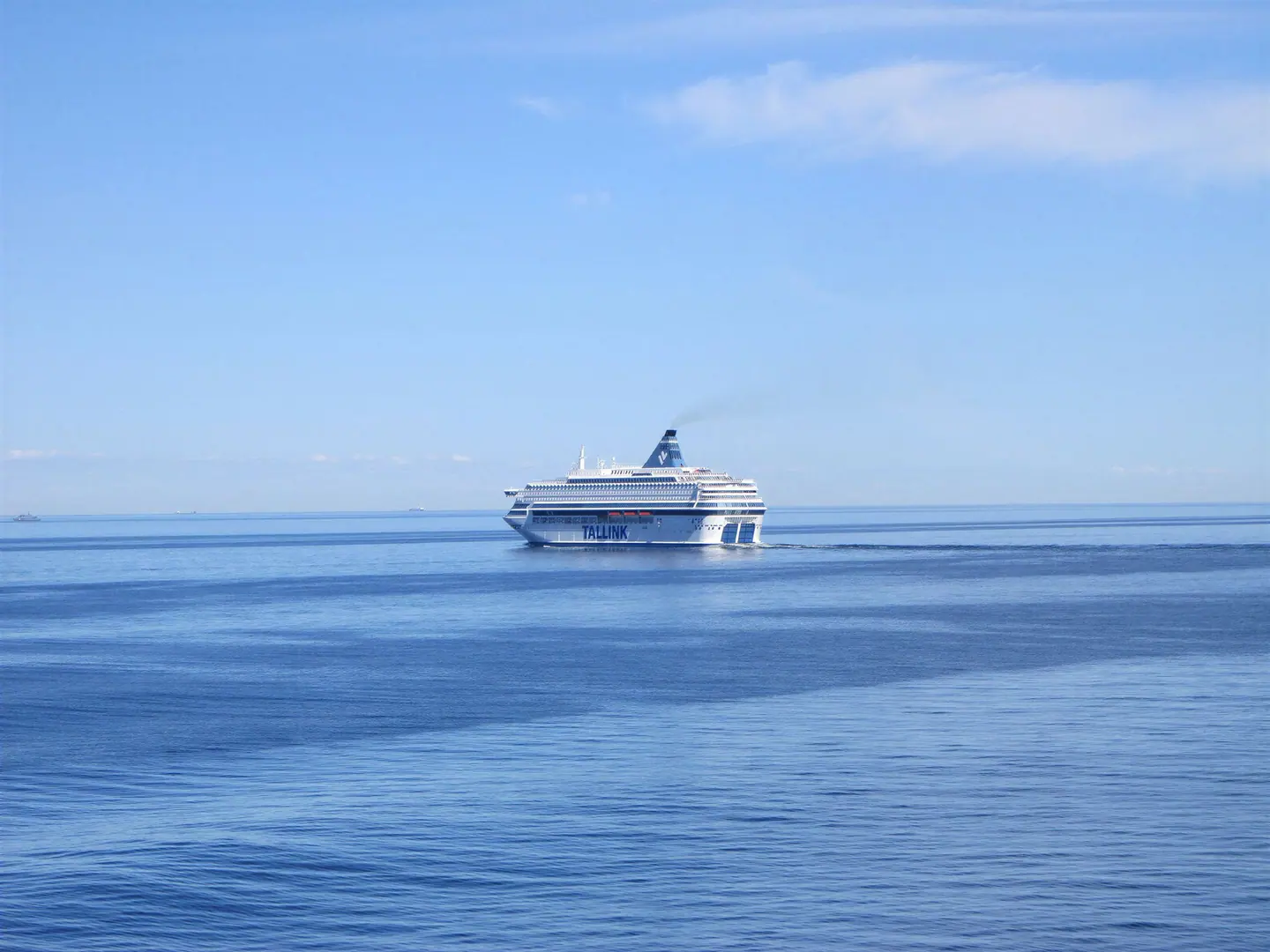
Töölönlahti Bay, Oodi Library, Rock Church & Sibelius Park
Oodi Helsinki Central Library, Musiikkitalo Music Centre, Finlandia Hall by Alvar Aalto, Parliament House Eduskuntatalo, National Museum of Finland, Temppeliaukio Rock-Cut Church, Sibelius Monument, Café Regatta, and Olympic Stadium Tower
Helsinki Central Library Oodi
Designed by the Finnish firm ALA Architects, this flagship library opened in 2018 to mark a century of Finnish independence. The building bridges traditional book lending with public workshops, reading rooms and sweeping glass balconies overlooking Kansalaistori square. Notice the curved timber bridge structure and the open upper floor bathed in natural light.
Kansalaistori
Kansalaistori, or Citizens' Square, forms the civic heart connecting Oodi, the Musiikkitalo and the contemporary art museum Kiasma. Once occupied by railway freight yards, the plaza hosts open-air gatherings, public performances and political assemblies throughout the year. Broad stone paving and wide sightlines frame the surrounding architectural monuments.
Helsinki Music Centre
Opened in 2011, the Helsinki Music Centre serves as the primary home for the Helsinki Philharmonic Orchestra and the Finnish Radio Symphony Orchestra. The subterranean vineyard-style main concert hall provides world-renowned acoustic clarity designed by Yasuhisa Toyota. The expansive glazed foyer integrates transparent communal spaces directly into the surrounding parkland.
Parliament House
Completed in 1931 by architect J.S. Siren, Eduskuntatalo stands on a granite plinth fronted by fourteen massive Corinthian columns. Built with reddish Kalvola granite, the edifice reflects both classicism and early functionalism. Inside, the circular plenary hall contains notable sculptures by Waino Aaltonen and original custom-built period furnishings.
Finlandia Hall
Conceived by Alvar Aalto as the centrepiece of an unbuilt urban plan, Finlandia Hall was inaugurated in 1971 on Töölönlahti Bay. Clad in white marble with an asymmetric acoustic tower, the venue hosted the 1975 Helsinki Accords. Look for Aalto's characteristic organic details, including curved wooden door handles, asymmetric lighting and deep cobalt interior tiles.
National Museum of Finland
Erected between 1905 and 1910 by Gesellius, Lindgren, and Saarinen, this museum resembles a medieval Finnish castle and stone church. The building charts Finland's history from prehistoric times through modern independence. Visitors entering the central foyer can look upwards to admire Akseli Gallen-Kallela's ceiling frescoes depicting scenes from the Kalevala epic.
Hakasalmi Villa
Built between 1843 and 1846 by architect E.B. Lohrmann, this elegant empire-style villa was once the summer residence of philanthropist Aurora Karamzin. Managed by the Helsinki City Museum, the property retains its historic side wings and period garden setting. It frequently stages temporary exhibitions documenting the social and visual heritage of the capital.
Hesperia Park
Stretching along the western shore of Töölönlahti Bay, Hesperia Park originated as grounds for nineteenth-century sanatoriums and villas. Today, mature horse chestnut trees line wide gravel footpaths, providing pleasant pedestrian routes between Finlandia Hall and the residential quarter. The park serves as an informal gallery for several outdoor public sculptures.
Finnish National Opera and Ballet
Inaugurated in 1993, this functionalist white opera house designed by Hyvamaki-Karhunen-Parkkinen brought major theatrical productions under one roof. The building features an expansive auditorium seating over 1,300 patrons and an amphitheatre on the bay's edge. Broad glazed foyers offer views over the water while accommodating dynamic opera and classical ballet performances.
Linnunlaulu Wooden Villas
Linnunlaulu represents a rare surviving enclave of elaborate wooden villas constructed in the late 1800s for affluent city residents. Positioned along the eastern ridge of the bay, several houses feature intricate gingerbread woodwork, decorative verandas and heritage gardens. Today, Villa Kivi among them serves as a writers' residence and cultural space.
Töölönlahti Bay
Töölönlahti Bay is a tranquil marine basin tucked directly north of Helsinki's central railway tracks. Although connected to the Baltic via a narrow culvert, the bay acts as a freshwater-like sanctuary for migrating waterfowl. A flat, popular circular walking path around the water gives travellers varied views of classic and modern architecture.
Töölö Church
Completed in 1930 and designed by Hilding Ekelund, Töölö Church stands out as a prime example of Nordic Classicism shifting toward functionalism. The simple red-brick facade, spare bell tower and restrained interior design reflect post-independence Finnish architectural tastes. Its clean sanctuary features muted tones, custom-designed brass lighting fixtures and refined plaster reliefs.
Temppeliaukio Church
Carved directly into solid granite bedrock by architects Timo and Tuomo Suomalainen in 1969, Temppeliaukio Church is an exceptional subterranean sanctuary. A domed ceiling fabricated from miles of coiled copper wire rests on radial concrete beams that admit daylight. The exposed, weeping stone walls create acoustics prized by organists and chamber ensembles.
Töölö Library
Opened in 1970 beside Topelius Park, Töölö Library is an acknowledged masterpiece of Finnish modernist public architecture. Aarne Ervi designed the structure with large sunken reading wells, minimalist suspended staircases and circular skylights reminiscent of Alvar Aalto. Its upper balconies offer quiet vantage points across the neighbouring residential tree canopies.
Sibelius Monument
Created by sculptor Eila Hiltunen and unveiled in 1967, this monument honours Finland's national composer, Jean Sibelius. The work comprises more than 600 hollow steel pipes welded into undulating wave patterns that echo soundwaves and northern pine forests. A separate bronze bust of the composer rests on a granite boulder alongside the main structure.
Sibelius Park
Named after Jean Sibelius in 1945 to celebrate his eightieth birthday, this seaside park stretches across coastal bedrock and lawns. Paved footpaths lead visitors through birch groves down toward the Gulf of Finland shoreline. It remains a tranquil refuge popular with locals seeking open waterfront views and shade beneath native birch and spruce.
Café Regatta
Occupying a wooden shed that once held fishing nets in the late nineteenth century, Café Regatta represents traditional Finnish waterside life. The building stands on rocky shoreline decorated with vintage maritime equipment, weather-worn tools and enamel signs. Visitors gather outside year-round around the open-air fire pit beside the sheltered mooring jetty.
Helsinki Olympic Stadium
Designed by Yrjo Lindegren and Toivo Jantti, this functionalist white stadium was completed in 1938 for the cancelled 1940 Games and later hosted the 1952 Olympics. Following extensive modern renovations, the stadium retains its curved facade and timber-slat upper eaves. It remains a primary venue for major athletic championships and national sporting fixtures.
Olympic Stadium Tower
Rising exactly 72.71 metres, an altitude matching the winning javelin throw of Finnish Olympian Matti Jarvinen in 1932, this slender tower anchors the stadium complex. An elevator brings travellers up to the open observation deck at the summit. The platform delivers unobstructed, 360-degree views across central Helsinki, Töölö's street grid and the Baltic archipelago.
Töölö Sports Hall
Originally known as Messuhalli, this grand arena was completed in 1935 to host exhibitions, trade fairs and sporting events. During the 1952 Olympic Games, it staged gymnastics, wrestling, boxing and weightlifting competitions. Its functionalist vaulting, grand staircases and preserved interior volumes provide an authentic window into mid-century Finnish civic athletics.
Design District, Punavuori, Ullanlinna & Kaivopuisto Coast
Design Museum & Museum of Finnish Architecture, St John’s Church Johanneksenkirkko, Huvilakatu Jugendstil Street, Eira Villa Quarter, Kaivopuisto Coastal Park, Allas Sea Pool, Löyly Wooden Sauna on Hernesaari, and Hietalahti Market Hall
Design Museum
Founded in 1873, this institution occupies an ornate neo-Gothic brick schoolhouse designed by Gustaf Nyström. The galleries document the evolution of Finnish industrial craft, ceramics, furniture and glassware through comprehensive permanent displays. Visitors can examine seminal sketches by Alvar Aalto alongside functionalist household items that defined modern Nordic living.
Museum of Finnish Architecture
Established in 1956, this museum resides in an 1899 neo-Renaissance building designed by Magnus Schjerfbeck directly behind the Design Museum. It preserves extensive architectural drawings, scale models, and photographic archives covering early wooden towns to contemporary structural innovations. Temporary exhibitions frequently explore Nordic urbanism and regional sustainable building techniques.
St John's Church
Constructed between 1888 and 1891 by Swedish architect Adolf Emil Melander, this red-brick basilica stands on a hill historically used for Midsummer bonfires. Its twin spires rise 74 metres, dominating the southern skyline of Ullanlinna. Inside, the cavernous nave seats over two thousand worshippers and features intricate wooden vaults alongside fine plaster ornaments.
Huvilakatu Street
Built during the first decade of the twentieth century, this picturesque residential street in Ullanlinna represents one of the finest ensembles of Jugendstil architecture in the capital. The multi-storey townhouses feature pastel stucco facades, turreted rooflines, and decorative bay windows. Walking along the pavement reveals intricate wrought-iron balconies and hand-carved stone doorways.
Eira Villa Quarter
Planned in 1908 by Lars Sonck, Bertel Jung and Armas Lindgren, this coastal district was conceived as an English-inspired garden suburb of private villas. The curving streets diverge from the strict grid pattern of the inner city, lined with romantic pastel-washed dwellings. Notable structures include Villa Ensi, famed for its classical reliefs and medicinal origins.
Kaivopuisto
Laid out during the 1830s around a prestigious bathing facility, this undulating landscape park remains a premier coastal recreation ground. Rolling lawns, centuries-old deciduous trees, and granite outcrops provide expansive views across the Gulf of Finland towards Suomenlinna fortress. Several historic diplomatic embassies and classic timber pavilions edge its northern borders.
Ursa Observatory
Perched on the highest bedrock point of Kaivopuisto, this compact astronomical observatory opened in 1926 for the Ursa Astronomical Association. Designed by Martti Välikangas, the yellow-brick building features a classic rotating viewing dome. Clear evenings offer public stargazing opportunities through its historic refracting telescope, overlooking the open waters of the harbour.
Allas Sea Pool
Situated directly beside Market Square, this contemporary timber marine bathing complex opened in 2016 using spruce components. The floating deck holds three basins, including a filtered seawater pool and heated freshwater swimming lanes. Visitors frequent its rooftop terraces and saunas for sweeping vistas of passing passenger ferries and classical harbour buildings.
Löyly
Designed by Avanto Architects and completed in 2016, this angular coastal pavilion is clad in heat-treated Finnish pine slats that weather to natural grey. The building incorporates traditional smoke saunas and conventional wood-heated chambers that open directly into the sea for cold plunge dips. Expansive timber terraces extend outwards over the rocky Gulf of Finland waterline.
Hietalahti Market Hall
Completed in 1903 to designs by architect Einar Flinkenberg, this red-brick market hall served the neighbouring industrial shipyards for decades. Today, the restored interior retains its original timber vendor stalls, serving seasonal produce, artisanal delicatessen goods and international lunches. During warmer months, an extensive open-air flea market fills the wide granite cobblestone square outside.
Sinebrychoff Art Museum
Housed within an 1842 neoclassical mansion built for industrialist Nikolai Sinebrychoff, this museum displays old European masters. The upper floor contains preserved period rooms furnished with Empire-style decor, fine porcelain and family portraits. Downstairs galleries showcase Dutch, Flemish and Italian paintings, including works attributed to Rembrandt and Lucas Cranach the Elder.
Mikael Agricola Church
Built between 1933 and 1935 to plans by Lars Sonck, this functionalist red-brick structure is dedicated to the reformer of the Finnish written language. The building features clean geometric lines and a 97-metre tower fitted with a famous retractable spire that could be lowered during wartime air raids. Its restrained interior contains functional furnishings and subtle decorative ironwork.
Villa Johanna
Constructed in 1906 for businessman Uno Staudinger, this grand private villa was designed by master architect Selim A. Lindqvist. The structure exemplifies the continental Art Nouveau style with asymmetric bay windows, sweeping gables, and botanical relief plasterwork. The surrounding walled garden and decorative coach houses provide an intact glimpse into early twentieth-century aristocratic life.
Villa Ensi
Completed in 1912 by architect Selim A. Lindqvist, this sculptural residence was commissioned by Uno Staudinger as a private maternity hospital. The facade features classical columns, flowing balconies, and prominent stone reliefs by sculptor Emil Wikström representing motherhood. Later converted into private apartments, the building anchors the peaceful coastal periphery of Eira.
Cygnaeus Gallery
Commissioned in 1870 by scholar Fredrik Cygnaeus as his summer residence, this romantic wooden villa is the oldest art museum building in Finland. Architect Johan Wijk designed the house in a Swiss cottage style with elaborate fretted woodwork and verandas. The collection preserves significant nineteenth-century Finnish landscape paintings and sculptures by the von Wright brothers and Walter Runeberg.
Diana Park
Officially known as Kolmikulma, this triangular public square forms the geographic heart of the Design District. The park is centred around Yrjö Liipola's 1928 bronze fountain depicting the goddess Diana hunting with her dog. Bordered by intact nineteenth-century stone apartment blocks and independent galleries, the garden offers public benches shaded by mature broadleaf trees.
Komendantintalo
Standing along Vuorimiehenkatu, this robust nineteenth-century stone edifice served key local administrative and military functions during Helsinki's expansion under the Russian Empire. The severe facade showcases classic Russian imperial stonework adapted to Nordic urban streetscapes. Today, the surrounding street retains tranquil antique shops, private design studios, and residential blocks.
Särkkä Fortress
Constructed in 1749 as an outer maritime redoubt for Suomenlinna, this fortified islet sits roughly five hundred metres off the Kaivopuisto shoreline. The stone battlements and cannon emplacements witnessed naval actions during the Crimean War before being repurposed in peace. Today, the historic garrison houses a sailing club restaurant accessible by private ferry during summer months.
Mattolaituri
Positioned along the sea promenade of Kaivopuisto, this wooden pier continues the traditional Finnish summer ritual of washing rag rugs in seawater. Rows of raised wooden drying poles and scrubbing tables stand over the water, backed by open maritime views toward Harakka Island. In summer, the adjacent seasonal pavilion attracts walkers resting along the coastal trail.
Sinebrychoff Park
Originating in the 1820s as private gardens for the Sinebrychoff family, this sloped park is among the oldest landscaped public grounds in the capital. An octagonal red-brick observation tower built in 1852 crowns the top of the hill beside the old brewery walls. Locals frequent the grassy slopes for seasonal picnics, surrounded by heritage linden trees and cobblestone footpaths.
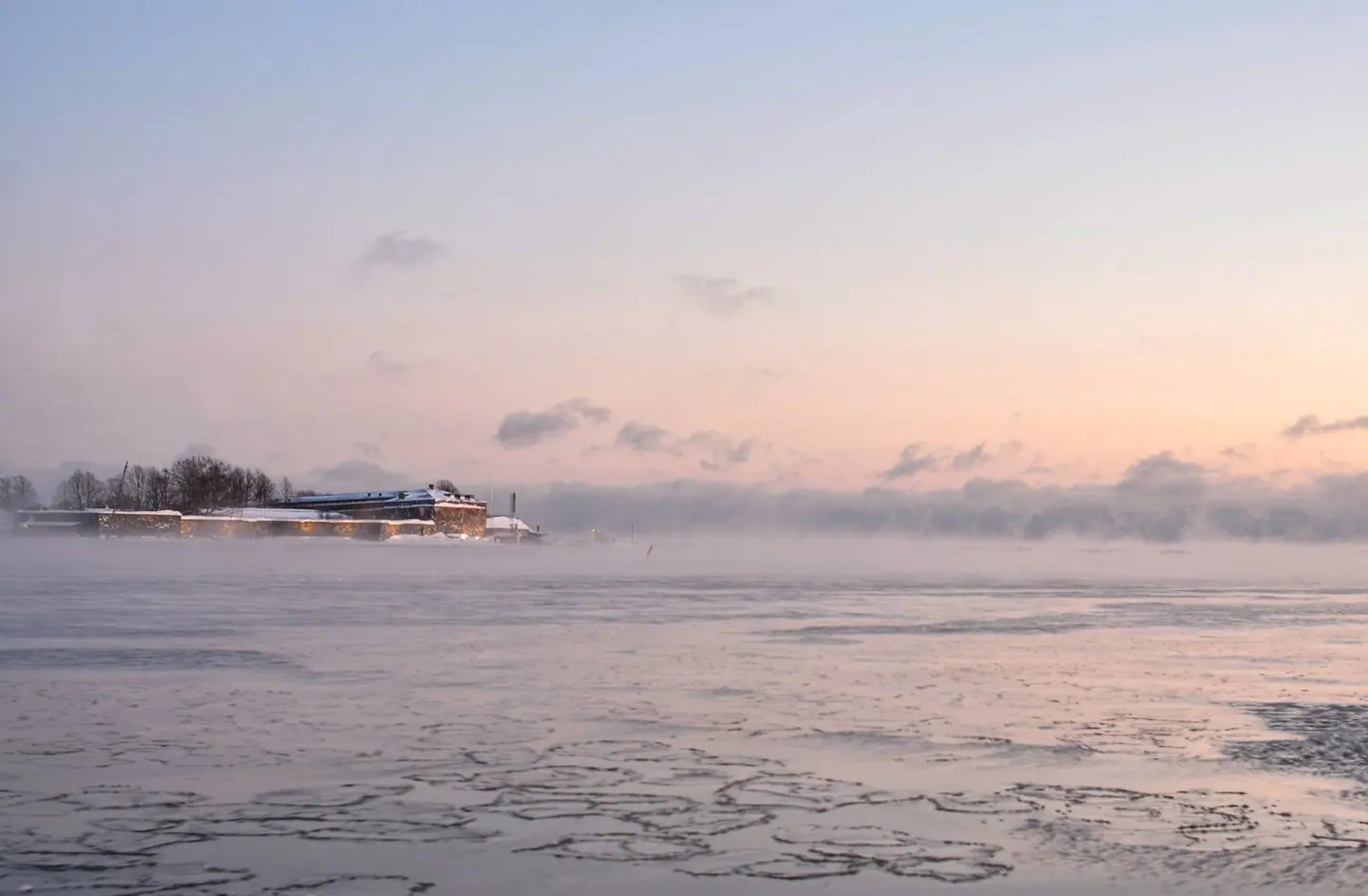
Suomenlinna UNESCO Sea Fortress, Seurasaari & Aalto House
Suomenlinna Ferry Crossing, Jetty Barracks, Great Courtyard & Ehrensvärd Tomb, Suomenlinna Dry Dock, King’s Gate Kuninkaanportti, Vesikko Submarine, Seurasaari Open-Air Museum, and The Aalto House & Studio Aalto in Munkkiniemi
Kauppatori Ferry Terminal
Located on the edge of Market Square, this quay serves as the primary embarkation point for municipal ferries crossing to Suomenlinna. The brief sea journey offers clear views of South Harbour, Katajanokka, and the outer archipelago bastions. We recommend standing on the open deck to observe the maritime approaches to the fortress island complex.
Jetty Barracks
Constructed between 1868 and 1870 under Russian rule, this curved pink building greeted ships arriving from the mainland. The vaulted ground floor once housed defensive artillery and guards, while upper floors served as military lodgings. Today, it contains a visitor centre and gallery space, retaining its thick neoclassical masonry walls.
Suomenlinna Church
Built in 1854 as an Eastern Orthodox garrison church with five onion domes, this building was heavily altered after Finnish independence in 1918. Architect Einar Sjöström stripped the Russian ornamentation, transforming it into a minimalist Lutheran church. Its steeple still operates as an active lighthouse, flashing Morse code for ships and aircraft.
Suomenlinna Great Courtyard
Completed in the 1750s, this courtyard served as the principal administrative and ceremonial centre of Sveaborg fortress. Its surrounding buildings feature baroque facades designed in perspective to make the square appear larger than it is. The area suffered heavy damage during the Crimean War bombardment but preserves its original eighteenth-century spatial arrangement.
Ehrensvärd Tomb
Positioned at the centre of the Great Courtyard, this granite monument holds the remains of Field Marshal Augustin Ehrensvärd. Designed by King Gustav III with sculptor Johan Tobias Sergel, the stone tomb was completed in 1800. Carved inscriptions on the granite slab record Ehrensvärd's lifetime dedication to fortifying the Finnish coastline against eastern invasion.
Ehrensvärd Museum
Housed in the fortress commander's official residence dating from 1756, this museum illustrates domestic life during the Swedish era. Rooms display period portraiture, weapons, Gustavian furniture, and detailed oil paintings of Sveaborg under construction. Visitors can examine original tiled stoves and personal effects belonging to Ehrensvärd and his junior officers.
Suomenlinna Dry Dock
Engineered in the 1760s by Daniel af Thunberg, this is one of the oldest functioning dry docks in Europe. The facility was designed to construct and repair shallow-draught naval galleys for the Swedish archipelago fleet. Today, craftsmen use the inner basin during winter months to restore historic wooden ships and sailing vessels.
Piper's Park
Originally planned in the eighteenth century atop the bastioned ramparts of Susisaari, this green enclave follows traditional English landscape principles. The grounds feature serpentine gravel paths, lilac bushes, and an ornamental pond formed from an old water reservoir. An early twentieth-century wooden pavilion sits on the highest rocky knoll, offering sea views across the Gulf of Finland.
Kustaanmiekka Sandbank Fortifications
Forming the southern tip of the island complex, Kustaanmiekka contains turf-covered earthen bastions built to absorb shell impacts. Late nineteenth-century Russian coastal artillery guns remain mounted along the perimeter walls, pointing out across the main shipping passage. Deep stone corridors, ammunition magazines, and dark vaulted passages run beneath the grassy embankments.
King's Gate Kuninkaanportti
Erected between 1753 and 1754, this monumental two-tier gate marks the spot where King Adolf Frederick of Sweden anchored during an inspection tour. Built with limestone from Gotland and Stockholm granite, it features ornamental columns, royal cartouches, and famous inscribed tablets. A timber drawbridge and double staircase lead directly down to the deep marine channel.
Vesikko Submarine
Launched at Turku in 1933, Vesikko served as a prototype for German Type II U-boats before joining the Finnish Navy. The vessel saw active service in the Winter and Continuation Wars, torpedoing the Soviet merchant ship Vyborg in 1941. Preserved as a museum ship, its cramped interior exhibits original torpedo tubes, diesel engines, and navigational stations.
Suomenlinna Museum
Located in the fortress inventory building, this museum provides an overview of Suomenlinna under Swedish, Russian, and independent Finnish governance. Exhibits display excavation finds, artillery tools, uniform fragments, and architectural models explaining how the bastions evolved. The permanent display also covers the harsh prisoner-of-war camp operated here following the 1918 Finnish Civil War.
Military Museum Manege
This vaulted brick structure was built in 1881 as an artillery storehouse and riding manege for the Russian imperial garrison. Today it functions as an annex of the Military Museum of Finland, displaying heavy weapons, field guns, uniforms, and armour from twentieth-century conflicts. Highlights include Finnish anti-tank guns and comprehensive displays documenting defensive tactics used against the Red Army.
Seurasaari Bridge
Constructed in 1892 following a severe autumn storm, this long wooden trestle bridge replaced earlier rowing ferry links to Seurasaari. Its white-painted railings and gentle span carry pedestrians and cyclists across the narrow sea channel. Crossing the bridge leads directly into quiet pine forests managed as an open recreation ground and ethnographic sanctuary.
Karuna Church at Seurasaari
Erected in 1685 in the parish of Karuna, this timber church is the oldest surviving structure in the Seurasaari Open-Air Museum. It was dismantled and reassembled on the island in 1912 under the guidance of ethnologist Axel Olai Heikel. The interior retains hand-hewn pews, a baroque pulpit, and an ornate shingle roof crowned by a steep ridge.
Antti Farmstead at Seurasaari
Originally built in Säkylä during the eighteenth and nineteenth centuries, this timber complex represents traditional western Finnish farm architecture. Living quarters, cowsheds, granaries, and stables join together to enclose a protective rectangular courtyard. The large common room features an open stone hearth, wooden grain vessels, spinning wheels, and built-in bunk beds where entire households lived.
Niemelä Tenant Farm at Seurasaari
Transported from Konginkangas in Central Finland in 1909, this cluster of low log buildings founded the Seurasaari museum collection. The farm includes a chimneyless smoke cabin where soot blackened the walls, alongside detached saunas, drying barns, and elevated grain stores. It illustrates the self-sufficient wilderness lifestyle of landless tenant farmers before modern agrarian reforms.
Florin Gazebo at Seurasaari
Designed in the late eighteenth century for physician Pehr Adrian Gadd, this octagonal timber summerhouse once stood in central Helsinki near Kamppi. Moved to Seurasaari in 1913, it displays rococo architectural elements including decorative cornice carvings and high arched windows. The structure provides insight into how wealthy town merchants enjoyed suburban garden life during the Gustavian period.
The Aalto House
Completed in 1936 in residential Munkkiniemi, this house served as Alvar and Aino Aalto's family home and architectural office. The building divides cleanly into a whitewashed brick studio wing and a private timber-clad domestic section facing a private garden. Inside, visitors can see built-in birch furniture, open fireplaces, and natural materials that defined Finnish functionalism.
Studio Aalto
Situated a short walk from his residence, Alvar Aalto designed this dedicated studio building in 1955 to accommodate his expanding architectural practice. The structure wraps around an amphitheatre-shaped garden courtyard where staff watched slide projections on the curved exterior wall. The high-ceilinged drafting studio features white painted brick, angled skylights, and original Artek wooden furnishings.
Archipelago Ferries and Design Streets in Helsinki
Before setting out, check local transit connections, museum booking notes and monthly weather data in our Helsinki city guide, and compare other walking itineraries.