Follow a sweeping architectural journey through the cultural enclaves, cinematic landmarks, and coastal boulevards that define Southern California's sprawling metropolis.
From Tongva Settlement and Franciscan Pueblo to Metropolis of Motion Pictures
Long before Spanish settlers founded El Pueblo de Nuestra Señora la Reina de los Ángeles in 1781, the Los Angeles basin was stewarded by the indigenous Tongva people, who established riverine settlements across the coastal plain. Transitioning from Spanish crown possession to Mexican ranchero territory, the modest agrarian settlement was formally incorporated as an American city in 1850 following the Mexican-American War. The arrival of transcontinental rail links in the late nineteenth century catalysed rapid demographic expansion, transforming the sun-drenched valley into an agricultural citrus centre and later a thriving oil boomtown.
The twentieth century reshaped Los Angeles into a global cultural capital driven by the blossoming motion picture industry and aerospace engineering. Urban growth stimulated remarkable architectural experimentation, visible in the Beaux-Arts bank halls of the Historic Core, the glamorous Art Deco movie palaces along Broadway, and the radical residential Modernism perched within the Hollywood Hills. Today, the metropolis balances sprawling coastal urbanism with the ongoing revival of its historic civic core.
El Pueblo and the Historic Downtown Core
Trace the civic origins of Southern California through Olvera Street's adobe walls, grand Beaux-Arts financial blocks, and the historic movie palaces of Broadway.
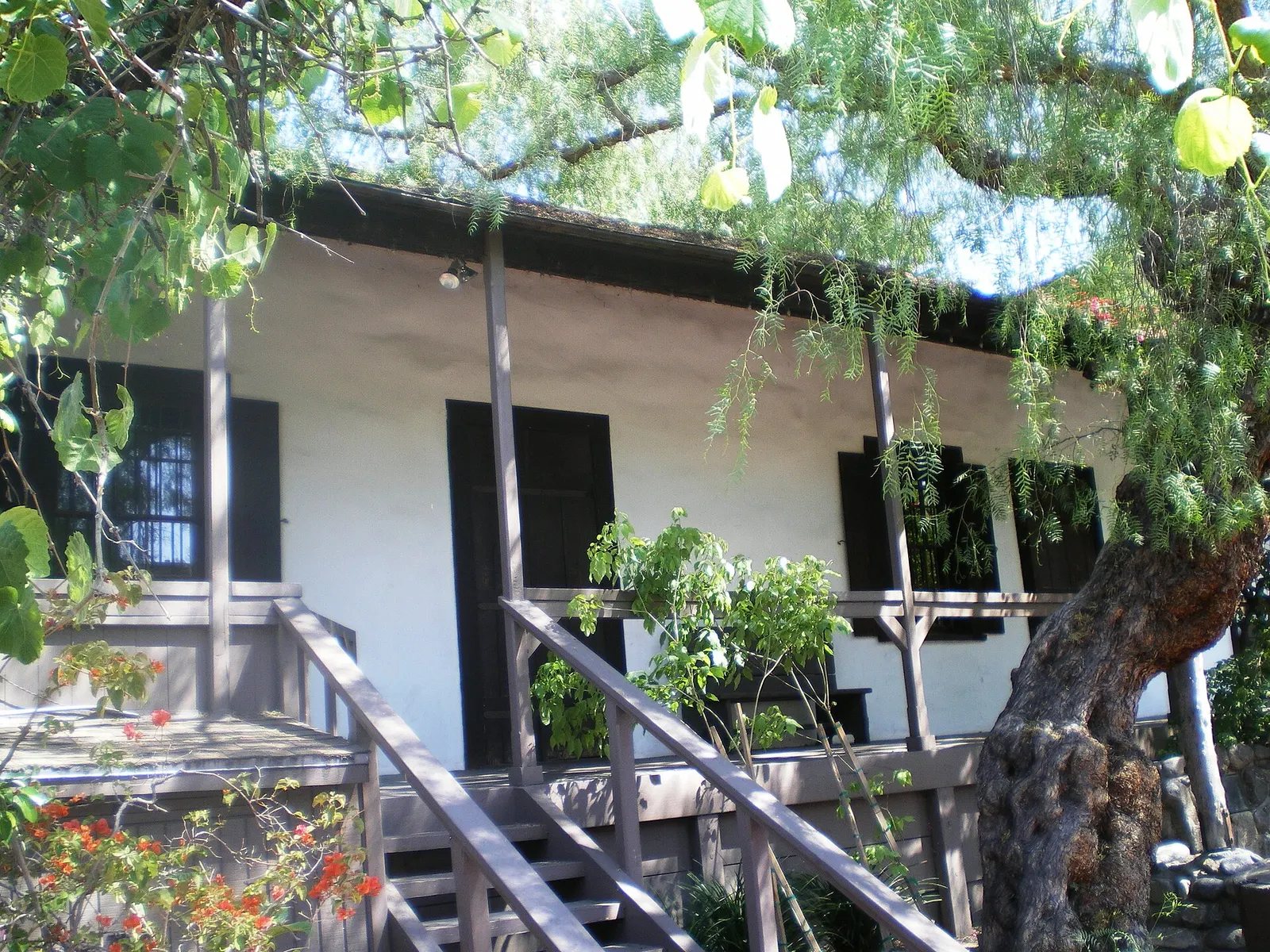
Avila Adobe
Constructed in 1818 by Francisco Avila, this single-storey home stands as a tangible link to Spanish and Mexican rule in Alta California. Built with sun-dried adobe bricks, its rooms are restored with nineteenth-century furnishings. Visitors can walk through the central courtyard to observe original construction methods and domestic artefacts from early pastoral life.
Plaza Church
Dedicated in 1822, this parish church remains one of the oldest religious structures in Southern California. Known formally as La Iglesia de Nuestra Senora Reina de los Angeles, the sanctuary features a traditional adobe core alongside a decorative bell wall added in later renovations. Inside, original devotional artwork and hand-hewn ceiling timbers illustrate Mexican provincial design.
Pico House
Commissioned by Pio Pico in 1869, this Italianate landmark was once the grandest accommodation in Southern California. The three-storey structure features an imposing stuccoed brick facade designed to resemble carved stone, surrounding a central interior courtyard. It represents the brief transitional era when Mexican rancho wealth adapted to rapid American commercial expansion.
Old Plaza Firehouse
Erected in 1884, this modest brick building served as Engine Company No. 1 during the frontier era. After decades of commercial conversion, the city restored the property to its original civic function. It now houses horse-drawn firefighting equipment, vintage helmets, and historic photographs documenting the municipal brigade during the late nineteenth century.
Sepulveda House
Dating to 1887, this dual-purpose structure demonstrates the blend of Anglo-American and Mexican cultures following the arrival of transcontinental railways. Designed with Eastlake architectural details and wooden framework, it once accommodated street-level commercial storefronts beneath boarding rooms. Today, the restored interior serves as a cultural museum documenting the social history of the neighbourhood.
Los Angeles Union Station
Completed in 1939 as the last of America's great union passenger terminals, the complex exhibits Mission Revival, Spanish Colonial, and Streamline Moderne elements. The spacious waiting room features high timber-trussed ceilings, travertine marble inlays, and custom leather seating. Courtyard patios with native flora provide passengers with a tranquil refuge outside the central concourse.
Bradbury Building
Commissioned by mining magnate Lewis Bradbury and opened in 1893, this five-storey office block masks an exceptional interior behind an understated Romanesque brownstone exterior. A massive central skylight illuminates intricate wrought-iron railings, open-cage hydraulic lifts, and polished Mexican tile walkways. Its striking vertical composition has made it an enduring landmark of American architectural innovation.
Million Dollar Theater
Opened in 1918, this cinema pioneered the concentration of entertainment venues along South Broadway. Sculptor Joseph Mora designed the flamboyant Churrigueresque terra-cotta facade, which displays allegorical figures alongside legendary Spanish explorers. The vast auditorium hosted silent film premieres before transitioning into a major venue for Latin American theatrical and musical productions.
Grand Central Market
Occupying the ground floor of the Homer Laughlin Building, this expansive market has fed city residents for over a century. The venue originally catered to households residing in nearby Victorian mansions on Bunker Hill, selling produce, meat, and dry goods. Today, historical neon signage still hangs above busy aisles filled with independent food vendors and grocers.
Angels Flight
Operating since 1901, this funicular railway was built to carry pedestrians up the steep slope of Bunker Hill. Two wooden cars, named Olivet and Sinai, counter-balance each other across a narrow incline track. Though relocated a short distance from its original position, the mechanical landmark retains its historic station archways and early-twentieth-century charm.
Los Angeles City Hall
Erected in 1928, this civic tower stood for decades as the tallest building in the city due to local height restrictions. Its architecture blends Art Deco detailing with Byzantine and Classicist forms, topped by a stepped pyramid inspired by the Mausoleum at Halicarnassus. The upper public observation deck provides expansive panoramas across the historic downtown grid.
Eastern Columbia Building
Designed by Claud Beelman and dedicated in 1930, this thirteen-storey tower served as the headquarters for two major retail furniture companies. The exterior is coated in historic turquoise terra-cotta tiles, accentuated with dark blue and gold trims. At the top, a prominent clock tower displays stylized numerals under modern, fluted decorative spires.
United Artists Theatre
Built in 1927 for the studio venture established by Chaplin, Pickford, Fairbanks, and Griffith, this building merges office spaces with an extravagant auditorium. Architect C. Howard Crane designed the auditorium in an ornate Spanish Gothic style, featuring elaborate stone plasterwork and intricate ceiling murals. The venue remains an important monument to golden-age cinema infrastructure.
Orpheum Theatre
Opened in 1926 as the fourth and final Los Angeles venue for the Orpheum vaudeville circuit, this auditorium retains exceptional decorative finishes. G. Albert Lansburgh designed the French Renaissance interior, which holds a fully operational Mighty Wurlitzer pipe organ and glittering crystal chandeliers. The venue witnessed performances by Jack Benny and Judy Garland during its early years.
Los Angeles Theatre
Constructed in 1931 for independent exhibitor H.L. Gumbiner, this cinema was patterned after the Hall of Mirrors at Versailles. Architect S. Charles Lee fitted the cavernous lobby with gold leaf, Corinthian columns, and a majestic central staircase. The opulent basement lounge was famously equipped with an innovative system of periscopes to project films into the foyer.
Title Guarantee and Trust Company Building
Finished in 1930 by the Parkinsons firm, this tower exemplifies late Art Deco and Zigzag Moderne design. The exterior features glazed terra-cotta pilasters terminating in dramatic gothic-style pinnacles. The building lobby contains historic narrative murals painted by Hugo Ballin, illustrating scenes of construction, banking, and settlement throughout early California history.
Pershing Square
Designated as La Plaza Abaja in early municipal maps, this open space developed into the financial centre's primary gathering square. Named after General John J. Pershing in 1918, it has undergone several dramatic redesigns, including a notable Postmodern overhaul by Ricardo Legorreta. It continues to host public memorials, historic statues, and community assemblies amidst high-rise facades.
Richard J. Riordan Central Library
Architect Bertram Goodhue designed this 1926 building, topping it with a mosaic pyramid and torch signifying the light of learning. Inside the central rotunda, expansive murals by Dean Cornwell depict foundational eras in California history. The library complex integrates historic reading rooms, modern additions, and sunken garden terraces into a singular scholarly precinct.
Biltmore Hotel
When completed in 1923 by Schultze and Weaver, this hotel stood as the largest facility of its kind west of Chicago. The interior corridors present an amalgam of Spanish Renaissance, Mediterranean, and Italian styles, highlighted by ceiling frescoes by Giovanni Smeraldi. The property notably hosted several early Academy Awards banquets within its storied ballrooms.
Cathedral of Saint Vibiana
Consecrated in 1876, this historic cathedral served as the seat of the Los Angeles Roman Catholic archdiocese for over a century. Designed by architect Ezra F. Kysor, the facade reflects Italian baroque models, including a tall bell tower that long dominated the skyline. Now converted into an arts centre, the restored hall maintains its lofty classical interior.
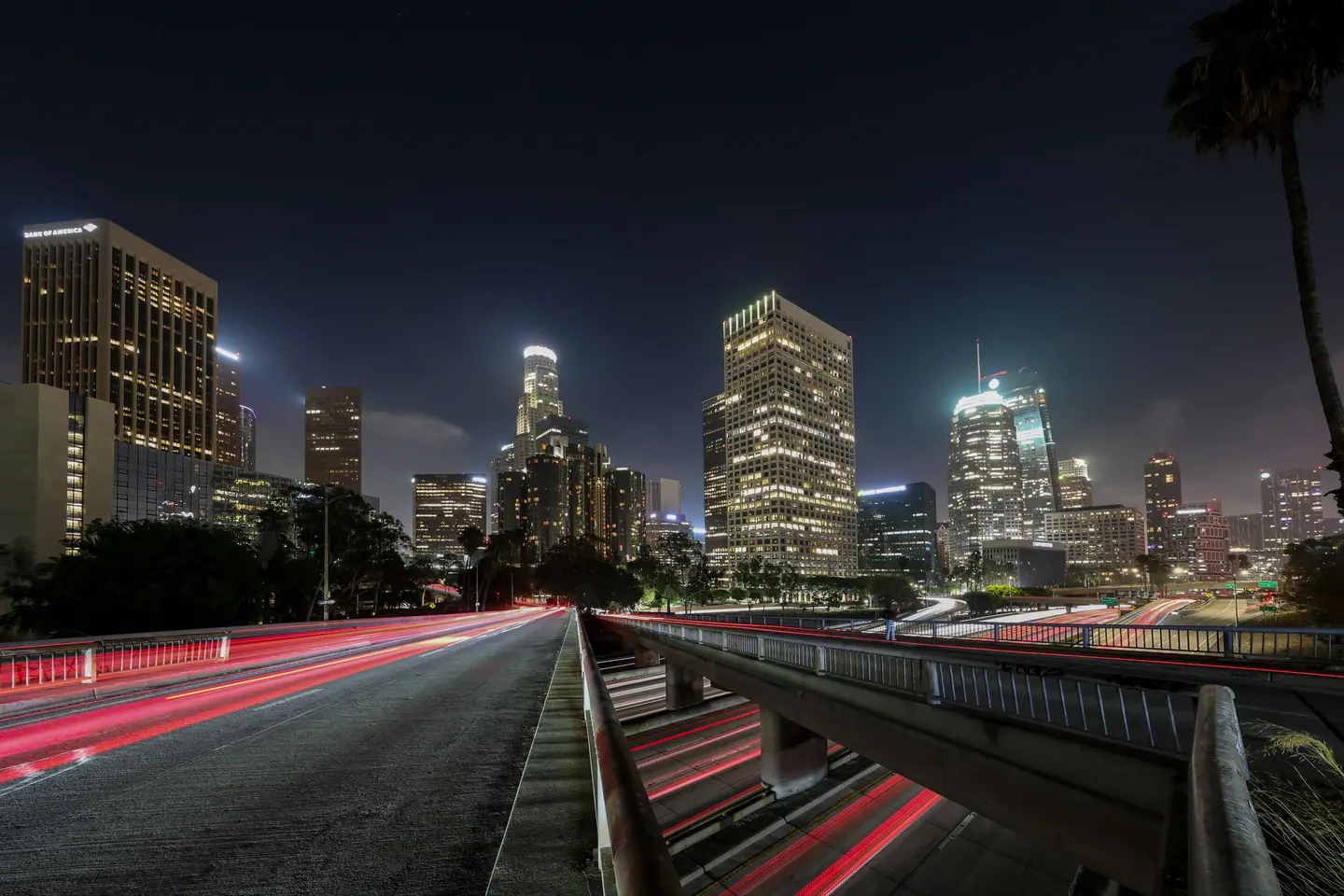
Bunker Hill and the Grand Avenue Cultural Corridor
Ascend this transformed civic plateau where Frank Gehry's stainless-steel concert hall sits alongside modernist civic institutions and contemporary art galleries.
Walt Disney Concert Hall
Opened in 2003 as the home of the Los Angeles Philharmonic, this concert venue features sweeping sculptural steel panels that reflect daylight across Grand Avenue. Inside, the vineyard style auditorium offers exceptional acoustics centred around a striking pipe organ. Public access extends to an elevated garden terrace that incorporates ceramic mosaic fountains.
The Broad
Founded by philanthropists Eli and Edythe Broad, this museum opened in 2015 to house an extensive postwar and contemporary art collection. Designed by Diller Scofidio + Renfro, the building employs a veil and vault architectural concept that filters natural light directly into the third floor galleries. Visitors encounter major works by Jean Michel Basquiat, Jeff Koons, and Yayoi Kusama.
Museum of Contemporary Art, Los Angeles
Established in 1979, the main Grand Avenue branch of this institution was designed by Japanese architect Arata Isozaki and completed in 1986. The structure descends below street level, defined by pyramid skylights and geometric red sandstone cladding that contrasts with surrounding office towers. The permanent collection focuses on artwork produced from 1940 to the present day.
Dorothy Chandler Pavilion
Inaugurated in 1964 as the flagship venue of the Los Angeles Music Centre, this theatre was designed by Welton Becket and Associates. The building hosted numerous Academy Awards ceremonies between 1969 and 1999, featuring interior spaces adorned with curved crystal chandeliers and travertine walls. Today it serves as the permanent performance base for the Los Angeles Opera.
Mark Taper Forum
Also designed by Welton Becket, this intimate circular playhouse opened in 1967 as part of the original Music Centre master plan. The exterior features a cast stone relief frieze created by Jacques Overhoff wrapping around the perimeter of the drum. Inside, a thrust stage brings audiences into close proximity with new theatrical productions.
Ahmanson Theatre
Completing the northern edge of the Music Centre complex, the Ahmanson opened in 1967 and underwent an extensive interior renovation in the mid 1990s. The austere travertine facade matches the neighbouring cultural buildings while fronting an expansive auditorium with configurable seating capacities. It primarily stages large scale dramatic works and musical theatre tours throughout the year.
Cathedral of Our Lady of the Angels
Consecrated in 2002 to replace the earthquake damaged Cathedral of Saint Vibiana, this massive seat of the archdiocese was designed by Spanish architect Rafael Moneo. The building employs acute angles and uses Spanish alabaster window panels instead of stained glass to diffuse warm daylight inside the nave. Bronze entrance doors by Robert Graham depict historic religious imagery.
Grand Park
Spanning twelve acres across Bunker Hill, this civic park opened in 2012, cascading down a series of pedestrian terraces. The layout incorporates drought tolerant botanical plantings from Mediterranean climate zones alongside lawns and shaded walking paths. At the upper terrace, the historic 1960 Arthur J. Will Memorial Fountain features an interactive splash pad and illuminated evening water displays.
Angels Flight
Constructed in 1901 and relocated half a block south in 1996, this narrow gauge funicular connects Hill Street with the upper level of California Plaza. The two wooden cars, named Sinai and Olivet, climb a 33 percent gradient along a 91 metre track. It provides an operational link to the district's late Victorian transit infrastructure.
Grand Central Market
Occupying the ground floor of the 1897 Homer Laughlin Building at the eastern foot of Bunker Hill, this market has traded continuously for over a century. The open plan hall preserves historic neon signs, tiled columns, and concrete floors beneath buzzing ceiling fans. Stalls present a range of heritage grocers and newer independent culinary counters reflecting urban food traditions.
Bradbury Building
Commissioned by mining tycoon Lewis L. Bradbury and completed in 1893 by draftsman George Wyman, this Romanesque revival exterior conceals an interior Victorian court. Natural light floods through an expansive glass ceiling onto delicate wrought iron railings, glazed bricks, and open cage birdcage lifts. Visitors can enter the lobby level to inspect the woodwork and marble staircases.
Los Angeles Central Library
Designed by architect Bertram Goodhue and completed in 1926, this municipal landmark fuses ancient Egyptian and Mediterranean architectural motifs. The central rotunda displays painted murals by Dean Cornwell that depict four major eras of Californian history. The adjacent Maguire Gardens feature limestone sculptures and fountains alongside the modern 1993 Tom Bradley Wing.
Wells Fargo History Museum, Los Angeles
Located within the Wells Fargo Center on Grand Avenue, this corporate museum illustrates early California transport and banking history. The centrepiece is an original Concord stagecoach used across western territories during the nineteenth century. Archival photographs, gold mining equipment, and historic telegraph instruments provide context on pioneer communication networks.
California Plaza Watercourt
Engineered as part of the late twentieth-century redevelopment of Bunker Hill, this sunken public plaza sits between two commercial towers. The space features stepped seating surrounding an artificial lake with programmable fountains that shoot water plumes to music. During warmer months, the venue frequently hosts free open air concerts, dance recitals, and cultural festivals.
One Bunker Hill
Originally known as the Southern California Edison Company Building, this fourteen-storey tower was among the earliest fully air conditioned buildings in the region. Architect Allison and Allison used limestone and granite with Art Deco reliefs celebrating energy generation. The two-storey lobby features a painted ceiling mural by Hugo Ballin, accompanied by polished marble walls.
Los Angeles City Hall
Completed in 1928, this municipal headquarters remained the tallest building in Los Angeles until 1964. Designed by John Parkinson, John C. Austin, and Albert C. Martin, its distinctive stepped pyramid cap was inspired by the Mausoleum at Halicarnassus. The twenty-seventh floor observation level provides panoramic vistas looking westward up the rise of Bunker Hill.
Gloria Molina Grand Park Olive Court
Situated midway down the Grand Park pedestrian slope between Hill Street and Broadway, Olive Court acts as a botanical breathing space. Shaded benches sit beneath mature olive trees salvaged and replanted during civic renovations. The plaza offers sightlines towards both the historic county courthouse above and the stepped tower of City Hall below.
The Colburn School
Positioned directly opposite the Museum of Contemporary Art, this dedicated music and dance academy completed its Grand Avenue campus in 1998. The facility, designed by Hardy Holzman Pfeiffer Associates, includes the four hundred seat Herbert Zipper Concert Hall known for clear chamber music acoustics. Public masterclasses and student recitals take place regularly within its brick clad complex.
Clara Shortridge Foltz Criminal Justice Center
Opened in 1972, this massive nineteen-storey municipal building handles criminal proceedings for the Los Angeles County court system. Constructed in a stark Brutalist idiom with vertical concrete louvres, it commands the eastern approach up Bunker Hill. In 2002, county supervisors renamed the facility to commemorate Clara Shortridge Foltz, a pioneering legal reformer.
General Thaddeus Kosciuszko Monument
Positioned along the pedestrian perimeter near the Music Centre plaza, this bronze monument honours Polish military leader Thaddeus Kosciuszko, who served in the Continental Army. Installed in the late twentieth century, the sculpture portrays the general in full eighteenth-century military uniform. The stone plinth details his fortification work at West Point and Saratoga.
Silver Lake, Echo Park and Victorian Angelino Heights
Wander through rolling hillside staircases framed by ornate Queen Anne estates, bohemian boutiques, and historic mid-century modernist bungalows.
Carroll Avenue
Forming the core of the Angelino Heights Historic Preservation Overlay Zone, this street retains one of the highest concentrations of Queen Anne and Eastlake residences in the western United States. The thoroughfare features ornate gingerbread millwork, wraparound porches, and heritage street lamps installed by civic conservationists.
Sessions House
Constructed in 1888 for dairyman Charles Sessions, this elaborate residence showcases patterned shingles, prominent gables, and decorative woodwork typical of Joseph Cather Newsom. The house serves as a primary exemplar of the extravagant domestic styling that defined late-nineteenth-century suburban Los Angeles.
Innes House
Built around 1887 for local city councilman Daniel Innes, this landmark structure exhibits a tall corner tower, complex rooflines, and original stained glass. Visitors frequently examine its distinctive spindle-work, which achieved broader recognition through various television and film productions over recent decades.
Echo Park Lake
Originally developed in 1868 as a drinking water reservoir, this public basin was redesigned into an urban leisure ground during the 1890s. The site features dense beds of sacred lotus, a historic boathouse, and an arched stone bridge leading to Lady of the Lake, an Art Deco statue.
Angelus Temple
Dedicated in 1923 by evangelist Aimee Semple McPherson, this monumental church was constructed without interior support columns to allow unobstructed views of the stage. Its enormous concrete dome and Classical Revival facade established the building as a pioneering centre for modern radio broadcasting and charismatic religious gatherings.
Neutra VDL Studio and Residences
Designed by Richard Neutra in 1932 and reconstructed with his son Dion after a 1963 fire, this glass-and-steel building demonstrates modernist integration of interior and outdoor spaces. The property features rooftop reflecting pools, automated louvres, and careful landscaping tailored to the microclimate beside the Silver Lake Reservoir.
Silver Lake Reservoir
Named after Water Commissioner Herman Silver and constructed in 1907 by William Mulholland, this dual-basin reservoir historically formed a key link in the municipal water system. Today, the water body is surrounded by a walking perimeter that provides broad views over hillside modernist architecture and eucalyptus groves.
Music Box Steps
Connecting Vendome Street with Descanso Drive, this 133-step public staircase served as the filming location for the 1932 Laurel and Hardy comedy The Music Box. A commemorative plaque and street sign mark the base, celebrating its role in early Hollywood slapstick history and civic pedestrian infrastructure.
Elysian Park
Founded in 1886 by city ordinance, this sprawling hillside reserve represents the first major municipal park established in Los Angeles. The park offers extensive network trails, historic groves of rare palms, and strategic lookout points overlooking the Los Angeles River basin and the downtown skyline.
Barlow Respiratory Hospital
Founded in 1902 by Dr W. Jarvis Barlow as a tuberculosis sanatorium, this healthcare campus preserves numerous historic Craftsman cottages and administrative halls. The wooded grounds reflect early-twentieth-century medical philosophies that prioritised open-air recovery, natural elevation, and shaded parkland settings for patient recuperation.
Jensen's Recreation Center
Built in 1924 by German immigrant Henry Jensen, this commercial block originally housed a bowling alley, billiard saloon, and local retail stores. The building is distinguished by its rooftop incandescent sign depicting a bowler delivering a strike, which remains an established neighbourhood landmark along Sunset Boulevard.
Canfield-Moreno Estate
Commissioned in 1923 by oil heiress Daisy Canfield and silent film actor Antonio Moreno, this sprawling estate was designed by architect Robert D. Farquhar. The complex includes grand courtyards, terraces, and loggias that later served as a convent and boarding school before returning to private cultural ownership.
Chavez Ravine Arboretum
Established in 1893 by the Los Angeles Horticultural Society, this public arboretum protects more than one thousand specimens, including early plantings of cape chestnut, kauri, and tipu trees. It remains the oldest municipal botanical collection in Southern California, retaining deep canopies across rolling hillside meadows.
Mattachine Steps
Ascending the slope between Cove Avenue and Angus Street, this concrete hillside stairway was dedicated in 2012 to honour the Mattachine Society, founded nearby in 1950 by Harry Hay. The steps commemorate the nation's earliest ongoing gay rights organisation, which met in residences scattered across these steep ridges.
Holloway House
Dating to the late 1880s on Carroll Avenue, this house displays the geometric incisions and turned spindle-work central to the Eastlake design movement. The building survived several twentieth-century redevelopment waves, standing today as a testament to local grassroots neighbourhood restoration efforts started in the late 1960s.
Bungalow Heaven
Dotted along the winding streets near Bellevue Park, these low-profile timber houses emerged during the Craftsman boom between 1910 and 1925. Characterised by wide eaves, cobblestone piers, and clinker brick chimneys, they illustrate the transition of Silver Lake from rural ranchland into an artistic residential district.
Bellevue Recreation Center
Developed as a public park during the mid-twentieth century, this green open space borders the convergence of Silver Lake and East Hollywood. The park preserves open lawns, broad athletic grounds, and views of the surrounding hillsides that grew rapidly after the introduction of regional red-car transit routes.
Foy House
Constructed in 1872 on Figueroa Street and moved to Witmer Street in 1993, this two-storey Italianate residence was the home of Mary Foy, the city's first woman head librarian. It exhibits overhanging eaves, ornate decorative brackets, and tall double-hung windows, making it one of the oldest residential structures standing in the city.
Silvertop
Constructed between 1956 and 1963 for industrialist Kenneth Reiner, this residential achievement showcases John Lautner's engineering genius with a massive monolithic arched concrete roof. The house features curved glass walls and innovative mechanical systems that frame broad panoramas across the Silver Lake Reservoir and surrounding mountains.
Chavez Ravine
Originally home to self-sustaining Mexican-American communities including La Loma, Palo Verde, and Bishop, this geographic canyon was cleared during the 1950s for public housing that was never built. Today, the surrounding hillsides and roads retain remnants of earlier topography, memorialising the layered urban transformations of modern Los Angeles.
Hollywood Boulevard and the Foothill Enclaves
Encounter golden-age cinema monuments, historic recording studios, and hillside outlooks offering panoramas over the vast metropolitan basin.
TCL Chinese Theatre
Opened in 1927 by showman Sid Grauman, this movie palace displays exotic revival architecture featuring temple bells, pagoda roofs, and stone heavenly dogs imported from China. The forecourt contains concrete slabs bearing signatures, footprints, and handprints of legendary screen performers. Inside, the massive auditorium retains ornate dragon motifs and elaborate gilded carvings.
Hollywood Walk of Fame
Conceived in the 1950s to maintain civic pride, this public monument spans fifteen blocks along the boulevard. More than 2,700 terrazzo and brass stars honour key figures from motion pictures, television, recording, radio, and live theatre. Walking along the pavements reveals decades of entertainment history embedded directly into the city centre streets.
El Capitan Theatre
Architect G. Albert Lansburgh designed this 1926 theatre with a Spanish Colonial Revival exterior and an opulent East Indian interior. Originally a venue for live dramatic productions, the building underwent extensive restoration in the 1990s to revive its original plaster mouldings and gilded proscenium arch. The auditorium houses a historic 1929 Wurlitzer pipe organ.
Egyptian Theatre
Built in 1922 during the global frenzy surrounding King Tutankhamun's tomb, this landmark hosted the first Hollywood film premiere, Robin Hood. Visitors pass through an open-air courtyard lined with massive columns decorated with carved hieroglyphs and colourful scarab motifs. Restored cinema programmes run regularly within the theatre's historic Egyptian-inspired auditorium.
Capitol Records Building
Welton Becket and Associates designed this 1956 tower, celebrated as the world's first circular office building. Its cylindrical concrete structure incorporates wide sun shades that give the impression of stacked vinyl records beneath a towering spire. The spire's beacon blinks out the word 'Hollywood' in Morse code continuously across the city skyline.
Hollywood Roosevelt Hotel
Opened in 1927, this twelve-storey establishment hosted the first Academy Awards banquet inside its Blossom Ballroom in 1929. The grand lobby showcases arched corridors, wrought-iron chandeliers, and original hand-painted ceiling tiles evocative of early California Spanish revival style. The poolside patio features an underwater mural painted by artist David Hockney.
Hollywood Bowl
Since 1922, this outdoor amphitheatre has staged symphonic concerts and popular music beneath the Hollywood Hills. The famous concentric acoustic shell, designed in its classic form by Frank Lloyd Wright's son Lloyd Wright, frames performers against the darkened slopes. Visitors can examine historic programmes, photographs, and audio recordings inside the on-site Hollywood Bowl Museum.
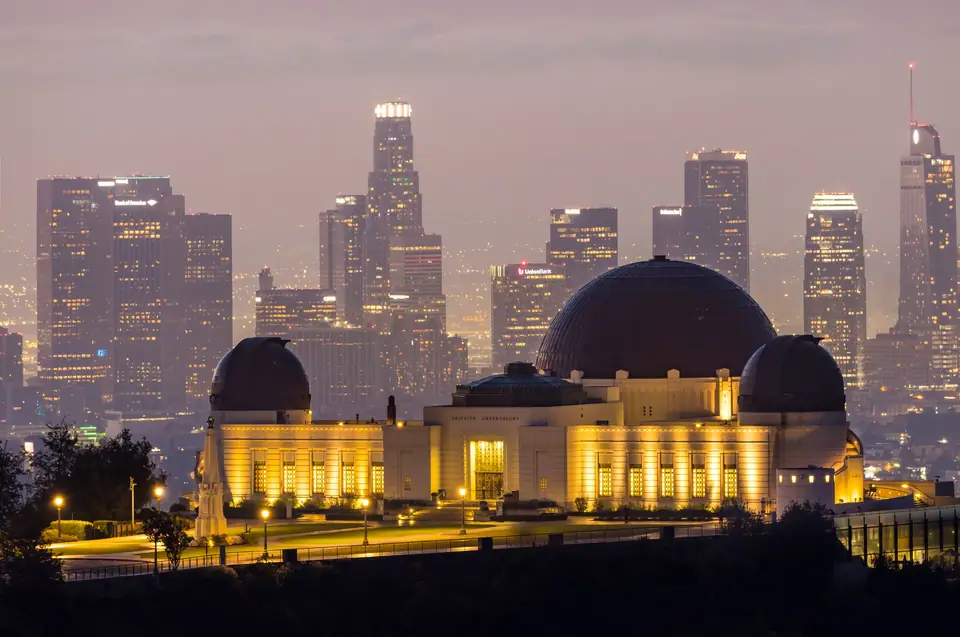
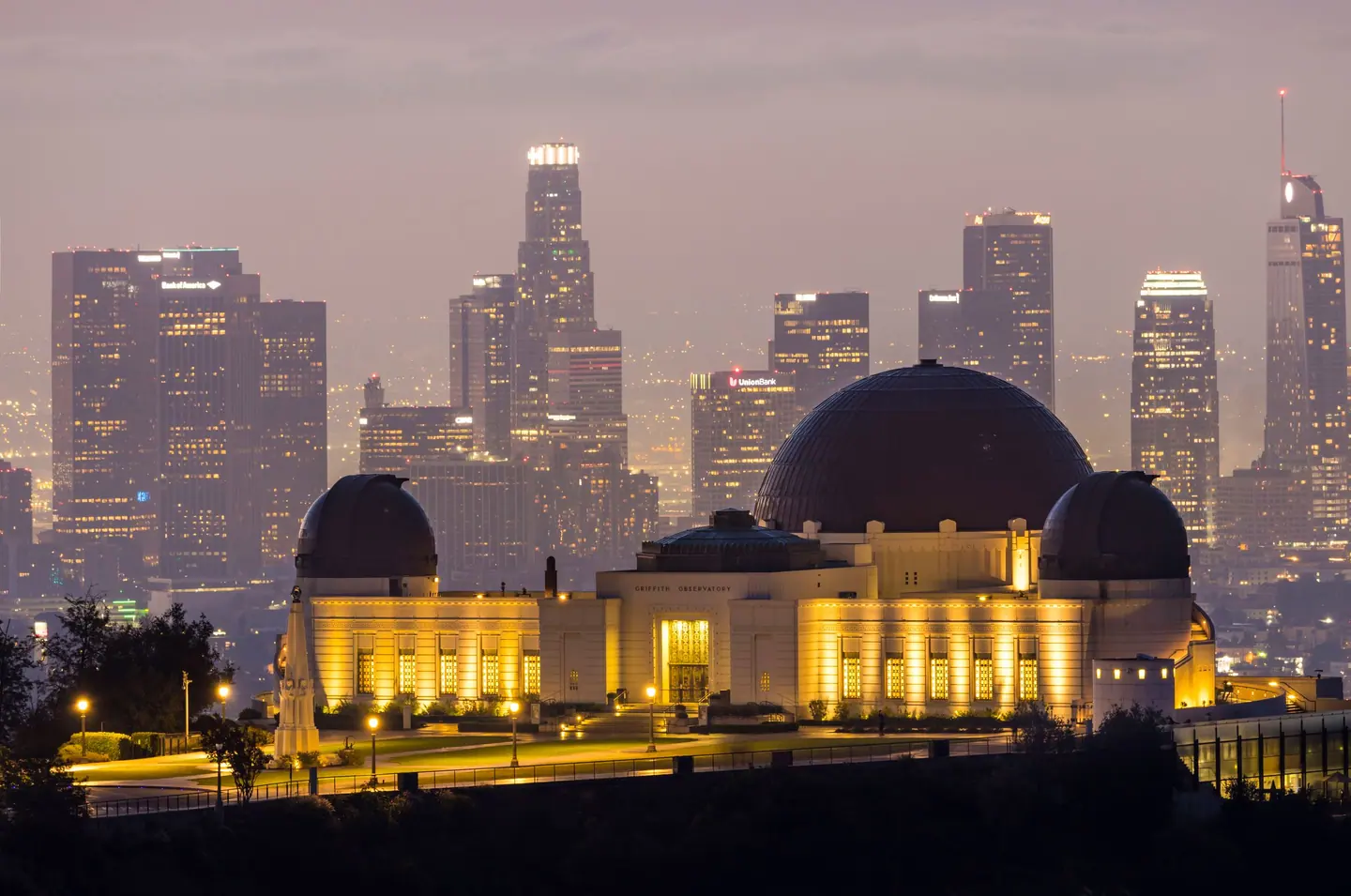
Griffith Observatory
Completed in 1935 on the south-facing slope of Mount Hollywood, this public astronomy centre combines Art Deco and Beaux-Arts architecture. The central rotunda features colourful Hugo Ballin ceiling murals depicting celestial mythologies, while working telescopes occupy the copper domes. The exterior terraces present sweeping vistas spanning the city basin to the Pacific Ocean.
Hollywood Sign
Erected in 1923 as an advertisement for the 'Hollywoodland' suburban housing development, these 13-metre-tall steel letters stand atop Mount Lee. The sign became a permanent municipal symbol after the Los Angeles City Council and civic leaders preserved it in 1949. Hillside lookouts and hiking trails through Griffith Park offer unobstructed vantage points of the monument.
Barnsdall Art Park
Oil heiress Aline Barnsdall donated this hill to the city, creating an arts complex surrounded by olive groves. The property centres on Hollyhock House, completed by Frank Lloyd Wright in 1921 using textured Mayan Revival concrete textile blocks. Walking the perimeter gardens offers clear views of both downtown Los Angeles and the neighbouring foothills.
Pantages Theatre
Architect B. Marcus Priteca built this magnificent Art Deco theatre in 1930 for vaudeville circuit operator Alexander Pantages. The expansive auditorium displays zigzag plaster patterns, bronze fixtures, and an elaborate gold-leaf ceiling evoking a celestial sunburst. It hosted the Academy Awards ceremonies throughout the 1950s and now stages touring Broadway musicals.
Hollywood Forever Cemetery
Founded in 1899 along Santa Monica Boulevard, this landscaped necropolis contains monuments dedicated to cinema founders, including Cecil B. DeMille and Rudolph Valentino. The grounds feature elaborate family mausoleums, sweeping lawns, and an artificial lake inhabited by black swans. During summer evenings, film retrospectives project directly onto the marble exterior of the Cathedral Mausoleum.
Yamashiro Historic District
Completed in 1914 by the Bernheimer brothers to house Asian art collections, this hilltop estate replicates a palace from Kyoto's Yamashiro mountains. The complex features tiered pagoda roofs, carved cedar screens, and tranquil courtyard gardens containing koi ponds. Positioned above the boulevard, the promontory provides sweeping vistas across the residential flats below.
High Tower Court
Constructed in 1920, this five-storey concrete lift tower resembles a medieval Italian campanile and serves a hillside enclave accessible only by footpaths. Residents of the surrounding Streamline Moderne and Spanish Revival cottages use the private elevator to bypass steep outdoor stairways. The secluded neighbourhood has appeared in numerous classic film noir productions.
Hollywood Heritage Museum
Known as the Lasky-DeMille Barn, this 1895 wooden stable served in 1913 as the shooting location for The Squaw Man, Hollywood's first full-length feature film. Relocated to its present site opposite the Hollywood Bowl, the structure now houses archival film props, historical documents, and early cinematography equipment. It operates under the stewardship of Hollywood Heritage preservationists.
First Presbyterian Church of Hollywood
Designed by architect H.M. Patterson and completed in 1923, this grand Gothic Revival church served as a civic sanctuary during Hollywood's rapid interwar growth. The structure exhibits pointed arches, stone traceries, and stained-glass windows commemorating community leaders. Its distinguished music programme has provided choir members and instrumentalists to adjacent recording and broadcasting studios for generations.
Max Factor Building
Cosmetics pioneer Max Factor commissioned architect S. Charles Lee to remodel this 1935 building into an Art Deco temple of makeup. Inside, custom consultation salons were colour-coded to complement distinct hair tones of actresses, including Jean Harlow and Lucille Ball. The structure now houses the Hollywood Museum, displaying costumes, movie props, and vintage cosmetic kits.
Mulholland Drive Scenic Overlook
Engineered in 1924 by water chief William Mulholland, this ridgeline road winds along the crest of the Santa Monica Mountains. The Hollywood Bowl Overlook provides open views across the natural amphitheatre below, downtown skyscrapers, and distant ocean fog. Interpretive plaques describe the engineering milestones that allowed Los Angeles to expand into neighbouring valleys.
Runyon Canyon Park
Covering 160 acres of chaparral on the southern slopes of the mountains, this open park was once the private retreat of singer John McCormack. Unpaved fire roads ascend to Clouds Rest and Indian Rock, giving walkers comprehensive views over the Los Angeles basin. Remnants of former estate foundations and cactus gardens are visible along the lower loop.
Hollywood Masonic Temple
Architect John C. Austin completed this Classical Revival lodge in 1922 for the local Freemasons, incorporating Corinthian columns and rusticated street-level masonry. The building contained multiple gathering halls, ballrooms, and a billiard room that served the early film community's social gatherings. Today, the adapted historic interior houses production studios and hosts late-night television broadcasts.
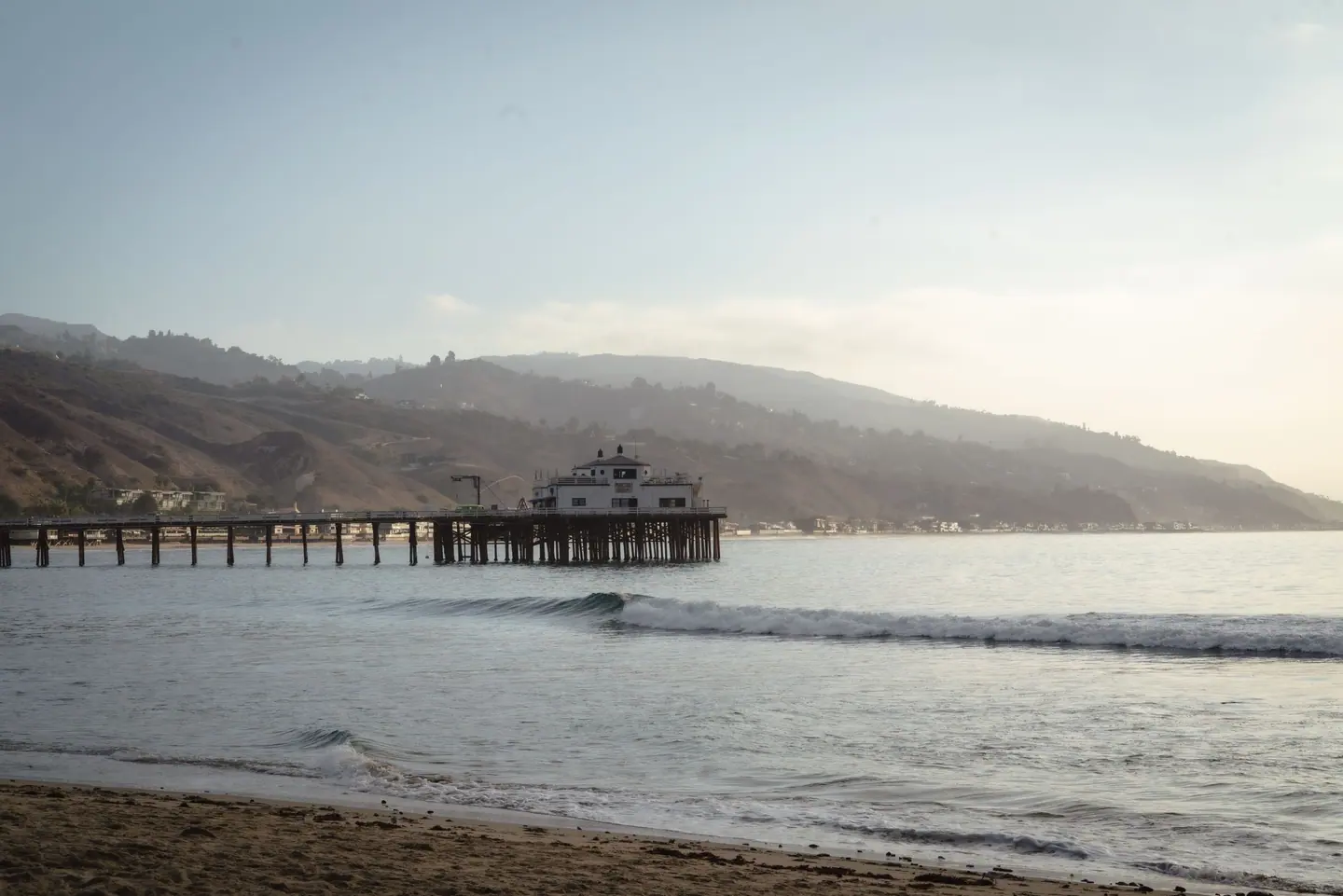
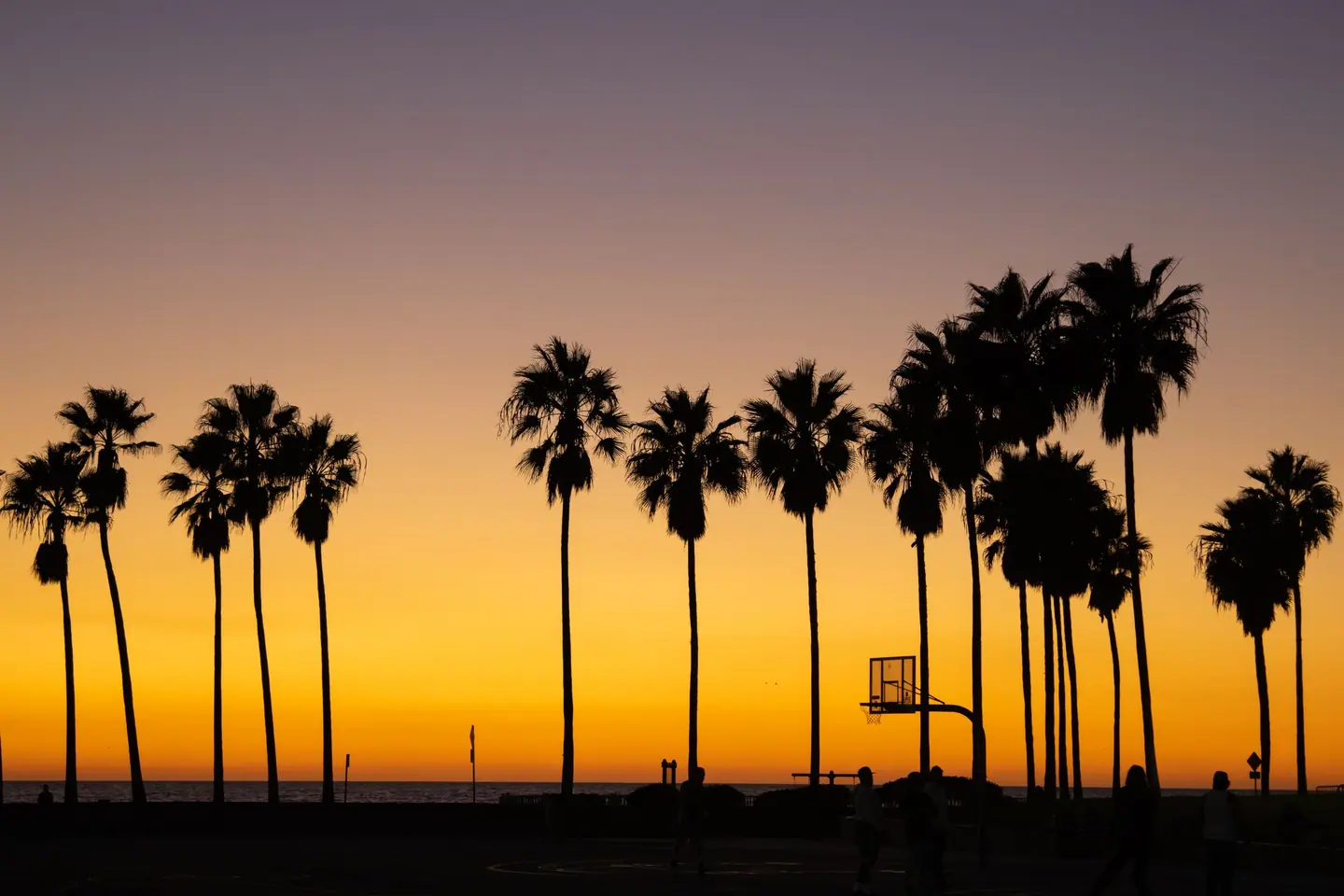
Venice Canals and the Santa Monica Oceanfront
Stroll picturesque residential waterways and lively oceanfront promenades that celebrate the laid-back coastal modernism of the Pacific rim.
Venice Canal Historic District
Created in 1905 to recreate northern Italy on the Pacific coast, these residential waterways survived early paving projects that covered neighbouring channels. Travellers wandering the pedestrian paths encounter arched pedestrian footbridges, floating duck islands, and diverse twentieth-century domestic architecture ranging from Craftsman bungalows to postmodern residences.
Santa Monica Pier
Dating from 1909, this double-jointed wooden jetty was initially constructed to carry treated sewage before evolving into an ocean amusement centre. The structure preserves vintage carnival attractions, a historic carousel building, and viewing decks offering sweeping outlooks over passing Pacific breakers and regional coastal bluffs.
Santa Monica Looff Hippodrome
Designed by master carver Charles I. D. Looff in 1916, this seaside landmark features distinctive rooflines blending Byzantine and Moorish revival elements. Inside, visitors observe an ornate 1922 Philadelphia Toboggan Company carousel adorned with hand-carved wooden horses, cherubs, and original mechanical calliope equipment.
Ocean Park, Santa Monica
Originally developed around the turn of the twentieth century as an independent resort community, Ocean Park retains a dense grid of preserved wooden cottages and historic walk streets. The area illustrates the region's transition from Edwardian bathing retreat to an enclave favoured by mid-century artists and modernist architects.
Camera Obscura Art Lab
Acquired by the city of Santa Monica in 1907, this pinhole projection mechanism redirects natural sunlight through mirrors to cast living images of the beachfront onto a white disc. The surrounding mid-century pavilion now hosts local artist residencies, public workshops, and maritime historical displays.
Palisades Park
Stretching along sandstone ocean bluffs for over twenty blocks, this coastal strip was laid out in the late nineteenth century. Shaded by wind-shaped eucalyptus and Canary Island date palms, the path offers benches, historic navigational monuments, and public vantage points across Santa Monica Bay towards Malibu.
Georgian Hotel
Opened in 1933 during the twilight of Prohibition, this hotel displays a distinctive blend of Art Deco lines and Romanesque arched windows. Often visited by Hollywood film figures during the interwar era, the building retains its original ocean-facing veranda and ornate plaster reliefs within the street-level salons.
Venice Beach Boardwalk
Running along Ocean Front Walk, this promenade has operated as an informal cultural stage since the Beat generation gathered here in the 1950s. Travellers observe painted seaside facades, impromptu musical performances, and historic retail arcades that celebrate southern California's enduring surf and skate traditions.
Muscle Beach Venice
Established in its current location in the 1950s after migrating south from Santa Monica, this gated weight pen helped popularise modern bodybuilding. The site features open-air barbells, calisthenics rigs, and bleachers where visitors gather to watch competitive training on the public beachfront.
Binoculars Building
Completed in 1991 for an advertising agency, this complex features an enormous pair of dark binoculars designed by sculptors Claes Oldenburg and Coosje van Bruggen. The binocular tubes serve as both an entryway and conference room, illustrating the playful Postmodern approach to urban coastal commercial design.
Horatio West Court
Designed by pioneering modernist architect Irving Gill, this complex represents an early experiment in flat-roofed concrete housing. The structure uses tilt-up concrete walls, unadorned surfaces, and clean geometric arches, rejecting ornamental excess in favour of stripped-down early twentieth-century regional form.
Santa Monica City Hall
Funded in part by the Public Works Administration, this civic headquarters presents formal symmetry enhanced by Art Deco and Streamline Moderne details. Visitors can admire decorative glazed ceramic tiles around the portal and interior mosaic murals painted by artist Stanton Macdonald-Wright depicting local historical scenes.
Venice Skate Park
Opened in 2009 directly on the sand, this multi-tiered concrete facility pays homage to the local 1970s Z-Boys skating movement. The park includes sunken bowls, street courses, and snake runs, providing an enduring physical platform for coastal boarding subcultures beside the Pacific.
Miles Memorial Playhouse
Constructed according to a bequest by local landowner Eunice Miles, this playhouse stands within Christine Emerson Reed Park. Designed by architect John Byers, it features whitewashed stucco walls, wrought-iron fixtures, and a hand-hewn wooden timber truss roof typical of southern California's Mediterranean revival movement.
Annenberg Community Beach House
Originally developed in the late 1920s by William Randolph Hearst for actress Marion Davies, the site once housed an expansive Georgian revival mansion. Today, the complex offers public beach access, cultural exhibitions, and the preserved marble-lined guest pool surrounded by classical decorative tiles.
St. Monica Catholic Church
Serving the Santa Monica Catholic community since the late nineteenth century, the current structure dates from 1925 and displays heavy Romanesque stone massing and high arched entrances. The spacious nave contains historic stained-glass windows, hand-carved altarpieces, and substantial ceiling timbers evoking traditional European ecclesiastical layouts.
Windward Avenue Arcades
Windward Avenue preserves the surviving colonnades of Abbot Kinney's original 1905 town development. Concrete pillars with Corinthian capitals shelter the sidewalks, evoking northern Italian arcades while framing the contemporary approach to the oceanfront through rows of cafes and neighbourhood souvenir shops.
Santa Monica Pier Carousel
Constructed in 1922 and housed within the Looff Hippodrome, this operational wooden carousel contains intricately detailed carvings across its animal mounts and chariot seats. It represents one of the few surviving historical carousels along the western American seaboard still operating in its original maritime context.
Bay Cities Guaranty Building
Rising twelve storeys, this historic office tower was one of the tallest commercial buildings along Santa Monica Bay during the interwar era. Designed by Walker and Eisen, it features a stepped roofline, intricate zig-zag cast-stone friezes, and decorative spandrels typical of high Art Deco metropolitan architecture.
Venice Branch Library
Opened in 1930 and subsequently expanded, this branch library on Venice Boulevard provides a repository of local historical manuscripts, town planning maps, and early photographs. The building showcases residential-scale civic architecture designed to serve the coastal neighbourhood while offering shaded interior courtyards for community reading.
Navigating the Sprawl: Transit Lines, Canyon Passes and Coastal Thoroughfares
For neighbourhood accommodation notes, seasonal weather tables and airport transfer details, consult our Los Angeles destination guide, or browse other city and regional walking routes across the atlas.