A 100-stop walking and harbour ferry route across Valletta, Floriana, and the Three Cities, exploring Knights of St John auberges, Baroque palaces, and limestone bastions.
After the 1565 Siege: Laparelli’s Renaissance Fortress on Sciberras
Following the Great Siege of Malta in 1565, Grand Master Jean Parisot de Valette of the Knights Hospitaller commissioned papal military engineer Francesco Laparelli to design an impregnable fortified capital on the rocky Sciberras Peninsula between Grand Harbour and Marsamxett Harbour. Laid out in 1566 on a strict Renaissance grid with towering golden globigerina limestone bastions, Valletta was Europe's first planned city built entirely from scratch.
Maltese architect Girolamo Cassar designed the city's conventual church and the monumental auberges housing the Order's regional tongues (Langues), later enriched with lavish High Baroque interiors and masterpieces by Caravaggio and Mattia Preti. Under British rule from 1800 to 1964, Grand Harbour served as the strategic headquarters of the Royal Navy's Mediterranean Fleet.
City Gate, Republic Street & St John’s Co-Cathedral
Valletta City Gate, Parliament Building, Royal Opera House site, Auberge de Castille, St John’s Co-Cathedral, Republic Square, and National Library of Malta
Valletta City Gate
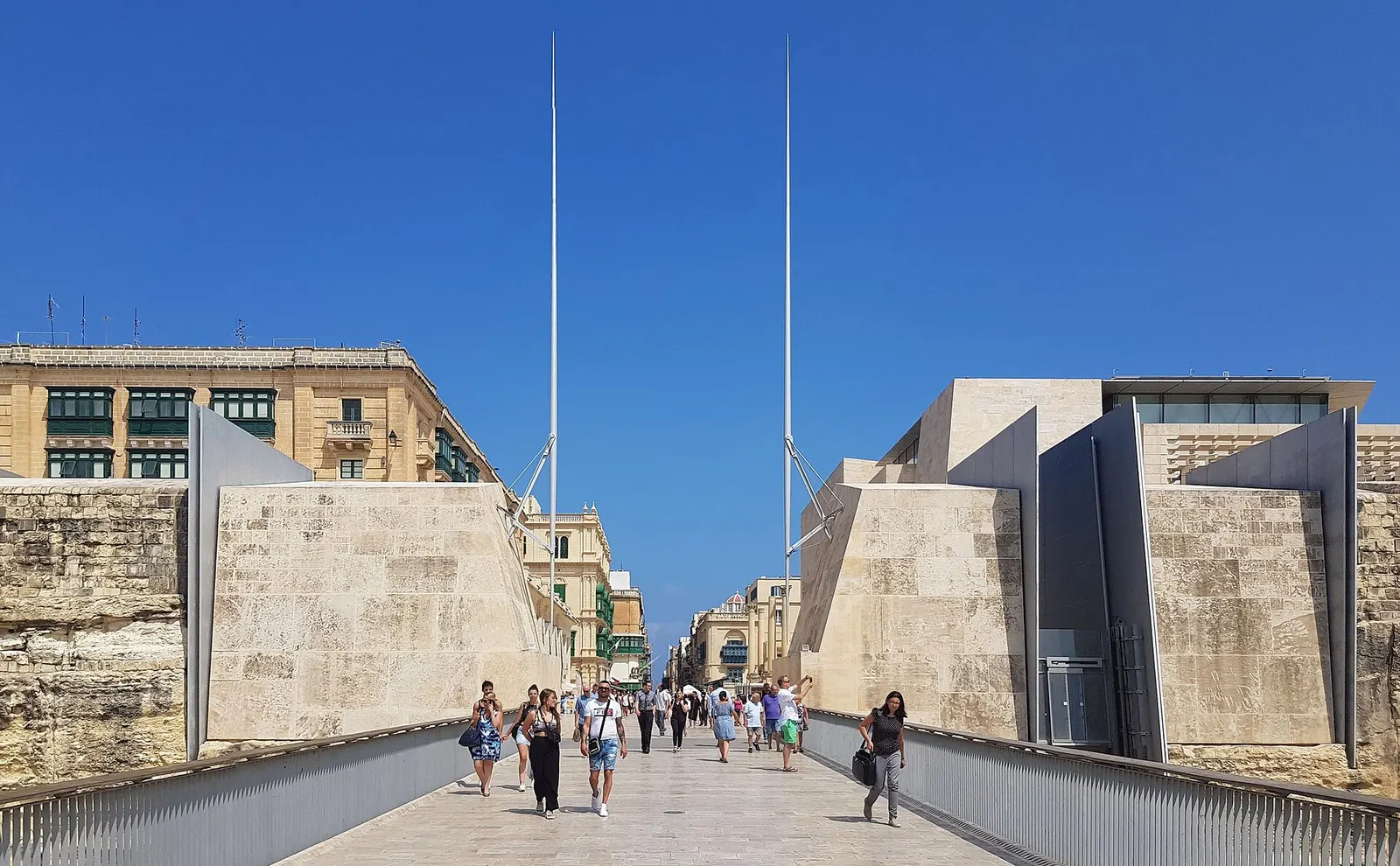
Designed by Renzo Piano, the fifth gateway to the capital opened in 2014, cutting through the massive counterguard defences. We admire how local Coralline limestone frames the deep ditch below, replacing earlier neoclassical arches. The entry points travellers directly down Republic Street, the spine of the fortified city.
Parliament House
Completed in 2015 as part of the City Gate project, this complex accommodates the Maltese House of Representatives. The two stone blocks feature computer-carved louvres designed to filter Mediterranean sunlight while mimicking eroded natural limestone. Elevated above an open piazza, it invites visitors to walk freely beneath the political chambers.
Pjazza Teatru Rjal
Edward Middleton Barry designed the original Royal Opera House in 1866, but aerial bombing during the Second World War devastated the auditorium. Rather than recreating the interior, architects preserved the surviving Corinthian colonnade as a permanent open-air venue. The weathered limestone stumps stand as a resilient monument to wartime survival.
Palazzo Ferreria
Constructed in the late nineteenth century on the site of the Order of Saint John's former armoury, this palace blends Venetian Gothic and Italianate styles. It is celebrated for its sweeping traditional timber balconies painted deep green across the upper tiers. The street level now hosts government offices and retail arcades.
Church of Saint Francis of Assisi
Originally completed in 1607, the church underwent a comprehensive Baroque reconstruction in 1681 under the patronage of Grand Master Gregorio Carafa. Inside, gilded vaulting surrounds paintings by Mattia Preti and Giuseppe Calì. The classical stone facade features a prominent statue of Saint Francis gazing over Republic Street.
Church of Saint Barbara
Rebuilt in 1739 by Romano Carapecchia, this church served the military guild of gunners responsible for coastal defence. The ornate facade features carved stone helmets, cannon barrels and military emblems beneath a crowning statue of Saint Barbara. The interior boasts an elliptical dome detailed with delicate gilded stucco work.
Church of Saint Catherine of Italy
Erected in 1576 by the Italian Knights of Saint John, the church was later redesigned by Romano Carapecchia in the early eighteenth century. Its striking octagonal sanctuary features a cupola painted with grey and gold trompe l'oeil decorations. Mattia Preti contributed the impressive altarpiece depicting the martyrdom of Saint Catherine.
Church of Our Lady of Victories
Grand Master Jean de Valette laid the city foundation stone here in 1566 to commemorate the defeat of Ottoman forces. The modest exterior conceals an interior ceiling painted by Maltese artist Alessio Erardi with scenes from the life of the Virgin Mary. Valette was initially buried inside before his translation to the cathedral crypt.
Auberge de Castille
Remodelled in the 1740s by Maltese architect Andrea Belli, this grand palace housed the influential knights of Castille, Leon and Portugal. The facade displays an imposing stepped flight of stairs, ornate trophies of war and a bust of Grand Master Manuel Pinto da Fonseca. Today it operates as the official administrative seat of government.
Castille Square
Positioned at the highest point of Mount Sceberras, this open public space connects the city gate axis to the eastern sea defences. It is framed by the Central Bank of Malta, Saint James Cavalier and several modern bronze sculptures commemorating prominent Maltese prime ministers. Paved pathways link pedestrians directly into the Upper Barrakka Gardens.
Saint James Cavalier
Engineered by military architect Francesco Laparelli, this massive pentagonal tower provided heavy artillery support over the city approaches. Its thick limestone walls withstood centuries of naval bombardment without structural alteration. The cavernous interior now operates as Spazju Kreattiv, hosting contemporary art exhibitions, independent cinema and performing arts spaces.
Auberge d'Italie
Constructed in successive phases between 1574 and 1595, this former headquarters of the Italian Langue centres on a classic rectangular courtyard. The exterior displays a celebrated Baroque centrepiece sculpted with military trophies and the coat of arms of Grand Master Gregorio Carafa. It now houses MUŻA, presenting historic and contemporary Maltese collections.
Great Siege Square
Situated opposite the co-cathedral along Republic Street, this open terrace forms a focal civic gathering place. The centrepiece is Antonio Sciortino's 1927 bronze monument featuring three figures representing Faith, Fortitude and Civilisation. The plaza directly borders the neoclassical Corinthian portico of the modern Law Courts building.
St John's Co-Cathedral
Built by Girolamo Cassar between 1572 and 1577, this conventual church was transformed into a showcase of Baroque art by Mattia Preti. Preti painted the stone barrel vault with scenes from the life of John the Baptist using oil on porous limestone. Nearly four hundred inlaid marble gravestones covering the floor commemorate noble knights.
Oratory of St John's Co-Cathedral
Constructed as a private place of devotion for the novices of the Order, this quiet rectangular room contains significant artistic treasures. Caravaggio completed his monumental masterpiece, The Beheading of Saint John the Baptist, specifically for this wall in 1608, signing it in paint. The neighbouring canvas shows his expressive portrait of Saint Jerome Writing.
National Museum of Archaeology
Dating to 1571, the Auberge de Provence showcases ornate Mannerist architecture, complete with an expansive timber-beamed Grand Salon decorated with eighteenth-century frescoes. The museum displays original Neolithic finds recovered from Maltese megalithic temples. Highlights include the delicate terracotta Sleeping Lady from the Ħal Saflieni Hypogeum and the Venus of Malta.
Republic Square
Originally known as Piazza Tesoreria, this stone-paved square has long functioned as a central civic gathering point. A white marble statue of Queen Victoria, sculpted by Giuseppe Valenti in 1891, dominates the centre of the square. Outdoor cafe tables line the space beneath the arcades, surrounded by historic government archives.
National Library of Malta
Designed by the Polish-Italian architect Stefano Ittar, this handsome neoclassical building was finished in 1796. The monumental facade features a classical pediment and arcaded ground floor opening onto Republic Square. Inside, the timber-lined reading rooms safeguard original royal charters, papal bulls and administrative records of the Order of Malta dating to 1113.
Banca Giuratale
Erected in the eighteenth century by Romano Carapecchia, this building served as the seat of local municipal magistrates, known as the Università. Its facade displays ornate Baroque pediments, classic Maltese balconies and detailed stonework along Merchants Street. It later served as the General Post Office and now contains public registry offices.
Castellania
Commissioned by Grand Master Manoel Pinto da Fonseca in 1757, this expressive Baroque building accommodated the civil and criminal courts of the Order. The facade is noted for its curved stonework, allegorical statues of Justice and Truth, and a central pillory pedestal. The building now functions as the Ministry for Health.

Grandmaster’s Palace, Casa Rocca Piccola & Fort St Elmo
Grandmaster’s Palace, Palace Armoury, St George’s Square, Casa Rocca Piccola, Manoel Theatre, MUZA Auberge d’Italie, and Fort St Elmo
Grandmaster's Palace
Commissioned by Grand Master Jean de la Cassière in 1571, this sprawling complex served as the executive centre of Malta for centuries. Inside, state apartments display extensive Gobelins tapestries and frescoes portraying the Great Siege of 1565. We can admire the limestone facades, shaded courtyards, and ornate corridors lined with portraits of successive rulers.
Palace Armoury
Housed on the ground floor of the Grandmaster's Palace, this collection ranks among the world's most complete military storehouses. It showcases authentic battle gear used by the Knights Hospitaller, including personal suits of parade plate armour belonging to Grand Masters Alof de Wignacourt and Jean de la Valette. Visitors can inspect siege artillery, cross-bows, and captured Ottoman muskets.
St George's Square
Also known as Misraħ San Ġorġ, this grand public plaza stretches directly before the main palace facade. It historically hosted military parades, state ceremonies, and public announcements throughout the Hospitaller and British eras. Today, computer-controlled water fountains animate the paving, surrounded by neo-classical facades and historic guardhouses.
Main Guard and Chancellery
Erected originally as a guardhouse by the Order in 1603, the building received its distinctive Doric portico under British Governor Sir Thomas Maitland in 1814. A sculptured British coat of arms and a Latin inscription crown the facade above St George's Square. The interior officers' mess contains dozens of wall paintings and caricatures painted by garrisoned regiments.
Casa Rocca Piccola
Constructed in 1580 for Don Pietro la Rocca, this privately owned palazzo remains the ancestral home of the de Piro family. The residence contains fifty rooms furnished with antique Maltese furniture, ancestral portraits, and rare silver collections. Beneath the private garden, deep subterranean chambers cut into the rock provided shelter during Second World War air raids.
Manoel Theatre
Commissioned in 1731 by Grand Master António Manoel de Vilhena, this intimate venue is one of Europe's oldest working theatres. Its horseshoe-shaped auditorium features pale blue wooden tiers decorated with gilded leaf motifs beneath a trompe-l'œil ceiling. We can admire the exquisite acoustics, historic box seating, and the small theatrical museum located in the adjoining courtyard.
Church of the Carmelites
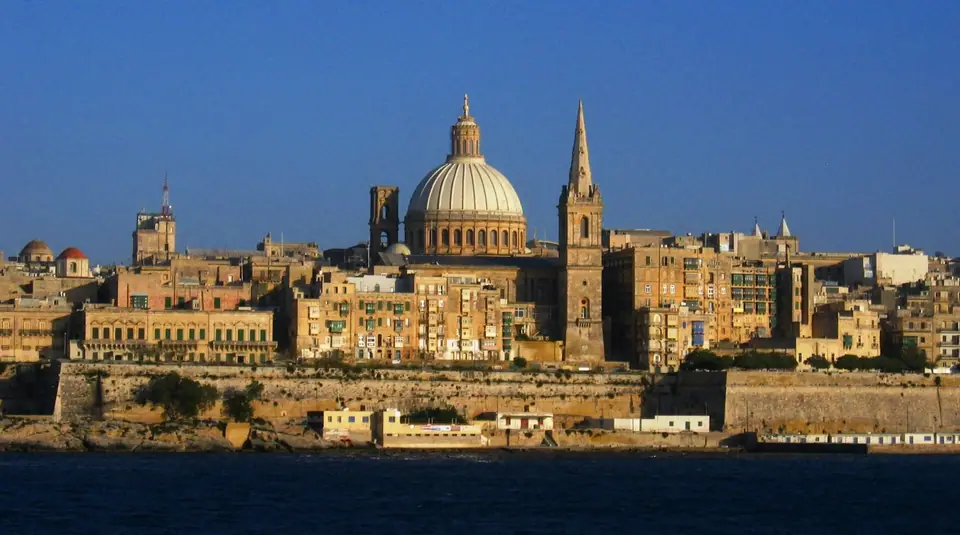
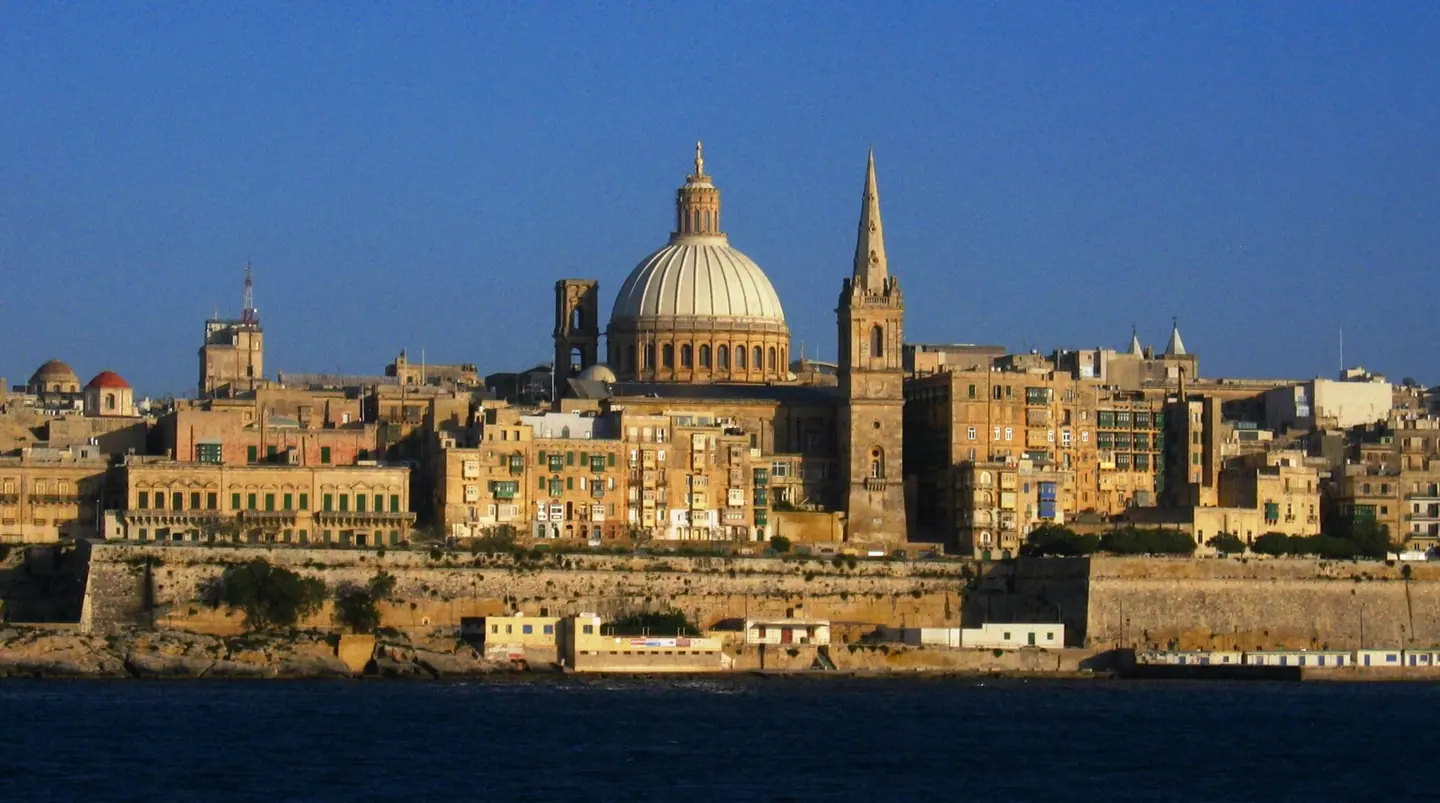
Dedicated to Our Lady of Mount Carmel, this landmark church was originally constructed in the late sixteenth century and comprehensively rebuilt following wartime bomb damage. Its massive 42-metre dome of white limestone towers over neighbouring streets and Marsamxett Harbour. The interior exhibits striking red marble columns and a revered seventeenth-century painting of the Virgin Mary.
National Museum of Fine Arts, MUŻA
Housed within the sixteenth-century Auberge d'Italie on Merchant Street, MUŻA showcases Malta's national art collection using innovative thematic galleries. The building served historically as the headquarters for Italian-speaking Knights of Saint John and retains an elaborate baroque portal. Inside, visitors encounter masterworks by Mattia Preti, local sculptors, and European painters spanning five centuries.
Auberge d'Aragon
Erected in 1571 to house knights from the Langue of Aragon, Catalonia, and Navarre, this remains the oldest surviving auberge retaining its original single-storey Mannerist design. Architect Girolamo Cassar designed the unadorned facade with rustic quoins and a classic central Doric portico added during British rule. It continues to house key government ministries.
Auberge de Bavière
Originally built as Palazzo Carnero in 1696, this imposing building was purchased in 1784 to serve the newly formed Anglo-Bavarian Langue of the Order. The palace overlooks the northern perimeter rocks with an expansive ashlar stone facade and severe baroque proportions. It later operated as a prominent British military hospital during the First World War.
Fort Saint Elmo
Positioned strategically at the tip of the Sciberras Peninsula, Fort St Elmo withstood intense Ottoman bombardment during the Great Siege of 1565. Rebuilt and strengthened by subsequent military engineers, its stout bastions and cavaliers command both surrounding sea approaches. Travellers can inspect deep gunpowder magazines, internal parade grounds, and early artillery positions.
National War Museum
Located within the historic buildings of Fort Saint Elmo, this museum details Malta's military history from the Bronze Age through the Second World War. Among its most notable exhibits are the Gloster Sea Gladiator biplane fuselage named Faith and the original George Cross medal awarded to the island in 1942. Exhibits also include wartime transport and anti-aircraft weaponry.
Lower Barrakka Gardens
Laid out on the French bastion of the outer fortifications, these peaceful gardens look out towards the breakwater and the Three Cities. The centrepiece is a neo-classical temple monument honouring Sir Alexander Ball, the British naval officer who led the revolt against French rule. Pathways feature olive trees, ornamental fountains, and stone arcades.
Siege Bell War Memorial
Inaugurated in 1992 by Queen Elizabeth II and President Ċensu Tabone, this monument commemorates thousands who perished during the Siege of Malta between 1940 and 1943. Designed by Michael Sandle, the stone belfry holds a massive ten-tonne bronze bell rung at noon. An adjacent bronze figure represents the anonymous burial of fallen soldiers at sea.
Church of Saint Catherine of Italy
Constructed in 1576 by Italian knights alongside their neighbouring auberge, this church received major architectural enhancements by Romano Carapecchia in the early eighteenth century. Its distinctive octagonal sanctuary is crowned by a dome decorated with stucco ornaments and paintings by Mattia Preti. The intimate church remains the primary parish for Malta's Italian-speaking community.
Church of Our Lady of the Pillar
Commissioned in the 1670s to serve the adjacent Auberge d'Aragon, this church displays a restrained Tuscan-Doric facade designed by Gerolamo Cassar and rebuilt by Romano Carapecchia. The interior boasts decorative wood carvings, gilded altars, and notable canvases by baroque artist Stefano Erardi. It remains under the stewardship of Heritage Malta and local cultural trusts.
Church of Saint Paul's Shipwreck
Dating back to the 1570s, this parish is dedicated to the traditional founding father of Maltese Christianity, the Apostle Paul. The lavish interior contains a celebrated gilded wooden statue of Saint Paul carved by Melchiorre Cafà in 1659. Visitors can also view revered relics, including what is held to be part of the saint's wrist bone.
Basilica of St Dominic
Officially known as the Church of Our Lady of Safe Haven and Saint Dominic, this basilica originated in 1571 and was rebuilt in 1815 after earthquake damage. The grand neo-classical interior features a sweeping nave adorned with Giuseppe Calì ceiling murals and rich marble altarpieces. It has long served mariners arriving into the adjacent harbours.
Mediterranean Conference Centre
Originally built in 1574 as the Sacra Infermeria, this monumental hospital was renowned throughout Europe for its advanced medical treatment of knights and pilgrims. Its main ward, stretching over 150 metres in length, stands as one of the longest historic halls on the continent. The restored limestone complex now functions as a premier civic and cultural venue.
St Francis of Assisi Church
Constructed in 1598 and substantially redesigned by 1681 under Grand Master Gregorio Carafa, this church boasts a graceful facade punctuated by Franciscan emblems. Inside, the single-nave barrel vault contains striking decorative stuccoes, historical friezes, and paintings attributed to Mattia Preti and Filippo Paladini. The high altar features an exceptional sculptured tabernacle.
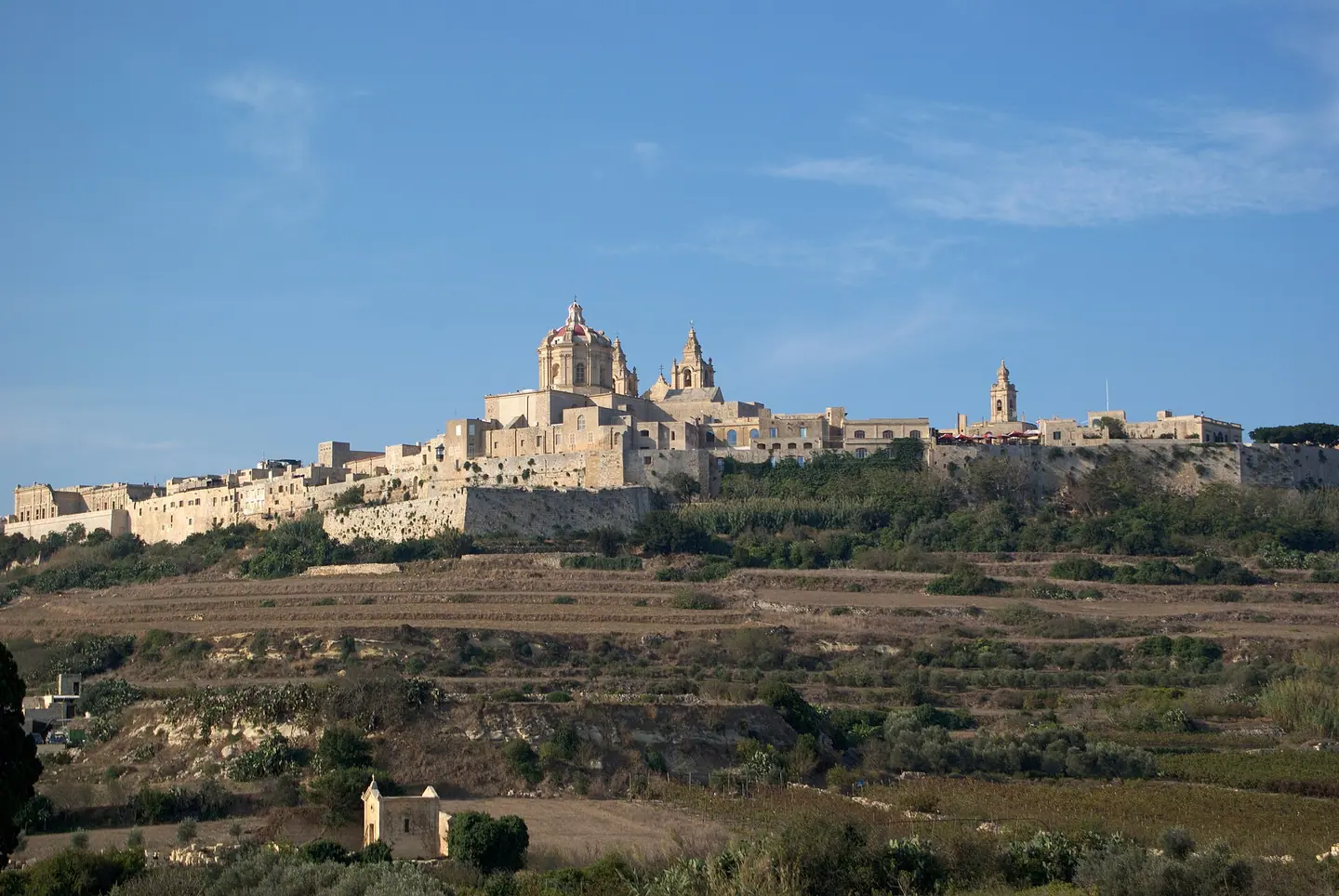
Barrakka Gardens, Waterfront & Marsamxett Bastions
Upper Barrakka Gardens, Saluting Battery, Lascaris War Rooms, Lower Barrakka Gardens, Siege Bell War Memorial, Victoria Gate, Valletta Waterfront, and Hastings Gardens
Upper Barrakka Gardens
Created in 1661 as a private exercise ground for Italian knights, this terrace became a public garden in the nineteenth century. Its colonnaded arcade frames sweeping views across the Grand Harbour towards the Three Cities. Visitors can inspect numerous bronze monuments, including a memorial to British Prime Minister Gerald Strickland.
Saluting Battery
Constructed in the 1560s by the Order of Saint John, this platform protected the harbour and fired ceremonial salutes. British forces later mounted heavy coastal guns here throughout the nineteenth and twentieth centuries. Today, restored cannons fire traditional mid-day and afternoon volleys across the water below the garden terrace.
Lascaris War Rooms
Tunneled directly beneath the Upper Barrakka ramparts, this subterranean complex served as the British defence headquarters for Malta. General Dwight D. Eisenhower coordinated Operation Husky, the invasion of Sicily, from these blast-proof chambers in 1943. Restored plotting maps, communications equipment, and acoustic baffles illustrate Allied joint service command operations.
Barrakka Lift
Rising nearly sixty metres against the golden limestone cliff, this lift carries travellers between the waterfront and city centre. Completed in 2012, it replaced an earlier twentieth-century hydraulic elevator dismantled in the 1980s. The glazed glass cabs offer dramatic, rapid vantage points over the harbour fortifications during the ascent.
Peter and Paul Bastion
Designed by military engineer Francesco Laparelli, this immense angle bastion forms the southeastern cornerstone of Valletta's land front. Its sheer masonry curtains withstand tidal wash and bomb impacts from centuries of Mediterranean conflict. Deep embrasures and thick parapet walls reveal the sheer scale of early modern Hospitaller stone fortifications.
Church of Our Lady of Liesse
Erected in 1715 by the French Langue of the Order of Saint John, this domed church replaced an earlier seventeenth-century shrine. It honours a medieval legend involving Christian knights rescued from Egyptian captivity. The facade displays elegant Pilasters and ornate scrollwork facing the sheltered inlet of the Grand Harbour.
Victoria Gate
Designed by Maltese architect Emmanuel Luigi Galizia, this double-arched limestone portal was completed in 1885 to replace the cramped Porta Marina. Named after Queen Victoria, it accommodated expanding vehicular traffic between the busy marina and urban streets. British royal coats of arms and portcullis motifs decorate its grand classical pediment.
Valletta Waterfront
Commissioned in 1752 by Grand Master Manuel Pinto da Fonseca, these nineteen vaulted warehouses accommodated maritime trade alongside the quay. Distinctive coloured shutters historically marked the type of merchandise stored inside, including grain, wine, and naval supplies. The restored promenade retains its classical facades, featuring sculptural pediments dedicated to Saint John.
Church of Flight into Egypt
Integrated directly into Pinto's grand warehouse terrace, this compact baroque chapel provided religious services for stevedores and sailors. Damaged during aerial bombardment in the Second World War, it was later painstakingly reconstructed alongside the wharves. Its simple facade mirrors the symmetrical pilasters of the neighbouring eighteenth-century dockside storehouses.
Lower Barrakka Gardens
Occupying a high bastion at the eastern entrance to the Grand Harbour, this garden offers exceptional views of Fort Ricasoli and the breakwater. Paved paths wind past olive trees, fountains, and classical stone pavilions. A central neoclassical monument commemorates Sir Alexander Ball, the first British Civil Commissioner of Malta.
Monument to Sir Alexander Ball
Constructed in 1810 through public subscription, this neoclassical circular temple features unfluted columns supporting a decorated stone architrave. It honours the naval officer who led Maltese insurgent forces against the French garrison in 1798. Four allegorical statues representing War, Prudence, Justice, and Commerce rest quietly inside the surrounding precinct.
Siege Bell War Memorial
Inaugurated in 1992 by Queen Elizabeth II, this open neoclassical belfry houses a bronze bell cast by the John Taylor foundry. The site commemorates the thousands who died defending Malta during the second Great Siege between 1940 and 1943. A bronze recumbent figure by sculptor Michael Sandle honours lost merchant seamen.
Saint Christopher Bastion
Engineered in the late sixteenth century, this broad bastion provided defensive crossfire towards the open sea and Bighi headland. Its elevated position above water level made it an indispensable strongpoint against naval bombardments. The bastion now supports both the Siege Bell War Memorial and the green terraces of Lower Barrakka.
Saint Lazarus Curtain
This fortified stone curtain wall links Saint Christopher Bastion with the seaward defenses of the lower peninsula. Constructed with local globigerina limestone blocks, the rampart was designed to absorb heavy cannon fire from invading warships. Elevated walkways along the parapet allow visitors to observe historic gun emplacements and rocky littoral shorelines.
Saint Sebastian Curtain
Stretching along the northern perimeter of the Valletta peninsula, this curtain wall overlooks Manoel Island and Sliema Creek. Built in the late sixteenth century, it completed the city's watertight defensive circuit against seaborne landings. Narrow sentry boxes, known locally as gardjoli, still cling to salient angles along the parapet edge.
Saint Salvatore Bastion
Positioned midway along the Marsamxett ramparts, this stone bastion mounted artillery batteries to command the outer harbour waters. Its thick sloping revetment wall drops sharply toward the perimeter roadway and the sea. The broad gun platform affords wide perspectives toward Fort Manoel across the narrow maritime channel.
Saint Andrew Bastion
Forming an essential protective bastion along Valletta's northern flank, this position defended the city against direct amphibious assault. Later modifications during the British colonial period adapted the limestone platforms for breech-loading coastal guns. Today, residential properties and open gardens crown the interior spaces of the historic defensive works.
Saint Michael Bastion
This high defensive work anchors the land front's northern terminus above the deep Marsamxett ditch. From this salient, gunners could protect the landward approaches while training firepower on vessels anchoring in the northern creeks. Hastings Gardens now occupies the broad earthen terreplein atop this massive sixteenth-century rampart.
Hastings Gardens
Laid out on Saint Michael and Saint John bastions, this public garden overlooks Floriana, Msida, and the open waters of Marsamxett Harbour. Named after Lord Hastings, a nineteenth-century Governor of Malta, it contains quiet gravel avenues and shade trees. An ornate marble monument marks the governor's burial site within the grounds.
Saint John Bastion
Rising high above the deep dry moat, this bastion formed a primary anchor of Valletta's sophisticated landward defence line. Engineered with broad flanks and cavaliers, it was designed to deliver raking artillery fire across the ditch. The limestone ramparts provide exceptional views of the outer Floriana lines and Renzo Piano's modern parliament.
Birgu (Vittoriosa), Senglea & Cospicua Across Grand Harbour
Fort St Angelo, Inquisitor’s Palace, Malta Maritime Museum, Collachio Quarter Birgu, Gardjola Gardens Senglea, St Lawrence Church, and Santa Margherita Lines
Fort St Angelo
Positioned at the tip of the Birgu peninsula, this imposing citadel served as the headquarters of the Knights of St John during the Great Siege of 1565. Extensive limestone bastions encase medieval elements and the high Cavalier, which offers commanding panoramas across Valletta. We recommend observing the ancient chapel of St Anne alongside the upper palatial quarters restored by the Sovereign Military Order of Malta.
Inquisitor's Palace
Constructed in the 1530s as civil law courts, this grand palace subsequently housed the Roman Inquisitors for over two centuries. The surviving complex contains formal state rooms, vaulted subterranean prison cells, and the inquisitorial courtroom decorated with timber beam ceilings. Today the site preserves important religious folk artefacts, domestic historic furnishings, and original prisoner graffiti etched into the sandstone walls.
Malta Maritime Museum
Housed inside the former Royal Naval Bakery designed by architect William Scamp in the 1840s, this expansive museum traces millennia of Mediterranean sea trade. Displays feature authentic Roman lead anchors, scale ship models of the Order of St John, and steam-era engineering equipment. Visitors can examine preserved navigational instruments alongside surviving mechanical bakery engines that once provisioned the British Mediterranean Fleet.
Collachio Quarter Birgu
This network of quiet, narrow alleys formed the private inner sanctum of the Knights Hospitaller during the sixteenth century. Strict regulations once barred the general public from entering this precinct, which contains surviving knightly residences decorated with Norman windows and stone coats of arms. We suggest exploring the winding cobblestone lanes to view authentic vernacular architecture and carved devotional niches.
St Lawrence Church
Serving as the conventual church of the Order of St John before the construction of Valletta, this ornate sanctuary was redesigned in baroque style by Lorenzo Gafa. The interior contains a magnificent altarpiece by Mattia Preti depicting the martyrdom of St Lawrence. Visitors should also inspect relics connected to the 1565 siege, including personal possessions of Grand Master Jean Parisot de Valette.
Church of St Anne, Fort St Angelo
Located inside the inner ward of Fort St Angelo, this ancient chapel stands upon foundations dating back to the Byzantine and Angevin periods. The present vaulted limestone structure was reconstructed in the early sixteenth century, incorporating antique porphyry columns suspected to originate from a classical temple of Juno. It remains one of the oldest surviving Christian spaces inside the Grand Harbour defences.
Birgu Clock Tower Site
Dominating Birgu central square until its destruction by aerial bombardment in 1942, the medieval clock tower was initially erected as an early maritime watch post. The open square now retains the footprint of this civic landmark alongside outdoor cafes and historic perimeter townhouses. Informative markers explain the importance of the structure, which sounded warning bells during naval raids across Grand Harbour.
Auberge d'Angleterre
Constructed around 1534, this two-storey limestone building is one of the few surviving English Langue inns anywhere in the Mediterranean. Its modest facade displays clean Melitan architectural lines, square windows, and an arched entrance portal. The interior features a central courtyard and vaulted chambers, currently operating as a public cultural venue and community library.
Auberge de France
Designed by master builder Niccolo Bellavante in the 1530s, this grand auberge housed knights from the Kingdom of France during the Great Siege. The facade displays moulded limestone stringcourses, decorative corbels, and classic proportions typical of early Hospitaller administrative centres. Now housing the Birgu Local Council, the property includes a stately main hall and vaulted storage basements.
Birgu Post of Castille
This massive bastion formed the principal defensive sector assigned to the Langue of Castile and Portugal during Ottoman assaults in 1565. The sturdy limestone works withstood weeks of intensive bombardment and hand-to-hand trench warfare. Visitors can walk the elevated terreplein to examine defensive gun embrasures and outer ditch excavations that guarded the eastern flank of the promontory.
Gardjola Gardens Senglea
Perched on the northern tip of the Senglea peninsula, these peaceful public gardens occupy the platform of St Michael Bastion. The prominent feature is the stone surveillance turret, or gardjola, carved with symbols of an eye and ear to denote perpetual vigilance. We recommend this vantage point for sweeping vistas of Valletta waterfront and the docks of French Creek.
Basilica of the Nativity of Mary, Senglea
Erected in the sixteenth century by Grand Master Claude de la Sengle to celebrate the lifting of the 1565 siege, this collegiate basilica was rebuilt following severe wartime damage. The interior contains gilded stuccowork, fine marble flooring, and an acclaimed wooden statue of the Virgin Mary known locally as Il-Bambina. A carved statue of Christ the Redeemer remains a focal point for pilgrims.
Fort Saint Michael
Constructed between 1551 and 1565, this bastion fort guarded the landward neck of the Senglea promontory against naval and terrestrial advances. Although large sections were dismantled in the twentieth century to accommodate shipyard development, monumental stone scarps and low casemates remain visible. Visitors can observe the thick military masonry that bore the brunt of fierce infantry assaults during the Great Siege.
Collegiate Church of the Immaculate Conception, Bormla
Dominating the central skyline of Cospicua, this grand collegiate church was begun in the late seventeenth century and completed in 1730. Remarkably surviving intense wartime air raids, the church contains valuable artistic treasures, including a silver devotional reredos and paintings by baroque masters. Richly carved stone pilasters, marble altars, and an imposing dome distinguish this prime example of Maltese ecclesiastical architecture.
Santa Margherita Lines
Engineered by Italian military architect Vincenzo Maculani in 1638, this outer trace of bastions was designed to protect the lower port communities against artillery fire from neighbouring hills. The fortifications comprise five sturdy bastions interconnected by substantial curtain walls and deep rock-cut ditches. Walking along the ramparts reveals impressive military stonecraft and historic masonry embrasures intended for heavy bronze cannon.
Cottonera Lines
Commissioned in 1670 by Grand Master Nicolas Cotoner, this massive semi-circular defensive perimeter enclosed the Three Cities within eight large bastions. Designed by Antonio Maurizio Valperga, the fortifications were built to shelter port residents and rural populations during potential siege campaigns. Today, large stretches of limestone curtain wall, arched gateway portals, and dry defensive moats survive intact along the urban boundary.
St Helen's Gate
Constructed in the 1730s under French military engineers, this historic portal serves as the primary ceremonial entry through the Santa Margherita Lines into Cospicua. The exterior facade features rusticated stone blocks, heavy gunports, and decorative pediment details bearing heraldic shields. Visitors can inspect the preserved timber drawbridge recesses and heavy limestone guard chambers flanking the vaulted central carriageway.
Bir Mula Heritage Museum
This private ethnographic museum occupies an ancient house containing architectural remnants that span from the Neolithic era to the twentieth century. The lower levels feature subterranean cisterns, medieval rock-cut chambers, and evidence of early Christian and Ottoman presence. Displays include domestic implements, historical maps, and archaeological finds discovered during the continuous structural conservation of the property.
Cospicua Waterfront and Dock 1
Dock 1 was excavated by British naval authorities in the mid-nineteenth century to repair warships of the Royal Navy Mediterranean Fleet. The surrounding waterside zone has been converted into an open public promenade connecting Cospicua directly with Senglea and Birgu. Walking along the inlet provides direct access to historic industrial pumping houses, restored bollards, and modern footbridges spanning the harbour.
Verdala Gate
Constructed by British military engineers in the 1850s to provide controlled access through the Santa Margherita Lines, this gate stands near the former Verdala Barracks. The structure displays solid defensive masonry with crenellated parapets and loopholed walls designed for small-arms fire. It provides travellers with a fine example of Victorian defensive adaptations superimposed onto earlier Hospitaller bastions.
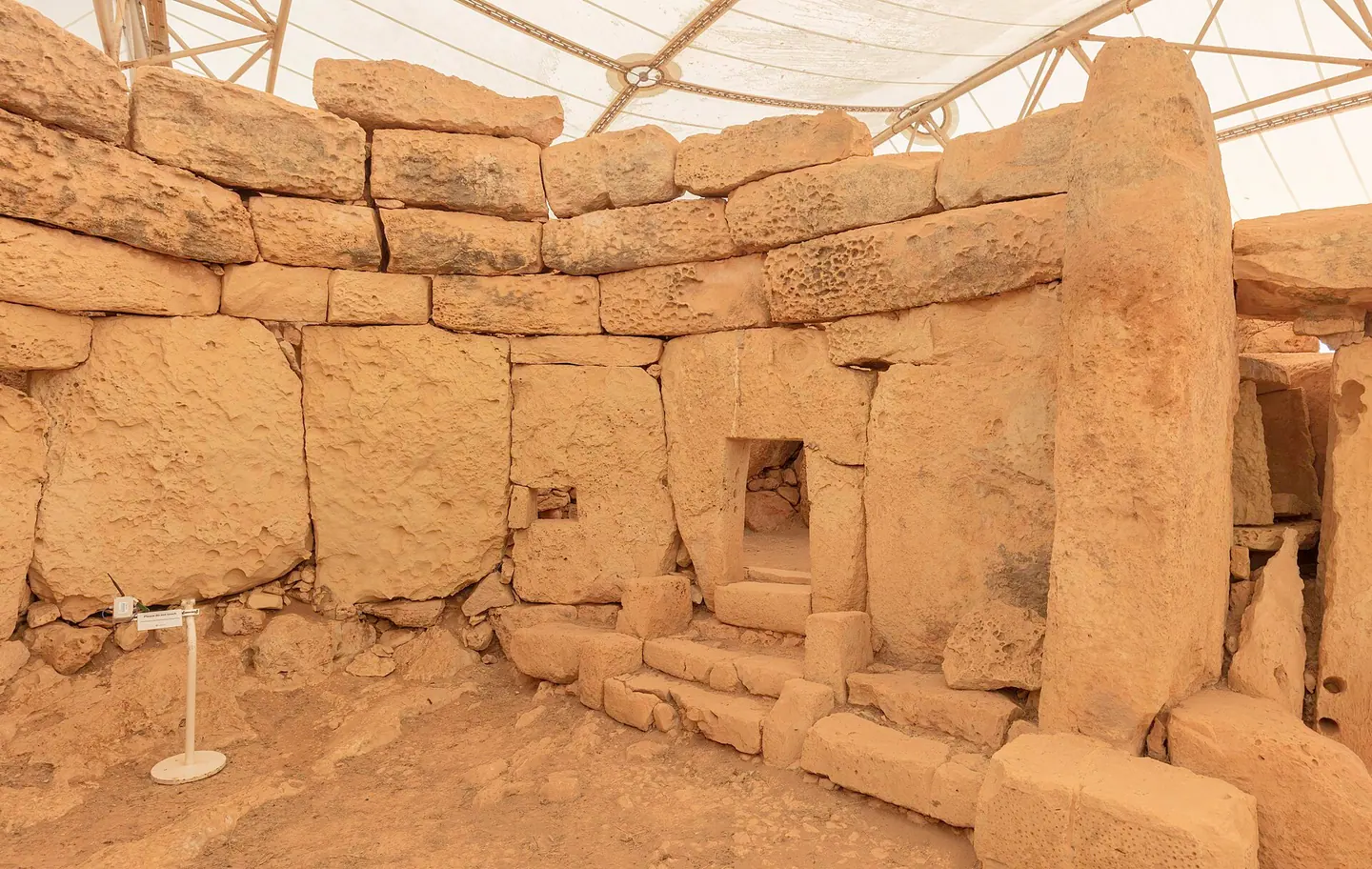
Floriana Granaries, Argotti Gardens & Manoel Island Viewpoints
Triton Fountain, Floriana Granaries Il-Fosos, St Publius Church, Argotti Botanic Gardens, Mall Gardens, Porte des Bombes, Wignacourt Water Tower, and Sliema Ferry viewpoint
Triton Fountain
Sculpted by local artist Vincent Apap in 1959, this vast bronze work portrays three mythological Tritons supporting an elevated basin. It stands at the centre of Valletta's primary bus terminus, serving as the landmark entrance to the fortified capital. Travellers can observe the restored travertine pavement and water jets framing the figures.
Christ the King Monument
Designed by master sculptor Antonio Sciortino, this bronze sculpture was erected to commemorate the XXIV International Eucharistic Congress held in Malta. The central figure of Christ stands above a kneeling female personification representing the nation. Positioned on the edge of the Mall, it reflects classical Beaux-Arts influences.
Floriana Granaries (Il-Fosos)
Known locally as Il-Fosos, this sprawling public square features dozens of circular stone caps covering subterranean grain storage silos. Constructed under the Order of Saint John and later expanded by British authorities, the underground chambers maintained food security during military sieges. Today the vast open plaza regularly hosts state ceremonies and public gatherings.
Saint Publius Parish Church
Dedicated to the Roman governor who welcomed Saint Paul, this grand parish church was founded in the late eighteenth century and completed in 1892. The facade exhibits neoclassical columns and twin bell towers that dominate the northern flank of the granaries. Inside, visitors can observe ornate barrel vaulting, gilded stucco, and titular paintings.
The Mall
Created by Grand Master Jean-Paul de Lascaris-Castellar in 1656 as an exclusive playing field for the knights, this tree-lined promenade is enclosed by low stone walls. British authorities later opened the space to the public and populated the avenue with commemorative statues honouring colonial governors and civic leaders. Shaded benches provide a calm walking route through Floriana.
Argotti Botanic Gardens
Originally developed as a private villa garden by Knight Ignatius de Argote y Guzman, the site became the official botanical garden of the University of Malta in 1855. The raised bastion setting features collections of Mediterranean cacti, ancient ficus trees, and historic stone water features. We can admire panoramic vistas across Marsamxett Harbour from the outer perimeter wall.
St Philip's Garden
Situated on a terrace just below Argotti Gardens, this public garden was originally established during the seventeenth century under the patronage of Grand Master Alof de Wignacourt. The centrepiece is a monumental stone fountain dating to 1615, which originally stood in Valletta's Saint George's Square. Mature citrus trees and stone pathways define its quiet historic layout.
Wignacourt Water Tower
Constructed in 1615, this circular stone tower formed a crucial inspection and distribution node for the aqueduct system that carried fresh spring water from Rabat into the capital. The structure features decorative pilasters, an escutcheon bearing Grand Master Alof de Wignacourt's fleur-de-lys coat of arms, and an adjoining stone basin. It remains a key relic of early municipal engineering.
Porte des Bombes
Built in 1721 by French military architect Charles François de Mondion, this gateway originally formed the outer sally port of the Floriana defensive perimeter. British administrators added a second matching arch in 1868 to accommodate increasing road traffic into Valletta. Carved military trophies and the coats of arms of Grand Master Perellos embellish the limestone facade.
Piazza Robert Samut
This public square is anchored by Robert Samut Hall, which was originally constructed between 1881 and 1883 as the Wesley Methodist Church. The building presents an uncommon neo-Gothic facade complete with pointed arches and an ornate rose window carved from yellow limestone. The square honours the local physician and composer who wrote Malta's national anthem.
Sa Maison Garden
Constructed within the stepped battlements of the Floriana fortifications, this park was originally developed as a private retreat by a French knight before coming under British Army management. Soldiers from various British regiments carved territorial crests and emblems directly into the limestone walls during the nineteenth and twentieth centuries. A historic watchtower offers sweeping views over Msida Bastion.
Msida Bastion Historic Garden
Serving as the principal Protestant burial ground in Malta between 1806 and 1856, this peaceful cemetery garden sits on the bastion facing Marsamxett Harbour. It contains the ornate tomb of Mikiel Anton Vassalli, the father of the written Maltese language, alongside memorials to British service personnel. Mature olive trees, pines, and carved funerary monuments characterise the grounds.
Vilhena Fountain
Erected in 1728 under Grand Master Antonio Manoel de Vilhena, this ornate stone fountain provided public drinking water to the newly established suburb of Floriana. The composition features a sculpted stone lion supporting the Portuguese grand master's coat of arms above a decorative basin. It represents one of the earliest civic monuments built outside Valletta's main walls.
War Memorial
Designed by English architect Louis Naudi and unveiled in 1938, this tall limestone obelisk stands on Saint Anne Street at the approach to Valletta. Four bronze tablets commemorate the service personnel and Maltese civilians who perished in World War I, with later panels added for World War II casualties. An eternal flame was inaugurated at the memorial base in 2012.
Saint Anne Street
Rebuilt in the mid-twentieth century following severe wartime bombardment, this grand boulevard connects Porte des Bombes directly to the capital approach. Both sides of the wide avenue are flanked by uniform limestone colonnades, beneath which pedestrians find shaded footpaths, cafes, and administrative offices. The street exemplifies post-war Maltese urban planning within a historic setting.
Polverista Gate
Set into the thick curtain wall of the Floriana Lines, this defensive portal was constructed in the seventeenth century to control military traffic towards the historic gunpowder magazine. The gateway displays robust military masonry with clean classical mouldings, reflecting the functional engineering of the Order of Saint John. It provides physical evidence of the island's layered suburban defences.
Curia of the Archbishop of Malta
Originally built as Casa Manresa between 1743 and 1751 by Jesuit priest Father Pier Francesco Caruana, this vast complex was designed as a spiritual retreat house. Today it accommodates the central administrative offices of the Archbishop of Malta. The facade exhibits dignified Baroque symmetry, incorporating a chapel dedicated to Our Lady of Manresa decorated with period paintings.
King George V Recreational Grounds
Opened in 1936 by the Duke of York, this public park was the first purpose-built playing field in Floriana. Set along the southern bastions, it overlooks the historic Grand Harbour, the naval docks, and the fortified Three Cities across the water. A stone colonnade, children's play areas, and quiet garden paths make it a popular vantage point.
Marsamxett Harbour Viewpoint
Positioned on the northwest defensive walls of Valletta, this stone vantage point offers clear lines of sight across Marsamxett Harbour. Travellers can examine the eighteenth-century star-shaped ramparts of Fort Manoel and the quiet yacht berths along Ta' Xbiex and Gzira. The location demonstrates how the fortifications commanded every marine approach to the peninsula.
Sliema Ferry Viewpoint
Located beneath the northern bastion curtain near the Saint Michael Bastion, this ferry landing links the capital to the residential town of Sliema across the water. Looking outward, passengers and pedestrians observe regular ferry movements, pleasure craft, and the modern waterfront towers of Tigne Point. The steep limestone topography of Valletta rises dramatically directly behind the landing.
Dghajsa Harbour Crossings and Maltese Fortifications
For neighbourhood accommodation notes, seasonal weather tables and airport transfer details, consult our Valletta Knights Quarter, Grand Harbour & Three Cities destination guide, or browse other city and regional walking routes across the atlas.