


























Quick Field Data
- UNESCO Inscription: 1991 (Cultural heritage property in Magelang Regency, Central Java, Indonesia, comprising Borobudur, Pawon, and Mendut temples)
- Scale & Footprint: Nine stacked platforms, comprising six square lower terraces and three circular upper terraces, rising 35 metres above a 123-by-123-metre base built from 55,000 cubic metres of andesite stone, adorned with 2,672 relief panels and 504 Buddha statues
- Access & Ticketing: Managed by Indonesian heritage and temple park authorities; check the official site for timed daily ascent quotas (capped at 1,200 visitors per day with mandatory guides and bamboo slippers)
- Arrival Logistics: Located in the Kedu Valley near Muntilan, roughly 40 kilometres northwest of Yogyakarta and 86 kilometres west of Surakarta between the Progo and Elo rivers
Syailendra Dynastic Patronage, the Kedu Plain Axis, and Step-Pyramid Cosmology
Rising from a natural hill on the fertile floor of the Kedu Valley in Magelang Regency, Central Java, ringed by the twin volcanic peaks of Sindoro-Sumbing and Merbabu-Merapi and watered by the Progo and Elo rivers, the Borobudur Temple Compounds constitute the largest Buddhist monument on Earth. For Indonesia, the UNESCO World Heritage Atlas in 1991 and situated 40 kilometres northwest of Yogyakarta near Muntilan, the World Heritage site unites three 8th- and 9th-century Mahayana Buddhist sanctuaries aligned along an exact east-west ritual axis: Mendut Temple in the east, Pawon Temple in the centre, and the colossal stepped mandala of Candi Borobudur (also spelt Barabudur or Candhi Barabudhur) in the west.
Constructed without mortar from approximately 55,000 cubic metres (72,000 cubic yards) of grey volcanic andesite stone quarried from neighbouring hills and the Progo River bed, locked together by carved stone knobs, indentations, and dovetail joints and drained by 100 corner makara and giant gargoyle spouts, Borobudur was erected in five architectural stages between roughly 780 and 833 AD during the zenith of the Sailendra (Syailendra) Dynasty, which shared and alternated power in Central Java with the Hindu Sanjaya Dynasty between 732 and 882 AD. While Javanese oral tradition attributes the temple's design to the legendary architect Gunadharma using the anatomical tala unit and a sacred 4:6:9 geometric ratio, epigraphic scholars including Johannes Gijsbertus de Casparis have linked the sanctuary to the 824 Karangtengah inscription, which records Princess Pramodhawardhani and King Samaratungga inaugurating a sacred Jinalaya monument, and the 842 Tri Tepusan inscription granting tax-free lands to maintain a Kamūlān of ancestor veneration named Bhūmisambhāra (interpreted as Bhūmi Sambhāra Bhudhāra, the "sacred mountain of virtues attained across the ten stages of Boddhisattvahood").
Architecturally, the monument synthesises the indigenous Indonesian Austronesian tradition of terraced ancestral earth-and-stone mounds, the punden berundak step pyramids seen at prehistoric sites such as Pangguyangan near Cisolok and Cipari near Kuningan, with the three-dimensional geometry of a tantric Buddhist mandala, showing parallels with the Pala stupa at Kesaria in India. Rising 35 metres (115 feet) above a square base measuring 123 by 123 metres (or 118 metres across the original foundation), the structure is divided vertically into three planes of Buddhist cosmology first popularised in modern scholarship by Willem Frederik Stutterheim: Kāmadhātu, the world of desire at the encased base; Rupadhatu, the world of forms across five receding square balustraded galleries; and Arupadhatu, the formless domain of Nirvana across three unadorned circular upper platforms crowned by a monumental central stupa.
Three Thousand Metres of Narrative Stone Reliefs and Five Hundred Buddhas
What transforms Borobudur into an encyclopaedic textbook of 8th- and 9th-century Buddhist philosophy and Maritime Southeast Asian daily life is its 2,500 square metres (27,000 square feet) of bas-relief carvings, comprising 2,670 to 2,672 individual stone panels, 1,460 narrative reliefs and 1,212 decorative panels, stretching for 3,000 metres along the hidden foot and the first four square galleries. Pilgrims enter through the main eastern gateway, guarded by 32 stone lions and carved Kala-Makara archways, and ascend clockwise in the ritual of Pradakshina, keeping the sanctuary wall to their right while reading 11 narrative series carved in situ into the grey andesite.
At the base lies the "hidden foot", accidentally rediscovered in 1885 by Dutch engineer Jan Willem IJzerman and photographed in 1890 to 1891 by Casijan Chepas before being re-encased by the massive stone retaining buttress that prevents the monument from sliding outward; its 160 carved panels, of which only the southeastern corner remains uncovered today, illustrate the Karmavibhanga law of karmic cause and effect across scenes of daily Javanese village, court, and market life. Entering the first gallery, two superimposed tiers of 120 panels each depict the Lalitavistara biography of the historical Buddha on the upper wall, from his descent from Tushita heaven as a six-tusked white elephant into Queen Maya's womb, his birth under a Shorea robusta sal tree in Lumbini near King Suddhodana's capital of Kapilavastu, and his Enlightenment to his inaugural sermon delivered at the Deer Park in Sarnath, paired with Jataka and Avadana tales of previous incarnations, including the 20-panel Sudhanakumaravadana, the 135-panel Jatakamala of 34 legends such as King Sibhi, and 237 additional panels across the first and second galleries, alongside famous depictions of 8th-century double-outrigger vessels like the Borobudur Ship (recreated in 2004 and displayed in the nearby Samudra Raksa Museum). Across the second, third, and fourth galleries unfold 460 panels illustrating the Gandavyuha chapter of the Avatamsaka Sutra, following the merchant's son Sudhana from Shakyamuni's miracle in the Garden of Jeta at Sravasti and the guidance of Manjusri through 53 spiritual teachers, including Megasri, Megha, Muktaka, Asa, Maitreya, and Samantabhadra, toward Ultimate Truth.
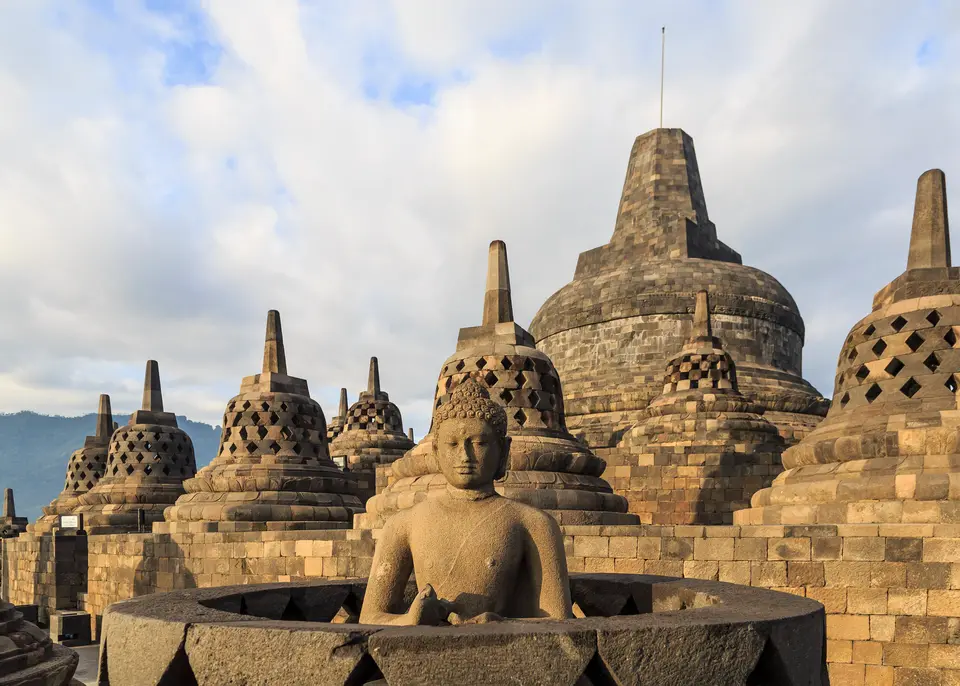
Above the narrative corridors sit 504 life-size lotus-seated Buddha statues: 432 placed inside external balustrade niches across the five Rupadhatu terraces (104 on the first, 104 on the second, 88 on the third, 72 on the fourth, and 64 on the fifth) displaying directional hand mudras for East, South, West, North, and the vitarka mudra on the fifth terrace, and 72 statues enclosed inside bell-shaped perforated stupas (32 on the first circular terrace, 24 on the second, and 16 on the third) displaying the dharmachakra mudra of turning the Buddhist Dharma around the empty central dome. Volcanic ash once buried the terraces. Abandoned between 928 and 1006 when King Mpu Sindok shifted the Mataram capital to East Java and following the 15th-century conversion to Islam, though remembered in Mpu Prapanca's 1365 Nagarakretagama and the 1709 and 1757 chronicles of Babad Tanah Jawi and Babad Mataram, the jungle-clad monument was brought to global notice in 1814 by British lieutenant-governor Thomas Stamford Raffles via Dutch engineer Hermann Cornelius, fully cleared in 1835 by Christiaan Lodewijk Hartmann, documented by Frans Carel Wilsen, Jan Frederik Gerrit Brumund, Conradus Leemans (1873), and photographer Isidore van Kinsbergen (1872), restored between 1907 and 1911 by Theodoor van Erp, and rescued after Soekmono's 1968 campaign through a 1975 to 1982 UNESCO and Indonesian anastylosis overhaul that dismantled, cleaned, and waterproofed over one million stones.
Ascending the Mandala Galleries and Walking the Three-Temple Pilgrimage
Because the soft volcanic soil, heavy tropical rains, seismic events like the 2006 Yogyakarta earthquake, the 2010 Mount Merapi ashfall (which required dismantling 55,000 stones to clear clogged drains), the 2014 Kelud eruption, and the feet of millions of visitors have worn down 1,028 of the monument's 2,033 stone stair steps, conservation rules introduced since 2014 and 2020 strictly regulate access to the upper structure.
- Mendut and Pawon temples along the eastern approach: Before reaching the main hill, follow the traditional Waisak (Vesak Day) pilgrimage path practised each May or June full moon by starting three kilometres east at Mendut Temple and continuing through Pawon Temple. Surveying these two smaller 9th-century shrines, which share Borobudur's 4:6:9 architectural proportions and align along a straight east-west sightline across the Kedu Plain, illuminates Jan Lodewijk Moens's and Giulio Magli's studies of the solar zenith ritual connecting the three sanctuaries.
- Clockwise Pradakshina through the four narrative galleries: Wearing the protective bamboo-fibre footwear provided by the park and accompanied by a registered guide within the 1,200-visitor daily ascent quota, pause at the exposed southeastern corner of the base to view the uncovered Karmavibhanga reliefs before climbing the wooden-sheathed eastern stairs. Walk clockwise around the first and second Rupadhatu galleries to trace the Lalitavistara life of Prince Siddhartha, the Jataka animal fables, and the carved double-outrigger Borobudur Ship, then ascend through the third and fourth galleries following Sudhana's quest in the Gandavyuha.
- Arupadhatu circular terraces and the Karmawibhangga and Samudra Raksa museums: Step out from the enclosed square corridors onto the three open circular Arupadhatu platforms, where 72 lattice-pierced bell stupas frame views across the palm-forested Kedu Plain toward the smoking cone of Mount Merapi. After descending via the northern stairway, walk north through the park grounds to visit the Karmawibhangga Museum, which houses Theodoor van Erp's dismantled chattra pinnacle stones and Casijan Chepas's 1890 photographs of the hidden foot, and the Samudra Raksa Museum housing the full-scale wooden ship that sailed from Indonesia to Africa in 2004.
