


























Quick Field Data
- UNESCO Inscription: 1983 (Criteria iv, vi; obligatory mid-Atlantic port of call for 15th- to 19th-century intercontinental sailing fleets and wind-adapted colonial urban ensemble reconstructed after the 1980 earthquake).
- Scale & Footprint: Occupies the historic central zone and the fortified Monte Brasil volcanic peninsula along the southern coast of Terceira Island within the 239.00-square-kilometre municipality of Angra do Heroísmo in the Azores, Portugal.
- Access & Ticketing: The urban street grid, Praça Velha, and public gardens are open continuously, while guided entry or separate admission applies to the Fort of São João Baptista, Sé Cathedral, and Palácio dos Capitães Generais, so check the official site.
- Arrival Logistics: Served by Lajes Airport on Terceira Island with direct flights to mainland Portugal and European destinations alongside inter-island connections across the Azores archipelago.
Mid-Atlantic Maritime Crossroads, Spanish Rule, and the Liberal Wars
Located along the southern shore of Terceira Island in the Azores archipelago of Portugal, Angra do Heroísmo (whose name derives from the Portuguese word angra for cove or bay) developed along an amphitheatre-like ridgeline overlooking two natural volcanic basins sheltered by the extinct volcano of Monte Brasil. Following Prince Henry the Navigator's donations between 1439 and 1449 and his March 1450 nomination of the Fleming Jácome de Bruges to colonize Terceira (alongside traditions crediting Álvaro Martins, who sailed with Didrik Pining and Bartolomeu Dias), early settlers established the town around 1478 above the deep 40-metre (130-foot) anchorage. In 1474, Álvaro Martins Homem diverted the local river into a stone-lined downhill channel to turn grain mill waterwheels below the high-ground fortress of the Castelo dos Moinhos (Castle of the Mills), allowing the valley floor on either side to be laid out in a rectilinear gridiron street plan skewed by navigators and cartographers to deflect prevailing Atlantic winds.
Officially raised into a city on 21 August 1534 and chosen that same year by Pope Paul III as the seat of the Diocese and Archbishop of the Azores, Angra functioned from the 15th to the 19th centuries as the obligatory mid-Atlantic port of call for caravels and galleons sailing between Europe, equatorial Africa, and the East and West Indies. Born at Guimarães, nobleman Pero Anes do Canto (1480 to 1556) was nominated in 1527 as Purveyor to the Armada of the Islands, a hereditary office held by the Canto family for three hundred years to oversee fleet welfare, customs, and naval defences. When Philip II of Spain claimed the Portuguese throne in 1580, rival claimant António, Prior of Crato (defeated on 25 August 1580 at Alcântara by Spanish Habsburg forces under the Duke of Alba, Fernando Álvarez de Toledo) established an opposition government in Angra until 1583 with French backing under Filippo di Piero Strozzi. After Spanish captain Pedro Valdez shelled Angra's bay on 5 July 1581 and landed one thousand Castilians at Salga Bay (12 kilometres east at Vila de São Sebastião) on 25 July 1581, heroine Brianda Pereira and friar Pedro famously drove over a thousand head of cattle into the Spanish ranks to win the Battle of Salga Bay, before Admiral Álvaro de Bazán (the 1st Marquis of Santa Cruz) defeated the allied privateer fleet off Ponta Delgada on 26 July 1582 and won the Battle of Terceira on 27 July 1583, writing to Philip II from Angra on 9 August 1583 to propose the Spanish Armada.
During the Anglo-Spanish War (1585 to 1604), Italian military engineer Giovanni Vicenzo Casale redesigned the Monte Brasil defences against English privateers Francis Drake and Walter Raleigh; when Portugal restored independence in 1640, island leaders Francisco Ornelas da Câmara alongside João de Bettencourt besieged Spanish governor Álvaro de Viveiros for eleven months (27 March 1641 to 4 March 1642) from trenches around the Solar de Madre de Deus to reclaim the fortress. After sheltering exiled King Afonso VI for seven years from 1667 under his brother Pedro II and young writer Almeida Garrett between 1809 and 1818, Terceira became the liberal headquarters during the Liberal Wars after liberals deposed Captain-General Manuel Vieira de Albuquerque Touvar on 22 June 1828 and repulsed a Miguelist assault at the Battle of Praia da Vitória on 11 August 1829, prompting Queen Maria II (Maria da Glória, who lived on Terceira between 1830 and 1833 before her forces triumphed the following year) to grant the city its royal title of Heroísmo alongside its motto as a Very Noble and Loyal city. Later 19th-century visitors included Charles Darwin aboard HMS Beagle (20 to 25 September 1836), the Confederate commerce raider CSS Alabama commissioned outside Angra on 24 August 1862, and exiled Gaza emperor Ngungunhane (the Lion of Gaza, captured at Chaimite in 1895 by Joaquim Mouzinho de Albuquerque), who died in Angra on 23 December 1906.
Interlocking Coastal Fortifications, Baroque Convents, and Vernacular Stonework
The architectural fabric of Angra do Heroísmo unites 400-year-old military bastions with Mannerist and Baroque religious monuments. Towering over the western peninsula, the volcanic cinder cone of Monte Brasil is crowned by the Fort of São João Baptista (built initially as the Fort of São Filipe during Philip II's rule), whose primary bulwark and 4-kilometre (2.5-mile) circuit of stone walls mounted four hundred pieces of artillery around parade grounds and the post-1642 Church of São João Baptista. Across the Bay of Angra facing the historic Porto de Pipas (or Port of Barrels) stands the 16th-century Fort of São Sebastião (now adapted into one of Portugal's forty-odd historic pousadas), whose cannon ranges interlocked with Monte Brasil, the small coastal redoubt of Forte de Santo António on Monte Brasil, the 1581 Forte do Negrito (now the Azorean Museum of Military History), and the 1567 Forte Grande de São Mateus da Calheta (built after French pirate Pierre Bertrand de Montluc's raid).
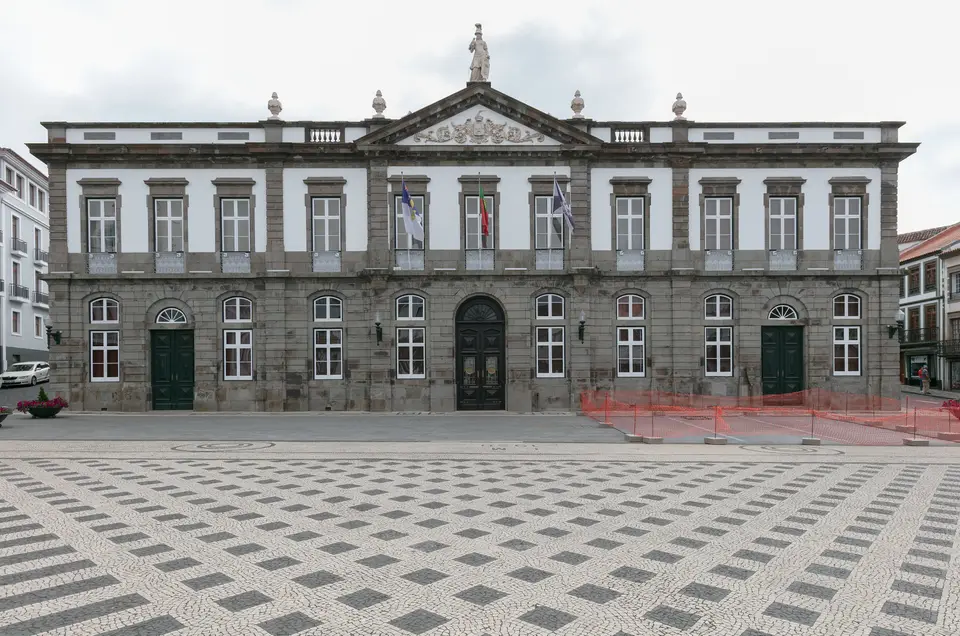
Around the middle of the skewed urban grid opens the broad Praça Velha (also known as the Praça de São Cosmo e Daimão or Praça dos Restoradores), paved in white limestone and black basalt Portuguese pavement stone and reshaped under the urbanism reconstruction initiative following the 1755 Lisbon earthquake; once the site of Sunday livestock markets, public hangings, and concerts by the 10th Chasseur regiment band after 1879, it is anchored by the Câmara Municipal (City Hall). Down by the primitive wharf of the Patio da Alfândega stands the 16th-century long-house Customshouse (Alfândega de Angra do Heroísmo) beside the Cais da Alfândega and Cais da Silveira. Every street slopes toward the cove.
Nine historic convents and grand Baroque churches (decorated inside with carved gilded woodwork alongside rich exotic woods imported from Brazil) punctuate the central parishes: the Cathedral of Santíssimo Salvador da Sé alongside the Baroque churches of the Misericórdia and Espírito Santo, the convents of the Franciscans and Jesuits, the 1542 Clarisse Convent of São Gonçalo founded by Brás Pires do Canto (which survived until 1832), and the Igreja da Nossa Senhora da Guia on the Ladeira de São Francisco, where seafarer Paulo da Gama is buried after accompanying his brother Vasco da Gama to India in 1497. Noble civic manors include Pero Anes do Canto's 16th-century Manor and Chapel of Nossa Senhora dos Remédios, the Solar de Dona Violante do Canto, the Solar do Conde de Vila Flor, the 17th-century Palácio Bettencourt (housing the public library and regional archives containing 400,000 books alongside two million historical documents), and the 16th-century Jesuit College of Santo Inácio near Largo Prior do Crato, converted in 1766 into the Palácio dos Capitães Generais.
Walking the Port Axis, Monte Brasil Ramparts, and Historic Squares
The compact layout of Angra's central zone allows visitors to link the harbour quays, the cathedral quarter, and the volcanic citadel on foot.
- Starting at the Harbour and Praça Velha: Begin at the Patio da Alfândega by the 16th-century Customshouse and the underwater archaeological park of the Bay of Angra (Parque Arqueológico Subaquático), which protects submerged shipwrecks and the Cemetery of Anchors (Cemitério das Âncoras). Walk past the Church of the Misericórdia up into the black-and-white mosaic pavement of the Praça Velha, then ascend through the terraced gardens of the Jardim Duque da Terceira to the 19th-century Alto da Memória obelisk, built on the ruins of the 16th-century Castelo dos Moinhos (Castle of São Cristóvão) in honour of King Peter IV, for a panorama over the city.
- Exploring the Cathedral and Captains-General Palace: Inspect the Baroque Cathedral of Santíssimo Salvador da Sé, the tomb of Paulo da Gama inside the Igreja da Nossa Senhora da Guia, the 1542 Convent of São Gonçalo, and the 17th-century Palácio Bettencourt archive, then tour the Palácio dos Capitães Generais and adjacent Jesuit College church near Largo Prior do Crato.
- Looping the Monte Brasil Peninsula: Walk past the Porto de Pipas or visit the 16th-century Fort of São Sebastião on the eastern headland, then pass through the stone gateway of the Fort of São João Baptista to hike the 4-kilometre curtain wall around the volcanic crater of Monte Brasil to the viewpoints of Miradouro do Pico das Cruzinhas and Forte de Santo António.
The 1980 Earthquake Reconstruction and Living Island Traditions
On 1 January 1980, a major earthquake struck Terceira, severely damaging the historic centre of Angra do Heroísmo; within four years, the city's monumental churches and vernacular residences were meticulously repaired and rebuilt, securing UNESCO World Heritage inscription in 1983. Tempered by the Gulf Stream with mild summer temperatures around 24 to 25 degrees (never exceeding 30 degrees), the municipality of 19 civil parishes and 35,402 residents (2011 census) balances academic life at the University of the Azores Department of Agrarian Sciences and the 1942 Terceira Island Historical Institute with chapels of the Cult of the Holy Spirit (each known as an Império) and traditional touradas à corda (rope bullfights held with four fighting bulls between May 1 and September 30). Discover more Atlantic maritime ports in our UNESCO World Heritage Atlas.
