


























Quick Field Data
- UNESCO Inscription: 1987 · Criteria (ix), (x).
- Scale & Footprint: 526,000 ha (5,260 square kilometres or 1,300,000 acres) in south-eastern Cameroon, with 90% of its surface left in an undisturbed state.
- Access & Ticketing: Entry is managed by Dja Conservation Services (DCS) under a conservator; check the official site for current research or visitor permit procedures.
- Arrival Logistics: Bordered almost completely by the natural course of the Dja River in south-eastern Cameroon inside the wider Congo Basin forest block.
Equatorial River Loop and Geological Basin
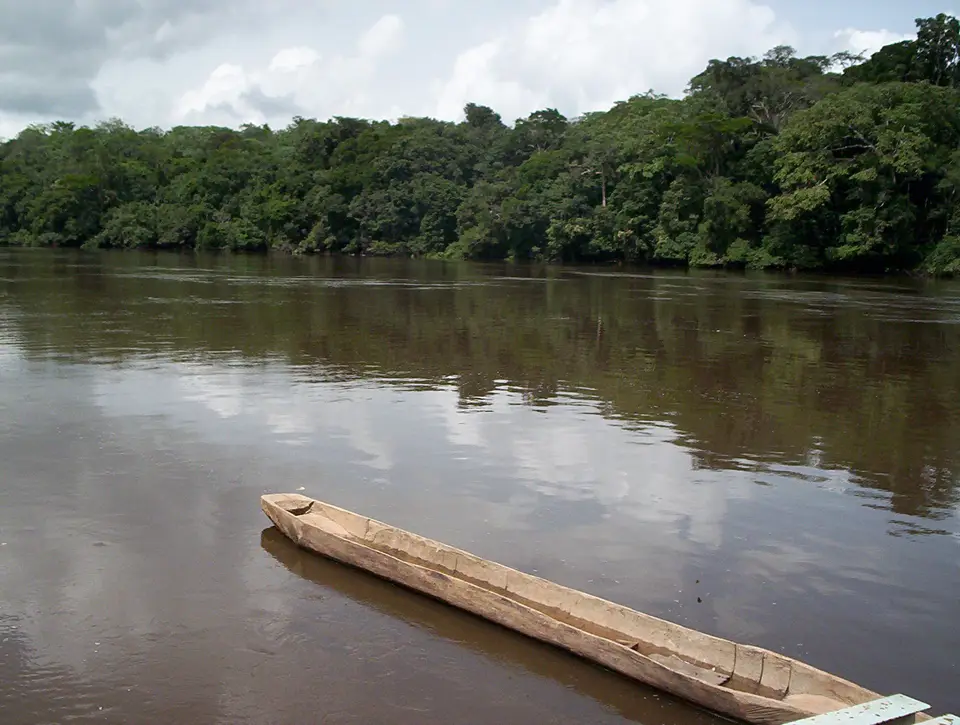
After 1987, the UNESCO World Heritage Atlas in 1987 under Criteria (ix) and (x), the Dja Faunal Reserve (known in French as Réserve de faune du Dja or Réserve de Biosphère Dja) occupies 526,000 hectares of dense equatorial rainforest in south-eastern Cameroon. The forest remains largely untouched. Roughly 90% of its 5,260 square kilometres (1,300,000 acres) stays completely undisturbed by industrial logging or agricultural conversion. What gives this reserve its unusual geographic security is the Dja River itself, as the waterway wraps almost completely around the territory to form a natural moat before feeding into the wider Congo Basin.
First founded in 1950 and inscribed as a World Heritage site in 1987 during the eleventh session, the reserve forms an integral component of the dense tropical rain forests that blanket the Congo Basin. Because the river loop isolates the interior forest from surrounding road networks together with large-scale plantations, human pressure was low when the site joined the international register. Inside the reserve boundaries, topographical diversity combines with three distinct biogeographical and geological influences to create a varied forest ecosystem where ongoing ecological evolution unfolds without modern industrial interruption. Across the broader central African forest block, the reserve adjoins the Congolese protected area of Odzala-Kokoua National Park together with the Gabonese territory of Minkébé National Park to form the transboundary TRIDOM zone, a critical regional landscape dedicated to safeguarding the primary rainforest habitats of the Congo Basin.
On the ground, visitors and researchers travelling by wooden pirogue along the Dja River witness a continuous green wall of primary equatorial vegetation rising directly from the water's edge. Away from the riverbanks, the rolling interior terrain supports a closed evergreen canopy interspersed with seasonal marshes alongside shaded stream valleys and natural forest clearings. Because commercial agriculture and professional hunting are strictly banned inside the reserve perimeter, the forest preserves the intact biological structure of central Africa's equatorial belt. This uninterrupted cover functions as a living benchmark for field scientists studying tropical forest dynamics alongside carbon storage and primate behavioural ecology across the three biogeographical zones that converge in south-eastern Cameroon.
Unlike fragmented forest islands elsewhere in West and Central Africa that have lost their large-bodied seed dispersers to timber concessions, the Dja peninsula retains the full ecological chain linking soil nutrients with fruiting canopy trees and wide-ranging mammals. Seasonal flooding along the bends of the Dja River deposits fresh alluvial sediment along the outer margins while the interior uplands drain through a network of shaded forest creeks. Consequently, the transition from riverine swamp forest to terra firme evergreen forest creates a mosaic of microhabitats across all 526,000 hectares, ensuring that fruiting cycles stagger throughout the calendar year to sustain resident frugivores and nomadic forest herds alike.
Canopy Botany and Primate Refugia
Botanical surveys have recorded more than 1,500 known plant species within the Dja Faunal Reserve, forming a multi-layered rainforest canopy that shelters an extraordinary concentration of forest wildlife. Across the reserve, biologists have documented 107 mammal species (over 100 mammal species in initial inventories, five of which are globally threatened) alongside more than 320 bird species. Primates represent one of the reserve's most celebrated biological strengths, with at least 14 primate species sharing the high canopy branches and shaded forest floor. Among these primates are five globally notable species: the western lowland gorilla alongside the chimpanzee, the white-collared mangabey, the mandrill, and the drill.
Because commercial timber extraction and professional hunting are excluded from the interior, family groups of western lowland gorillas and troops of chimpanzees forage across undisturbed fruiting trees and terrestrial herb patches. At the same time, drills, and mandrills and white-collared mangabeys move through the lower and middle strata of the forest. Sharing the dense understory with these primates are several of central Africa's flagship megafauna species. Herds of endangered forest elephants trace ancient paths between mineral-rich forest clearings and streams, accompanied by the shy, stripe-sided bongo antelope alongside the African forest buffalo and the elusive leopard, which acts as the apex predator of the rainforest interior.
These large mammals perform essential ecological work across the 1,300,000-acre sanctuary. Forest elephants and western lowland gorillas swallow large seeds from canopy fruits and deposit them kilometres away in sunny forest gaps created by fallen trees, directly regenerating the 1,500 plant species that make up the reserve's botanical wealth. Meanwhile, African forest buffaloes and bongos graze along the edges of natural marshy clearings, maintaining open glades within the dense equatorial timber where primates and terrestrial mammals gather to drink mineral-rich water.
Avian life across the reserve is equally rich, with more than 320 recorded bird species inhabiting the emergent treetops alongside river margins and tangled vine thickets. Foremost among the threatened birds of the reserve is the nearly extinct African grey parrot, which gathers in noisy flocks along riverine clearings and fruiting canopy crowns. Together, the 1,500 plant species alongside 107 mammal species and 320 bird species make the Dja loop a vital genetic reservoir for species that have vanished from more disturbed African equatorial forests.
Human Geography and Conservation Pressures
Beyond its biological wealth, the Dja Faunal Reserve and its surrounding forest zone are home to roughly 40,000 people, comprising settled Bantu farmers along the outer periphery and semi-nomadic Baka hunter-gatherers, for whom the rainforest remains a sacred living landscape. A population of Baka pygmies lives according to ancestral customs inside the protected perimeter, conferring a recognized cultural value upon the World Heritage site. Whilst commercial agriculture and professional hunting are prohibited inside the protected area, the Baka are permitted to hunt alongside fishing and gathering forest resources using traditional sustainable methods that conserve wildlife populations and native plants.
For the Baka communities, cultural identity, and spiritual beliefs and ecological knowledge is closely bound to the rhythms of the rainforest and passed down across generations through oral stories alongside songs and communal forest rituals. Their seasonal movement through the forest follows the ripening of wild fruits alongside the harvesting of wild yams and low-impact subsistence hunting that has coexisted with the forest fauna for centuries. By recognizing these customary rights while excluding industrial agriculture and commercial bushmeat hunters, the reserve model links biodiversity preservation with indigenous cultural survival.
Day-to-day administration of the protected area is carried out by Dja Conservation Services (DCS), an administrative body led by a conservator with substantial technical and financial backing from international conservation partners and bilateral supporters operating in Cameroon. Protecting the 5,260-square-kilometre river loop requires constant river patrols alongside monitoring of the three biogeographical transition zones and community cooperation with both Baka camps and neighbouring Bantu farming villages so that the 90% undisturbed forest core continues to shelter its western lowland gorillas, chimpanzees, forest elephants, African forest buffaloes, bongos, leopards, and African grey parrots for future generations.
For travellers and conservation researchers alike, approaching the Dja loop along its winding river border reveals why this 526,000-hectare enclave holds such high standing within the Congo Basin conservation network. Every bend of the Dja River shields a self-contained equatorial world where 1,500 plant species alongside 107 mammal species and 320 bird species thrive beneath an unbroken tropical canopy, linking the biological wealth of south-eastern Cameroon directly to the wider TRIDOM rainforest block.
- Natural River Moat: The Dja River encircles nearly the entire 526,000-hectare reserve in south-eastern Cameroon, creating an isolated peninsula of Congo Basin rainforest linked to the wider TRIDOM conservation zone.
- Primate Sanctuary: At least 14 primate species inhabit the canopy and understory, led by western lowland gorillas alongside chimpanzees, drills, mandrills, and white-collared mangabeys among 107 mammal species.
- Baka Forest Heritage: Indigenous Baka pygmy communities maintain traditional semi-nomadic foraging practices inside the reserve alongside more than 1,500 plant species and 320 bird species.
