Quick Field Data
- UNESCO Inscription: Cultural World Heritage Site (Ref. 902), inscribed in 1999 under Criteria (iii) and (v).
- Scale & Footprint: 33 hectares encompassing the fortified hilltop Citadel (Cetatea) and adjoining historic core along the Târnava Mare valley in Mureș County, central Romania.
- Access & Ticketing: Walking cobbled citadel lanes, town squares, and Scholars' Stairs stays completely free year-round, while Clock Tower museum galleries and churches charge small local admission fees.
- Arrival Logistics: Avram Iancu Cluj International Airport (CLJ) lies 106 km northwest as the main hub, while Târgu Mureş Transilvania International Airport (TGM) sits 40 km northwest with limited routes. Bucharest sits 224 km southeast across the Carpathians.
Transylvanian Saxon Frontier Origins Above the Târnava Mare
Rising on river terraces along the left bank of the meandering Târnava Mare River inside Romania's historic Transylvania region, Sighişoara Romania pairs strategic medieval fortification with living residential streets. Starting in the mid-twelfth century, Hungarian King Géza II invited German craftsmen and merchants, known as Transylvanian Saxons (Siebenbürger Sachsen), to settle and guard his frontier while strengthening the regional economy. Chronicler Krauss noted a Saxon settlement here by 1191, and a 1280 charter records the hexagonal town built on an old Roman fort site as Castrum Sex (six-sided camp).
Recorded in early medieval charters as Schaäsburg (1282), Schespurg (1298), and Segusvar (1300) across German, Latin, and Hungarian variants, the hill settlement achieved royal centre prominence by 1337 and gained formal city rank in 1367 as Civitas de Segusvar. Skilled artisans travelled from across the Holy Roman Empire to join local German workshops, dominating both urban commerce and perimeter fortification. At its sixteenth-century and seventeenth-century height, Sighişoara sustained 15 guilds and 20 handicraft branches behind its stone walls.
Around 1435, exiled Wallachian voivode Vlad Dracul minted local coins (an exceptional exception to Hungarian royal mint monopolies) and issued the oldest surviving charter displaying the Romanian name Sighişoara, derived from Hungarian Segesvár (where vár denotes a fort). His son Vlad III the Impaler, later famous worldwide as inspiration for Count Dracula, remains closely linked with the town's medieval history. Years of military occupations, fires, and plagues tested seventeenth-century residents, vividly documented in notary Georg Kraus's chronicles spanning 1606 to 1666, while Prince George Rákóczi won election as Prince of Transylvania and King of Hungary inside the town in 1631.
Modern history touched surrounding valleys during the nineteenth and twentieth centuries. On 31 July 1849, Russian imperial forces led by Lüders defeated Józef Bem's Hungarian revolutionary army nearby on the Albești plain at the Battle of Segesvár. Today visitors find both an 1852 monument honouring fallen Russian general Skariatin and an 1897 memorial commemorating Hungarian poet Sándor Petőfi, widely believed to have fallen in that engagement. Incorporated into Romania after the First World War, the town administers seven surrounding villages: Angofa, Aurel Vlaicu, Hetiur, Rora, Șoromiclea, Venchi, and Viilor. According to the 2021 census, the sighisoara romania population stands at 23,927 residents, comprising 65.69 percent Romanians, 12.57 percent Hungarians, and 2.93 percent Roma, shifting from 28,102 residents recorded in 2011 (when 1.5 percent identified as Transylvanian Saxons).
Guild Defence Towers, Clock Tower, and Citadel Houses
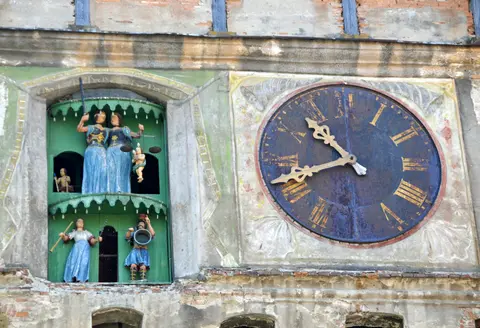
What distinguishes sighisoara romania citadel across eastern and southeastern Europe is its living two-tier layout dividing the fortified upper Citadel (Cetatea) from the lower valley town along the Târnava Mare. Medieval military writings required perimeter towers to operate for mutual defence while remaining self-sufficient strongholds equipped with internal hoists and underground passages so breaching one wall base or capturing one tower could not surrender the entire town. Towering 64 metres above the main archway stands the thirteenth-century Sighișoara Clock Tower (Turnul cu Ceas), today housing the city's history museum.
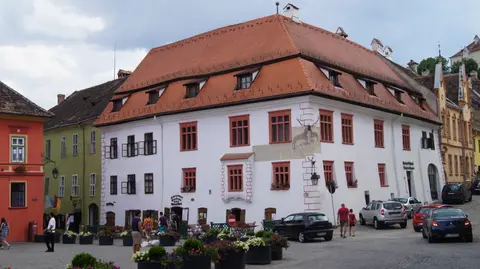
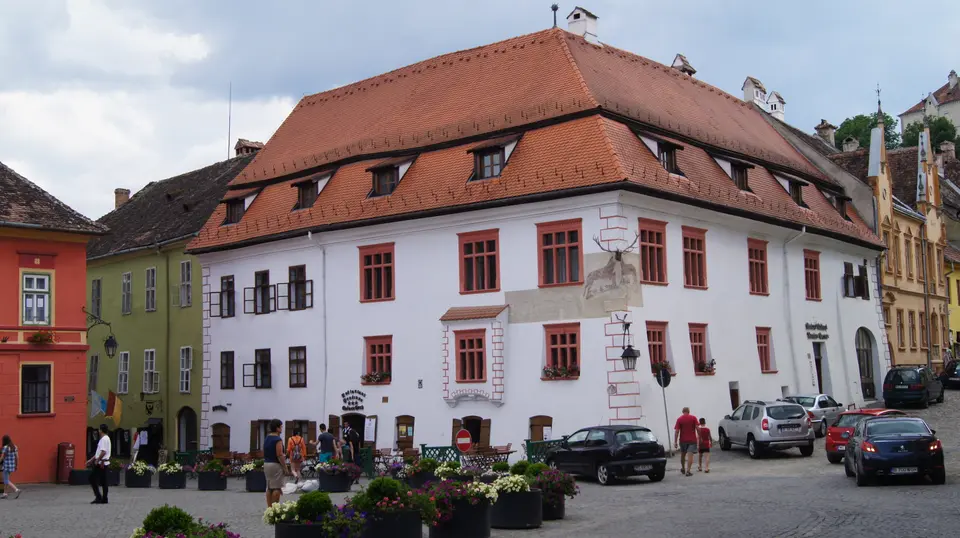
Around the fortified perimeter endure other guild-named bastions celebrating trades that funded and guarded each wall section. Visitors trace the Tinsmiths' Tower, Butchers' Tower, Bootmakers' Tower, Tailors' Tower, Furriers' Tower, Ironsmiths' Tower, Ropemakers' Tower, and Tanners' Tower, plus the Face Tower standing outside the citadel along the road toward Târgu Mureș. Inside the ramparts, roughly 164 houses at least 300 years old hold historical monument status framing rectangular Citadel Square (Piața Cetății). While noble residences on the square saw later alterations, quiet side lanes retain original medieval craftsman proportions.
Standout historic buildings inside the walled sector display centuries of Saxon urban craftsmanship and civic memory. Key houses include the Venetian House (Green House), Stag House (House with Antlers), Vlad Dracul's House, House on the Rock, House with Shingles (Evert, dedicated to crafts for the Educational Interethnic Centre for Youth), Guilders' Association House (La Perla), Josef B. Teutsch House, and the 1886 to 1889 former City Hall complex. Together these ochre, terracotta, and green facades preserve the street rhythm of an intact craftsmen's stronghold.
Stepping beyond Citadel Square reveals how sharply Sighişoara's historic social classes shaped different lanes across the hillcrest and valley floor. Most surviving medieval homes follow compact Saxon artisan plans built around workshop doorways and narrow courtyard wings, whereas wealthy merchant and patrician families erected grander corner residences with stone coats of arms and painted murals. Beneath the ramparts in the lower town along the Târnava Mare floodplain, nineteenth-century civic complexes grew outward around parish churches and rail links while leaving the cobbled hilltop fortress wholly intact. Walking from the riverside valley up steep stone lanes through the Clock Tower archway lets visitors trace that urban contrast on foot within minutes.
Across Transylvania, Sighișoara endures because residents never turned the medieval core into a deserted open ruin or seasonal tourist compound. Bakers, schoolchildren, and tradespeople pass daily under vaulted archways built seven centuries ago, keeping timbered roofs, lime-washed walls, and painted guild signs anchored in ordinary civic life.
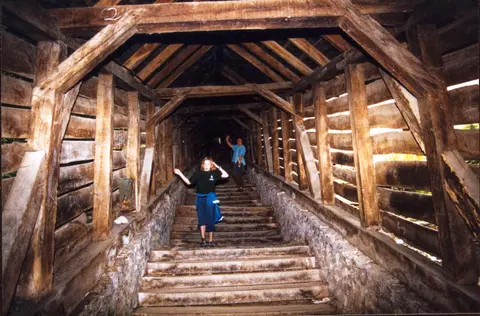
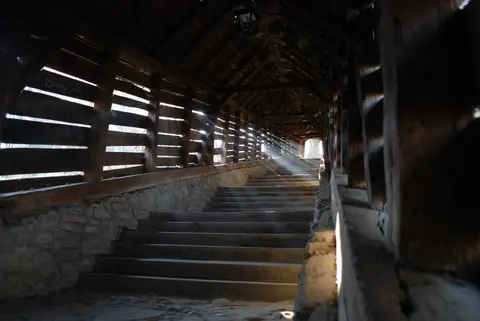
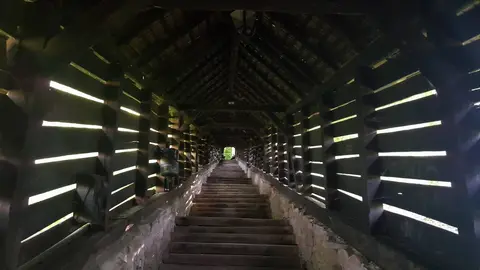
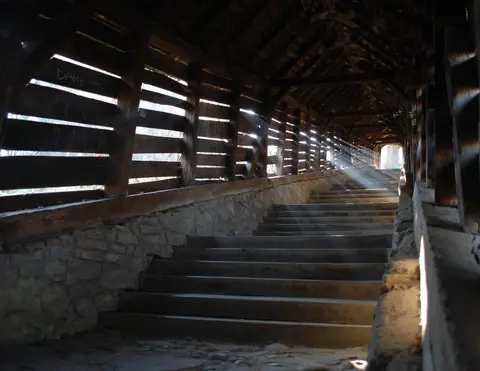
From the upper square, the roofed wooden Scholars' Stairs (Covered Staircase) climbs steeply toward the School on the Hill (Joseph Haltrich High School) and the Gothic Church on the Hill (Biserica din Deal), ranked among Romania's finest Gothic buildings. Near the Clock Tower stands the early thirteenth-century Gothic Monastery Church (Biserica Mânăstirii Dominicane), uniquely lacking a bell because Saxon residents judged the hilltop church bell enough for the entire town. Completing the town's religious landmarks are Saint Joseph Roman Catholic Church, Leprosy Church, the old Orthodox church, and the lower town's Orthodox Cathedral, supplemented by surviving art from resident Baroque sculptor Elias Nicolai.
Notable citizens born or active in Sighişoara extend well beyond medieval guild masters. Historic figures include Transylvanian Saxon archaeologist Johann Michael Ackner, architect Friedrich Grünanger, and seventeenth-century mystic Johannes Kelpius, who immigrated to Pennsylvania to establish a religious community. Later names span feminist leader Marie Stritt, Lutheran bishop Georg Daniel Teutsch, folk guitarist Adrian Ivanițchi, and Romanian sportsmen and women Radu Voina, Gabriel Mureșan, Doina Cojocaru, and Ralph Gunesch.
Sighișoara Medieval Festival, Conservation, and Valley Geography
Surrounding the fortified terrace, Mureș County terrain rises gently along the Transylvanian Depression and Târnava Plateau. North of the river rise the Jacod Hills, while to the south sits the Vânători Plateau (550 to 600 metres), part of the broader Hârtibaciu Plateau, topping out at 698 metres on Dealul Icoanei near Aurel Vlaicu and 560 metres inside town on Dealul Bisericii. The gentle Târnava Mare winds below a gradient under 1.5 per thousand, fed by the western Șaeș stream together with Șercheș lake and Rusu lake. Enclosed valley slopes foster morning fog and temperature inversions within a humid continental climate (Köppen Dfb) averaging 10 degrees Celsius and 650 to 700 millimetres of annual rain. Recorded extremes reached minus 33.3 degrees Celsius on 23 January 1963 and 38.8 degrees Celsius on 25 August 2012.
Active civic protection keeps Sighişoara authentic rather than commercialised. Between 2001 and 2003, local civil society groups, historians, and international critics halted plans for a Dracula theme park inside the nearby Braite nature preserve, defending both medieval street integrity and ancient woodland. Today, low-impact tourism thrives along the Via Transilvanica long-distance trail and during the annual July Sighișoara Romania medieval festival inside the Citadel, filling Piața Cetății with traditional crafts and music.
Access Zones Across Sighișoara Citadel and the Lower Town
Walking between the hilltop citadel and river terraces divides things to see in Sighișoara Romania cleanly into four walkable sectors inside the 33-hectare core.
| Complex Zone | Key Highlights | Access & Ticket Rule |
|---|---|---|
| Clock Tower and Monastery Quarter | 64-metre Clock Tower history museum, Monastery Church, and Vlad Dracul's House. | Exterior square lanes stay free year-round; Clock Tower museum galleries charge local tickets. |
| Citadel Square and Guild Towers | 164 historic burgher houses, Stag House, Venetian House, and perimeter guild bastions. | Walking perimeter walls and Piața Cetății stays free at all times; selected towers host exhibits. |
| Scholars' Stairs and Church on the Hill | Covered timber staircase, Joseph Haltrich High School, Gothic hilltop church, and Saxon cemetery. | The covered timber walkway remains open freely to pedestrians; church nave entry requires local admission. |
| Lower Valley Town and Târnava Mare | Orthodox Cathedral, Leprosy Church, former 1889 City Hall complex, and riverside paths. | Streets, rail station walks, and valley trails stay free year-round with local dining and lodging. |
Guild Bastions, Timbered Scholars' Stairs, and Bell-Free Nave
Wandering quiet cobblestone alleys early in the morning brings out three material details defining Sighișoara's Saxon urban architecture.
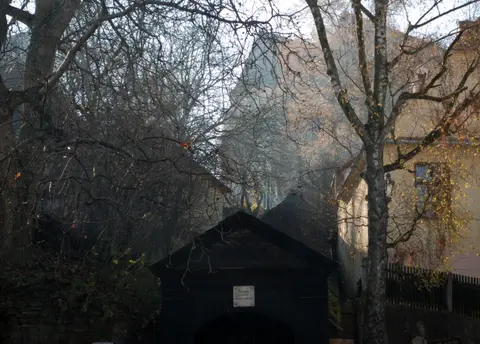
- Bell-free Gothic nave at the Monastery Church: Look across the roofline next to the Clock Tower to notice a tall Gothic church completely lacking a bell tower, relying instead on the hilltop parish bell.
- Boarded incline of the Scholars' Stairs: Climb through the shaded timber gallery built straight up the hill slope to feel how steep shingle roofing shielded pupils travelling to the School on the Hill in winter snow.
- Independent masonry bastions around the ring wall: Trace where each guild financed and fortified its own enclosed defensive tower along the hillside rim so any single wall breach remained isolated.
Best Time to Visit, Airports, and Travel from Bucharest
Exploring things to do in Sighișoara Romania works smoothly from May through September, when dry valley days suit hillside walks up the covered stairs and open squares around Piața Cetății. Travellers hoping to attend the annual Sighișoara Romania medieval festival plan visits for July, whereas late spring and September offer mild daytime warmth without midsummer crowds. Winter valley mist rising off the Târnava Mare gives cobbled lanes atmospheric depth, though steep stone ramps require steady winter footwear. Visitors walking out past the citadel walls can also join segments of the Via Transilvanica trail winding across surrounding Transylvanian plateaus, connecting medieval Saxon craft towns with quiet rural villages and oak woodlands. Staying overnight inside historic burgher houses reveals hushed morning light across pastel streets before day-trip coaches arrive.
Understanding how to get to Sighișoara Romania by rail or air is simple despite its tucked-away Transylvanian valley setting. Direct Romanian rail lines connect Bucharest (224 km southeast) overland across the Carpathians right into Sighișoara's lower-town station below the citadel hill, simplifying sighisoara romania to bucharest journeys without renting a car. Air travellers checking Sighișoara Romania airport connections fly into Avram Iancu Cluj International Airport (CLJ) 106 km northwest as the main international hub. Smaller Târgu Mureș Transilvania Airport (TGM) sits 40 km northwest with limited flight options, pairing smoothly with historic European cities across the UNESCO World Heritage Atlas.