


























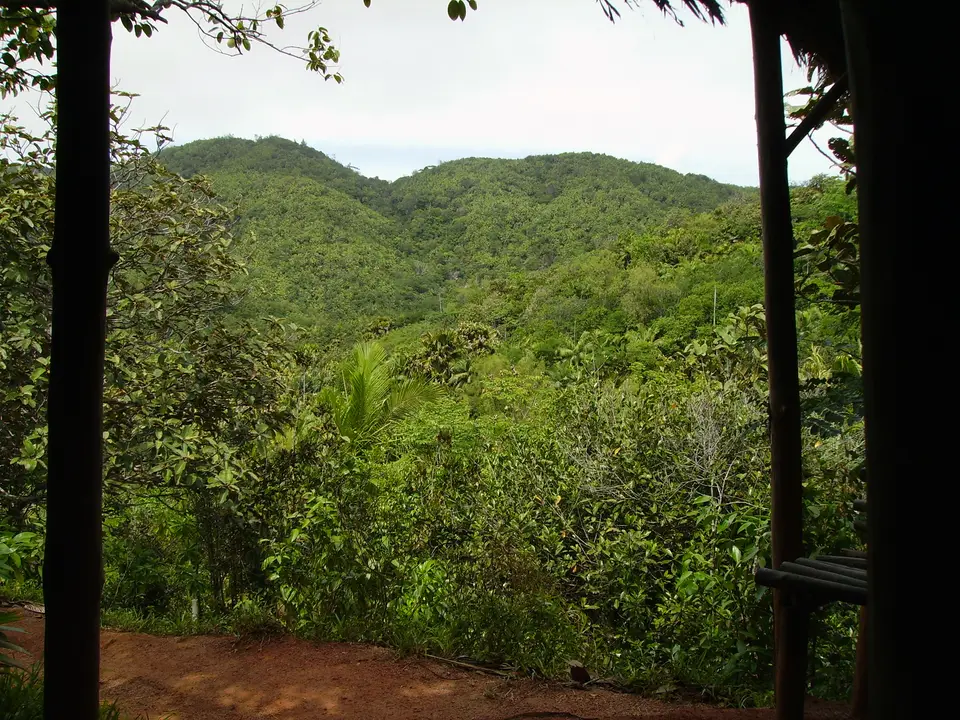
Quick Field Data
- UNESCO Inscription: 1983 · Criteria (vii), (viii), (ix), (x).
- Scale & Footprint: 19.5 hectares (48 acres) of primeval palm forest inside the 37-square-kilometre granitic island of Praslin.
- Access & Ticketing: Managed and maintained by the Seychelles Islands Foundation; visitors enter along marked forest footpaths from the central valley gate.
- Arrival Logistics: Located in the middle of Praslin Island in the Seychelles, about 45 kilometres (28 miles) north-east of Mahe in the Indian Ocean.
A Granitic Gondwana Microcontinent and the Garden of Eden Legend
Set in the lower valley of a stream near the centre of Praslin Island, the second-largest island in the Seychelles, covering 37 square kilometres (14 square miles) and measuring 11 by 5.5 kilometres (6.8 by 3.4 miles), where the highest peak of Fond Azore reaches 373 metres (1,224 feet) about 45 kilometres (28 miles) north-east of Mahe, the Vallée de Mai Nature Reserve ("May Valley") protects 19.5 hectares (48 acres) of ancient palm forest in a near-natural state. Recognised on the UNESCO World Heritage Atlas in 1983 under all four natural criteria (vii, viii, ix, and x), it ranks among the smallest natural sites on the World Heritage List. Unlike the volcanic or coralline islands typical of the Indian Ocean, Praslin and its neighbours consist of Precambrian granite, forming a continental "microcontinent" left behind between present-day Madagascar and India when the ancient supercontinent of Gondwana broke apart. Because of this geological isolation, the low- and intermediate-altitude palm forest of the Vallée de Mai acts as a living evolutionary laboratory, preserving a relict plant and animal community from prehistoric times before more advanced plant families spread across the tropics.
Before human settlement reached the archipelago, the gigantic double-nut seeds of the valley's flagship palm washed out to sea and drifted on Indian Ocean currents, leading mariners to believe the nuts grew on submerged trees in the depths of the sea, hence the name coco de mer. When British General Charles George Gordon visited Praslin on a military mission in 1881, he conducted a Kabbalistic reading of the Book of Genesis and proclaimed that the Vallée de Mai was the terrestrial Garden of Eden. In Gordon's theory, the endemic coco de mer palm was the biblical tree of knowledge of good and evil (with its suggestively shaped double nut acting as the forbidden fruit), while the introduced breadfruit tree was the tree of life. Although writer H. Watley Estridge pointed out to Gordon that Eve could never have bitten through the fruit's 10-centimetre (3.9-inch) fibrous husk, the legend brought lasting international fame to the "Coco-de-mer" valley.
The valley remained an undisturbed virgin forest until the 1930s, when limited plantings of coffee and pineapple and ornamental palms were introduced alongside native palm supplementation. Legal protection began on 18 April 1966 when the valley was declared a protected reserve through Regulation S.I. 27/1696 under the Wild Birds Protection enactments, followed by the 1978 Coco-de-Mer Management Decree and re-designation within Praslin National Park under the 1979 Nature Conservancy and National Parks legislation (Cap. 159, S.I. No. 57) and the Praslin National Park (Designation) Order of 1979. Managed by the Seychelles Islands Foundation (as confirmed through July 2025), conservation teams continue active work to remove exotic coffee and pineapple alongside ornamental plants so the primeval palm canopy remains intact.
Lodoicea maldivica and the Five Companion Endemic Palms
Canopy life in the Vallée de Mai is dominated by the world's largest natural population of the endemic coco de mer (Lodoicea maldivica), a giant monocot belonging to the palm family Arecaceae and numbering some 4,000 to 5,000 individual trees split equally between male and female plants. Supported at the base by tough stilt roots where root and trunk are hard to distinguish, the palm grows to a height of 25 to 34 metres (82 to 112 feet). Its crown spreads fan-shaped fronds measuring 7 to 10 metres (23 to 33 feet) in length and 4.5 metres (15 feet) in width atop rigid 4-metre (13-foot) petioles. Female palms bear round or oval fruits covered in a 10-centimetre husk that enclose the largest double-nut seed in the plant kingdom, with the heaviest recorded fruit weighing 42 kilograms (93 pounds).
What makes the 19.5-hectare valley unique in the Seychelles and the entire Indian Ocean is that all six palm species endemic to the Seychelles occur together here in their ancient evolutionary state. Alongside Lodoicea maldivica grow five companion endemic palms: the millionaire's salad (Deckenia nobilis), the thief palm (Phoenicophorium borsigianum), the Seychelles stilt palm (Verschaffeltia splendida), the latanier millepattes (Nephrosperma vanhoutteanum), and the latanier palm (Roscheria melanochaetes). Beneath the dappled sunlight filtering through green, red, and brown palm fronds stand dense groves of Pandanus screw palms, Chrysobalanus icaco (cocoplum), and two notable endemic broadleaf trees: Dillena furruginea (known locally as bwa rouz) and Northia hornei (the kapisen), while flowering takamaka trees frame the reserve entrance.
The Seychelles Black Parrot, Geckos, Caecilians, and Stream Life
The dead standing trunks and fruiting crowns of the ancient palms provide essential habitat for the rare Seychelles black parrot (Coracopsis barklyi), an enigmatic endemic bird related to the vasa parrots of Madagascar that nests almost exclusively in hollow coco de mer trunks and feeds on valley fruits. Five other prominent bird species share the canopy: the Seychelles blue pigeon (Alectroenas pulcherrimus), the Seychelles bulbul (Hypsipetes crassirostris), the Seychelles sunbird (Nectarinia dussumieri, often seen sipping nectar from flowering takamaka trees at the entrance), the Mascarene swiftlet (Collocalia francica), and the Seychelles kestrel (Falco araea), while shy tenrecs introduced from Madagascar forage on the forest floor.
Reptiles, amphibians, and molluscs thrive across every level of the palm forest. Clinging to the trunks and male palm catkins are the Seychelles giant day gecko (Phelsuma sundbergi), the Seychelles small day gecko (Phelsuma astriata), and the nocturnal Seychelles bronze gecko (Ailuronyx seychellensis), alongside the tiger chameleon (Archaius tigris). On the leaf-strewn floor move the Seychelles skink (Trachylepis seychellensis), Wright's skink (Mabuya wrightii), Scelotes braueri, and Gardiner's burrowing skink (Pamelaescincus gardineri), hunted by three harmless snakes: the Seychelles house snake (Boaedon geometricus), the Seychelles wolf snake (Lycognathophis seychellensis), and the blind snake (Ramphotyphlops braminus). Hugging the broad palm leaves are Seychelles treefrogs (Tachycnemis seychellensis), while the deep moist soil layers shelter six species of worm-like burrowing caecilians. Two endemic land snails, the pointed-shell Praslin snail (Pachnodus paslinus) and the large Stylodonta studeriana, graze on the flowers of male coco de mer catkins, and the valley stream harbours freshwater crustaceans and the golden panchax (Pachypanchax playfairi), the sole endemic freshwater fish native to the Seychelles archipelago.
Walking the Valley Trails and Conservation Etiquette
Stepping beneath the giant fronds of the Vallée de Mai feels like entering a prehistoric cathedral of rustling palm leaves. Dappled light shifts across red, green, and brown fronds high overhead. Since the protected palm valley covers just 19.5 hectares along the headwaters of a granite valley stream, visitors can explore the forest comfortably on foot without strenuous climbing. Botanical and travel studies of the archipelago, including Malcolm James Coe's 1998 botanical study on the granitic Seychelles and its endemic flowering flora (published by Princeton University Press, page 24) and Lyn Mair and Lynnath Beckley's 2012 Seychelles guide (Bradt Travel Guides, page 126), highlight how the 19.5-hectare valley preserves an intact slice of Gondwana evolutionary history. Even visitors with no formal training in tropical botany are struck by the sheer scale of the 25-to-34-metre palm canopy, the rustle of 7-to-10-metre fan leaves overhead, and the sight of male catkins visited by endemic geckos and twirled-shell Praslin snails while female palms carry double nuts weighing up to 42 kilograms. By maintaining strict biosecurity and gradually removing remnant coffee and pineapple alongside ornamental plantings introduced in the 1930s, the Seychelles Islands Foundation ensures that all six endemic Seychelles palms and their dependent birds, reptiles, amphibians, and stream fauna continue to thrive in their primeval state.
- Entry and Route Through the Palm Forest: Begin at the roadside entrance lined with flowering takamaka trees in central Praslin and follow the waymarked loop footpaths into the lower stream valley, pausing beneath the 25-to-34-metre trunks of Lodoicea maldivica to compare the long flowering catkins of the male trees with the heavy double-nut fruits of the female palms.
- Tickets and Trail Observation: Before crossing from Mahe or coastal Praslin, check the official site of the Seychelles Islands Foundation for current entry ticket rules and guided trail walks before arriving from Mahe or coastal Praslin. Along the shaded paths, look closely at the palm stems and leaf litter to spot Phelsuma day geckos, Archaius tigris chameleons, Pachnodus paslinus snails on the male flowers, and the rare Seychelles black parrot around hollow dead trunks.
- Timing and Onward Connections: Visit early in the morning when the Seychelles black parrot and Seychelles blue pigeon are most vocal and the tropical heat is mild, and stay strictly on the maintained trails without touching fallen seeds or fronds. To compare Praslin with other island ecosystems, consult our UNESCO World Heritage Atlas to discover other island sanctuaries across the Indian Ocean and Africa.
