Wenceslas Square and the New Town: A Walking Route
A self-guided walk through the boulevards where modern Czech history happened.
The New Town is less pretty than the Old Town and far more useful for understanding the country. Charles IV founded it in 1348 around wide market squares, and its long boulevards became the stage for the 20th century: crowds celebrated independence here in 1918, faced Soviet tanks in 1968 and filled the streets in November 1989 until the communist government fell. This route covers about 3 km and takes two to three hours with stops.
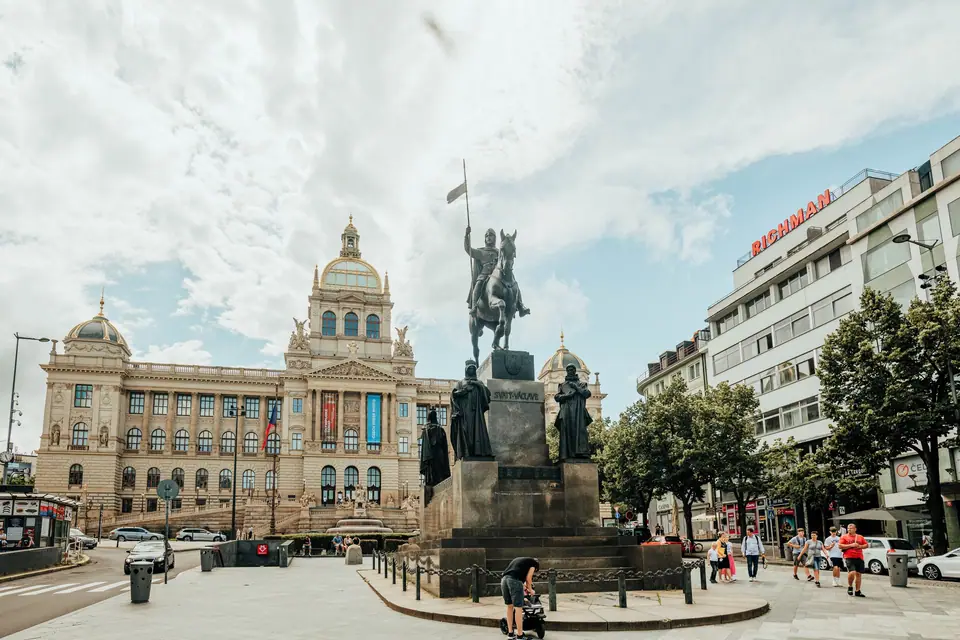
- The National Museum. The neo-Renaissance building at the top of Wenceslas Square reopened in 2018 after a long renovation. Look at the facade first: lighter patches in the stone mark where bullet holes from 1968 were filled. Inside, the domed pantheon holds statues of Czech writers and scientists, and an underground passage links to the museum's modern building next door.
- St Wenceslas and the Palach memorial. Below the museum stands Josef Václav Myslbek's equestrian statue of the country's patron saint, the traditional meeting point for protests. Just in front of it, a bronze cross set into the pavement remembers Jan Palach and Jan Zajíc, two students who set themselves on fire in 1969 in protest at the occupation.
- Down the square. Wenceslas Square is really a boulevard, about 750 metres long and originally Prague's horse market. Halfway down on the left, the Art Nouveau Hotel Evropa has been restored; opposite, the Melantrich building's balcony is where Václav Havel and Alexander Dubček addressed the crowds on 24 November 1989.
- The Lucerna passage. Turn into Vodičkova street and enter the Lucerna palace, built by Havel's grandfather. Under its glass dome hangs David Černý's St Wenceslas riding an upside-down dead horse, a joke at the expense of the statue you have just seen. The building also holds a historic cinema and the Lucerna Music Bar.
- The Franciscan Garden. A quiet walled garden behind the square, next to the Church of Our Lady of the Snows, whose unfinished Gothic choir has the tallest vault in Prague.
- Národní třída. In the arcade at number 16, a bronze plaque of raised hands marks where riot police beat student marchers on 17 November 1989, the night that started the Velvet Revolution. Around the corner, outside the Quadrio centre, Černý's giant rotating head of Franz Kafka turns in mirrored slices.
- The National Theatre. Built with money collected from ordinary Czechs, burned shortly after opening and rebuilt by 1883, its gold roof faces the river.
- The Dancing House. Walk south along the embankment to Frank Gehry and Vlado Milunić's 1996 building, nicknamed Ginger and Fred for its two towers leaning into each other.
- The Church of Sts Cyril and Methodius. On Resslova street, its crypt is where the Czechoslovak paratroopers who assassinated Reinhard Heydrich in 1942 made their last stand. Bullet marks still surround the crypt window, and a memorial exhibition tells their story.
The lower end of Wenceslas Square is lively by day and seedy late at night, with touts and strip clubs; our accommodation guide explains which streets to choose if you stay nearby.
Traveller tips
Real advice from people who have been to Wenceslas Square and the New Town: A Walking Route. Every tip is read by our team before it goes live.
No tips yet. Been here? Yours could be the first.
Thank you! Your tip will appear here after a quick review.
More in Prague
Continue exploring Prague with related neighbourhood, food, and planning guides