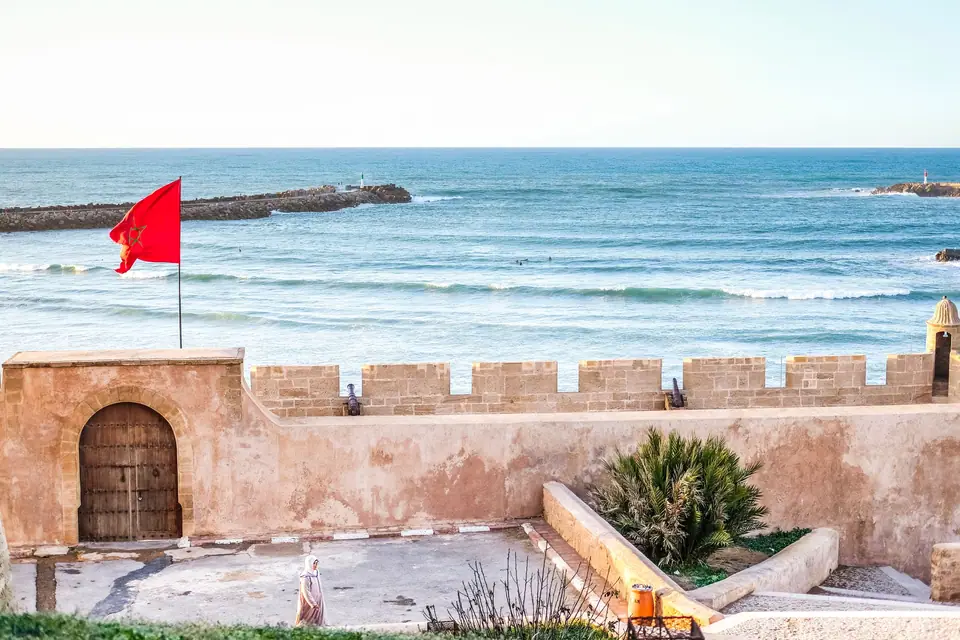
Kasbah of the Udayas, Andalusian Gardens and the Medina
Walking through the 12th-century cliffside fortress, ocean lookouts, mint tea terraces and craft lanes.
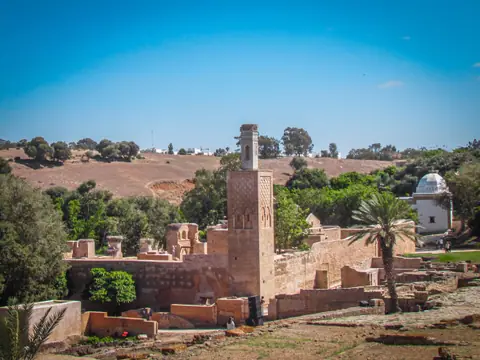
Perched on a rocky bluff where the Bou Regreg River empties into the Atlantic surf, the Kasbah of the Udayas (Kasbah des Oudayas) is the oldest and most atmospheric quarter of Rabat. Immediately south of its ochre walls spreads the 17th-century Medina, protected on the landward side by the straight Andalusian Wall and the wider outer ring of 12th-century Almohad ramparts.
Bab Oudaia, Rue Jamaa and the Semaphore ocean lookout
Approach the fortress up the wide stone steps from the riverfront tram stop to admire Bab Oudaia, built around 1195 under Almohad Caliph Yaqub al-Mansur. Carved from warm reddish-gold stone with concentric horseshoe arches scalloped in curvilinear patterns and Koranic inscriptions, it ranks among the masterpieces of Moorish military architecture. Step through the gate onto Rue Jamaa, the main spine of the living Kasbah residential quarter, where lower walls are washed in vivid indigo blue and upper storeys gleam bright white to deflect the Atlantic glare.
Halfway along Rue Jamaa stands El-Atiqa Mosque, the oldest mosque in Rabat (dating to 1150). Follow the lane all the way to its northern tip to emerge onto the broad stone Semaphore Platform (Plateforme du Sémaphore). From here you look straight down onto surfers riding Atlantic swells beside the jetty, the white houses of Sale across the river mouth, and the tiered Muslim cemetery tumbling down the seaward slope.
Cafe Maure and the Andalusian Gardens
Retrace your steps slightly and follow the southern wall of the Kasbah down toward the estuary to find the open-air Cafe Maure (Café des Oudayas). Seated on blue-and-white zellij benches beneath wooden pergolas overlooking the Bou Regreg and Sale's marina, waiters pour hot green tea steeped with fresh spearmint alongside plates of gazelle horns, honeyed sesame cookies and roasted almonds. Right beside the cafe, pass through an arched doorway into the Andalusian Gardens (Jardin Andalou), laid out during the early 20th-century French Protectorate around a 17th-century palace crafted by Moulay Ismail, now housing the National Jewellery Museum (Musée National de la Parure) with Amazigh silver fibulae, amber necklaces and embroidered caftans.
Rue des Consuls and the calm lanes of the Medina
Cross the avenue at the foot of the Kasbah to enter the Medina along Rue Souika and Souk es-Sebbat (the covered shoe and leather market), which leads east into Rue des Consuls. Named after the European and American diplomats who were required to reside on this street until 1912, the lane is shaded by an airy lattice roof that casts geometric shadows across stalls selling hand-knotted red-and-blue Rabat wool carpets, brass lanterns and blown glass. Combine a morning here with an afternoon in the Ville Nouvelle museums.
Traveller tips
Real advice from people who have been to Kasbah of the Udayas, Andalusian Gardens and the Medina. Every tip is read by our team before it goes live.
No tips yet. Been here? Yours could be the first.
Thank you! Your tip will appear here after a quick review.
More in Rabat
Continue exploring Rabat with related neighbourhood, food, and planning guides