


























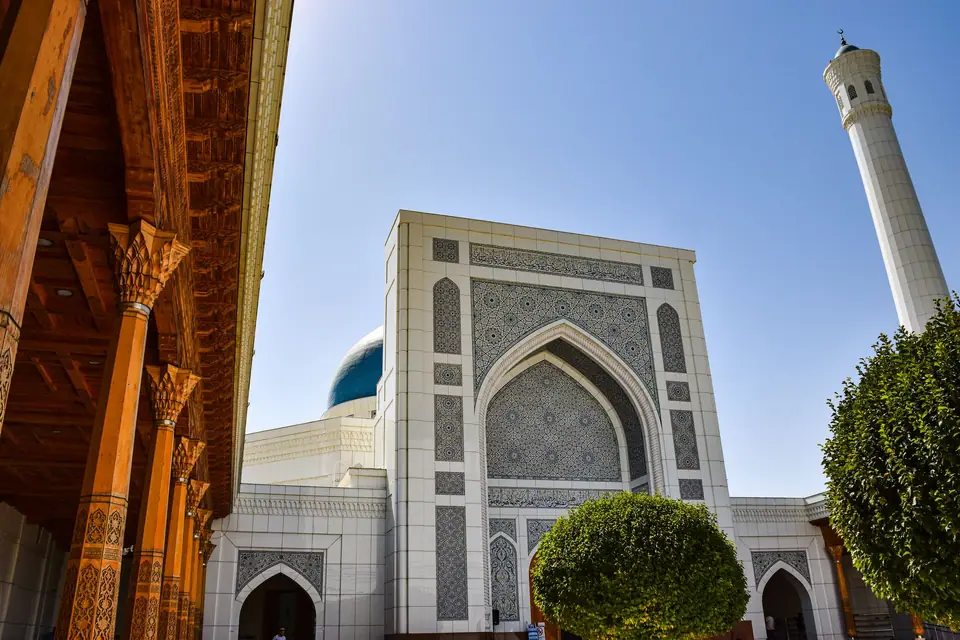
Chorsu Bazaar, the Khast Imam Complex and Old Town Mahallas
Walking historic Tashkent from Chorsu Bazaar and Kukeldash Madrasah to the Khast Imam Complex.
While southern and central Tashkent were rebuilt as a leafy modernist metropolis after 1966, the north-western quarter around Chorsu Metro station preserves the trading pulse and spiritual architecture of ancient Silk Road Tashkent. You can connect Kukeldash Madrasah, Chorsu Bazaar, the traditional mahalla residential lanes and the Khast Imam Complex on a single morning walk.
Chorsu Bazaar and its giant turquoise dome
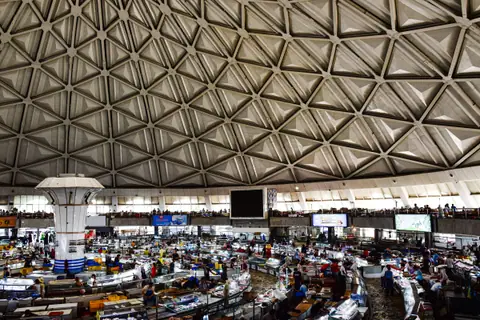
Literally meaning "Crossroads" in Persian, Chorsu Bazaar has operated on this spot for more than a thousand years at the meeting point of four Silk Road caravan avenues. In the early 1980s, Soviet modernist architects Vladimir Azimov and Sabir Adylov crowned the market with a column-free concrete dome clad in glazed turquoise ceramic tiles. Step inside the two-tier circular pavilion:
- Ground ring and basement: butchers, horsemeat sausage (kazy), horse-radish salads, and rows of women selling snowy pyramids of kurt (sundried salted curd balls flavoured with basil or paprika).
- Upper mezzanine balcony: a fragrant halo of saffron, wild mountain cumin (zira), barberries for plov, dried Samarkand apricots stuffed with walnuts, roasted pistachios and honeyed almonds.
- Outer bread and craft pavilions: outside the main dome, follow your nose to the Non (Bread) Bazaar, where bakers slap round flatbreads stamped with decorative iron pins (chekich) onto the glowing clay walls of tandir ovens, then browse the food alley (Ovqat Bozor) and upstairs workshops selling hand-painted Rishtan ceramics and chapan robes.
Kukeldash Madrasah and the Old Town mahallas
Rising on the citadel mound directly above Chorsu Metro exit stands the 16th-century Kukeldash Madrasah, built around 1570 by the vizier of the Shaybanid rulers next to the Juma Mosque. Climb through its towering pishtaq portal into the quiet inner courtyard lined with student cells (hujras) and mulberries. Afterwards, walk twenty minutes north from Chorsu through the earthen-walled residential lanes (mahallas) of Gulbozor and Sagban, where families chat on wooden courtyard daybeds (tapchans) beneath grapevines.
The Khast Imam (Hazrati Imam) Complex and the Usman Quran
Your walk through the mahallas opens onto the brick esplanade of Khast Imam (Hazrati Imam), built around the 16th-century mausoleum of Kaffal Shashi. Alongside the twin-minaret Hazrati Imam Mosque and artisan workshops inside the 16th-century Barak Khan Madrasah stands the Muyi Muborak Library Museum. Inside a climate-controlled glass vault rests the Mushaf of Usman (Samarkand Kufic Quran), revered as the oldest surviving Quran in the world, written in bold Kufic calligraphy on deer parchment in the 7th century and brought to Samarkand by Amir Timur. Combine this morning walk with afternoon Metro stations and squares.
Traveller tips
Real advice from people who have been to Chorsu Bazaar, the Khast Imam Complex and Old Town Mahallas. Every tip is read by our team before it goes live.
No tips yet. Been here? Yours could be the first.
Thank you! Your tip will appear here after a quick review.
More in Tashkent
Continue exploring Tashkent with related neighbourhood, food, and planning guides
The Tashkent Metro, Soviet Modernism and Central Squares
Tashkent, Uzbekistan
Besh Qozon Plov Centre and What to Eat in Tashkent
Tashkent, Uzbekistan
Where to Stay in Tashkent: Best Neighbourhoods Compared
Tashkent, Uzbekistan
Tashkent 3-Day Itinerary: Old Town Bazaars, Metro Art and Mountains
Tashkent, Uzbekistan
