


























The Tashkent Metro, Soviet Modernism and Central Squares
Exploring Tashkent's underground subway palaces and above-ground seismic modernist architecture.
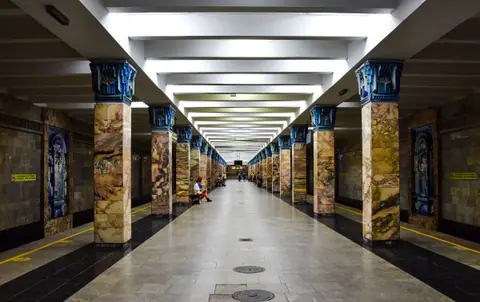
Opened in 1977 as the first underground railway in Central Asia, the Tashkent Metro was engineered both to withstand earthquakes and to give every neighbourhood its own subterranean palace of ceramic art, carved alabaster (ganch), bronze and crystal. Because a single contactless tap at the entry gate lets you ride and change lines freely as long as you do not exit the turnstiles, you can tour the six finest stations in an hour and pair them with the 1960s and 1970s modernist landmarks above ground.
Six standout stations on the Blue, Red and Green Lines
- Kosmonavtlar (Blue Line): opened in 1984 to honour space exploration and Uzbek-born cosmonaut Vladimir Dzhanibekov. The platform walls fade from deep cobalt blue to starry black, lined with circular glazed ceramic medallions depicting Icarus, astronomer-king Mirzo Ulugbek, Valentina Tereshkova and Yuri Gagarin beneath a glass Milky Way ceiling.
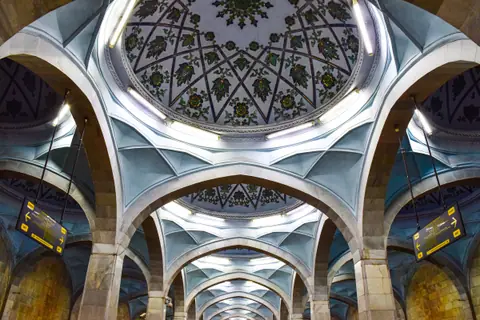
- Alisher Navoi (Blue Line, connected to Paxtakor): named after the 15th-century poet, its vaulted hall is crowned by twelve turquoise-and-lapis Islamic cupolas embossed with floral reliefs and scenes from Navoi's Khamsa epic poems.
- Paxtakor ("Cotton Picker", Red Line): linked by footway to Alisher Navoi, featuring sweeping wall mosaics of stylised turquoise and white cotton bolls.
- Mustaqillik Maydoni (Red Line): a classical hall of white Gazgan marble octagonal columns and geometric ceiling domes dropping cascades of crystal light.
- Toshkent (Blue Line, at Tashkent North Railway Station): decorated with blue ceramic relief murals celebrating the 2,200th anniversary of the city.
- Gafur Gulom and Bodomzor (Green Line): Bodomzor features arched light ribs on the route to Besh Qozon Plov Centre and the white marble Minor Mosque.
Amir Timur Square and Hotel Uzbekistan
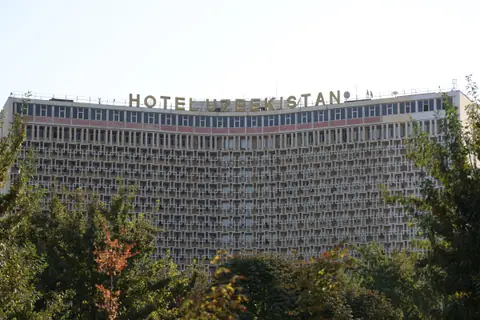
Emerge at Amir Timur Meydoni to stand in Tashkent's circular central park, anchored by the bronze equestrian statue of 14th-century conqueror Amir Timur and the 1947 Tashkent Chimes clock towers. Framing the eastern rim of the square rises the 17-storey curved sweep of Hotel Uzbekistan (1974), whose concrete lattice sun-screen (panjara) is the architectural symbol of post-1966 Tashkent.
Broadway, Navoi Opera House and Eastern Modernism
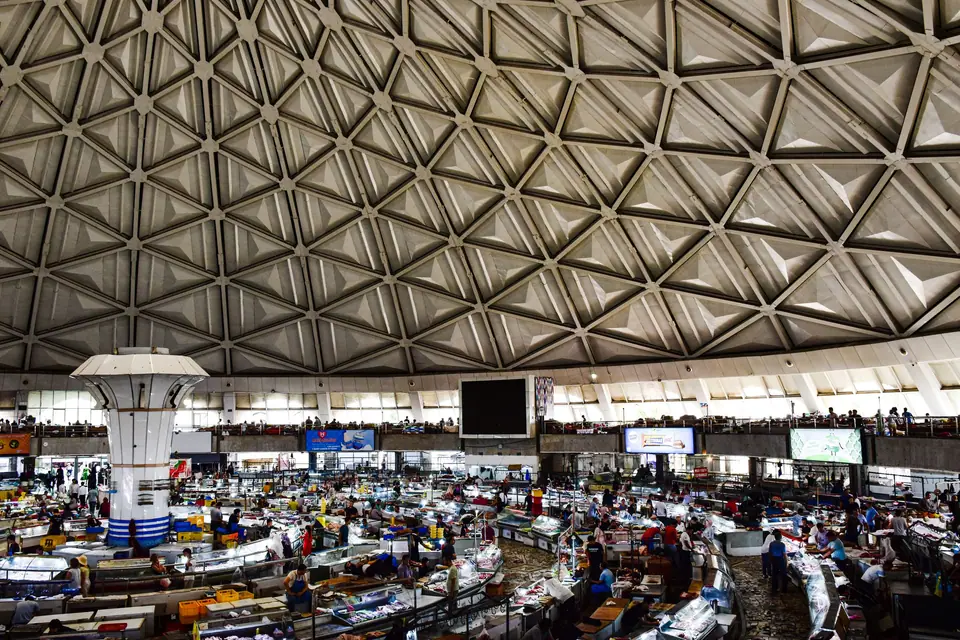
Walk west down pedestrian Sailgokh Street ("Broadway") to the 1947 Alisher Navoi Opera and Ballet Theatre and vast Mustaqillik Maydoni (Independence Square). For lovers of seismic Soviet modernism, look one block further for the concrete pearl-shell domes of the State Museum of History of Uzbekistan, the turquoise-domed Tashkent Circus near Chorsu, and the geometric Palace of International Forums.
Traveller tips
Real advice from people who have been to The Tashkent Metro, Soviet Modernism and Central Squares. Every tip is read by our team before it goes live.
No tips yet. Been here? Yours could be the first.
Thank you! Your tip will appear here after a quick review.
More in Tashkent
Continue exploring Tashkent with related neighbourhood, food, and planning guides
Chorsu Bazaar, the Khast Imam Complex and Old Town Mahallas
Tashkent, Uzbekistan
Besh Qozon Plov Centre and What to Eat in Tashkent
Tashkent, Uzbekistan
Where to Stay in Tashkent: Best Neighbourhoods Compared
Tashkent, Uzbekistan
Tashkent 3-Day Itinerary: Old Town Bazaars, Metro Art and Mountains
Tashkent, Uzbekistan
