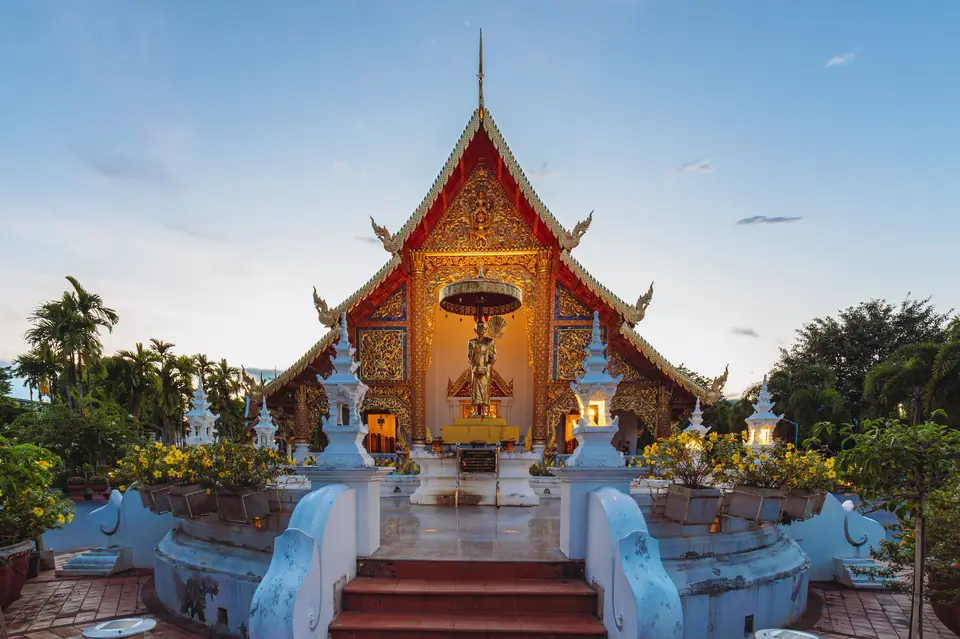
A detailed route through King Mangrai’s moated Lanna capital, carved teak temples, Ping River merchant bridges, forest monasteries, and Mount Suthep.
King Mangrai’s 1296 Square Grid and Seven Centuries of Lanna Craft
Founded in 1296 by King Mangrai the Great in alliance with King Ramkhamhaeng of Sukhothai and King Ngam Muang of Phayao, Chiang Mai (New City) replaced Wiang Kum Kam on the Ping River floodplain as the permanent capital of the Kingdom of Lanna (A Million Rice Fields). Laid out as an auspicious square enclosed by a brick wall and moat aligned to the cardinal directions beneath sacred Doi Suthep mountain, the city became a golden centre of Theravada Buddhism and teakwood architecture.
Featuring multi-tiered sweeping roofs, naga staircases, and monumental brick chedis at Wat Chedi Luang and Wat Phra Singh, Lanna heritage endured through Burmese rule and integration into Siam under King Chulalongkorn.
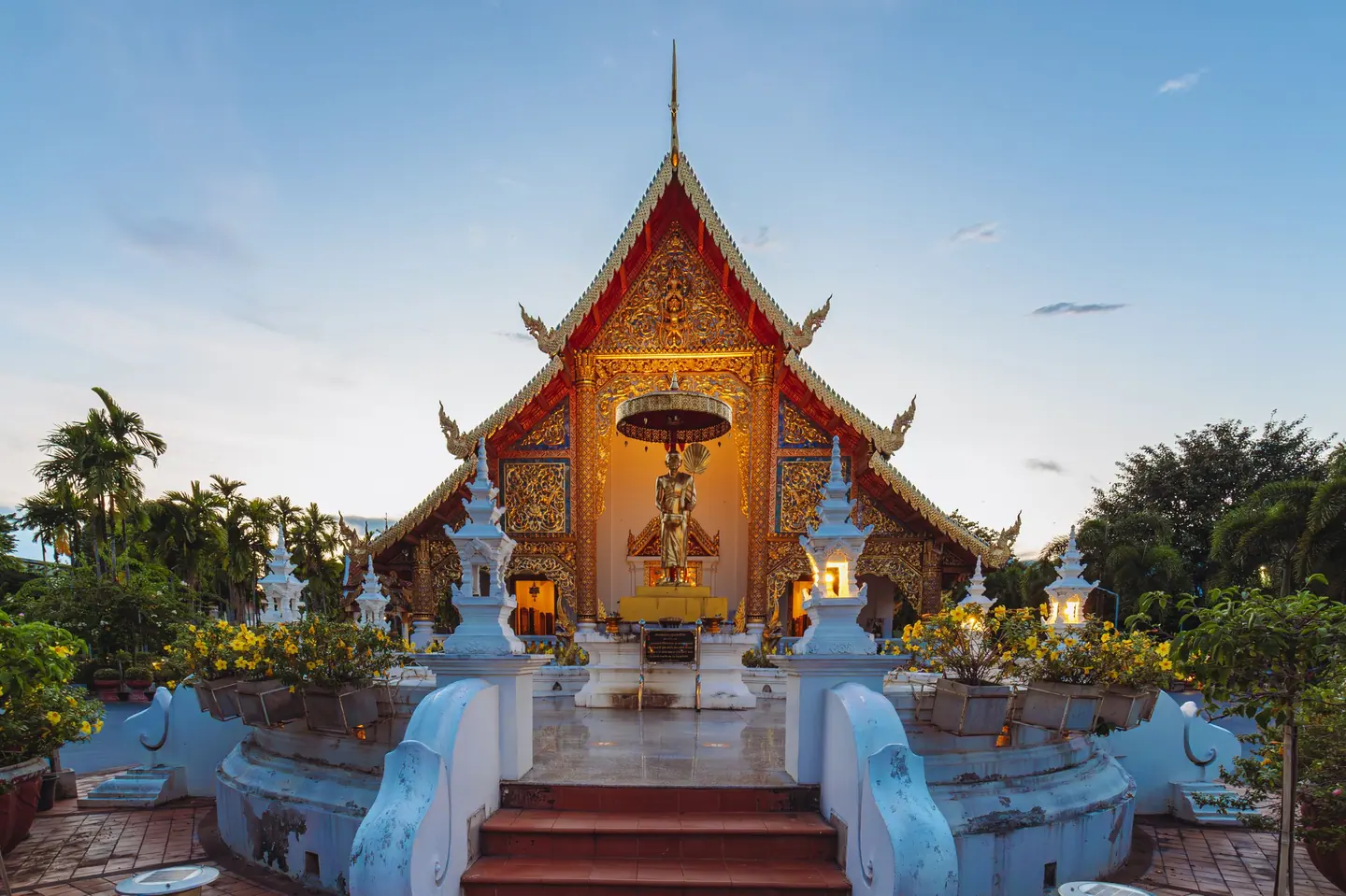
Tha Phae Gate, Three Kings Monument & Central Old City
Tha Phae Gate, Three Kings Monument, Chiang Mai City Arts and Cultural Centre, Lanna Folklife Museum, Wat Inthakhin Sadue Muang, Wat Chedi Luang, Pillar of the City Sao Inthakhin, and Wat Phan Tao Teak Viharn
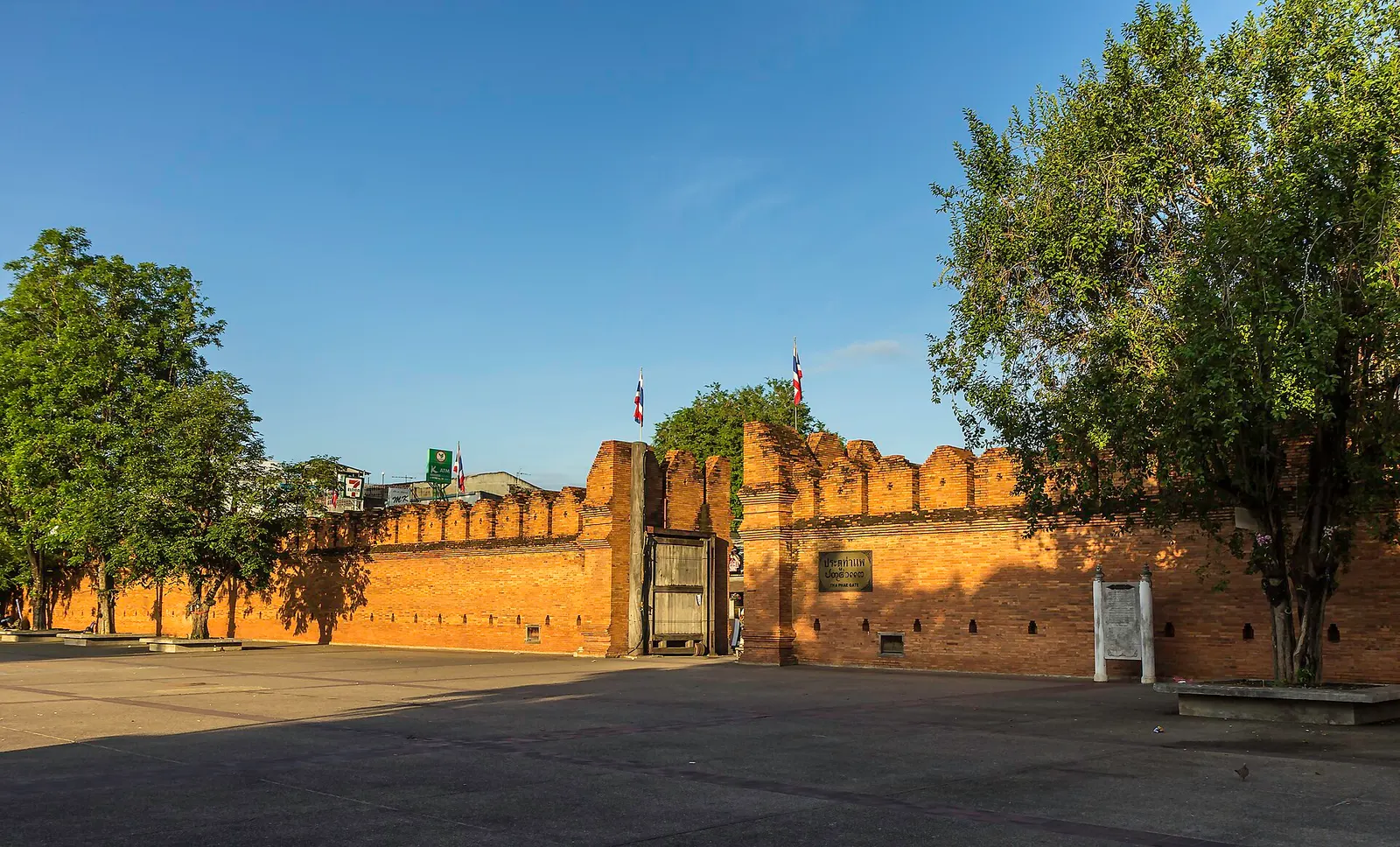
Tha Phae Gate
Originally constructed in the late thirteenth century, this eastern bastion served as the fortified entry point for traders arriving from the Ping River. The current red-brick structure reproduces the historic ramparts, framing an expansive public square. Visitors can study the defensive crenellations and examine the boundary between the inner heritage district and modern trade routes.
Three Kings Monument
Standing before the former provincial hall, this bronze monument honours King Mengrai of Lanna, King Ramkhamhaeng of Sukhothai, and King Ngam Muang of Phayao. Tradition holds that the three allied monarchs collaborated to design and establish the regional capital in 1296. The central square hosts cultural ceremonies and serves as an orienting landmark for travellers.
Chiang Mai City Arts and Cultural Centre
Constructed in 1924, this elegant administration building showcases early twentieth-century royal Siamese architecture with subtle colonial influences. Today, its galleries present interactive displays that trace prehistoric settlements, royal lineages, and regional urban planning. The interior courtyard provides a quiet architectural counterpoint to the central exhibition halls.
Lanna Folklife Museum
Occupying the former municipal court building, this museum explores the everyday customs, spiritual beliefs, and decorative arts of northern Thailand. Exhibitions showcase intricate lacquerware, ceremonial textiles, and detailed miniature reconstructions of historic village shrines. The preserved courtroom architecture stands as a rare specimen of early modern institutional design in the old city.
Wat Inthakhin Sadue Muang
Erected at the historical centre of the municipal grid, this temple originally sheltered the sacred city pillar established by King Mengrai. Its prominent viharn features dark carved timber eaves, gilded floral reliefs, and a revered octagonal brick stupa behind the main sanctuary. Travellers often pause here to view centuries-old Buddha images that survived numerous regional conflicts.
Wat Chedi Luang
Commissioned in the late fourteenth century, this massive Buddhist pagoda once rose to eighty metres before an earthquake compromised its upper tiers in 1545. The colossal brick base still features sculpted stone elephants and soaring naga staircases on four sides. It also housed the sacred Emerald Buddha for over eighty years during the fifteenth century.
Chiang Mai City Pillar Shrine
Relocated from Wat Inthakhin to the grounds of Wat Chedi Luang in 1800 by Prince Kawila, this shrine protects the city's guardian foundation post. The small cross-plan chapel is adorned with ornate interior murals detailing northern mythology and royal processions. Traditional beliefs bar women from the inner chamber, though the exterior woodwork remains easily observed.
Wat Phan Tao
Originally functioning as a royal residence for Prince Mahotra Prathet, this building was later repurposed as a monastic assembly hall. The facade features a carved wooden pelmet displaying a gilded peacock, representing the solar lineage of regional royalty. Supported by substantial teak pillars, the darkened interior maintains a sombre, contemplative atmosphere distinct from gilded stone temples.
Wat Phra Singh
Founded in 1345, this temple represents the pinnacle of classic northern religious architecture. The Lai Kham assembly hall contains fourteenth-century murals illustrating early regional costumes alongside the sacred lion Buddha image. Its multi-tiered wooden roofs and sweeping golden chedi draw visitors studying the golden age of the Lanna kingdom.
Chiang Mai Historical Centre
Positioned behind the civic square, this educational complex integrates modern exhibition spaces with preserved archaeological ruins discovered on the premises. Visitors walk along raised gangways to view ancient brick foundations dating back to the city's origins. Displays explain trade patterns, agricultural innovations, and regional military alliances using scale models and recovered ceramic shards.
Wat Chiang Man
Established by King Mengrai as his royal residence during the construction of the capital, this site serves as the city's senior monastery. The striking Chedi Chang Lom features fifteen brick-and-stucco elephants emerging from its base beneath a gilded spire. A smaller shrine on the grounds protects two ancient images, including a revered crystal Buddha.
Wat Duang Dee
Meaning the Temple of Good Fortune, this complex provided spiritual guidance and administrative education to young princes during the early nineteenth century. Its compact wooden scripture repository displays intricately carved window frames and mirrored glass inlay work. The principal assembly hall contains a traditional raised sermon pulpit crafted entirely from lacquered timber.
Wat Phan On
Dating back to 1501, this sanctuary features the Sari-Rikakhan stupa, an ornate golden chedi containing sacred relics. The surrounding cloister holds smaller meditation figures and shaded arcades used by resident monks for daily recitations. Its proximity to the main eastern road makes it a prominent landmark for visitors exploring the central district.
Wat Mahawan
Constructed in the nineteenth century during the height of the teak trade, this temple reflects architectural input from Shan and Burmese merchants. Carved teak ceilings, tiered rooflines, and guardian lion statues showcase fine craftsmanship rarely seen in pure Lanna sanctuaries. The plasterwork on the outer walls depicts mythical creatures from Buddhist cosmological traditions.
Wat Muen San
Situated south of the central core in the traditional silversmith quarter, this monastery is renowned for its hand-beaten metal assembly hall. The interior walls feature repoussé tin and silver panels recounting local lore, the life of the Buddha, and second world war history. Monks and master artisans still maintain metalworking workshops on site.
Wat Buppharam
Founded in 1497 by King Mueang Kaeo, this temple underwent extensive renovations during the Burmese occupation and subsequent nineteenth-century resettlement. The two-storey cruciform hall displays teakwood carvings and contemporary temple murals painted in classical styles. Within the grounds stands a five-hundred-year-old chedi housing revered Buddhist relics.
Wat Chai Si Phum
Strategically positioned at the north-eastern corner of the old city wall, this temple was established to protect the city against eastern invasions. Its quiet grounds feature a stepped brick stupa decorated with painted guardian deities and gilded finials. Monastic halls here preserve classical northern proportions with deep sloping roofs and carved timber gables.
Wat Lam Chang
According to municipal chronicles, this site served as the stables and grazing ground for royal elephants during the city's initial founding. Today, the quiet courtyard contains several elephant statues and a whitewashed brick chedi entwined with sacred bodhi trees. The main viharn displays historic stucco mouldings and red lacquer columns.
Wat Umong Maha Thera Chan
Not to be confused with the cavernous forest retreat outside town, this central temple was established by a senior monk from Sukhothai in the fourteenth century. The leafy courtyard preserves an ancient brick stupa with arched niches designed for silent contemplation. The surrounding prayer halls feature understated woodwork characteristic of meditative monasteries.
Wat Sai Moon Mueang
Located near the southern canal ramparts, this compound features architectural details introduced by Shan migrant communities who settled nearby. Its gilded prayer hall houses a prominent Buddha statue seated beneath layered multi-tiered canopies. The temple grounds provide valuable insights into the multi-ethnic heritage that shaped the city's post-eighteenth-century revival.
Wat Phra Singh, Western Moat & Silver/Woodcraft Lanes
Wat Phra Singh Viharn Lai Kham, Wat Tung Yu, Wat Puak Hong, Suan Dok Gate, Chang Phuak North Gate, Wat Chiang Man (1297 oldest temple), Wat Lok Moli, and Wat Rajamontean
Wat Phra Singh
Founded in 1345 by King Pha Yu, this complex houses the venerated Phra Buddha Sihing statue. Visitors should inspect Viharn Lai Kham, notable for its gilded wood carvings and early nineteenth-century murals depicting local folklore and daily life.
Viharn Lai Kham
Standing directly behind the main assembly hall of Wat Phra Singh, this classic wooden chapel exemplifies authentic Lanna religious architecture. Its interior walls feature detailed depictions of the Sang Thong epic, rendered in gold leaf and natural pigments by local artisans.
Wat Tung Yu
Positioned just east of Wat Phra Singh, this community temple displays typical northern gables adorned with carved naga serpents. The peaceful courtyard features a whitewashed stupa surrounded by small prayer shrines and resident monk quarters.
Wat Si Koet
Constructed during the classical Lanna period, Wat Si Koet serves as an enduring spiritual centre for the western quarter. The main assembly hall holds an impressive bronze Buddha image, complemented by detailed plaster ornamentation across the front entrance pillars.
Suan Dok Gate
Historically opening towards the royal flower gardens of King Kue Na, this gate formed an essential defensive strongpoint in the city perimeter. Portions of the rebuilt red-brick parapet and neighbouring moat show how the fortified boundary protected medieval Chiang Mai.
Wat Puak Hong
Located inside the southwestern corner of the walls, this temple is celebrated for Chedi Si Liam, a circular seven-tiered brick stupa dating from the late sixteenth century. Niches encircling each tier hold standing stucco Buddha images showing possible Mon-Burmese design influences.
Wat Puak Pia
Positioned close to the southern moats, this temple is recognized for its finely preserved stupa featuring decorative plaster reliefs. The assembly hall features ornate teak pediments that demonstrate the exceptional skill of the neighbourhood craft guilds.
Wat Muen San
Set along Wualai Road, this temple reflects centuries of silversmith heritage brought by resettled artisans from the Shan States. The compound houses an impressive silver pavilion, built using repoussé aluminium and silver panels that depict Buddhist teachings and regional folklore.
Wat Sri Suphan
Originally founded in 1500, the shrine underwent major reconstruction using handcrafted silver, nickel, and aluminium sheets. Both the interior and exterior walls present intricate beaten metal panels showing scenes from the Buddha's life, celestial beings, and northern zodiac symbols.
Wat Lok Moli
Sited along the northern moat, this royal temple housed monks from Burma during the Mangrai dynasty. The complex is distinguished by its unplastered chedi containing the ashes of several monarchs, entered through a dramatic arched brick gateway guarded by stone naga figures.
Wat Rajamontean
Standing directly opposite Wat Lok Moli across the road, this temple draws notice with its exterior colossal seated Buddha. The multi-storey assembly hall displays maroon and gold paintwork, embellished with fine stucco dragons, Kinnara figures, and gilded Lanna woodwork.
Chang Phuak Gate
Also termed the White Elephant Gate, this entry point historically served as the formal state portal for arriving monarchs and foreign dignitaries. Restored brick bastions and remnants of the defensive moat clearly show the medieval layout conceived by King Mangrai.
Wat Chiang Man
Established during the founding of Chiang Mai by King Mangrai, this site served as his royal camp during city planning. Highlights include the elephant-supported chedi, Chang Lom, and the protected crystal and marble Buddha images kept inside the smaller hall.
Wat Lam Chang
Translating to the temple of tethered elephants, this sanctuary marks the historic stables used for the king's working beasts during city construction. The quiet grounds display elephant statues, a golden spire, and an intricately decorated wooden prayer hall.
Wat Mo Kham Tuang
Positioned near the northern fortification wall, this temple retains strong connections to historic bronze and gold smiths. The assembly hall features traditional multi-tiered eaves, supported by carved timber columns and fronted by detailed golden guardian statues.
Wat Prasat
Positioned mere steps from Wat Phra Singh, this temple retains one of the oldest surviving wooden assembly halls in Chiang Mai. The structure opens directly onto an integrated brick chedi at the rear, creating a direct visual link to the main stucco Buddha image.
Wat Pa Daeng Luang
Located just inside the western moat walls, this temple preserves ties to the fifteenth-century monastic reform movement in Northern Thailand. Visitors find a serene courtyard bordered by leafy canopies, historic stupa bases, and classic wooden monk residences.
Wat Pha Bong
Situated on Singharat Road, this temple features an ornate viharn fronted by stone Makara monsters disgorging naga serpents. The leafy grounds house a revered holy water well and an imposing bell-shaped stupa coated in reflective bronze and gold leaf.
Wat Chai Phra Kiat
Commissioned by King Mae Ku in the mid-1500s, this temple exhibits classical northern architecture with heavy layered rooflines. Within the assembly hall, a prominent bronze Buddha seated in the bhumisparsha mudra remains an exceptional example of late Chiang Saen metal casting.
Wat Methang
Occupying a shaded lane near the woodcraft workshops, Wat Methang features an elegant teak viharn resting on a raised masonry platform. Its carved door panels showcase local lacquerware techniques, depicting celestial dancers surrounded by traditional northern flora.

Southern Gates, Silver Temple Wat Sri Suphan & Wiang Kum Kam
Chiang Mai Gate Market, Suan Buak Haad Park, Katam Corner, Wat Sri Suphan Silver Temple Wualai Road, Wat Muen San, Wat Chai Mongkhon on the Ping River, and Wiang Kum Kam Sunken Ancient City
Chiang Mai Gate
Forming the southern threshold of the historic square, this brick gate once controlled trade entering from Lamphun. Reconstructed fortifications demonstrate the classical Lanna defensive layout bounded by the moat. Visitors can inspect the preserved masonry and use the crossing as an orientation point for exploring the southern quarters.
Chiang Mai Gate Market
Operating along the southern moat, this market serves as a central hub for northern Thai provisions. Stalls display regional staples such as sai oua sausage, sticky rice, and fresh tropical produce. It provides an immediate look into local foodways that have sustained the surrounding neighbourhoods for generations.
Suan Buak Haad Park
Occupying the southwestern corner of the walled city, this landscaped enclave contains interconnected ponds and mature tropical trees. Paved pathways loop around flowerbeds and traditional pavilions, offering an open civic space within the urban grid. It regularly hosts municipal horticultural exhibitions, particularly during the annual flower festival.
Katam Corner
This corner bastion anchors the southeastern angle of Chiang Mai's brick defences and water-filled moat. The restored red-brick ramparts illustrate classical medieval military planning designed to protect the capital against invading armies. Today the quiet perimeter allows travellers to examine the masonry techniques of the restored Lanna ramparts.
Wat Sri Suphan
Founded in 1500, this temple serves as the spiritual heart of the traditional silversmith community along Wualai Road. Its central ubosot is completely clad in beaten silver, aluminium, and zinc panels executed by local artisans. The repousse metalwork depicts Buddhist mythology alongside scenes of contemporary global events.
Wat Muen San
Located in the Wualai metalworking district, this monastery displays silver repousse craftwork created by resident silversmiths. The grounds house an elaborate metal-clad pavilion and a historical museum detailing the site's role as a Japanese military hospital during the Second World War. Fine hammered plaques decorate the shrine walls.
Wualai Walking Street
Running southwest from the old moat, Wualai Road has accommodated metalworkers and lacquer craftsmen since King Mengrai settled captured artisans here. Workshop fronts still display hand-hammered silver bowls, jewellery, and decorative religious implements. The lane preserves historic wooden shophouses alongside functional workshops continuing ancestral craft traditions.
Wat Pu Pia
Dating from the late thirteenth century, this excavated temple ruin features a five-tiered bell stupa resting upon a high square plinth. Plaster stucco work on the upper levels still outlines classical niche figures of standing Buddhas. The ruin illustrates early Hariphunchai architectural influences that informed early Lanna religious masonry.
Wat Chedi Liam
King Mengrai constructed this landmark stepped stupa around 1288, modelling it directly on the Mon-style Chedi Ku Kut in Lamphun. The square pyramid rises in five levels, accommodating sixty standing Buddha images within arched terracotta niches. While the surrounding monastery remains active, the ancient brick foundation represents raw thirteenth-century engineering.
Wat Chang Kham
This ruined monastery features an elevated chedi supported around its base by stone-and-stucco elephant forequarters. Excavation teams uncovered extensive brick foundations, an ordination hall platform, and stone boundary markers buried beneath centuries of Ping River silt. A venerable sacred bodhi tree shades the temple's modern outdoor prayer area.
Wat E-Kang
Named after the wild monkeys that once inhabited the overgrown mound, Wat E-Kang was excavated by the Fine Arts Department in the 1980s. The site reveals a large bell-shaped brick chedi positioned directly behind an east-facing assembly hall. Clear stratigraphy shows the deep flood layers that repeatedly submerged the city.
Wat Nan Chang
Wat Nan Chang presents one of the most elaborate ground plans within Wiang Kum Kam, featuring dual viharns and an ornamental torana gateway. Archaeologists discovered Chinese ceramic shards here from the Yuan and Ming dynasties, proving flourishing trade links before major flooding. The exposed brick floors demonstrate sophisticated drainage channels.
Wat That Khao
Known historically as the White Stupa due to its original lime-plaster finish, this monument consists of an open brick prayer platform and collapsed chedi. The plinth preserves the lower portions of a seated Buddha statue facing east towards former waterways. It offers clear evidence of the thirteenth-century brick construction techniques.
Wiang Kum Kam Information Centre
This cultural centre houses artefacts recovered during the state excavations of the ancient settlement established by King Mengrai in 1286. Displays include clay votive tablets, architectural stucco fragments, and detailed topological maps showing how the Ping River changed course. It provides essential historical context before touring the dispersed ruins.
Wat Chai Mongkhon
Positioned on the western bank of the Ping River, this active monastery features a distinct Mon-influenced chedi and bright assembly hall. Its riverside piers serve as traditional moorings for river longboats travelling upstream through rural outskirts. The temple grounds contain animal release sanctuaries and quiet pavilions overlooking the water.
Wat Nantharam
Situated south of the ancient gates in a quiet residential quarter, Wat Nantharam maintains an ornate teak viharn with multi-tiered gables. The interior features gilded wooden pillars, painted jataka murals, and an elevated bronze Buddha image cast in northern style. The monastery courtyard preserves a serene village environment away from city traffic.
Wat Puak Taem
Founded inside the southern city ramparts, this temple has long been associated with craftsmen producing temple finials, brass parasols, and crowns for Buddha images. The small complex features a traditional brick-and-timber viharn with detailed Lanna roof carvings. Metalworkers can occasionally be seen crafting repousse umbrellas in the adjacent communal yard.
Wat Fong Min
Located just outside the southern moat line, Wat Fong Min serves the surrounding merchant district with its well-kept Lanna-style viharn. Intricate nagas flank the entrance steps, leading to an interior filled with traditional northern Thai Buddhist cosmology paintings. Its small brick chedi displays classic layered octagonal architecture.
Wat Daowadung
Resting a short distance southeast of the Chiang Mai Gate, this temple is named after the heavenly realm of Indra in Buddhist cosmology. The compound contains an impressive ordination hall flanked by stone chinthe lions and an octagonal chedi decorated with mirrored tiles. It remains an active centre for community merit-making and monk ordination.
Wat Ku Pa Dom
Lying towards the southern limit of Wiang Kum Kam, Wat Ku Pa Dom preserves the foundations of an ancient viharn and stupa plinth. Excavations by state archaeologists revealed substantial brick pillars that once supported timber beams, long since rotted away. The ruin demonstrates the severe alluvial deposits left by medieval floods.
Ping River Bridges, Warorot Market & Eastern Quarter
Warorot Market Kad Luang, Ton Lamyai Flower Market, Chansom Memorial Bridge, Iron Bridge Saphan Lek, Wat Ket Karam Museum, Nawarat Bridge, Wat Buppharam, and Mae Kha Canal Village
Warorot Market
Named after the ruler Inthawarorot Suriyawong, this sprawling indoor trading complex dates from the early twentieth century. We find regional dry goods, northern sausages and fermented tea leaves spread across several interconnected levels. The ground floor displays packed food stalls, while the upper balconies stock traditional Lanna fabrics, handicrafts and everyday domestic wares.
Ton Lamyai Flower Market
Standing directly adjacent to Warorot Market, this riverfront trading strip functions continuously through day and night. Stalls overflow with woven jasmine garlands, orange marigolds and cut lotus blossoms transported daily from nearby mountain nurseries. The market serves temple devotees and florists who gather to purchase bulk ceremonial offerings and decorative arrangements.
Chansom Memorial Bridge
This pedestrian footbridge spans the Ping River, directly linking the Chinese market quarter with the historic Wat Ket neighbourhood. Constructed to replace a traditional bamboo span destroyed by seasonal flooding, the concrete walkway accommodates streams of commuters and food vendors. Crossing the span offers unobstructed viewpoints of river silt banks and traditional wooden riverside shophouses.
Iron Bridge
Known locally as Saphan Lek, this black girder crossing echoes the industrial railway engineering of northern Thailand. The bridge connects the southern edge of the Charoen Prathet neighbourhood to the eastern riverbank. In the evenings, pedestrians gather across its pedestrian paths to view illuminated water currents, distant city lights and night markets operating nearby.
Nawarat Bridge
Named in honour of Major General Chao Kaew Nawarat, this major crossing connects Tha Phae Road to the eastern suburbs. The original teak timber span gave way to the current reinforced concrete structure during the mid-twentieth century. It functions as the central transport axis for festive river parades and water gatherings during northern festival seasons.
Wat Ket Karam
Founded in the fifteenth century, this temple serves as an astrological pilgrimage centre for those born in the Year of the Dog. Its striking central viharn features intricate Lanna woodcarving, ceramic roof ornaments and sweeping multi-tiered eaves. The whitewashed main stupa leans slightly, surrounded by small shrines, sacred bells and lush riverbank trees.
Wat Ket Karam Community Museum
Housed inside a former monastic residence on the temple grounds, this community archive preserves antique domestic artefacts from the trading quarter. The displays contain early photographic portraits of Chiang Mai royalty, vintage European glass bottles, mechanical typewriters and traditional woven textiles. It offers valuable insight into the multicultural merchant history of the surrounding neighbourhood.
First Church of Chiang Mai
Established in 1868 by American Presbyterian missionaries Daniel and Sophia McGilvary, this represents the oldest Christian congregation in northern Thailand. The present brick sanctuary, built in the nineteen-sixties, retains a tall bell tower and dignified, unadorned interior lines. The surrounding mission compound originally contained northern Thailand's first modern medical clinic and western printing press.
Chiang Mai Christian School
Situated on the eastern banks of the Ping River, this educational campus developed alongside early Christian mission initiatives in Lanna territory. The leafy grounds display colonial period brick buildings with louvered wooden shutters and covered exterior walkways. The institution played an instrumental role in introducing modern western curricula to provincial northern families.
Wat Buppharam
Established in 1497 by King Mueang Kaeo, this Tha Phae Road temple boasts a cruciform, two-storey royal pavilion. Intricate teak carvings, Burmese-style plaster moulding and mirror glass mosaics decorate the principal hall. Inside, visitors encounter revered teak Buddha images and mural cycles depicting traditional Lanna folklore and early urban trade.
Wat Saen Fang
Set back from the main thoroughfare, this tranquil temple is reached through an elongated corridor guarded by undulating stucco naga serpents. The complex features a Burmese-style chedi decorated with tiny hanging chimes, glass mosaics and colourful tiles. The teak monstrance library displays exquisite timber pediments that reflect the heritage of wealthy nineteenth-century teak merchants.
Wat Chetawan
Located in the eastern commercial quarter, this temple stands out due to its trio of distinct chedis finished in differing regional styles. The primary stupas incorporate Mon, Burmese and classical Lanna architectural forms within a single compound. Within the assembly hall, painted plaster columns support gilded roof timbers around an antique seated bronze Buddha.
Wat Mahawan
Funded largely by Shan and Burmese timber traders in the late nineteenth century, this temple features ornate mythological lions flanking its gateways. The assembly hall presents woodcarvings alongside glass inlay panels and multi-tiered metal spires. A neighbouring brick viharn retains traditional Lanna proportions, creating a direct architectural dialogue between two historic regional traditions.
Wat Upakhut
Positioned close to the Ping River, this monastery honours Upagupta, a mythical Buddhist monk reputed to meditate beneath deep ocean waters. The temple serves as the starting point for midnight alms-giving ceremonies during specific full moons. Its viharn houses dynamic wall paintings showing celestial water deities, maritime legends and traditional northern mercantile life.
Guan Yu Shrine
Hidden behind the stalls of the produce market, this bright red temple stands as an anchor for the local Teochew community. Carved wooden eaves, ceramic dragon crests and incense spirals adorn the main courtyard. Devotees visit to make offerings before the gilded statue of Guan Yu, seeking business success, personal loyalty and moral integrity.
Pung Tao Gong Ancestral Temple
Constructed in 1876 by early Chinese immigrants who settled along the Ping River, this temple features traditional southern Chinese architecture. Curved ceramic roof ridges, stone lion guardians and painted ancestral plaques fill the hall. It remains a focal point for lunar new year celebrations and riverfront trade guilds operating in Kad Luang.
Mae Kha Canal Village
Originally functioning as an outer defensive moat and natural water transport corridor, this revitalised canal channel resembles a Japanese waterfront village. Concrete block banks now carry pedestrian paths, wooden footbridges and timber kiosks selling refreshments and crafts. Murals, potted ferns and paper lanterns decorate the modest shophouse facades that flank the gentle stream.
Attaqwa Mosque
Erected in 1967 on the eastern bank of the Ping River, this serves as a community centre for Chiang Mai's Chinese Muslim population. The architecture blends classical Islamic domes and minarets with East Asian decorative flourishes on its window arches. The grounds also host the first Islamic school in northern Thailand, offering language instruction and community events.
Wat Chai Mongkhon
Occupying a spacious parcel along the Ping River, this monastery incorporates a modern monastic hall alongside a glittering central stupa. Large stone stairways descend directly to the river current, where visitors gather to release fish for karmic merit. The temple pier functions as the primary departure point for scenic wooden boat excursions cruising upstream.
Baan Ounkaew
Set inside the shaded laneways behind Wat Ket, this heritage house exemplifies late-nineteenth-century domestic timber architecture. The building showcases fretwork wooden screens, raised hardwood piles and high hipped roofs that facilitate natural ventilation in the tropical climate. It provides a rare authentic glimpse into the prosperous residential estates of early Ping River trading families.
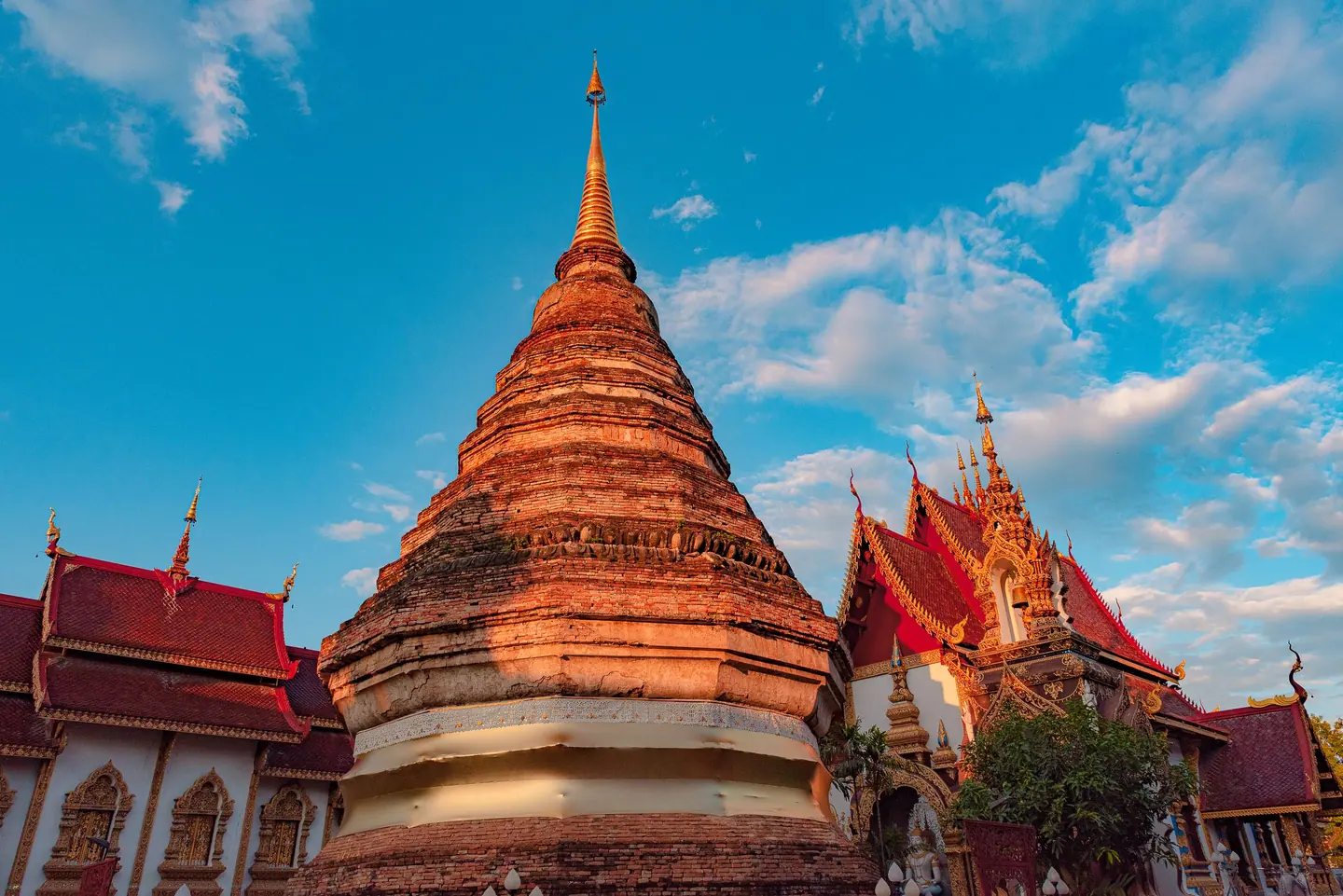
Wat Suan Dok, Wat Umong Forest Tunnels & Doi Suthep Summit
Wat Suan Dok White Royal Chedis, Wat Jed Yod Seven Spires, Nimmanhaemin Road, Wat Umong Forest Tunnel Monastery, Wat Pha Lat Monk’s Trail Hidden Temple, Wat Phra That Doi Suthep Golden Chedi, and Bhubing Palace Gardens
Wat Suan Dok
Founded in 1370 by King Kue Na of Lan Na, this royal temple houses a commanding Sri Lankan style bronze stupa. The grounds also feature an open-sided prayer hall sheltering two revered bronze Buddha statues, alongside gardens that once belonged to local monarchs.
Royal Cemetery of Chiang Mai
Situated on the western grounds of Wat Suan Dok, this collection of white mausoleums preserves the cremated ashes of the Northern Thai royal family. Princess Dara Rasmi relocated the ancestral urns here in the early twentieth century, creating a solemn, orderly heritage landmark.
Wat Chet Yot
Commissioned by King Tilokaraj in 1455, this complex hosted the Eighth Buddhist World Council. The central laterite sanctuary supports seven distinct spires above exterior brick walls adorned with seventy delicately carved stucco reliefs representing heavenly celestial devas.
Chiang Mai National Museum
Established in 1973 next to Wat Chet Yot, this museum chronicles the cultural progression of northern Thailand. Galleries display prehistoric artefacts, bronze Buddha figures from the Hariphunchai era, and royal regalia illustrating the political history of the Lan Na kingdom.
Wat Umong Suan Phutthatham
King Mangrai established this sanctuary around 1297 to house a scholarly forest monk. Visitors can walk through vaulted underground brick corridors containing small Buddha niches, before ascending exterior stone stairways to view a massive, weathered Bell-shaped stupa surrounded by trees.
Wat Umong Tunnels
These subterranean brick galleries were built into a natural mound to create quiet chambers shielded from heat and forest disturbances. Faint fragments of classic Lan Na murals still cling to the arched ceilings, leading outwards towards an expansive reflection pond.
Wat Ram Poeng
Founded in 1492 by King Yotchiangrai, this peaceful monastery remains an internationally recognised venue for Vipassana instruction. A square-based brick stupa dominates the central courtyard, where traditional Lanna roof lines frame shaded meditation paths and residential monastic quarters.
Chiang Mai University Art Center
Operated by the Faculty of Fine Arts at Chiang Mai University, this spacious pavilion showcases rotating exhibitions by established and emerging creators. Its multi-level galleries display paintings, modern sculptures, and conceptual installations that engage with regional traditions and modern society.
Nimmanhaemin Road
Named after a prominent landowning family, this avenue evolved from an ordinary university district into Chiang Mai's modern design quarter. The surrounding side lanes contain artisan workshops, architecture studios, and independent coffee roasters that showcase contemporary northern urban culture.
Wat Pha Lat
Originally constructed as a resting place for royal pilgrims climbing Doi Suthep, this sanctuary sits beside a mountain stream. Stone staircases, moss-covered pavilions, and small shrines blend into the rocky forest terrain, creating a quiet retreat away from lower city avenues.
Monk's Trail Doi Suthep
This historic earthen trail served as the primary route up the mountain before modern road construction in 1935. Following a natural watercourse, the path guides hikers through bamboo thickets, passing small shrines and trees wrapped in monastic cloth towards Wat Pha Lat.
Wat Phra That Doi Suthep
Built on the mountain crest in 1383, this royal temple houses a sacred bone relic of Gautama Buddha. Pilgrims ascend a steep staircase flanked by multi-headed mythological serpents to circle the glittering central gilded stupa and admire historical courtyard murals.
Naga Staircase of Wat Phra That Doi Suthep
Comprising more than three hundred steps, this ceremonial stairway provides a physical approach to the mountain shrine. Elaborate mosaic nagas run the entire length of the ascent, their undulating ceramic bodies representing the transition from the secular world to sacred space.
Khruba Sriwichai Monument
Located at the foot of Doi Suthep, this open-air bronze monument honours the monk Khruba Sriwichai. In 1935, he mobilised thousands of local volunteers to construct the first paved access route to Wat Phra That Doi Suthep without modern mechanical equipment.
Doi Suthep-Pui National Park Headquarters
Covering more than two hundred square kilometres of granite ridges, this park facility coordinates regional environmental conservation. The headquarters area offers trail maps, botanical information, and shaded walkways through evergreen forests that shelter hundreds of indigenous bird and orchid species.
Huay Kaew Waterfall
Positioned just past the park entrance, this ten-metre waterfall tumbles over polished dark rocks into shaded forest pools. Historical rest pavilions built during the mid-twentieth century line the banks, serving as quiet picnic spots for both city residents and travellers.
Bhubing Palace
Commissioned in 1961 for King Bhumibol Adulyadej and Queen Sirikit, this highland royal complex accommodates visiting foreign dignitaries. The grounds display Northern Thai timber architecture, extensive terraced rose nurseries, and rare temperate flowering plants watered by an ornamental mountaintop reservoir.
Bhubing Rose Gardens
Located within the royal estate, these meticulously landscaped terraces utilise the cooler mountain climate to nurture rare roses and seasonal blooms. Winding stone paths pass beside water fountains and glasshouses that safeguard sensitive ferns and sub-tropical flora collected across Thailand.
Hmong Doi Pui Village
Situated on the upper slopes past Bhubing Palace, this settlement illustrates traditional Hmong lifestyle and architecture. A community-run museum exhibits tribal silver jewellery, hemp-weaving looms, and historical hunting instruments, while outdoor paths pass terraced vegetable plots and coffee groves.
Doi Pui Summit Viewpoint
Rising to 1,685 metres above sea level, this mist-covered summit marks the highest point in the immediate Chiang Mai range. Surrounded by dense montane evergreen forest, the natural clearing provides sweeping views over rolling jungle-clad ridges towards the neighbouring Mae Rim valley.
Old Moat Gates and Mountain Monk Trails in Chiang Mai
Pair this route with the practical neighbourhood breakdowns, climate charts and transport advice in our Chiang Mai travel overview, alongside additional mapped city walks.