A 100-stop literary and architectural route across Dublin, connecting Viking Wood Quay, Trinity College’s Long Room, red-brick Georgian squares, and River Liffey bridges.
Viking Dubh Linn, Norman Castles and the Eighteenth-Century Wide Streets
Dublin took shape in the ninth century around two settlements at the mouth of the River Liffey: the Gaelic monastic enclosure of Áth Cliath (Hurdled Ford) and the Viking longphort beside the dark tidal pool known as Dubh Linn, which gave the city its English name. After Anglo-Norman knights seized the town in 1170, King John ordered the construction of Dublin Castle in 1204 as the seat of English administration in Ireland.
During the eighteenth-century Georgian golden age, the Wide Streets Commission created Europe's finest ensemble of red-brick terraced squares around Merrion Square and Fitzwilliam Square alongside James Gandon's neoclassical Custom House and Four Courts, before the 1916 Easter Rising at the General Post Office ushered in Irish independence.
Trinity College, Grafton Street & Medieval Dublin Castle
Trinity College Dublin, Old Library Long Room & Book of Kells, Bank of Ireland Parliament House, Grafton Street, Molly Malone Statue, Dublin Castle, Chester Beatty Library, and City Hall Dublin
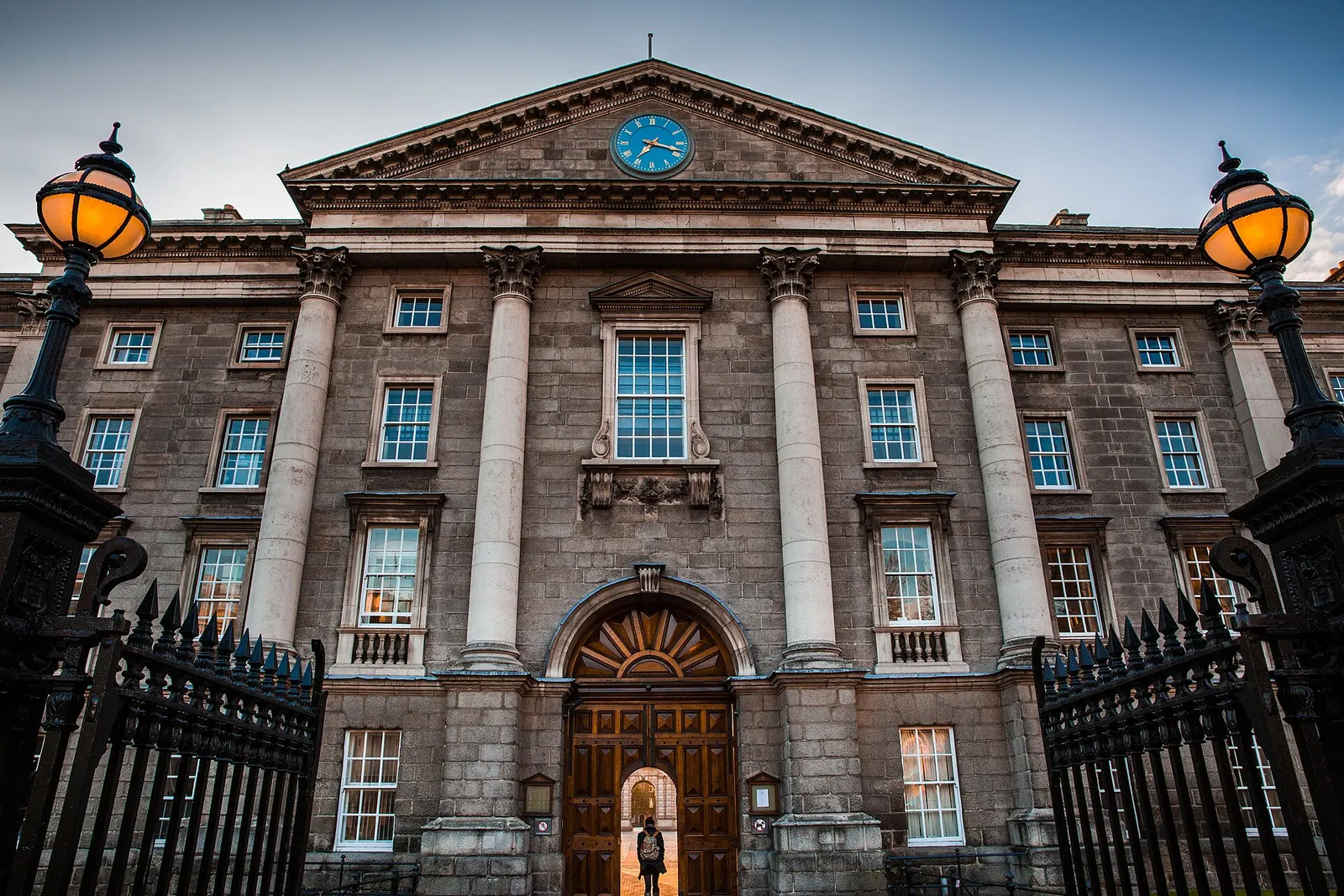
Trinity College Dublin
Established by royal charter, Ireland's oldest university centres around cobbled quadrangles framed by neoclassical architecture. The expansive Parliament Square features the Campanile, designed by Charles Lanyon in 1853, alongside the Exam Hall and Chapel. Travellers can wander through lawns that once served as monastic grounds of All Hallows priory.
Library of Trinity College Dublin
Thomas Burgh designed the Old Library building, completed in 1732 to house Ireland's legal deposit collection. Inside, the 65-metre Long Room features a soaring barrel-vaulted ceiling, marble busts by Louis François Roubiliac, and the ninth-century Book of Kells. Visitors should also inspect the Brian Boru harp, one of the nation's earliest emblems.
Douglas Hyde Gallery
Opened in 1978 inside Paul Koralek's Brutalist Arts Building, this space was Ireland's first publicly funded gallery for contemporary art. The cavernous concrete interior features rotating international exhibitions and experimental projects. Its quiet subterranean galleries provide a striking modern architectural counterpoint to the neighbouring Georgian stone quads.
Bank of Ireland, College Green
Constructed by Edward Lovett Pearce in 1729, this colonnaded complex served as the world's first purpose-built bicameral parliament building. Following the 1800 Act of Union, the government sold the property to the Bank of Ireland. Visitors can explore the preserved House of Lords chamber, complete with Irish oak woodwork and historic tapestries.
Statue of Henry Grattan
Sculpted by John Henry Foley and unveiled in 1876, this bronze statue depicts orator Henry Grattan addressing the nearby House of Commons. Set upon a granite pedestal in College Green, Grattan raises his arm in an impassioned rhetorical pose. The site stands as a historic gathering point for civic demonstrations and political rallies.
Molly Malone Statue
Cast by sculptor Jeanne Rynhart for the 1988 Dublin Millennium, this public artwork depicts the fictional fishmonger from the song Cockles and Mussels. Clad in seventeenth-century dress, Molly wheels her handcart past the former St Andrew's Church. The monument remains one of the city's most recognisable photographic landmarks.
Grafton Street
Developed in the early eighteenth century, Grafton Street evolved from a residential lane into Dublin's premier commercial corridor. Victorian red-brick facades, decorative ironwork, and shopfronts line the pedestrian thoroughfare. Street musicians and buskers have performed here for decades, contributing to the lively daily rhythm between Trinity College and the south city.
Powerscourt Centre
Built between 1771 and 1774 for Richard Wingfield, 3rd Viscount Powerscourt, this Palladian mansion showcases elaborate rococo plasterwork by Michael Stapleton. The residence was adapted into an artisanal retail centre during the twentieth century without erasing its original grandeur. Visitors can observe classical cornices, a grand ashlar facade, and a bright central courtyard.
The Little Museum of Dublin
Located in an eighteenth-century townhouse on St Stephen's Green, this community-driven museum chronicles the cultural and political shifts of the capital. Its rooms display thousands of public donations, ranging from historical letters to ephemera of Irish rock bands. Guided tours detail daily city life, the 1916 Rising, and modern social changes.
St Stephen's Green
Originally marshy common land enclosed in 1664, Lord Ardilaun funded the park's Victorian redesign, opening it to the public in 1880. Formal flowerbeds, a central lake, and tree-shaded paths host sculptures of historical figures such as Constance Markievicz and Wolfe Tone. Portions of the Fusiliers' Arch still bear bullet marks from the 1916 Easter Rising.
Mansion House, Dublin
Built in 1710 by property developer Joshua Dawson, this Queen Anne mansion was acquired by the city five years later. Its distinctive Victorian facade was applied later, while the adjacent Round Room hosted the inaugural meeting of the First Dáil in 1919. It remains a key venue for civic ceremonies and diplomatic receptions.
Royal Irish Academy
Founded in 1785 by royal charter, the Academy moved into Academy House on Dawson Street in 1851. The interior retains grand Victorian scholarly facilities, including an ornate library holding the sixth-century Cathach of St Columba. Scholars continue to publish research and manage invaluable collections of medieval Irish manuscripts here.
St Ann's Church, Dawson Street
Constructed in the early eighteenth century, St Ann's received its elaborate neo-Romanesque facade in 1868, designed by architect Thomas Newenham Deane. The interior preserves the bread shelf, established by an 1723 bequest to distribute loaves to Dublin's poor. Bram Stoker and Florence Balcombe married here in 1878 beneath its stained-glass windows.
George's Street Arcade
Designed in Venetian Gothic style by Lockwood & Mawson, the South City Market opened in 1881 and was rebuilt after a fire in 1892. Stalls beneath its iron-and-glass roof sell second-hand books, vintage clothing, and specialty foods. The ornate red-brick exterior dominates South Great George's Street with decorative turrets and carved stone accents.
Dublin Castle
Erected by order of King John in 1204, Dublin Castle served as the centre of English and British rule until 1922. While largely rebuilt in classical Georgian style following a 1684 fire, the medieval Record Tower survives intact. Today, the complex accommodates state inaugurations, international summits, and tours of the grand State Apartments.
Chester Beatty Library
Situated in the Clock Tower Building within Dublin Castle gardens, this institution houses the vast collection bequeathed by mining magnate Sir Alfred Chester Beatty. Galleries display rare Islamic calligraphy, early Christian biblical papyri, East Asian scrolls, and European illuminated manuscripts. The adjacent rooftop garden offers quiet views over the castle grounds.
Dubh Linn Gardens
Laid out behind the State Apartments, these circular gardens mark the site of the ancient Dubh Linn, or Black Pool, from which the city took its name. Celtic knotwork motifs are carved into the central lawn, visible from the surrounding stone terraces. The lawn serves as an open-air sculpture space and helicopter pad for visiting heads of state.
Chapel Royal, Dublin
Completed in 1814 as the official place of worship for the Lord Lieutenant of Ireland, this Gothic Revival structure features over ninety carved stone heads on its exterior. Inside, intricate plaster vaults and stained-glass panels sit alongside the carved coats of arms of every Viceroy of Ireland. The building now hosts recitals and guided tours.
Dublin City Hall
Erected between 1769 and 1779 as the Royal Exchange, Thomas Cooley's Corinthian masterpiece became Dublin's municipal headquarters in 1851. The interior rotunda is supported by twelve classical columns beneath an ornate hemispherical dome. Statues of Daniel O'Connell and Charles Lucas overlook an expansive mosaic floor that depicts the coat of arms of Dublin.
Olympia Theatre, Dublin
Established in 1879 as The Star of Erin Music Hall, this Dame Street venue underwent redesigns by prominent theatre architects including John Callaghan. Its preserved auditorium features plush red seating, cantilevered balconies, and plasterwork proscenium arches. A decorative cast-iron glass canopy extends over the pavement, welcoming generations of playgoers and live concert audiences.
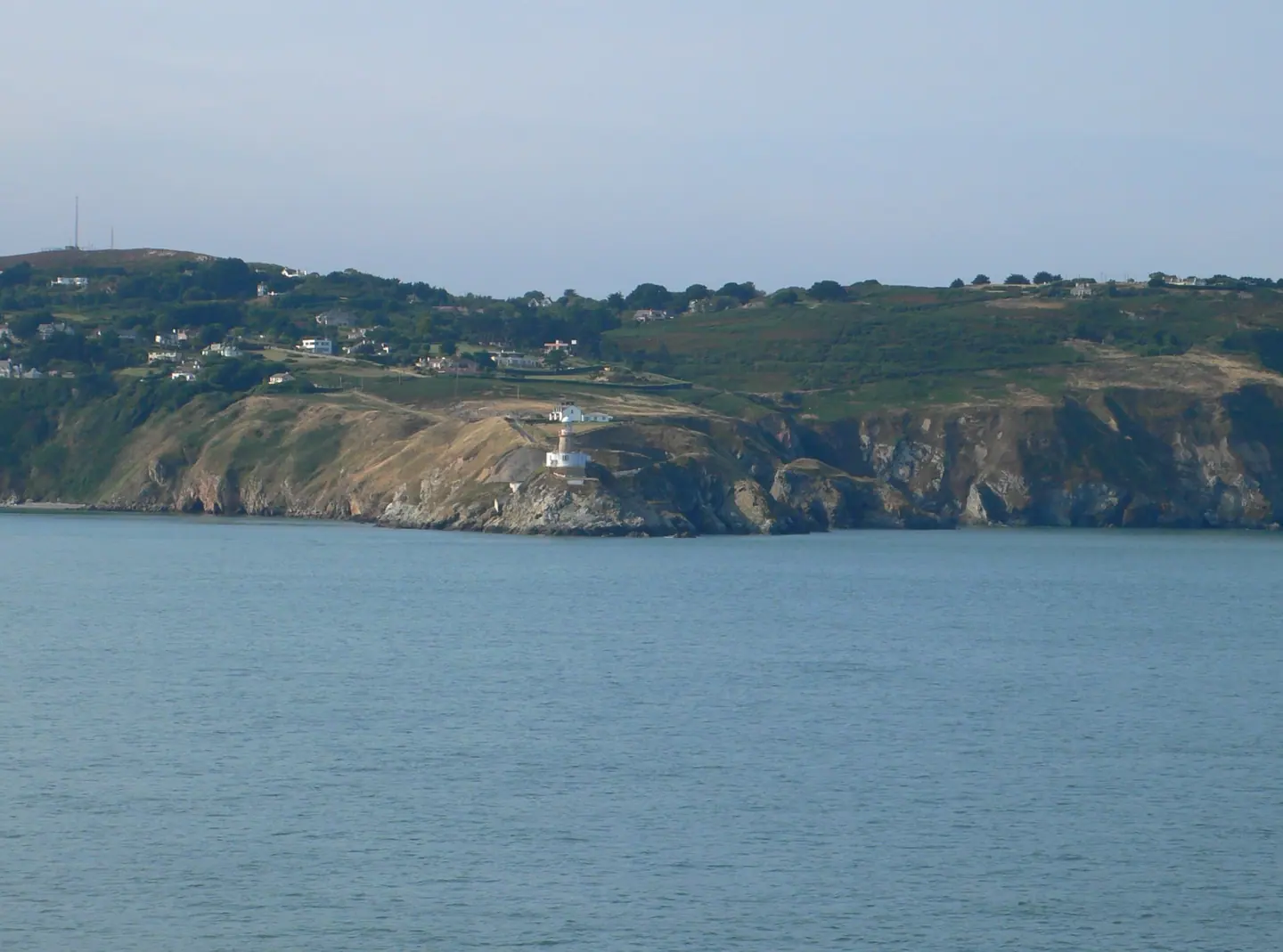
Christ Church, St Patrick’s Cathedral & The Liberties
Christ Church Cathedral, Dublinia, St Audeon’s Church, Marsh’s Library, St Patrick’s Cathedral, Teeling Whiskey Quarter, Guinness Storehouse St James’s Gate, and Kilmainham Gaol
Christ Church Cathedral
Founded originally by the Viking King Sitric Silkenbeard, the cathedral was rebuilt in stone under the Anglo-Norman warlord Strongbow during the late twelfth century. Inside, visitors can explore the vast medieval crypt, one of the oldest structures in Dublin, which shelters a mummified cat and rat trapped inside an organ pipe during the Victorian era.
Dublinia
Connected to Christ Church Cathedral by an elegant covered stone footbridge, this historical centre occupies the Victorian Synod Hall constructed in 1875. The exhibitions recreate life in medieval and Viking Dublin, tracing settlement patterns along the River Liffey through archaeological finds from Wood Quay. The adjacent St Michael's Tower offers broad views across the historic core.
Wood Quay
This stretch of the southern Liffey riverbank was the heart of Norse Dublin and the location of major archaeological excavations during the 1970s. The digs revealed well-preserved wooden house foundations, defensive earthen banks, and thousands of personal artefacts dating to the tenth century. Today, civic offices occupy the site, accompanied by commemorative bronze pavement plaques detailing the findings.
St Audoen's Church
Dating back to 1190, this ancient place of worship was dedicated to Saint Ouen of Rouen by Anglo-Norman settlers. It remains the only operational medieval parish church in the city, retaining its original twelfth-century nave and a fifteenth-century portlester chapel. Visitors can inspect medieval gravestones and the fifteenth-century bell tower housing some of Ireland's oldest bells.
St Audoen's Arch
Constructed in 1240, this imposing limestone archway is the last surviving gate from Dublin's original ring of medieval defensive walls. Situated down a flight of stone steps beside St Audoen's Church, it once guarded northern pedestrian access from the quays into the fortified city. The surrounding stone masonry demonstrates the thickness and defensive design of thirteenth-century urban fortifications.
Tailors' Hall
Constructed in the early eighteenth century, this brick building served as the meeting place for the Guild of Tailors and remains Dublin's sole surviving guildhall. In 1792, it hosted the historic Catholic Convention, earning it the moniker of the Back Lane Parliament. It now functions as the headquarters of An Taisce, Ireland's national heritage trust.
St Werburgh's Church
Established in the late twelfth century and redesigned in 1719 by Thomas Burgh, this classical stone church served the parish of Dublin Castle for generations. Beneath its floor lies the burial vault of Lord Edward FitzGerald, a notable leader of the 1798 United Irishmen Rebellion. The church retains its Georgian interior, including an ornate carved oak pulpit and royal coat of arms.
St Patrick's Cathedral
Founded in 1191 beside a holy well where Saint Patrick is said to have baptised converts, this imposing Gothic cathedral is the largest in Ireland. Jonathan Swift, author of Gulliver's Travels, served as dean here during the eighteenth century and lies buried in the south nave aisle. The interior features carved stone effigies, regimental flags, and the Door of Reconciliation.
Marsh's Library
Opened in 1707 under Archbishop Narcissus Marsh, this is Ireland's oldest public library, housed in a purpose-built late-renaissance brick building. The interior remains remarkably unchanged, retaining dark oak bookcases, brass fittings, and wire reading cages where scholars were locked in to prevent book theft. The collection preserves over 25,000 rare books and manuscripts from the sixteenth to eighteenth centuries.
St Patrick's Park
Adjoining the north transept of St Patrick's Cathedral, this formal park was created at the beginning of the twentieth century through the philanthropy of the Guinness family. Formerly an area of dense, derelict tenements, the space was transformed into lawns, gravel paths, and flowerbeds. The Literary Parade on the western wall showcases bronze plaques honouring Dublin writers including Swift, Shaw, and Beckett.
St Nicholas of Myra
Built between 1829 and 1834, this landmark Catholic church was designed by architect John Leeson following the passage of the Roman Catholic Relief Act. The classical facade features an imposing portico of Ionic columns topped with statues of saintly patrons. Inside, visitors can observe an ornate baroque-style plaster ceiling and stained-glass panels created by the renowned Dublin Harry Clarke studios.
Iveagh Fitness
Constructed in the early twentieth century by the philanthropic Iveagh Trust, this distinctive red-brick building initially provided public washhouses and slipper baths to improve hygiene among local tenement residents. Designed in an Edwardian Renaissance style, the structure was later repurposed as a sports centre while retaining its exterior character. It stands as an important monument to municipal social reform in the Liberties.
Iveagh Market
Built by Edward Guinness, the first Earl of Iveagh, and opened in 1906, this vast iron and brick hall was erected to shelter street traders from Francis Street. The building featured dedicated dry, wet, and second-hand clothes markets with sophisticated ventilation and stone carvings of river gods on its exterior. Although currently derelict, the complex remains an emblematic civic landmark of the Liberties.
Teeling Whiskey Distillery
Opened in 2015, this installation marked the revival of legal whiskey distillation in Dublin city centre after an absence of nearly four decades. Newmarket Square was traditionally known as the Golden Triangle of distilling and brewing throughout the eighteenth and nineteenth centuries. The facility operates three traditional copper pot stills, producing pot still and single malt whiskeys on historical ground.
St Catherine's Church, Thomas Street
Designed by architect John Smyth and finished in 1769, this classical stone church dominates the eastern approach to Thomas Street. Outside its front steps, the nationalist leader Robert Emmet was executed following the 1803 rebellion, an event marked by a stone plaque on the exterior wall. The facade presents a balanced Doric portico surmounted by an entablature and pediment.
St Augustine and St John the Baptist Church
Commonly known as John's Lane Church, this high-Victorian Gothic structure was designed by Edward Welby Pugin and opened in 1874. Its soaring spire reaches over sixty-one metres, making it the highest church steeple in Dublin. The interior contains remarkable stained-glass work by Harry Clarke and intricate stone capitals carved with angels and biblical foliage.
St James's Gate
This fortified stone entrance gave its name to the global Guinness brewery founded by Arthur Guinness in 1759 under a famous 9,000-year lease. The heavy black wooden gates and surrounding limestone arches date to the late nineteenth century, preserving a vintage industrial appearance. It was historically a key staging post along the medieval pilgrimage route leading to Santiago de Compostela.
Guinness Storehouse
Constructed in 1902 as a state-of-the-art fermentation house, this multistory Chicago-style steel-framed building now functions as an educational visitor centre dedicated to brewing science and advertising heritage. The central atrium is shaped in the form of a giant glass pint, rising seven storeys to the circular Gravity Bar. The top floor offers 360-degree views across Dublin and the Dublin Mountains.
Royal Hospital Kilmainham
Commissioned in 1679 by the Duke of Ormonde as a retirement home for military veterans, this quadrangle complex was inspired by Les Invalides in Paris. The building features an elegant central courtyard, an arcaded cloister, a classical clock tower, and an ornate chapel with woodcarvings by Grinling Gibbons. It now accommodates the Irish Museum of Modern Art and formal seventeenth-century gardens.
Kilmainham Gaol
Opened in 1796, this forbidding stone prison held ordinary criminals, famine debtors, and key political figures from almost every modern campaign for Irish independence. The Victorian East Wing displays a panoptic design with iron walkways and central skylights engineered for observation. The Stonebreakers' Yard marks the location where the leaders of the 1916 Easter Rising were executed by firing squad.
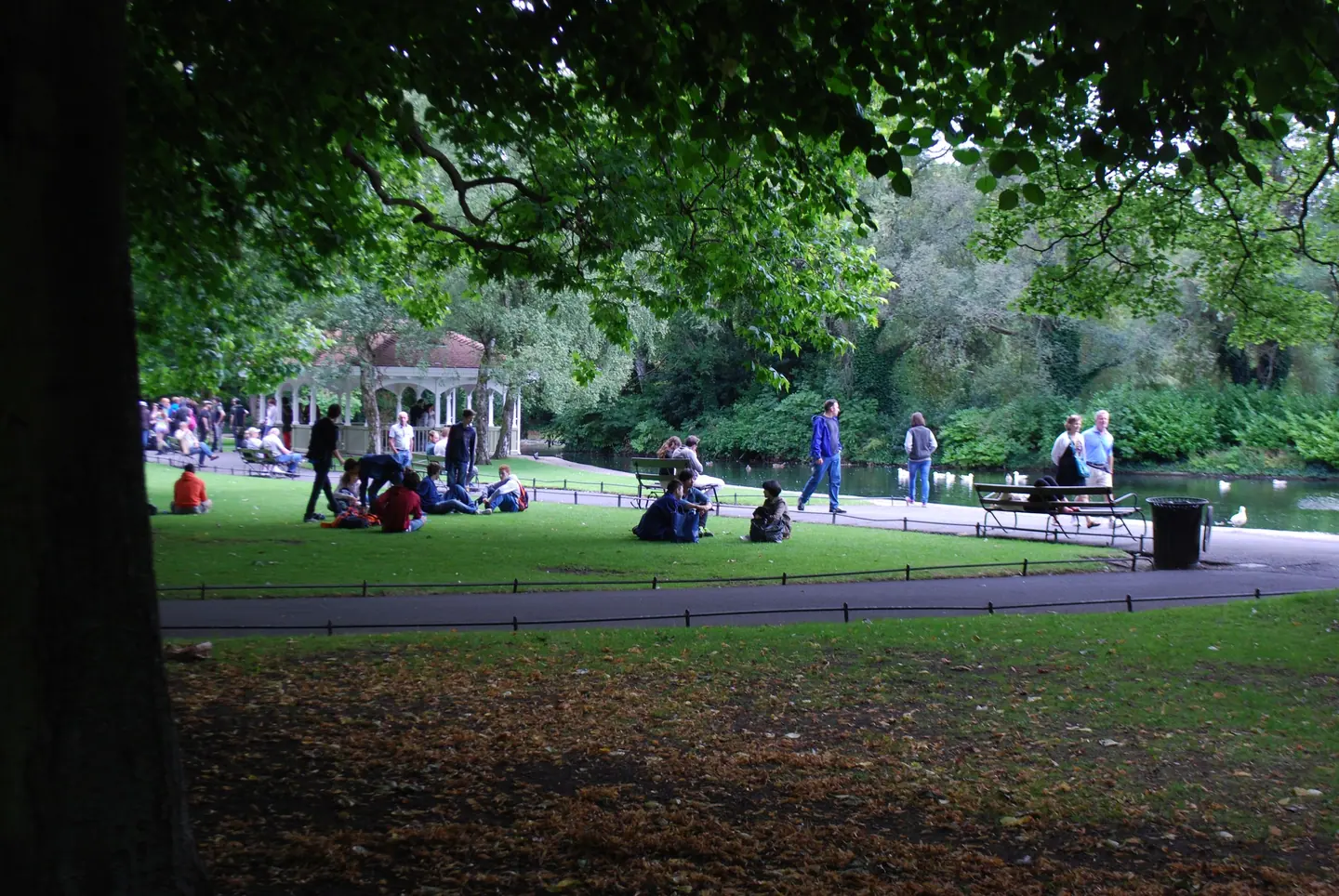
St Stephen’s Green, Merrion Square & Georgian Mile
St Stephen’s Green, Little Museum of Dublin, Iveagh Gardens, National Museum of Ireland Archaeology, National Library of Ireland, Leinster House, National Gallery of Ireland, Merrion Square, and Fitzwilliam Square
Fusiliers' Arch
Erected in 1907, this ornamental gateway commemorates the Royal Dublin Fusiliers who fell during the Second Boer War. Designed by John Howard Pentland, it reflects classical Roman triumphal architecture. Visitors can observe the carved names of battle honours inscribed across the stone lintel and inner pillars.
St Stephen's Green
Lord Ardilaun financed the redesign of this former private commons into an ornamental Victorian park, reopening it to the public in 1880. Pathways wind past historic pavilions, mature trees and an artificial lake crossed by a stone bridge. The grounds feature numerous monuments commemorating figures such as Countess Markievicz and Wolfe Tone.
The Little Museum of Dublin
Set within an eighteenth-century residence on the north side of the square, this civic collection chronicles local life across the twentieth century. The rooms display photographs, letters, political memorabilia and ephemera donated by residents. Visitors can examine an extensive archive covering social movements, writers and popular culture.
Iveagh House
Architect Richard Cassels designed this grand residence in 1736, which later became the Dublin home of the Guinness family. Donated to the Irish state in 1939, it now serves as the administrative centre for international diplomacy. The exterior displays Portland stone cladding, classical pediments and ornate wrought-iron railings along the street frontage.
Newman House
Comprising two linked eighteenth-century mansions, this complex served as the founding campus of the Catholic University of Ireland under John Henry Newman. The interiors contain exceptionally fine rococo stucco ceilings crafted by the Swiss-Italian stuccodores Paolo and Filippo Lafranchini. The property also houses exhibitions dedicated to Irish literary heritage.
University Church, Dublin
John Henry Newman commissioned John Hungerford Pollen to construct this distinctive place of worship in 1856. Drawing inspiration from early Christian basilicas in Ravenna and Rome, the interior features alabaster capitals, local marble revetments and wooden ceiling trusses. The semi-circular apse showcases intricate decorative motifs distinct from Dublin's predominant Gothic Revival churches.
Iveagh Gardens
Ninian Niven designed these gardens in 1865 for the Dublin Exhibition Palace, creating an intricate layout bounded by high stone walls. The park includes a sunken lawn, an archery ground, a rosarium and an artificial waterfall built using stones from each county in Ireland. Restored formal parterres offer a quiet retreat.
National Concert Hall
Originally constructed for the Dublin International Exhibition of Arts and Manufactures in 1865, this complex later became a primary wing of University College Dublin. Opened as the national symphonic venue in 1981, its main auditorium features celebrated acoustic properties. The facade retains neoclassical stonework facing Earlsfort Terrace.
Mansion House, Dublin
Built by merchant Joshua Dawson in 1710, this Queen Anne style dwelling was purchased by the Dublin Corporation in 1715. The Round Room, added in 1821 for the royal visit of George IV, was where the inaugural First Dáil ratified Irish independence in 1919. A distinctive cast-iron porch fronts the stuccoed exterior.
St Ann's Church, Dawson Street
Begun in 1707 to plans by Isaac Wills, this parish church received an elaborate Romanesque Revival facade designed by Thomas Newenham Deane in 1868. Inside, visitors can view the historic 1723 Bread Shelf, established by Lord Theophilus Netterville to provide food for the poor. The interior contains grand woodwork and fine stained-glass memorials.
Royal Irish Academy
Founded in 1785 to promote science, literature and antiquarian studies, the Academy has occupied this mid-eighteenth-century townhouse since 1851. The library safeguards historic treasures, including the sixth-century Cathach of St Columba and the Book of the Dun Cow. The building features a classical reading room with decorative plasterwork and mahogany book presses.
National Museum of Ireland, Archaeology
Architect Thomas Newenham Deane designed this purpose-built Victorian museum, which opened to the public in 1890. The central domed rotunda leads into galleries displaying prehistoric Irish gold artefacts, Bronze Age hoards, bog bodies and Celtic ecclesiastical metalwork like the Ardagh Chalice. Marble colonnades and mosaic tile floors accentuate the grand interior.
National Library of Ireland
Mirroring the National Museum across a landscaped courtyard on Kildare Street, this institution was designed by Thomas Manly Deane and opened in 1890. Its central reading room possesses a vast horseshoe dome ringed by arched clerestory windows. The collections encompass millions of Irish publications, personal papers, prints, maps and genealogical records.
Leinster House
Built between 1745 and 1748 for the Earl of Kildare by architect Richard Cassels, this monumental ducal residence inspired James Hoban's design for the White House. The complex became the permanent seat of the Oireachtas, the Irish parliament, in 1922. The western limestone facade fronts Kildare Street, while the eastern wing overlooks landscaped lawns.
National Gallery of Ireland
Established in 1854 and opened a decade later, the gallery incorporates interconnected historic wings, including the neoclassical Dargan Wing and the contemporary Millennium Wing. The collection spans major European schools from the early Renaissance to the twentieth century, alongside Irish masters like Jack B. Yeats. Natural light illuminates the renovated upper-floor rooms.
Merrion Square
Laid out in 1762, this expansive residential square is bordered by remarkably intact Georgian townhouses displaying fanlight doorways, sash windows and iron balconies. The central public park features manicured flowerbeds, a collection of historic lamp posts and outdoor sculpture displays. Many former residents, including political leaders and artists, are honoured on plaques.
Oscar Wilde Memorial Sculpture
Unveiled in 1997 inside the northwest corner of Merrion Square park, Danny Osborne's sculpture commemorates Oscar Wilde directly across from his childhood home. The figure reclines on a huge quartz boulder from the Wicklow Mountains, carved using jade, thulite and granite. Two flanking stone plinths carry bronze sculptures and engraved literary quotations.
14 Henrietta Street
Constructed between 1904 and 1922, this imposing quadrangle served as the Royal College of Science before conversion into state offices. Designed by Aston Webb and Thomas Manly Deane, the building incorporates Portland stone dressings, classical colonnades and a central copper dome. It now houses the Department of the Taoiseach and Cabinet chambers.
Fitzwilliam Square
Completed between 1791 and 1825, this is the smallest and most cohesive of Dublin's principal Georgian squares. The enclosing townhouses feature decorative wrought-iron balconies, ornate fanlights and uniform brick facades. The central railed garden remains private for local keyholders, preserving the original domestic planning of the Georgian estate.
St Patrick's Hospital
Constructed between 1821 and 1824 to plans by John Bowden, this parish church terminates the vista down Upper Mount Street. Known locally as the Peppercanister due to its narrow cylindrical cupola, the building features a classical portico with fluted Ionic columns. The interior contains neoclassical plasterwork and memorials to nineteenth-century civic figures.
River Liffey Bridges, Temple Bar & O’Connell Street
Ha’penny Bridge, Temple Bar Square, O’Connell Bridge, General Post Office GPO, Spire of Dublin, Hugh Lane Gallery, Dublin Writers Museum area, Custom House Dublin, and EPIC The Irish Emigration Museum
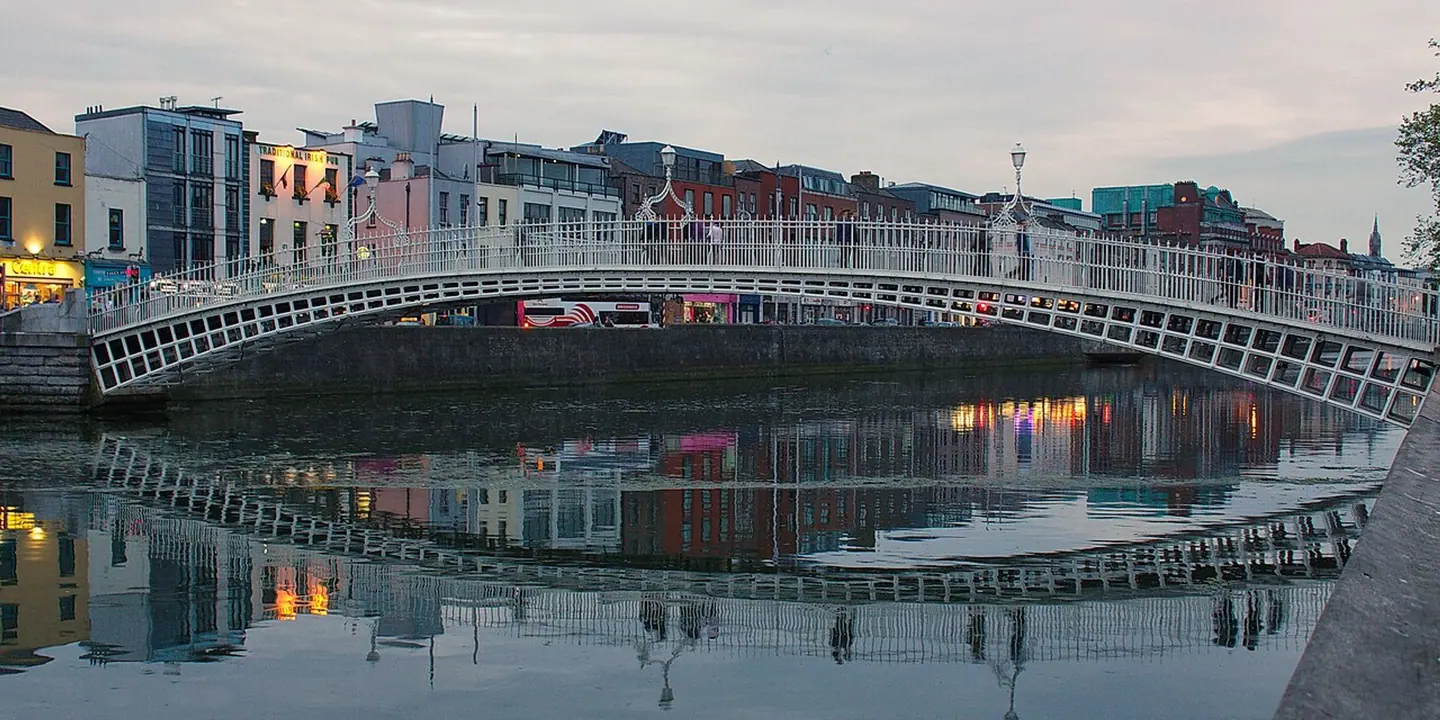
Ha'penny Bridge
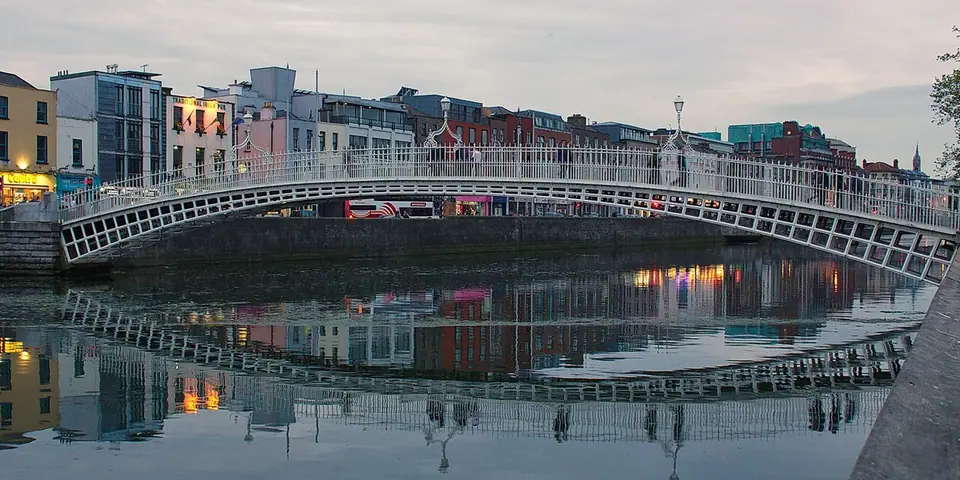
Officially named the Liffey Bridge, this elegant single-span structure opened in May 1816 to replace deteriorating ferry services across the river. Cast at Coalbrookdale in Shropshire, its white-painted railings and decorative gas lanterns remain distinct riverside features. Pedestrians paid a halfpenny toll to cross until the turnstile charges were eliminated in 1919.
Temple Bar Square
Developed during the 1990s urban regeneration programme, this open-air square serves as a primary orientation point for the cultural precinct south of the River Liffey. Paved in stone and framed by cafe terraces and bookshops, it regularly hosts outdoor markets and cultural performances. Narrow medieval lanes radiate outward toward historic theatres and independent galleries.
The Temple Bar Pub
Occupying a prominent street corner since the mid-nineteenth century, this establishment exemplifies traditional Victorian pub exterior architecture. Its bright red facade features hanging floral baskets, gold-leaf lettering, and leaded glass windows. Inside, visitors encounter narrow flagstone passageways, timber-panelled drinking snugs, and an extensive collection of rare Irish whiskeys.
The Clarence Hotel
Opened in 1852, this riverside hotel was extensively refurbished in the 1990s under the ownership of rock band U2 members Bono and The Edge. The building retains its red-brick facade and classic fenestration along Wellington Quay overlooking the River Liffey. Inside, the Octagon Bar retains period details alongside contemporary wood finishes and bespoke furniture.
Millennium Bridge
Installed in December 1999 to commemorate the turn of the millennium, this slender pedestrian crossing spans fifty-one metres across the water without river piers. Fabricated from structural steel in Carlow, the bridge forms an arch connecting Eustace Street with the north quays. Its open design offers clear sightlines toward older historic crossings upstream and downstream.
Grattan Bridge
Connecting Capel Street with Parliament Street, this broad roadway bridge replaced the historic Essex Bridge in the 1870s. Designed by Bindon Blood Stoney, it features wide cast-iron footpaths supported by granite piers and decorative iron lamp standards crowned with sea horses. The crossing offers excellent views toward Dublin Castle and the City Hall dome.
O'Connell Bridge
Remarkable for being nearly as wide as it is long, this central crossing originated in 1794 as Carlisle Bridge before its substantial reconstruction around 1880. Designed by Bindon Blood Stoney, the three-span granite structure carries vehicular and tram traffic between central boulevards. Keystone heads carved by Edward Smyth represent the River Liffey, Atlantic Ocean, and Anna Livia.
O'Connell Monument
Unveiled in 1882 at the southern entrance to O'Connell Street, this towering nineteenth-century monument honors political reformer Daniel O'Connell. Sculpted by John Henry Foley, the bronze statue stands atop a high granite plinth surrounded by four winged figures representing religious and civil courage. Lower friezes depict allegorical representations of Ireland breaking historic chains of servitude.
General Post Office
Completed in 1818 to designs by architect Francis Johnston, the General Post Office features a commanding six-column Greek Ionic portico carved from Portland stone. As the headquarters for rebel leaders during the 1916 Easter Rising, the building sustained heavy shelling, leaving bullet scars still visible in the exterior pillars. The restored main hall houses working counters and commemorative exhibits.
The Spire of Dublin
Rising 120 metres above the central reservation of O'Connell Street, this pin-like stainless steel monument was completed in 2003 on the site of the former Nelson's Pillar. Designed by Ian Ritchie Architects, the slender cone tapers from three metres in diameter at ground level to just fifteen centimetres at its lit apex. Its polished base is patterned with fractal designs.
Parnell Monument
Situated at the northern apex of O'Connell Street, this monument was designed by American sculptor Augustus Saint-Gaudens and dedicated in 1911. The composition consists of a bronze statue of parliamentary leader Charles Stewart Parnell positioned against a nineteen-metre triangular obelisk of Galway granite. Carved lettering quotes his speech defending the right of the Irish nation to political self-determination.
Hugh Lane Gallery
Housed within Charlemont House, a stately Georgian town mansion built in 1765 by Sir William Chambers, this public gallery was founded by Sir Hugh Lane in 1908. It holds an extensive collection of French Impressionist masterpieces alongside prominent twentieth-century Irish paintings. A highlight is the relocated, meticulously preserved London studio of Dublin-born painter Francis Bacon.
Garden of Remembrance
Dedicated in 1966 on the fiftieth anniversary of the Easter Rising, this quiet public space honors all who gave their lives for Irish independence. Architect Dáithí Hanly designed the sunken enclosure with a cross-shaped reflection pool featuring mosaics of Celtic weapons cast into water. At the western head sits Oisín Kelly's monumental bronze sculpture, the Children of Lir.
Dublin Writers Museum
Located on Parnell Square North, this restored eighteenth-century townhouse features sumptuously restored plasterwork ceilings, wood carvings, and grand Georgian reception rooms. The museum was established to celebrate Dublin's literary history, documenting figures such as Jonathan Swift, Bram Stoker, Oscar Wilde, and James Joyce. Collections historically included original manuscripts, first editions, letters, and personal effects.
Gate Theatre
Founded in 1928 by Hilton Edwards and Micheál MacLiammóir, the Gate Theatre occupies an eighteenth-century wing designed by Richard Johnston for the Rotunda Hospital. The playhouse gained international renown as an avant-garde venue, staging classic international drama alongside groundbreaking new Irish work. Inside, the intimate auditorium features period mouldings, framed archival photographs, and classical architectural detailing.
Custom House, Dublin
Designed by master architect James Gandon and completed in 1791, this neoclassical riverside masterpiece features four distinct facades crowned by a central copper dome and statue of Commerce. Edward Smyth carved its riverine keystones and heraldic arms. Gutted by fire during the War of Independence in 1921, the building underwent extensive structural reconstruction using durable Ardbraccan limestone.
EPIC The Irish Emigration Museum
Located in the restored subterranean vaults of the early nineteenth-century CHQ Building, this digital museum chronicles the journeys of Irish emigrants throughout history. Twenty high-tech interactive galleries present the social, cultural, and political influences of the diaspora worldwide. Visitors explore historic stone archways and iron columns dating back to the tobacco warehouse era of 1820.
The Custom House Quay Famine Memorial
Created by Dublin sculptor Rowan Gillespie and installed in 1997, this haunting set of life-sized bronze figures stands silently on Custom House Quay along the River Liffey. The emaciated statues portray desperate people walking toward the docks to board early famine ships during the nineteenth century. The site connects historically with the nearby Jeanie Johnston tall ship replica.
Jeanie Johnston
Moored on Custom House Quay, this ocean-going tall ship is a meticulously built replica of the original three-masted barque that sailed between Tralee and North America from 1848 to 1855. Unlike many period vessels, the original never lost a single passenger or crew member to disease. Guided tours take visitors down into the cramped, authentic timber steerage quarters.
Talbot Memorial Bridge
Opened to traffic in 1978, this reinforced concrete beam bridge spans the River Liffey directly east of the Custom House. Designed by De Leuw, Chadwick, OhEocha and Partners, the low-profile structure connects Memorial Road on the north bank with Moss Street to the south. It offers uninterrupted eastward vistas toward Dublin's modern docklands and the Samuel Beckett Bridge.
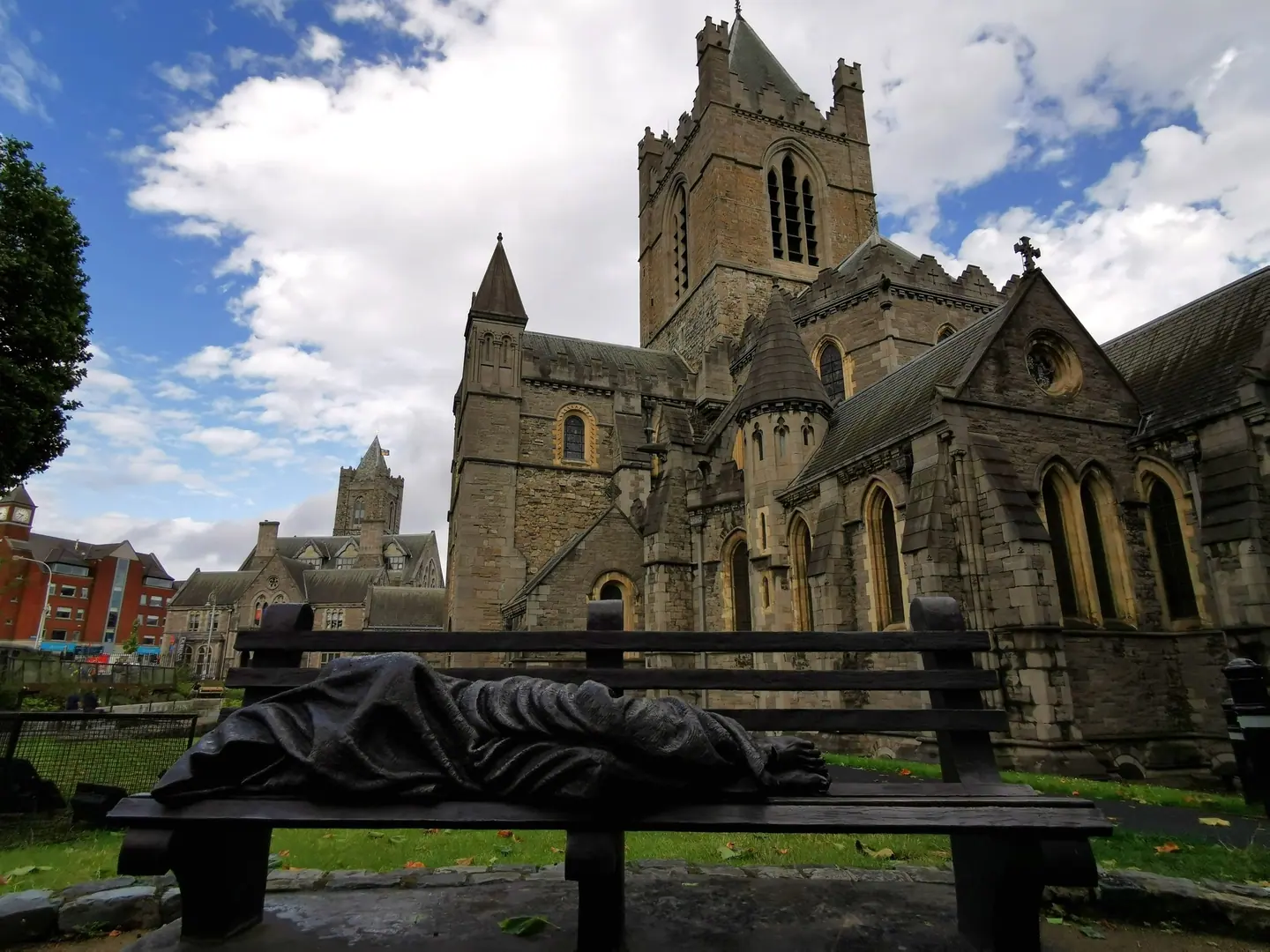
Four Courts, Phoenix Park, Glasnevin & Coastal Howth
Four Courts, St Michan’s Church, Jameson Distillery Bow St, National Museum Collins Barracks, Phoenix Park, Áras an Uachtaráin, National Botanic Gardens Glasnevin, Casino at Marino, and Howth Cliff Walk
Four Courts
Designed by architect James Gandon and completed in 1802, this monumental neoclassical complex houses Ireland's superior courts. The central dome and Corinthian portico dominate Inns Quay, though much of the original interior was reconstructed after severe bombardment during the Irish Civil War in 1922. Visitors can observe the grand circular central hall beneath the copper dome.
St Michan's Church
Founded in 1095 to serve the Norse population, the present structure primarily dates from a comprehensive late seventeenth-century rebuilding. Beneath the church floor lie stone crypts where atmospheric conditions have naturally preserved centuries-old human remains in open caskets. The interior also preserves an imposing pipe organ said to have been played by George Frideric Handel.
Jameson Distillery Bow St.
John Jameson founded his celebrated whiskey enterprise here in 1780, operating continuously on this Smithfield site until full production transferred to County Cork in 1971. The former industrial buildings have been converted into an educational visitor centre explaining the traditional triple distillation process. Preserved kilns, aging warehouses, and copper pot stills trace the evolution of the city's distilling trade.
Smithfield Square
Laid out during the seventeenth century as a livestock and horse market, this vast cobblestone open space serves as an urban focal point for north Dublin. Tall lighting masts reminiscent of historic factory chimneys line the plaza, framing views across renovated red-brick warehouses. At the northern end stands a converted brick observation chimney originally associated with the local distilling industry.
St Paul's Church, Arran Quay
Erected between 1835 and 1844 to designs by Patrick Byrne, this Roman Catholic parish church features a disciplined Ionic portico carved from local granite. A delicate clock tower and copper-domed cupola rise above the roofline, establishing a prominent landmark along the riverfront. Inside, the coffered barrel-vaulted ceiling and sculpted marble altarpieces reflect strict adherence to Roman classical models.
Collins Barracks
Constructed in 1702 by surveyor-general Thomas Burgh, this sprawling Georgian military post claims to be the oldest continuously inhabited military barracks in Europe. Today it accommodates the decorative arts and military history collections of the National Museum of Ireland. The enormous central parade ground, known as Clarke Square, is surrounded by colonnaded stone facades and comprehensive military exhibitions.
Croppies' Acre Memorial Park
Situated directly across the quays from Heuston Station, this public park historically served as an execution site and mass grave for United Irishmen rebels after the 1798 uprising. The landscaped grounds contain commemorative stone monuments, paved walkways, and reflective planting schemes dedicated to those who perished. It offers uninterrupted views across the river towards the Royal Hospital Kilmainham.
Phoenix Park
Established in 1662 by the Duke of Ormonde, this walled urban enclosure encompasses over seven hundred hectares of pastureland, grand tree-lined avenues, and botanical gardens. A wild herd of fallow deer still roams freely across the open grasslands, descending from the original royal stock. The park accommodates several vital state institutions alongside historic lodges and sporting grounds.
Wellington Monument
Designed by Robert Smirke and completed in 1861, this colossal granite obelisk rises sixty-two metres above the south-eastern entrance of Phoenix Park. It stands as the tallest obelisk in Europe, honouring the Dublin-born military commander Arthur Wellesley. Four large bronze relief panels cast from captured cannons decorate the plinth, depicting key moments from Wellington's military career.
Áras an Uachtaráin
Originally built in 1751 as a park ranger's lodge, this elegant white-painted mansion later served as the Viceregal Lodge for British lords lieutenant before becoming the presidential home in 1938. The classical facade, attributed to Nathaniel Clements, is said to have influenced James Hoban's design for the American White House. Formal gardens and ceremonial avenues frame the house.
Magazine Fort
Constructed in 1735 to store gunpowder and ammunition for the British military garrison, this star-shaped fortress crowns Thomas Hill within Phoenix Park. Its construction inspired a sharp satirical epigram from Jonathan Swift regarding government priorities during local hardship. The brick ramparts, sentry posts, and dry moat remain visible, offering wide panoramas towards the Dublin Mountains.
Papal Cross
This thirty-five-metre white steel cross was erected on the open expanse of the Phoenix Park racecourse for the visit of Pope John Paul II in September 1979. Over one million people gathered on the surrounding lawns to attend the open-air service, marking an unprecedented gathering in Irish history. The simple structure remains a prominent orientation point across the park's central fields.
Glasnevin Cemetery
Established in 1832 through the advocacy of Daniel O'Connell, this non-denominational burial ground covers more than fifty hectares and contains over one million interments. A fifty-five-metre granite round tower rises above O'Connell's subterranean crypt, while nearby plots contain the graves of Charles Stewart Parnell and Michael Collins. The on-site museum displays extensive genealogical and political records.
National Botanic Gardens
Founded in 1795 along the River Tolka, these gardens cultivate thousands of plant species across nineteen hectares of landscaped grounds and research collections. The premier architectural attractions are the nineteenth-century curvilinear glasshouses engineered by Richard Turner, recognised for their elegant ironwork and tropical palms. Woodland paths, herbaceous borders, and rose gardens surround the preserved Victorian conservatories.
Casino at Marino
Built between 1759 and 1773 for James Caulfeild, first Earl of Charlemont, this miniature neoclassical villa is widely considered a masterpiece of eighteenth-century European architecture. Although appearing from the exterior as a single-room square pavilion, the ingenious layout contains sixteen intricately planned rooms across three levels. Carved urns, classical statues, and discreet hollow columns conceal rainwater drainage systems.
Clontarf Castle
Standing on grounds associated with the Knights Templar and the historic 1014 Battle of Clontarf, the current mock-Tudor castle was rebuilt in 1837 by architect William Vitruvius Morrison. The structure features battlements, a tall square tower, and gothic traceried windows constructed from local limestone. It now operates as a luxury hotel, preserving historical heraldic details within its public reception halls.
St Anne's Park
Originally assembled by the prominent Guinness family throughout the nineteenth century, this coastal estate was acquired by the municipal corporation in 1939. The grounds preserve a notable rose garden, an artificial lake, follies modelled on classical ruins, and sheltered walking avenues lined with holm oaks. The Naniken River flows through the estate before discharging into Dublin Bay.
Howth Castle
Serving as the ancestral seat of the St Lawrence family for over seven centuries, the castle combines medieval defensive towers with Georgian and nineteenth-century residential additions. The grounds contain formal terraced gardens, dense rhododendron collections planted on high rocky outcrops, and the ancient ruins of St Mary's Church. The building illustrates changing domestic fortified architecture from 1235 onward.
Howth Harbour Lighthouse
Completed in 1818 to the designs of engineer John Rennie, this compact granite lighthouse stands at the tip of Howth's East Pier. Constructed as part of the initial royal mail packet route between Ireland and Britain, the fortress-like complex includes an attached defensive wall and lightkeeper's cottage. The surrounding pier provides wide prospects across Ireland's Eye and the outer bay.
Howth Cliff Walk
Tracing the perimeter of the Howth peninsula, this coastal pathway follows the high crest of the sea cliffs above the Irish Sea. The trail passes the Baily Lighthouse, built in 1814 on a dramatic rocky promontory that historically protected shipping entering Dublin Bay. Seabirds nest across the quartzite rock faces, while offshore views extend northwards to Lambay Island.
Footbridges and Coastal DART Links from Dublin
For neighbourhood accommodation notes, seasonal weather tables and airport transfer details, consult our Dublin Trinity College, Georgian Squares & Liffey Route destination guide, or browse other city and regional walking routes across the atlas.