A 100-stop archaeological and coastal route through Classical and Roman Ephesus, Selçuk’s Ayasuluk Hill, Şirince, Priene-Miletus-Didyma, and Izmir’s historic Agora and Kemeraltı bazaar.
Sacred Harbor of Artemis, Roman Provincial Capital and Aegean Port Trade
Inhabited since the Neolithic era at Çukuriçi Höyük and founded as an Ionian Greek port by Androklos in the tenth century BC near the Sanctuary of Artemis, one of the Seven Wonders of the Ancient World, Ephesus was relocated to the valley between Mount Pion and Mount Koressos by Alexander the Great's general Lysimachus around 290 BC. Under Emperor Augustus it became the capital of Roman Asia Minor, a marble metropolis of over two hundred thousand citizens famed for the Library of Celsus and its twenty-four-thousand-seat theatre.
Sacred to early Christianity through the preaching of St Paul, the Basilica of St John on Ayasuluk Hill, and the Third Ecumenical Council of AD 431, the city gradually shifted inland as the Cayster River silted its harbour, while nearby Smyrna (modern Izmir) rose as the premier port of the Aegean.
Upper Ephesus, Curetes Street & Terrace Houses
Magnesia Gate, State Agora, Bouleuterion Odeon, Prytaneion, Memmius Monument, Temple of Domitian, Hercules Gate, Trajan Fountain, Temple of Hadrian, and Terrace Houses of Ephesus
Magnesia Gate
Marking the classical southern entrance to the city, this gate once formed a key defensive portal in the Hellenistic walls. Roman engineers later adapted it into a monumental archway flanked by circular towers. Travellers can examine the heavy ashlar foundations that received caravans arriving from neighbouring Magnesia ad Maeandrum.
East Gymnasium
Constructed during the second century AD, this sprawling establishment integrated a classical wrestling court with an expansive bathing suite. Statues of philosophers and athletes once lined its marble-paved corridors to inspire young scholars. Visible today are the vaulted brick hypocaust chambers that heated the caldarium beneath the stone floors.
Varius Baths
Financed by a wealthy local benefactor named Flavius Damianus, these baths serviced citizens entering the civic centre from the eastern gates. The complex features surviving sections of mosaic pavements and fragments of the original heating network. Notice the sophisticated clay pipe conduits embedded directly within the surviving vertical wall masonry.
State Agora
Dating from the Hellenistic era and overhauled under Augustus, this open esplanade served as the political nerve centre of Roman Ephesus. Double colonnades bordered the square on three sides, shielding local officials during administrative meetings. Today, substantial marble stylobates and fallen column drums define the monumental boundaries of the plaza.
Basilica Stoa
Spanning over one hundred and sixty metres along the northern flank of the State Agora, this colonnaded hall was dedicated around 11 AD. Its Ionic columns carried carved capitals bearing expressive bulls heads that symbolised Roman civic authority. Excavators recovered statues of Emperor Augustus and Empress Livia from its eastern termination.
Odeon of Ephesus
Funded in the mid-second century by Publius Vedius Antoninus, this covered auditorium held up to fifteen hundred spectators. The semicircular cavea rises in tiers of polished limestone facing a narrow marble orchestra and stage wall. It accommodated both closed deliberations of the municipal senate and intimate public concerts.
Prytaneion of Ephesus
Dedicated to Hestia, the goddess of the hearth, this religious town hall represented the beating heart of the community. Priests maintained an eternal fire within the central courtyard as a symbol of civic vitality. Several celebrated statues of Artemis of Ephesus were discovered buried beneath the paved floor of this building.
Chalcidicum and Hydrekdocheion
Serving as a transition zone between the political district and upper streets, this monument combined ceremonial architecture with water distribution. Stone conduits channelled water from distant aqueducts into decorative pools for public use. Visitors can observe inscribed architrave blocks that record public repairs completed during late antiquity.
Temple of Domitian
Erected in the late first century, this immense pseudo-dipteral temple affirmed the loyalty of Ephesus to the Flavian imperial dynasty. Because Domitian suffered senatorial condemnation after his death, citizens swiftly rededicated the temple to his father Vespasian. Massive stone vaults remain visible, having historically supported the vast elevated platform above.
Memmius Monument
Constructed during the reign of Augustus, this four-sided marble monument commemorated Gaius Memmius and his famous ancestor Sulla. The design featured curved facades decorated with relief carvings representing virtues such as military valour and civic duty. Its conspicuous position beside the public thoroughfare ensured high visibility to arriving dignitaries.
Pollio Fountain
Built around 97 AD by the wealthy Ephesian citizen C. Sextilius Pollio, this public fountain featured a sweeping semicircular basin. Water was transported through clay aqueducts to pour through sculpted stone spouts. The structure was historically adorned with mythological statues depicting Odysseus blinding the cyclops Polyphemus.
Hercules Gate
Dating in its current form to the fifth century, this gateway deliberately restricted wheeled traffic from accessing the descending avenue. Its two central pillars bear high-relief carvings of the mythical hero Hercules draped in the skin of the Nemean lion. The restricted passage funnelled shoppers into the pedestrianised shopping district below.
Curetes Street
Named after the priestly college of the Curetes, this marble-paved avenue sweeps downward from the State Agora toward the Library of Celsus. Covered colonnades shielded pedestrians from rain, while mosaic pathways ran front of affluent commercial premises. Deep grooves cut into the flags demonstrate centuries of heavy municipal use.
Monument of Sextus Iulius Frontinus
Positioned prominently along the upper section of Curetes Street, this pedestal supported a public statue dedicated to Frontinus. Known across the empire as a general and author on water management, he held high administrative office within Roman Asia. Surviving Greek and Latin epigraphs detail his contributions to regional engineering projects.
Trajan Fountain
Dedicated around 104 AD, this fountain featured a vast pool surrounded on three sides by a two-tiered Corinthian facade. A colossal statue of Emperor Trajan stood at the centre, with freshwater cascading from beneath his feet over carved steps. Today, the reconstructed lower tier demonstrates the rich ornamentation characteristic of Roman imperial civic architecture.
Heroon of Androklos
Greek tradition records that the prince Androklos established Ephesus after consulting the Delphic oracle regarding a fish and a boar. Hellenistic and Roman authorities honoured his memory through this rectangular funerary monument located along the main avenue. Elaborate friezes once recorded his heroic military battles against the indigenous Carian population.
Temple of Hadrian
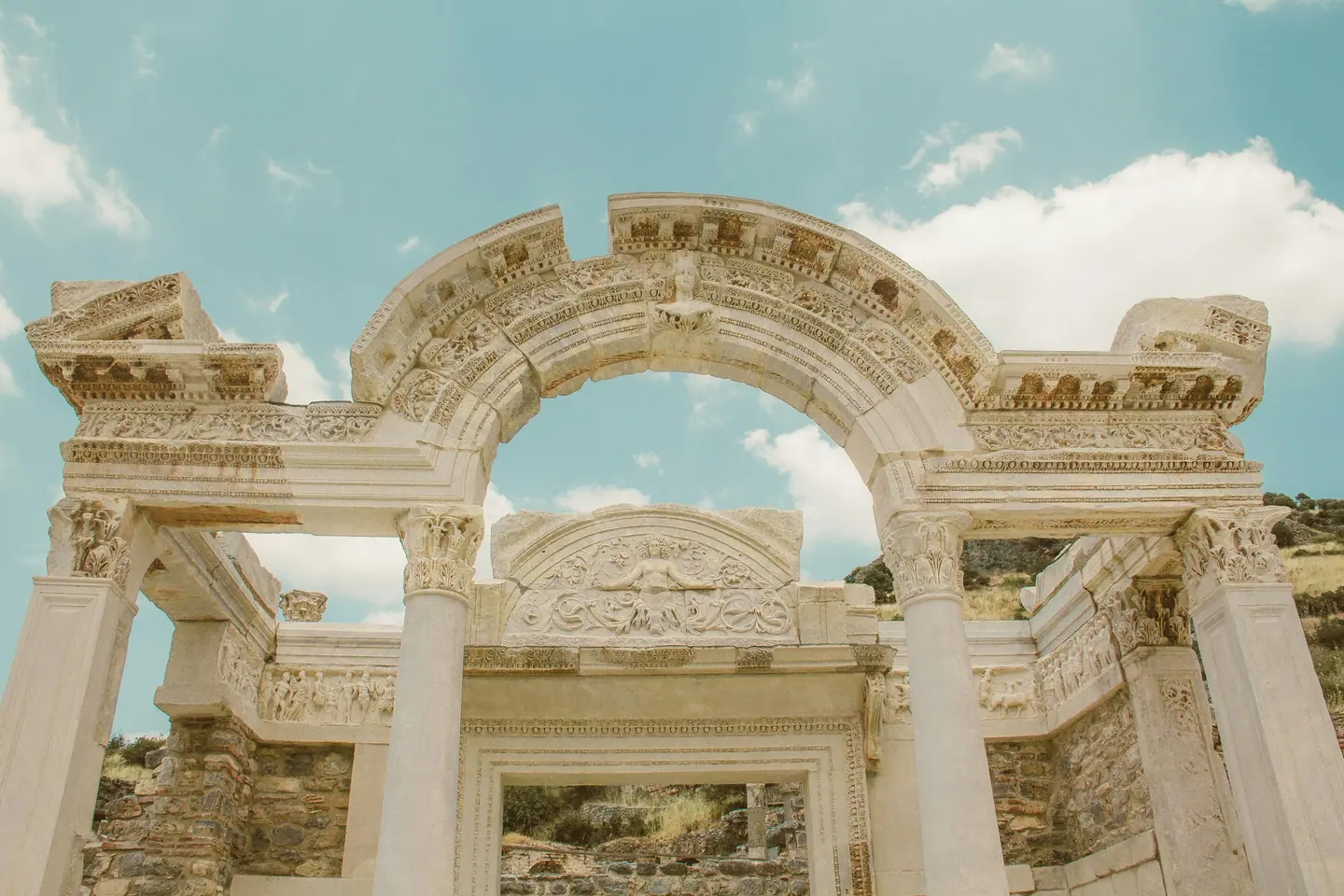
Built before 138 AD by P. Quintilius, this monument ranks among the finest architectural achievements in Roman Asia. The facade presents four Corinthian columns supporting a pediment whose central arch frames a relief of the goddess Tyche. Inside the porch, carved friezes depict the foundation myth of Ephesus and members of the imperial family.
Scholastica Baths
Originally built during the first century, this complex underwent a major fourth-century restoration led by a Christian woman named Scholastica. Her headless seated statue still greets visitors at the eastern entrance to the changing halls. The site preserves an extensive hypocaust basement alongside massive piers that once supported vaulted bathing halls.
Public Latrine of Ephesus
Constructed as an integral annexe of the neighbouring baths, this facility demonstrates the sophisticated sanitation networks of imperial Ephesus. Marble benches with cut seating apertures line three sides of an open-air peristyle courtyard. Running water flushed the deep drains beneath the seats, while a shallow clean-water channel served personal sponge cleaning.
Terrace Houses of Ephesus
Occupied by wealthy Ephesian elites, these multilevel residences provide unmatched insight into ancient domestic life. Protected under a modern canopy, the houses contain intact polychrome floor mosaics, refined peristyle courtyards, and historic mythological wall frescoes. Advanced central heating pipes and private bathrooms confirm the extraordinary luxury enjoyed by the resident aristocracy.
Library of Celsus, Great Theatre & Harbour Street
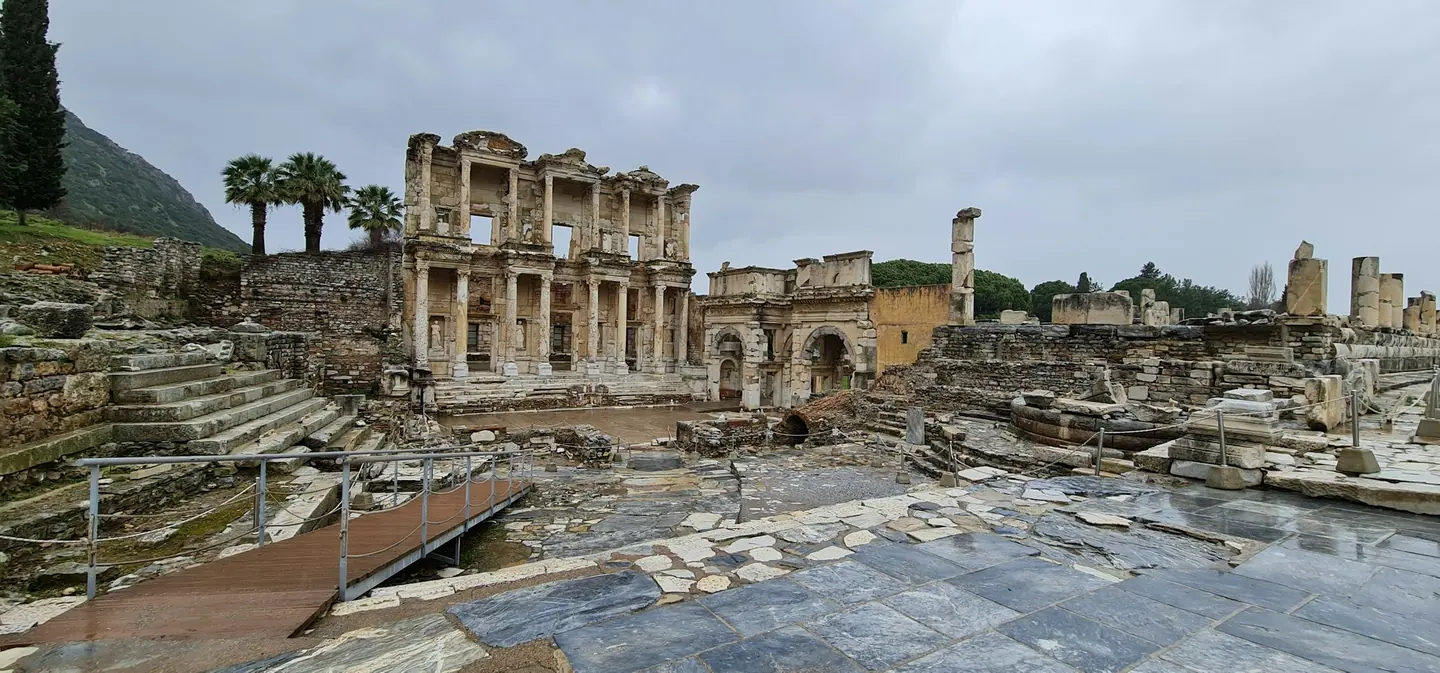
Library of Celsus, Gate of Mazeus and Mithridates, Commercial Agora Tetragonos, Marble Road, Great Theatre of Ephesus, Arcadian Way Harbour Street, Church of Mary Council Church, Harbour Baths, and Cave of the Seven Sleepers
Library of Celsus
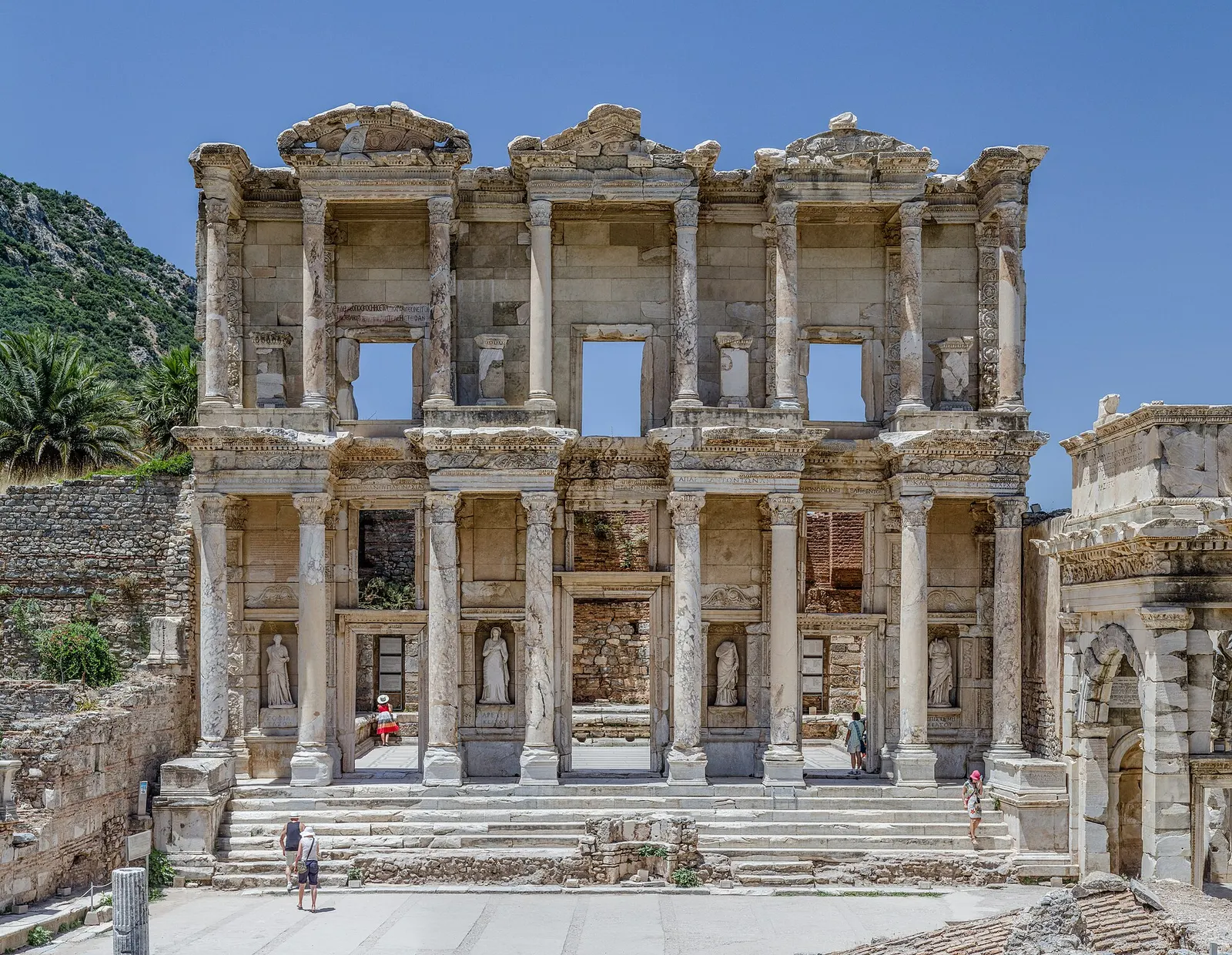
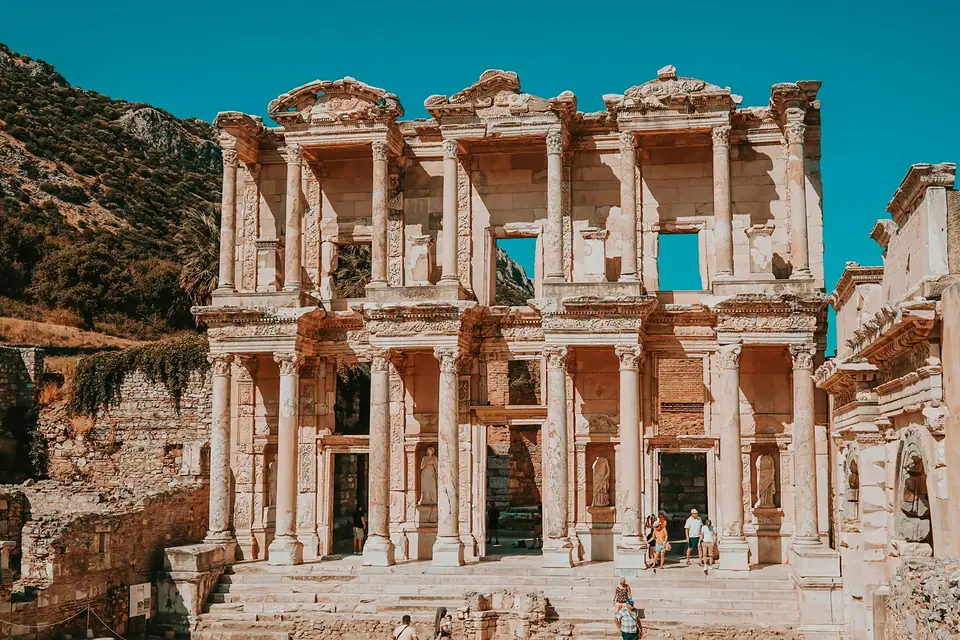
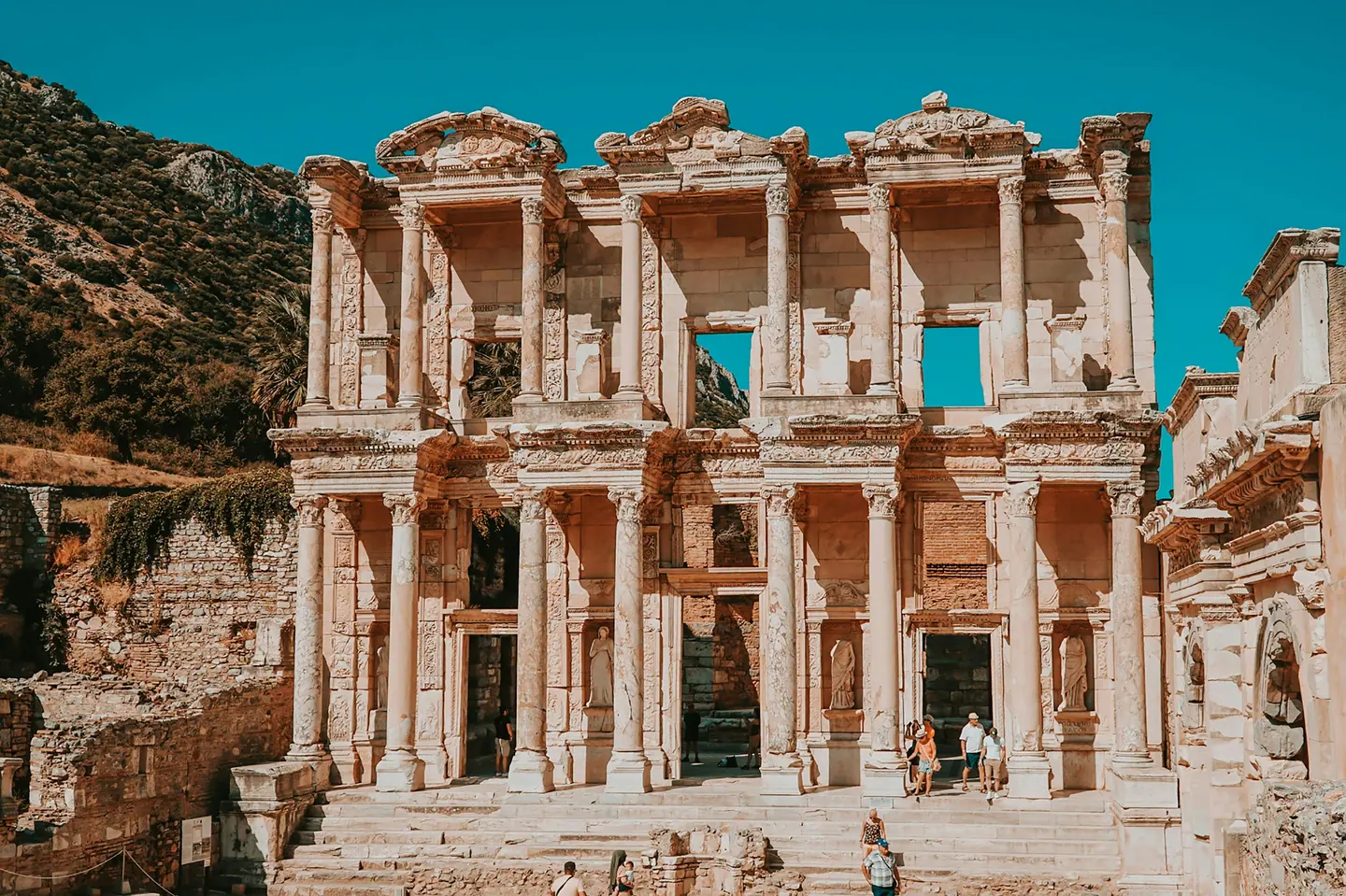
Commissioned in 110 AD by Gaius Julius Aquila to honour his father Tiberius Julius Celsus Polemaeanus, this monumental structure held thousands of papyrus scrolls. The two-tier marble facade features niches displaying statues of Wisdom, Knowledge, Intelligence, and Virtue. Visitors can examine the crypt below the reading room that held the sarcophagus of Celsus.
Gate of Mazeus and Mithridates
Built between 4 and 3 BC, this triple-arched gate was dedicated to Emperor Augustus and his family by two freed slaves. The portal connects the courtyard fronting the Library of Celsus to the Tetragonos Agora. Latin and Greek dedicatory inscriptions carved deeply into the marble attic storey remain legible for travellers observing the masonry.
Commercial Agora of Ephesus
Known as the Tetragonos Agora, this vast square measured over one hundred metres on each side and served as the primary trading hub of Roman Ephesus. Colonnaded porticoes shielded shops selling silks, spices, and regional produce brought from the nearby harbour. Stone bases and reconstructed doric columns illustrate the extensive rebuilding sponsored by Emperor Caracalla.
Marble Street
Extending from the Library of Celsus northward to the Great Theatre, this marble-paved thoroughfare carried ceremonial processions and pedestrian traffic. Carved drainage channels and raised pavements flank the roadway, which was restored in the fifth century AD under Eutropius. A celebrated carving in the stone flagstones depicts a footprint, woman, and purse pointing toward a nearby brothel.
Neronian Stoa of the Agora
Constructed along the southern perimeter of the Commercial Agora, this covered hall sheltered merchants and shoppers from the Mediterranean climate. Erected during the reign of Emperor Nero, the colonnade utilised Ionic capitals atop unfluted marble shafts. Remains of the foundation wall illustrate Roman engineering solutions adapted to the low-lying topography near the ancient harbour.
Great Theatre of Ephesus
Originally carved into the slopes of Panayır Dağ during the Hellenistic period, this auditorium was expanded under Claudius, Nero, and Trajan to seat 25,000 spectators. The three-storey stage wall supported intricate friezes, statues, and loge seating. Biblical accounts record the silversmith Demetrius inciting a riot here against the Apostle Paul to defend the cult of Artemis.
Arcadian Way
Stretching over five hundred metres from the Great Theatre to the ancient maritime basin, this monumental avenue was rebuilt by Emperor Arcadius around 400 AD. Lined with marble porticoes and fifty street lamps, it provided visiting dignitaries and merchants an imposing entrance into the city. Four tall Corinthian columns topped with statues of Christian evangelists once marked the central junction.
Harbour Gate
Situated at the western terminus of the Arcadian Way, this structure received merchants arriving by ship at the inland basin. Silt deposited by the Cayster River eventually cut the gate off from the sea, leading to its eventual decline. Surviving plinths and column bases demonstrate the formal symmetry employed to greet maritime travellers entering Roman Asia.
Harbour Baths of Ephesus
Initiated under Emperor Domitian and completed during the second century AD, this complex provided comprehensive cleansing facilities for arriving sailors and citizens. The layout included cold frigidaria, vaulted hot rooms, and adjoining palaestrae for athletic training. Immense stone arches and deep hypocaust systems survive, showing how warm air circulated beneath suspended brick floors.
Harbour Gymnasium
Built concurrently with the Harbour Baths, this open athletic courtyard facilitated wrestling, running, and physical education. Colonnades constructed from local breccia and marble enclosed the central sand-covered exercise arena. Today, fallen architraves and partially reconstructed column drums reveal the colossal proportions of the public sports complex.
Church of Mary
Inserted into an earlier Roman trade hall, this cathedral hosted the Council of Ephesus in 431 AD, which confirmed Mary as Theotokos, or God-bearer. The building measures over two hundred metres long and features an intact octagonal baptistery with an immersion pool. Visitors can trace early Christian masonry resting atop classical foundations.
Baptistery of the Church of Mary
Located off the northern narthex of the cathedral, this well-preserved baptismal room represents late antique ecclesiastical ritual. Candidates descended steps into a circular sunken basin lined with hydraulic plaster to undergo total immersion. Brick walls punctuated by semi-circular niches once supported a masonry dome that illuminated the sacred ceremony.
Verulanus Hall
Funded by Claudius Verulanus, the high priest of the imperial cult, this enormous courtyard measured over two hundred metres in width. Rows of columns surrounded an open field dedicated to athletic competitions and festival assemblies. Excavations revealed polished marble cladding and stone drainage systems that kept the ground firm during public games.
Heroon of Ephesus
Constructed as a memorial shrine, this monument is thought to honour Androklos, the mythical prince of Athens credited with founding Ephesus. An open square court gave access to a burial chamber surmounted by an elevated classical facade. Stone carvings salvaged from the site depict scenes of battles against native Carians and the pursuit of a wild boar.
Theatre Gymnasium
Positioned immediately north of the Great Theatre, this second-century complex offered facilities for study, exercise, and bathing. A spacious palaestra stood in front of vaulted brick halls heated by sophisticated charcoal furnaces. The ruins display cross-vaulted corridors that provided direct access for performers and spectators heading into the adjacent auditorium.
Cave of the Seven Sleepers
According to Christian and Islamic tradition, seven young believers sought refuge here during the third-century Decian persecutions, falling into a miraculous multi-century slumber. The hillside complex contains rock-cut burial chambers, hundreds of masonry graves, and a Byzantine funerary church. Inscriptions and graffiti left on plaster walls record centuries of devotional pilgrimages to this sacred grotto.
Hellenistic City Wall of Mount Pion
Built by Lysimachus, one of Alexander the Great's generals, around 290 BC, these defensive walls enclosed the relocated settlement on Panayır Dağ. Constructed from precisely drafted ashlar blocks, the ramparts featured projecting rectangular towers and crenellated battlements. Stretches of the masonry remain visible along the mountain crest, demonstrating Hellenistic military architecture.
St. Paul's Prison
Perched upon the crest of Bülbül Dağ, this stone fortification functioned as a harbour watchtower and military outpost. Local tradition associates the site with the imprisonment of the Apostle Paul, though historical evidence confirms its primary role as a defensive station. From this vantage point, travellers can inspect the silted plain that once served as the Ephesus maritime basin.
Western City Gate
Integrated into the circuit of Hellenistic city walls, this gate controlled terrestrial access along the shoreline of the Gulf of Ephesus. Excavations have brought to light the lower foundation courses, massive threshold blocks, and grooves cut for iron-plated wooden doors. The stonework provides key physical evidence for the changing shoreline during the early centuries of the Roman Empire.
Double Church Precinct
Following earthquake damage to the initial Church of Mary, Byzantine builders subdivided the long basilica into two smaller ecclesiastical structures during the sixth century. The eastern section incorporated brick piers and a domed apse, creating a self-contained parish church. Visitors can trace multiple construction phases spanning from pagan Roman halls to medieval Christian sanctuaries.
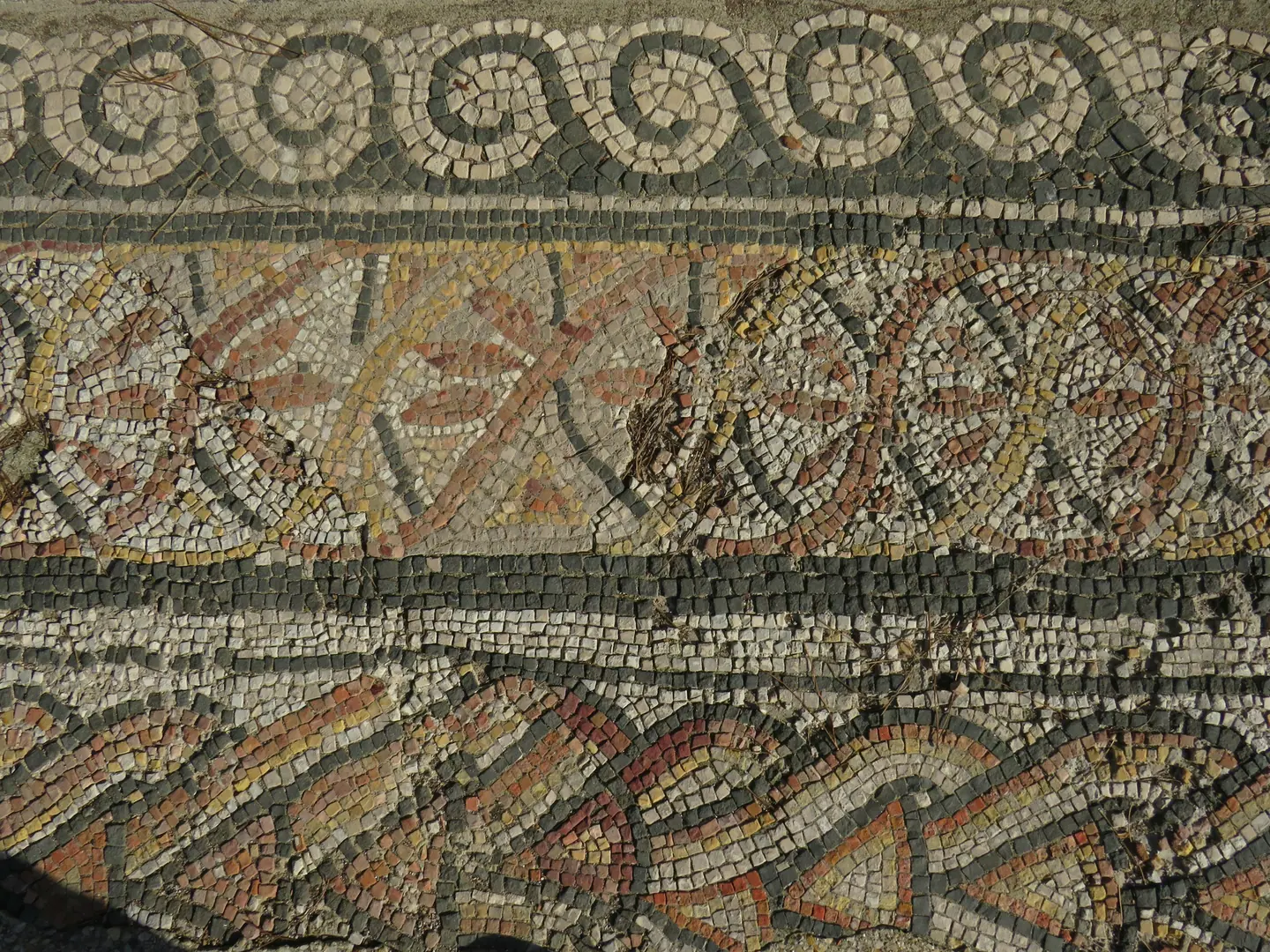
Selçuk, Ayasuluk Citadel, Temple of Artemis & Şirince
Ephesus Archaeological Museum, Temple of Artemis Site, Isa Bey Mosque, Basilica of St John, Ayasuluk Fortress, House of the Virgin Mary Meryemana, Çamlık Steam Locomotive Museum, and Şirince Village
Ephesus Archaeological Museum
Situated in the centre of Selçuk, this institution preserves monumental finds recovered from decades of Austrian excavations. Galleries highlight the colossal marble statues of Artemis adorned with symbolic ovules, exquisite Roman bronzes, and restored domestic artefacts from the hillside terrace houses. We examine intricate ivories, gladiatorial tombstones, and delicate jewellery that illuminate daily life in the Roman imperial metropolis.
Temple of Artemis Site
A single reconstructed column standing amidst marshland marks the position of this celebrated Hellenistic sanctuary. Funded originally by King Croesus of Lydia and later rebuilt after arson, the colossal marble temple exceeded the Parthenon in scale. Today, visiting archaeologists study scattered column drums, foundations submerged in groundwater, and interpretive markers outlining the precinct dedicated to the Anatolian fertility goddess.
Isa Bey Mosque
Constructed between 1374 and 1375 by the Syrian architect Ali bin Mushimish al-Dimashqi, this building exemplifies post-Seljuk Anatolian architecture. The asymmetric courtyard incorporates antique granite columns and carved capitals salvaged from neighbouring Ephesian monuments. Inside, visitors observe two shallow domes resting on octagonal drums, delicate glazed ceramic tiles, and towering pointed arches framing the serene western entrance.
Basilica of St John
Emperor Justinian I erected this monumental cruciform sanctuary during the sixth century, replacing an earlier fourth-century church. Six grand domes originally vaulted the marble nave, supported by massive brick piers and monolithic columns bearing imperial monograms. Visitors cross the monumental Gate of Persecution to reach the venerated raised tomb chamber and adjacent fifth-century octagonal baptistery.
Ayasuluk Fortress
Crowning the highest crest of Ayasuluk Hill, this fortress defended the inland settlement after coastal Ephesus silted up. The perimeter contains fifteen stone towers, extensive curtain walls rebuilt by Seljuk and Ottoman garrisons, and a small single-domed mosque. Walking the excavated interior reveals medieval cisterns, grain silos, and stone houses that provided shelter during regional sieges.
House of the Virgin Mary
Perched on the wooded slopes of Mount Koressos, this stone chapel dates architecturally to the fifth century with foundations from earlier periods. Christian tradition and papal pilgrimages associate the site with Mary's final residence under the care of John the Apostle. The grounds feature a peaceful prayer room, flowing spring waters believed to possess healing properties, and a dedicated petition wall.
Çamlık Steam Locomotive Museum
Set on the grounds of the former Çamlık railway junction, this outdoor museum displays over thirty vintage steam locomotives manufactured across Britain, Germany, France, and the United States. Visitors inspect engine cabs, passenger carriages used by Mustafa Kemal Atatürk, and classic maintenance facilities. The exhibits document the crucial role of railways in Anatolia's nineteenth-century industrial development.
Şirince Village Centre
Clustered along a secluded valley, Şirince preserves whitewashed two-storey houses characterised by projecting timber framed oriels and traditional clay roof tiles. Originally known as Kirkidje, the village transitioned from an Orthodox Greek community to Turkish settlement following the 1923 population exchange. Stone-paved alleys wind past artisanal olive oil presses, family fruit orchards, and traditional bakeries.
Saint John the Baptist Church, Şirince
Constructed in 1805 over older ecclesiastical foundations, this stone basilica served the primary Greek Christian community of the hillside settlement. The structure retains vaulted ceilings, remnants of religious frescoes depicting biblical scenes, and a sunken interior courtyard with a stone wishing fountain. Archaeological restoration programmes have secured the perimeter walls, stone bell tower base, and historic floor mosaics.
Saint Demetrios Church, Şirince
Occupying a prominent southern terrace overlooking the village, this smaller stone church was consecrated in honour of Saint Demetrios of Thessaloniki. The interior features a carved wooden iconostasis frame, arched windows that illuminate the nave, and painted plaster ornamentation. The grassy terrace offers wide panoramas over the terracotta roofs, fig orchards, and olive groves of the valley.
Byzantine Aqueduct of Selçuk
Prominently bisecting the modern town of Selçuk, these towering masonry arches carried freshwater from the eastern hills directly to Justinian's basilica and fortress. Constructed from dressed ashlar and fieldstone, several piers measure over fifteen metres in height. Today, the ruined tops of the arches serve as seasonal nesting stations for white storks during spring and summer months.
Grotto of the Seven Sleepers
Excavated into the northeastern flank of Mount Pion, this vast rock-cut burial complex features terraced mausolea, catacombs, and a fifth-century cemetery church. Tradition links the cave to seven early Christians who fell asleep during Decian persecutions and awoke centuries later. Archaeologists have catalogued hundreds of grave niches and devotional inscriptions left by pilgrims across late antiquity.
Gate of Persecution
Erected during the sixth century using decorative marble spolia from the Ephesian stadium and theatre, this arched portal protected the southern approach to the basilica. Two square towers flanked the primary entryway, which was designed to withstand Arab maritime raids. Detailed friezes on the inner piers originally depicted classical mythological subjects before being repurposed in Christian fortification work.
Ayasuluk Citadel Mosque
Dating to the Aydinid Beylik period, this modest single-domed sanctuary served soldiers defending the Ayasuluk fortifications. The masonry structure features a square prayer hall covered by a brick dome sitting upon squinches, alongside a damaged minaret base. Excavations around the perimeter revealed domestic ceramics and weapon fragments that illustrate daily military routines in medieval western Anatolia.
Selçuk Station Old Water Tower
Constructed around 1860 by the British-owned Smyrna Cassaba and Prolongements company, this cylindrical brick tower supplied water to regional steam engines. The functional industrial design features cast-iron piping, rusticated masonry bases, and neat arched brickwork. Positioned beside modern passenger tracks, the monument stands as an important relic of Western Anatolia's earliest intercity rail corridor.
Turkish Bath Museum of Selçuk
Located near the Isa Bey Mosque, this restored stone hamam preserves the traditional tripartite layout of hot, warm, and cool chambers. Glass floor panels reveal underground hypocaust brick heating pillars and clay flue pipes embedded in the walls. The central caldarium displays marble basins, perforated star-shaped daylight vaults, and informative panels detailing medieval hygiene culture.
Kızılkilise (Red Church)
Named for its distinctive reddish brick fabric and mortar, this modest single-nave chapel dates to the late thirteenth or early fourteenth century. The surviving apse wall retains decorative recessed brick pilasters and fragments of painted lime plaster. The structure represents one of the final ecclesiastical buildings erected prior to the consolidation of Turkish Beylik rule in the Cayster valley.
Pollio Aqueduct Bridge
Constructed between 4 and 14 AD under the patronage of regional magnate Gaius Sextilius Pollio, this stone bridge crosses a seasonal gorge east of Selçuk. The robust civil engineering feat features two tiers of semicircular arches crafted from rusticated limestone ashlar. Latin and Greek dedication inscriptions identify its vital role in supplying water to imperial fountain monuments in Ephesus.
Stesichoros Monument Hill
This elevated limestone knoll west of central Selçuk provides panoramic perspectives across the historic landscape connecting Mount Pion, Mount Koressos, and the Aegean sea corridor. Footpaths lead past antique ashlar foundations and scattered ceramic sherds to the summit. Here, travellers can clearly trace the ancient coastline shift caused by centuries of river silt accumulation.
Matrice Church of Şirince
historic into the northern slope above the village orchards, this stone chapel served outlying pastoral estates during the nineteenth century. Surrounding dry-stone terraces display abandoned pressing vats, decorative marble door lintels, and arched masonry niches. The site provides a quiet historical perspective on the agrarian lifestyle that defined the rural hinterland of Ephesus prior to modern urbanisation.
Ionian Triad: Priene, Miletus & Temple of Apollo at Didyma
Belevi Mausoleum, Klaros Oracle Sanctuary, Metropolis Ancient City, Priene Temple of Athena, Priene Bouleuterion, Miletus Theatre, Faustina Baths Miletus, İlyas Bey Mosque, and Temple of Apollo at Didyma
Belevi Mausoleum
Standing as the second largest Hellenistic tomb in Anatolia after Halicarnassus, this monument likely served as the burial place for Antiochus II Theos. We observe a rock-cut square podium once surrounded by Doric columns and topped with ornate marble sarcophagi. The surviving architectural reliefs provide vital clues regarding Seleucid royal funerary tradition.
Klaros Oracle Sanctuary
Dating back to the thirteenth century BC, this Panhellenic oracle centre gained immense fame during the Roman imperial era. The Doric temple honours Apollo, Artemis, and Leto, complete with colossal statues whose fragments remain visible in the field. Below the temple platform, sacred vaulted crypts where the prophet drank sacred spring water are preserved.
Metropolis Ancient City
Positioned over the fertile Cayster plain near Torbalı, Metropolis flourished during the Hellenistic period under the Kingdom of Pergamon. The site features a well-preserved marble theatre carved into the slope, a restored bouleuterion, and expansive Roman bath complexes. Excavated honorary inscriptions across the agora document strong mercantile ties with neighbouring coastal communities.
Metropolis Bouleuterion
Constructed in the second century BC, this assembly hall held meetings for the governing council of Metropolis. Semicircular tiers of limestone seats converge on an orchestra paved with flagstones, flanked by sculpted marble armrests carved with griffin paws. Archaeologists recovered significant decrees from this hall, illustrating the administrative life of Hellenistic Ionia.
Priene Temple of Athena Polias
Dedicated by Alexander the Great in 334 BC, this temple represents the canonical standard of the Ionic order. Architect Pytheos formulated its rigorous mathematical proportions, which served as a reference across the Hellenistic world. Five reconstructed Ionic columns stand on a terrace overlooking the Meander plain, backed by the sheer cliff of Mount Mycale.
Priene Bouleuterion
Regarded as one of the best preserved ancient parliament houses, this covered hall accommodated around six hundred representatives. Concentric stone benches rise along three sides around an intact sacrificial altar decorated with carved bucrania. Excellent acoustics and structural integrity allow travellers to appreciate the civic planning that defined democratic Priene.
Priene Ancient Theatre
Constructed during the third century BC, the theatre at Priene escaped substantial Roman remodelling, preserving its Hellenistic character. Five carved marble armchairs or proedria line the front row of the orchestra, reserved for honoured dignitaries and priests of Dionysus. The two-storey stage building displays stone pillars that once supported painted scenic panels.
Priene Agora
Positioned at the heart of Priene, this open market was bordered by stoas and public offices. The long Sacred Stoa provided shelter for merchants, philosophers, and citizens, and retains multiple limestone plinths that held honorary statues. Its alignment reflects the town planning principles pioneered by Hippodamus of Miletus.
Priene Synagogue
Converted from a Hellenistic residential home in the third or fourth century AD, this sanctuary is one of the earliest identified synagogues in Anatolia. Carvings of the menorah, shofar, and lulav appear on local marble architectural elements near the apse. The modest structure demonstrates the continuity of local Jewish religious life into Byzantine times.
Priene Sacred Stoa
Erected around 130 BC with royal funding from the Kingdom of Cappadocia, this colonnade stretched over one hundred metres. It featured an external Doric colonnade and an interior Ionic row that provided shaded assembly space. Excavations revealed inscribed historical records and rooms reserved for local city magistrates along its back wall.
Miletus Ancient Theatre
Holding up to fifteen thousand spectators, this theatre originated in the Hellenistic period before major expansion under Trajan and Marcus Aurelius. Visitors explore vaulted access tunnels, arched vomitoria, and imperial box seats adorned with stone relief columns. The upper tiers offer expansive vistas across the silted landscape once occupied by the Latmian Gulf.
Faustina Baths Miletus
Built during the second century AD, this bath complex was financed through the patronage of Emperor Marcus Aurelius's wife. The layout features massive brick-and-mortar caldarium vaults, a spacious palaestra, and cold plunge pools lined with marble. A carved statue base depicting the river god Meander remains situated beside the frigidarium pool.
Miletus Delphinion
This open-air rectangular precinct served as the main sanctuary of Miletus, honouring Apollo in his form as protector of ships. It constituted the departure point for the annual sacred procession that walked along the Sacred Way to Didyma. The field contains stepped altars, votive bases, and semicircular exedrae dating across Archaic and Hellenistic periods.
Miletus Ionic Stoa and Sacred Way
Connecting the civic centre to the processional road toward Didyma, this Roman colonnaded street features intact paving grooves left by ancient cartwheels. Along the eastern edge stands a reconstructed colonnade of slender Ionic columns dating to the Flavian era. Behind the portico, stone foundations mark individual commercial workshops serving urban residents.
İlyas Bey Mosque
Built in 1404 by the ruler İlyas Bey, this religious complex illustrates Anatolian beylik architecture preceding classical Ottoman styles. The single-domed mosque incorporates salvaged Roman ashlar and marble reliefs, creating an eclectic decorative facade. Its mihrab features intricate carved plaster calligraphy, flanked by a restored madrasa and hammam.
Miletus Museum
Located near the entrance to ancient Miletus, this museum displays treasures unearthed across the surrounding region. The exhibition rooms house Mycenaean pottery, archaic terracotta votive figures, funerary stelae, and coins spanning three millennia. Exterior courtyards showcase Roman imperial sarcophagi, decorative entablatures, and carved inscriptions recovered from local civic monuments.
Miletus Harbour Monument
Constructed in the first century BC, this monumental tiered structure celebrated a pivotal naval victory near the entrance of Lion Harbour. Surmounted originally by a marble triton blowing a shell, the limestone base survives amidst alluvial silt. Nearby lie the weathered stone statues of reclining lions that gave the ancient military anchorage its name.
Temple of Apollo at Didyma
As the third largest temple in the Hellenistic Greek world, Didyma served as the famous oracle of the Branchidae priesthood. The building features colossal Ionic columns measuring nearly twenty metres high, decorated with carved Medusa reliefs around its base. Sloping barrel-vaulted tunnels lead down into a sunken hypaethral courtyard containing Apollo's sacred spring.
Didyma Sacred Way Colonnade
This grand stone thoroughfare once stretched sixteen kilometres between the harbour at Miletus and the temple precinct at Didyma. The final approach to the sanctuary preserves limestone flagstones flanked by the plinths of seated archaic statues and stone sphinxes. We can trace where pilgrim processions culminated after travelling the full route on foot.
Didyma Medusa Frieze
Resting on the grass surrounding the Apollo temple, these massive architectural blocks formed part of the monumental architrave frieze. Carved during the second century AD, the striking relief depictions of the snake-haired Medusa were intended to ward off evil from the sanctuary. The fine stone carving highlights late Roman decorative craftsmanship in Ionian marble.
Izmir Konak, Ancient Agora of Smyrna, Kemeraltı & Kadifekale
Izmir Clock Tower Konak, Konak Pier, Kemeraltı Bazaar, Kızlarağası Han, Hisar Mosque, Agora of Smyrna, Kadifekale Mount Pagus, Asansör Historical Elevator, Dario Moreno Street, and Kordon Promenade
İzmir Clock Tower
Designed by French architect Raymond Charles Péré, this 1901 landmark commemorates the silver jubilee of Ottoman Sultan Abdul Hamid II. The structure features intricate Moorish stone carvings, four tiers of arches, and four delicate fountains at its base. German Emperor Wilhelm II gifted the working clock mechanism, which remains remarkably accurate.
Yalı Mosque
Commissioned in 1755 by Ayşe Hanım, this octagonal sanctuary stands beside the Aegean waterfront in Konak Square. Its single dome and slender minaret contrast with the nearby public administration buildings. Observers admire the detailed turquoise faïence tiles lining the exterior walls, which exemplify classical Ottoman ceramic art.
Konak Pier
Constructed in 1890 as a marine customs house, this seaside structure utilised cast-iron framing engineered by Gustave Eiffel's firm. After serving maritime commerce for over a century, the building was sensitively converted into an upscale retail gallery and dining promenade. Visitors can examine the original riveted steel trusses extending over the water.
Kemeraltı
Kemeraltı developed when the inner bay silted up during the seventeenth century, creating prime ground for commercial expansion. The winding alleys shelter traditional metalworkers, spice vendors, jewelers, and century-old sweet shops. Travellers navigating the cobbled passages encounter historic inns, fountains, and small courtyards that reveal İzmir's historic commercial wealth.
Kızlarağası Han
Erected in 1744 by Hacı Beşir Ağa, the chief black eunuch of the Ottoman court, this two-storey stone inn hosted travelling camel caravans. The lower level accommodated pack animals and merchant goods, while private guest chambers occupied the upper gallery. Today, the central open courtyard serves Turkish coffee prepared over hot coals.
Hisar Mosque
Completed in 1598 by Aydınoğlu Yakup Bey, Hisar Mosque marks the site of the former Byzantine sea castle of Smyrna. The monumental prayer hall features a large central dome flanked by smaller cupolas and supported by stout carved pillars. Inside, ornate plasterwork in the Ottoman baroque style adorns the grand prayer niche.
Şadırvan Mosque
Constructed between 1636 and 1638, this mosque takes its name from the prominent ablution fountain, or şadırvan, situated beside its entrance. To maximise valuable ground space within Kemeraltı, the prayer hall was elevated on stone vaults over merchant workshops. Delicate floral murals and painted woodwork characterise the upper interior prayer space.
Kestanepazarı Mosque
Erected in 1668 by Ahmet Ağa, this bazaar sanctuary sits on massive stone arches above commercial storage cellars. The prayer room is crowned by a wide central dome encircled by several secondary cupolas. Inside, ancient marble pieces, possibly salvaged from Roman Smyrna, were reused to build the substantial courtyard balustrades.
Başdurak Mosque
Founded in 1652 by merchant Hacı Hüseyin, this building exemplifies the classical practice of integrating civic worship with commercial infrastructure. The main floor rests on a solid ground-level row of shops whose rent traditionally funded religious upkeep. The interior retains charming painted plaster motifs depicting floral garlands, fruits, and scrolling arabesques.
Bikur Holim Synagogue
Established by Portuguese-Jewish philanthropist Salomon de Ciaves, this temple was rebuilt following a destructive city fire in 1772. The central elevated bimah features painted wooden columns reminiscent of Iberian Jewish architecture. The complex long served as a hospital and refuge for poor community members during regional epidemics.
Bet Israel Synagogue (İzmir)
Commissioned in 1905 under an imperial edict from Sultan Abdul Hamid II, Bet Israel is İzmir's largest synagogue. The interior showcases extensive carved mahogany, imported Italian marble, and elaborate chandeliers suspended over two gallery tiers. Its architecture blends traditional Jewish liturgical orientation with regional Ottoman decorative woodwork.
Agora of Smyrna
Constructed during the Hellenistic period and rebuilt after an earthquake in 178 AD by Emperor Marcus Aurelius, this site anchored civic life. Notable remains include the expansive three-storey western basilica, subterranean vaulted water channels, and standing Corinthian colonnades. Excavations also revealed one of the ancient world's largest collections of Greek graffiti.
Kadifekale
General Lysimachus, a successor of Alexander the Great, founded this citadel in the fourth century BC to control the Gulf of Smyrna. The surviving perimeter features thick medieval masonry, five towers, and massive vaulted Roman cisterns beneath the courtyard. The summit offers panoramas over the bay, Kemeraltı, and the urban core.
Asansör
Built by Jewish banker Nesim Levi Bayraklıoğlu, this 58-metre brick tower was engineered to connect the coastal avenue with steep hillside residences. Originally powered by water pressure before its electrification, the structure eliminated the need to climb 155 steps. The upper terrace provides views of the inner bay alongside a public café.
Dario Moreno Street
Named after the Jewish-Turkish singer and actor Dario Moreno, who lived here during his early career, this street leads directly to the Asansör. The pedestrian passage retains restored nineteenth-century stone residences with distinctive wooden bay windows known as cumbas. Statues and brass plaques celebrate the musical heritage of the Karataş neighbourhood.
İzmir Ethnography Museum
Housed in a nineteenth-century stone hospital operated by the French Daughters of Charity, this museum exhibits local Aegean customs. Displays include bridal costumes, pottery, blue evil-eye bead kilns, felt-making workshops, and weaponry. Rooms are styled as traditional living quarters, showcasing the daily life of Ottoman İzmir's multicultural residents.
İzmir Archaeological Museum
Located in Bahribaba Park, this state repository preserves antiquities recovered across the province, including Bayraklı, Smyrna, and Ephesus. The three floors exhibit bronze running figures, colossal Roman portraits of emperors, and archaic pottery. Visitors can study the fine detail on classical marble friezes salvaged from regional sanctuaries.
Ahmet Piriştina Metropolitan City Archive and Museum
Occupying the 1932 central fire brigade building, this cultural institution documents İzmir's urban transformation from antiquity to the modern republic. The interior houses extensive historic photography, old city plans, municipal registers, and newspaper files. Exhibits illuminate the devastating 1922 fire and subsequent reconstruction efforts that shaped modern downtown districts.
Church of Saint Polycarp
Built in 1625 with permission from Sultan Suleiman, this Catholic church honours Saint Polycarp, the second-century bishop of Smyrna who suffered martyrdom nearby. The interior was restored by French architect Raymond Charles Péré following the 1888 earthquake. Detailed frescoes on the vaults portray scenes from Polycarp's trial and execution by the Romans.
Kordon
Laid out during the late nineteenth century to facilitate modern shipping and tram traffic, Kordon remains the social heart of İzmir. The broad promenade stretches along the Aegean shore from Cumhuriyet Square toward Alsancak harbour. Patrons gather on the wide lawns to observe arriving ferries and watch the sun descend behind the distant Karaburun Peninsula.
Rail Links Between Izmir, Selçuk and the Maeander Valley
You can combine these stops with the district-by-district where-to-stay notes and seasonal planning tables on our Ephesus, Selçuk & Izmir Aegean Coast destination page, or explore further regional and neighbourhood guides.