A detailed heritage route across the seven UNESCO Monument Zones of the Kathmandu Valley: Newar pagoda squares in Kathmandu, Patan, and Bhaktapur, plus Swayambhunath and Boudhanath.
Licchavi Chaityas and Malla Brick-and-Timber Court Squares
According to geological evidence and Buddhist legend alike, the Kathmandu Valley was once a primordial lake drained via the Chobar Gorge. Located on the trans-Himalayan caravan route between India and Tibet, the valley flourished under the Licchavi Dynasty (fourth to eighth centuries) and reached its artistic zenith under the Malla kings between the twelfth and eighteenth centuries, when the indigenous Newar master woodcarvers, bronze casters, and bricklayers built the competing royal capitals of Kantipur (Kathmandu), Lalitpur (Patan), and Bhaktapur.
Taking its name from the twelfth-century Kasthamandap timber pavilion, Kathmandu became the capital of unified Nepal under King Prithvi Narayan Shah in 1768, preserving an unparalleled density of Hindu temples, Buddhist bahal courtyards, and stupas.
Kathmandu Durbar Square (Basantapur) & Asan Tol Old Bazaars
Kathmandu Durbar Square Hanuman Dhoka, Kumari Ghar House of the Living Goddess, Taleju Bhawani Temple, Kala Bhairav, Jagannath Temple, Basantapur Nine-Storey Tower, Freak Street Jhochhen, Indra Chowk, Akash Bhairav, Seto Machhendranath Temple, and Asan Tol Market Square
Kathmandu Durbar Square
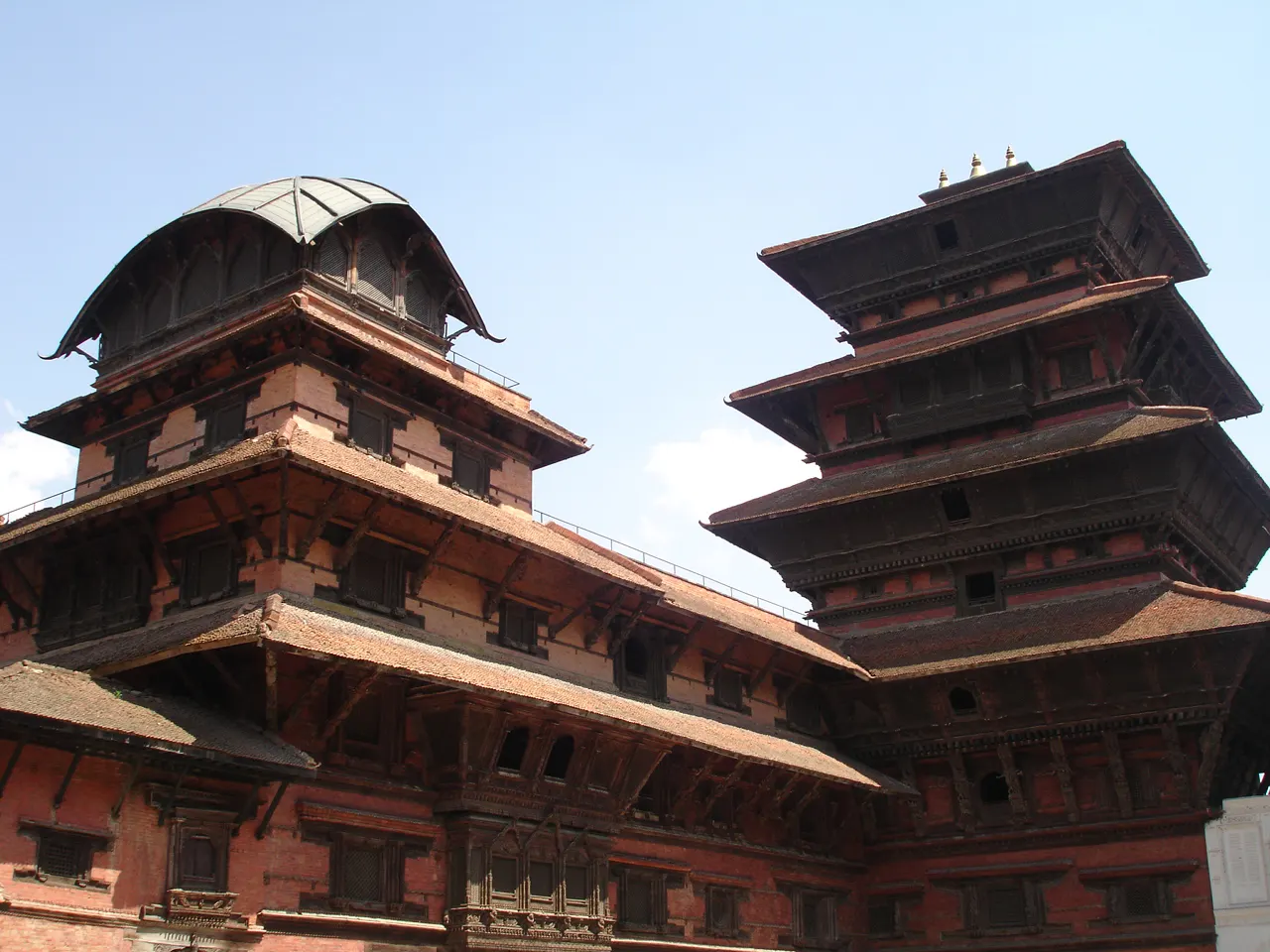
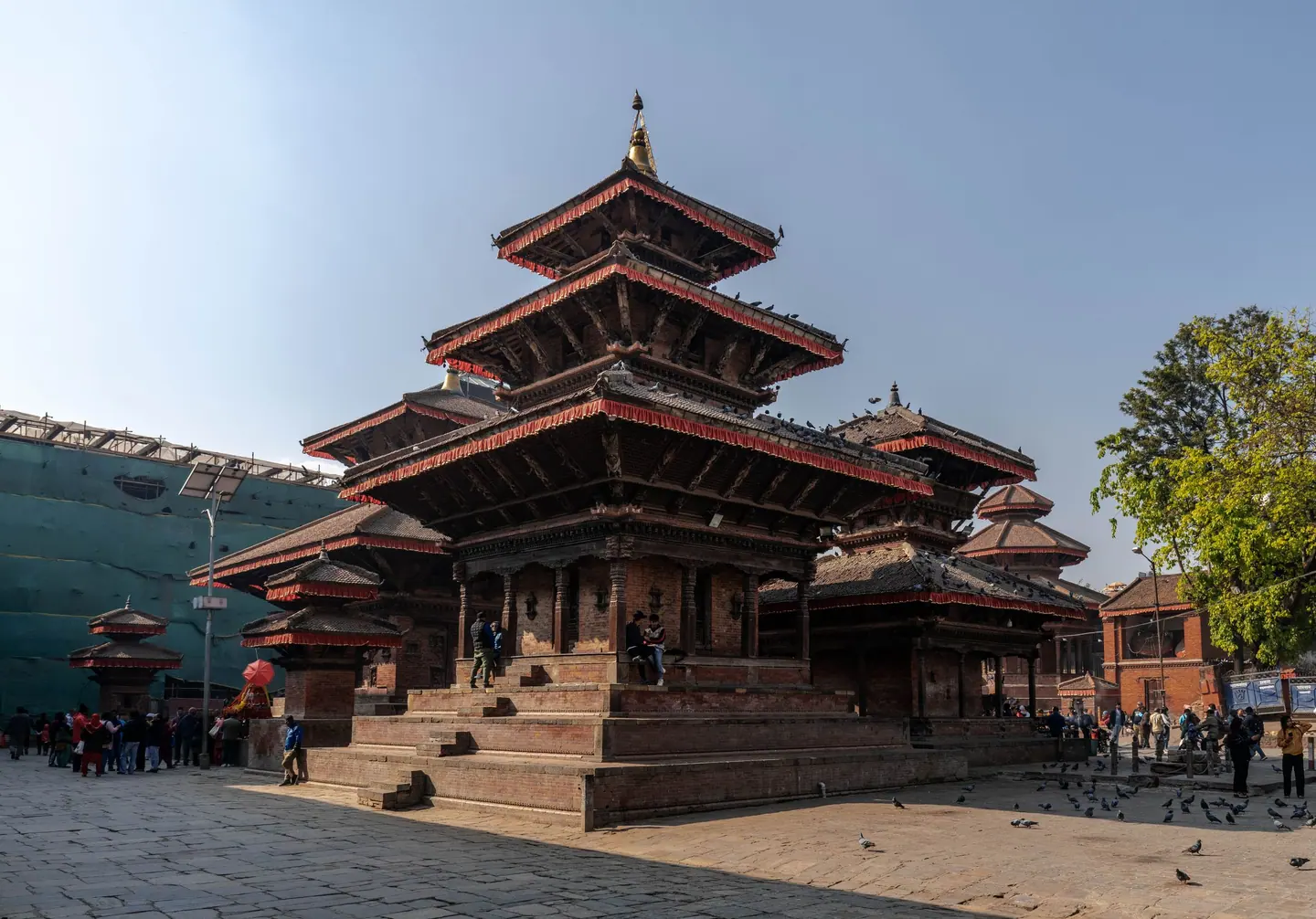
This expansive royal plaza served as the seat of the Malla and early Shah kings. We observe intricately carved wooden struts, stone pavilions, and tiered pagoda roofs that define traditional Newar craftsmanship. While several monuments underwent structural reconstruction after the 2015 earthquake, the square remains an essential repository of the Valley's civic and religious history.
Hanuman Dhoka Palace
Named after the vermilion-daubed stone statue of Hanuman standing beside its golden entrance, this palace spans multiple interconnected courtyards. Founded in the Licchavi period and expanded across centuries, the complex holds coronation halls and museum galleries. Visitors should notice the sun-soaked Mul Chowk and the elegant metalwork adorning the main doorway.
Kumari Ghar
Constructed in 1757 during the reign of King Jaya Prakash Malla, this three-storey residence houses the young girl chosen as the Living Goddess. The courtyard displays exceptionally fine woodcarvings on its windows and balconies. Quiet visitors may enter the central courtyard, where gilded toranas and painted beams demonstrate late Malla civic domestic architecture.
Taleju Temple
Erected in 1549 by King Mahendra Malla, this massive multi-tiered pagoda rests atop an elevated stepped plinth. The temple honours Taleju Bhawani, the protector deity of the royal dynasty. While public entry is restricted to the annual Dashain festival, travellers can study its monumental profile, golden pinnacles, and surrounding ancillary shrines from the courtyard below.
Kala Bhairav
Dating from the sixth or seventeenth century depending on historical interpretations, this dramatic four-metre stone carving depicts Shiva in his most fearsome guise. He wields weapons and wears a garland of severed heads beneath an ornamental halo. Devotees regularly offer flowers and vermilion here, invoking ancient beliefs that telling a lie before Bhairav invites sudden ruin.
Jagannath Temple
Recognised as one of the oldest standing structures in Durbar Square, this two-tiered temple dates to the sixteenth century. It stands on a raised three-step platform with four open doorways facing the cardinal directions. Travellers examine the finely chiselled wooden struts supporting the lower roof, which depict intricate mythological scenes alongside renowned erotic figures.
Basantapur Tower
Commissioned by King Prithvi Narayan Shah after his conquest of the Valley in 1768, this nine-storey tower anchors the southern wing of the palace. It features prominent overhanging eaves and timber windows commanding extensive views over the old town. Extensive post-earthquake restoration has returned its distinctive silhouette and structural timber frames to historical accuracy.
Kasthamandap
Legend holds that this colossal three-storey public hall was constructed from the timber of a single sal tree. Archaeological excavations trace its foundational timbers back to the seventh century. Following faithful post-2015 reconstruction using traditional mortise-and-tenon joints, the open-sided wooden pavilion again functions as a communal gathering space and a shrine to Gorakhnath.
Trailokya Mohan Narayan Temple
Built in 1680 by the mother of King Parthivendra Malla, this five-roofed pagoda honours Vishnu across a broad five-tiered brick base. Facing the main eastern staircase sits a large, finely sculpted stone figure of the kneeling mythical eagle Garuda. During major chariot festivals, crowds gather on the stepped plinth to watch ceremonial masked dances in the square.
Shiva Parvati Temple
Constructed during the reign of Bahadur Shah in the late eighteenth century, this temple sits on a low stone plinth flanked by guardian lions. The focal point is the upper central window, where painted wooden images of Shiva and Parvati peer out over the plaza. The building demonstrates classical Newar joinery within a symmetrical late-dynastic layout.
Gaddhi Baithak
Erected in 1908 by Prime Minister Chandra Shumsher, this neoclassical palace hall presents a stark stylistic contrast to the neighbouring timber pagodas. Inspired by European grand public buildings, it features fluted Corinthian columns, a white-stucco facade, and tall pedimented windows. The hall historically accommodated state receptions and the formal presentation of credentials by foreign ambassadors.
Freak Street
Known locally as Jhochhen, this narrow street achieved international renown during the 1960s and 1970s as the epicentre of the hippie overland trail. Today it operates as a relaxed market quarter lined with bookshops, bakeries, and small guesthouses. We observe traditional Newar townhouses with brick facades standing alongside modern cafes, reflecting decades of travel subculture.
Kotilingeshwara Mahadev Temple
Dating to the reign of King Mahendra Malla in the sixteenth century, this distinctive stone temple employs the north Indian shikhara style rather than the local wooden pagoda design. It rests on a three-tiered plinth and enshrines a Shiva lingam surrounded by sacred emblems. A stone bull, Nandi, kneels before the flight of steps leading into the sanctum.
Saraswati Temple
Situated just north of Kasthamandap, this modest pagoda-style sanctuary is dedicated to Saraswati, the Hindu goddess of knowledge, arts, and learning. During school examination seasons and the festival of Vasant Panchami, local children line up here to write sacred scripts on the outer walls. The quiet shrine features small stone carvings and traditional floral brass ornaments.
Indra Chowk
This historic junction sits at the intersection of six ancient streets connecting Kathmandu Durbar Square with northern trading routes. The square is lined with blanket merchants, bead sellers, and traditional textile vendors plying their trade beneath pagoda eaves. During the annual Indra Jatra festival, this crossroads becomes a central arena for dramatic masked dances and chariot processions.
Akash Bhairav Temple
Overlooking Indra Chowk, this three-storey temple enshrines Akash Bhairav, revered locally as the Kirati warrior-king Yalambar. The main deity, represented by an ornate silver mask, is positioned on the first floor rather than at ground level. The street-level arcade houses brass merchants and shops, while painted murals of guardian lions and deities frame the upper gallery.
Seto Machhendranath Temple
Tucked away inside the Jana Baha courtyard, this two-tiered temple houses Seto Machhendranath, the White Karunamaya. Both Newar Buddhists and Hindus venerate the small white-faced icon within. The sunlit courtyard is populated by resting pigeons, brass butter lamps, prayer wheels, and small stupas, offering an oasis of calm just steps from the surrounding bazaar.
Asan Tol
Asan Tol serves as the historical heart of Kathmandu's traditional mercantile quarter. Six alleys meet at this paved open space, where vendors sell hill spices, dried fish, seasonal produce, and brassware directly from temple plinths. The convergence of centuries-old trading customs, resident pigeons, and steady foot traffic makes it one of the most culturally vital civic spaces in the city.
Annapurna Temple
Occupying a prominent corner of Asan Tol, this two-storey temple honours Asan Annapurna, the goddess of grain and agricultural sustenance. Rather than an anthropomorphic idol, the deity is represented by a silver purna kalasha, an overflowing vessel of abundance. Market traders and shoppers pause at the threshold each morning to make offerings of rice and coins.
Yata Chapah
Located on the western approach to Asan Tol, this open timber pavilion exemplifies the community rest houses built for neighbourhood assemblies and sacred music. Guild musicians play traditional percussion and flutes here during regional celebrations. The structure features exposed brickwork and hand-carved pillars that demonstrate vernacular architecture preserved outside the royal palace courtyards.
Swayambhunath Monkey Temple, Thamel & Garden of Dreams
Kathesimbhu Stupa, Thahiti Square, Chusya Bahal, Garden of Dreams Kaiser Mahal, Narayanhiti Palace Museum, National Museum of Nepal Chhauni, and Swayambhunath Stupa All-Seeing Eyes of Buddha
Kathesimbhu Stupa
Built around 1650, this whitewashed dome provides an urban alternative for worshippers unable to make the pilgrimage uphill to Swayambhunath. It stands in an open courtyard surrounded by smaller votive chaityas and carved stone deities. Look for the gilded spire, the monastery building, and a statue of Avalokiteshvara in the northern corner.
Thahiti Square
Marking the traditional boundary between central Kathmandu and the southern approaches to Thamel, this stone-paved square centres on the Nateshwar stupa, believed to date from the fifteenth century. Traditional Newar residential buildings surround the plaza. Travellers can observe morning rituals where butter lamps and floral offerings are placed around the central plinth.
Chusya Bahal
Constructed in 1667 by Gunajyoti Sakya, this courtyard represents one of the finest preserved Buddhist monasteries in the city. The two-storey brick structure retains its carved wooden roof struts depicting fierce deities and Buddhist scenes. Visitors should examine the torana over the main shrine entrance, which showcases intricate repousse metal craftsmanship.
Garden of Dreams
Commissioned in 1920 by Field Marshal Kaiser Shumsher Rana, this historical estate combines classical European landscape design with Himalayan flora. The grounds feature sunken amphitheatres, marble fountains, decorative pavilions, and pergolas designed by Kishore Narsingh. It serves as an architectural counterpoint to the traditional Newar brickwork found throughout central Kathmandu.
Kaiser Library
Housed within Kaiser Mahal, this vast collection was amassed by Kaiser Shumsher Rana and gifted to the nation in 1969. The interior maintains an atmospheric colonial library aesthetic with antique globe stands, hunting trophies, and glass-fronted bookcases. It preserves eleventh-century palm-leaf manuscripts alongside rare maps detailing early Himalayan explorations.
Narayanhiti Palace Museum
Designed by American architect Benjamin Polk and opened in 1970, this grand palace served as the royal residence until Nepal became a republic. The complex features fifty-two ornate reception halls, a tall central tower, and the infamous banquet hall site of the 2001 royal family massacre. Intricate wood carvings and state gifts decorate the ceremonial state apartments.
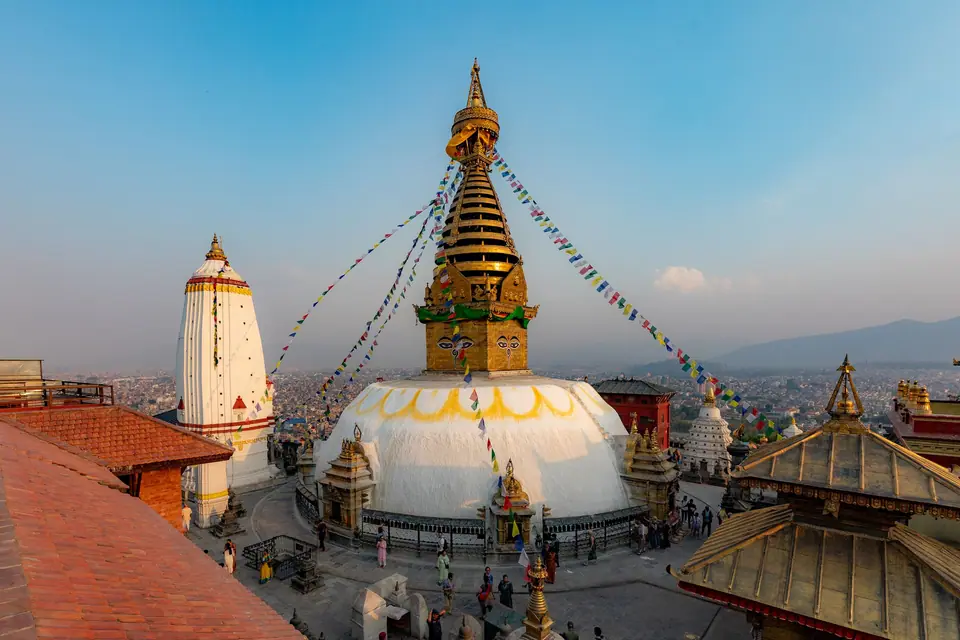
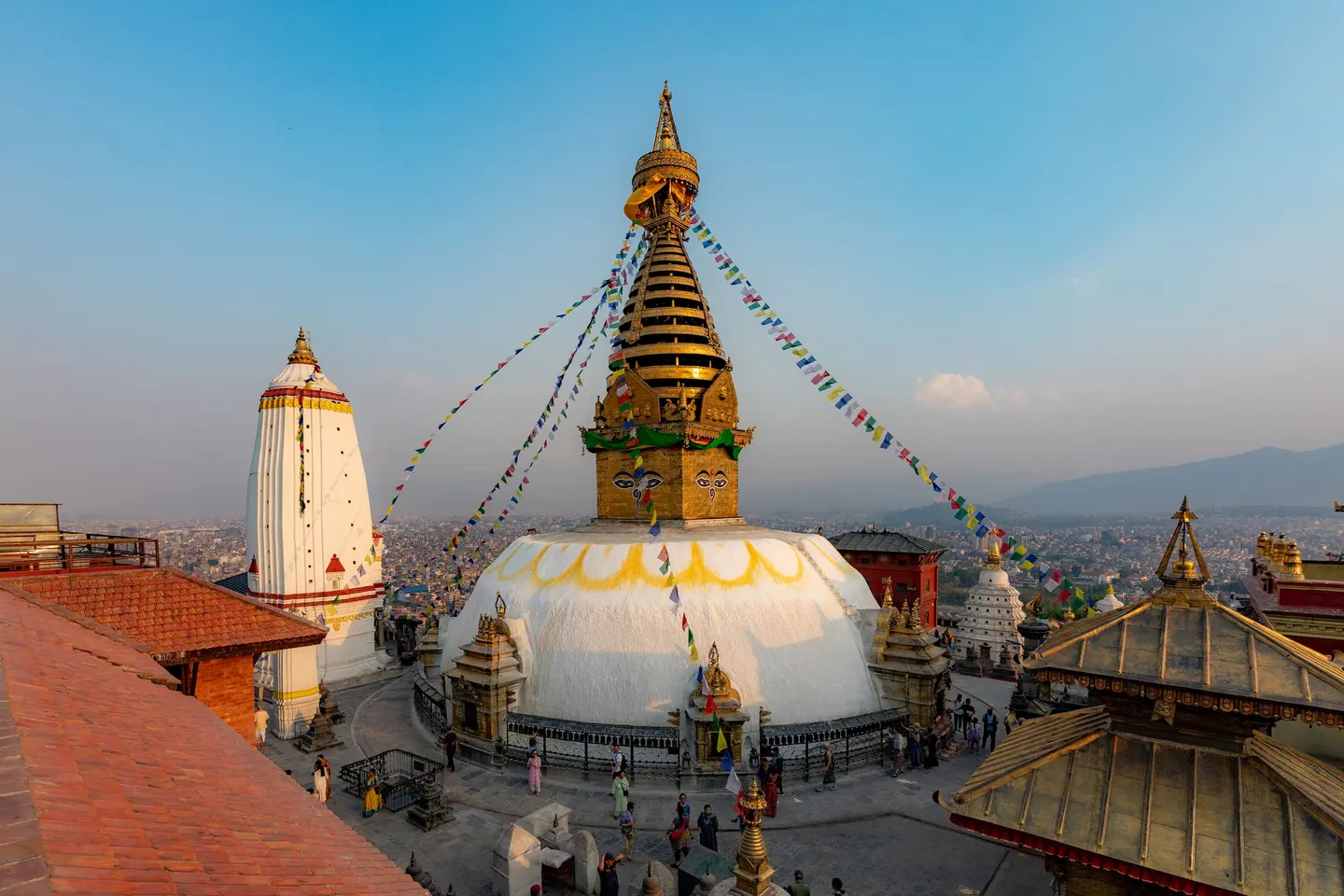
Swayambhunath Stupa
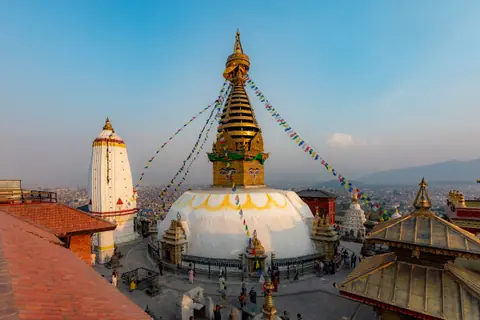
Founded during the Licchavi period around the fifth century, this sacred hill commands broad views across the Kathmandu Valley. The central whitewashed stupa is topped by a gilded cubical structure painted with the compassionate eyes of the Buddha. Pilgrims spin copper prayer wheels lining the base, accompanied by troops of rhesus macaques inhabiting the wooded slopes.
Harati Temple
Positioned beside the main stupa at Swayambhunath, this two-tiered pagoda honours Harati, a demoness turned protective deity of smallpox and childhood ailments. Both Hindu and Buddhist devotees frequent the sanctuary with rice offerings and flowers. The structure exhibits finely carved timber struts, bronze roofs, and detailed repousse work on the eastern facade.
Pratapapur and Anantapur Temples
King Pratap Malla erected these striking twin temples in the seventeenth century to honour tantric deities. Their pointed North Indian shikhara profiles form a distinct visual contrast with the circular Buddhist stupa between them. Though damaged in the 2015 earthquake, both towers have undergone meticulous reconstruction to restore their plastered masonry facades.
National Museum of Nepal
Established in 1928 at Chhauni, this institution occupies a nineteenth-century military building and showcases the country's artistic legacy. The historical gallery preserves antique firearms, leather cannons, and royal regalia. In the art gallery, visitors find stone sculptures dating from the Licchavi and Malla dynasties alongside Buddhist bronze castings.
Bhagwan Bahal
Also known as Bikramashila Mahavihara, this historic monastery complex is situated in the middle of northern Thamel. Tradition links its establishment to the Bengali master Atisha Dipamkara during his eleventh-century journey to Tibet. The central courtyard preserves ancient chaityas, ornate stone sculptures, and timber pavilions used for community celebrations.
Amriteshwar Mahadev Temple
Tucked away off the commercial thoroughfares of Thamel, this historic Shaivite temple displays classic Newar pagoda architecture. It rests upon a raised brick foundation with multi-tiered roofs supported by carved timber rafters depicting various forms of Shiva. The peaceful courtyard provides neighbourhood worshippers with a sheltered place for evening prayers.
Asan Tole
Six ancient trade routes converge on this historic plaza, which has served as a central trading hub since the Malla era. The square is famed for the three-tiered temple of Annapurna, the goddess of food and grains. Spices, brassware, and ceremonial powders are traded beneath traditional carved timber overhanging windows.
Seto Machindranath Temple
Located in Janabahal between Asan and Indra Chowk, this sacred courtyard houses the white mask of Avalokiteshvara. Built in the seventeenth century, the temple features two tiers of gilded copper roofs and intricately engraved metal prayer wheels. Each spring, the central deity is placed inside a towering wooden chariot for an annual citywide procession.
Annapurna Temple
Dominating the eastern corner of Asan, this three-tiered pagoda does not contain a conventional deity figure. Instead, it honours Annapurna through a silver purna kalasha, a vessel representing prosperity and nourishment. The temple structure is noted for its carved wooden brackets and the perpetual stream of shoppers touching the stone plinth in reverence.
Indra Chowk
Named after the Vedic rain god Indra, this traditional crossroads connects royal Durbar Square with northern merchant quarters. The square is framed by the Akash Bhairav temple and traditional cloth merchants selling blankets and shawls. Looking upward, observers can admire classic Newari brickwork and carved wooden jharokha bay windows.
Akash Bhairav Temple
This prominent temple in Indra Chowk enshrines a bronze mask of Akash Bhairav, revered locally as a protector of Kathmandu. The facade features elaborate balcony carvings, hanging metal mirrors, and decorative bells. During the Indra Jatra festival, the mask is displayed outside on the street while traditional rice wine is ritually poured through its mouth.
Bijeshwori Temple
Perched on the west bank of the Bishnumati River along the pilgrimage route to Swayambhunath, this temple honours the tantric goddess Vajrayogini. The complex features seventeenth-century wood carvings and brass toranas depicting yoginis and protective figures. Tantric practitioners have gathered in these courtyards for centuries to conduct esoteric Newar Buddhist rituals.
Shobha Bhagwati Temple
Occupying a riverside position where the Bishnumati flows past the base of Swayambhunath hill, this open-air sanctuary dates to the early medieval era. The primary idol is a fifth-century stone carving of Durga vanquishing the buffalo demon Mahishasura. Devotees visit during Dashain to offer prayers and bathe in the riverside sacred ghats.
Natural History Museum of Nepal
Located near the southern base of the Swayambhunath hill, this research institution was established in 1975 under Tribhuvan University. The galleries contain over fifty thousand specimens, including preserved Himalayan fauna, geological fossils, and endemic plant pressings. It provides visitors with educational insights into the complex ecological biodiversity across Nepal.

Boudhanath Great Stupa, Pashupatinath & Changu Narayan
Pashupatinath Temple on the Bagmati River, Arya Ghat, Guhyeshwari Shakti Peetha, Boudhanath Great Mandala Stupa, Guru Lhakhang Monastery, Shechen Monastery, Kopan Monastery, Gokarna Mahadev, and Changu Narayan 4th-Century Hilltop Temple
Pashupatinath Temple
Dedicated to Lord Shiva, this sacred complex features a tiered pagoda roof plated in copper and gilded brass, flanked by silver-sheathed doors. Established in its present form during the late seventeenth century, it stands as the spiritual centre of Nepalese Hinduism. Visitors observing from the riverbank can examine ornate stone shrines, sacred bull carvings, and devotional rituals.
Arya Ghat
Situated on the western bank of the Bagmati River directly beneath the main temple, these stone platforms serve as the traditional site for Hindu funerary rites. The river waters here are believed to grant spiritual liberation to the departed. We observe quiet solemnity along the banks, where families perform ancient Vedic ceremonies alongside stone lingams and carved prayer terraces.
Guhyeshwari Temple
Built during the reign of King Pratap Malla in the seventeenth century, this revered sanctuary is dedicated to Adi Parashakti. The temple architecture departs from traditional pagoda forms, featuring an open sanctum centred on an underground natural spring covered by a silver kalasha. Practitioners of Tantric Hinduism revere the location as one of the most powerful sacred body-part relic sites.
Mrigasthali Forest
Extending across the eastern bank of the Bagmati River, this dense wooded ridge is steeped in legendary lore as the forest where Shiva roamed in the guise of a deer. Ancient stone walkways wind between centuries-old Shiva lingams, hermitages, and centuries of commemorative funerary chaityas. The canopy provides a habitat for wild spotted deer and troops of rhesus macaques.
Gorakhnath Temple
Crowning a clearing in the Mrigasthali woods, this whitewashed temple honours the medieval saint Gorakhnath, patron of the Nath monastic tradition. The complex features a central shikhara tower surrounded by smaller pavilions where kanphata sadhus gather. Travellers can examine distinctive yogic iconography, trident emblems, and bronze bells marking centuries of continuous ascetic residence.
Boudhanath Stupa
Dominating the eastern valley skyline, this monumental hemisphere rests on three stepped plinths forming a massive architectural mandala. Rebuilt following ancient origins and refreshed over successive centuries, its gilded cubical tower displays the watchful eyes of the Buddha under thirteen stepped rings. Devotees circumambulate the perimeter daily, turning copper prayer wheels embedded within its whitewashed base.
Guru Lhakhang Monastery
Positioned directly along the outer circumambulation path of Boudhanath, this traditional Tibetan monastery ranks among the earliest gompas established around the Great Stupa. Its prayer hall houses an impressive gilded statue of Padmasambhava alongside butter lamp altars and intricate lineage murals. From the upper balcony, observers gain unobstructed views of pilgrims circumambulating the whitewashed dome below.
Shechen Monastery
Founded by Dilgo Khyentse Rinpoche in the late twentieth century, this monastery preserves the traditions of the Shechen lineage from eastern Tibet. The main assembly hall displays magnificent frescoes created by master painters, depicting complex cosmologies and meditation deities. The quiet courtyard hosts regular ritual dances and serves as a premier centre for Buddhist philosophical studies.
Sechen Clinic and Archives
Adjoining the main monastery grounds, this cultural and medical facility maintains the legacy of traditional Tibetan medicine and manuscript preservation. Scholars and medical practitioners study historic texts while providing herbal remedies and holistic care to the local community. Visitors can admire the integration of historic monastic architecture with active social service and literary conservation.
Dilyak Dabzang Monastery
Located in the dense lanes behind the Boudhanath stupa wall, this gompa represents the Drukpa Kagyu tradition within the valley. The shrine hall features gilded statues of the Kagyu lineage founders alongside fine silk thangkas hung along high timber columns. Daily pujas, accompanied by the resonance of long horns and drums, maintain traditional ritual practices.
Kapan Monastery
Perched on a quiet ridge north of Boudhanath, this Tibetan Buddhist monastery was established in 1969 by Lama Thubten Yeshe and Lama Zopa Rinpoche. It houses a large community of monks, a grand prayer hall, and landscaped meditation gardens. Visitors can observe ornate reliquary stupas, extensive library archives, and views across the valley floor.
Khachoe Ghakyil Ling Nunnery
Affiliated with nearby Kopan, this expansive residential nunnery provides rigorous spiritual training and degree programmes for hundreds of Buddhist women. The modern pagoda style temple contains an impressive central Tara statue and walls covered in detailed devotional paintings. Its tranquil hillside grounds provide a dedicated environment for sacred debate, ritual arts, and daily contemplation.
Gokarna Mahadev Temple
Constructed in 1582 on foundations dating back to the Lichhavi era, this three-tiered pagoda temple sits quietly beside the upper Bagmati River. The temple struts feature masterfully carved depictions of Hindu deities and celestial attendants. In the outer paved courtyard, visitors can study Lichhavi period stone sculptures, including rare depictions of Shiva and Parvati.
Changu Narayan Temple
Resting on a high ridge east of the capital, this two-tiered pagoda contains Nepal's earliest dated stone inscription, inscribed by King Manadeva in 464 CE. The temple struts, doors, and surrounding courtyards contain peerless masterworks of stone, bronze, and timber from the fifth to eighth centuries. Notable treasures include stone reliefs of Vishnu in his multi-armed universal form.
Changu Narayan Historical Museum
Positioned along the paved approach leading to the hilltop temple, this independent museum houses a private collection of regional ethnographic objects, antique locks, coins, and domestic tools. The exhibits detail the historical development of the village settlement and its continuous service to the temple complex. The displays provide cultural context for traditional Newar village daily life.
Chhinnamasta Temple
Located within the northern sector of the outer Changu Narayan courtyard, this compact brick and timber shrine is dedicated to the Tantric deity Chhinnamasta. Worshippers honour the goddess as an aspect of divine power and radical transcendence, associated with life force and cosmic preservation. Carved stone icons and small metal offerings line the threshold of this sacred recess.
Kileshwor Mahadev Temple
Standing directly adjacent to the main Changu Narayan sanctuary, this smaller pagoda shrine honours Lord Shiva in his Kileshwor manifestation. The temple features traditional Newar brickwork, carved eaves, and brass finials that complement the grander Vaishnava sanctuary nearby. It represents the historic religious harmony and synthesis between Shaivite and Vaishnavite devotion characteristic of the Kathmandu valley.
Jay Bageshwari Temple
Situated on the approach road to Pashupatinath, this three-tiered pagoda honours an ancient manifestation of Bhagavati. The temple interior preserves some of the oldest surviving mural paintings in the valley, displaying historic mineral pigments from centuries past. Travellers can examine the carved struts and brass doorway decorations that reflect classical Newar artisanal traditions.
Tamreswor Mahadev Temple
Located north of the central burning ghats on the western river bank, this distinctive shrine features an unusual copper-sheathed dome and intricate stone railings. It was established as a dedicated space for quiet meditation, away from the principal temple throngs. Inscriptions around the base record royal land endowments and historic renovations undertaken during the Malla period.
Rajeshwari Temple
Overlooking the lower ghats of the Bagmati, this elegant complex incorporates fine terracotta reliefs and classical pagoda roofs. Historically used for rituals associated with departing sovereigns and high dignitaries, the compound contains multiple subsidiary lingams under open-air colonnades. The surrounding flagstone terrace provides perspective on the continuous stream of religious pilgrims gathering along the river.
Patan (Lalitpur) Durbar Square, Golden Temple & Bahals
Patan Durbar Square, Patan Museum Royal Palace Courtyards, Krishna Mandir 21-Spire Stone Temple, Sundari Chowk Royal Bath, Hiranya Varna Mahavihar Golden Temple, Kumbheshwar Five-Tiered Pagoda, Mahabouddha Thousand Buddha Temple, Rudra Varna Mahavihar, and Ashoka Stupas of Patan
Patan Durbar Square
This central plaza served as the administrative and ceremonial heart of the Malla kings of Lalitpur. Paved with red bricks, the square features concentrated courtyards, stone statues, and multistoreyed temples displaying traditional woodcarvings and repousse metalwork. Visitors can observe centuries of layered Newar craftsmanship preserved across the palace facades and public pavilions.
Patan Museum
Housed within the restored Keshav Narayan Chowk palace wing, this museum presents the artistic traditions of the Kathmandu Valley. The galleries showcase bronze casting, repousse metalwork, and stone sculptures illustrating Buddhist and Hindu iconography. The brick courtyard retains its original gilded doorway and carved timber pillars overlooking peaceful internal gardens.
Keshav Narayan Chowk
Rebuilt in the eighteenth century by King Vishnu Malla, this inner quadrangle surrounds a small central shrine dedicated to Keshav Narayan. The timber window frames display delicate fretwork and carved mythological guardians. The facade includes a gilded copper entrance, known as the Golden Door, flanked by images of river goddesses and celestial heralds.
Mul Chowk
As the largest and oldest of the three royal courtyards, Mul Chowk historically hosted principal state rituals and religious festivals. The square quadrangle contains the small gilded temple of Bidya, surrounded by two storeys of elaborately carved wooden galleries. Stone lions guard the main entrance, while painted struts overhead depict various Tantric manifestations of Taleju Bhawani.
Sundari Chowk
King Siddhi Narasimha Malla commissioned this royal courtyard in 1647 to serve as a private domestic and ceremonial retreat. The perimeter features dense geometric woodcarvings depicting musicians, ascetics, and deities around every lintel. At the centre lies the sunken Tusha Hiti, lined with dozens of miniature stone deities and a gilded water spout.
Tusha Hiti
This sunken royal bath represents one of the finest single achievements of Malla stone carving. Built in an octagonal plan, the walls present seventy-two miniature carved stone plaques representing Hindu deities and guardians. A gilded Makara water spout crowns the basin, flanked by representations of Vishnu and Lakshmi resting upon the serpent Ananta.
Krishna Mandir
Erected by King Siddhi Narasimha Malla in 1637, this multistoreyed shrine was built entirely from carved grey stone rather than the traditional brick and timber. It incorporates Indian shikhara towers alongside Newar arcaded pavilions. Friezes along the first and second floor interior balustrades present relief narrations of the Mahabharata and Ramayana epics in fine detail.
Bhimsen Temple
Constructed in 1680, this rectangular three-tiered temple honours the Pandava hero Bhimsen, revered across the valley as the protector of commerce. Unlike most local shrines, the sanctum sits on the upper floor behind large timber-shuttered windows. Elaborate brass brackets, silver sheets, and brass bells adorn the exterior facade above the public thoroughfare.
Vishwanath Temple
Built in 1627, this pagoda houses a large stone Shiva lingam inside its brick and timber sanctum. Two life-sized stone elephants guard the western stairway, each carrying riders carved in classical Malla attire. The external wooden roof brackets display detailed carvings depicting the manifestations of Shiva alongside diverse Tantric motifs and erotic imagery.
Taleju Bell
King Jaya Vishnu Malla erected this massive bronze bell in 1737 opposite the palace compound. Historically rung to summon citizens in times of civic alarm or royal assemblies, it also sounded regular warnings during periods of curfew. The heavy bell hangs between two stone columns, crowned with a tiled roof canopy that mirrors neighbouring shrines.
Chyasin Dega
This distinctive octagonal shrine honours Krishna and features eight small shikhara spires ringing its primary stone dome. Rebuilt with meticulous care after suffering severe earthquake damage, the monument illustrates classical stone carving methods. Its raised plinth offers wide views across the central palace square and accommodates open-air gatherings beneath the surrounding stone pillars.
Hiranya Varna Mahavihar
Dating from the twelfth century, this three-roofed Buddhist monastery is famed for its brass and gilded copper plates covering the central facade. The courtyard features an ancient silver chaitya, brass turtle effigies, and guardian lions positioned along the floor. Young boys from the local Shakya clan serve as the monastery's daily ritual custodians.
Kumbheshwar Temple
Dating to 1392, this five-tiered pagoda is one of only two temples of this vertical scale surviving in the entire Kathmandu Valley. Dedicated to Shiva, the complex contains natural water spouts believed to be fed by the sacred glacial lake of Gosaikunda. Elaborate roof struts, heavy stone Nandi bulls, and a large courtyard enclosure define the site.
Mahabouddha Temple
Modelled after the Mahabodhi Temple in Bodh Gaya, this architectural work was constructed during the sixteenth century using thousands of specially moulded terra-cotta bricks. Each individual brick carries an image of Gautama Buddha, giving the tower its popular name. The temple sits tucked inside a small residential courtyard, framed by traditional brick houses.
Rudra Varna Mahavihar
Known locally as Uku Bahal, this historic monastery was associated with royal coronations and Newar metalworkers across several centuries. The stone-paved inner courtyard displays an array of bronze lions, peacocks, garudas, and kneeling donor figures. The two-tiered main sanctuary shelters a gilded image of Shakyamuni Buddha surrounded by ancient repousse ornamentation.
Northern Ashoka Stupa
This hemispherical earthen stupa, locally called Ibahi Thura, is traditionally attributed to the Mauryan Emperor Ashoka during his legendary third-century BC pilgrimage. Encased in brick and whitewashed plaster, it represents an archaic form of stupa architecture predating later Newar modifications. Small shrines dedicated to the Dhyani Buddhas are set into its four cardinal compass points.
Southern Ashoka Stupa
Locally known as Lagan Thura, this massive mound stands as the largest of Patan's four perimeter stupas. Built from compressed earth and brick, it retains a simple, archaic dome crowned by a whitewashed stone square and tiered finial. The surrounding perimeter garden provides open views over neighbourhood settlements and classical boundary markers.
Eastern Ashoka Stupa
Known as Teta Thura, this eastern mound stands on higher ground along the old trading approach toward Lubhu. The structure preserves its original earthen mass behind modest brickwork, featuring perimeter prayer wheels and whitewashed stone niches. Devotees circle the perimeter during morning walks, observing centuries-old circumambulation rituals beneath ancient trees.
Western Ashoka Stupa
Known as Pucho Thura, this boundary mound rises near Pulchowk, marking the historical entry into Lalitpur from the Bagmati River crossing. The whitewashed earthen dome supports a square harmika painted with the watchful eyes of the Buddha. Surrounding smaller stone chaityas reflect centuries of devotional votive offerings placed by visiting Newar Buddhist pilgrims.
Manga Hiti
Positioned just north of Patan Durbar Square, Manga Hiti is an active communal water fountain dating back to the sixth century Licchavi period. The deeply sunken stone basin features three carved stone makara water spouts discharging fresh mountain water. Terraced stone steps provide resting areas, showcasing early hydrological engineering alongside classical stone ornamentation.
Bhaktapur Brick City, Kirtipur & Bungamati
Bhaktapur Durbar Square 55-Window Palace, Golden Gate Sun Dhoka, Taumadhi Square Nyatapola Five-Storey Pagoda, Bhairavnath Temple, Dattatreya Square Peacock Window, Potters’ Square, Kirtipur Bagh Bhairab & Chilancho Stupa, and Bungamati Rato Machhendranath Temple
Bhaktapur Durbar Square
This open plaza served as the seat of the Malla kings until the late eighteenth century. The expansive brick complex features pagoda shrines, stone plinths, and royal residences. Travellers can examine intricate woodcarvings and stone sculptures that survived major earthquakes across the Kathmandu Valley.
55-Window Palace
Constructed during the reign of King Yaksha Malla and remodelled by King Bhupatindra Malla, this royal residence features a striking upper facade lined with fifty-five carved wooden windows. The building houses historical frescoes and ornate balconies. It stands as a prime example of seventeenth-century Newar woodcraft.
Golden Gate
Commissioned by King Ranjit Malla in the mid-eighteenth century, this ornate brass gateway serves as the ceremonial entrance to the palace inner courtyards. The tympanum portrays the goddess Taleju alongside Garuda and celestial attendants. Experts consider its chased metal relief among the finest in Nepal.
Taleju Temple Bhaktapur
Dedicated to the protective goddess Taleju Bhavani, this sacred compound was founded in the fourteenth century and enlarged by successive Malla monarchs. Non-Hindu visitors cannot enter the innermost sanctum, but the surrounding courtyard displays carved wooden brackets and gilded doorframes. It remains an active ceremonial centre.
Nyatapola Temple
Erected in 1702 under King Bhupatindra Malla, this five-roofed pagoda dedicated to Siddhi Lakshmi is the tallest temple in Nepal. Five steep plinths flank the stairway, each guarded by paired stone figures including wrestlers, elephants, lions, and deities. Its structural design survived both the 1934 and 2015 earthquakes.
Bhairavnath Temple
Standing opposite Nyatapola in Taumadhi Square, this broad pagoda honours the fierce manifestation of Shiva. Originally a single-storey building, King Bhupatindra Malla added two levels to balance the square. Visitors can view the carved struts depicting guardian deities and the metal replica of Bhairava on the exterior.
Dattatreya Temple
Dating to 1427, this pagoda in eastern Bhaktapur honours the hybrid deity Dattatreya, representing Brahma, Vishnu, and Shiva. Tradition asserts that the primary structure was fashioned from the timber of a single tree. Stone statues of the Malla wrestlers Jayamel and Phattu guard the front entry.
Peacock Window
Set into the brick wall of the Pujari Math in Dattatreya Square, this openwork wooden screen is celebrated for its precise joinery. The master carver depicted a strutting peacock whose tail feathers form an intricate geometric lattice. It remains one of the finest surviving examples of medieval Newar woodcraft.
Pujari Math
This former Hindu monastery was built in the fifteenth century and rebuilt in the eighteenth century by King Jaya Jitamitra Malla. The quadrangle features carved timber cornices, interior courtyards, and museum galleries devoted to traditional woodcarving. It offers an authentic look at residential monastic architecture.
Potters' Square
Located south of Durbar Square, this cobbled courtyard serves as a centre for the local Kumhar caste. Rows of clay pots dry on open mats, while artisans shape vessels on rotating wheels. The square also houses a small shrine dedicated to the elephant-headed deity Jeth Ganesh.
Siddha Pokhari
Constructed in the early fifteenth century during the reign of King Yaksha Malla, this rectangular stone water reservoir lies near the western entrance to the city. The bank features classical pavilions and stone images of Hindu and Buddhist deities. On clear days the surface mirrors the surrounding skyline.
Changu Narayan Temple
Perched on a forested ridge north of Bhaktapur, this two-storey sanctuary dedicated to Vishnu traces its origin to the Licchavi dynasty. The courtyard preserves a fifth-century stone pillar erected by King Manadeva, which is the oldest dated inscription in the Kathmandu Valley. Intricate gilt copperwork covers the doors.
Bagh Bhairab Temple
This triple-tiered brick temple occupies a high ridge in Kirtipur, dedicated to Bhairava in the guise of a tiger. Legend associates its foundation with the Licchavi period, though the current layout dates to the sixteenth century. The eaves display rusted swords captured during the historic siege of Kirtipur in 1767.
Chilancho Stupa
Positioned on the southern hill of Kirtipur, this whitewashed dome is among the oldest Buddhist monuments in the settlement. Attributed to the medieval period with roots possibly extending to Emperor Ashoka, the main mound is circled by four smaller stone chaityas. The brick terrace affords views across the valley floor.
Uma Maheshwar Temple
Constructed in 1673 by the local governor, this hilltop temple honours Shiva and Parvati. Two large stone elephants protect the steep approach stairs, guiding visitors toward the brick terrace. A seventeenth-century stone relief inside portrays the divine couple seated in domestic harmony on Mount Kailash.
Rato Machhendranath Temple Bungamati
Situated in the core of Bungamati, this shikhara-style temple houses the red-faced deity Rato Machhendranath for six months every year before the chariot festival begins. Rebuilt following earthquake damage, the courtyard displays traditional woodcarvings and brass lamps. The surrounding town is noted for its generational woodcarvers.
Karya Binayak Temple
Located between Bungamati and Khokana, this peaceful forest sanctuary honours Ganesh in the form of a natural, aniconic stone. Devotees visit the shrine before starting new endeavours to ensure auspicious outcomes. The site features traditional pagoda architecture and panoramic outlooks across the surrounding farm terraces.
Sheshnarayan Temple
Positioned south of Kirtipur near Pharping, this Licchavi-era sanctuary is one of four primary Narayana shrines guarding the Kathmandu Valley. The temple sits below a limestone cliff, flanked by clear spring-fed ponds containing sacred fish. Intricate stone carvings date back to the seventh and eighth centuries.
Vatsala Devi Temple
Situated within Bhaktapur Durbar Square, this sandstone shikhara temple honours the goddess Vatsala Devi. The structure features delicate stone carvings and octagonal tiers reminiscent of Krishna Mandir in Patan. In front of the plinth hangs the Taleju Bell, cast in 1737 to summon townspeople during civic emergencies.
Taumadhi Square
Positioned between Durbar Square and eastern Bhaktapur, this urban plaza is anchored by the five-tiered Nyatapola and the Bhairavnath Temple. Traditional brick rest houses, called sattals, enclose the perimeter, providing spaces for pilgrims and musicians during annual festivals. It represents a vital hub of Newar civic life.
Moving Between Kathmandu, Patan and Bhaktapur
Our main Kathmandu guide covers airport arrivals, neighbourhood bases and multi-day pacing to complement this walk; see also our full collection of city route guides.