A detailed walking and streetcar route along the crescent of the Mississippi River, from French and Spanish Creole courtyards in the Vieux Carré to Faubourg Marigny and the Garden District.
Creole Ironwork, Congo Square Rhythms and Upriver Antebellum Mansions
Along a high natural levee at a sharp bend of the Mississippi River known to the Choctaw and Chitimacha as Bulbancha, Jean-Baptiste Le Moyne de Bienville founded La Nouvelle-Orléans in 1718 as capital of French Louisiana. Ceded to Spain in 1762 before the 1803 Louisiana Purchase, the Vieux Carré (French Quarter) was rebuilt after the fires of 1788 and 1794 with Spanish colonial brick arcades, hidden lush courtyards, and wrought-iron balconies.
Through the convergence of West African, Afro-Caribbean, French, Spanish, and American traditions around Congo Square, New Orleans became the nineteenth-century birthplace of jazz, brass band second lines, and Creole cuisine while antebellum Greek Revival mansions rose upriver in the Garden District along the 1835 St Charles Streetcar line.
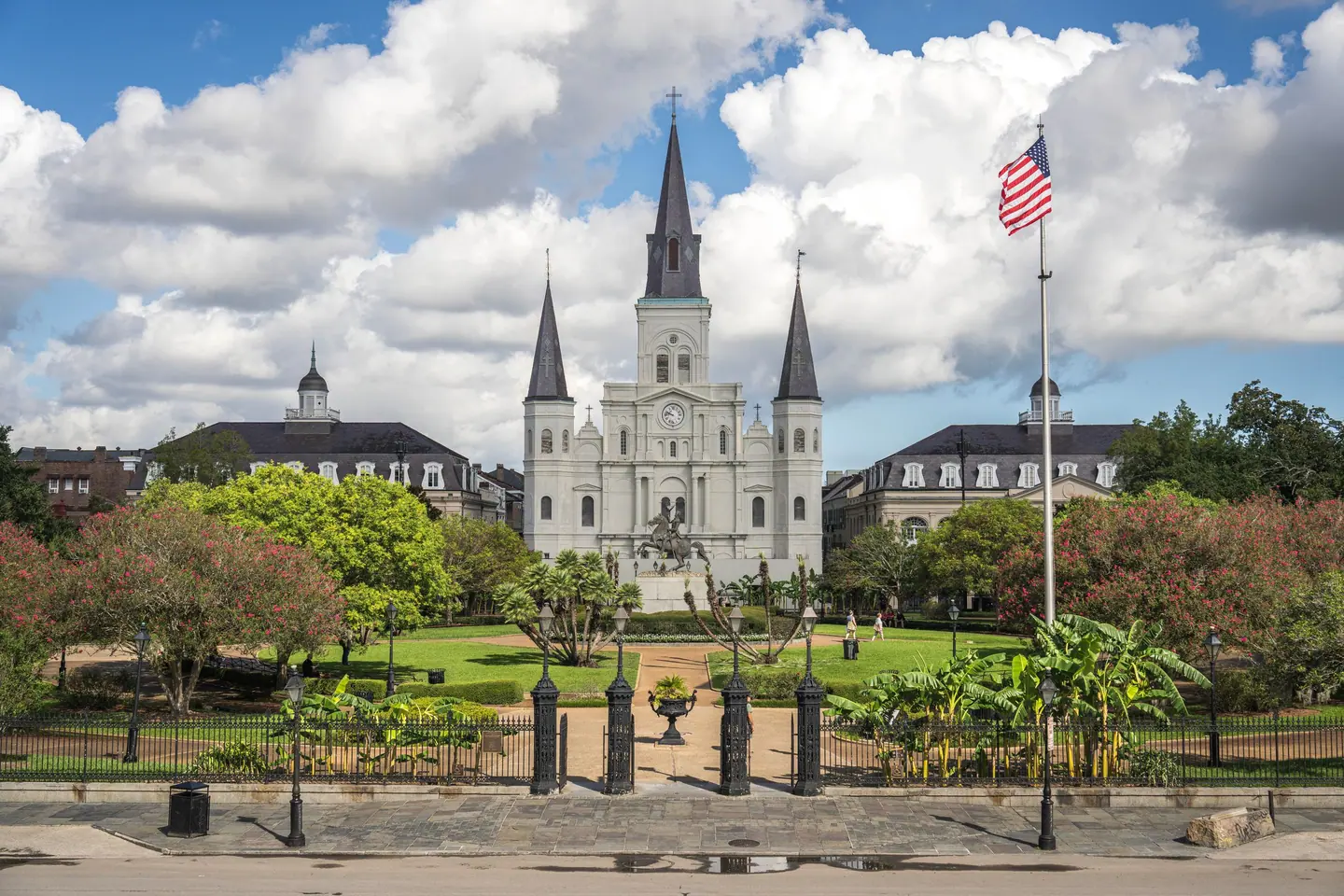
Jackson Square, Cabildo, French Market & Mississippi Riverfront
Jackson Square, St Louis Cathedral, The Cabildo, The Presbytère, Pontalba Buildings, Café Du Monde, Old Ursuline Convent, Beauregard-Keyes House, Gallier House, and French Market
Jackson Square
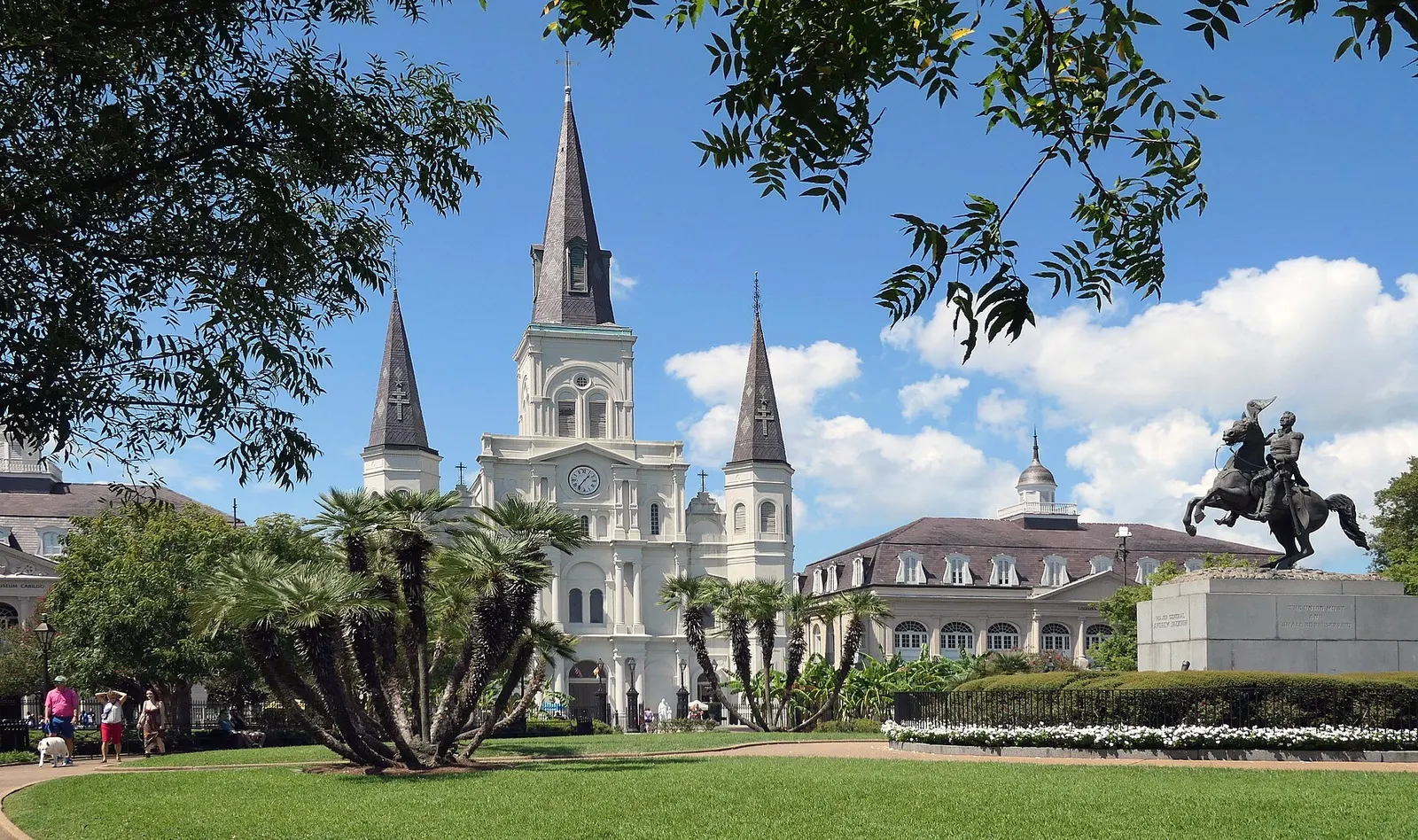
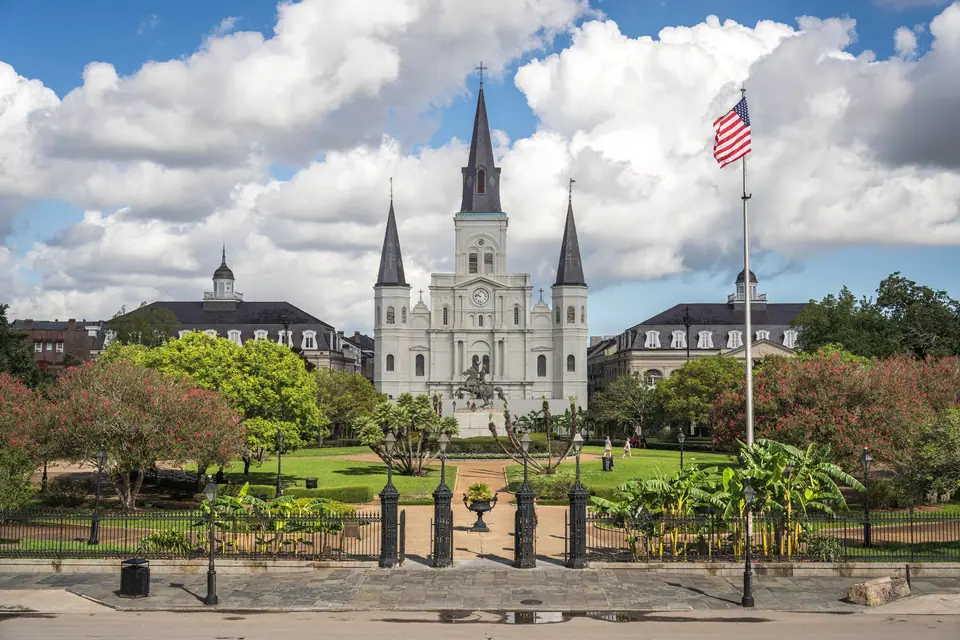
Originally known as the Place d'Armes, this formal urban park was landscaped in the 1850s under the direction of Baroness Micaela Almonester de Pontalba. Clark Mills cast the central bronze equestrian statue of General Andrew Jackson in 1856. Visitors can view the surrounding perimeter of wrought iron railings, local artists at work, and the balanced facade of civic architecture.
St. Louis Cathedral
Dedicated to King Louis IX of France, the current structure dates largely from an extensive 1850 reconstruction designed by architect J. N. B. de Pouilly. The building features three distinctive slate-covered spires and a classical stucco exterior. Inside, travellers can observe Rococo-style ceiling murals painted by Erasme Humbrecht and a gilded high altar framed by marble columns.
The Cabildo
Constructed between 1795 and 1799 under the supervision of architect Gilberto Guillemard, this building served as the meeting place of the Spanish municipal council. It was the site of the 1803 Louisiana Purchase transfer ceremonies. Today, the Louisiana State Museum operates the facility, displaying historical artefacts including Napoleon's death mask and early colonial trade documents beneath a French mansard roof.
The Presbytère
Built on the site of the former Capuchin monks' residence, this structure was designed by Gilberto Guillemard in 1791 and completed in 1813. Though intended as a rectory, it long served as a courthouse before joining the Louisiana State Museum complex. Travellers will note the neo-Renaissance facade, wide ground-floor arcades, and comprehensive exhibitions detailing Mardi Gras traditions and local environmental history.
Lower Pontalba Building
Commissioned by the Baroness de Pontalba and completed in 1851, this four-storey block represents one of the earliest examples of continuous row-house construction in the United States. Its distinctive cast-iron balconies feature the entwined initials 'AP' representing the Almonester and Pontalba families. The ground floor houses civic retail while upper floors remain residential flats.
Upper Pontalba Building
Forming the upriver flank of Jackson Square, this matching block was completed in 1850 using Parisian terrace architecture adapted to southern maritime conditions. The building was constructed using locally kilned red brick and Parisian-style cast iron. Visitors should notice the ground-level arcades, which shelter pedestrian walkways from subtropical rain, and the historic 1850 House museum installation located within.
Café Du Monde
Established in 1862 on the perimeter of the French Market, this open-air cafe has continuously served dark-roast coffee blended with chicory alongside traditional square beignets dusted with powdered sugar. The venue occupies a covered pavilion structure with green-and-white striped awnings. Its position offers views of the Mississippi River levee and passing municipal streetcars.
French Market
Originating as an Indigenous trading post before European colonisation, this six-block market area evolved through Spanish and French municipal administrations. The extant colonnaded structures date from reconstructions in 1813 and the 1930s under the Works Progress Administration. Today, the open-sided market stalls showcase local produce, regional spices, handmade crafts, and traditional culinary items.
Old Ursuline Convent
Completed in 1752 by French military engineers, this convent provided quarters for the Ursuline nuns who established the city's first formal schooling for girls. The architecture exemplifies French neoclassical design with thick masonry walls, a steep hipped roof, and small casement windows. Inside, visitors can examine original cypress woodwork, historic religious reliquaries, and formal herb gardens.
Beauregard-Keyes House
Built in 1826 for auctioneer Joseph Le Carpentier, this residence incorporates a Greek Revival portico with twin curved staircases alongside traditional Creole floor plans. The property was briefly inhabited by Confederate General P. G. T. Beauregard and later restored by novelist Frances Parkinson Keyes. Travellers can view period Victorian furnishings, doll collections, and a walled courtyard garden.
Gallier House
Designed in 1857 by architect James Gallier Jr. as his personal family residence, this townhouse features engineering innovations of the era including an interior ventilation system and early indoor plumbing. The facade displays ornate cast-iron galleries painted in a soft grey tone. Inside, guided tours highlight decorative trompe-l'oeil painting, Rococo Revival furniture, and an authentic rear carriageway.
Moonwalk Riverfront Park
Named after former mayor Maurice 'Moon' Landrieu, this riverside boardwalk opened in the 1970s to reconnect the historic district with the working river. The promenade features broad wooden boardwalks, granite steps leading down toward the water, and cast-iron gas-style lanterns. It provides travellers with uninterrupted views of industrial cargo ships, traditional paddle-wheel steamers, and passing tugboats.
Washington Artillery Park
Constructed atop the Mississippi River levee opposite Jackson Square, this concrete amphitheatre honors the historic Washington Artillery of New Orleans, active since 1838. A mounted Civil War cannon stands on the upper platform. The terrace serves as an elevated viewpoint, enabling visitors to photograph the symmetrical layout of the square and the triple spires of St. Louis Cathedral.
Woldenberg Park
Converted from old shipping wharves in the late 1980s, this linear park stretches along the Mississippi River crescent. The grounds contain manicured lawns, brick paths, and native magnolia trees alongside prominent public monuments such as the Holocaust Memorial. It offers views of commercial shipping traffic navigating the river's deep navigational channel.
Steamboat Natchez Wharf
This waterfront landing serves as the primary home berth for authentic sternwheel steamboats navigating the lower Mississippi. The vessel features traditional steam propulsion powered by antique machinery salvaged from earlier twentieth-century boats. From the wharf, visitors can watch the massive red paddle wheel turn, listen to the steam calliope play melodies, and observe traditional maritime mooring techniques.
Madame John's Legacy
Constructed in 1788 immediately following the Great New Orleans Fire, this residence preserved traditional French colonial raised cottage architecture despite being rebuilt during the Spanish administrative period. The building features an elevated brick ground floor, cedar-shingle roof, and wide wrap-around wooden gallery. It is operated by the Louisiana State Museum to display historic architectural construction methods.
LaLaurie Mansion
Constructed in 1832 for socialite Delphine LaLaurie and her husband, this three-storey residence is an imposing example of classical French Quarter domestic masonry. The property features elaborate exterior wrought iron, a carved wooden entrance door, and classical pediments. While closed to the public as a private residence, visitors observe its austere facade during historical walking tours.
New Orleans Jazz Museum
Housed within the imposing red-brick Old U.S. Mint constructed in 1838, this facility preserves the musical heritage of early American jazz. The building itself is historically unusual for having minted coins under both Federal and Confederate authorities. Travellers can inspect rare early brass instruments, including cornet equipment used by Louis Armstrong, alongside listening stations and sheet music.
Père Antoine's Alley
Named after Antonio de Sedella, a Spanish Capuchin friar who served as pastor of St. Louis Cathedral for over four decades, this flagged stone passage links Royal Street to Jackson Square. Bordered by towering stucco walls and historic iron gas lamps, the narrow corridor offers an intimate spatial perspective on the cathedral's Gothic buttresses and heavy flanking masonry.
Pirate's Alley
This twenty-nine-foot-wide stone walkway runs along the downriver flank of the Cabildo, connecting Chartres and Royal Streets. Paved in historic flagstones, the lane was laid out during colonial street planning and later associated with folklore regarding privateer Jean Lafitte. Notable sights include a former home of author William Faulkner and views of the cathedral's rear garden gates.
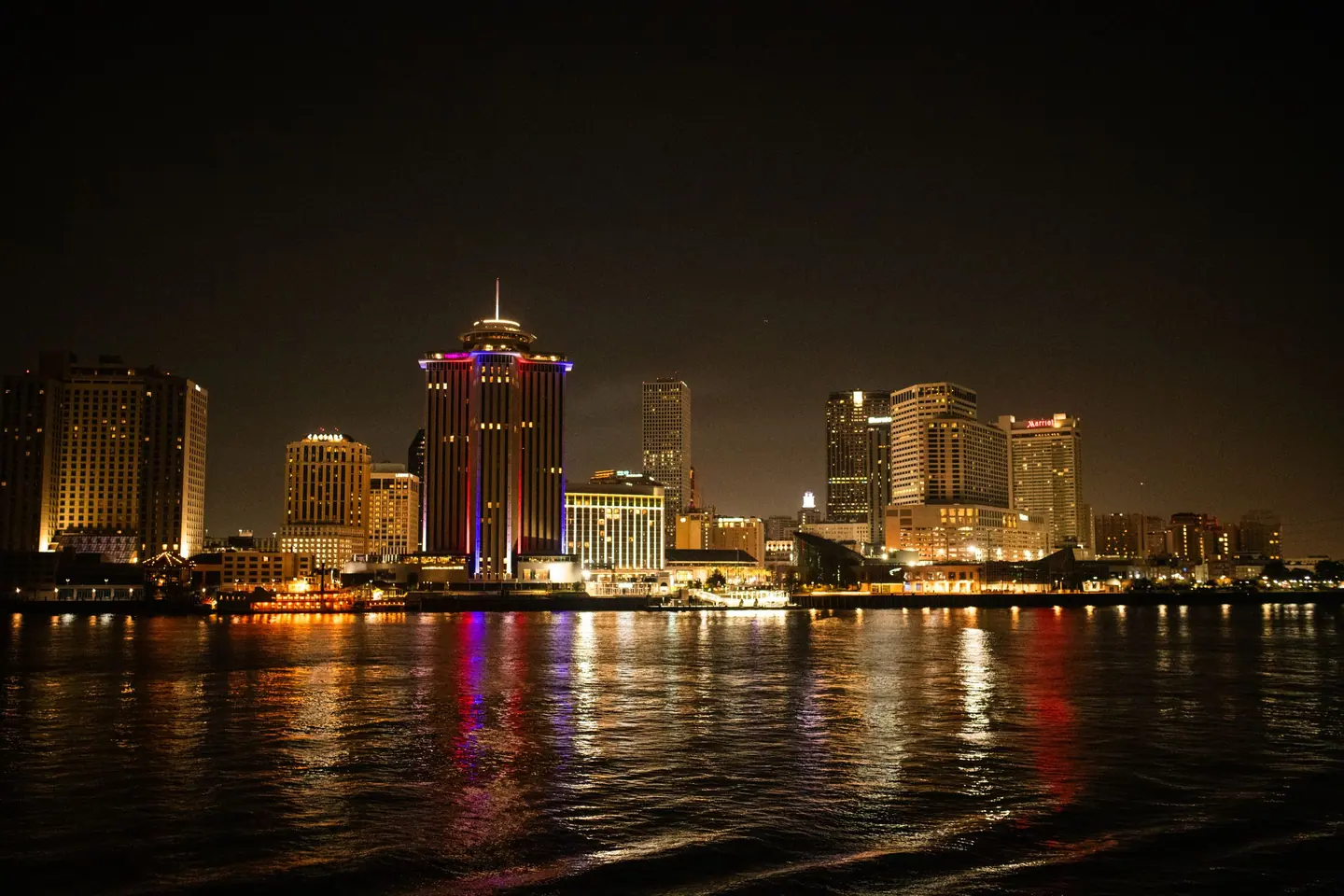
Royal Street Courtyards, Preservation Hall & Upper Vieux Carré
Royal Street Antiques Row, Historic New Orleans Collection, Hermann-Grima House, Preservation Hall, Lafitte’s Blacksmith Shop, Pharmacy Museum, Napoleon House, St Louis Cemetery No. 1, and Congo Square Armstrong Park
Historic New Orleans Collection
Founded by General and Mrs L. Kemper Williams, this museum spans several historic Royal Street properties including the 1792 Merieult House. The complex features manicured Spanish courtyards, period galleries, and extensive municipal archives. Visitors can examine rare regional maps, colonial property transfers, and changing art exhibitions highlighting Louisiana history.
Hermann-Grima House
Constructed in 1831 for German merchant Samuel Hermann, this brick mansion represents one of the finest Federal style structures in the French Quarter. The property retains an intact outdoor kitchen with functional wood-burning hearths, slave quarters, and a horse stable. The central courtyard displays citrus trees and heirloom plants typical of early Creole gardens.
Preservation Hall
Operating since 1961 inside an unadorned 1803 carriage house, this intimate room remains dedicated to acoustic New Orleans jazz traditions. The interior lacks air conditioning and modern amplification, preserving an austere, time-worn atmosphere with peeling plaster and wooden benches. Nightly performances by resident ensembles perpetuate musical repertoires developed in the early twentieth century.
Lafitte's Blacksmith Shop
Dating from the 1770s, this low-slung building ranks among the oldest surviving residential structures in the Mississippi River Valley. Its construction exhibits authentic briquette-entre-poteaux masonry, where soft colonial bricks fill the spaces between heavy timber uprights. Legend connects the site to privateer Jean Lafitte, who allegedly ran smuggling operations behind a blacksmith front.
New Orleans Pharmacy Museum
This townhouse was established by Louis Joseph Dufilho Jr, the first licensed pharmacist in the United States. Inside, visitors encounter mahogany display cases lined with hand-blown apothecary bottles, proprietary patent remedies, and historic surgical tools. The rear cobblestone courtyard showcases medicinal herbs, leech jars, and early voodoo potions documenting nineteenth-century public health.
Napoleon House
Erected in phases around 1797, this landmark served as the residence of Mayor Nicholas Girod, who plotted to rescue Napoleon Bonaparte from exile in Saint Helena. The interior retains aged patina, classical busts, and weathered maritime portraits across its interconnected dining rooms. An attractive brick courtyard features climbing greenery and traditional wrought-iron tables.
St. Louis Cemetery No. 1
Opened in 1789 to replace a graveyard destroyed by fire, this is the oldest existing burial ground in the city. Saturated swamp soils required above-ground brick and marble mausoleums, forming narrow passages reminiscent of a miniature city. Notable interments include Voodoo priestess Marie Laveau and architect Benjamin Henry Latrobe.
Congo Square
Located within Louis Armstrong Park, this historic open ground allowed enslaved and free people of colour to trade and play music on Sunday afternoons during the eighteenth and nineteenth centuries. The complex rhythmic gatherings here directly informed the birth of jazz and contemporary rhythm and blues. Informative plaques and bronze sculptures commemorate the site.
Louis Armstrong Park
Covering thirty-one acres just north of the French Quarter, this park honours trumpeter Louis Armstrong through sculptural works, walking bridges, and landscaped lagoons. It encompasses Congo Square, the Mahalia Jackson Theater, and the historic buildings of Perseverance Hall No. 4. Sweeping arched iron gates form the ceremonial entryway on Rampart Street.
Gallier House
Designed in 1857 by architect James Gallier Jr for his family, this Victorian townhouse showcases ingenious engineering adaptations for subtropical living. It boasts early indoor plumbing, a skylit double parlour, and ventilation ports designed to circulate cool river drafts. The adjacent carriageway leads to a restored garden and service wing.
Madame John's Legacy
Constructed in 1788 following the great municipal fire, this residence reflects French colonial raised cottage architecture rather than the ubiquitous Spanish style. Built with wooden colonnettes, deep covered galleries, and a high-pitched roof, the compound survived subsequent urban conflagrations. The complex takes its popular name from George Washington Cable's nineteenth-century Creole fiction.
Old Absinthe House
Dating to 1806, this corner establishment originally served as an importing merchant house before becoming a popular tavern. The interior is celebrated for its antique marble counter, dripping brass absinthe fountains, and thousands of signed calling cards affixed to the timber walls. Historic figures including Mark Twain and Oscar Wilde frequented the establishment.
LaBranche House
Built around 1835 for sugar planter Jean Baptiste LaBranche, this prominent brick building anchors the intersection of Royal and St. Peter streets. Its three upper tiers are wrapped in ornate cast-iron filigree decorated with scrolling oak leaves and acorns. Ground-floor storefronts have housed antique dealers, curators, and independent shops for generations.
Merieult House
Completed in 1792 by merchant Jean François Merieult, this is one of very few French Quarter structures to survive the catastrophic 1794 city fire. Constructed of solid brick and lime mortar, the property features a broad facade with classical proportions and heavy wooden casements. Today it forms an integral wing of the Historic New Orleans Collection.
Perseverance Hall No. 4
Built between 1819 and 1820 for a fraternal lodge, this Greek Revival temple is recognised as the oldest surviving Masonic hall in Louisiana. The site later became an influential venue for early fraternal society dances and jazz rehearsals at the turn of the twentieth century. Restored structures stand quietly inside the bounds of Louis Armstrong Park.
Our Lady of Guadalupe Church
Consecrated in 1826 as the Chapel of St Anthony of Padua, this modest church was built as a dedicated burial sanctuary near the city cemeteries during yellow fever epidemics. The brick building features a modest nave and stained-glass fixtures alongside shrines dedicated to Saint Expedite and Saint Jude. It remains an active parish on North Rampart Street.
Court of Two Sisters
Named after sisters Emma and Bertha Camors, who operated a notions shop here in the late nineteenth century, the complex surrounds a massive flagstone courtyard. A prominent wrought-iron entry gate was hand-forged in Spain and shipped directly to the colony. Gas lanterns, native wisteria, and a historic stone fountain enhance the expansive outdoor enclosure.
BK Historic House and Gardens
Erected in 1826 for auctioneer Joseph LeCarpentier, this stately residence balances Greek Revival symmetry with Tuscan portico elements. It sheltered Confederate general P.G.T. Beauregard after the American Civil War and later author Frances Parkinson Keyes, who restored the structure. A formal Victorian boxwood parterre garden sits adjacent to the main building on Chartres Street.
Miltenberger Houses
Built in 1838 by widow Miltenberger for her three sons, this unified terrace of red brick townhouses exemplifies the domestic prosperity of antebellum Creole merchants. The buildings are embellished with cast-iron balconies and wide arched carriage doorways leading to linked internal courtyards. Alice Heine, later Princess of Monaco, was born in the central residence.
Cornstalk Hotel
This early nineteenth-century mansion was converted into a boutique Victorian lodging house adorned with ornate plaster mouldings and crystal chandeliers. Its defining exterior asset is the 1840 cast-iron fence cast in the shape of ripe cornstalks entwined with morning glories and pumpkins. The enclosure was commissioned to comfort the owner's homesick Midwestern spouse.
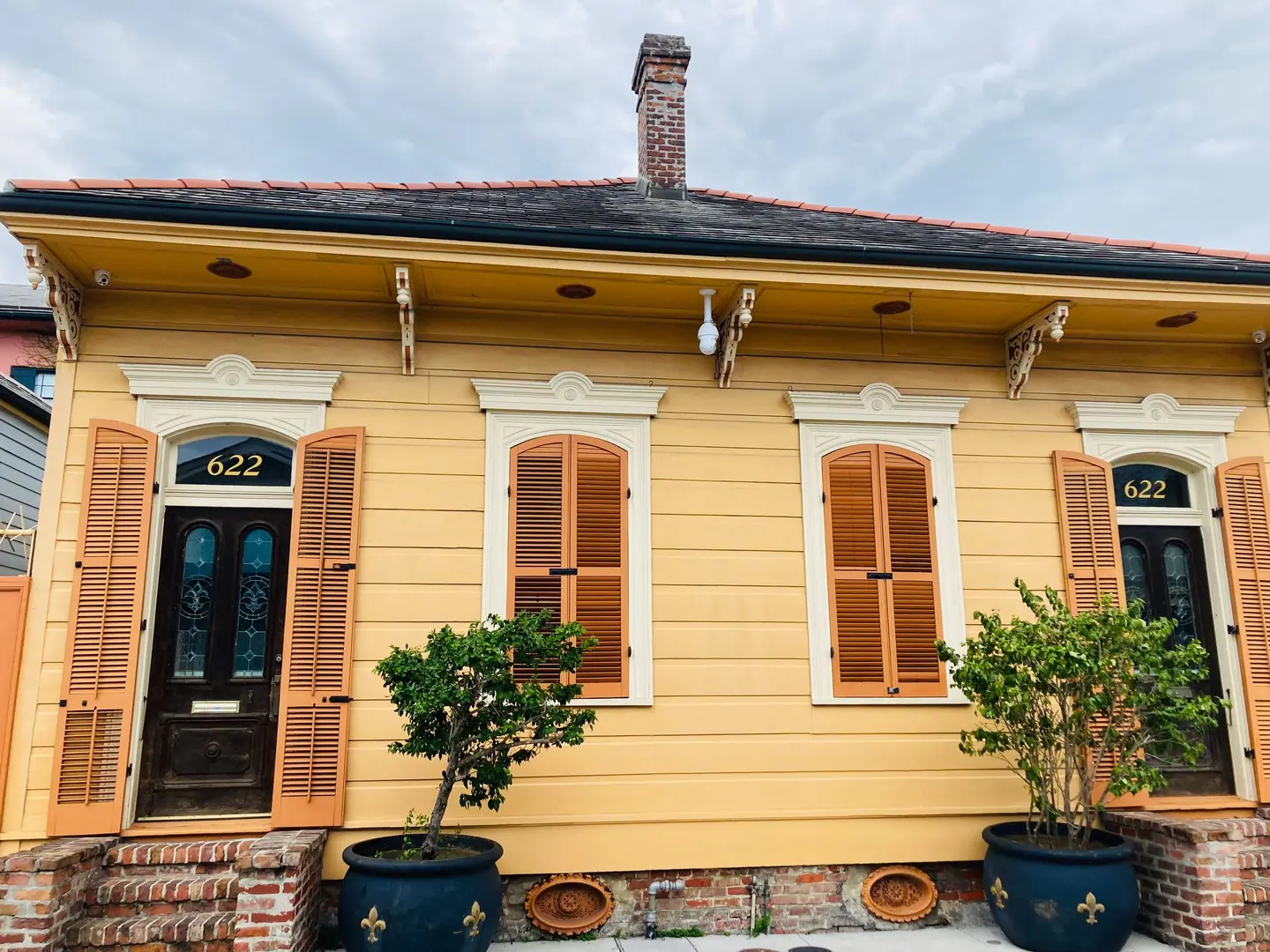
Faubourg Marigny, Frenchmen Street, Bywater & Tremé
Esplanade Avenue Creole Mansions, Frenchmen Street Jazz Clubs, Snug Harbor, Washington Square Marigny, Studio Be Bywater, Crescent Park Rust Rainbow Bridge, St Augustine Church Tremé, and Backstreet Cultural Museum
St. Augustine Catholic Church
Dedicated in 1842, this parish was established by free people of colour who purchased pews for enslaved worshippers. Visitors can observe the simple Greek Revival portico and the Tomb of the Unknown Slave, marked by a massive marine chain configured into a cross outside the sanctuary.
Backstreet Cultural Museum
Founded by Sylvester Francis, this Tremé institution documents Mardi Gras Indians, Social Aid and Pleasure Clubs, and jazz funeral traditions. The displays feature hand-beaded suits crafted from feathers and rhinestones, alongside extensive photographic archives that record community processions across several decades.
Washington Square
Surveyor Joseph Pilié designed this rectangular commons in the early nineteenth century during the subdivision of the Marigny plantation. Enclosed by ornamental iron fencing and shaded by mature live oaks, the park offers a tranquil respite encircled by historic Creole cottages and Greek Revival townhouses.
Snug Harbor Jazz Bistro
Occupying a restored nineteenth-century storefront on Frenchmen Street, this intimate venue serves as an anchor for contemporary New Orleans jazz. The listening room provides tiered seating where audiences hear resident musical dynasties, including members of the Marsalis family, performing traditional and modern acoustic sets.
Studio BE
Housed within a former industrial warehouse, this vast gallery features large-scale murals and installations by artist Brandan 'BMike' Odums. The exhibits address civil rights history, Black culture, and community resilience through painted portraits, reclaimed architectural elements, and immersive multimedia displays across several cavernous rooms.
Crescent Park
This twenty-acre linear greenspace reclaims former industrial river wharves along the Mississippi River. Designed by architectural firm EskewDumezRipple with landscape architect George Hargreaves, the promenade incorporates native gardens, repurposed steel maritime sheds, and panoramic viewpoints overlooking the city skyline.
Piety Street Wharf Bridge
Designed by architect David Adjaye, this parabolic pedestrian footbridge arches over active railway tracks to connect Bywater with the river promenade. Built from weathered Corten steel, the elevated structure rewards climbers with unobstructed vantage points across the river bend and neighbouring residential roofscapes.
The Spotted Cat Music Club
A diminutive staple of the Marigny live music district, this small room presents traditional jazz, blues, and swing ensembles. The interior features a modest wooden stage and an upright piano, where patrons gather in close quarters to observe local brass and string performers.
St. Roch Cemetery No. 1
Father Peter Leonard Thevis established this burial ground in 1874 following a yellow fever epidemic. Inside the Gothic Revival chapel, visitors encounter an extraordinary collection of ex-votos, including prosthetic limbs and marble thank-you plaques, left by supplicants seeking healing from Saint Roch.
St. Roch Market
Erected in 1875 as an open-air municipal food market, this structure showcases classical revival columns and wide eaves. Extensively restored following flood damage, the light-filled hall now operates as a food market hosting regional independent vendors within an intact historic civic interior.
Degas House
French Impressionist master Edgar Degas lived and painted inside this 1852 Italianate residence during an extended stay with maternal relatives. The property features original galleries, period furnishings, and reproduction paintings illustrating the domestic scenes he captured here before returning to Paris.
Musée Rosette Rochon
Constructed around 1806, this rare brick-between-posts cottage belonged to Rosette Rochon, a prosperous free woman of colour and real estate investor. The preserved residence exemplifies early vernacular Creole construction with its steep roof pitch, French doors, and cypress framing elements.
St. Peter Claver Catholic Church
Constructed in the 1850s, this towering brick church originally served St. Ann's parish before becoming dedicated to Saint Peter Claver in 1920. The Gothic Revival edifice displays soaring lancet arches, detailed stained glass windows, and a heritage deeply entwined with the neighbourhood's spiritual life.
Gauché House
Built in 1856 for crockery merchant John Gauché, this palatial home represents the zenith of mid-nineteenth-century residential grandeur along Esplanade Avenue. The design incorporates intricate cast-iron double galleries, bold classical cornices, and soaring interior ceilings framed by generous ornamental gardens.
Benachi-Torre House
Greek cotton merchant and consul Nicolas Benachi commissioned this country house in 1858 at the outer end of Esplanade Avenue. Surrounded by grand magnolias, the home features fluted Ionic columns, wide verandahs, and an observation cupola once used to view shipping traffic along nearby Bayou St. John.
Palace Market Frenchmen
Set between the music venues of Frenchmen Street, this open-air space gathers regional sculptors, jewellers, and painters under illuminated canopies. Visitors encounter contemporary handcrafted artwork, steel sculptures, and screen prints that reflect the distinct creative traditions of Faubourg Marigny.
Masonic Temple Tremé
Constructed in the early twentieth century, this monumental lodge hall served as a meeting centre for Prince Hall Freemasons and neighbourhood mutual aid societies. The façade exhibits sober classical symmetry, masonry pilasters, and carved stonework reflecting the civic pride of historic Tremé.
The Maison
Occupying a spacious historic commercial building, this multi-stage venue features performances from traditional swing bands, brass ensembles, and funk groups. Its exposed brick interior and mezzanine balcony provide vantage points to observe both the stage and the continuous flow of evening street life.
Tomb of the Unknown Slave
Unveiled in 2004 in the garden of St. Augustine Church, this austere monument honours anonymous individuals held in bondage throughout American history. The memorial consists of heavy maritime chains welded into the form of a cross, interspersed with shackles, fetters, and commemorative brass markers.
St. Claude Arts District
Spanning the avenue dividing Marigny and St. Roch, this corridor developed within converted commercial storefronts and former auto shops. The precinct features artist-run spaces presenting experimental contemporary sculpture, regional video installations, and print exhibitions, serving as an important alternative artistic hub.
Warehouse District, WWII Museum & St Charles Streetcar to Garden District
National WWII Museum, Ogden Museum of Southern Art, Contemporary Arts Center, Lafayette Square, St Charles Streetcar Line, Lafayette Cemetery No. 1, Commander’s Palace, Colonel Short’s Villa, and Walter Grinnan Robinson House
National WWII Museum
Founded by historian Stephen Ambrose in 2000, this expansive campus preserves the global story of the Second World War through personal artefacts, immersive pavilions, and restored aircraft. Visitors can examine the crucial role of New Orleans shipbuilder Andrew Higgins, whose amphibious landing craft proved decisive during the Normandy landings.
Ogden Museum of Southern Art
Housed partially within Henry Hobson Richardson's historic 1889 Howard Memorial Library, this institution holds the largest collection of Southern art in the nation. The galleries display nineteenth-century landscape paintings alongside self-taught folk art and contemporary regional photography, illustrating the evolving visual identity of the American South.
Contemporary Arts Center
Established in 1976 by local artists, this innovative space occupies a former four-storey commercial warehouse in the Arts District. The centre features rotating visual art exhibitions, experimental theatre, and dance performances. Its soaring open atrium retains industrial architectural elements including exposed timber columns and heavy brick walls.
Lafayette Square
Designed in 1788 by surveyor Charles Laveau Trudeau, this public green space served as the civic centre for the city's nineteenth-century American sector. It hosts bronze statues of Henry Clay, Benjamin Franklin, and John McDonogh. Lush oaks and magnolia trees provide shaded footpaths facing the grand classical portico of Gallier Hall.
Gallier Hall
Designed by celebrated architect James Gallier Senior and completed in 1853, this building functioned as the administrative centre of New Orleans for over a century. Its impressive facade features fluted Ionic columns carved from Tuckahoe marble and a sculpted pediment depicting Liberty and Justice. Today it serves for major civic ceremonies.
St. Charles Streetcar Line
Operating since 1835, this historic transit line carries passengers from the Central Business District along picturesque avenues lined with live oaks to uptown neighbourhoods. The historic green Perley Thomas streetcars, built in the early 1920s, retain original mahogany seats, brass fittings, and hand-operated controls, offering an authentic glimpse of early twentieth-century urban transport.
Julia Row
Constructed in 1832 for wealthy merchant James Brand, this uniform row of red-brick residences showcases typical American Federal architecture mixed with Creole details. Known historically as the Thirteen Sisters, the properties feature elegant cast-iron fanlights, classical doorway surrounds, and granite lintels, marking an era when American newcomers settled apart from the French Quarter.
Piazza d'Italia
Completed in 1978 to a daring design by architect Charles Moore, this colourful public space features historic concentric colonnades, neon arches, and cascading water fountains. The central fountain is shaped into a map of the Italian peninsula, celebrating the cultural contributions of Sicilian immigrants who arrived in Louisiana during the late nineteenth century.
The Southern Food and Beverage Museum
Situated inside the historic O.C. Haley Boulevard market building, this cultural venue documents the distinct culinary history of the American South. Exhibits trace African, European, and indigenous influences on local cuisine, featuring the Museum of the American Cocktail alongside historical cooking utensils, vintage restaurant menus, and a restored nineteenth-century mahogany bar.
Ashby W. Spratling House
Formerly known as Lee Circle, this prominent circular intersection was laid out in the 1806 urban plan of the Faubourg Delord. Today named Harmony Circle, the grand stone plinth at its centre stands encircled by heritage oaks and museum buildings. It serves as a visual hinge between downtown commercial avenues and residential St. Charles Avenue.
Lafayette Cemetery No. 1
Founded in 1833 by the former City of Lafayette, this cemetery contains over a thousand above-ground whitewashed brick and marble family tombs. Due to the high water table, residents built raised vaults rather than traditional in-ground graves. Society tombs honouring immigrant associations and volunteer firemen line the central intersecting cruciform pathways.
Commander's Palace
Established in 1893 by Emile Commander, this prominent Victorian mansion features an eye-catching turquoise and white exterior adorned with lace-like gingerbread brackets and broad verandas. Long managed by the Brennan family, it helped define upscale Creole culinary arts and trained prominent regional chefs, serving as a social landmark opposite Lafayette Cemetery.
Colonel Short's Villa
Built in 1859 by architect Henry Howard for Kentucky merchant Robert Short, this stately residence represents the zenith of Garden District luxury. The double-galleried facade combines Italianate brackets with classical Corinthian columns. Its perimeter is surrounded by an intricate cast-iron fence woven with decorative morning glories and cornstalks, cast in Philadelphia.
Walter Grinnan Robinson House
Architect Henry Howard designed this magnificent residence in 1859 for a wealthy Virginia merchant. The structure features a monumental two-storey portico supported by fluted Doric and Corinthian columns, surrounded by sweeping ironwork verandas. It was among the earliest homes in the district engineered with an integrated indoor plumbing system powered by roof cisterns.
George Washington Cable House
Constructed in 1874, this picturesque raised cottage served as the home of writer George Washington Cable, who captured local multilingual Creole society in novels like Old Creole Days. The house sits high above the ground on brick piers, displaying deep wrap-around verandas, timber balustrades, and a verdant residential garden typical of Victorian suburban retreats.
Bradish Johnson House
Erected in 1872 for sugar planter Bradish Johnson, this grand residence diverged from traditional regional styles by adopting French Second Empire architecture. The building features a prominent slate mansard roof, dormer windows, and carved stone dressings. Since 1929, it has functioned as the private Louise S. McGehee School for young women.
Payne-Strachan House
Built around 1849 by Judge Jacob U. Payne, this dignified white residence exemplifies Garden District Greek Revival architecture, characterized by austere Doric columns and shaded galleries. The property holds regional historical importance as the location where former Confederate president Jefferson Davis died in 1889 while staying as an extended houseguest.
Pritchard-Pigott House
Dating to the early 1850s, this fine residence demonstrates the transitional Greek Revival style favoured by affluent Anglo-American merchants settling upriver from the old French Quarter. The property features deeply recessed porches, symmetrical entranceways, and cast-iron balustrades set amidst expansive manicured lawns that gave the neighbourhood its distinctive pastoral character.
Adams-King House
Erected in 1860 for merchant John I. Adams, this well-proportioned house is distinguished by lavish double-tiered iron verandas cast with intricate grapevine and floral motifs. The architectural layout reflects the quintessential Southern design of grand central hallways and tall sash windows oriented to catch Mississippi River breezes during humid summer months.
Toby-Westfeldt House
Constructed in 1838 for Philadelphia businessman Thomas Toby, this dwelling is widely considered the oldest surviving residential structure in the Garden District. The simple Greek Revival raised cottage is built of cypress and brick on raised piers, preserving a remnant of the rural plantation properties that preceded dense nineteenth-century suburban development.
Magazine Street, Audubon Park, Bayou St John & City Park
Magazine Street Shops, Audubon Park Live Oaks, Tulane & Loyola Campuses, Pitot House Bayou St John, Degas House, New Orleans Museum of Art NOMA, Besthoff Sculpture Garden, and City Park Peristyle
Audubon Park
Originally an eighteenth-century plantation and later the site of the 1884 World Cotton Centennial, the grounds were redesigned by the Olmsted Brothers landscape firm. Visitors can admire the Tree of Life, a colossal live oak draped in Spanish moss, alongside winding walking paths and a historic golf course lagoon.
Audubon Zoo
Operating since the 1914 expansion of Audubon Park, this public institution preserves early Works Progress Administration stone architecture alongside contemporary wildlife exhibits. Key architectural sights include the ornate classical bronze fountain sculptures and historic sea lion pool that date to the early decades of the twentieth century.
Tulane University
Founded in 1834 as the Medical College of Louisiana, the university relocated to St Charles Avenue in 1894. Gibson Hall, the centrepiece of the historic front campus, exhibits massive Indiana limestone arches, heavy stone masonry, and picturesque gables typical of late nineteenth-century collegiate design.
Loyola University New Orleans
Established by the Society of Jesus in 1904, Loyola occupies land neighbouring Tulane on St Charles Avenue. Its main academic structures, such as Marquette Hall, reflect the Collegiate Gothic style with red-brick facades, decorative stone pinnacles, and carved ecclesiastical coats of arms.
Holy Name of Jesus Church
Consecrated in 1918, this monumental church serves the Loyola community and the surrounding Uptown district. The building features dramatic pointed-arch rib vaults, a towering central belfry, and French stained-glass windows depicting the life of Christ and Jesuit saints.
Pitot House
Constructed around 1799, this country dwelling served as the residence of James Pitot, the first elected mayor of incorporated New Orleans. Built with bousillage plaster walls and surrounded by wide double galleries, the property preserves early Louisiana creole architecture and period furnishings.
Bayou St. John
Native Americans and early French colonists used this natural bayou as a portage route into the Mississippi River basin. Today the placid channel is framed by grassy embankments, residential creole cottages, and historic masonry bridges that reflect the growth of New Orleans beyond the French Quarter.
Degas House
Built in 1852 in the Greek Revival style, this elegant town home was leased by the maternal relatives of French Impressionist Edgar Degas during his 1872 visit. Inside, travellers can view reproduction sketches, period antique parlour furniture, and original courtyard fountains preserved along the oak-lined avenue.
New Orleans Museum of Art
Opened in 1911 through a bequest by Isaac Delgado, the museum stands at the formal entrance to City Park. The main building showcases neoclassical architecture with soaring Ionic columns, housing extensive collections of French painting, pre-Columbian artefacts, and decorative glass.
Sydney and Walda Besthoff Sculpture Garden
Spanning eleven acres across tidal lagoons in City Park, this landscaped space opened in 2003 to complement the museum. Pathways lead past monumental contemporary bronzes, stone forms, and glass installations set against weeping willows, native palmettos, and century-old cypress trees.
City Park
Established in the mid-nineteenth century on land previously used for plantations and formal duelling, the park encompasses approximately 1,300 acres. Highlights include the Dueling Oaks, lagoons constructed during the Great Depression, and the oldest grove of mature live oaks in North America.
City Park Peristyle
Erected in 1907 as an open-air dancing pavilion, the Peristyle features towering Ionic columns supporting an entablature beside the water. Stone lions guard the steps leading to the lagoon shore, where visitors observe reflections of the pediment framed by mossy oak branches.
Tad Gormley Stadium
Constructed in 1937 by the Works Progress Administration, this athletic arena was named in honour of a prominent local coach. Its symmetrical facade and arched ticket pavilions represent classic municipal architecture from the New Deal era.
New Orleans Botanical Garden
Opened in the 1930s as the City Park Rose Garden, this site contains one of the few surviving Art Deco public gardens in America. Travellers can examine decorative metal gates and limestone fountain reliefs executed by Mexican-born sculptor Enrique Alférez.
Popp Bandstand
Built in 1917 through a gift from industrialist John F. Popp, this round structure mirrors the neoclassical design of the nearby Peristyle. Supported by twelve Corinthian columns on a raised plinth, the bandstand was built to accommodate civic orchestral performances beside bayou waterways.
Longue Vue House and Gardens
Constructed between 1939 and 1942 for philanthropic leaders Edgar and Edith Stern, this estate blends classical domestic architecture with formal landscaping. The exterior displays symmetrical facade windows and porticoes, while the grounds feature distinct themed spaces designed by landscape architect Ellen Biddle Shipman.
St. Vincent's Guest House
Built in 1861 under the direction of Sister Margaret Haughery, this red-brick structure originally served as an orphanage for destitute infants. The facade features extensive ironwork balconies, deep verandas, and heavy Italianate cornices characteristic of Lower Garden District institutional design.
Our Lady of Good Counsel Church
Dating to 1894, this brick sanctuary was designed in the Queen Anne and Romanesque Revival styles to serve immigrant Catholic working families. Its exterior boasts rounded towers, stained-glass clerestories, and decorative timber bracing along the gables.
St. Alphonsus Church
Constructed in 1855, this cavernous church reflects the Italianate style with twin towers and brick pilasters. The interior preserves ornate painted trompe-l'oeil ceilings executed by Dominique Canova, original wood carvings, and German stained glass installed in the late nineteenth century.
St. Mary's Assumption Church
Erected in 1860 for German immigrants, this national historic landmark stands directly across the street from St Alphonsus. It features intricate baroque brick patterns on its exterior walls, an ornate carved high altar shipped from Munich, and the reliquary shrine of Blessed Francis Xavier Seelos.
Streetcar Lines and Neighbourhood Porches in New Orleans
For neighbourhood accommodation notes, seasonal weather tables and airport transfer details, consult our New Orleans destination guide, or browse other city and regional walking routes across the atlas.