A detailed Baroque and Alpine walking route through the Prince-Archbishops’ Rome of the North: Getreidegasse wrought-iron guild signs, Salzburg Cathedral, Hohensalzburg, and Mirabell.
White Gold from Dürrnberg Salt Mines and the Prince-Archbishops’ Baroque Court
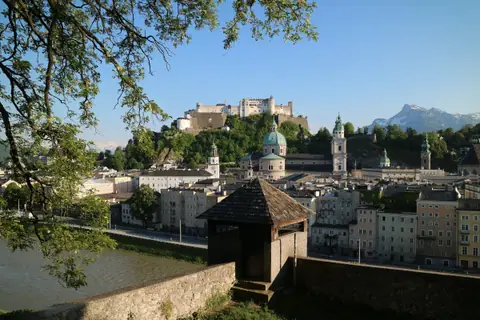
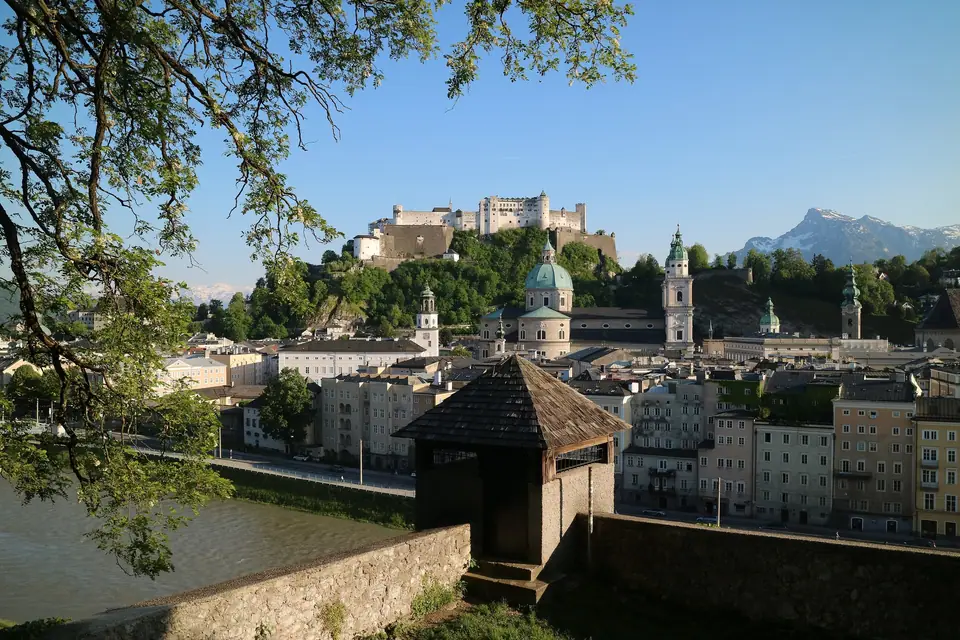
Established on the site of the Roman municipality of Iuvavum along the Salzach River, Salzburg (Salt Fortress) was refounded around AD 696 when St Rupert built St Peter's Abbey and Nonnberg Convent, financed by the white gold mined from the Dürrnberg salt mountains. Ruled for over a millennium by independent Prince-Archbishops of the Holy Roman Empire from high atop the 1077 Hohensalzburg Fortress, the medieval city was radically reshaped after 1587 when Prince-Archbishop Wolf Dietrich von Raitenau hired Italian architect Vincenzo Scamozzi to transform Salzburg into the Baroque Rome of the North.
On 27 January 1756, Wolfgang Amadeus Mozart was born at Getreidegasse 9, immortalising the city that founded the Salzburg Festival in 1920.
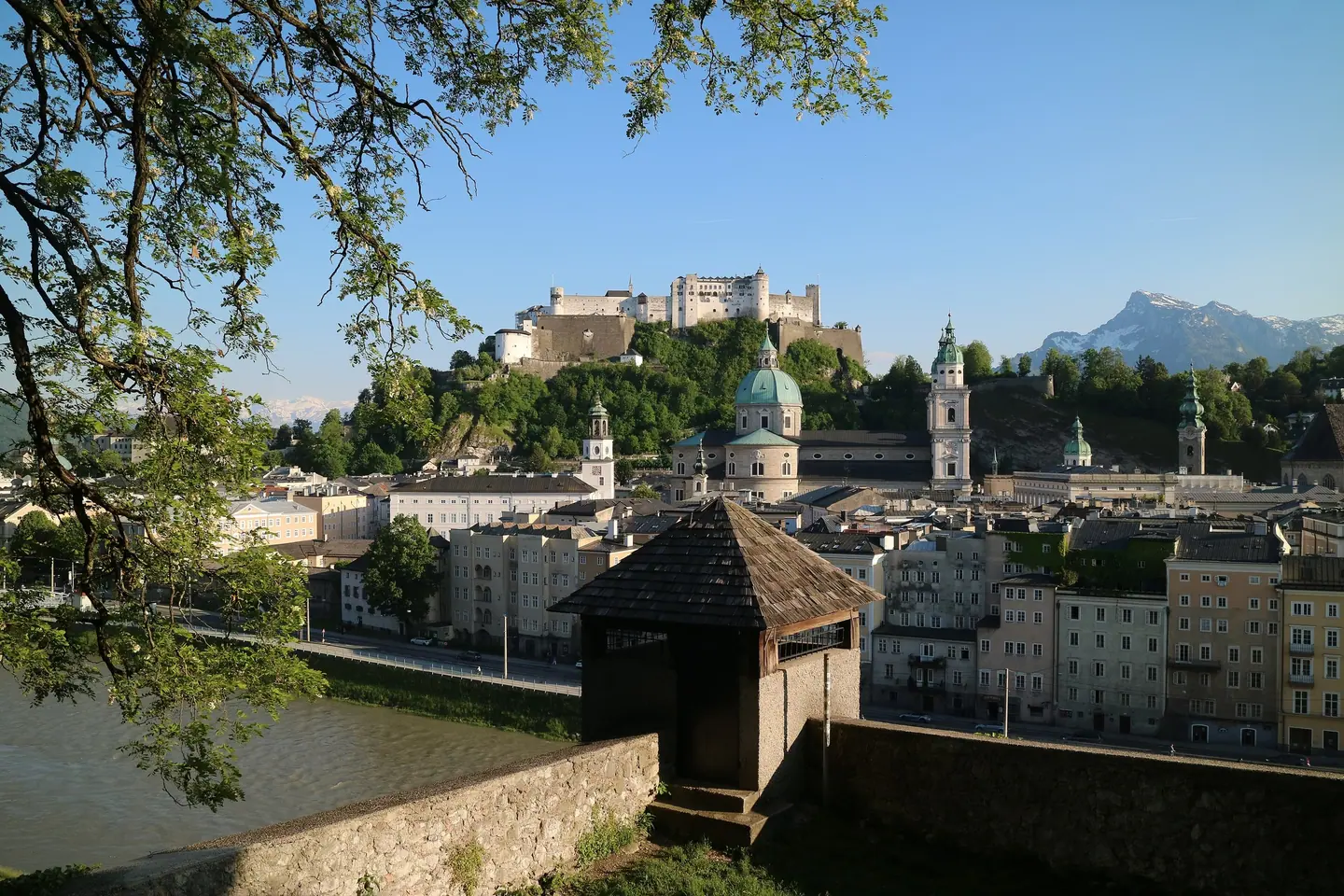
Residenzplatz, Salzburg Cathedral & DomQuartier Core
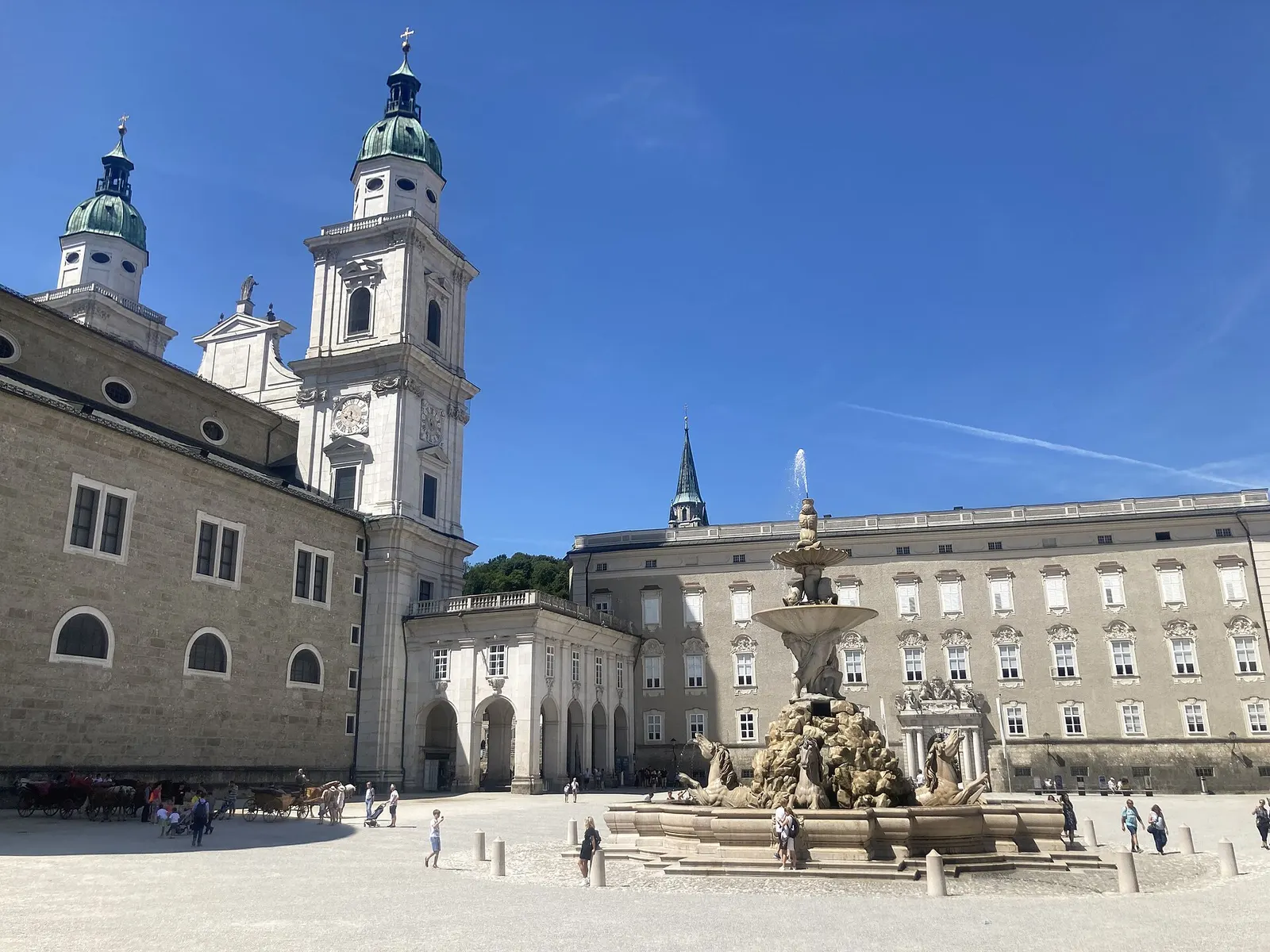
Residenzplatz & Residenzbrunnen (1661 Italian Baroque Fountain), Alte Residenz State Rooms, Neue Residenz Salzburg Museum & Carillon, Salzburg Cathedral (where Mozart was baptised), Domplatz Marian Column, Kapitelplatz Golden Sphere (Sphaera) & Kapitelschwemme Horse Pond
Residenzplatz
Commissioned in the late sixteenth century by Prince-Archbishop Wolf Dietrich von Raitenau, this sprawling paved square replaced medieval cemeteries and residences. It was designed according to ambitious Italian Renaissance urban ideals, creating an open civic space flanked by ecclesiastical palaces. Travellers gather here to view the grand facades that define the historic city centre.
Residenzbrunnen
Erected between 1656 and 1661, this colossal water monument is attributed to the Italian sculptor Tommaso di Garona. Hewn from Untersberg marble, it features snorting sea horses, muscular Atlas figures, dolphins, and a triumphant Triton blowing a conch shell. It remains one of the largest and most intricate Baroque fountains preserved north of the Alps.
Salzburg Cathedral
Rebuilt by Santino Solari after a catastrophic fire destroyed the Romanesque predecessor, the cathedral was consecrated in 1628. Its imposing twin-tower facade of dark conglomerate and white marble overlooks the square, crowned by a vast crossing dome. Inside, visitors encounter rich stucco work, monumental organs, and the Romanesque bronze font where Wolfgang Amadeus Mozart was baptised.
Domplatz
Designed as an atrium-like courtyard between 1614 and 1628, Domplatz is enclosed by three overarching porticos connecting the cathedral to the surrounding archiepiscopal palaces. The cobblestone expanse creates a dramatic theatrical enclosure, traditionally serving as the open-air stage for the annual performance of Hugo von Hofmannsthal's Jedermann during the Salzburg Festival.
Mariensäule
Sculpted by Wolfgang and Johann Baptist Hagenauer between 1766 and 1771, this central monument honours the Virgin Mary. Cast from local lead, the figure stands atop a globe supported by clouds and allegorical representations of the Church, Wisdom, and Angels. When viewed from the square's arcade, the Virgin appears crowned by two angels affixed to the cathedral facade.
Alte Residenz
This expansive palace complex served as the official seat and urban residence of the sovereign prince-archbishops from the early Middle Ages through the secularisation of 1803. The building reveals layers of Renaissance, Baroque, and Neoclassical modifications ordered by successive rulers. Its exterior presents a sober facade that conceals lavish interior apartments and historic meeting halls.
State Rooms of the Alte Residenz
The sequence of ceremonial staterooms includes the Carabinierisaal, the Rittersaal, and the Konferenzzimmer, where a young Mozart regularly performed for the prince-archbishop. The chambers feature intricate ceiling frescoes by Johann Michael Rottmayr, gilded stucco ornament, authentic French tapestries, and crystal chandeliers. They provide direct insight into the political and ceremonial rituals of the former ecclesiastical court.
Residenzgalerie
Established in 1923 in the private rooms of the prince-archbishops, this public gallery filled the cultural void left by the dispersal of the archiepiscopal art collections. The permanent display showcases European painting from the sixteenth to the nineteenth centuries, with notable works by Rembrandt, Peter Paul Rubens, and Jan Brueghel the Elder, complemented by Austrian masters.
DomQuartier
Opened in 2014, this continuous cultural route reconnects the Alte Residenz, the cathedral oratories, and the Monastery of St Peter. The walkway restored historic circulation paths that had been closed to the public for two centuries. Visitors walk through magnificent state apartments, high organ galleries, and monastic art cabinets along an uninterrupted historic sequence.
Cathedral Organ Loft and Oratories
Accessible via the DomQuartier passage, these elevated western galleries offer a commanding vantage point over the grand nave and central dome. The south oratories house sacred exhibits and liturgical vestments, while the north side once accommodated the private musical ensemble of the prince-archbishops. Mozart himself composed and directed masses from these elevated positions.
Cathedral Museum
Housed within the cathedral oratories, this ecclesiastical museum preserves precious artefacts from the archdiocese spanning over a thousand years. The highlight of the collection is the eighth-century Rupert Cross, cast from copper and adorned with enamel plaques. Other galleries exhibit jewelled chalices, silver monstrances, and ornate liturgical vestments crafted for episcopal celebrations.
Cathedral Arches
Constructed in the seventeenth century, these monumental double-arched portals connect the Residenz with the cathedral and the Franciscan monastery. Known locally as the Dombögen, the stone arches create elevated enclosed passageways above while permitting pedestrian and carriage passage below. They deliberately frame dramatic vistas between Domplatz, Residenzplatz, and the neighbouring monastery grounds.
Neue Residenz
Commissioned around 1588 by Archbishop Wolf Dietrich von Raitenau, the New Residence was initially planned as a private home for his brothers. The expansive courtyard palace features ashlar masonry, a decorative Renaissance portal, and an imposing central clock tower. Today, the complex forms the main site of the Salzburg Museum, presenting city history and art collections.
Salzburg Glockenspiel
Mounted within the octagonal tower of the Neue Residenz, this historic carillon consists of thirty-five bronze bells cast in Antwerp by Melchior de Haze. Installed between 1702 and 1704, the mechanical cylinder mechanism sounds traditional melodies across the rooftops multiple times daily. The complex brass drum contains thousands of holes allowing musical arrangements to be adjusted throughout the year.
Salzburg Museum
Located inside the Neue Residenz, this municipal museum showcases archaeology, Roman remains, medieval sculpture, and modern regional painting. Exhibits detail Salzburg's evolution from a Roman trading post named Juvavum into an autonomous prince-archbishopric. The subterranean Passage connects the main building directly to the Panorama Museum, revealing preserved sections of early defensive walls.
Kapitelplatz
Situated immediately south of the cathedral, this spacious square historically housed the cathedral chapter and high ecclesiastical administrators. Bordered by the chapter palace and clerical residences, it opens out towards the precipitous rock of the Festungsberg. Today, it hosts public art installations, outdoor chess players, and provides clear perspectives of Hohensalzburg Fortress above.
Sphaera
Created by German artist Stephan Balkenhol in 2007, this nine-metre-high artwork consists of a massive gilded sphere topped by a neutral male figure. The sculpture forms part of the Salzburg Art Project, contrasting modern minimalism with surrounding Baroque architecture. It stands in direct dialogue with another Balkenhol figure positioned across the old town within the cliff wall.
Kapitelschwemme
Constructed in 1732 under Archbishop Leopold Anton von Firmian, this ornate fountain served as a washing pond for the horses of the cathedral chapter. Designed in late Baroque style, it features a central marble sculpture of the sea god Neptune holding a trident while seated on a seahorse. The basin backs directly into the cliff, creating a theatrical watery ensemble.
Cathedral Excavations
Located beneath the cathedral floor, these underground excavation areas reveal structural remains from previous architectural eras. Visitors can inspect fragments of Roman villas with underfloor heating systems that stood on this ground before the Christian era. The site also preserves foundations from the Romanesque cathedral erected by Archbishop Conrad I in the twelfth century.
Kapitelgasse
This quiet stone alley connects Kapitelplatz to the western district, winding between substantial seventeenth and eighteenth-century curial residences. These grand houses once accommodated the aristocratic canons who formed the cathedral chapter and elected the prince-archbishop. The lane retains its historic flagstones, wrought-iron wall lamps, and heavy vaulted portals leading into private courtyards.
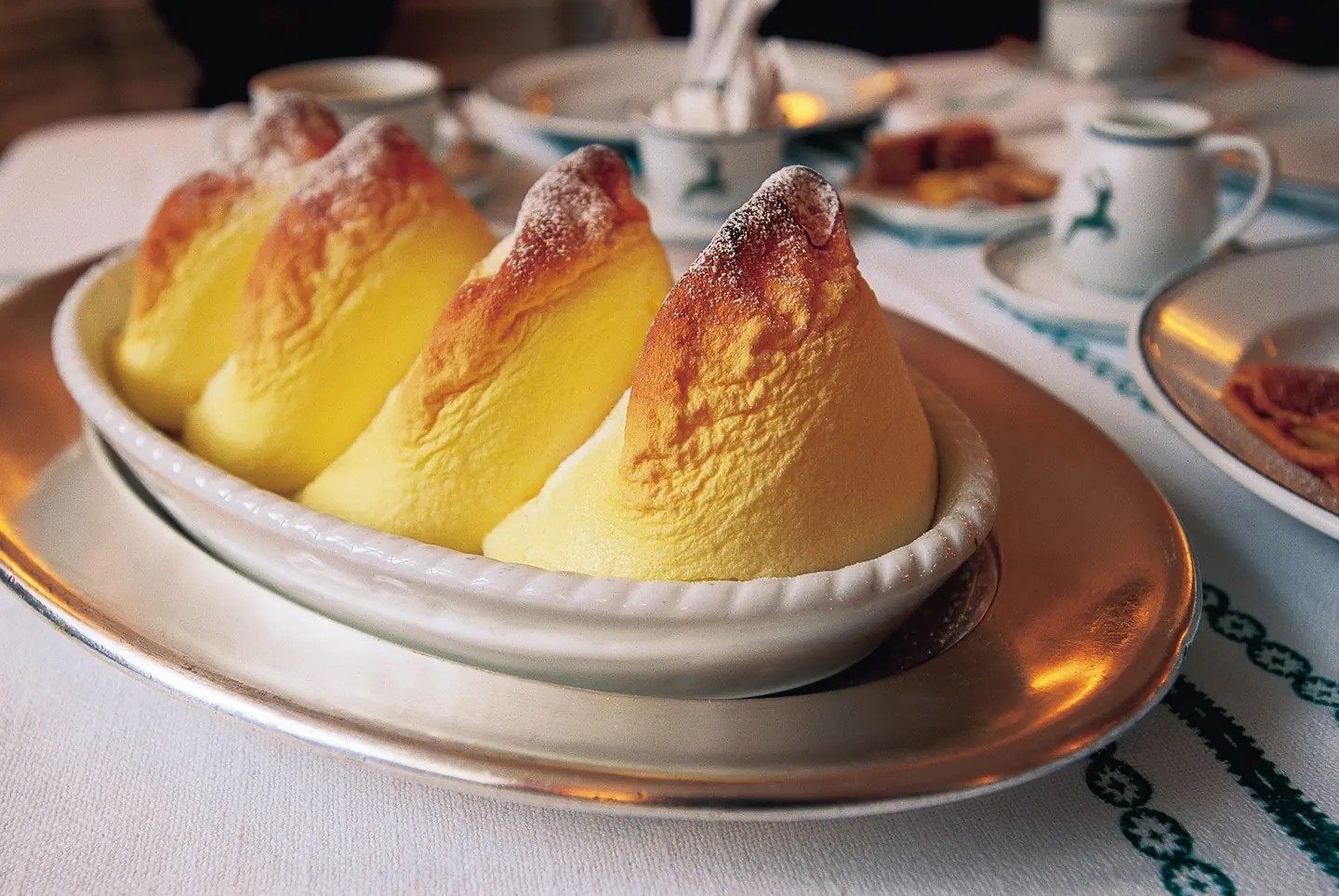
St Peter’s Abbey, Festival District & Getreidegasse Passages
St Peter’s Abbey (AD 696) & Petersfriedhof Catacombs, Stiftsbäckerei St Peter Watermill, Franciscan Church Gothic Choir, Festival Halls (Grosses Festspielhaus & Felsenreitschule Rock Riding School), Horse Pond Pferdeschwemme, Collegiate Church Kollegienkirche by Fischer von Erlach, Getreidegasse Durchhäuser Courtyards, and Mozart’s Birthplace (Getreidegasse 9)
St Peter's Archabbey
Founded in 696 by Saint Rupert, this Benedictine monastery is regarded as the oldest continuously active abbey in the German-speaking world. The abbey church exhibits Romanesque origins overlaid with elaborate eighteenth-century Rococo stuccoes and altar paintings. Visitors can explore the peaceful courtyards, view the historic library portal, and inspect the Romanesque south portal dating to the thirteenth century.
St Peter's Cemetery
Established during Late Antiquity, Petersfriedhof ranks among the oldest Christian cemeteries in Central Europe. The graveyard contains elaborate wrought-iron grave markers, family crypts, and the burial vaults of notable historical figures, including Mozart's sister Nannerl and architect Santino Solari. The cemetery lies directly against the sheer rock face of the Mönchsberg, offering a quiet sanctuary of historical resonance.
St Peter's Catacombs
Carved directly into the conglomerate cliff of the Mönchsberg, these rock-hewn hermitages and chapels served as early Christian meeting points. Steps lead visitors up into the Gertrauden Chapel, consecrated in 1178, and the higher Maximus Chapel. Narrow windows cut through the stone afford aerial views down across the manicured flower beds of St Peter's cemetery.
Stiftsbäckerei St Peter
Operating since the twelfth century, the abbey bakery sits beside the Almkanal millrace that powered the mill wheel for grinding rye grain. The facility still produces traditional sourdough loaves baked inside a wood-fired stone oven using historic recipes. Travellers can observe the rotating water wheel outside and watch bakers haul fresh bread from the oven inside the stone entrance.
St Peter's Stiftskulinarium
First documented in 803 by the scholar Alcuin of York, this historic dining complex claims status as the oldest inn in Central Europe. Several vaulted dining rooms are carved directly into the cliff rock of the mountain, while others feature ornate Baroque stuccoes and chandeliers. The stone corridors link medieval masonry with refined seventeenth-century archiepiscopal hospitality rooms.
Franciscan Church
This ancient parish church presents a striking architectural contrast between its dark Romanesque basilica nave and its soaring fifteenth-century Gothic hall choir. Architect Hans von Burghausen designed the slender central pillar supporting the complex stellar rib vaulting above the high altar. Baroque master Johann Bernhard Fischer von Erlach later framed the medieval Madonna statue with a splendid multi-columned altar.
Großes Festspielhaus
Opened in 1960 for the Salzburg Festival, this monumental opera house was designed by architect Clemens Holzmeister inside the former prince-archiepiscopal court stables. The auditorium features an exceptionally wide stage and seating flanked by bronze gates, local timber, and conglomerate masonry. The foyer preserves seventeenth-century equestrian frescos alongside modern tapestries by Oskar Kokoschka.
Felsenreitschule
Carved into the quarry face of the Mönchsberg in 1693 under Prince-Archbishop Johann Ernst von Thun, this open-air arena originally staged horse tournaments. Master builder Fischer von Erlach carved ninety-six tiered stone arcades across three storeys directly into the cliff wall. Today, the venue functions as an auditorium equipped with a modern retractable textile roof for festival opera performances.
Haus für Mozart
Originally built in 1607 as the archiepiscopal winter riding school, the structure underwent significant conversions before reopening as the Haus für Mozart in 2006. Architects Holzbauer and Valentinitsch opened the foyer towards the Toscanini Courtyard, incorporating historic stone walls and gilded reliefs. The auditorium seats more than fifteen hundred patrons and offers acoustic properties tailored specifically to Mozart's operatic works.
Toscaninihof
This secluded courtyard sits between the Festival Halls and the sheer cliff face of the Mönchsberg, named in honour of conductor Arturo Toscanini. The space provides access to the historic backstage areas and features modern sculpture alongside the rugged rock wall. A steep outdoor stone staircase climbs from the corner of the court directly onto the wooded heights above.
Pferdeschwemme
Constructed in 1695 by Fischer von Erlach, this grand horse pond was designed for washing the ceremonial steeds of the prince-archbishops. At its centre stands Michael Bernhard Mandl's dynamic marble sculpture of the Horse Tamer restraining an untamed steed. The curved retaining wall behind the basin displays restored early eighteenth-century frescoes illustrating diverse equestrian breeds in parade livery.
Sigmundstor
Completed in 1767 under Prince-Archbishop Sigismund von Schrattenbach, this 131-metre passage is the oldest road tunnel in Austria. Engineered by Elias Götz, the portals exhibit sophisticated Late Baroque stone masonry celebrating civic improvement and military defence. The eastern facade facing the old town features a sculpted bust of the prince-archbishop surrounded by military trophies and classical inscriptions.
Kollegienkirche
Erected between 1694 and 1707 as the Roman Catholic university church, the Kollegienkirche represents the pinnacle of Fischer von Erlach's ecclesiastical work. Its undulating whitewashed facade is framed by two rounded towers and a soaring drum dome. The brilliant white interior departs from colourful Baroque conventions, focusing attention on spatial geometry, light distribution, and stucco allegories of divine wisdom.
Universitätsplatz
This expansive public square spreads before the facade of the Kollegienkirche, serving as the setting for the daily Green Market. Traditional wooden stalls sell regional cheeses, pretzels, flowers, and local produce against a backdrop of historic burgher houses. The paved square connects the academic quarter of the old university with the narrow alleyways leading towards Getreidegasse.
Getreidegasse
Getreidegasse has served as Salzburg's primary commercial artery since Roman times, flanked by tall, narrow merchant houses dating from the fifteenth to eighteenth centuries. A defining feature is the collection of wrought-iron guild signs projecting from building facades above window bays. The street preserves traditional architectural elements, including timber doors, stone lintels, and high ridge parapets concealing steep roofs.
Mozart's Birthplace
Located at Getreidegasse 9 in the Hagenauer Haus, this bright yellow town house was the birthplace of Wolfgang Amadeus Mozart in 1756. The third-floor apartment occupied by the Mozart family now houses a comprehensive biographical museum displaying original musical instruments, family correspondence, and contemporary portraits. Visitors can walk through the historic kitchen and parlour where the young prodigy spent his early childhood.
Getreidegasse Durchhäuser
The Durchhäuser are public through-houses and arcaded passageways that slice through private merchant properties to connect Getreidegasse with Universitätsplatz and Griesgasse. These pedestrian passages feature internal courtyards lined with open Renaissance loggias, Roman fragments, and historic stone coats of arms. They provided crucial shortcuts for market traders and continue to form an intricate pedestrian circulation system.
Schatz-Durchhaus
Connecting Getreidegasse 3 with the Universitätsplatz, the Schatz-Durchhaus is one of the most picturesque interior passages in the old quarter. The quiet courtyard preserves round Renaissance arches, cast-iron lamps, and a small shrine depicting the Virgin Mary. Traditional specialty shops and a historic pastry cafe line the paved path beneath overhead stone vaults.
Sternbräu Courtyards
First referenced as a brewery in 1542, the Sternbräu comprises an ensemble of interconnected courtyards stretching between Getreidegasse and Griesgasse. The open courts feature ivy-covered walls, original stone doorways, and traditional taverns serving regional Austrian fare. Chestnut trees shade paved outdoor terraces that once accommodated horse-drawn beer wagons delivering fresh barrels across the city.
Blaue Gans Courtyard
Documented as an inn since 1350, the Blaue Gans sits at the western terminus of Getreidegasse near the horse pond. Its atmospheric passage contains medieval arches, uneven flagstone floors, and exposed seventeenth-century wooden beams integrated with contemporary artwork. The building reflects seven centuries of commercial hospitality, preserving its original architectural footprint within the dense fabric of the old town.
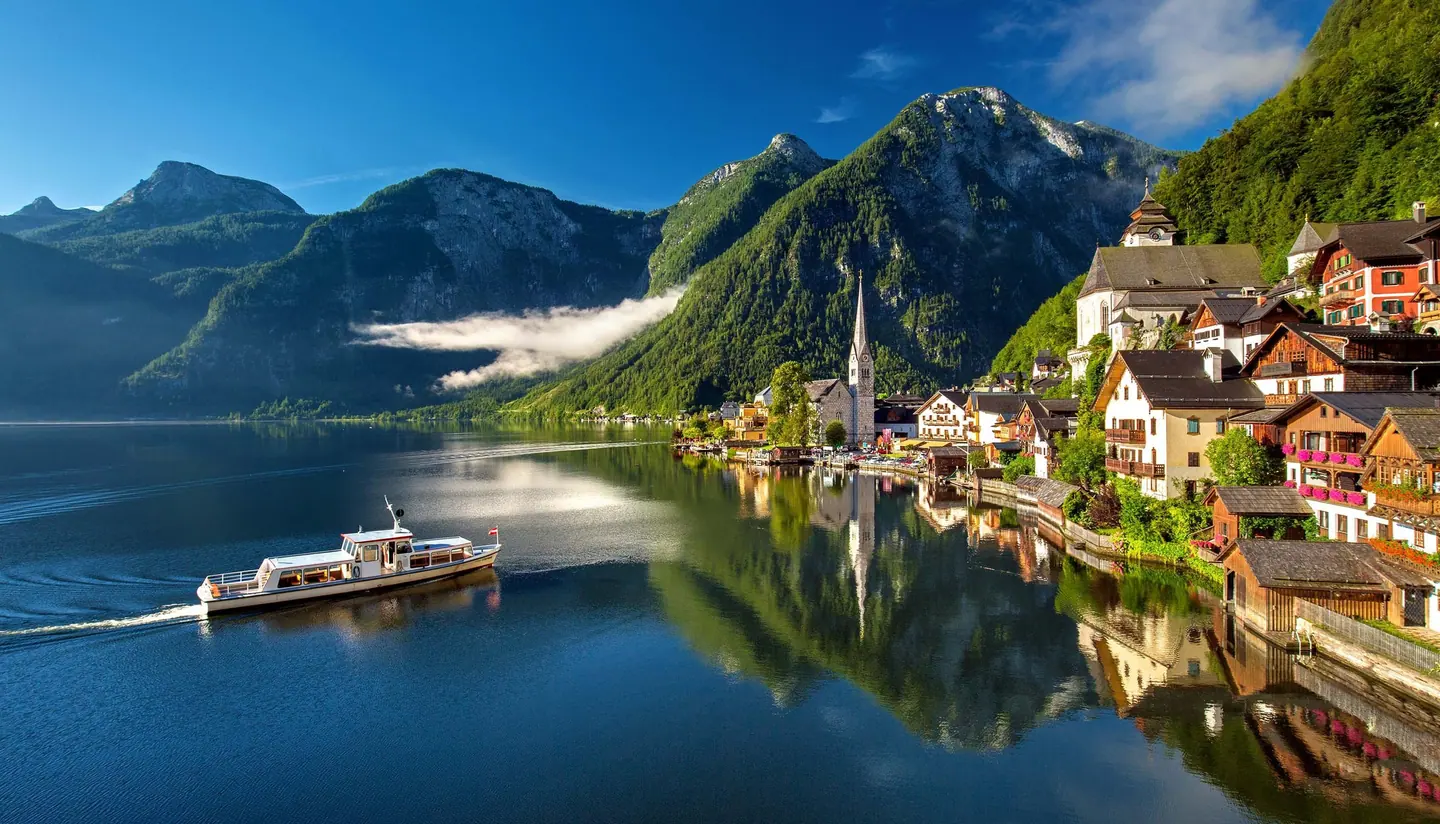
Hohensalzburg Fortress, Nonnberg Abbey & Mönchsberg Cliffs
Festungsbahn Funicular, Hohensalzburg Fortress (1077) Golden Hall & Reckturm Panorama, Nonnberg Benedictine Abbey (oldest continuously existing convent north of the Alps), Kaigasse, Kajetanerplatz, Museum der Moderne on Mönchsberg, and Augustiner Bräu Mülln Monastery
Festungsbahn Funicular
Operating since 1892, this funicular railway carries visitors from the historic centre up the steep rock face of the Festungsberg. Originally powered by water ballast before conversion to electricity, the modern carriages glide smoothly along a track spanning nearly two hundred metres, offering passengers panoramic city views as they ascend.
Hohensalzburg Fortress
Founded in 1077 by Archbishop Gebhard, this expansive citadel ranks among the largest preserved medieval fortresses in central Europe. Extensive expansions under Prince-Archbishop Leonhard von Keutschach around 1500 reinforced the ramparts with massive outer bastions. Inside, visitors encounter grand courtyards, military storehouses, and layers of medieval defensive architecture.
Golden Hall of Hohensalzburg
Situated on the upper floor of the fortress palas, the Golden Hall served as the principal reception room for the prince-archbishops. Intricate late Gothic woodcarvings and gold-painted ornaments adorn the walls, complemented by heavy wooden ceiling beams supported by twisted marble pillars. The chamber hosted elaborate state banquets and formal imperial receptions.
Reckturm Observation Tower
The Reckturm forms part of the castle's northern defensive belt and once served as an observation post and prison. A climb up the interior wooden staircase brings visitors to an open viewing platform, revealing an uninterrupted panorama across the baroque domes of Salzburg, the River Salzach, and the limestone peaks of the Northern Limestone Alps.
Fortress Museum
Located in the former princely living quarters, this museum displays artefacts illustrating the long military and domestic history of the fortress. Exhibits feature Roman masonry discovered on the hilltop, late medieval weaponry, historic armour, and scale models tracking architectural changes. Detailed dioramas illustrate the everyday existence of ordinary garrison soldiers across centuries.
Marionette Museum Salzburg
Set within vaulted cellars beneath the castle courtyards, this small museum showcases historic string puppets from the acclaimed Salzburg Marionette Theatre tradition. Exhibits highlight scenes from classic Mozart operas, regional folk tales, and historical stage productions. Intricately carved wooden figures and period stage sets offer insight into local puppetry craftsmanship.
Nonnberg Abbey
Established around the year 714 by Saint Erentrudis, Nonnberg stands as the oldest continually existing nunnery north of the Alps. The monastic complex clings to the eastern slope of the Festungsberg, featuring an impressive gothic choir, an early Romanesque crypt, and distinctive onion-domed bell towers visible across the southern suburbs.
Stiftskirche Nonnberg
Rebuilt in the late fifteenth century following a devastating fire, the abbey church features an elaborate net-vaulted ceiling and tall pointed-arch windows. Beneath the choir, the crypt preserves the tomb of Saint Erentrudis alongside Romanesque wall paintings dating from the twelfth century. Early morning services here include the traditional choral singing of the resident nuns.
Kaigasse
Running parallel to the cathedral quarter, Kaigasse traces an ancient Roman traffic route through the southern part of the Old Town. Today, the narrow cobblestone lane features pastel-painted baroque facades, wrought-iron guild signs, and quiet interior residential courtyards. It links major civic squares to the foot of the Nonnberg convent ascent.
Kajetanerplatz
Located at the south-eastern edge of the historic centre, Kajetanerplatz serves as a gathering space hosting regular open-air produce markets. The perimeter contains substantial medical buildings and historic dwellings originally built over Roman settlements. In the centre, the marble Schlossergassler fountain commemorates ancient municipal guilds.
Kajetanerkirche
Constructed between 1685 and 1697 by Italian architect Gaspare Zuccalli, this church was built for the Theatine order and dedicated to Saint Cajetan. The facade features giant pilasters and a central dome, while the interior is covered in lavish white stucco work and altarpieces by Paul Troger. A Holy Staircase replicates the Scala Sancta in Rome.
Museum der Moderne Mönchsberg
Opened in 2004, this minimalist building clad in local Untersberg marble contrasts sharply with the medieval city below. The museum exhibits modern and contemporary paintings, sculptures, and photographic collections from international and Austrian artists. Expansive glass windows and outdoor terraces provide vistas across the rooftops and spires of the city centre.
Mönchsberg Lift
Built directly inside the vertical face of the Mönchsberg, this lift system ascends sixty metres in fewer than thirty seconds. Originating at Anton-Neumayr-Platz, the elevator delivers passengers directly to the entrance of the modern art museum and adjacent walking trails, bypassing the steep zigzag stairs that climb the rocky hillside.
Richterhöhe on Mönchsberg
Named after the geographer Eduard Richter, this elevated bastion formed an integral part of the outer fortifications established by Prince-Archbishop Paris Lodron during the Thirty Years' War. The stone terrace overlooks the pastoral green meadows of the Leopoldskron valley, leading the eye directly toward the steep rocky face of Mount Untersberg.
Bürgerwehr on Mönchsberg
Erected in the fifteenth century to reinforce the municipal defence network, the Bürgerwehr consists of a fortified wall flanked by four distinctive round towers. The battlements offered municipal guards a clear view of approaching armies from the west. Today, walking paths run along the old ramparts, weaving through beech woodlands and landscaped grassy clearings.
Humboldtterrasse
Perched on a narrow rocky spur of the Mönchsberg, this natural viewing terrace honours Alexander von Humboldt, who famously praised the regional landscape. From this vantage point, travellers look down upon the curve of the Salzach River, the old parish quarter of Mülln, and the verdant slopes surrounding the Kapuzinerberg across the water.
Klausentor
Originally constructed in the thirteenth century and rebuilt during the Thirty Years' War, the Klausentor guarded the narrow northern exit from Salzburg along the riverbank. Its thick stone arches and steep roof demonstrate medieval military engineering, designed to seal the thoroughfare against enemy advance where the rocky Mönchsberg drops directly to the water.
Müllner Steg
This steel pedestrian bridge links the historic district of Mülln on the left bank with the Mirabell gardens quarter on the right bank. Crossing the Salzach on foot, travellers can observe the dramatic silhouette of Hohensalzburg Fortress rising against the southern skyline, framed by the long wooded ridge of the Mönchsberg.
Mülln Parish Church
Dating back to the twelfth century and significantly remodeled in the Gothic and Baroque periods, this parish church features a tall green copper steeple. Inside, visitors find ornate altars carved by master sculptors alongside historic tombs of local dignitaries. A steep stone staircase leads from the riverbanks up to the church courtyard.
Augustiner Bräu Mülln Monastery
Established in 1621 by Augustinian monks, this substantial monastic estate has operated its own brewhouse for over four centuries. Visitors collect ceramic stone steins from cool running water basins before proceeding into the vast vaulted tavern halls or the sprawling shaded chestnut beer garden. Traditional food stands serve regional cold meats, cheeses, and warm roasted specialities.
Right Bank: Mirabell Palace, Mozart Residence & Kapuzinerberg
Marko-Feingold-Steg Footbridge, Mirabell Palace Marble Hall, Mirabell Gardens Pegasus Fountain, Dwarf Garden & Hedge Theatre, Mozarteum University, Mozart’s Residence (Tanzmeisterhaus on Makartplatz), Holy Trinity Church by Fischer von Erlach, Linzer Gasse, St Sebastian’s Cemetery (Tomb of Wolf Dietrich & Constanze Mozart), and Kapuzinerberg Bastions
Marko-Feingold-Steg
Originally named Makartsteg after painter Hans Makart, this pedestrian bridge was renamed in 2020 to honour Marko Feingold, a Holocaust survivor and leader of the local Jewish community. Thousands of inscribed padlocks line the safety mesh. It links the medieval old town with the right bank districts, offering unobstructed vistas towards the fortress.
Mirabell Palace
Prince-Archbishop Wolf Dietrich von Raitenau commissioned this grand residence in 1606 for his mistress Salome Alt. Following an extensive fire in 1818, court architect Peter de Nobile redesigned the complex into its sober neoclassical form. Today, the building accommodates the offices of Salzburg's municipal government and the office of the mayor.
Marble Hall at Mirabell Palace
Situated on the first floor of Mirabell Palace, this lavishly decorated hall survived the devastating city fire of 1818. Wolfgang Amadeus Mozart performed here alongside his sister Nannerl for the prince-archbishop court. It now functions as a celebrated setting for classical chamber concerts and civil marriage ceremonies.
Donnerstiege
Georg Raphael Donner sculpted this ceremonial marble staircase between 1726 and 1728 during the baroque alterations overseen by architect Johann Lukas von Hildebrandt. Cherubs and lively putti slide down the polished stone balustrades while classical statues inhabit ornate niches along the walls. The staircase leads visitors upwards to the palace's state rooms.
Mirabell Gardens
Redesigned around 1690 under Prince-Archbishop Johann Ernst von Thun, these geometric baroque gardens follow plans drawn up by Johann Bernhard Fischer von Erlach. Symmetrical flowerbeds, ornamental parterres, and classical marble sculptures direct the eye towards Hohensalzburg Fortress. Emperor Franz Joseph I opened the grounds to the general public in 1854.
Pegasus Fountain
Sculptor Kaspar Gras cast this dynamic copper figure of Pegasus in 1661, originally for a fountain in the Kapitelplatz. After multiple relocations across the city, workers installed the winged horse in the Mirabell Gardens in 1913. Four sculptural groups surrounding the central circular basin depict the classical elements: fire, air, earth, and water.
Dwarf Garden
Established around 1695, this curious terrace displays comic figures carved from white Untersberg marble representing regional trades, months, and court jesters. Crown Prince Ludwig of Bavaria auctioned off many of the statues in the nineteenth century, deeming them grotesque. Several originals have since been tracked down and returned to their bastion pedestals.
Hedge Theatre
Laid out between 1704 and 1718, this outdoor performance space stands among the oldest surviving hedge theatres in central Europe. Dense walls of trimmed European beech form natural wings, stage entries, and an orchestra pit. Prince-archbishops originally utilised the enclosed grass arena for pastoral plays, ballets, and small theatrical productions.
Mozarteum University
Founded in 1841 as the Cathedral Music Association and Mozarteum, this institution grew into an internationally respected arts university. The main complex on Mirabellplatz includes the historic Great Hall, celebrated for its clear acoustic qualities and classical organ. Students from dozens of countries study musical performance, composition, and theatre arts within these halls.
Salzburg State Theatre
Designed by the celebrated Viennese architectural duo Fellner and Helmer, this neoclassical theatre opened its doors in 1893 on the site of an earlier court playhouse. The auditorium features three tiers of seating framed by gilded stucco decorations and plush red velvet. It stages continuous seasons of opera, theatre, and classical ballet.
Mozart Residence
The Mozart family relocated to this spacious dwelling, historically called the Tanzmeisterhaus, in 1773 when Wolfgang was seventeen years old. He composed symphonies, serenades, and concertos within these rooms before his departure for Vienna in 1781. Reconstructed after wartime bomb damage, the building operates as a museum exhibiting authentic instruments, portraits, and family documents.
Makartplatz
This expansive public square evolved outside the medieval core on the Salzach's right bank. Named in honour of nineteenth-century academic painter Hans Makart, the square is framed by historic residences, including the former dwelling of physicist Christian Doppler. A striking bronze sculpture by artist Anthony Cragg anchors the open centre.
Holy Trinity Church
Constructed between 1694 and 1702, this monumental place of worship was Johann Bernhard Fischer von Erlach's first major architectural commission in Salzburg. The concave facade and twin flanking towers draw inspiration from Roman baroque churches, particularly Borromini's Sant'Agnese in Agone. Inside, Johann Michael Rottmayr's dome fresco depicts the Holy Trinity crowned by the Virgin Mary.
St Sebastian's Church
Dating back to an early sixteenth-century chapel built during a plague outbreak, this church was completely rebuilt in late baroque style between 1749 and 1753. Sculptor Josef Anton Pfaffinger supplied the stone figures adorning the facade, including a dynamic statue of Saint Sebastian. The church provides the principal access portal to the historic cemetery behind it.
St Sebastian's Cemetery
Commissioned by Prince-Archbishop Wolf Dietrich von Raitenau between 1595 and 1600, this burial ground replicates an Italian campo santo bordered by arcaded cloisters. It contains the resting places of notable historical figures, including physician Paracelsus, Leopold Mozart, and Wolfgang's wife Constanze Mozart. Elaborate baroque wrought-iron crosses line the covered walkways.
Mausoleum of Wolf Dietrich von Raitenau
Standing centrally in St Sebastian's Cemetery, this freestanding round mortuary chapel was designed by Elia Castello for Prince-Archbishop Wolf Dietrich. Its interior features glazed polychrome earthenware tiles covering walls and vaults, alongside relief panels showing the Cardinal Virtues. The prince-archbishop was interred in the crypt below following his imprisonment at Hohensalzburg.
Linzer Gasse
Serving for centuries as the primary thoroughfare leading northeast towards Linz and Vienna, this pedestrian street retains an authentic burgher character. Tall, narrow townhouses featuring traditional wrought-iron guild signs line the gently curving lane. Quaint passageways branch off the main route, leading either into secluded residential courtyards or towards the slopes of Kapuzinerberg.
Kapuzinerberg
Rising to an elevation of 636 metres, this limestone hill forms a natural green rampart along the eastern edge of the urban centre. Walking trails lead through dense beech woodland past historical fortifications, viewpoints, and stone shrines. The cliffs provide uninterrupted panoramic perspectives over the domes, spires, and river of the historic old town below.
Capuchin Monastery
Wolf Dietrich von Raitenau summoned the Capuchin friars to Salzburg in 1599, establishing their friary on the site of a medieval watchtower called the Trompeterschlösschen. The church features an unadorned interior, adhering strictly to the ascetic ideals of the Franciscan order. Its carved wooden entrance doors date from around 1450, salvaged from the former Romanesque cathedral.
Kapuzinerberg Bastions
Prince-Archbishop Paris Lodron fortified these precipitous slopes between 1629 and 1632 to protect Salzburg from the Swedish forces during the Thirty Years' War. The massive stone bastions, complete with sentry walk and artillery parapets, step down the rock face toward the Salzach river. A commemorative plaque and stone bust honour author Stefan Zweig, who lived on the hill.
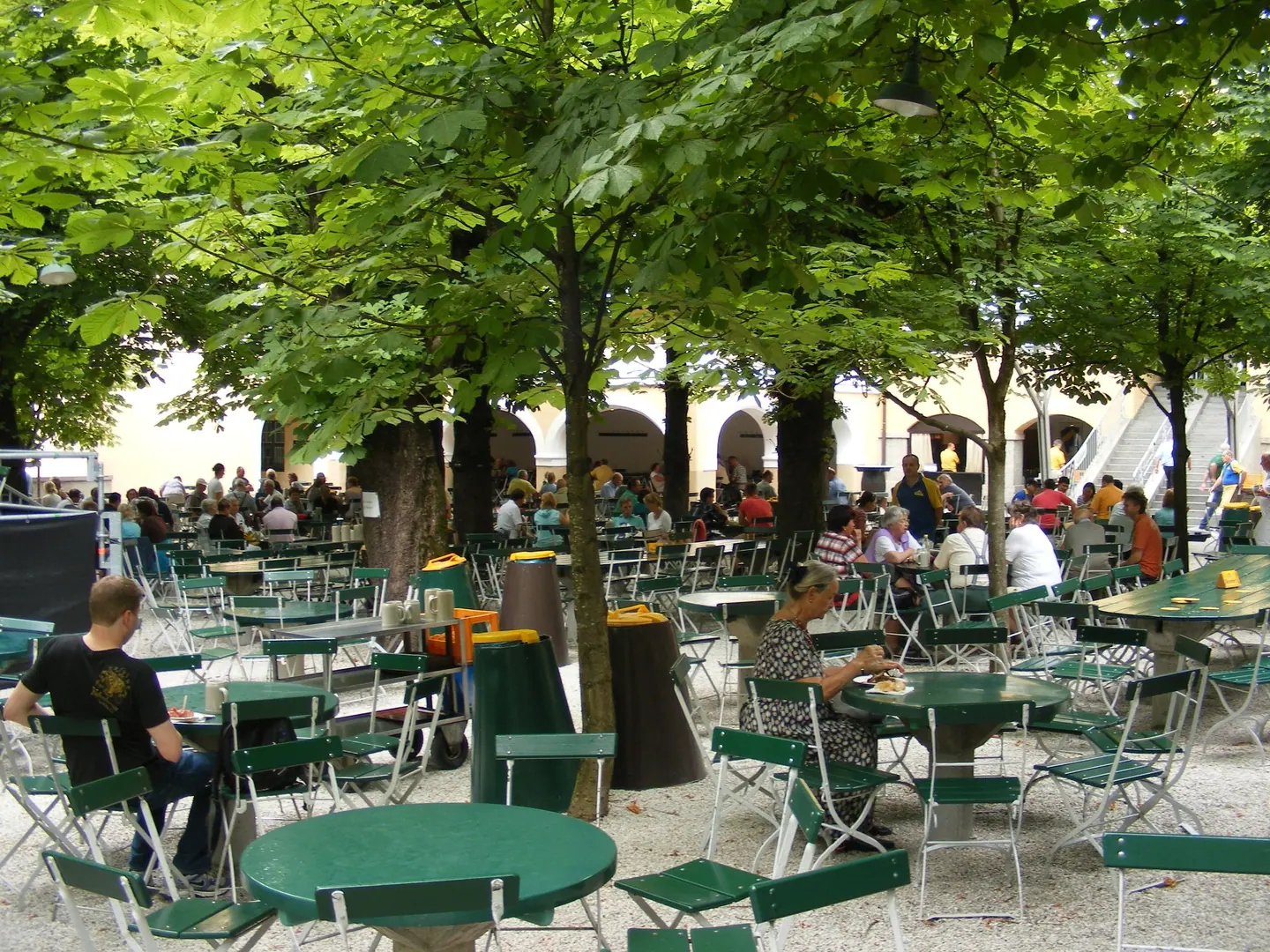
Leopoldskron, Hellbrunn Trick Fountains & Untersberg
Schloss Leopoldskron & Lake, Hellbrunner Allee, Hellbrunn Palace & 1615 Mannerist Trick Fountains (Wasserspiele), Monatschlössl Folk Museum, Stone Theatre in Hellbrunn Park, Maria Plain Pilgrimage Basilica, Hangar-7, and Untersberg Cable Car Alpine Summit
Schloss Leopoldskron
Commissioned in 1736 as a family seat, this Rococo residence stands beside an idyllic artificial lake facing the Unterberg ridge. Theatre director Max Reinhardt acquired the estate in 1918, restoring its stuccoed interiors and founding the Salzburg Festival within its ornate halls. Visitors admire the stuccoed Venetian room and lakeside terrace garden.
Leopoldskroner Weiher
Excavated alongside the palace in the 1730s, this body of water served as a peat reservoir and an ornamental reflecting pool. Walking paths encircle the perimeter, offering clear vistas of the fortress ridge reflected across tranquil water. Waterfowl congregate along the reedy banks where locals walk throughout the changing seasons.
Hellbrunner Allee
Planted in 1614 under Prince-Archbishop Markus Sittikus von Hohenems, this avenue represents one of the oldest preserved landscaped roads in Europe. Oak and chestnut trees shade the gravel track, which remains reserved exclusively for pedestrians and cyclists. Several noble country manors, including Schloss Emsburg and Schloss Frohnburg, punctuate the pastoral route.
Schloss Frohnburg
Built around 1670 for Prince-Archbishop Max Gandolf von Kuenburg, this country residence features classical Mannerist proportions and a symmetrical facade. The Mozarteum University now utilises the building as a music academy campus and concert venue. Its wrought-iron gateway and manicured courtyard front directly onto the historic carriage thoroughfare.
Schloss Emsburg
Originally established in the early seventeenth century, this private residence was expanded by the von Ems noble family into an elegant country retreat. The estate preserves a traditional walled orchard, crests carved above stone doorways, and decorative hipped roofs. It provides an authentic glimpse into the aristocratic pleasure estates flanking the avenue.
Hellbrunn Palace
Constructed between 1612 and 1619, this summer villa was conceived solely for daytime entertainment and never contained bedrooms. Santino Solari designed the bright yellow estate, incorporating grand banquet halls embellished with trompe-l'oeil frescoes depicting classical processions. Extensive landscaped grounds surround the palace, featuring formal parterres, fish ponds, and wooded pathways.
Hellbrunn Trick Fountains
Devised by Prince-Archbishop Markus Sittikus, these famous water gardens use gravity-fed mountain streams to operate ingenious practical jokes and mechanical figures. Highlights include a stone dining table with seats that spray unsuspecting diners, alongside grottos dedicated to classical deities. The hydraulic engineering remains operational in its original seventeenth-century form.
Mechanical Theatre at Hellbrunn
Added to the trick fountains in 1750 by master builder Lorenz Rosenegger, this hydraulic installation contains over one hundred animated wooden figures. A waterwheel powers the intricate mechanism, setting miniature artisans, merchants, and soldiers in motion to the sound of an organ. It demonstrates sophisticated pre-industrial hydraulics and precision clockwork craftsmanship.
Grotto of Neptune
Situated within the palace fountain complex, this grotto is adorned with porous volcanic rock, shells, and a statue of the sea god. Concealed nozzles douse visitors entering the shaded chamber, while mirror effects produce playful water reflections on the damp masonry. It exemplifies Mannerist garden theatricality designed to delight and surprise guests.
Monatschlössl
Erected in 1615 on a steep hill overlooking the palace grounds, legend states this compact hunting lodge was built in just four weeks to settle a wager. Today it houses the folklore collection of the Salzburg Museum, displaying regional folk art, traditional costumes, and carved wooden furniture. The elevation affords panoramic views over the Salzach river basin.
Stone Theatre in Hellbrunn Park
Hewn directly into a limestone quarry outcrop in 1617, this rustic stage hosted early operatic and dramatic productions north of the Alps. Historical accounts note that Monteverdi's opera L'Orfeo was performed here within years of its Italian debut. Tiered rocky platforms and rough caverns create a dramatic natural amphitheatre within the woodland.
Salzburg Zoo Hellbrunn
Occupying ground originally used as an archbishop's deer hunting park in 1619, the modern zoo integrates steep limestone precipices directly into its enclosures. Alpine ibex, griffon vultures, and African savannah species inhabit spacious enclosures adapted to the natural terrain. The park balances historical conservation with contemporary wildlife preservation programmes.
Maria Plain Pilgrimage Basilica
Designed by architect Giovanni Antonio Dario and completed in 1674, this twin-towered Baroque sanctuary guards an image of the Virgin Mary that survived the Thirty Years' War. Wolfgang Amadeus Mozart composed his Coronation Mass specifically for liturgical services celebrated here. The hilltop square commands comprehensive views southward across the entire Salzburg valley.
Calvary Chapels of Maria Plain
Ascending the Plainberg slope towards the basilica, this historic route features a sequence of covered shrines constructed in the seventeenth and eighteenth centuries. Each chapel displays sculpted tableaus illustrating the Stations of the Cross, restored to preserve vivid regional devotional artistry. Centuries of pilgrims have walked this steep tree-lined track towards the hilltop church.
Hangar-7
Designed by architect Volkmar Burgstaller, this aerofoil-shaped exhibition hall is assembled from twelve hundred tonnes of steel and hundreds of custom glass panes. Inside, the Flying Bulls collection showcases meticulously restored historic aircraft, including a rare Lockheed P-38 Lightning and contemporary Formula One racing vehicles. Rotating modern art exhibitions complement the aviation engineering.
Klessheim Palace
Begun in 1700 as a summer seat for Prince-Archbishop Johann Ernst von Thun, this grand estate displays classical Baroque proportions and intricate stone pediments. The monumental entrance ramp features sculpted couchant stags balancing coats of arms. Now hosting the Salzburg Casino, the surrounding formal park retains historic English-style avenues and perimeter woodland.
Untersberg Cable Car Lower Station
Located in the village of Sankt Leonhard, this mid-century base terminal has conveyed travellers to alpine heights since its inauguration in 1961. The aerial lift ascends across sheer limestone walls without intermediate support towers on its upper stretch, spanning an immense vertical rise. It serves as the primary gateway for mountaineers exploring the massif.
Geiereck Alpine Peak
Rising to an elevation of 1,805 metres above sea level, this prominent peak marks the northern edge of the Berchtesgaden Alps. A monumental wooden summit cross crowns the ridge, looking out across the Austrian-German frontier and the glittering Salzach valley far below. Walking trails trace the rocky limestone crest towards neighbouring alpine summits.
Salzburger Hochthron
Reaching 1,853 metres, this high peak provides panoramic perspectives over the Hohe Tauern range, Watzmann peak, and the Bavarian pre-Alps. Karst fissures, sinkholes, and endemic alpine flora characterise the plateau terrain, which is accessible via marked ridgeline paths. The mountain contains numerous deep cave networks historically associated with regional Emperor Barbarossa folklore.
Marktschellenberg Ice Cave Gateway
Perched on the eastern flank of the Untersberg ridge, this cavern complex contains thick subterranean ice sheets and towering frozen stalagmites preserved year-round. Guided visitors navigate dimly lit wooden walkways descending deep into limestone vaults where temperatures remain perpetually near freezing. The site represents one of the significant geological treasures of the border mountain.
Mönchsberg Clifftop Walks and Hellbrunn Allee in Salzburg
Pair this route with the practical neighbourhood breakdowns, climate charts and transport advice in our Salzburg travel overview, alongside additional mapped city walks.