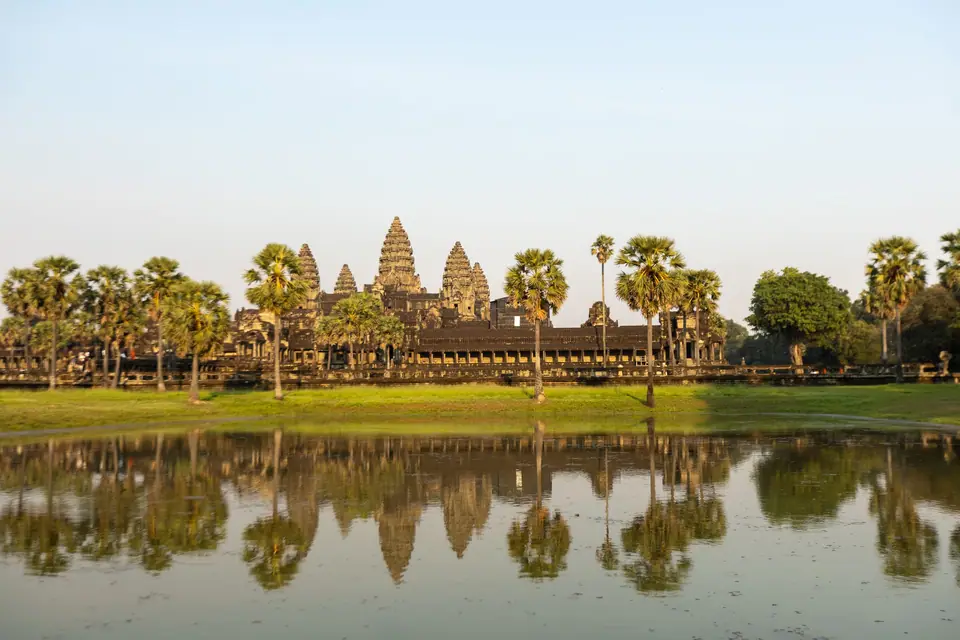
A detailed archaeological route across the Khmer Empire capital of Yasodharapura: the Small Circuit, Grand Circuit, Banteay Srei, Roluos Group, and Siem Reap River.
Hydraulic Cities and Sandstone Bas-Reliefs of the Khmer Empire
In AD 802 King Jayavarman II proclaimed himself Chakravartin (Universal Monarch) atop sacred Phnom Kulen mountain, founding the Khmer Empire that dominated mainland Southeast Asia for six centuries. Moving from Hariharalaya (the Roluos Group) to Yasodharapura (Angkor), Khmer kings engineered an immense hydraulic network of reservoirs (barays), moats, and canals that sustained up to a million inhabitants.
In the early twelfth century Suryavarman II raised Angkor Wat, the largest religious monument on earth, dedicated to Vishnu and carved with nearly two thousand apsaras and epic bas-reliefs, before Jayavarman VII built the walled Buddhist capital of Angkor Thom centred on the 216 smiling stone faces of the Bayon.
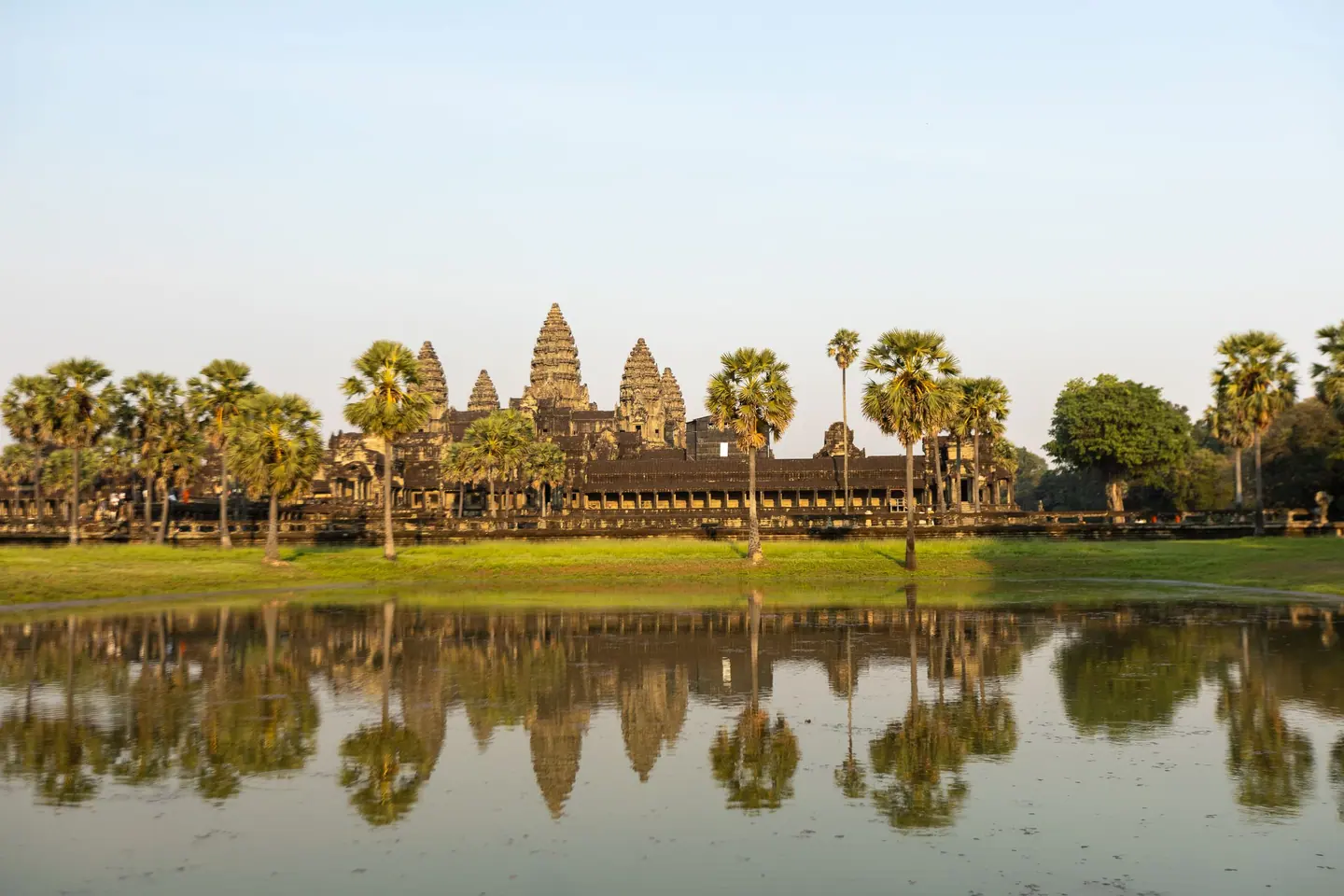
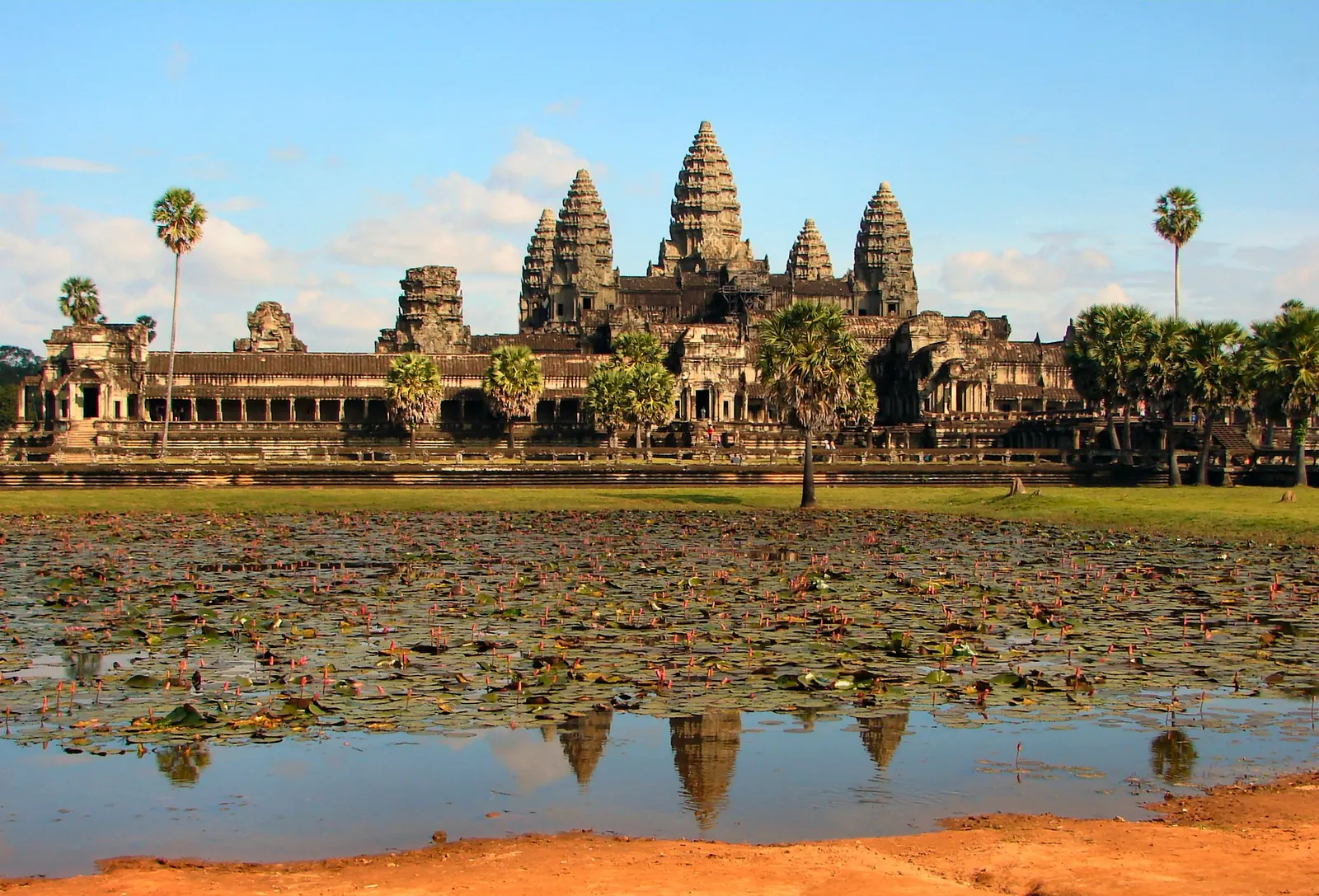
Angkor Wat, Phnom Bakheng & Southern Moat
Angkor Wat Western Causeway, Naga Balustrades, Library Pavilions, North and South Reflecting Ponds, Battle of Kurukshetra Bas-Relief, Churning of the Ocean of Milk Gallery, Bakan Central Sanctuary, Baksei Chamkrong, and Phnom Bakheng Sunset Hill
Angkor Wat Western Causeway
This massive sandstone causeway extends across the two-hundred-metre-wide moat, serving as the formal ceremonial approach to the temple complex. Restored through extensive international cooperation, the paved crossing features ancient stone paving blocks fitted together without mortar. Travellers can examine the structural foundation that has supported pilgrims and royal processions since the twelfth century.
Angkor Wat Naga Balustrades
Carved serpent balustrades line the grand walkways of the temple, representing Vasuki and Shesha from Hindu mythology. The multiple flared heads rear upwards at the terminal points, framing the primary thresholds with intricate scaly crests. Inspect the underbellies and joints where Khmer masons slotted individual sandstone sections directly into interlocking stone sockets.
Western Gopura of Angkor Wat
This monumental gateway pierces the outer laterite wall, offering five separate portals designed to admit pedestrians, royalty, and elephants. Three ruined towers rise above the sandstone facade, which mimics the design of the primary sanctuary within. Inside the southern passage stands an imposing eight-armed statue of Vishnu, carved from a single piece of sandstone.
Angkor Wat North Reflecting Pond
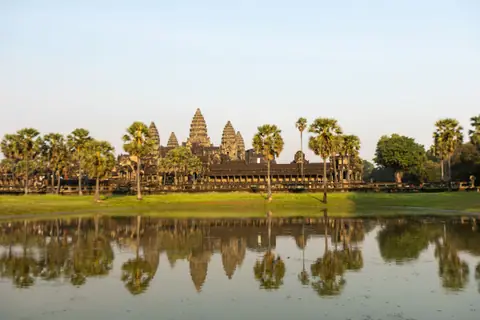
Positioned north of the grand processional walkway, this rectangular stone-stepped basin provides the classic mirror reflection of the central quincunx of towers. Originally excavated as part of the ritual water management network, its tiered laterite steps lead down to the waterline. Early morning visitors gather here to watch dawn illuminate the distinct silhouette of the main sanctuary.
Angkor Wat South Reflecting Pond
Mirroring its northern counterpart across the main axial road, this stepped pond retains its original Khmer basin geometry. The surrounding lawns contain remnants of ancillary shrines and coconut palms that frame views of the southern gallery walls. We find quieter vantage points along these banks, away from the principal pedestrian flows across the parkland.
North Library of the Outer Courtyard
Set within the spacious western parkland, this detached sandstone building served as a repository for palm-leaf manuscripts and religious texts. The structure rests on a moulded plinth, featuring cruciform porticoes, corbelled vaults, and balustraded windows. Detailed pediments depict scenes from Hindu legend, carved above doorways that align precisely with the cardinal directions.
South Library of the Outer Courtyard
Identical in plan to its northern twin, this southern pavilion balances the ceremonial avenue leading from the outer gateway. Its weathered columns, false windows, and decorated gables exemplify classical twelve-century Khmer civic architecture. Notice the delicate floral motifs carved into the sandstone doorframes and the drainage channels carved along the lower plinth.
Battle of Kurukshetra Bas-Relief
Spanning forty-nine metres along the western third of the southern gallery wall, this relief depicts the climax of the Mahabharata epic. The scene shows the Kaurava and Pandava armies colliding in combat, complete with infantry, war elephants, and chariot-mounted commanders. Look closely to distinguish Bhishma dying upon a bed of arrows, surrounded by grief-stricken soldiers.
Army of King Suryavarman II Gallery
Carved into the southern gallery, this panel depicts King Suryavarman II leading his ministers and royal army on parade. The king appears seated on an elephant, shaded by fifteen parasols and accompanied by armed retinues. Further along, allied Siamese warriors march in distinctive skirts and headdresses, presenting valuable records of regional twelve-century military attire.
Heaven and Hell Bas-Relief Gallery
This narrative relief depicts thirty-seven heavens and thirty-two hells arranged in three distinct tiers. Yama, the judge of the dead, directs souls towards either celestial palaces or horrific tortures overseen by demons. The lower registers show sinners being stretched, roasted, and pierced with nails, providing graphic moral allegories from ancient Hindu scripture.
Churning of the Ocean of Milk Gallery
Covering forty-nine metres of the eastern gallery, this relief illustrates the creation myth from Hindu theology. Eighty-eight devas and ninety-two asuras pull the giant serpent Vasuki around Mount Mandara to churn the cosmic ocean for the elixir of immortality. Above the churning sea, carved apsaras dance in mid-air alongside Vishnu, who directs the cosmic undertaking.
Victory of Vishnu over the Asuras Gallery
This panel depicts Vishnu mounted upon his eagle mount Garuda, routing legions of demon warriors across a chaotic battlefield. While added during the sixteenth century under post-Angkorian rulers, the carving adheres closely to traditional themes. Look for intricate details of celestial birds, charging chariots, and multi-headed demons brandishing clubs and swords in full retreat.
Hall of Echoes
Situated within the cruciform cloister between the outer and intermediate galleries, this small stone chamber possesses unusual acoustic properties. When standing against the wall and striking one's chest, a deep reverberation resonates throughout the space, while ordinary speech produces no echo. Local tradition links this phenomenon to spiritual purification rituals practiced by Angkorian royalty.
Gallery of a Thousand Buddhas
Connecting the second tier to the lower enclosures, this cruciform cloister served as a repository for Buddhist statues after the temple converted to Theravada practice. Although many relics were removed or damaged during conflicts, several gilded figures and pedestals remain in situ. The surrounding stone pillars bear centuries of historic inscriptions left by pilgrims from across Asia.
Bakan Central Sanctuary
Rising forty metres above the second terrace, this innermost sanctuary represents Mount Meru, the cosmic centre of the universe. Steep staircases on all four sides lead to a square platform crowned by five lotus-bud towers. Within the heart of the central tower, quiet passages lead to secluded shrines that once held the principal deity image.
Angkor Wat Southern Moat
The southern stretch of Angkor Wat's moat spans nearly two hundred metres in width and over one and a half kilometres in length. Bound by meticulously stacked laterite steps, this body of water stabilised the temple's sand foundations while providing municipal drainage. Shaded earthen banks allow quiet walks past water lilies and traditional irrigation works used by neighbouring villages.
Baksei Chamkrong
Built by King Harshavarman I, this early tenth-century temple pyramid features four diminishing tiers of laterite topped by a brick sanctuary tower. Fine lime plaster remnants still cling to the brickwork, alongside detailed lintels depicting Indra riding Airavata. Its steep, clean profile represents one of the earliest complete temple-mountains built in the Angkor region.
Phnom Bakheng Hill Path
This wide trail gently winds around the southern slopes of the sixty-metre-high natural hill that dominates the southern plain of Angkor. Shaded by dense dipterocarp forest, the path ascends past ruined shrines and ancient elephant trails. Walkers occasionally catch clear glimpses through the canopy towards the distant grey towers of Angkor Wat.
Phnom Bakheng Temple Mountain
Founded by King Yasovarman I in the late ninth century, this temple served as the centre of the first capital city, Yasodharapura. The five-tiered sandstone pyramid sits atop the bedrock, originally surrounded by one hundred and eight small brick towers arranged according to astronomical cycles. Its worn stone terraces demonstrate the transition from brick to sandstone construction.
Phnom Bakheng Sunset Terrace
The uppermost tier of the temple hill functions as an open observation platform with three-hundred-and-sixty-degree vistas across Siem Reap province. To the southeast, the lotus towers of Angkor Wat rise above the forest canopy, while the Tonle Sap lake appears to the south. Visitors assemble here in late afternoon to watch twilight descend over the monuments.
Angkor Thom Royal City & The Bayon
South Gate of Angkor Thom Devas and Asuras, Bayon Temple 54 Towers, Baphuon Reclining Buddha, Phimeanakas Royal Palace, Terrace of the Elephants, Terrace of the Leper King, Preah Palilay, Tep Pranam, Suor Prat Towers, and Victory Gate
South Gate of Angkor Thom
Serving as the primary southern access into King Jayavarman VII's walled capital, this tower features colossal faces of Avalokiteshvara gazing in four directions. The causeway crossing the moat presents fifty-four devas and fifty-four asuras engaged in the churning of the milk ocean. Visitors can examine the triple-headed stone elephants pulling lotus stalks around the portal base.
The Bayon
Constructed in the late twelfth century as the centre of Angkor Thom, this state temple displays dozens of stone towers bearing serene bas-relief faces. The outer galleries preserve detailed stone carvings of everyday Khmer life, military marches, and naval battles against Cham invaders. We observe shifting light across the upper terrace, where the giant stone visages look down from every angle.
Baphuon
Built during the mid-eleventh century by King Udayadityavarman II, this sandstone pyramid represents Mount Meru and predates Angkor Thom itself. A long elevated sandstone causeway on round pillars leads across the courtyard to the main pyramid. On the western facade, a massive reclining Buddha was formed in the sixteenth century by rearranging original stones during a Buddhist conversion.
Phimeanakas
Standing inside the walled Royal Palace grounds, this three-tiered laterite temple mountain was initiated by King Rajendravarman and completed under Suryavarman I. Legend recorded by Chinese diplomat Zhou Daguan recounts that the sovereign spent the night here with a nine-headed serpent spirit to ensure the realm's welfare. Steep stone staircases flanked by guardian lions lead up to the topmost sanctuary platform.
Terrace of the Elephants
This three-hundred-metre sandstone terrace served as an imperial viewing platform where King Jayavarman VII watched royal processions and military exercises in the grand plaza. Its exterior wall features life-size bas-reliefs of working elephants hunting tigers alongside their mahouts. Prominent stairways are fronted by three-headed elephant sculptures whose trunks gather lotus blossoms from the ground.
Terrace of the Leper King
Positioned just north of the Terrace of the Elephants, this sandstone platform is famous for its intricate bas-reliefs of underworld deities, nagas, and celestial nymphs. The upper level supports a mossy replica of an enigmatic nude statue, traditionally identified either as an afflicted monarch or Yama, the god of death. An excavated inner trench reveals a second, earlier carved wall.
Preah Palilay
Tucked away northwest of the Royal Palace enclosure, Preah Palilay is a twelfth-century sandstone sanctuary crowned by a distinctive chimney-shaped central tower. A cruciform terrace flanked by seven-headed serpent balustrades leads to the east entrance, where delicate pediments depict Buddhist narratives. Deep tree roots and dense jungle canopy create a quiet setting that contrasts with the open ceremonial plazas nearby.
Tep Pranam
Originally part of an expansive Buddhist monastery founded by King Yasovarman I, this site features a grand eighty-two-metre cruciform platform built from sandstone and laterite. The focal point is a large seated Buddha figure reconstructed from ancient fragments on a lotus base. Travellers can examine decorative boundary stones along the terrace perimeter that marked the sacred monastic precinct.
Prasat Suor Prat
Lining the eastern perimeter of the Royal Square, these twelve symmetrically arranged laterite towers face west toward the royal terraces. Zhou Daguan reported that these structures were used for judicial trials by ordeal, where disputing parties were confined until guilt manifested through sickness. The structures feature rectangular ground plans, vaulted roofs, and stone lintels framing open porticoes.
Victory Gate of Angkor Thom
Aligned along the central axis of the Royal Palace rather than the Bayon, this gate allowed victorious armies to march directly into the public square. The stone tower carries four carved faces of Avalokiteshvara, flanked by Indra riding three-headed Airavata elephants at the portal jambs. A stone causeway crosses the broad moat outside, bordered by statues of gods and demons.
North Gate of Angkor Thom
Connecting Angkor Thom with the grand monastic complex of Preah Khan, this northern passage mirrors the architecture of the capital's other outer gates. Huge carved faces gaze over the surrounding woodland, while the narrow entry passage displays slots where heavy wooden doors once barred entry. Travellers can view intact serpent balustrades resting in the arms of stone devas and asuras.
West Gate of Angkor Thom
The West Gate, or Gate of the Dead in local lore, marks the city's link to the Western Baray reservoir through dense evergreen woods. Because it receives fewer visitors, the approach provides a clearer view of the laterite rampart that runs eight kilometres around the city. The towering face shrine preserves intricate carvings of celestial dancers along its inner stone surfaces.
Preah Pithu Group
This cluster of five distinct shrines, lettered T through X by modern archaeologists, dates from the twelfth century and includes both Hindu and Buddhist sanctuaries. Built on elevated platforms, the central towers display finely preserved floral lintels, guardian lions, and reliefs of Hindu gods. The quiet grounds are shaded by tall dipterocarp trees, offering calm exploration away from the central monuments.
Khleang North
Standing directly behind the northern Suor Prat towers, North Khleang is a rectangular sandstone gallery constructed under King Jayaviravarman in the early eleventh century. While traditionally called a storehouse, the building likely served as a reception hall for visiting dignitaries or an administrative bureau. Its central hall contains balustraded windows and finely carved friezes depicting garudas and floral garlands.
Khleang South
Constructed slightly later than its northern twin by Suryavarman I, South Khleang completes the architectural balance along the eastern boundary of the royal plaza. The structure presents a long gallery flanked by double side wings, erected from sandstone blocks over a laterite foundation. A walk through the interior corridors reveals classic Khleang-style lintels displaying central figures framed by scrolling foliage.
Mangalartha
Consecrated in 1295 during the reign of King Jayavarman VIII, this small sandstone sanctuary honours the Hindu scholar Mangalartha and represents the final dated stone temple built at Angkor. Situated in thick forest south of the Victory Way, it comprises a cruciform sanctuary chamber on a low base. The door lintels preserve carvings of Vishnu reclining on the serpent Shesha.
Srah Srei Royal Bathing Pool
Located in the northern section of the Royal Palace enclosure, Srah Srei was the private bathing basin reserved for the sovereign and court women. Sandstone steps descend into the basin, decorated with tiered friezes of fish, crocodiles, water monsters, and winged creatures. Nearby, a smaller companion pool was used by courtiers, surrounded by remnants of residential foundations.
Preah Khan of Angkor Thom
Built by Jayavarman VII on the northern threshold of his capital, Preah Khan served as a combined monastic university, administrative hub, and royal residence. Its maze-like corridors contain vaulted halls, delicate stone apsaras, and a unique two-storey pavilion resting on cylindrical columns. Colossal trees grow directly from the ruined laterite outer walls, intertwining stone lintels with extensive root networks.
Prasat Chrung Southeast
Occupying the southeast corner bastion of Angkor Thom's outer wall, this sandstone pavilion is one of four defensive temples dedicated to Avalokiteshvara. The sanctuary preserves stelae that celebrate the deeds of Jayavarman VII and the building of the city defences. From the stone platform, travellers can view the peaceful moat waters below and the long stretch of the earthwork ramparts.
Gate of the Dead
Serving as the southeastern gate of Angkor Thom, this entrance is traditionally associated with funerary processions departing the royal city for cremation sites. The four-faced stone tower matches the dimensions of the South Gate, framed by giant sculptures of elephant riders carved into the stone corners. We can explore the surrounding forest along the rampart trail, where peaceful wilderness meets ancient defensive masonry.
Small Circuit: Ta Prohm, Banteay Kdei & Srah Srang
Chau Say Tevoda, Thommanon, Spean Thma Stone Bridge, Ta Keo Temple-Mountain, Ta Nei Forest Temple, Ta Prohm Silk-Cotton Tree Roots, Banteay Kdei Citadel of Chambers, Srah Srang Royal Bath, and Prasat Kravan Brick Reliefs
Chau Say Tevoda
Constructed during the reign of King Suryavarman II, this elegant sandstone temple mirrors its northern counterpart across the victory way. Visitors can examine remarkably detailed bas-reliefs depicting scenes from the Ramayana alongside intricately carved female devatas on the central shrine. A Chinese-led restoration team successfully reassembled the collapsed pavilions and elevated causeway during the early 2000s.
Thommanon
Built contemporaneously with Angkor Wat, this compact temple displays superior preservation compared to neighbouring monuments due to its durable sandstone construction. We can observe exceptionally crisp carvings of celestial maidens wearing elaborate floral headdresses alongside detailed lintels dedicated to Vishnu and Shiva. The single central sanctuary connects seamlessly to an east-facing entrance pavilion through a slender vestibule.
Spean Thma
Constructed during the post-Angkorian period using repurposed sandstone blocks from earlier temples, this bridge once spanned the diversion of the Siem Reap River. Travellers can observe narrow corbelled arches that struggled to accommodate floodwaters, which ultimately led the river to carve a new course beside it. The weathered masonry retains visible traces of recycled bas-relief carvings and architectural mouldings.
Ta Keo
Commissioned around the year 1000, this soaring five-tiered pyramid represents Mount Meru and was the first Khmer monument built entirely of green sandstone. Construction halted abruptly after a lightning strike, which ancient priests interpreted as an ominous omen, leaving the outer facades undecorated. Climbing the steep stone stairs rewards visitors with expansive views across the surrounding forest canopy.
Ta Nei
Erected under Jayavarman VII near the East Baray, this relatively small monastic complex remains largely unrestored amidst jungle vegetation. Lichen-crusted gopuras and collapsed galleries surround an inner enclosure decorated with images of the Buddha and peaceful Lokeshvara faces. Its tranquil forest setting provides an authentic impression of how early nineteenth-century European explorers encountered these sandstone ruins.
Ta Prohm
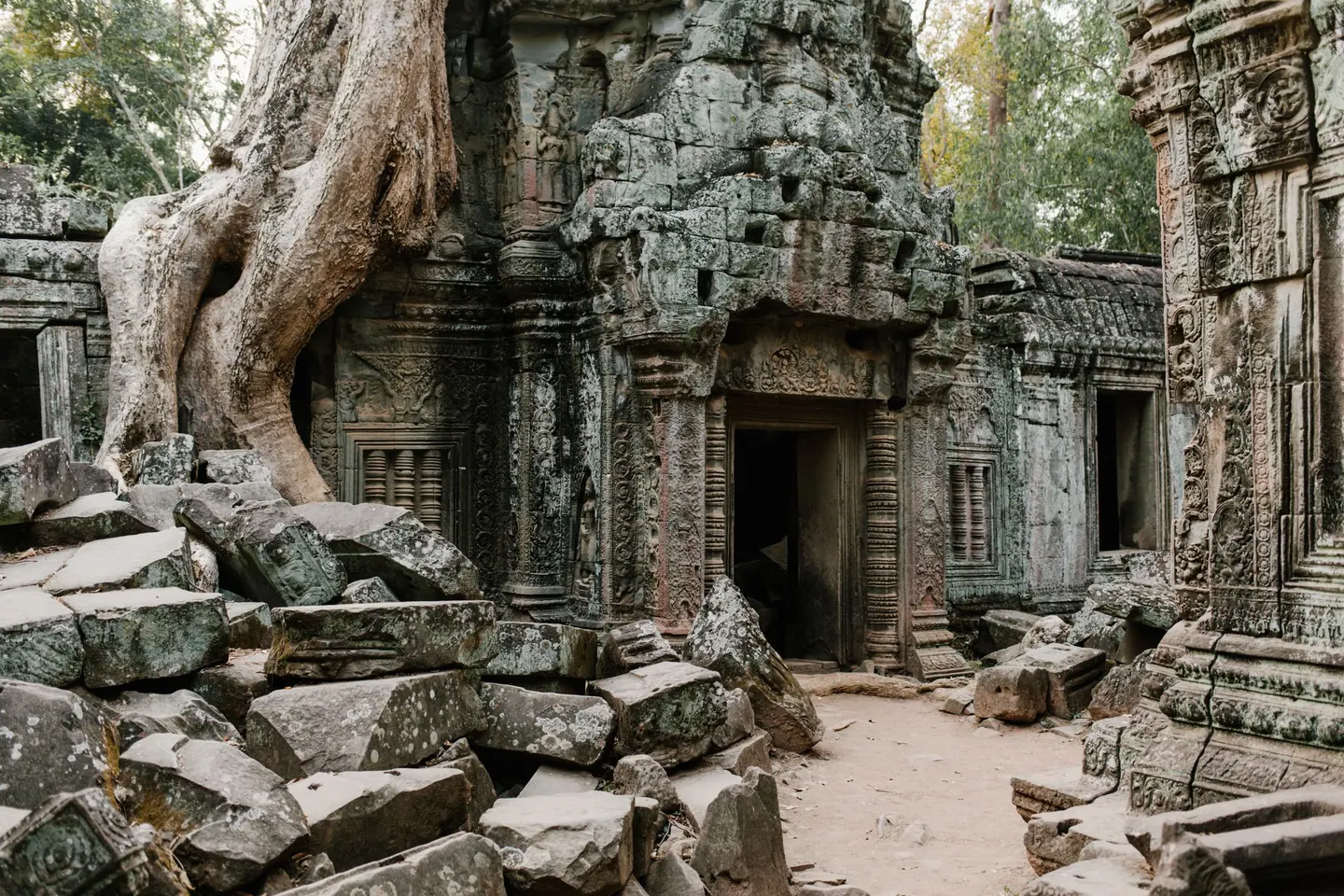
Founded in 1186 as the Rajavihara monastery to honour the mother of Jayavarman VII, this sprawling compound housed thousands of attendants and monks. The École française d'Extrême-Orient deliberately left the site in partial ruin, allowing immense silk-cotton and strangler fig trees to embrace the crumbling galleries. We encounter narrow stone corridors adorned with intricate devata carvings alongside dramatic natural root formations.
Banteay Kdei
Built in the Bayon style between the late twelfth and early thirteenth centuries, this extensive Buddhist complex features concentric enclosure walls entered via colossal face towers. The site is constructed largely of softer sandstone and porous laterite, resulting in weathered pillars and evocative, partially collapsed chambers. Excavations here in 2001 revealed a cache of hundreds of buried Buddha statues.
Srah Srang
Originally dug in the tenth century and later redesigned by Jayavarman VII, this vast rectangular reservoir measures 700 by 350 metres. A sandstone terrace on the western shoreline features guardian lion sculptures and balustrades shaped like mythical serpents, serving as a royal boarding dock. Visitors frequently gather here at daybreak to watch the sky reflect across the still surface.
Prasat Kravan
Erected in 921 by high-ranking royal courtiers, this south-facing row of five brick towers displays a design rare in classical Khmer architecture. Unlike most regional monuments, the primary works of art are carved directly into the interior brickwork rather than stone lintels. The central sanctuary holds a large relief of Vishnu striding across the cosmic ocean alongside depictions of his consort Lakshmi.
Bat Chum
Commissioned in 953 by Kavindrarimathana, a Buddhist architect who served King Rajendravarman, these three ruined brick shrines stand atop a single laterite platform. Inscriptions discovered on the door jambs celebrate Buddhist teachings alongside traditional praise of the sovereign, a notable deviation from prevailing Shaivite royal cults. Travellers can examine decorative lintels and quiet, seldom-visited enclosures situated south of the royal reservoir.
East Mebon
Built during the reign of King Rajendravarman, this three-tiered temple mountain originally rose on an artificial island within the vast East Baray reservoir. The corners of the first two terraces are guarded by remarkably preserved, life-sized stone elephants sculpted from single blocks of sandstone. Its central brick towers retain fine stucco decorations and decorative false doors honouring the Hindu god Shiva.
Pre Rup
Dedicated in 961, this imposing pyramid temple served as the royal state shrine and marked the shift of the capital back to Angkor from Koh Ker. The upper terrace supports five brick sanctuaries adorned with intricate lintels depicting Indra on Airavata and Narasimha slaying demons. Local folklore historically associated the eastern stone cistern with funerary cremation rituals, giving the monument its modern name.
Prasat Bei
Constructed in the early tenth century by King Yasovarman I, this linear arrangement of three brick shrines sits on a shared laterite base facing east. The central tower houses a carved sandstone lintel illustrating Indra mounted on his three-headed elephant, Airavata, surrounded by delicate foliate scrollwork. The northern and southern towers were left incomplete, offering useful architectural insights into the stages of classical brick construction.
Baksei Chamkrong
Founded in the tenth century by Harshavarman I and finished by Rajendravarman, this compact temple mountain is constructed with four receding tiers of rough laterite blocks. A single brick tower crowns the summit, entered via a well-preserved doorway with inscriptions detailing the mythical genealogy of the early Khmer kings. The monument is one of the earliest regional examples of utilizing stone stairs with steep, decorative risers.
Ta Prohm Kel
Situated northwest of Angkor Wat, this small sandstone tower is one of 102 medical chapels erected across the Khmer empire during the late twelfth century. Although missing its original northern wall, the shrine retains fine carvings of the Medicine Buddha alongside protective devatas and lotus-patterned base mouldings. An adjoining laterite library provided storage for medicinal texts and sacred ritual items.
Angkor Thom Victory Gate
This massive stone gateway marks the eastern termination of the royal avenue leading directly from the Royal Palace and the Terrace of the Elephants. It features four towering faces of the compassionate bodhisattva gazing towards the cardinal directions, flanked by three-headed stone elephants pulling lotus stems. An approach bridge is lined with rows of stone devas and asuras clasping the body of Vasuki.
Preah Khan
Dedicated in 1191, this immense fortified temple complex functioned as both a Buddhist university and a royal residence while Angkor Thom was under construction. Visitors navigate cruciform corridors lined with carved garudas, open cruciform sanctuaries, and a unique two-storey pavilion resting on rounded Greek-style columns. Restorations by the World Monuments Fund have preserved its delicate balance between fallen masonry and jungle canopy.
Neak Pean
Constructed on an artificial island in the now-restored Jayatataka reservoir, this unique sanctuary was designed as a physical representation of the mythical Himalayan lake Anavatapta. The central circular pond contains a sandstone shrine wrapped by the coils of two nagas, connected by stone spouts to four perimeter basins representing the elements. Pilgrims originally bathed here to seek healing and spiritual purification from consecrated waters.
Ta Som
Built at the end of the twelfth century, this enclosed monastic temple exhibits classic Bayon-period features including decorative face towers and low relief devatas. Its most celebrated feature is the eastern outer gate, where the massive root system of a sacred fig tree completely encases the carved sandstone faces without causing their collapse. The interior retains well-preserved pediments portraying Lokeshvara standing on open lotuses.
Banteay Samre
Named after the indigenous Samre people of the Phnom Kulen foothills, this citadel-like Hindu temple was constructed in the style of Angkor Wat during the twelfth century. The monument was comprehensively restored using the anastylosis method, resulting in pristine condition across its raised interior causeways, central tower, and surrounding gallery windows with stone balusters. Detailed pediments depict scenes from the churning of the ocean of milk.
Grand Circuit, Preah Khan, Neak Pean & Banteay Srei
Preah Khan Sacred Sword Monastery, Neak Pean Island Sanctuary, Ta Som Eastern Gate Strangler Fig, East Mebon Stone Elephants, Pre Rup Sunset Pyramid, Banteay Samré, Banteay Srei Pink Sandstone Citadel of Women, and Kbal Spean River of a Thousand Lingas
Preah Khan
Dedicated in 1191 to Jayavarman VII's father, this vast flat temple complex functioned as an administrative centre and Buddhist university. We find vaulted stone corridors choked with tree roots, exquisite carvings of dancing apsaras, and a rare two-storey pavilion featuring round columns that resemble classical Mediterranean architecture.
Preah Khan North Gate Causeway
Approaching Preah Khan from the north brings travellers across a stone bridge across the moat, illustrating the Churning of the Ocean of Milk. Mythological gods and demons hold the body of the serpent Vasuki, although many heads were looted or replaced by casts during conservation efforts.
Preah Khan Hall of Dancers
Located just east of the central sanctuary, this sandstone hall features lintels and pillars decorated with friezes of dancing apsaras. The roof has long collapsed, but the remaining wall sections preserve fine relief work depicting celestial nymphs stepping across lotus blooms under detailed pediments.
Preah Khan Two-Storey Pavilion
Standing in the eastern sector of Preah Khan, this mysterious two-storey edifice is supported by round, cylindrical columns reminiscent of Greco-Roman design rather than traditional Khmer masonry. Scholars debate whether it served as a granary, a sacred repository for holy texts, or an aristocratic lodge.
Neak Pean
Engineered as an artificial island in the centre of the Jayatataka baray, Neak Pean represents Lake Anavatapta, a sacred Himalayan lake whose waters cure all diseases. Four peripheral ponds surround a central square pool, connected by ornate water spouts shaped like an elephant, lion, horse, and bull.
Jayatataka Baray
Excavated during the late twelfth century, this rectangular reservoir measured roughly three and a half kilometres long by nine hundred metres wide. Having held water again in recent decades thanks to restoration work, a wooden footbridge carries visitors across dead tree trunks standing eerily within the flooded landscape.
Banteay Prei
Commissioned by Jayavarman VII, this small moated temple shares stylistic similarities with neighbouring Preah Khan on a much reduced scale. The central sandstone sanctuary and surrounding galleried enclosure feature intricate carvings of devatas, false doors, and Buddhist reliefs that survived the Hindu iconoclasm of the thirteenth century.
Prasat Prei
Situated adjacent to Banteay Prei, this modest late twelfth-century ruin consists of a single tower mounted on a tall platform alongside a ruined library. Although damaged by weathering and vegetation, its lintels showcase delicate carvings of mythological lions and scenes from Buddhist lore.
Krol Ko
Constructed in the late twelfth century, Krol Ko is enclosed by a laterite wall and features a central tower facing east. Visitors can inspect pediments depicting the Bodhisattva Avalokiteshvara standing on a lotus, flanked by devotees, which escaped the systematic desecration that affected larger royal monuments.
Ta Som
Built during the reign of Jayavarman VII, Ta Som is a compact Buddhist temple oriented towards the east. The complex features outer gopuras topped with the benevolent four-faced portraits of the king or Lokeshvara, set amid laterite walls and decorated with carvings of graceful female guardians.
Ta Som Eastern Gopura
The eastern gateway of Ta Som provides one of Angkor's best-known sights where nature and masonry collide. A massive strangler fig has completely swallowed the carved sandstone face tower, its roots cascading over the doorway like melted wax, framing the entrance corridor used by visitors leaving the temple grounds.
East Mebon
Consecrated in 953 by King Rajendravarman, this temple mountain originally stood on an island in the middle of the East Baray, requiring visitors to arrive by boat. Its three tiers feature five upper brick towers and exceptional stucco relief holes where plaster once adhered to stone surfaces.
East Mebon Stone Elephants
At the corners of the first and second tiers of the East Mebon stand life-sized stone elephants sculpted from single blocks of sandstone. These guardian statues retain fine harness decorations and ears, having survived centuries of tropical weathering far better than the adjacent brick towers.
Pre Rup
Built by King Rajendravarman in 961, Pre Rup is a pyramid-like structure of laterite and warm reddish brick rising through three stepped terraces. Dedicated to Shiva, the monument is traditionally associated with funerary rituals in local folklore due to a large stone cistern once thought to be an incinerator.
Banteay Samré
Named after the ancient Samré people who lived at the base of Phnom Kulen, this early twelfth-century Hindu temple is renowned for its defensive high walls and meticulous restorations. The central tower features well-preserved narrative bas-reliefs illustrating episodes from the Ramayana alongside scenes of Vishnu and Krishna.
Banteay Srei
Consecrated in 967, this miniature temple was built not by a king but by two royal courtiers, including the scholar Yajnavaraha. The pinkish sandstone allowed craftsmen to carve filigree details with three-dimensional depth, resulting in depictions of Hindu deities, dvarapalas, and floral motifs unmatched in Southeast Asia.
Banteay Srei Mandapa and Sanctuaries
The inner enclosure holds three miniature sanctuary towers flanked by two libraries, oriented towards the east. Travellers should observe the pediments displaying deep reliefs of Shiva dancing, Ravana shaking Mount Kailash, and Indra astride Airavata, framed by mythological sea monsters known as makaras.
Kbal Spean
Carved into the sandstone riverbed and banks of the Stung Kbal Spean, this eleventh-century archaeological site features hundreds of phallic lingas and carved yonic bases. The sacred water flowing over the carvings was believed to be spiritually purified before irrigating the agricultural fields across the plains of Angkor.
Kbal Spean Waterfall and Rock Reliefs
A forest trail through the Kulen hills terminates at this scenic rock face where water cascades down natural steps. Boulders along the falls display carved tableaus of Vishnu reclining on the serpent Ananta, accompanied by Lakshmi at his feet and Brahma emerging upon a sacred lotus flower.
Prasat Lek Bei
Positioned just outside the main enclosure of Pre Rup, these auxiliary towers illustrate the transition from brick to stone architecture in the tenth century. We find stone lintels perched above brick door frames, with carvings depicting Indra riding three-headed Airavata and guardian lions flanking the base.
Roluos Group, Beng Mealea, Siem Reap Town & Tonlé Sap
Bakong (881 AD), Preah Ko, Lolei, Beng Mealea Jungle Temple, Angkor National Museum, Royal Independence Gardens, Preah Ang Chek Preah Ang Chom, Wat Bo Frescoes, Artisans Angkor, Old Market Psar Chaa, and Kampong Phluk Stilt Village Tonlé Sap
Bakong
Dedicated in 881 AD under King Indravarman I, this stepped pyramid represents Mount Meru as the central state sanctuary of Hariharalaya. Five sandstone tiers ascend towards a restored central tower, surrounded by a broad moat and stone elephant sentinels. Visitors can examine the surviving eighth-century brick satellite sanctuaries and remnants of delicate base-relief carvings.
Preah Ko
Built in 879 AD by King Indravarman I, Preah Ko was the first temple erected at Hariharalaya. Six brick towers stand arranged in two rows upon a low platform, guarded by carved statues of Nandi, the sacred bull of Shiva. The temple preserves ornate lintels and plaster bas-reliefs showing miniature warriors mounted on mythical beasts.
Lolei
King Yasovarman I consecrated this island sanctuary in 893 AD to honour his parents and ancestors. Originally surrounded by the waters of the vast Indratataka baray, the four brick towers feature sandstone false doors and detailed Sanskrit inscriptions. An active Theravada monastery stands directly beside the ancient structures, displaying colourful modern murals.
Beng Mealea
Constructed in the early twelfth century by Suryavarman II, this temple shares a floor plan remarkably similar to Angkor Wat. Vast sandstone galleries, collapsed lintels, and moss-covered courtyards remain largely unrestored amidst dense forest. Elevated wooden walkways permit safe navigation across tumbled masonry blocks and roots that split the ancient walls.
Angkor National Museum
Opened in 2007, this spacious museum houses thousands of religious and royal artefacts recovered from the Angkor Archaeological Park. The galleries trace the chronology of the Khmer civilisation from pre-Angkorian times through the height of the empire. Key displays include the Gallery of 1,000 Buddhas and intricately carved sandstone lintels from Banteay Srei.
Preah Ang Chek Preah Ang Chom
Located near the Royal Residence, this small shrine holds two bronze standing Buddha figures believed to date to the sixteenth century. Local residents regard the statues as protective guardian deities of Siem Reap, visiting daily to offer lotus flowers and incense. The shrine serves as a central gathering place for domestic pilgrims seeking blessings.
Royal Gardens, Siem Reap
Situated on the banks of the Siem Reap River, these landscaped grounds feature ornamental fountains and shaded pedestrian paths. The canopies of the towering dipterocarp trees are famous for harbouring a large permanent colony of fruit bats. The park stands directly opposite the historic colonial-era Grand Hotel d'Angkor and the King's northern residence.
Wat Bo
Founded in the eighteenth century, Wat Bo is one of the oldest operating Buddhist pagodas in Siem Reap. The main sanctuary preserves intricate nineteenth-century frescoes illustrating the Reamker, the Cambodian version of the Ramayana epic. The paintings offer rare visual records of colonial-era everyday life, including French soldiers and Chinese merchants.
Artisans Angkor
Established in the late 1990s, this vocational training centre revitalises traditional Khmer arts such as stone carving, wood sculpting, and silk painting. Visitors observe artisans working with chisels and polishing blocks to recreate historic motifs found at Angkor Wat. The adjacent showroom displays fine silk garments, lacquered objects, and silver-plated copper figures.
Psar Chaa
Rebuilt after the Khmer Rouge era, the Old Market represents the commercial core of downtown Siem Reap. Dense rows of stalls supply local residents with spices, dried fish, fresh produce, and household goods. The outer perimeter provides travellers with handwoven textiles, silver jewellery, and street food stalls serving traditional noodle soups.
Kampong Phluk
Located on the floodplains of the Tonle Sap lake, this settlement features wooden houses constructed on stilts up to ten metres high. The village adapts seasonally to dramatic water level fluctuations driven by the monsoon Mekong river reversal. Small wooden boats ferry visitors past floating schools and through a submerged mangrove forest.
Chong Kneas
This floating settlement shifts location across the bay according to seasonal water levels of the Tonle Sap lake. Entire civic facilities, including clinics, schools, boat workshops, and fish-raising pens, float on tied bamboo platforms and metal barrels. The site offers an authentic glimpse into how fishing families adapt to the largest freshwater lake in Southeast Asia.
Prek Toal Bird Sanctuary
Situated within the Tonle Sap Biosphere Reserve, Prek Toal is the premier breeding ground for endangered large waterbirds in the region. The seasonally flooded swamp forest supports substantial colonies of spot-billed pelicans, greater adjutants, and black-headed ibis. Traditional wooden longboats access elevated observation platforms positioned along the waterway margins.
Wat Damnak
King Sisowath utilized this site as a royal palace residence before it transformed into a monastic compound in the early twentieth century. Today, the peaceful garden grounds house the Centre for Khmer Studies, which maintains an extensive public research library on Cambodian history. The main vihara displays carved lintels and contemporary religious statues.
Cambodia Landmine Museum
Founded by former child soldier Aki Ra, this museum chronicles the history of decades of conflict and unexploded ordnance throughout Cambodia. The facility educates visitors on demining techniques through displays of deactivated landmines, mortars, and military ordnance. A relief facility on site provides schooling and medical care for children impacted by landmine explosions.
Phare, The Cambodian Circus
Run by graduates of the Phare Ponleu Selpak arts school in Battambang, this performance tent hosts regular circus and theatrical productions. The shows weave traditional folk tales, recent history, and social commentary through acrobatics, juggling, and live Khmer music. The institution provides professional training and sustainable livelihoods for vulnerable Cambodian youths.
Wat Kesoraram
Positioned off the central highway, this functioning monastery offers a quiet garden setting amidst Siem Reap town. The tall central vihara features detailed interior wall paintings illustrating the Jataka tales and the stages of the Buddha's enlightenment. Monks reside in raised wooden dormitories across the peaceful paved courtyard.
Wat Preah Prom Rath
Dating to the early twentieth century, this central temple occupies a commanding position along the Siem Reap River. The compound features vivid outdoor sculptures depicting Buddhist legends, including a distinctive stone ship bearing monk Ta Prom. Inside the main vihara rests a large reclining Buddha statue flanked by modern decorative murals.
Chau Srei Vibol
Built during the eleventh century, this secluded complex rests atop an isolated hill northeast of Hariharalaya. An earthen rampart and wide moat enclose several ruined laterite towers, sandstone gopuras, and a dilapidated gallery overgrown by forest. A functioning modern Buddhist pagoda shares the hill summit, offering sweeping views across the surrounding paddy fields.
Trapeang Phong
Constructed in the late ninth century during the reign of Jayavarman III, Trapeang Phong remains a remote member of the Roluos complex. The single square brick tower features finely detailed devata figures and doorframes carved from grey sandstone. It offers valuable structural insight into the developmental transition between the pre-Angkorian style and the classic Angkor period.
Sunrise Orientations and Circuit Loops at Angkor
For neighbourhood accommodation notes, seasonal weather tables and airport transfer details, consult our Siem Reap & Angkor destination guide, or browse other city and regional walking routes across the atlas.