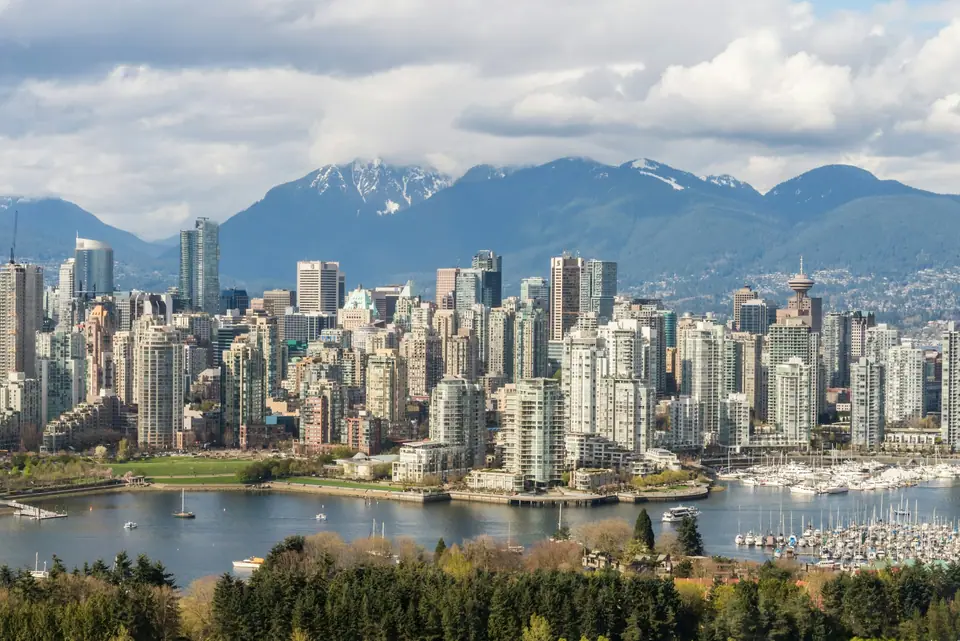
A detailed coastal and forest route between Burrard Inlet, English Bay, and the North Shore mountains, covering Stanley Park, Victorian Gastown, False Creek, and UBC.
Coast Salish Cedar Shores, Sawmill Towns and the Pacific Terminus
For thousands of years the unceded traditional territories of the xʷməθkʷəy̓əm (Musqueam), Sḵwx̱wú7mesh (Squamish), and səlilwətaɬ (Tsleil-Waututh) Coast Salish Nations encompassed the old-growth cedar forests, salmon streams, and inlets around Burrard Inlet and False Creek, including the major village of X̱wáyx̱way at Lumbermen's Arch. European lumber mills opened at Moodyville and Hastings Mill in the 1860s, spawning the waterfront settlement of Granville (Gastown).
Selected in 1885 as the western terminus of the Canadian Pacific Railway and incorporated as Vancouver in 1886, the city dedicated the thousand-acre peninsula of Stanley Park in 1888 and built the world's longest uninterrupted waterfront pathway along its seawall.
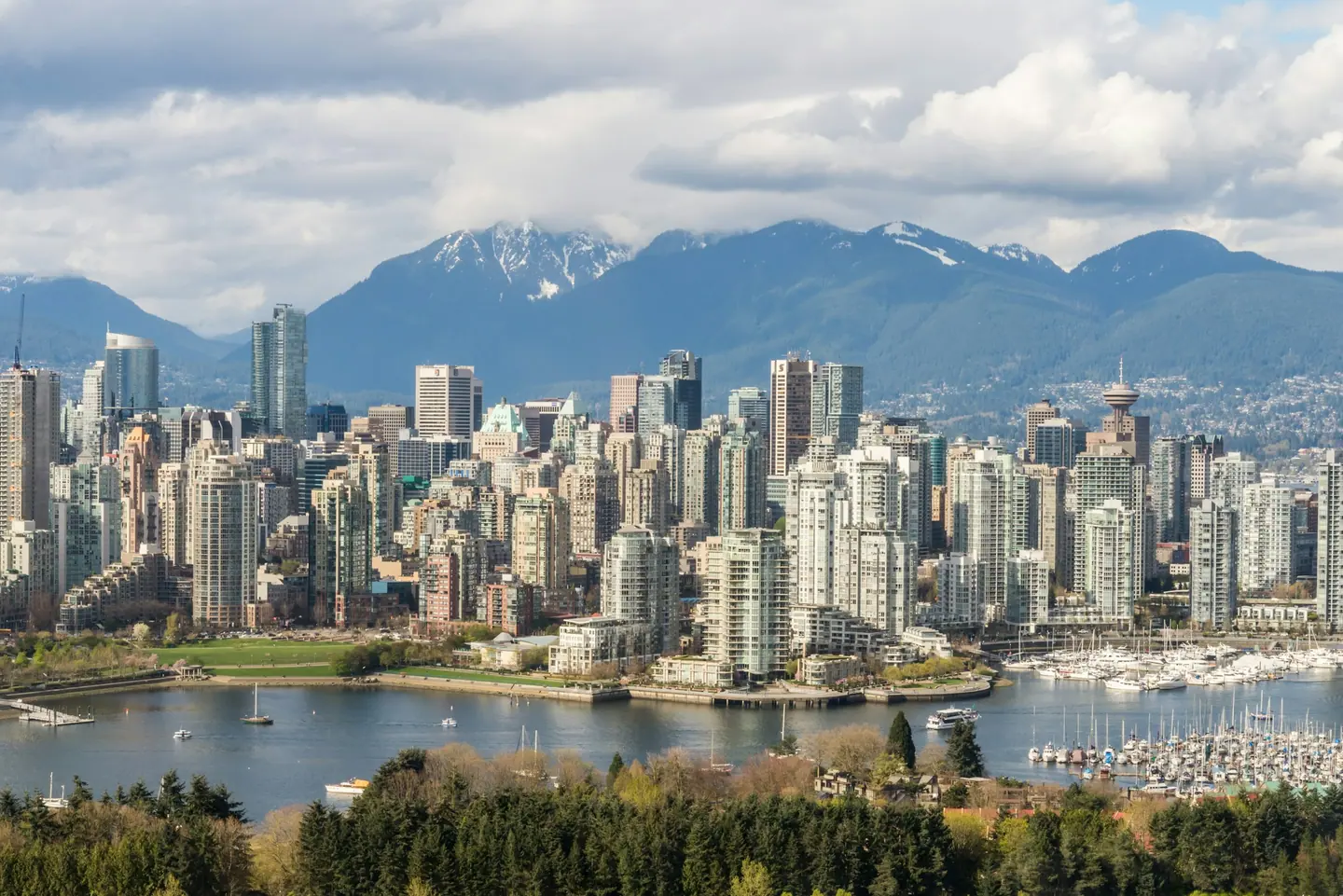
Canada Place, Waterfront, Gastown & Chinatown
Canada Place Sails, Marine Building Art Deco Lobby, Harbour Centre Lookout, Gastown Steam Clock, Maple Tree Square Gassy Jack, Hotel Europe Flatiron, Sun Tower, Dr Sun Yat-Sen Classical Chinese Garden, and Sam Kee Building
Canada Place
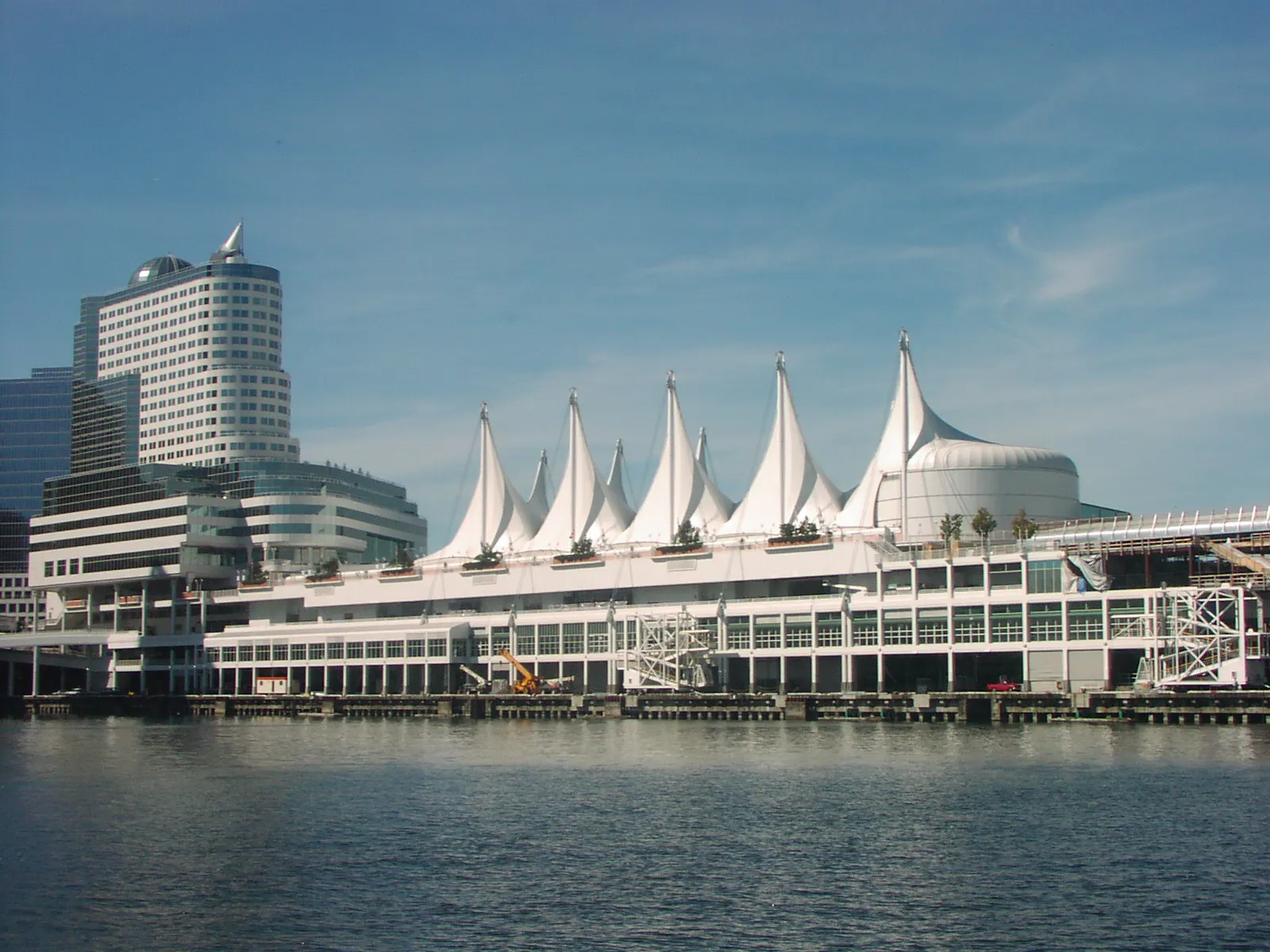
Constructed as the Canada Pavilion for the Expo 86 world fair, this prominent waterfront complex resembles a giant sailing vessel. Five Teflon-coated fibreglass fabric sails dominate the harbour skyline, serving as both a cruise ship terminal and a convention facility. Visitors can stroll along the Canadian Trail promenade to inspect regional plaques while watching seaplanes land across Burrard Inlet.
Marine Building
Opened in 1930, this twenty-two-storey skyscraper was designed by McCarter and Nairne to resemble a great marine rock rising from the sea. The exterior displays terra-cotta reliefs depicting sea creatures, ships, and airships of the era. Inside the grand lobby, we find intricate plaster mouldings, inlaid hardwood floors, and brass elevator doors featuring relief carvings of sea flora.
Harbour Centre
Completed in 1977, this prominent downtown office tower rises twenty-eight storeys, terminating in a flying-saucer-shaped observation deck known as the Vancouver Lookout. External glass-fronted lifts transport visitors rapidly to the top viewing level. The elevated platform offers unobstructed panoramic views encompassing the North Shore mountains, the active port terminals, and the historic urban grid below.
Gastown Steam Clock
Erected in 1977 by horologist Raymond Saunders, this clock stands at the corner of Camborne and Water Streets. Although built with an antique Victorian aesthetic, it was funded by local merchants to celebrate the heritage restoration of the district. The mechanism harnesses steam from the city's central heating network to power internal weights and sound miniature whistles every quarter hour.
Maple Tree Square
This cobbled junction marks the original settlement of Granville, where saloonkeeper John Deighton set up business beneath a maple tree in 1867. Surrounding brick facades date from the post-fire rebuilding programme of the late nineteenth century. The open plaza links five historic street alignments, providing an informative focal point for examining the early commercial foundations of the city.
Hotel Europe
Designed by Parr and Fee and built between 1908 and 1909, this triangular structure was among the earliest reinforced concrete buildings erected in Canada. Commissioned by Italian entrepreneur Angelo Calori, it operated as a luxury hotel serving travellers arriving by sea and rail. The narrow flatiron facade features rounded corner bays, original leaded glass, and cast-iron supporting pillars.
Sun Tower
Completed in 1912 for the Vancouver World newspaper, this seventeen-storey Beaux-Arts tower was briefly the tallest commercial building in the British Empire. Architect William Tuff Whiteway incorporated nine nine-foot-tall terracotta caryatids sculpted by Charles Marega to support the cornices. A distinctive green-painted faux-copper dome crowns the building, serving as a prominent orienting feature across the surrounding district.
Dr. Sun Yat-Sen Classical Chinese Garden
Constructed in 1985 by fifty-two craftsmen from Suzhou, this walled retreat represents the first full-scale classical Chinese garden built outside China. The design applies principles of Taoist harmony, balancing asymmetric limestone rocks, tranquil jade-green water, covered walkways, and native plantings. Hand-carved lattice windows and clay-tiled courtyards reflect classical architectural traditions from the Ming Dynasty period.
Sam Kee Building
Recognised by the Guinness Book of Records, this remarkably slender property measures just under five feet wide on the ground floor. Commissioned in 1913 by merchant Chang Toy after the city expropriated the rest of his lot, architects Brown and Gillam maximised space using bay windows and a basement extending under the pavement. The structure remains an enduring symbol of immigrant resilience.
Chinese Cultural Centre
Established in 1973 and expanded in the 1980s, this community complex preserves and exhibits historical artefacts reflecting the early Chinese diaspora in British Columbia. Traditional architectural motifs, such as flared eaves and central courtyards, blend with modern exhibition halls. The site hosts historical displays, language classes, and cultural records detailing the lives of pioneering railway and industrial labourers.
Chinatown Millennium Gate
Erected in 2002 at Pender and Taylor Streets, this ornate four-pillar ceremonial archway welcomes visitors into historic Chinatown. The structure merges traditional Qing Dynasty imperial palace aesthetics with modern engineering, featuring intricate hand-painted eaves, relief dragons, and glazed ceramic tiles. Bilingual inscriptions adorn the arch, celebrating cultural heritage while acknowledging the contributions of early settlers.
Chinese Canadian Museum
Housed within the Wing Sang Building, Chinatown's oldest existing structure built in 1889, this museum documents the Chinese immigrant journey across Canada. Restored spaces feature Victorian brickwork, an original schoolroom, and period domestic rooms preserved behind modern display galleries. Exhibitions highlight personal stories, early immigration legislation, and the commercial history of Pender Street.
Dominion Building
Facing Victory Square, this thirteen-storey steel-frame structure was the British Empire's tallest commercial building upon its completion in 1910. Architect John S. Helyer utilised Classical Revival ornamentation, including red brick facades, terra-cotta detailing, and a distinctive mansard roof. The building's central light court, circular stairwells, and bronze post-box chute remain intact and operational.
Victory Square
Originally the grounds of Vancouver's first provincial courthouse, this sloped triangular urban park was rededicated as a memorial space in the 1920s. At its heart stands a granite cenotaph unveiled in 1924, inscribed with the words 'Their Name Liveth For Evermore'. Stone steps, heritage lampposts, and mature shade trees border the open lawn, where civic remembrance ceremonies occur annually.
Sinclair Centre
Restored in the 1980s by Henriquez Partners Architects, this complex unites four civic structures under a central glass atrium. The ensemble includes the 1910 Post Office, the 1913 Winch Building, the 1937 Customs Examining Warehouse, and the Federal Building. Visitors can view limestone facades, the ornate main clock tower, and classical columns from the indoor central galleria.
Waterfront Station
Constructed in 1914 as the western Pacific terminus for the Canadian Pacific Railway, this imposing Neoclassical structure features red-brick exterior walls framed by massive Ionic limestone columns. The grand concourse boasts high coffered ceilings and panoramic plaster relief landscape murals depicting British Columbia scenery. Today, it operates as the city's primary intermodal transit hub.
Portside Park
Created following community advocacy during the 1980s, this waterfront park provides public shoreline access directly adjacent to the historic core. Paved pathways, open lawns, and a commemorative monument dedicated to local community members define the grounds. Visitors gain close views of shipping cranes, container vessels, and tugboats navigating the busy waters of Burrard Inlet.
Alhambra Building
Erected in 1887 directly after the Great Vancouver Fire, this building is one of the oldest standing brick structures in the municipality. Designed in the Italianate style, it features cast-iron ground-level storefronts, arched sash windows, and decorative cornice brackets. The building anchored the commercial expansion of Gastown as sea merchants and shipping offices moved ashore.
Vancouver City Institute Building
Located along the southern approach to Chinatown, this heritage property reflects early twentieth-century academic and civic development. Brick masonry and stone window surrounds illustrate the transition from Victorian to Edwardian architectural taste. Today, the surrounding streetscape presents a functional look into the administrative corridor that historically connected Gastown's commercial docks with inner-city neighbourhoods.
Ormidale Block
Built in 1900 on Water Street, this four-storey structure showcases the sturdy Romanesque Revival brickwork typical of the post-fire commercial building phase. Heavy rusticated stone lintels, arched upper windows, and decorative brick corbelling emphasise its industrial durability. Originally used for warehousing and retail, the premises now house design offices and street-level storefronts along the cobbled corridor.
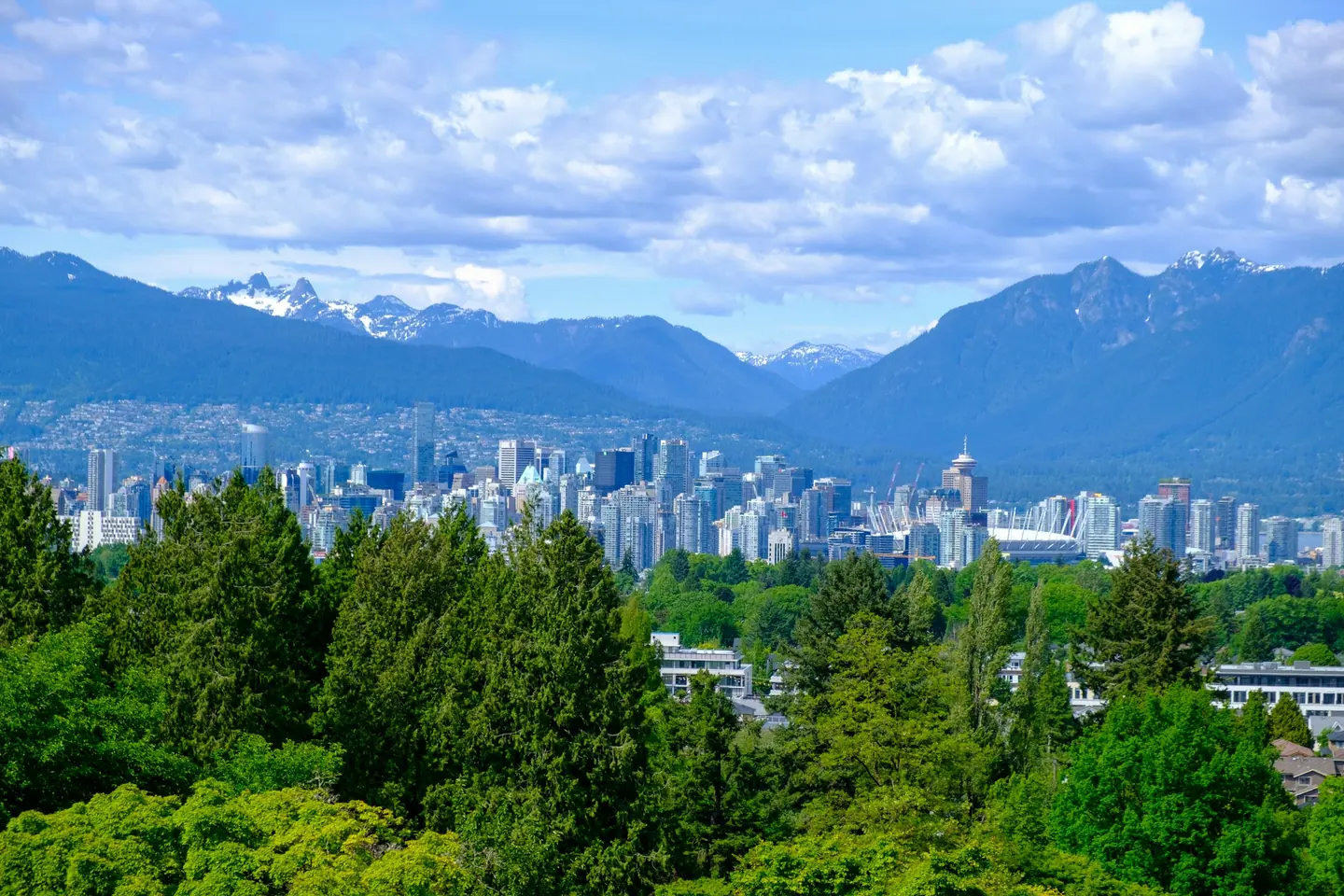
Complete Circuit of Stanley Park & Coal Harbour
Coal Harbour Seawall, Brockton Point Totem Poles, Brockton Point Lighthouse, Girl in a Wetsuit Statue, Prospect Point, Lions Gate Bridge Viewpoint, Siwash Rock, Third Beach, Lost Lagoon, and Rose Garden Stanley Park
Coal Harbour Seawall
Paved pathways trace the working waterfront from Canada Place towards the forest entrance. Walkers observe seaplane terminals, modern marinas, and panoramic vistas of the North Shore mountains across Burrard Inlet. Interpretive plaques describe the former shipyard industry that once occupied the shoreline.
Brockton Point Totem Poles
Installed throughout the mid twentieth century, these wooden monuments honour Indigenous artistry from British Columbia coastal nations. Carvers including Robert Yelton and Ellen Neel contributed monumental poles featuring ravens, eagles, and thunderbirds. Informative panels offer cultural context on potlatch traditions and heritage preservation.
Brockton Point Lighthouse
Constructed in 1914, this square concrete lighthouse stands on arched supports above the lower pedestrian seawall. Architect William P. Anderson designed the beacon to guide commercial shipping vessels through the First Narrows. Visitors frequently pause beneath the white and red tower to watch freighters navigate into port.
Girl in a Wetsuit Statue
Sculptor Elek Imredy placed this bronze figure on a granite boulder off the northern shoreline in 1972. Wearing a diving mask, snorkel, and fins, the modern figure represents the region's connection to recreational scuba diving. Observers can view the sculpture easily from the paved seawall path at high tide.
Prospect Point
Perched at the highest northern crest of the peninsula, this scenic lookout surveys the entrance to Burrard Inlet. In 1888 the SS Beaver ran aground on the rocks directly below the precipice, marking a notable maritime event. The surrounding terrace provides an elevated outlook towards West Vancouver and shipping channels.
Lions Gate Bridge Viewpoint
Completed in 1938 by the Guinness brewing family, the suspension bridge spans the First Narrows to connect the city with North Vancouver. Looking upwards from this viewing area, travellers admire the massive steel towers and structural art deco details. Pairs of sculpted stone lions guard the bridge approach along the highway.
Siwash Rock
Rising fifteen metres above the saltwater, this basalt pinnacle formed through volcanic dyke activity millions of years ago. Squamish oral history identifies the sea stack as a monument to an unselfish father transformed to stone for his purity. A solitary Douglas fir tree persistently grows from the rock summit.
Third Beach
Tucked away in Ferguson Point, this westward beach provides open views across the Strait of Georgia. Dense forest canopies of cedar and hemlock slope directly down to the sand, shielding the shoreline from traffic noise. The location is an established gathering spot for viewing maritime sunsets.
Lost Lagoon
Originally an intertidal mudflat, the basin was enclosed in 1916 during the construction of the causeway bridge. Poet Pauline Johnson gave the body of water its name because the tide would make water disappear at low level. Today, paths circle the perimeter, where mute swans, herons, and ducks nest in reed beds.
Stanley Park Rose Garden
The Kiwanis Club established this landscaped garden in 1920 to display hundreds of rose cultivars along with perennial borders. Geometric flowerbeds and wooden pergolas create a traditional English garden layout beside the main pavilion. Walking through the grounds reveals seasonal floral variations, arbor structures, and quiet seating benches.
Nine O'Clock Gun
Cast in 1816 in Woolwich, England, this twelve-pound naval cannon was brought to the point in 1894 to assist mariners in calibrating chronometers. Housed within a protective iron cage structure, it still automatically fires every evening at nine o'clock. The loud blast resonates clearly across Coal Harbour and the downtown shore.
Empress of Japan Figurehead
This ornate dragon figurehead commemorates the RMS Empress of Japan, a transpacific steamship that serviced the port around the turn of the twentieth century. The original wooden sculpture was preserved in the park for decades before being transferred to a museum. The replica now gazes over Burrard Inlet from a plinth near the seawall.
Vancouver Rowing Club
Founded in 1886, this athletic institution moved into its two-storey shingled clubhouse in 1911. Built on wooden pilings over the water at the park threshold, the building features traditional craftsman carpentry. The club continues to train rowers and rugby players while functioning as an architectural landmark along the inlet.
Hallelujah Point
This peaceful promontory earned its name from the Salvation Army, who held outdoor musical services here in the late nineteenth century. The open lawn offers unobstructed photographic views across the harbour toward the modern high-rises of downtown Vancouver. Visitors often stop here while walking or cycling from the main park gates.
Lord Stanley Statue
Created by Sydney March and unveiled in 1960, this bronze monument portrays Frederick Stanley, the Governor General of Canada who dedicated the park in 1889. The figure stands with arms outstretched, recreating his famous dedication of the grounds to the use of people of all colours, creeds, and customs. It sits near the park entrance driveway.
Hollow Tree
This centuries-old western red cedar stump boasts a circumference of roughly eighteen metres and once hosted historical automobile photo sessions inside its cavity. Following storm damage, community campaigns engineered an interior metal framework to preserve the hollow trunk. It serves as an impressive physical specimen of old-growth coastal rainforest flora.
Second Beach
Overlooking English Bay, this coastal area features soft sands and a large heated outdoor saltwater pool built right on the shoreline. Broad lawns and picnic pavilions surround the beach, providing space for public leisure and recreation. The location links the western seawall path with pedestrian trails into the temperate rainforest.
Pauline Johnson Memorial
Dedicated in 1922 near Ferguson Point, this natural stone cairn marks the final resting place of Mohawk poet and storyteller E. Pauline Johnson (Tekahionwake). Johnson collected Coast Salish legends and celebrated local indigenous culture through her widely read publications. A small water fountain and bronze plaque complement the quiet woodland memorial.
Devonian Harbour Park
Established in the 1970s through a donation from the Devonian Group of Charitable Foundations, this green space connects downtown streets with Stanley Park. Gentle mounded lawns, weeping willows, and duck ponds lead walkers towards the harbour promenade. Public art sculptures and gravel pathways invite quiet strolls near the residential towers.
SS Beaver Display
This historic display honours the pioneering Hudson Bay Company paddle wheeler that ran aground beneath Prospect Point in July 1888. The vessel was the first steamship to navigate the Pacific Northwest waters, operating for over half a century. A salvage anchor and informational plinth describe the ship's colourful career and eventual wreck.
Downtown Art Gallery, West End & English Bay Beaches
Vancouver Art Gallery Robson Square, Christ Church Cathedral Vancouver, Bill Reid Gallery of Northwest Coast Art, Vancouver Public Library Central Branch, Roedde House Museum, English Bay Beach A-maze-ing Laughter, and Sunset Beach
Vancouver Art Gallery
Housed within Francis Rattenbury's 1906 provincial courthouse, this civic institution holds an extensive collection of works by British Columbia painter Emily Carr. The building features grand granite Ionic columns and an ornate dome. We admire the interior rotunda alongside revolving modern and Indigenous art exhibitions.
Robson Square
Completed in the late 1970s, this complex integrates government law courts with terraced rooftop gardens, cascading waterfalls, and an outdoor public skating rink. Arthur Erickson's concrete design reshaped the heart of the city. Visitors can walk up the pioneering sloped 'stramp' staircases that seamlessly blend stairs with access ramps.
Christ Church Cathedral
Consecrated in 1895, this is the oldest surviving church building in downtown Vancouver. Constructed from local sandstone and Douglas fir, its interior evokes an inverted ship's hull with striking timber ceiling beams. Stained-glass windows illuminate stone memorials and an intricately carved Indigenous cedar reconciliation totem pole.
Bill Reid Gallery of Northwest Coast Art
Named after the acclaimed Haida master artist, this cultural space opened in 2008 to display Reid's intricate gold, silver, and argillite jewellery alongside monumental sculptures. The gallery presents changing regional First Nations exhibitions. A central highlight is the bronze casting of Reid's Mythic Messengers frieze.
Vancouver Public Library Central Branch
Designed by Moshe Safdie and opened in 1995, Library Square features a colonnaded nine-storey circular concrete wall enclosing a glazed pedestrian galleria. It houses millions of volumes alongside reading rooms and civic spaces. A landscaped rooftop garden offers quiet seating and views across the downtown core.
Roedde House Museum
Built in 1893 for the city's first bookbinder, Gustav Roedde, this heritage house displays late-Victorian domestic life. The wooden residence features a cupola, wrap-around porch, and period furnishings across several furnished rooms. It anchors Barclay Heritage Square, a preserved enclave of nine turn-of-the-century family houses.
A-maze-ing Laughter
Created by Beijing artist Yue Minjun for the 2009 Vancouver Biennale, this popular installation comprises fourteen monumental bronze figures depicting the artist in hysterics. Each statue stands over two and a half metres tall in various contorted laughing postures. The open layout encourages visitors to interact directly with the sculptures.
English Bay Beach
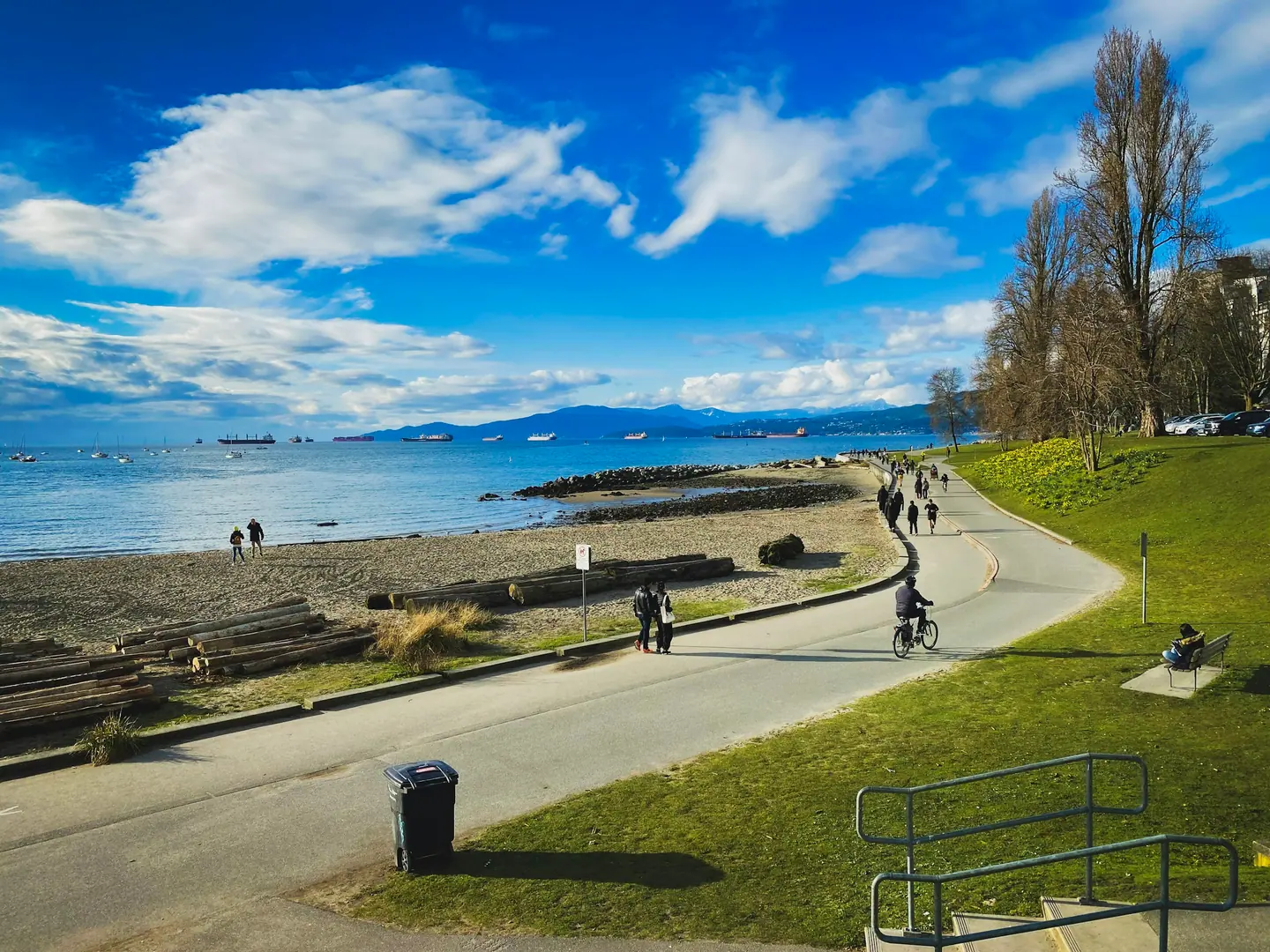
English Bay has drawn city residents for bathing since the late nineteenth century, led by pioneer swimming instructor Joe Fortes. Today, the curved sandy beach offers vistas over Burrard Inlet and the distant North Shore mountains. Palm trees, historic bathing pavilions, and the coastal seawall path line the shoreline.
Sunset Beach
Positioned just south of English Bay Beach, this sandy expanse features wide lawns, access to the False Creek Ferries dock, and walking paths. It is known as the location for the Vancouver Pride Parade festival grounds. We can watch watercraft navigate between Burrard Inlet and False Creek from its seawall.
Inukshuk
Crafted from grey granite slabs by Inuvialuit artist Alvin Kanak of Rankin Inlet, this traditional stone marker was built for Expo 86 before moving to English Bay. The commanding landmark served as the visual inspiration for the 2010 Winter Olympic emblem. It stands prominently against the ocean horizon at Sunset Beach Park.
Hotel Vancouver
Constructed in 1939 by the Canadian National Railway, this 111-metre tall building exemplifies Canadian grand railway hotel architecture. The exterior displays distinctive gargoyles, carved stone reliefs, and an oxidised turquoise copper roof. Step inside the polished lobby to inspect heritage wood paneling and historic photography from the royal visit of King George VI.
Marine Building
Opened in 1930 during the twilight of the grand Art Deco era, this skyscraper celebrates maritime trade and navigation. Terracotta bas-reliefs of steamships, sea creatures, and transport pioneers cover the exterior archway. The opulent lobby dazzles with brass ship clocks, inlaid hardwood floors, and elevator doors cast with bronze marine life.
Holy Rosary Cathedral
Dedicated in 1900, this parish church serves as the seat of the Roman Catholic Archdiocese of Vancouver. Its exterior features local sandstone walls and two unequal spires reaching up to 66 metres high. The nave boasts twenty-one stained-glass windows produced in France, alongside a massive 1900 pipe organ.
Barclay Heritage Square
This full city block was acquired by the City of Vancouver to conserve West End residential architecture built between 1890 and 1908. Gravel pathways lead past manicured gardens, mature shade trees, and wooden heritage houses. It provides a rare physical contrast between historic single-family dwellings and surrounding high-rise apartment towers.
Orpheum
Designed by Marcus Priteca in a lavish Spanish Renaissance style, the Orpheum was once Canada's largest theatre. Saved from demolition by citizen protests in the 1970s, it now serves as the permanent home of the Vancouver Symphony Orchestra. The interior features a domed ceiling fresco, crystal chandeliers, and a historic Wurlitzer pipe organ.
Commodore Ballroom
Opening its doors along Granville Street in 1930, this celebrated live music hall was patterned after British dance palaces. The hall is famous for its sprung dancefloor, which relies on tires and horsehair underlay to absorb movement. We note the venue's curved mezzanine balconies and historic role in hosting major musical acts.
Sun Tower
Originally constructed in 1912 as the headquarters for the World newspaper, this seventeen-storey building was briefly the tallest in the British Empire. The building is distinguished by nine pairs of terracotta caryatids sculpted by Charles Marega supporting the upper cornice. A painted dome sits proudly atop the terra-cotta clad brick facade.
Burrard Bridge
Opened in 1932 to connect downtown with the southern city neighbourhoods, this bridge features central steel overhead trusses framed by concrete pylons. The towers display carved stone nautical rosettes and bronze braziers honouring Canadian soldiers from the First World War. Dedicated pedestrian and cycle paths provide open perspectives over False Creek.
St. Andrew's-Wesley United Church
Erected in 1933 from quarried British Columbia stone, this downtown church blends traditional Gothic buttresses with solid regional materials. The lofty interior nave is illuminated by stained-glass installations designed by both Canadian and European master artisans. Deep timber arches support the vaulted roof above an expansive liturgical performance platform.
Engagement
Constructed by American artist Dennis Oppenheim, this outdoor installation consists of two nearly thirty-foot-tall steel and translucent glass engagement rings. Set into the grass near Sunset Beach, the illuminated crystalline diamonds rise vertically out of the sod. The work offers commentary on the dual private and public realities of traditional matrimonial bonds.
False Creek Ferries, Granville Island, Kitsilano & UBC
Granville Island Public Market, Net Loft, False Creek Seawall, Museum of Vancouver Vanier Park, Kitsilano Beach Pool, Jericho Beach, UBC Museum of Anthropology MOA, Nitobe Memorial Garden, and Queen Elizabeth Park Bloedel Conservatory
Granville Island Public Market
Established in 1979 as part of a major federal urban renewal scheme, this market repurposed corrugated sheet-metal factories into a civic food hall. Visitors can inspect stalls laden with local produce, artisanal cheeses, and fresh seafood from the Pacific coast. The exterior retention of industrial overhead cranes and timber beams recalls the island's early twentieth-century manufacturing heritage.
The Net Loft
Originally built to store and repair commercial fishing nets, the structure now houses independent craftspeople, printmakers, and textile studios. Its weathered timber framing and broad clerestory windows provide natural illumination suited to traditional bench crafts. We can observe traditional paper marbling, bespoke hat making, and indigenous jewellery fabrication within its preserved interior.
Granville Island Pet Hotel and Industrial Heritage Rails
Granville Island operated for decades as an industrial park serviced by the British Columbia Electric Railway and the Canadian Pacific Railway. Today, disused standard-gauge track embedded directly into the cobblestones traces the historical path of heavy freight wagons. Walking along the southern perimeter reveals original switch points, loading docks, and timber sheds preserved alongside contemporary workshops.
False Creek Seawall
Constructed to expand the city's pedestrian coastal network beyond Stanley Park, this pathway flanks both shores of the inlet. It offers dedicated bidirectional paths that separate foot travellers from cyclists while presenting unbroken sightlines of the skyline across the water. The route incorporates interpretive plaques, public artworks, and reconstructed salt marshes reflecting coastal remediation initiatives.
Burrard Street Bridge
Opened in 1932 to connect downtown Vancouver with the southern suburban tracts, this five-lane road bridge represents fine civic Art Deco design. Architect George Lister Thornton Sharp embellished the central steel trusses with stone-faced pylons, carved coats of arms, and bronze sea-themed decorative lamps. Look closely at the overhead concrete portals designed to conceal the utilitarian steel framework.
Museum of Vancouver
Founded in 1894, the city's primary history repository moved in 1968 to this Vanier Park facility designed by modernist architect Gerald Hamilton. The distinctive conical roof pays tribute to the woven cedar hats crafted by Coast Salish peoples. Inside, comprehensive galleries chart urban development, twentieth-century social movements, and early First Nations settlements through preserved domestic and industrial artefacts.
H.R. MacMillan Space Centre
Sharing Gerald Hamilton's 1968 civic complex, this institution features a large planetarium dome and the Gordon Southam Observatory. The facility houses astronomical instruments, interactive space flight simulators, and historic artifacts detailing Canadian contributions to rocketry. A substantial stainless steel crab sculpture by artist George Norris stands outside, greeting arrivals in the central reflecting pool.
Vancouver Maritime Museum
Located on the southern shore of English Bay, this museum preserves British Columbia's extensive seafaring narrative. Its central A-frame gallery was erected specifically around the historic RCMP vessel St. Roch, the first ship to traverse the Northwest Passage from west to east. Outside, visitors can examine a submerged research submersible and nineteenth-century steamship fittings.
Vanier Park Heritage Harbour
This small marina shelters an active fleet of historic vessels, including wooden tugs, private schooners, and retired fish packers. Established on the former site of industrial timber yards and Royal Canadian Air Force operations, the harbour provides moorings for the Maritime Museum's floating collection. Paved paths circle the docks, allowing visitors to inspect vintage timber joinery and traditional rigging.
Kitsilano Beach Pool
Opened in 1931 and later reconstructed, this 137-metre outdoor heated saltwater facility ranks among the longest swimming pools in North America. Positioned on the foreshore, it features three distinct swimming zones: a shallow beach-entry area, lap lanes, and deep recreational sections. Its broad concrete deck offers clear vantage points across the open bay towards the North Shore mountains.
Kitsilano Showboat
Erected in 1935 as an amateur community amphitheatre, this wooden stage mimics the prow of a passenger steamship. It was established during the Great Depression to offer free public entertainment and community gatherings along the beachfront. Rebuilt after a serious fire in 1954, it continues to host local dancers, choirs, and bands against a coastal marine backdrop.
Jericho Beach
Long before its conversion to public parkland in the 1970s, this site served as an ancestral village of the Musqueam people and later hosted a flying boat base operated by the Department of National Defence. Remaining concrete seaplane aprons and military ramps still edge the sand near the modern sailing centre. Broad grassy lawns and coastal scrub now support native shorebirds.
Jericho Arts Centre
Housed in a utilitarian military structure dating to the Second World War, this building formerly served as a drill hall and service facility for the flying boat station. It was adapted into a community performing arts space in the late twentieth century. Its functional wooden architecture and industrial interior roof framing present an engaging contrast to contemporary experimental stage sets.
Old Hastings Mill Store Museum
Constructed in 1868 on the south shore of Burrard Inlet, this modest timber structure is the oldest surviving colonial building in Vancouver. It famously survived the Great Vancouver Fire of 1886 before being transported by barge to Point Grey in 1930. Operated by the Native Daughters of British Columbia, it houses pioneer clothing, tools, and early civic trade documents.
Museum of Anthropology at UBC
Opened in 1976 on Point Grey cliffs, this landmark building takes inspiration from traditional post-and-beam architecture of Northwest Coast First Nations. Its towering concrete and glass Great Hall showcases massive carved cedar totem poles, feasts dishes, and bentwood boxes under natural light. Outside, reconstructed Haida houses, memorial poles, and Second World War coastal gun emplacements dot the headland.
Nitobe Memorial Garden
Established in 1960 on the UBC campus, this authentic stroll and tea garden honours Dr Inazo Nitobe, a prominent Japanese educator and diplomat. Designed by landscape architect Kannosuke Mori, every stone, pond contour, and trimmed pine was carefully arranged according to classical Shinto and Buddhist design canons. The ensemble includes an authentic ceremonial teahouse, stone lanterns, and arched wooden bridges.
UBC Botanical Garden
Established in 1916 by British Columbia's first provincial botanist, John Davidson, this expansive reserve contains thousands of temperate plant accessions. The grounds encompass specialised sections, including an Asian garden, a traditional European physick garden based on a seventeenth-century design, and a rainforest canopy walkway. It serves as an active international research station dedicated to alpine and coastal flora conservation.
Cecil Green Park House
Designed in 1912 by prominent architect Samuel Maclure, this estate showcases classic Tudor Revival half-timbering, granite stonework, and leaded casement windows. Originally named Langara by its wealthy industrialist owner, the building was later gifted to the university by philanthropist Cecil Green. The property features formal brick terraces, wrought-iron balustrades, and expansive coastal views from the cliff edge.
Bloedel Conservatory
Completed in 1969 atop Little Mountain in Queen Elizabeth Park, this modernist dome consists of 1,490 acrylic panels suspended within an aluminium skeleton. Designed by Underwood, McKinley, Cameron, Wilson and Smith, the conservatory replicates three distinct climatic zones: tropical, subtropical, and desert. Inside, visitors can observe free-flying exotic birds, ornamental orchids, and mature palm collections within an architecturally expressive interior.
Queen Elizabeth Park Quarry Gardens
Occupying Vancouver's highest natural point, this park was transformed from an active basalt stone quarry into public gardens during the 1950s. The former excavation pits now contain sunken display gardens linked by stone pathways, timber footbridges, and rockery waterfalls. From the upper plaza near the reservoir, travellers can examine panoramic views encompassing the downtown peninsula and the Coast Mountains.
North Shore Mountains: Lonsdale Quay, Capilano & Lynn Canyon
SeaBus to Lonsdale Quay, The Shipyards Polygon Gallery, Capilano Suspension Bridge, Capilano Salmon Hatchery, Cleveland Dam, Grouse Mountain Peak, Lynn Canyon Suspension Bridge, Deep Cove Quarry Rock, and Lighthouse Park West Vancouver
SeaBus Waterfront Terminal
Operating since 1977, this marine terminal integrates with the heritage Canadian Pacific Railway station. Travellers board catamaran passenger ferries crossing Burrard Inlet on regular sailings. We appreciate the wide floor to ceiling harbour views framed as vessels depart for the North Shore mountains.
Lonsdale Quay Market
Developed as a carnival-style market during the 1986 world exposition, this commercial centre transformed former industrial shipyards. The ground floor features local food artisans, whilst upper terraces host retail vendors. An outdoor observation tower offers panoramic vistas across the harbour toward the downtown Vancouver skyline.
The Polygon Gallery
Opened in 2017, this purpose-built photography gallery replaced the historic Presentation House Gallery. The building features an angular steel cantilever clad in perforated metal shingles that evoke the industrial maritime past of the waterfront. Inside, natural light illuminates rotating exhibitions dedicated to Canadian and international lens-based media.
The Shipyards
Occupying the former grounds of the Burrard Dry Dock, which produced naval vessels during the Second World War, this precinct blends heritage salvage with civic space. The restored Machine Shop and historic Burrard Pier frame expansive public plazas. Visitors can walk the reconstructed timber wharf to examine historical interpretive plaques.
Burrard Inlet Dry Dock Crane
This towering red machinery piece anchors the eastern sector of The Shipyards. It stands as a physical monument to thousands of shipbuilders who constructed cargo freighters during wartime programmes. Today, the surrounding deck features public splash pads that convert into an outdoor ice rink during winter months.
North Vancouver Museum at MONOVA
Opened in the historic Shipyards District, this cultural facility highlights Indigenous Coast Salish traditions, early logging, and industrial shipbuilding heritage. Exhibits display artifacts such as a restored 1908 streetcar and Coast Salish carvings. Multimedia galleries present the evolving social history of diverse community members across decades.
St. Paul's Indian Catholic Church
Erected in 1884 and rebuilt after an 1898 fire, this Carpenter Gothic church is the oldest surviving Catholic building in the region. Built by Squamish Nation members in the Mission Reserve neighbourhood, it features twin wooden spires and lancet windows. The site was formally designated a National Historic Site of Canada.
Capilano Suspension Bridge
Originally constructed in 1889 using hemp ropes and cedar planks, this modern wire-cable footbridge spans 137 metres across a steep canyon. Elevated 70 metres above the river, it anchors a historic forest park featuring Douglas firs. Travellers cross swaying pathways to reach the Treetops Adventure bridges and cliff walks.
Capilano Salmon Hatchery
Established in 1971 by Fisheries and Oceans Canada, this riverside facility was engineered to restore depleted salmon stocks impacted by municipal dam construction. Visitors explore self-guided indoor galleries with glass walls looking into aquatic fish ladders. Exhibits show Chinook, coho, and steelhead migrating upstream during their seasonal reproductive cycles.
Cleveland Dam
Completed in 1954, this 91-metre-high concrete gravity dam impounds the Capilano Lake reservoir to supply clean drinking water to the Lower Mainland. The structure is named after Ernest Cleveland, the region's first water commissioner. A public walkway runs across the crest, offering viewpoints over the plunging spillway into the river gorge below.
Capilano River Regional Park
Encompassing the canyon between Cleveland Dam and Burrard Inlet, this nature park preserves temperate rainforest containing massive western red cedar and hemlock trees. Marked hiking paths connect natural viewpoints such as Fisherman's Trail and Pipe Bridge. The area provides essential habitat for native wildlife, bald eagles, and spawning fish populations.
Grouse Mountain Skyride
Opened in 1966, this aerial tramway whisks visitors 1,600 metres up the rugged slopes of the North Shore mountains. The system carries passengers above tall coniferous canopies, ascending directly to the upper ski lodge plateau. The summit terminal provides broad perspectives across metropolitan Vancouver, Point Grey, and Vancouver Island.
Grouse Mountain Wildlife Refuge
Situated atop the mountain ridge, this five-acre secure habitat provides a protected sanctuary for orphaned grizzly bears. Established as a research and education facility, it allows visitors to study bear behaviour in a natural subalpine setting. Surrounding platforms feature informational signs explaining local ecosystem management and biodiversity preservation programmes.
The Eye of the Wind
Commissioned ahead of the 2010 Winter Olympics, this 65-metre utility-scale turbine supplies clean energy to mountain facilities. It holds a glass-encased viewing pod built directly below the rotating three-blade tower hub. Travellers taking guided tours stand high above the tree line to observe surrounding peaks in the Coast Mountains range.
Lynn Canyon Suspension Bridge
Built in 1912 by the local municipality, this wooden-decked suspension bridge hangs 50 metres above the rushing waters of Lynn Creek. Unlike its commercial counterpart in Capilano, it forms part of a free municipal park network. The narrow structure gently sways as hikers cross between lush forest trails and cascading waterfalls.
Lynn Canyon Ecology Centre
Opened in 1971, this educational centre features an architecturally distinctive building shaped like the provincial floral emblem. Interactive displays introduce the biodiversity of coastal temperate rainforests, indigenous plant species, and local geology. Naturalist staff lead educational walks, interpreting how climate influences the dense forest canopy of the Pacific Northwest.
Twin Falls at Lynn Canyon
Located a short walking distance downstream from the canyon suspension bridge, this scenic point features two parallel waterfalls rushing through granite rock channels. A sturdy wooden bridge spans the chasm directly above the cascades, offering secure viewing vantage points. Mossy rock walls and hemlock branches frame the churning pools beneath.
Deep Cove Waterfront
Deep Cove marks the southern entry to Indian Arm, a dramatic saltwater glacial fjord carving into coastal peaks. Traditionally used by the Tsleil-Waututh Nation for seasonal hunting and crabbing, the community evolved into a mid-century boating retreat. The sheltered marina and beachfront park now serve as a primary launch for marine paddlers.
Quarry Rock
Reached via a section of the Baden-Powell Trail, this large bare granite outcrop rises prominently over the eastern North Shore waters. Glacial movement during the last ice age carved and polished the stone plateau. From the summit ledge, visitors gain open views of Indian Arm, Belcarra, and pleasure boats navigating below.
Point Atkinson Lighthouse
Established originally in 1875 and replaced in 1912 by the present hexagonal concrete tower, this lighthouse guides marine traffic entering Burrard Inlet. Designated a National Historic Site of Canada, it represents early twentieth-century reinforced concrete engineering. It sits among old-growth fir groves in Lighthouse Park, overlooking the expansive waters of the Strait of Georgia.
Seawall Loops, False Creek Ferries and North Shore Trails
You can combine these stops with the district-by-district where-to-stay notes and seasonal planning tables on our Vancouver destination page, or explore further regional and neighbourhood guides.