All 100 essential sights across Vienna Innere Stadt, the Hofburg Imperial Palace, the Ringstraße boulevards, Belvedere, MuseumsQuartier and Schönbrunn mapped in walking order.
Roman Frontier Camp to Habsburg Imperial Capital on the Danube
Established in the first century AD as the Roman Danube legionary camp of Vindobona (where Emperor Marcus Aurelius died in 180 AD), Vienna rose under the medieval Babenberg dukes and became in 1278 the seat of the House of Habsburg, who ruled the Holy Roman Empire and the Austro-Hungarian Empire from the Hofburg for more than six centuries. After successfully withstanding the Ottoman sieges of 1529 and 1683, Baroque architects Johann Bernhard Fischer von Erlach and Johann Lucas von Hildebrandt transformed the city with the Karlskirche, the Winter Palace, the Belvedere and the summer residence of Schönbrunn.
In the late eighteenth and nineteenth centuries, Vienna drew Haydn, Mozart, Beethoven, Schubert, Brahms, Mahler and Strauss, making it the undisputed capital of European classical music. When Emperor Franz Joseph I ordered the demolition of the old city walls in 1857, the resulting Ringstraße boulevard encircled the medieval Innere Stadt with monumental opera houses, museums, parliament and coffeehouses.
Stephansplatz, St Stephen Cathedral, Graben & Medieval East Innere Stadt
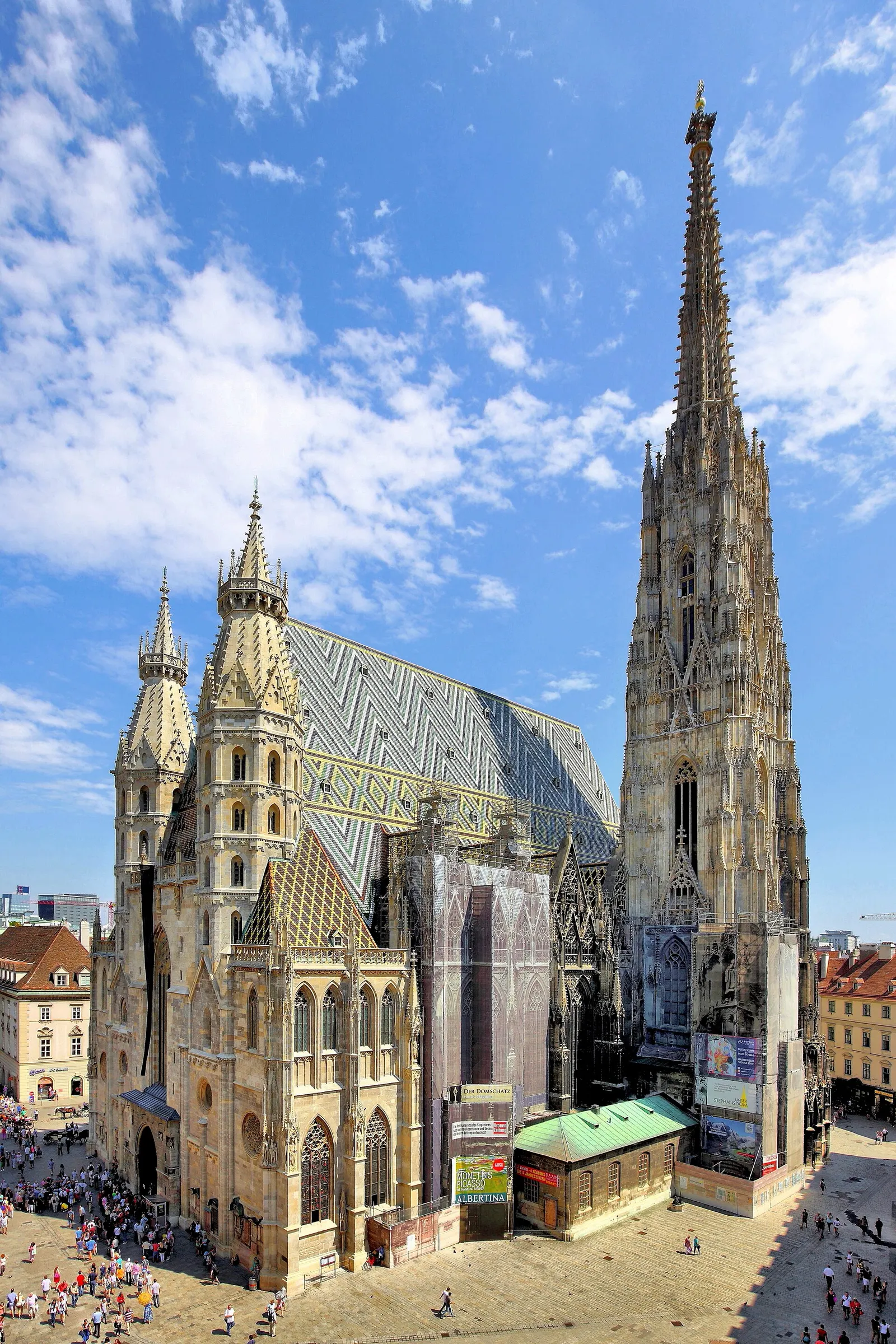
Begin under the tiled Gothic spire of St Stephen Cathedral (Stephansdom), exploring the Mozarthaus, medieval courtyards, the Graben and the Baroque Peterskirche.
St Stephen's Cathedral
Standing at the heart of the city, this Gothic mother church features a 136-metre south tower and a roof decorated with thousands of coloured tiles. Inside, visitors can examine the carved stone pulpit created by Anton Pilgram and Emperor Frederick III's monumental red marble tomb.
Stephansplatz
This paved central plaza has functioned as the civic and commercial focal point of Vienna since the Middle Ages. Archaeological work beneath the surface revealed the submerged Virgilkapelle, while surface outlines trace the foundations of the vanished Romanesque Mary Magdalene Chapel.
Virgilkapelle
Constructed around 1250, this underground Gothic sanctuary originally lay beneath a cemetery chapel dedicated to Saint Mary Magdalene. Rediscovered during underground railway excavations in the 1970s, the preserved chamber exhibits pointed arches and medieval wheel crosses painted on bare stone.
Haas Haus
Designed by Austrian architect Hans Hollein and completed in 1990, this building caused heated architectural debate due to its modernist contrast with the cathedral opposite. Its mirrored glass facade mirrors the Gothic spire, curving sharply at the entry to the Graben promenade.
Stock im Eisen
Enclosed in glass on the corner of the Palais Equitable, this tree trunk section dates back to the fifteenth century. Travelling blacksmiths hammered iron nails into the wood for good fortune before leaving town, creating a bizarre folk relic steeped in Viennese guild traditions.
Palais Equitable
Erected in 1891 for an American life assurance company, this grand mansion displays ornate limestone sculpting and bronze embellishments. Its opulent entrance atrium features polished granite columns and marble staircases, while the facade protects the medieval Stock im Eisen tree trunk.
Domgasse
This narrow residential street retains much of its pre-modern character, lined with tall Renaissance and Baroque tenements. Walking along the cobblestones reveals ancient vaulted archways and inner courtyards that sheltered scholars, musicians and merchants during Vienna's imperial centuries.
Mozarthaus Vienna
Located at Domgasse 5, this preserved seventeenth-century house contains the composer's sole surviving Viennese apartment. Mozart resided on the first floor between 1784 and 1787, completing The Marriage of Figaro and hosting musical evenings with Joseph Haydn in the panelled rooms.
Blutgasse
Blutgasse, or Blood Lane, derives its dramatic name from local folklore involving the slaughter of Knights Templar in the fourteenth century. The quiet passageway features cobblestones, iron gas lamps and narrow doorways that open into interconnected medieval pawlatsche courtyards.
Fährichhof
Dating back to medieval foundations, this peaceful residential enclave within the Blutgasse district showcases tiered pawlatschen galleries with wrought-iron railings. Plant-filled balconies look over a flagstone courtyard, offering a rare view into Vienna's seventeenth-century domestic architecture.
Deutschordenskirche
Consecrated in 1395 and dedicated to Saint Elisabeth of Hungary, this church forms the core of the Teutonic Knights' Viennese headquarters. The interior features coats of arms of past Grand Masters and an elaborate sixteenth-century winged altarpiece crafted in Mechelen.
Treasury of the Teutonic Order
Housed on the upper floors of the order's complex, this collection preserves centuries of chivalric heritage. Exhibits include ceremonial daggers, coin hoards, scientific instruments and imperial insignia collected by Grand Masters who ruled the order from Vienna.
Singerstrasse
Running parallel to the medieval core, Singerstrasse is known for its concentration of noble palaces and guild houses. Pedestrians passing through can admire classical entrance portals, stone heraldry and secluded residential courtyards that date from the seventeenth and eighteenth centuries.
Palais Neupauer-Breuner
Constructed around 1715, this palace represents one of the finest High Baroque town mansions in the Innere Stadt. The exterior displays fine pilasters and stone reliefs, while the monumental portal leads into a classical vaulted carriage entrance.
Church of the Nine Choirs of Angels
Situated on nearby Schulhof, this fourteenth-century church was rebuilt with an elaborate Baroque facade in the seventeenth century. From its stone terrace, heralds proclaimed the end of the Holy Roman Empire in 1806, marking a turning point in central European history.
Graben
Originating as the protective moat outside the Roman fort of Vindobona, the Graben was filled in during the twelfth century to become a market street. Today, this expansive pedestrian avenue is framed by historicist facades, luxury stores and grand ornamental fountains.
Plague Column
Erected by Emperor Leopold I following the devastating plague of 1679, this complex marble monument was designed by artists including Matthias Rauchmüller and Johann Bernhard Fischer von Erlach. Cloud formations, angels and saintly figures ascend toward the golden Trinity atop the pedestal.
Peterskirche
Inspired by Saint Peter's Basilica in Rome, this early eighteenth-century Baroque church was designed by Johann Lukas von Hildebrandt. The interior features trompe-l'oeil frescoes by J. M. Rottmayr, gilded stucco altars and an intimate setting renowned for afternoon organ recitals.
Ankeruhr
Spanning the alley between two insurance buildings at Hoher Markt, this clock was crafted by painter Franz Matsch between 1911 and 1914. Twelve historical figures, including Emperor Marcus Aurelius and Prince Eugene of Savoy, cross the face accompanied by organ music.
Hoher Markt
As the historical heart of Vindobona, this square was once the site of Roman legionary headquarters before serving as the medieval fish and textile market. Beneath the pavement lies an underground museum preserving Roman masonry, while the surface is centred on the Baroque Vermählungsbrunnen.
Kohlmarkt, Hofburg Imperial Palace, Spanish Riding School & Freyung
Walk down Kohlmarkt into the Hofburg complex for the Imperial Treasury, State Hall of the National Library, Albertina, Imperial Crypt and historic squares of Am Hof and Freyung.
Kohlmarkt
Originally settled in Roman times as an access route to the legionary camp, this street later hosted medieval charcoal dealers before transforming into a fashionable shopping avenue. Elegant nineteenth-century facades frame the vista toward the Imperial Palace. Visitors can examine decorative plasterwork and refined shopfronts established by official purveyors to the Habsburg court.
Michaelerplatz
Dominated by the sweeping curve of the Michaelertrakt, this neoclassical square serves as the primary northern entrance to the Hofburg palace complex. Archaeological excavations preserved in the centre reveal fragments of ancient Roman settlements alongside medieval foundations. Horse-drawn carriages congregate along the cobblestones beneath grand limestone facades and sculptural wall fountains.
St. Michael's Church
Dating back to the early thirteenth century, this venerable church served as the parish church of the imperial court for centuries. The interior combines Romanesque elements with soaring Gothic rib vaults and a monumental baroque high altar depicting the fall of rebel angels. Beneath the floorboards lie extensive catacombs containing naturally mummified remains.
Looshaus
Architect Adolf Loos designed this commercial building in 1909, sparking fierce contemporary debate due to its stark absence of window mouldings. The lower floors are clad in polished green marble, contrasting sharply with the plain plaster walls of the upper domestic storeys. It stands as a pivotal landmark in the evolution of early twentieth-century modernism.
Michaelertrakt
Conceived by Joseph Emanuel Fischer von Erlach in the 1720s and completed in the late nineteenth century, this monumental wing encloses Michaelerplatz. Massive marble statues celebrating imperial virtues and military triumphs flank the main archway, which is topped by a towering copper dome. The grand gate leads directly through into the inner courtyard.
In der Burg
This expansive courtyard forms the architectural core of the Hofburg, bounded by wings that span several centuries of construction. At its centre stands a monumental bronze statue of Emperor Francis I, commissioned in the nineteenth century and surrounded by allegorical figures. The square connects key historic complexes, including the Swiss Wing and the Imperial Chancellery.
Schweizertor
Erected in 1552 under Emperor Ferdinand I, this fortified gateway takes its name from the Swiss mercenaries who once guarded the inner imperial residence. Painted in striking red, black and gold, the portal displays Habsburg heraldic coats of arms and the collar of the Order of the Golden Fleece. It leads directly to the oldest surviving courtyard.
Imperial Treasury
Housed within the medieval core of the Swiss Wing, this treasury preserves the most significant secular and ecclesiastical heirlooms of the Habsburg dynasty. Highlights include the tenth-century Imperial Crown of the Holy Roman Empire, the Austrian Imperial Crown, and the ceremonial robes of the Golden Fleece. Richly decorated reliquaries and agate vessels demonstrate imperial power.
Spanish Riding School
Founded in the sixteenth century, this equestrian institution preserves the classical Renaissance tradition of haute école horsemanship. Performances take place in the Winter Riding School, a baroque hall designed by Joseph Emanuel Fischer von Erlach in 1729, illuminated by crystal chandeliers. White Lipizzan stallions execute complex movements within an architectural setting of white balustrades.
Josefsplatz
Recognised as one of the finest public squares in the city, Josefsplatz is framed by the palatial facade of the Austrian National Library. An expressive bronze equestrian statue of Emperor Joseph II stands in the centre, erected in the early nineteenth century. The harmonious neoclassical enclosure creates a tranquil transition between the Hofburg wings and the surrounding streets.
Austrian National Library State Hall
Built under Emperor Charles VI by Johann Bernhard Fischer von Erlach, this majestic baroque hall extends nearly eighty metres in length. Vast walnut bookcases hold hundreds of thousands of historic printed works beneath an ornate dome painted by Daniel Gran. Marble statues of Austrian emperors and finely detailed pairs of Venetian globes punctuate the centre.
Augustinian Church
Constructed in the fourteenth century, this monastic church served as the official court church where numerous Habsburg weddings took place, including that of Empress Maria Theresa. The austere Gothic nave contains the neoclassical marble tomb of Archduchess Marie Christine, sculpted by Antonio Canova. A side chapel, the Herzgruft, preserves the embalmed hearts of Habsburg rulers.
Albertina
Perched atop a remaining section of the ancient city fortifications, this former residence of the Duke of Saxe-Teschen now houses one of the world's largest collections of prints and drawings. The complex features restored neoclassical staterooms alongside modern exhibition galleries. An avant-garde titanium canopy extends dramatically over the main public terrace overlooking the Opera district.
Imperial Crypt
Located beneath the unassuming Capuchin Church, this subterranean vault complex contains the resting places of over one hundred and forty Habsburg royals. The burial chambers range from unadorned stone rooms to the double sarcophagus of Empress Maria Theresa, sculpted with intricate rococo relief panels. The final tombs include those of Emperor Franz Joseph and Empress Elisabeth.
Neuer Markt
Established in the thirteenth century as an alternative to the older Hoher Markt, this rectangular square long served as a trading site for grain and produce. At its centre stands the Donner Fountain, adorned with allegorical figures representing the tributaries of the Danube River. The surrounding architecture displays a refined mix of baroque facades and post-war reconstructions.
Am Hof
This expansive square was originally home to the Babenberg dukes before the imperial residence shifted to the Hofburg in the thirteenth century. In 1667, Emperor Leopold I erected the central bronze Marian Column in gratitude for deliverance from Swedish forces. Today, the perimeter displays historic patrician residences, seasonal craft markets, and the Renaissance-era municipal armory.
Church of the Nine Choirs of Angels
Constructed in the fourteenth century for the Carmelite Order, this church was later transferred to the Jesuits, who added its monumental stone facade in 1662. The exterior features an open loggia from which imperial proclamations were made to crowds gathered in the square below. Inside, the quiet hall preserves tall Gothic proportions alongside classical baroque side chapels.
Freyung
Named after the historic right of sanctuary granted by the neighbouring monastery, this triangular square developed into Vienna's most aristocratic quarter in the seventeenth century. The central Austria Fountain portrays the empire surrounded by allegorical river figures. Elegant private residences, including the grand Palais Kinsky, flank the plaza and host popular farmers markets.
Schottenstift
Founded in 1155 by Duke Jasomirgott, this Benedictine abbey was originally staffed by Gaelic monks, known locally as Scots. The present church combines seventeenth-century architectural foundations with extensive nineteenth-century interior renovations and gilded ornamentation. Its secluded cloistered courtyards offer a peaceful sanctuary from urban streets, complemented by an active monastic museum.
Palais Ferstel
Designed by architect Heinrich von Ferstel in the late 1850s, this elaborate building reflects the influences of the Venetian Trecento and Florentine Renaissance. Inside, a covered glass-roofed arcade links the Freyung to the Herrengasse, terminating at the Donaunixenbrunnen fountain. It famously houses Cafe Central, a historic meeting place for Vienna's early twentieth-century literary and political figures.
Ringstraße Monumental Mile, Opera, Kunsthistorisches Museum & MuseumsQuartier
Follow the grand Ringstraße from the Vienna State Opera, Kunsthistorisches and Naturhistorisches Museums and MuseumsQuartier to Parliament, Rathaus and Burgtheater.
Vienna State Opera
Designed by August Sicard von Sicardsburg and Eduard van der Nüll, this flagship theatre opened in 1869 with Mozart's Don Giovanni. Although devastated by wartime bombing in 1945, the historic loggia and the magnificent grand staircase survived. Visitors can admire the bronze fountain statues outside and the elaborate allegorical frescoes overhead.
Palais Todesco
Built between 1861 and 1864 for the Todesco banking family, this Italianate Renaissance residence features lavish interior decor created by painter Carl Rahl. It served as a celebrated artistic salon where notable musicians and writers convened. Today, the building houses prestigious shops and offices beneath its classical pediments.
Goethe Monument
Unveiled in 1900, this imposing bronze likeness by Edmund von Hellmer portrays Johann Wolfgang von Goethe seated comfortably in an armchair. The monument anchors the corner of the Opernring, gazing outward across the boulevard towards the Burggarten. Its marble base incorporates delicate reliefs depicting allegories from Goethe's extensive poetic works.
Schiller Monument
Standing in the centre of Schillerplatz, this 1876 statue by Johannes Schilling honours the revered dramatist and poet. Bronze figures symbolising the four ages of life accompany allegories of genius, poetry, science, and art around the granite pedestal. The surrounding garden square offers a calm vantage point opposite the Academy of Fine Arts.
Academy of Fine Arts Vienna
Designed by Theophil Hansen in the classical Greek Renaissance style, this prestigious institution has trained painters and sculptors since the late seventeenth century. Its monumental facade is distinguished by terracotta brickwork and statues of antiquity's greatest masters. Inside, the paintings gallery displays Hieronymus Bosch's famous Last Judgment triptych.
Burggarten
Commissioned by Emperor Franz I in an English landscape style, this pleasant public park served as the private pleasure grounds of the Habsburg family until 1919. Shaded paths loop past statues, including the celebrated marble Mozart Monument designed by Viktor Tilgner. A large pond and weeping willows provide a green backdrop near the palace walls.
Palmenhaus
Erected by Friedrich Ohmann between 1901 and 1905, this curved iron and glass conservatory replaced an earlier classical greenhouse. The soaring central hall features delicate botanical ironwork, while the side pavilions house a tropical butterfly sanctuary and a popular restaurant. It remains one of the finest Jugendstil glass structures in central Europe.
Mozart Monument
Crafted from South Tyrolean Lasa marble, this ornate memorial was unveiled in 1896 and relocated to the Burggarten in 1953. Sculptor Viktor Tilgner depicted the composer with his music stand, surrounded by putti playing various orchestral instruments. In warmer seasons, the manicured lawn in front is traditionally planted with red flowers shaped like a musical clef.
Äußeres Burgtor
Designed by Peter von Nobile and finished in 1824, this massive stone portal stands as the monumental outer entrance to the Hofburg Palace complex. Inscribed with golden Latin maxims, it was adapted into an official Austrian war memorial during the interwar period. The gate features five vaulted arches that frame striking vistas of the Ringstraße boulevard.
Maria-Theresien-Platz
Conceived by Gottfried Semper as part of an ambitious imperial forum, this expansive esplanade is paved with gravel pathways, topiary shrubbery, and ornate fountains. At its centre rises the colossal nineteenth-century monument to Empress Maria Theresa seated atop her throne. The plaza seamlessly links the historic Ringstraße with the modern cultural district.
Maria Theresa Monument
Unveiled in 1888 after thirteen years of work by Kaspar von Zumbusch, this bronze and granite monument measures nineteen metres in height. Maria Theresa sits commanding the summit, holding the Pragmatic Sanction and a sceptre. Below her, equestrian statues of her leading generals and standing figures of prominent statesmen and scholars encircle the base.
Kunsthistorisches Museum
Opened in 1891, this opulent Renaissance Revival museum was designed by Gottfried Semper and Karl von Hasenauer to exhibit the Habsburgs' art treasures. The octagonal dome and lavish marble staircase present frescoes by Gustav Klimt and his contemporaries. Inside, galleries house extraordinary masterworks by Pieter Bruegel the Elder, Titian, and Caravaggio.
Naturhistorisches Museum
Mirroring its sister art museum across the square, this elaborate institution opened in 1889 to house imperial natural science specimens. The facade displays sculpted allegories of continents and historical scientists, while the interior preserves nineteenth-century mahogany display cabinets. Highlights include the tiny Venus of Willendorf figurine and an extensive hall of meteorites.
MuseumsQuartier
Once the Baroque royal stables designed by Johann Bernhard Fischer von Erlach, this sprawling complex was converted into a sprawling cultural precinct in 2001. Historic stuccoed wings contrast boldly with contemporary basalt and limestone museum cubes set within spacious public courtyards. It houses cutting-edge galleries, artist studios, and popular outdoor lounge furniture.
Leopold Museum
Clad in pale Danube limestone, this minimalist cube building by Ortner and Ortner opened inside the MuseumsQuartier in 2001. It contains the prolific collection assembled by Rudolf and Elisabeth Leopold, focusing on late nineteenth-century and early twentieth-century Austrian art. The museum features the planet's largest assembly of paintings and drawings by Egon Schiele.
MUMOK
Contrasting with the surrounding Baroque architecture, this monolithic cube is clad in curved, charcoal-grey volcanic basalt stone. The museum presents major twentieth and twenty-first century artistic movements, including Fluxus, Pop Art, and Viennese Actionism. Visitors explore five expansive exhibition levels connected by glass bridges and sunken light shafts.
Kunsthalle Wien
Housed within the former imperial winter riding arena and its modern brick annex, this venue focuses on international contemporary art and debate. It operates without a permanent collection, instead staging rotating thematic exhibitions that reflect global socio-political developments. The interior spaces provide flexible settings for large-scale installations and multimedia presentations.
Austrian Parliament Building
Conceived by architect Theophil Hansen to recall ancient Athenian democracy, this magnificent complex features Corinthian porticos and intricate marble friezes. Before the main ramp stands the monumental Pallas Athene fountain, depicting the goddess of wisdom surrounded by river allegories. Following a major restoration, its ornate parliamentary chambers host active democratic assemblies.
Burgtheater
Designed by Gottfried Semper and Karl von Hasenauer, this renowned German-language playhouse opened on the Ringstraße in 1888. The curved facade features portrait busts of illustrious playwrights such as Shakespeare, Goethe, and Schiller. Inside, visitors can observe lavish ceiling paintings above the imperial staircases, executed by Gustav Klimt and Franz Matsch.
Vienna City Hall
Erected between 1872 and 1883 by master builder Friedrich von Schmidt, this civic palace was inspired by medieval Flemish town halls. The central clock tower rises nearly one hundred metres, crowned by the Rathausmann statue serving as a guardian symbol. Its open central courtyard and expansive front square host major city festivals throughout the year.
Karlsplatz, Secession, Naschmarkt, Musikverein & Belvedere Palaces
Combine the golden dome of the Secession, Naschmarkt, the Golden Hall of the Musikverein and Karlskirche with Klimt masterpieces at Upper and Lower Belvedere.
Karlskirche
Designed by Johann Bernhard Fischer von Erlach, this monumental church honours Saint Charles Borromeo. The facade combines an ancient Roman portico with two giant relief columns modelled after Trajan's Column. Inside, travellers can admire expansive ceiling frescoes by Johann Michael Rottmayr depicting the saint in intercession.
Karlsplatz Stadtbahn Pavilion
Otto Wagner designed this Jugendstil rail pavilion in the late 1890s using wrought iron, white marble slabs and gilt sunflower ornaments. It originally served as an entrance to the historical Stadtbahn transport network. Today the western pavilion operates as an exhibition venue dedicated to Wagner's architectural legacy.
Vienna Secession Building
Constructed in 1898 by Joseph Maria Olbrich, the Secession served as an architectural manifesto for artists breaking away from conservative historicism. The exterior features a distinctive dome formed of thousands of gilded laurel leaves and floral reliefs. Below ground, visitors find Gustav Klimt's celebrated Beethoven Frieze painted for a 1902 exhibition.
Naschmarkt
Dating back to the sixteenth century as an ash and milk trading point, this linear market stretches along the paved river culvert. Stalls display regional produce, cheeses, spices and prepared foods from across the former Habsburg territories and the Mediterranean. On Saturdays, the western end hosts an extensive flea market.
Majolikahaus
Otto Wagner built this apartment house along the Linke Wienzeile in 1898. The facade is clad entirely in weather-resistant glazed ceramic tiles painted with flowing pink roses and natural motifs. We observe how the decorative scheme integrates with elaborate wrought-iron balconies that celebrate modern urban materials.
Medallion House
Standing directly beside the Majolikahaus, this companion structure showcases Otto Wagner's talent for gilded surface treatment. The facade features gilded stucco medallions created by sculptor Kolo Moser alongside striking corner sculptures by Othmar Schimkowitz. It exemplifies the bold transition towards early twentieth-century architectural modernism.
Theater an der Wien
Opened in 1801 by Mozart's collaborator Emanuel Schikaneder, this historic venue staged the world premiere of Beethoven's Fidelio in 1805. Beethoven even lived in apartments within the building while composing portions of his symphonies. The Papageno Gate on Millöckergasse depicts Schikaneder in the costume of the famous Magic Flute character.
Wien Museum Karlsplatz
Originally designed by Oswald Haerdtl in the 1950s, this urban museum reopened following a major expansion and renovation. The permanent collections document Vienna's development from Roman Vindobona through the nineteenth-century expansion to modern times. Key exhibits include model reconstructions, historical guild signs and fine portraits of prominent municipal figures.
Musikverein
The Society of Friends of Music commissioned architect Theophil Hansen to construct this concert venue, which opened in 1870. Its Golden Hall is renowned globally for its shoebox acoustics, caryatid pillars and gilded coffered ceiling. The venue serves as the traditional setting for the annual Vienna New Year's Concert.
Künstlerhaus
Constructed in 1868 by August Weber, the Künstlerhaus was modelled after Italian Renaissance villas to host the city's academic artists. After extensive modern restorations, the building houses the Albertina modern collection alongside rotating shows of regional painting and sculpture. Its northern facade faces the broad pedestrian plaza above Karlsplatz.
TU Wien Main Building
Founded in 1815 as the Imperial-Royal Polytechnic Institute, this central institution pioneered scientific education across Central Europe. The grand central block features a classical pediment and statues honouring mathematical and engineering achievements. Extensive courtyards connect historic lecture halls with modern university laboratories behind Karlsplatz.
Brahms Memorial
Sculptor Rudolf Weyr erected this memorial in Karlsplatz park in 1908 to honour Johannes Brahms, who spent his final decades in Vienna. The composer is portrayed seated in deep contemplation above an allegorical muse resting upon a lyre. The monument stands near the Musikverein, where Brahms frequently conducted.
Schwarzenbergplatz
This open plaza straddles the central Ringstrasse and the third district, named after field marshal Karl Philipp, Prince of Schwarzenberg. The southern section features the Hochstrahlbrunnen, a monumental fountain constructed in 1873 to celebrate the completion of the city's alpine water pipeline. Palaces and foreign embassies line its perimeter.
Soviet War Memorial
Constructed in 1945 immediately after the Battle of Vienna, this memorial commemorates Soviet troops who fell liberating the city from Nazi rule. A curved marble colonnade surrounds an elevated bronze soldier bearing a flag and the Soviet state emblem. An inscribed base displays quotations by Joseph Stalin alongside casualty records.
Palais Schwarzenberg
Begun by Johann Lukas von Hildebrandt in 1697 and completed by Johann Bernhard Fischer von Erlach, this palace reflects aristocratic Baroque taste. The building features an expansive private park that runs parallel to the Belvedere estate. Its decorative riding school, ceremonial cour d'honneur and garden facades display classical stone carving.
Upper Belvedere
Commissioned by Prince Eugene of Savoy and built by Johann Lukas von Hildebrandt, the Upper Belvedere opened in 1723 atop the southern ridge. The interior contains the marble hall where the 1955 Austrian State Treaty was signed, alongside art galleries displaying Gustav Klimt's The Kiss. The roofline features distinctive copper vaults and decorative lanterns.
Belvedere Gardens
Designed by garden architect Dominique Girard, this terraced landscape links the Upper and Lower Belvedere complexes. The layout incorporates trimmed hedges, parterres, gravel paths and ornamental water basins with cascading fountains. Classical statues representing Apollo, the nine Muses and the elements line the central axis.
Lower Belvedere
Completed in 1716 as the residential wing for Prince Eugene, this lower palace provides an intimate counterpoint to the Upper Belvedere. The Marble Hall features ceiling frescoes by Martino Altomonte and illusionistic architectural paintings. Adjoining rooms, including the Grotesque Hall, host changing exhibitions of historic and modern European art.
Belvedere Orangery
Originally engineered with a removable wooden roof so citrus trees could enjoy summer weather, the Orangery reflects eighteenth-century horticultural ingenuity. Hildebrandt integrated this long hall alongside the Lower Belvedere garden parterres. Today the converted interior provides naturally illuminated galleries for temporary exhibitions and preservation projects.
Palais Salm
Constructed in the early nineteenth century along the Salmgasse, this dignified residence showcases the transition from late Baroque to reserved neoclassical design. The facade exhibits restrained cornices, fluted pilasters and a central stone entrance opening into an enclosed courtyard. Its location recalls the dense concentration of nobility around the imperial garden estates.
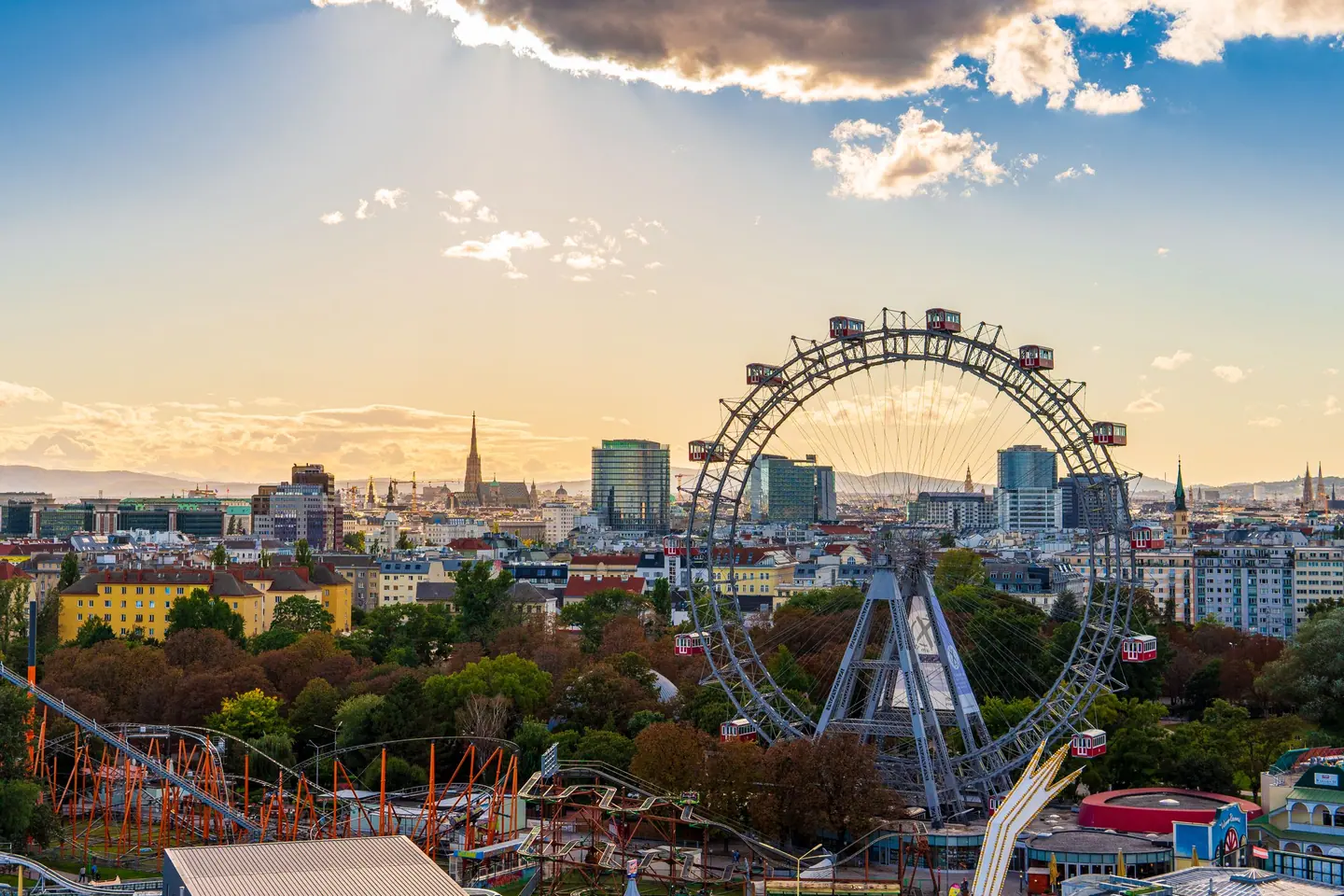
Stadtpark, Hundertwasserhaus, Prater & Schönbrunn Imperial Palace
Explore the golden Johann Strauss monument in Stadtpark, the Prater Giant Ferris Wheel and the 1,441-room Baroque palace and Gloriette gardens of Schönbrunn.
Johann Strauss Monument
Edmund Hellmer sculpted this gilded bronze effigy of Johann Strauss II playing his violin, unveiled in 1921. It stands framed by a marble relief depicting floating nymphs and swirling water motifs. Travellers often pause along the park pathways to admire the gleaming contrast of gold against the surrounding trees.
Kursalon Hübner
Designed by Johann Garben, this Italian Renaissance Revival venue opened in 1867 as a spa pavilion before turning into a concert hall. Johann Strauss II directed his orchestra from the terrace, cementing its role in classical waltz tradition. Its columned loggia and broad balustrades face the landscaped gardens of the Stadtpark.
Franz Schubert Monument
Karl Kundmann created this seated statue of the Viennese composer, which was inaugurated in 1872. Carved from Carrara marble, the monument depicts Schubert holding a notebook with his pen poised to write melody lines. Reliefs along the base illustrate allegorical figures representing music and choral song.
Hundertwasserhaus
Completed in 1985 by artist Friedensreich Hundertwasser and architect Joseph Krawina, this apartment block rejects straight lines in favour of organic forms. The exterior features uneven patches of bright colour, irregular windows and mature trees growing out of living rooms. It remains an occupied municipal housing estate.
Kunst Haus Wien
Converted from a former furniture factory, this museum opened in 1991 to showcase Hundertwasser paintings, graphics and environmental philosophy. The building incorporates undulating floors, enamel tile mosaics and rooftop flora that illustrate his ecological architecture. Temporary exhibitions of international photography regularly occupy the upper galleries.
Wiener Riesenrad
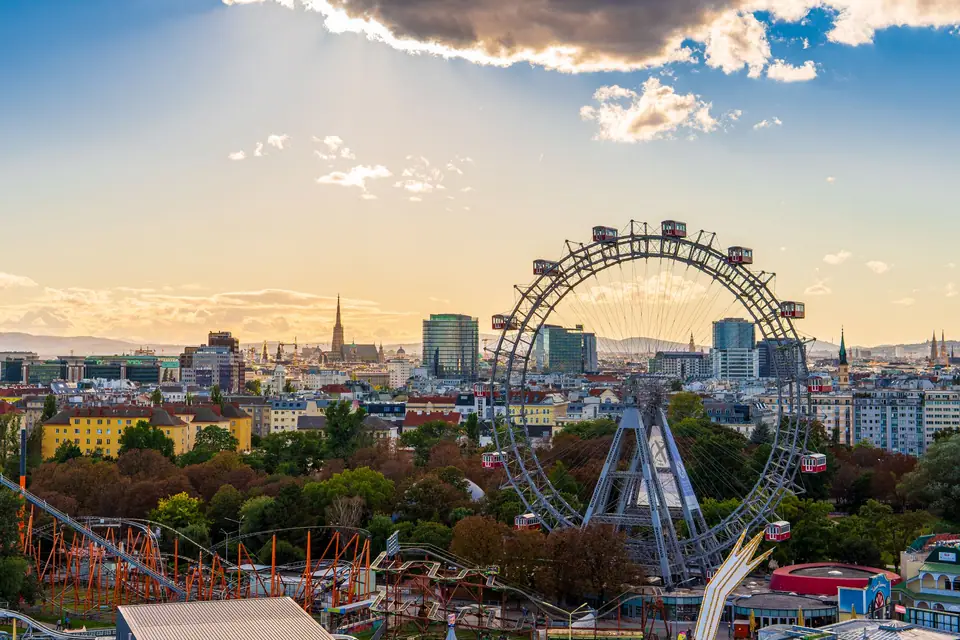
British engineer Walter Basset built this 64.75-metre-tall observation wheel in 1897 to mark Emperor Franz Joseph's golden jubilee. Surviving heavy damage from the Second World War, it operates with fifteen red passenger cabins providing views across the Danube and the inner city. Its steel lattice structure defines the amusement park skyline.
Prater Liliputbahn
Operating since 1928, this light railway follows a 3.9-kilometre circuit through the open amusement grounds into the quiet woodlands of the Prater. Both vintage steam locomotives and diesel engines pull open carriages along the 381-millimetre gauge track. The main departure station features original interwar railway architecture.
Prater Museum
Situated in modern premises beside the amusement park, this branch of the Vienna Museum traces the history of the Wurstelprater from 1766 onwards. Exhibits feature antique carousel horses, fortune-telling automata, historical posters and ventriloquist dummies. The displays illustrate how imperial hunting grounds transformed into Europe's oldest continuous fairground.
Hauptallee
Laid out in 1538, this four-kilometre straight thoroughfare connects the Praterstern roundabout with the Lusthaus pavilion at the park eastern edge. Lined with thousands of horse chestnut trees, it serves as a central artery for cyclists and long-distance runners. The avenue is closed to motor vehicles, preserving its quiet park atmosphere.
Prater Lusthaus
Architect Isidore Canevale constructed this octagonal neoclassical hunting pavilion in the 1780s on the site of an older lodge. It features circular colonnaded balconies across two storeys, providing panoramic perspectives over the old imperial hunting grounds. Today it houses a traditional restaurant serving classic Viennese cuisine beside the Danube canal.
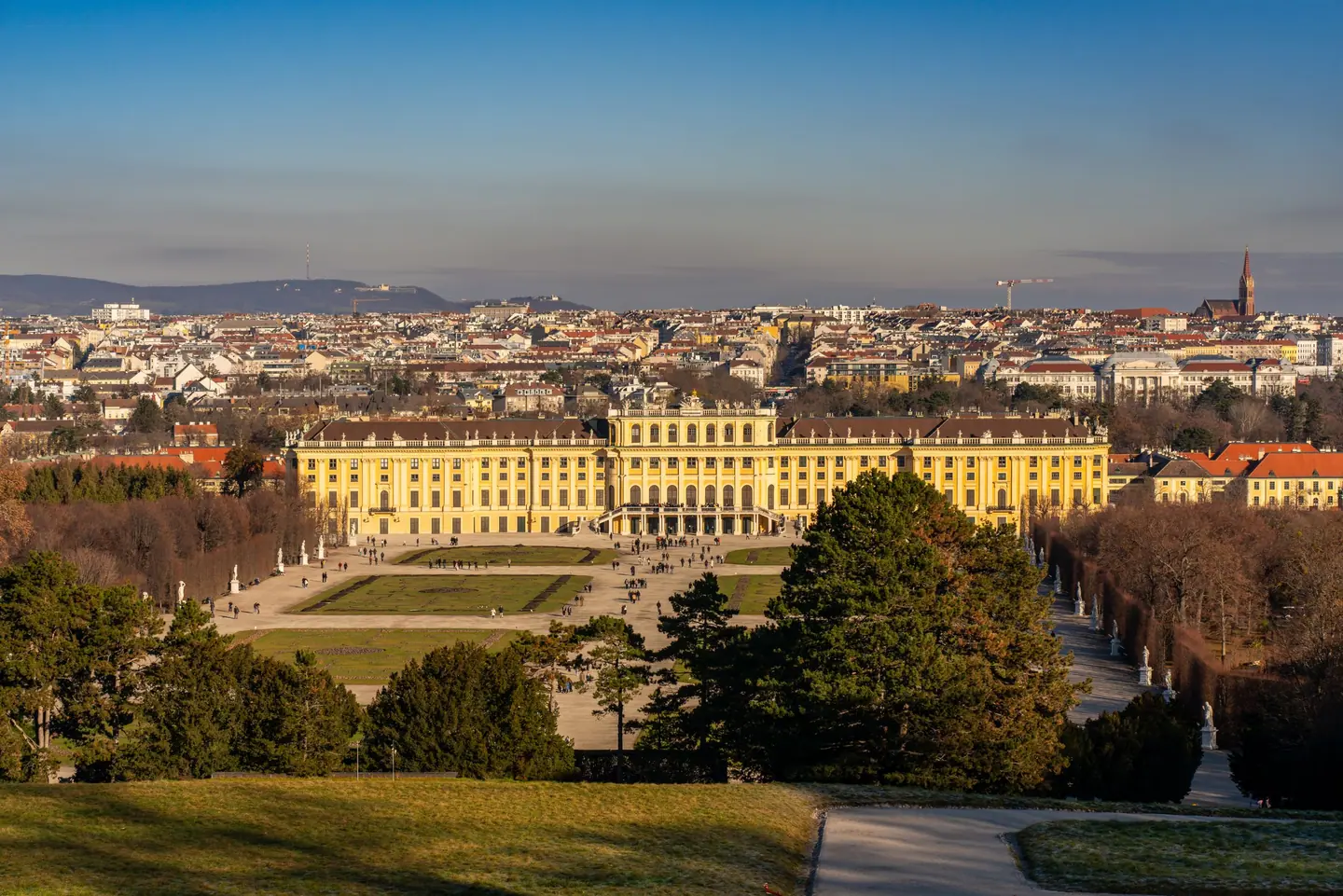
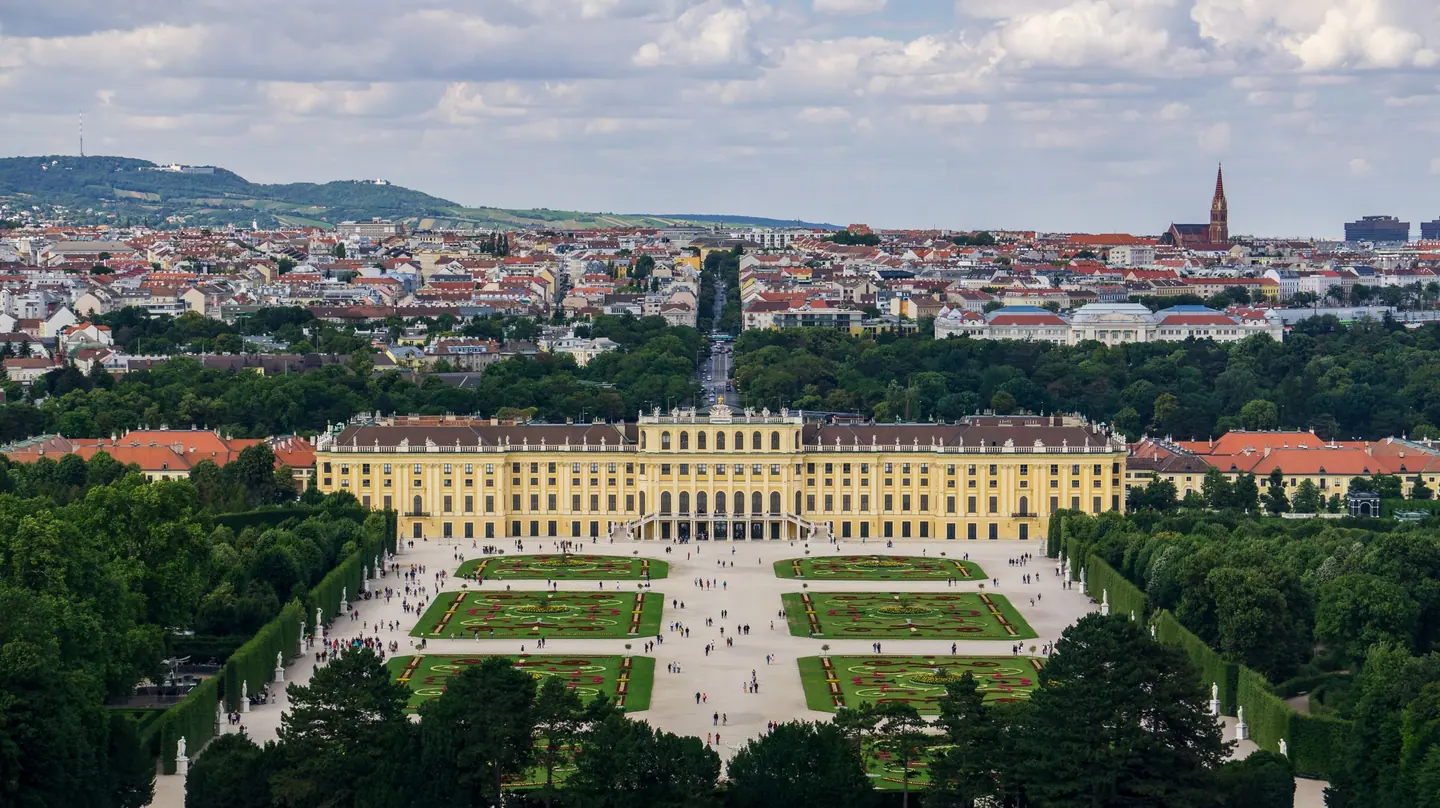
Schönbrunn Palace
Johann Bernhard Fischer von Erlach and later Nikolaus Pacassi created this sprawling Rococo complex for the Habsburg monarchs. Maria Theresa made it her primary summer court, furnishing state apartments such as the Great Gallery and the Millions Room with gilt woodwork and frescoes. Outside, formal courtyards lead toward extensive manicured gardens.
Schönbrunn Gloriette
Designed by Johann Ferdinand Hetzendorf von Hohenberg in 1775, this arcaded pavilion crowns the hill behind the main palace. Built from limestone reclaimed from Schloss Neugebäude, it commemorates Prussian-Austrian military engagements under a central triumphant eagle. The viewing platform delivers panoramic sweeps across the palace roofs toward central Vienna.
Neptune Fountain
Positioned at the base of the palace gardens slope, this sculptural fountain was completed in 1780 by Franz Anton von Zauner. It portrays Neptune in a sea-shell chariot accompanied by tritons and the sea goddess Thetis imploring safe passage for Achilles. A walkway behind the water curtain offers framed perspectives of the palace.
Schönbrunn Roman Ruin
Constructed in 1778, this romantic architectural folly represents the crumbling temple of Vespasian and Titus half-submerged in a pool. Architect Johann Ferdinand Hetzendorf von Hohenberg designed the decayed arches to evoke classical antiquity and political decline. Statues of river gods and overgrown foliage reinforce the picturesque atmosphere of decay.
Palmenhaus Schönbrunn
Court architect Franz Xaver von Segenschmid constructed this 111-metre-long iron pavilion in 1882, making it one of the largest botanical glasshouses in continental Europe. Supported by cast-iron pillars, its central dome encloses temperate, tropical and cold environmental zones for rare flora. Visitors observe ancient palms, Mediterranean ferns and historic botanical specimens.
Wüstenhaus Schönbrunn
Originally built between 1900 and 1904 as the Sundial House, this Art Nouveau glass conservatory sits across from the Palmenhaus. Today it recreates arid desert habitats spanning the Americas, Africa and Asia, housing rare cacti and succulents alongside adapted desert animals. A botanical trail guides travellers past miniature desert landscapes.
Imperial Carriage Museum
Housed in the former winter riding school of Schönbrunn, this museum displays more than sixty historic court carriages. The central attraction is the gilded Imperial Coronation Coach, which weighed four tonnes and required eight white kladruber horses to pull. Other exhibits include the carriage of Empress Elisabeth and historical riding equipment.
Schönbrunn Tiergarten
Founded in 1752 by Emperor Franz I, this institution preserves its original circular Baroque layout radiating from an octagonal imperial breakfast pavilion. While modern enclosures support international conservation programmes, historic rococo stone architecture remains visible throughout the grounds. It stands within the UNESCO-inscribed palace grounds.
Schönbrunn Maze and Labyrinth
Originally planted around 1720, this geometric yew maze was reconstructed in 1999 following historical blueprints from the eighteenth century. Tall, dense hedges lead visitors along narrow dead-ends toward a central raised viewing platform overlooking the green corridors. Adjacent sections include interactive mathematical puzzles and carved stone labyrinths.
Schönbrunn Orangerie
Spanning 189 metres, this is one of the longest Baroque orangeries ever built, equipped with underfloor hypocaust heating to protect exotic citrus plants in winter. In 1786, Emperor Joseph II staged a musical duel here between Wolfgang Amadeus Mozart and Antonio Salieri. The hall continues to host classical concerts and seasonal horticultural events.
Planning Days in Vienna’s Inner Districts
Our main Vienna guide covers airport arrivals, neighbourhood bases and multi-day pacing to complement this walk; see also our full collection of city route guides.