


























Quick Field Data
- UNESCO Inscription: 1979 · Extended 1992 and 2014 · Criteria (ix), (x)
- Scale & Footprint: 141,885 hectares (1,418.85 km2) of transboundary lowland forest with a 166,708-hectare buffer zone across Podlaskie Voivodeship in Poland and Brest and Grodno oblasts in Belarus
- Access & Ticketing: Outer forest trails and cycling tracks are open to the public, whereas the strictly protected reserve core on the Polish side requires advance booking with an accredited local guide
- Arrival Logistics: Located 62 km southeast of Białystok via Hajnówka to the village of Białowieża in Poland, and 70 km north of Brest to the Belovezhskaya Pushcha gate at Kamieniuki in Belarus
Watershed Ecology, Deadwood Dynamics, and Monumental Oaks
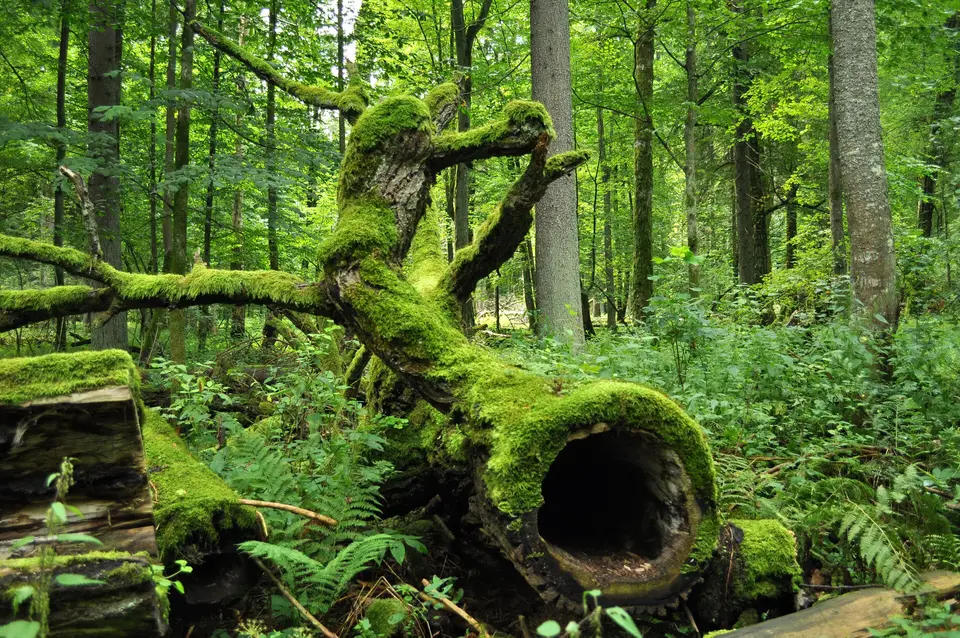
Stretching across the watershed dividing the Baltic Sea and the Black Sea, Białowieża Forest (known in Polish as Puszcza Białowieska and in Belarusian as Biełaviežskaja pušča) protects 141,885 hectares of continuous lowland woodland surrounded by a buffer zone of 166,708 hectares. Situated in the Central European mixed forests ecoregion across Podlaskie Voivodeship on the Polish side alongside the Brest and Grodno regions of Belarus, the reserve preserves the largest surviving remnant of the primeval forest that once carpeted the North European Plain. Deadwood drives the entire ecosystem here. Unlike commercial timber plantations cleared of ageing trees, the core reserves leave natural succession and windthrow together with seasonal flooding and fungal decay undisturbed. Almost half of the wood biomass in the strictly protected forest consists of standing snags and fallen logs, roughly 10 times the volume found in managed woodlands.
This abundance of decaying timber fuels an extraordinary food web. Over 12,000 invertebrate species and thousands of fungi depend directly on rotting oak and hornbeam alongside lime, spruce, and pine trunks, including saproxylic beetles such as the near-threatened Cucujus cinnaberinus. Those wood-boring insects sustain rare cavity-nesting birds among the more than 250 avian species recorded in the reserve, including the white-backed woodpecker and the pygmy owl. Beneath the multi-layered canopy, peatlands and marshes together with slow river valleys such as the Leśna Prawa support 59 mammal species alongside 13 amphibians and 7 reptiles, ranging from Eurasian lynx and wolves to Eurasian elk and red deer.
Towering pedunculate oaks (Quercus robur) anchor the oldest stands, many reaching heights between 30 and 41 metres and trunk circumferences exceeding 600 centimetres at 130 centimetres above the ground. Individual veteran trees carry centuries of recorded forest lore. Great Mamamuszi reaches a circumference of 690 cm and a height of 34 m with a healthy columnar crown, while the Guardian of Zwierzyniec measures 658 cm in girth and leans westward across the forest floor. Other giants stand as barkless dead monoliths still vital to the ecosystem: Barrel Oak, estimated at 450 years of age, spans 740 cm in circumference, while Dominator Oak measures 680 cm and Tsar Oak rises 41 m with a wood volume of 75 m3 beside the Leśna Prawa valley. On the Belarusian side near the estate of Ded Moroz, Patriarch Oak exceeds 550 years of age and 31 m in height.
Above all, the forest is the stronghold of the European bison (wisent), Europe's heaviest surviving land mammal. Approximately 900 European bison roam the transboundary reserve, representing nearly 25% of the global population and more than 30% of all free-living individuals on Earth. Grazing across forest glades and river meadows as well as mixed deciduous stands, these herds shape understorey regeneration just as their ancestors did across prehistoric Europe.
Royal Hunting Decrees, Imperial Reserves, and the Rescue of the Wisent
Paradoxically, the survival of this primeval ecosystem owes less to remoteness than to five centuries of royal and imperial hunting law. Until the 14th century, dense mire and river channels limited human passage, and the woodland takes its Polish name from the white wooden hunting manor erected in the village of Białowieża by Grand Duke Władysław II Jagiełło, who sheltered here during a plague in 1426 and hunted before the 1410 Battle of Grunwald. Royal conservation statutes began in 1518 when nobles were barred from hunting bison, followed in 1553 by King Sigismund I, who instituted the death penalty for bison poaching, alongside a 1557 royal forest charter. Under a royal forest decree issued by King Vladislaus IV in 1639, local peasants were freed from serfdom and taxes in exchange for serving as royal foresters (osocznicy) across triangular patrol wards (straże), which numbered 13 by the late 18th century.
Following the Third Partition of Poland in 1795, Russian imperial rule briefly relaxed protection until Tsar Alexander I, ascending the throne, restored the foresters' privileges in 1802 and banned unauthorised hunting in 1820, allowing bison numbers to rebound from fewer than 200 to 772 by 1830. After 120 of the 135 local guards joined the Polish uprising of 1830-31 and fighting returned during the January Uprising of 1863, imperial authorities reorganised the wards and eliminated brown bears before placing the woodland in 1888 under the Ministry of the Imperial Court as the private reserve of the Russian emperors. Tsar Alexander II and Tsar Nicholas II built a brick palace complex and administrative apartments alongside rail links at the Białowieża Glade (Polana Białowieska), opening a natural history museum in 1914 before Nicholas II made the final imperial visit in 1912.
Catastrophe struck during World War I, when the German 9th Army occupied the forest in August 1915. Under Major Georg Escherich, the military forestry administration laid 250 kilometres of narrow-gauge railway tracks and built six sawmills, felling 5 million m3 of primeval timber and decimating wildlife until the last wild bison was killed in 1919. Only 54 European bison survived in captivity worldwide by 1923. After Poland established a National Reserve in 1921 under phytosociologist Professor Józef Paczoski, the state purchased four captive bison in 1929 and founded Białowieża National Park in August 1932, growing the herd to 16 animals by 1939 with bloodlines descending from a bull at Pszczyna.
World War II brought Soviet deportations in 1939 and German occupation in 1941 when Hermann Göring sought to turn the woods into a personal hunting estate while conducting anti-partisan massacres, followed by the destruction of the tsarist palace by retreating Wehrmacht troops in July 1944. Post-war negotiations between Polish representative Edward Ochab and Vyacheslav Molotov together with Stalin divided the woodland along the new state border, with Poland reopening Białowieża National Park in 1947 and the Soviet Union protecting Belovezhskaya Pushcha, where leaders of Russia and Ukraine alongside Belarus later signed the December 1991 Belavezha Accords dissolving the USSR. Inscribed by UNESCO in 1979 for the Polish park and extended to Belarus in 1992 before a major enlargement across both nations in June 2014, the forest faced a severe crisis in 2016 and 2017 when Polish minister Jan Szyszko authorised felling 190,000 cubic metres of timber under the pretext of spruce bark beetle control before the European Court of Justice ruled in April 2018 that the logging violated European Union Natura 2000 law.
Field Routing Across the Polish and Belarusian Sectors
Exploring the forest today centres on two distinct national park hubs separated by the international frontier running through the woodland. On the Polish side, the village of Białowieża sits inside a large clearing surrounded by the 105 km2 Białowieża National Park and state-managed forestry districts, while the Belarusian sector covers 823 km2 of core heritage forest and 1,309 km2 of buffer zone managed from Kamieniuki. Walking and cycling trails thread through damp hornbeam groves and alder swamps alongside towering oak stands.
- Polana Białowieska and the Strictly Protected Reserve: Begin in the village of Białowieża at the former imperial Palace Park (Polana Białowieska), where nineteenth-century tsarist administrative buildings and the natural history museum introduce the forest's botany and royal hunting history. From the park headquarters, join a mandatory licensed guide on foot or bicycle or by horse-drawn carriage to pass through the wooden portal into the strictly protected area, walking beneath 40-metre oaks and moss-draped hornbeams as well as fallen trunks left untouched since 1921.
- Named oaks, bison enclosures, and Kamieniuki: Outside the strict reserve, follow self-guided walking and cycling routes through the Polish forest districts to inspect named veteran trees including the Jagiełło Oak site and the living giants along the educational paths, as well as the European bison demonstration reserve between Hajnówka and Białowieża. Travellers visiting the Belarusian side enter through the Belavezhskaya Pushcha National Park headquarters at Kamieniuki, 70 km north of Brest, or via the cross-border pedestrian and cycle post, where paved forest lanes lead to wildlife enclosures and research laboratories together with the 550-year-old Patriarch Oak.
- Dawn wildlife tracking and onward regional travel: Schedule guided ornithological walks and free-roaming bison tracking at dawn between autumn and early spring, when sparse foliage and snow cover make spotting herds in forest meadows and locating pygmy owls or white-backed woodpeckers far easier. Hajnówka, 20 km west of Białowieża, and Białystok, 62 km northwest, provide rail and road links across Podlaskie. Consult our UNESCO World Heritage Atlas to compare this lowland refuge with Europe's other transboundary wilderness reserves.
