


























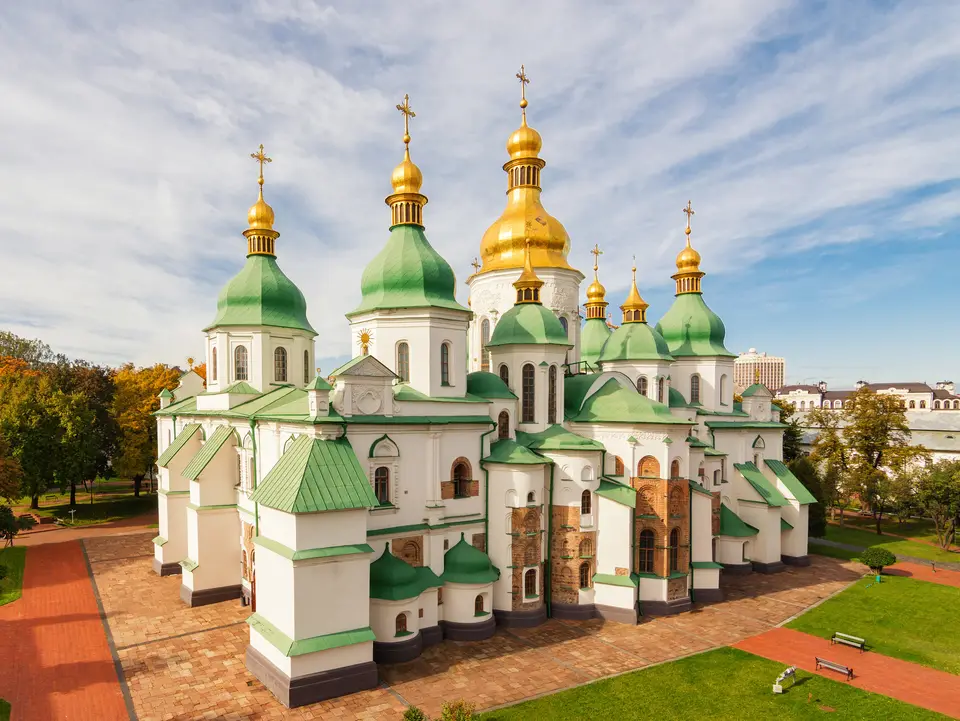
Quick Field Data
- UNESCO Inscription: 1990, inscribed as a cultural property (Cultural heritage property in Kyiv, Ukraine; placed on the List of World Heritage in Danger in 2023)
- Scale & Footprint: Three monumental architectural complexes, Saint-Sophia Cathedral in historic Kyiv, the Kyiv-Pechersk Lavra, and the Church of the Saviour at Berestove, rising above the right bank of the Dnipro River
- Access & Ticketing: Administered by the National Kyiv-Pechersk Historic-Cultural Preserve and state heritage authorities; check the official site for current visiting schedules, bell tower climbs, and cave access
- Arrival Logistics: Saint-Sophia Square stands in the central historic Pechersk and Old Kyiv districts near Golden Gate, while the Kyiv-Pechersk Lavra occupies the wooded Pechersk hills roughly three kilometres south overlooking the Dnipro
Yaroslav the Wise, Christianisation of Kyivan Rus’, and the Monastic Caves
Crowning the steep loess hills along the high right bank of the Dnipro River in the heart of Ukraine's capital, the serial property comprising Saint-Sophia Cathedral alongside its monastic buildings and the, Kyiv-Pechersk Lavra brings together the two foremost spiritual, architectural, and intellectual centres of medieval Eastern Europe. Throughout Ukraine, the UNESCO World Heritage Atlas in 1990, adjusted in boundary in 1990 and placed on the List of World Heritage in Danger in 2023 amid the ongoing war in Ukraine, the site commemorates the political and cultural flowering of the medieval state of Kyivan Rus’ following Prince Vladimir's Christianization of Kyivan Rus’ from Constantinople in AD 988.
In the first half of the 11th century, Prince Yaroslav the Wise erected Saint-Sophia Cathedral in the 11th century as the principal metropolitan church of Kyiv. Designed to rival Hagia Sophia in Constantinople in conscious emulation of the great Hagia Sophia of Constantinople, the cathedral served simultaneously as the seat of the Metropolitan of Kyiv, the site of princely enthronements and foreign ambassadorial receptions, the royal necropolis where Yaroslav the Wise himself was laid to rest inside a carved white marble sarcophagus, and the home of the earliest known library and chronicle scriptorium in Kyivan Rus’.
Just over a decade after Yaroslav founded Saint-Sophia in the walled Upper Town, the monastic movement of Kyivan Rus’ took root three kilometres downriver on the wooded Berestove slopes overlooking the Dnipro. In 1051 the ascetic monk Anthony, Anthony returned from Mount Athos after living in a cave at Liubech in the Principality of Chernigov and settled inside a small subterranean cell excavated into the soft hillside clay. Joined by his disciple Theodosius, Theodosius, with the blessing of Metropolitan Hilarion and the patronage of Prince Iziaslav I, who granted the hill above the caves to the Anthonite monks, the growing brotherhood excavated extensive networks of underground chapels, hermit cells, and burial niches while constructing above-ground stone churches beginning with the Dormition Cathedral up to 1078 under Prince Sviatoslav II. Over the centuries the Kyiv-Pechersk Lavra, the Monastery of the Caves, became a leading centre of East Slavic historiography, icon painting, medicine, and printing: here Nestor the Chronicler worked on the Primary Chronicle and the Kiev Pechersk Patericon, the painter Alipy led the Icon Painting Workshop, Agapetus practised medicine, and in 1613, 1620 Archimandrite Eliseus Pletenetsky, Pletenetskyi, founded the Lavra Printing House alongside scholars such as Zacharias Kopystensky and Joannicius Galiatovsky before Metropolitan Peter Mohyla established his collegium and united it with the Kyiv Brotherhood school to form the Kyiv Brotherhood Academy. Following the devastation of the Mongol siege of 1240 and decades of neglect, both Saint-Sophia and the Lavra underwent a magnificent architectural rebirth during the late 17th and 18th centuries under the patronage of Cossack Hetman Ivan Mazepa, who clothed the medieval red-brick and stone churches in the exuberant whitewashed stucco, floral ornament, and gilded pear-shaped domes of the Ukrainian (Cossack) Baroque. Golden domes crown the river hills.
Eleventh-Century Byzantine Mosaics, Frescoes, and Cossack Baroque Ensembles
Behind its whitewashed 18th-century Ukrainian Baroque exterior crowned by thirteen gilded cupolas, arranged to symbolize Christ and the Apostles, Saint-Sophia Cathedral retains the most complete surviving 11th-century Byzantine interior layout and monumental decorative programme anywhere in the Orthodox world. Built by Byzantine master masons from Constantinople and local builders in the opus mixtum technique of alternating courses of pink lime-and-crushed-brick mortar, natural fieldstone, and flat plinthite bricks, the original five-aisled cross-in-square core measured five-aisled dimensions and was wrapped by two tiers of open exterior galleries and two western staircase towers leading up to the expansive princely choir gallery.
Preserved across the central dome, drum, triumphal arch, and main apse are brilliant 11th-century mosaics composed of smalt glass tesserae laid over gold and silver leaf. Looking down from the zenith of the central cupola is the stern stern medallion of Christ Pantocrator surrounded by four archangels and the Apostles in the drum, while the half-dome of the eastern apse is dominated by the six-metre-tall figure of the Virgin Orans standing in prayer with raised hands above a Deisis, the Annunciation, and the liturgical scene of the Apostles, accompanied by a Greek inscription proclaiming that God is in the midst of the city and it shall not be shaken. Complementing the mosaics are thousands of square metres of original 11th-century wet-plaster frescoes that cover the side aisles, galleries, and staircase towers. Alongside biblical narratives and standing saints, the nave walls preserve remnants of the family portrait of Prince Yaroslav the Wise, and his princely family, while the two western staircase towers display unique 11th-century secular frescoes of the Constantinople hippodrome showing the Byzantine emperor and empress watching four-horse chariot races, musicians playing pipes and a pneumatic organ, acrobats, clowns, and hunting scenes. Surrounding the cathedral inside its defensive walls stand the four-tiered, Baroque Belltower begun under Hetman Ivan Mazepa, the Metropolitan’s House, the Refectory Church, the Zaborovsky Gate crafted by Johann Gottfried Schädel, the Theological Seminary, and the monastic walls.
Three kilometres south, the Kyiv-Pechersk Lavra spreads across two terraced hills divided by a forested ravine into the Upper Lavra and the Lower Lavra, linked along its northern edge to the early 12th-century Church of the Saviour at Berestove founded by Prince Volodymyr Monomakh. Dominating the Upper Lavra is the Great Lavra Bell Tower, erected between 1731 and 1745 by architect Johann Gottfried Schädel as an octagonal four-tiered neoclassical and Baroque campanile rising 96.5 metres above the Dnipro, beside the reconstructed seven-domed Dormition Cathedral, the 12th-century Trinity Gate Church painted inside and out with vivid early 18th-century Ukrainian Baroque frescoes above the main western entrance, the All Saints Church over the northern gate, the Refectory Church of Saints Anthony and Theodosius, and the fortified walls constructed by Hetman Ivan Mazepa and military engineer Debosquette. Descending into the Lower Lavra leads to the Near Caves and the Far Caves, where narrow candlelit underground passages connect subterranean chapels, including the churches of the Exaltation of the Cross, the Nativity of the Mother of God, the Conception of Saint Anne, and the Life-Giving Spring, and burial niches containing the relics of over 100 Lavra saints and historical figures, including Nestor the Chronicler, Kuksha, Alipy, Agapetus, Spyridon, Ilya Muromets, Pope Clement I, Duke Feodor Ostrogski, Konstanty Ostrogski, Simeon Olelkovich, Skirgaila, Vasily Kochubey, Ivan Iskra, and Pyotr Stolypin.
Visiting Saint-Sophia Square and the Upper and Lower Lavra
Because the World Heritage property consists of two distinct historic precincts separated by central Kyiv, visitors typically dedicate a morning to the Saint-Sophia Cathedral conservation area in the Upper Town and an afternoon to the sprawling hilltop grounds, museums, and subterranean labyrinths of the Kyiv-Pechersk Lavra and the Church of the Saviour at Berestove.
- Saint-Sophia Cathedral interior, Yaroslav's sarcophagus, and the Bell Tower: Enter the walled garden of Saint-Sophia Square through the ground floor of the Baroque Belltower to step into the dim, golden interior of the 11th-century cathedral. Pause beneath the central cupola to study the mosaics of Christ Pantocrator and the Virgin Orans in the apse, examine the carved Christian symbols on the marble sarcophagus of Yaroslav the Wise in the northern aisle, and climb the western staircase tower, viewing the 11th-century Constantinople Hippodrome and hunting frescoes along the steps, to reach the expansive second-floor princely choir gallery and hundreds of medieval Greek, and Latin wall graffiti, before ascending the exterior Belltower for views toward St. Michael's Golden-Domed Monastery.
- Upper Lavra, Trinity Gate Church, and the Great Lavra Bell Tower: Enter the Upper Lavra through the richly painted archway of the 12th-century Trinity Gate Church, whose upper chapel preserves carved gilded iconostases and dynamic Baroque wall paintings by master painters including Alimpy Galik and Stefaovych Sonin. Walk the cobblestoned square around the rebuilt Dormition Cathedral and climb the steps of Schädel's 96.5-metre Great Lavra Bell Tower to look out across the Dnipro River, before visiting the Museum of Historical Treasures of Ukraine, which houses the Martynivka Treasure and ancient gold artefacts from the Black Sea steppes, alongside the Museum of Book and Printing and the Museum of Ukrainian Folk Art inside the former monastic buildings.
- Church of the Saviour at Berestove and the Near and Far Caves: Just outside the northern ramparts of the Upper Lavra, visit the Church of the Saviour at Berestove to see the uncovered 12th-century fresco of the early medieval wall paintings, the 17th-century frescoes commissioned by Metropolitan Peter Mohyla, and the marble tomb of Prince Yuri Dolgoruki, son of Volodymyr Monomakh. Then walk down the covered wooden gallery into the Lower Lavra to explore the underground passages of the Near Caves and Far Caves overlooking the Dnieper River overlooking the Dnipro valley.
