


























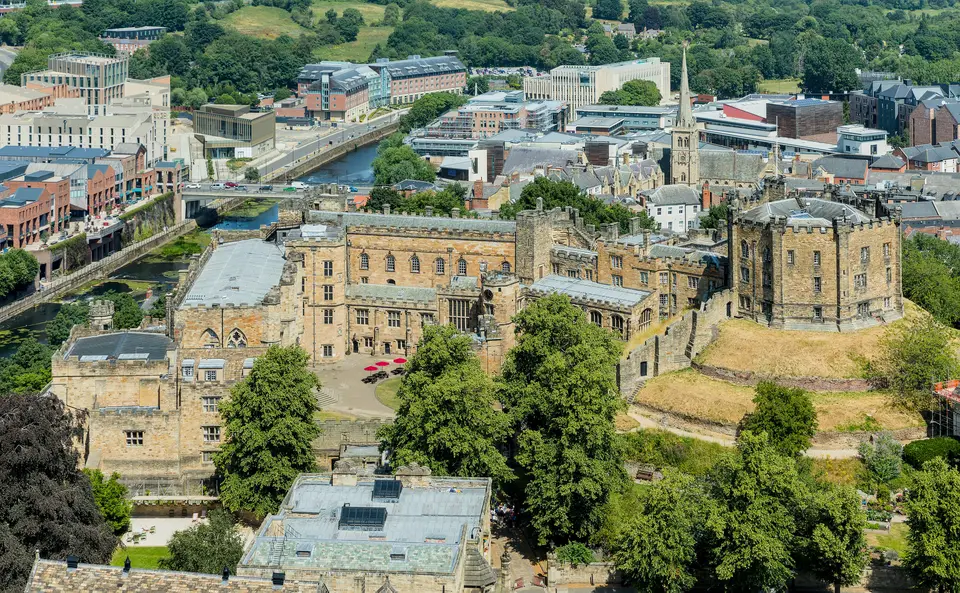
Quick Field Data
- UNESCO Inscription: 1986, extended in 2008 (Cultural, Criteria ii, iv, vi; Property ID 370bis).
- Scale & Footprint: 8.79-hectare fortified peninsula precinct above the River Wear linking Durham Cathedral, Durham Castle (with 17 listed structures at Grade I), and the civic buildings of the Durham Palatinate around Palace Green.
- Access & Ticketing: Durham Cathedral is open to visitors; Durham Castle has housed University College, Durham (over 100 students) since 1837 and is accessible to the public only via guided tours; check the official site for tour booking and service schedules.
- Arrival Logistics: Located at 54.7747°N, 1.5761°W (grid reference NZ274423) in the city of Durham, County Durham, England, on the main railway and road corridor linking northern England and Edinburgh.
St Cuthbert, the Norman Conquest, and the Prince-Bishops of the Durham Palatinate
Commanding a steep rocky peninsula formed by a tight incised bend of the River Wear at 54.7747 degrees north and 1.5761 degrees west in northeast England, Durham Castle and Cathedral form one of the most dramatic architectural silhouettes in Europe. The natural defensive line of the steep river banks first attracted the monastic community of St Cuthbert (AD 634 to 687), the evangeliser of Northumbria, who came to Durham in the 10th century in search of a safe base for the saint's body after enduring repeated Viking raids across several centuries. Following the Norman Conquest of England, William the Conqueror ordered the construction of Durham Castle on a Norman motte-and-bailey plan in 1072, six years after his victory and shortly after Norman forces reached the North. Early work on the fortress was supervised by Waltheof, Earl of Northumbria, until his rebellion against William led to his execution in 1076, while stone blocks for the new buildings were quarried from the river cliffs beneath the walls and hoisted up with winches.
To defend the turbulent northern English frontier against Scottish raids and local uprisings, the English crown granted virtual autonomy and dual religious and secular power to the Bishops of Durham, beginning with Bishop Walcher, whom the king appointed to exercise royal authority from the castle seat and who expanded his authority by purchasing the Earldom of Northumbria. Walcher continued developing the stronghold as both a bishops' residence and a military fortress with inner and outer baileys and a keep, until rebels from Northumbria besieged the castle for four days in May 1080 and killed Bishop Walcher. Ruling the County Palatine of Durham, the line of Prince-Bishops initiated by Walcher held the right to muster armies, collect taxes, and strike their own coins until the Durham (County Palatine) Act 1836 ended the bishops' temporal jurisdiction. Across Palace Green, the Benedictine monastic community built Durham Cathedral between the closing decades of the 11th century and the opening decades of the 12th century to house the relics and bodies of St Cuthbert and the Venerable Bede (AD 672/3 to 735).
Durham Castle served as the episcopal palace for the Bishops of Durham until 1832, when the bishops' residence moved roughly ten miles south to Auckland Castle, where the current bishop still maintains offices. Subsequently, Bishop William Van Mildert donated Durham Castle to the University of Durham to become University College. The college occupied the castle in 1837 after the next bishop, Edward Maltby, completed renovations of the building, and it continues to house over 100 students. During the Second World War, Durham Cathedral was targeted for a German Baedeker Blitz bombing raid, but escaped destruction because a thick bank of fog rolled in over the River Wear and blocked the pilots' view.
Romanesque Rib Vaulting at the Cathedral and Norman Architecture at the Castle
Erected between the late 11th century and the early 12th century, Durham Cathedral demonstrates the prominence of the early Benedictine monastery and stands out as the largest and finest Norman monument in England, while the bold engineering of its stone vaulting directly foreshadowed Gothic architecture across Europe. To span the monumental nave and choir with stone vaulting, the Norman master masons introduced pointed transverse arches and ribbed groin vaults supported by massive composite piers alternating with cylindrical drum columns deeply incised with geometric patterns, braced externally by concealed flying buttresses beneath the triforium roofs. At the western end of the cathedral above the steep river banks, the twelfth-century prelate Hugh de Puiset (Bishop Pudsey) constructed the Galilee Chapel, where the tomb of the Venerable Bede rests alongside the cathedral's eastern shrine of St Cuthbert.
Opposite the cathedral across Palace Green on the northern hill of the peninsula stands Durham Castle (grid reference NZ274423). Seventeen separate structures of the castle are listed at the highest national grade (Grade I), including the keep, the entrance gatehouse, the north and west ranges, a defensive bastion, and twelve sections of the curtain walls. While the earliest structures on the motte and bailey may have been of wood, stone building is documented from the end of the 11th century. The oldest accessible part of the castle is the Norman Chapel, erected against the interior face of the inner bailey wall around 1075 or shortly after 1080. Measuring 32 feet 10 inches (10.01 metres) by 20 feet 9 inches (6.32 metres) in rectangular plan, its architecture is Anglian in nature, possibly because forced Anglian labour was used to build it, with a vaulted ceiling supported by six stone columns each topped with carved capitals; historian David Rollason has argued that this chapel was the St Michael's church where the body of William de St-Calais was laid prior to his burial. During the 15th century, expansion of the keep blocked the chapel's three windows, leaving the room unused until 1841 when it became an access passage to the keep. During the Second World War the Royal Air Force used the chapel as a command and observation post, and through the late 1940s it served as a bicycle shed before being reconsecrated in the 1950s for weekly college services and undergoing outer-wall excavations in the early 2020s to reduce damp.
Successive Prince-Bishops continually modified the castle ranges. During the 12th century, Hugh de Puiset (Bishop Pudsey) added the richly carved Norman archway before a dispute with King Henry II of England prompted the monarch to seize the fortress in 1177. In the early 14th century, Bishop Antony Bek created the vast Great Hall (originally called a Dining Hall), which was modified, enlarged, and later reduced in size by subsequent bishops, measuring 14 metres (46 feet) high and over 30 metres (98 feet) long today. In the 1300s, Bishop Thomas Hatfield added a wooden minstrels' gallery to the Great Hall, rebuilt the keep, and enlarged the keep mount. In the 16th century, Bishop Cuthbert Tunstall built Tunstall's Chapel, which Bishop Cosin subsequently remodelled in the 17th century and which remains in use for worship within the college.
Palace Green, the Palatinate Precinct, and Field Logistics
Throughout United Kingdom, the UNESCO World Heritage List in 1986 and extended in 2008 to cover 8.79 hectares, the designated precinct links Durham Cathedral and Durham Castle across Palace Green, a broad open lawn where the Prince-Bishops once staged ceremonial processions and civic assemblies and which continues to serve as a forum for public events. Bordering Palace Green within the castle precinct stand historic civic buildings of the Durham Palatinate that reflect the secular jurisdiction of the Prince-Bishops, including the Bishop's Court (now a university library), historic almshouses, and schools. Because Durham Castle is a working university college housing over 100 students, it is open to the general public only through guided tours. Travellers continuing north by rail can pair Durham with our Edinburgh travel guide or locate its peninsula on our interactive world map. Steep wooded banks frame the medieval skyline.
- Walking the nave vaults and Galilee Chapel of Durham Cathedral: Enter the cathedral to study the incised drum piers and innovative Norman rib vaulting that foreshadowed Gothic architecture, then visit Bishop Pudsey's western Galilee Chapel housing the Venerable Bede and the eastern shrine of St Cuthbert.
- Joining a guided tour of Durham Castle: Book a guided tour across Palace Green to descend into the 11th-century Norman Chapel with its six carved Anglian capitals, inspect Bishop Antony Bek's 30-metre Great Hall and Hatfield's minstrels' gallery, and visit Tunstall's Chapel with Bishop Cosin's 17th-century woodwork.
- Circling the River Wear peninsula and Palace Green: Explore the civic buildings of the Durham Palatinate bordering Palace Green, including the Bishop's Court library, almshouses, and schools, before walking the footpaths along the steep banks of the River Wear below the castle walls.
