


























Quick Field Data
- UNESCO Inscription: 1988 (Natural Criteria vii, x)
- Scale & Footprint: 3,700-hectare uninhabited elevated coral limestone atoll in the Pitcairn Island group, 200 kilometres northeast of Pitcairn Island
- Access & Ticketing: Administered within the Pitcairn Islands in the British Overseas Territories; check the official site for strict scientific and expedition landing permits
- Arrival Logistics: Situated in the eastern South Pacific with no airfields or ports, more than 5,000 kilometres from the nearest major continental land mass
An Untouched Raised Coral Atoll in the Eastern South Pacific
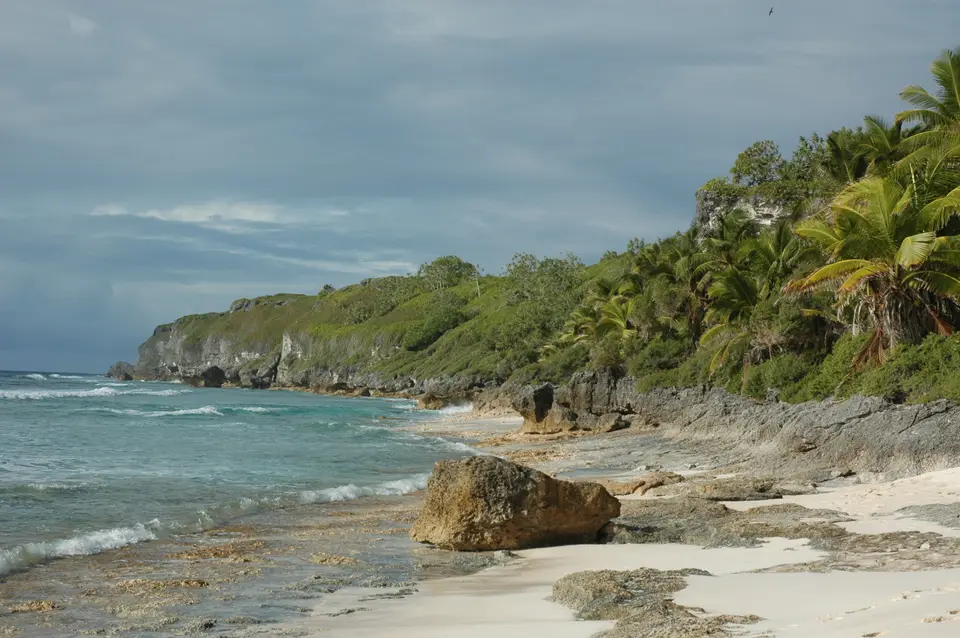
Rising out of the open waters of the eastern South Pacific at approximately 24.3667 degrees south latitude and 128.3333 degrees west longitude, with no major continental land mass within a 5,000-kilometre radius, Henderson Island is one of the very few elevated coral atolls on earth whose terrestrial ecology has remained practically untouched by permanent human presence. Since 1988, the UNESCO World Heritage Atlas in 1988 under natural criteria vii and x (following the United Kingdom's ratification of the 1972 UNESCO World Heritage Convention on 29 May 1984) and plotted on the Atlas, the remote and uninhabited 3,700-hectare island is the largest member of the four-island Pitcairn archipelago, among which only Pitcairn Island itself, lying 200 kilometres to the southwest, is inhabited. Because its raised limestone plateau has little fresh water and is completely unsuitable for agriculture, the island escaped modern clearance and provides an undisturbed baseline for investigating island evolution alongside the processes of natural selection. Coral cliffs ring the entire island.
Within the wider network of 35 World Heritage Sites distributed across the United Kingdom alongside its British Overseas Territories, Henderson Island occupies a distinct geographical and ecological niche. Under the 1972 convention, UNESCO classifies heritage across ten selection criteria, where criteria i to vi recognise cultural monuments, architectural works, monumental sculptures, inscriptions, groups of buildings, and archaeological sites, while criteria vii to x recognise physical and biological formations, geological and physiographical structures, and protected habitats supporting threatened plant and animal species valued for science, conservation, or natural beauty. Across the 35 British listings (comprising eighteen properties across England, seven in Scotland, four across Wales, and two in Northern Ireland, plus one cross-border listing shared between England and Scotland, namely the transnational Frontiers of the Roman Empire shared with Germany alongside transnational listings for the Great Spa Towns of Europe shared with six European countries and the Moravian Church Settlements shared with Denmark, Germany, and the United States including Gracehill in 2024), 29 properties are listed for their cultural significance (ranging from the first 1986 inscriptions at Durham Castle and Cathedral, the industrial valley of Ironbridge Gorge, Studley Royal Park with the Ruins of Fountains Abbey, the prehistoric monuments of Stonehenge and Avebury, and King Edward's Castles and Town Walls in Gwynedd to Greater London's Maritime Greenwich, Kew's Royal Botanical Gardens, the medieval Tower of London, and Westminster Abbey together with the Palace of Westminster and Saint Margaret's Church, as well as Bath, Blenheim, Canterbury, Saltaire, New Lanark, Edinburgh, Pontcysyllte, Forth Bridge, Blaenavon, Welsh Slate, Derwent Valley Mills, Orkney, Lake District, and Jodrell Bank). Only five properties are inscribed solely for their natural significance (including the Giant's Causeway and Causeway Coast in 1986, the Jurassic Coast, and the Flow Country), while one, St Kilda in Scotland, is inscribed for both cultural and natural criteria, and five further properties stand on the tentative list. Across the global British Overseas Territories, just four World Heritage listings exist: one each in Bermuda, Gibraltar (Gorham's Cave), Saint Helena (Gough Island and Inaccessible Island in the South Atlantic), and the Pitcairn Islands (Henderson Island in the South Pacific).
Unlike low-lying ring atolls that barely break the ocean surface around a shallow lagoon, Henderson Island is an uplifted oceanic coral atoll whose ancient reef flat and central lagoon have been raised high above the waves by tectonic and volcanic forces in the South Pacific. Over millennia of exposure to rain and salt spray, the porous coral limestone weathered into a jagged, honeycombed karst plateau of sharp limestone pinnacles, sinkholes, and sheer coastal cliffs bordered by narrow coral beaches. Archaeological evidence indicates that early human voyagers colonised the island for a period before abandoning the waterless rock; during that early human colonisation, at least four other endemic bird species and one native bird species are believed to have become extinct. Once human occupation ceased, however, the dense tangled scrub forest covering the raised plateau persisted without colonial agricultural plantations or industrial mining, leaving the fundamental geological and biological features of an uplifted, scrub-forested oceanic coral atoll intact as a key reference for comparable atolls across the Pacific.
Ten Endemic Plants, Four Land Birds, and the Henderson Petrel
Given its compact 3,700-hectare footprint and extreme geographic isolation in the eastern South Pacific, Henderson Island exhibits exceptional biological diversity and endemism across its vascular flora, terrestrial avifauna, and breeding pelagic seabird colonies:
- Fifty-seven native vascular plants and ten endemic taxa: Although oceanic atoll floras are typically species-poor due to salt spray, nutrient-poor limestone substrates, and the scarcity of fresh water, botanical surveys on Henderson Island have recorded 57 native vascular plant species across the coastal cliffs and forested interior plateau. Among these 57 native vascular plants are 10 endemic taxa found nowhere else: six fully endemic plant species restricted solely to Henderson Island, three endemic botanical varieties, and one additional vascular species endemic strictly to Henderson and neighbouring Pitcairn.
- Four endemic species of land birds: Because no native terrestrial mammals inhabit the atoll, land birds evolved to fill the ecological niches of the forested limestone plateau from the leaf litter to the upper scrub canopy. Four surviving species of land birds are wholly endemic to Henderson Island, demonstrating how small founding populations on an isolated oceanic island adapt their foraging behaviour, plumage, and morphology through natural selection.
- Sole global nesting ground for the endangered Henderson Petrel: For pelagic seabirds ranging across thousands of kilometres of the open South Pacific, the remote karst ledges and dense plateau vegetation of Henderson Island provide an essential breeding sanctuary. Most importantly, the island is the sole global nesting ground for the endangered Henderson Petrel, which breeds beneath the sheltered scrub of the forested plateau.
- Ten other breeding seabird species: Alongside the endangered Henderson Petrel, the atoll functions as a vital nesting ground for ten or more additional pelagic seabird species, whose vast breeding colonies enrich the thin soils of the forested coral plateau with marine nutrients and sustain the ecological balance of the raised atoll ecosystem.
Conservation Baseline, Remote Governance, and Expedition Protocols
Whereas urban development pressures in the United Kingdom once led the World Heritage Committee to place Liverpool (first inscribed as a cultural site in 2004) on the List of World Heritage in Danger in 2012 before its removal from the register in 2021 (leaving it as one of only three properties worldwide ever removed from the World Heritage register), Henderson Island owes its preservation to its extreme geographic isolation 5,000 kilometres from any major continent and 200 kilometres from the nearest inhabited settlement on Pitcairn. That same remoteness requires strict biosecurity vigilance whenever scientific monitoring teams visit the atoll, ensuring that no new invasive species or human disturbances compromise its value as an undisturbed scientific baseline for Pacific atoll ecosystems:
- Entry and route: Henderson Island has no harbour, airstrip, jetty, fresh water supply, or permanent human residents. Reaching the atoll is possible only aboard a long-range ocean-going research vessel or chartered expedition yacht sailing 200 kilometres northeast from Pitcairn in the eastern South Pacific, followed by small boat landings through the coastal surf when sea swells are calm.
- Tickets and viewpoints: All visits and scientific landings on Henderson Island are strictly regulated by the authorities of the Pitcairn Islands within the British Overseas Territories to protect the 10 endemic plant taxa, four endemic land bird species, and ground-nesting Henderson Petrel colonies; check the official site well in advance of any voyage to apply for a formal landing permit and mandatory biosecurity clearance.
- Timing and onward connections: Because cutting paths through the jagged coral limestone pinnacles and dense scrub of the 3,700-hectare plateau can damage fragile nesting habitat and endanger visitors, authorised scientific personnel and expedition observers restrict their movements to approved coastal landing zones during brief daylight weather windows.
