Quick Field Data
- UNESCO Inscription: 2000 (Ref. 960), cultural monastic complex in Kotayk Province, Armenia; Criterion (ii).
- Scale & Footprint: 2.97 hectares enclosing the fortified monastic compound and rock-hewn chambers at the Upper Azat Valley entrance, framed by a protective buffer zone established in 1986.
- Access & Ticketing: Owned by the Armenian Apostolic Holy Church and protected under national monument laws; check official local monastery guidelines for dress norms and access inside active chapels.
- Arrival Logistics: Closest major commercial air hub is Zvartnots International Airport (EVN), 36 kilometres west. Regional overland links extend 175 kilometres north toward Tbilisi.
Ayrivank Cave Origins and Geghard Monastery History in Armenia
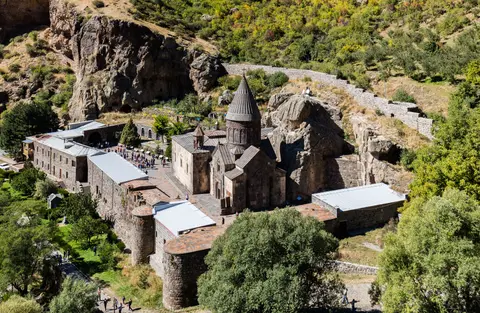
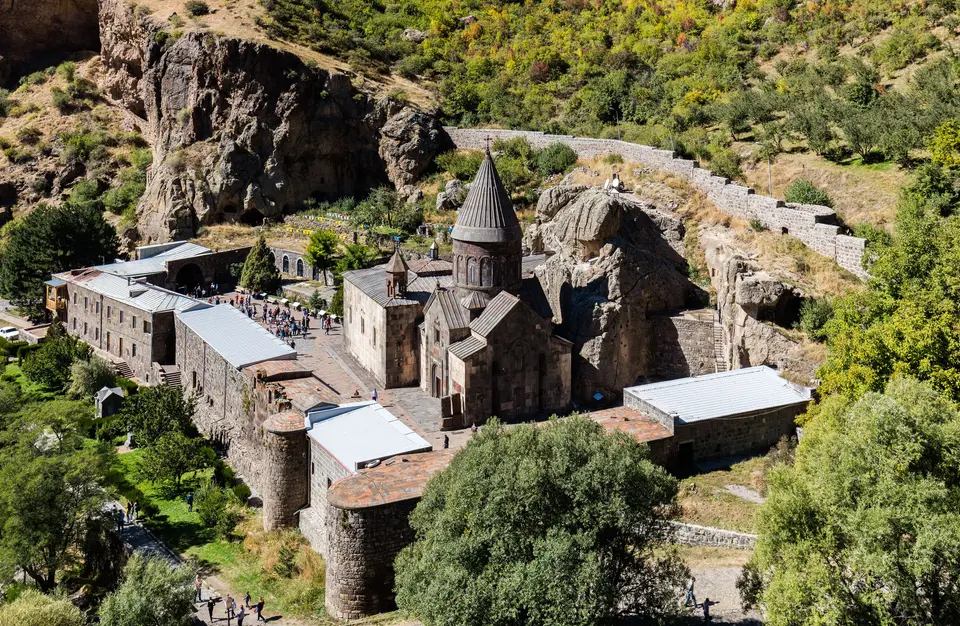
Positioned where towering canyon walls narrow the entrance to the Upper Azat Valley in Armenia's Kotayk Province, Geghard Monastery blends free-standing medieval stonework straight into sheer cliff rock. Tradition credits St. Gregory the Illuminator with founding the first sanctuary here in the early fourth century AD, right after Christianity became Armenia's state religion. He established the settlement beside a spring rising inside a cavern that had already drawn pre-Christian reverence. Early centuries knew the cliff sanctuary as Ayrivank, meaning Monastery in the Cave, reflecting its excavated shrines.
Nothing survives above ground from that earliest fourth-century foundation because medieval invasions and earthquakes battered the canyon repeatedly. Historical writers from the fourth, eighth and tenth centuries record that early Ayrivank supported substantial residential and service quarters together with its sacred caves. Arab armies destroyed the original monastic foundation during the ninth century. In 923, Nasr, vice-regent of an Arabian caliph in Armenia, plundered Ayrivank's treasures, carried off irreplaceable manuscripts and set fire to the complex before seismic shocks damaged surviving structures further.
Revival began in the late 12th century and accelerated dramatically after Zakarid generals Zakare and Ivane recovered much of Armenia under Queen Tamar of Georgia. Carved wall inscriptions inside the western precinct date back to the 1160s, while St. Astvatsatsin Chapel outside the ramparts preserves engraved donor texts from 1177 and 1181 AD. In 1215, Zakare and Ivane sponsored construction of Katoghike, the present main church pressed against the northern mountain wall. Soon after, Prince Prosh Khaghbakian, a vassal of the Zakarians and founder of the Proshian principality, bought the site and financed extraordinary rock-cut chambers.
Sacred relics elevated Geghard Monastery history into a premier pilgrimage destination across medieval Armenia. According to monastic tradition, the Apostle Thaddeus brought the lance that wounded Christ on the Cross to Armenia, where monks safeguarded the iron spearhead for roughly five centuries. Documents dating from 1250 first record the name Geghardavank, meaning Monastery of the Spear. Relics of the Apostles Andrew and John arrived during the 12th century, while pilgrims granted estates, gold and illuminated manuscripts; the diamond-tipped spear now rests inside a 1687 gilded silver case at the Echmiadzin treasury.
Scholarship flourished together with pilgrimage inside the cliff-side cells during the 13th century, when Geghard operated as a leading ecclesiastical and cultural centre. Famous 13th-century Armenian historians Mkhitar Ayrivanetsi and Simeon Ayrivanetsi studied and wrote here, advancing Armenian manuscript illumination while teaching inside the monastic school, scriptorium and library. Known contemporarily as the Monastery of the Seven Churches and the Monastery of the Forty Altars, Geghard later fell dormant, even sheltering Karapapakh nomads' winter flocks inside Katoghike until monks from Echmiadzin resettled the canyon after the Russian conquest.
Katoghike Church, Stalactite Gavit, and Rock-Cut Proshyan Chambers
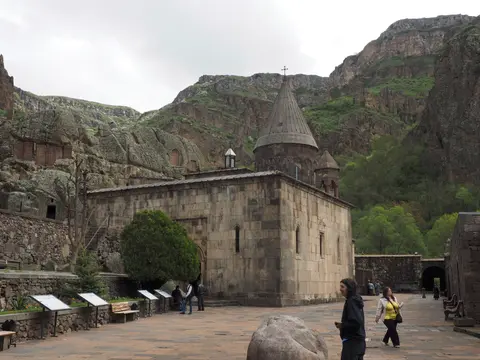
Entering from the west reveals how 12th-to-13th-century defensive ramparts enclose three sides of the monastic courtyard while natural mountain cliffs seal the northern flank. Outside the walls along the western hillside stand rock-cut monastic cells, simple oratories and St. Astvatsatsin Chapel, partially hewn into living rock as the oldest surviving monument beyond the fortifications. Perimeter one- and two-storey residential quarters and service buildings experienced repeated reconstruction, especially in the 17th century and again between 1968 and 1971. Across surrounding rock faces and courtyard walls, relief-carved and free-standing Armenian cross-stones (khachkars) commemorate departed donors and monastic endowments.
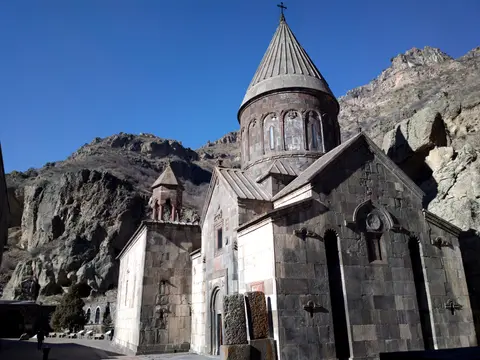
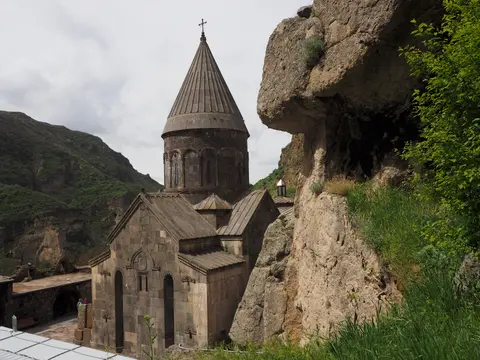
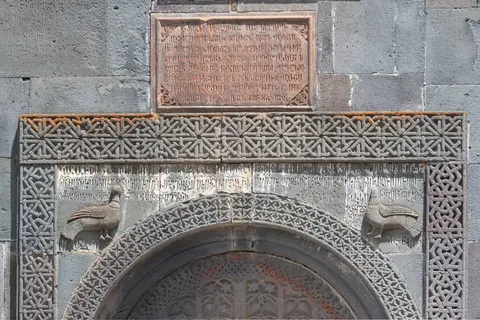
Katoghike, completed in 1215, anchors the courtyard with classical Armenian masonry even though its interior never exposes raw mountain rock. Laid out as an equal-armed cross inscribed inside a rectangle, the church rises toward a vaulted drum and conical dome over a square base. Its eastern arm closes in a curved apse, while small barrel-vaulted two-storey chapels occupy the four corner chambers, reached by narrow stone steps jutting from the interior walls. Inside, closely fitted masonry preserves carved donor inscriptions, while the southern facade carries reliefs of pomegranate trees, intertwining grape leaves, doves and a lion attacking an ox.
Linked directly west of Katoghike stands the rock-attached gavit (entrance vestibule), constructed between 1215 and 1225 for teaching, monastic assemblies and pilgrim receptions. Partially masonry and partially carved out of the mountain, the hall supports its ceiling on four massive free-standing stone columns leaving a central light aperture open to the sky. The central bay rises into a sculpted stalactite vault widely regarded as the finest Armenian example of this muqarnas-inspired masonry technique. Western portal archivolts display finely chiselled floral bands framing dense garlands of petals and oblong leaves.
Northwest of the gavit, excavators in the 1240s hollowed Avazan, the first major rock-cut church, directly into the ancient spring cave during the rule of Prince Avag. Built on an equal-armed cruciform plan under architect Galdzak, whose name appears carved below pomegranate reliefs around the tent dome, the chamber channels living spring water across stone channels. Two crossed pointed arches carry the central stalactite cupola over an altar apse and deep wall niches, while acoustic resonance turns quiet liturgical singing into prolonged harmonic echoes throughout the carved stone vault.
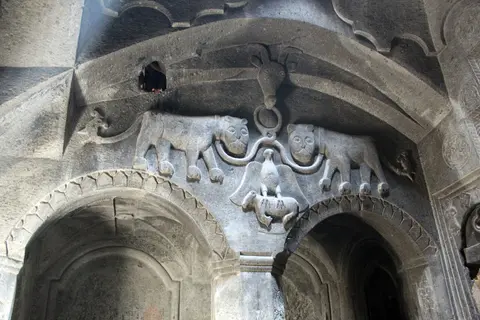
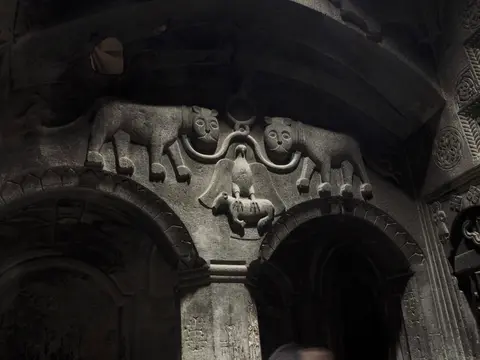
East of Avazan opens the square rock-cut funerary chamber (zhamatun) carved in 1283 as the tomb of Prince Prosh Khaghbakian, bearing the Proshian family crest of an eagle gripping a lamb between two chained lions. This princely sepulchre opens directly into a second rock-cut church completed in 1283, forming part of architect Galdzak's four-decade cave programme. An external stairway west of the gavit climbs upward to a second rock-hewn zhamatun carved in 1288 for Princes Papak and Ruzukan Proshian, next to a former assembly hall that collapsed during the mid-20th century.
Upper Azat Gorge Cliffs, Seismic Risks, and Heritage Stewardship
Beyond the monastic ramparts, Geghard forms part of an extraordinary cultural landscape where more than twenty carved spaces pierce surrounding stone massifs at varying heights. Western cliff cavities functioned chiefly as practical service rooms, whereas eastern and upper excavations house small rectangular chapels fitted with semicircular apses and carved stone altars. Twin and triple chapels frequently share single ornamented portals facing the Upper Azat Valley. Even the Proshyan princes' 13th-century irrigation channels demonstrate how medieval engineers harnessed mountain snowmelt across the rocky gorge slopes.
Today, Geghard ranks among the oldest and best-preserved monasteries in Armenia, holding both UNESCO World Heritage status since 2000 and enhanced international protection. Joint stewardship pairs ownership by the Armenian Apostolic Holy Church with national statutory protection under Armenia's historic monument legislation and Civil, Administrative, Land and Criminal Codes. Methodological and architectural councils shared equally between the Ministry of Culture and the Mother See of Holy Echmiadzin oversee technical reviews and maintenance, while a state monument agency guards the 1986 buffer zone against unauthorised development.
Preserving rock-cut architecture carved directly into vertical cliffs demands vigilant monitoring against seismic tremors, rockslides, water infiltration and surrounding environmental pressures. Situated inside an active earthquake belt, Geghard relies on water-isolation designs to protect submerged rock-hewn domes from freeze-thaw seepage without altering historic stone permeability. When part of a wall adjacent to auxiliary quarters collapsed over time, conservation engineers rebuilt it during 2006 and 2007 using matching traditional masonry materials. Heavy tourist flows along the active canyon approach also require steady path upkeep to protect exposed cliff khachkars.
Because active Armenian Apostolic services continue inside Katoghike and the rock-hewn chambers, living liturgical traditions remain inseparable from the architecture. Near the secondary eastern gate, a stone bridge crosses the mountain stream beside a traditional stone table reserved for ritual matagh offerings. Visitors walking up from the paved car park pass local stalls selling sweet bread, dried fruit sheets called lavash and walnut-filled sweet sujukh coated in grape molasses. Keeping both living monastic worship and structural rock preservation balanced protects the site for pilgrims and architectural historians alike.
Access Zones Across Geghard Monastery Armenia
Arriving early helps visitors explore quiet rock-hewn chambers before midday tour coaches reach the Upper Azat Valley. Check local church etiquette signs at the western entrance before stepping inside active chapels of Geghard Monastery Armenia.
| Complex Zone | Key Highlights | Access & Ticket Rule |
|---|---|---|
| Western Approach and Cliffs | Hillside caves, ancient wish shelves, St. Astvatsatsin Chapel and 12th-to-13th-century perimeter defensive walls. | Open pedestrian approach path from the valley road; keep clear of steep cliff ledges and loose scree slopes. |
| Katoghike and Stalactite Gavit | 1215 domed cruciform church, carved south portal, four-columned entrance vestibule and muqarnas ceiling aperture. | Free public entry into active sanctuary spaces; wear modest attire and maintain quiet behaviour during services. |
| Avazan and Proshyan Caves | 1240s rock-cut spring church, 1283 Proshyan zhamatun heraldic reliefs and upper 1288 Papak-Ruzukan funerary chamber. | Access via interior rock doorways and external stone stairs; watch for damp stone floors near the cavern spring. |
| Eastern Stream and Yard | Reconstructed 17th-century residential perimeter quarters, khachkar-carved rock walls, stream footbridge and matagh altar. | Open courtyard trails; avoid touching carved relief inscriptions or disturbing active monastic clergy rooms. |
Three Rock-Cut and Relief Details Around Geghardavank
- Central Light Aperture in the 1215 to 1225 Gavit: Stand beneath the four stout columns inside the vestibule to view the sculpted stalactite dome channelling soft canyon daylight downward through its narrow ceiling opening.
- Proshian Eagle and Bull Head Reliefs: Inside the 1283 rock-cut funerary chamber, inspect the carved dynastic coat of arms depicting an eagle clutching a lamb flanked by chained lions and a bull's head gripping a rope.
- Southern Katoghike Portal Tympanum: Step outside into the courtyard to trace crisp medieval stone carvings of fruiting pomegranate trees, intertwined grape vines, perched doves and a lion subduing an ox above the church door.
Planning a Garni-Geghard Day Route From Yerevan Airport
Among famous monasteries in Armenia, Geghard pairs effortlessly with the classical pagan Temple of Garni lower down the Azat River gorge. Travellers searching for geghard temple armenia often confuse the Christian cave complex with nearby Garni, yet exploring both together along the paved Garni-Geghard valley road offers an exceptional contrast between Hellenistic colonnades and medieval rock-cut churches. Clear, mild spring and autumn days provide the most comfortable walking weather across stone stairways, while winter snowfall adds quiet drama around the canyon walls.
Plan two unhurried hours inside the 2.97-hectare compound to inspect the carved southern portal, listen to singing inside Avazan's spring chamber and climb the external stone steps up to the 1288 Proshyan tomb. Walking past the western entrance wish shelves before crossing the eastern stream footbridge reveals dozens of cliffside khachkars carved directly into raw stone faces. Because active liturgical services draw local Armenian families throughout weekends and feast days, quiet weekday mornings give photographers and architectural students clear views inside the dim gavit.
International visitors reach Geghard swiftly via Zvartnots International Airport (EVN), positioned just 36 kilometres west on the outskirts of Yerevan. Regional overland itineraries also link Armenia's Kotayk highlands northward across the Caucasus border toward Tbilisi (175 kilometres north). Explore more medieval monastic traditions and rock-cut complexes inside our UNESCO World Heritage Atlas.