Quick Field Data
- UNESCO Inscription: 2019 (Ref. 1587), 15-component serial cultural site across Xiengkhuang Province, Lao People's Democratic Republic; Criterion (iii).
- Scale & Footprint: 174.56 hectares across 15 protected hillside and quarry components holding 1,325 of the more than 2,100 megalithic jars recorded across the Xiangkhoang Plateau.
- Access & Ticketing: Protected under the Law on National Heritage (2013), Presidential Decree (1997) and Provincial Governor Decrees Nos. 870, 995 and 996; seven UXO-cleared sites (Sites 1, 2, 3, 16, 23, 25 and 52) are open to visitors with strict path-staying rules and village revenue-sharing gate tickets.
- Arrival Logistics: Closest international gateway is Luang Phabang International Airport (LPQ), 123 kilometres west across northern Laos before mountain overland transfers to Phonsavan. Regional Southeast Asian routes also connect northeast across the Annamite Range toward Hanoi (327 kilometres).
Xiengkhuang Plateau Crossroads and Iron Age Jar Origins
Checking plain of jars laos location coordinates places this megalithic landscape across upland valleys of central-northern Laos. Known locally in Lao as Thong Hai Hin, the plain occupies the Xiangkhoang Plateau at the northern tip of the Annamese Cordillera, Indochina's main mountain chain. Here, upland passes linked two great prehistoric Asian corridors: the Mun-Mekong river system and the Red River to Gulf of Tonkin route. Because these natural valley corridors encouraged ancient overland travel, trade and cultural exchange, communities placed massive stone jars along lower hill slopes, spurs and ridges watching over regional trails.
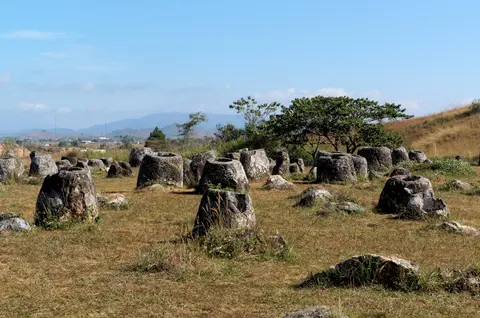
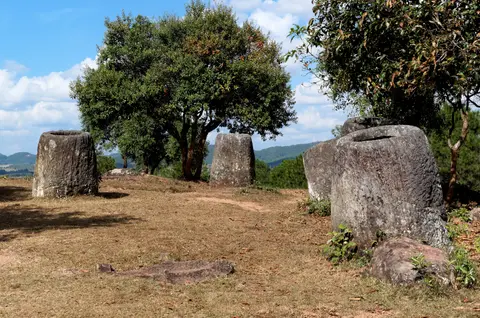
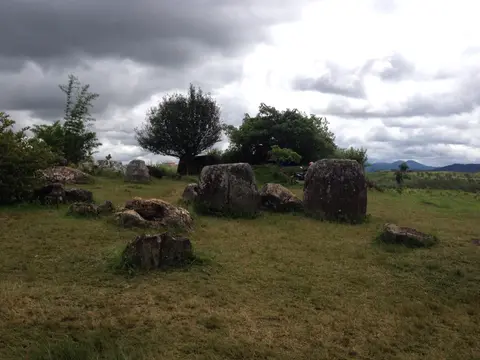
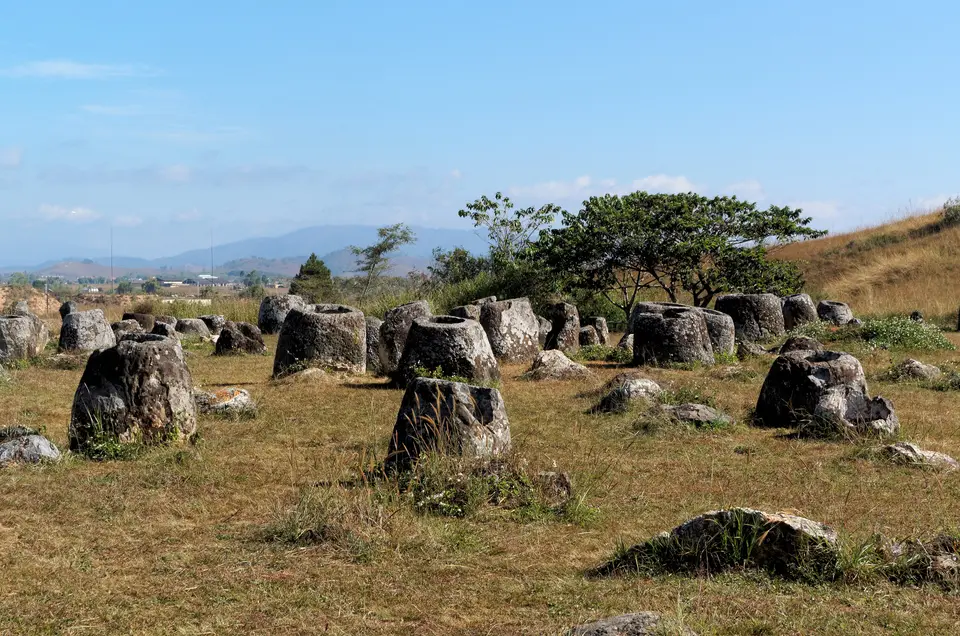
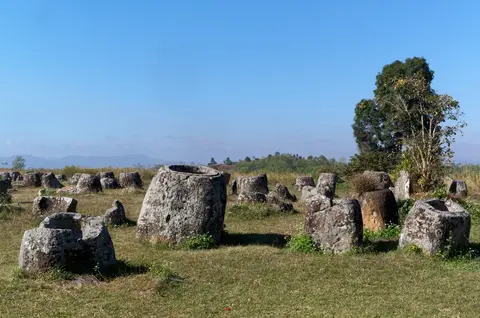
Systematic surveys across Xiangkhoang Province confirm 129 jar sites containing over 2,100 tubular stone vessels in clusters ranging from single jars up to nearly 400. While more than 50 locations carry UNESCO recognition, the 2019 plain of jars laos unesco serial listing selects 15 components spanning 174.56 hectares and preserving 1,325 jars plus quarries, discs and graves. Each cylindrical vessel stands one to three metres tall and wide, engineered with a wider solid base that balanced heavy masonry on sloped hillside ridges. Researchers led by Dougald O'Reilly in 2018 catalogued six distinct rim finishes: flat, recessed inner, outer, recessed inner with outer rim, prominent and collar. Their 59-site survey further established that mountain terrain held most clusters, with 16 sites containing 20 to 60 jars and only three sites exceeding 200 jars.
Archaeometric dating traces plain of jars laos history across a vast span of prehistoric and early historic funerary customs. Optically stimulated luminescence dating indicates initial jar placement occurred as early as 1240 to 660 BCE, while UNESCO syntheses assign the primary Iron Age jar culture roughly between 500 BCE and 500 CE (continuing possibly toward 800 CE). Scattered near the jars sit 200 carved stone discs flat on at least one side. Because no disc fits jar rims and none sat atop a vessel, scholars identify them as flat burial-pit markers paralleling northern Huaphanh's Bronze Age standing stones, carrying spread-eagle human figures, tigers and monkeys.
Plain of Jars Laos Excavation From Colani to 2026 Findings
Modern plain of jars laos excavation began in 1930 with French researcher Madeleine Colani, whose landmark two-volume 1935 monograph documented 21 sites and excavated twelve. Around Site 1 (Ban Ang) near Phonsavan, Colani excavated around 20 jars and recovered black organic soil containing coloured glass beads, burnt human bone fragments and teeth sometimes belonging to multiple individuals. Associated layers yielded spindle whorls, ear discs, ceramic weights, charcoal and bronze and iron knives, tools and jewellery, while unburnt secondary human burials surrounded jar bases in a unified mortuary complex.
Post-war fieldwork resumed decades later after shifting metric coordinate systems had temporarily obscured several of Colani's outlying locations. In November 1994, Eiji Nitta of Kagoshima University and Lao archaeologist Thongsa Sayavongkhamdy mapped Site 1, demonstrating that surrounding burial pits were cut directly into the jar-placement surface. Between 1994 and 1996, Sayavongkhamdy and Peter Bellwood (Australian National University) interpreted central jars as elite primary or secondary graves ringed by family burials. Subsequent bomb-clearance digs led by UNESCO archaeologist Julie Van Den Bergh in 2004, 2005 and 2007 confirmed these findings, while Dougald O'Reilly's 2018 Safeguarding the Plain of Jars Project surveyed 59 sites (recording 16 with 20 to 60 jars and just three exceeding 200).
Recent bioarchaeological excavations uncovered striking continuity of funerary use centuries after Iron Age builders faded. Fieldwork by the joint Lao-Australian Plain of Jars Archaeological Project (2016 to 2020) confirmed secondary burials at Site 1 spanning the eighth to thirteenth centuries CE and exposed uncremated human remains inside a stone vessel at Site 75. In 2026, archaeologists excavating Jar 1 at Site 75 (roughly 1.3 metres high and over two metres wide) recovered glass beads and undisturbed remains of at least 37 adults and children radiocarbon-dated between 890 and 1160 CE, proving repeated multi-generational secondary burials.
Carved iconography around jar groupings connects Xiengkhuang to wider mainland Asian prehistoric art. Many of the 200 flat-sided stone burial-marker discs bear uniform anthropomorphic spread-eagle figures with straight or bent legs, joined by zoomorphic carvings of tigers and monkeys. In sharp contrast, only one carved stone vessel anywhere on the plain displays exterior sculpture: a jar at Site 1 bearing a human frogman bas-relief closely echoing 500 BCE to 200 CE Huashan cliff paintings in Guangxi, China.
Five Rock Types, Unexploded Ordnance Clearance, and Conservation
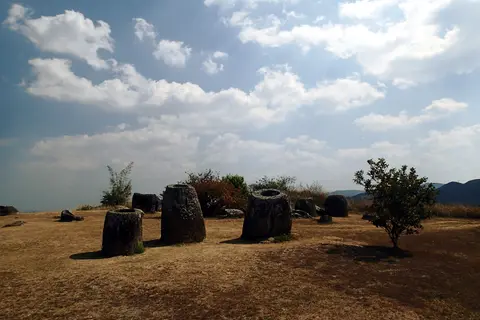
Detailed geological mapping reveals skilled quarrying across five distinct rock types scattered around Xiangkhoang's valleys. Sandstone accounts for the majority of jars and every massive vessel perched on highland ridges, matching upland quarries closely. Detrital zircon analysis on Site 1 sandstone jars traced their stone to a quarry roughly eight kilometres away, while bedrock outcrops near Sites 2 and 3 still retain partially hewn jars locked directly into living rock. Although iron chisels are widely suspected, experimental archaeology showed stone tools could carve sandstone jars even though Laos's two main iron ore deposits sit inside Xiangkhoang.
Four other local stone varieties appear in smaller regional clusters with varying preservation states. Small, deeply weathered granite vessels occur exclusively in Khun District, reflecting harder extraction effort, while conglomerate jars composed of medium gravel clasts in fine matrix often survive broken and fragmented. Brittle honeycombed limestone and stronger mid-grey reef limestone appear only at Site 39 (Ban Phonekham), Ban Tha, Site 41 (Phou En Kha) and Site 43 (Phu Hai Hin), whereas breccia jars occur solely at Ban Nom Hom beside a fault-line hot-spring valley.
Twentieth-century conflict left heavy physical scars linked directly to plain of jars laos vietnam war history across the plateau. Wartime aerial bombing gouged craters around Site 1 and left unexploded ordnance (UXO) across rural ridges, compounded locally by cattle grazing, poorly sited tracks and modern constructions near Site 3 and outside Site 1's buffer zone. Following sustained clearance campaigns, Lao authorities achieved UXO clearance across all 15 UNESCO components. Today seven cleared sites welcome visitors safely: Sites 1, 2 and 3, Site 16 near old Xieng Khouang, Site 23 near Muang Kham's hot spring, remote Site 25 in Phou Kout District and 392-jar Site 52 beside a Hmong village. Preserving all 15 components together documents the complete ancient cycle from mountain bedrock extraction through funerary placement.
Statutory governance coordinates preservation across national, provincial, district and village levels under Laos's Law on National Heritage (2013) and Presidential Decree (1997). Coordinated by the National Committee for World Heritage and Xiengkhuang Heritage Steering Committee, Provincial Decrees Nos. 870, 995 and 996 created the Plain of Jars Heritage Technical Division, established tourism revenue-sharing formulas and launched a five-year project plan covering fencing, roads, interpretive boards and Heritage Impact Assessments. Day-to-day site care at most components operates directly through contracts between nearby villages and the provincial government, pairing archaeological protection with steady community stewardship.
Access Zones Across the UXO-Cleared Plain of Jars Sites
Checking a plain of jars laos map before departing Phonsavan ensures every excursion stays inside the seven cleared heritage grounds. Obey red-and-white UXO safety boundary markers strictly and never wander off swept pathways into unmarked pastureland.
| Complex Zone | Key Highlights | Access & Ticket Rule |
|---|---|---|
| Site 1 (Ban Ang, near Phonsavan) | Most visited hillside cluster featuring giant sandstone jars, the unique frogman bas-relief jar, cave mouth and wartime craters. | Shortest drive from Phonsavan; buy gate tickets at the village entrance and stay strictly inside cleared pathway markers. |
| Sites 2 and 3 (Southern Phonsavan Circuit) | Ridge-top stone clusters near Phou Salato and Ban Xiengdi paired with nearby upland sandstone quarry sites holding unfinished jars. | Accessible by local road south of Phonsavan; village-managed ticket booths enforce strict path-only safety zones. |
| Sites 16, 23, and 25 | Site 16 near old Xieng Khouang capital, Site 23 beside Muang Kham hot springs and remote Site 25 in Phou Kout District. | Cleared for public access across wider Xiengkhuang rural roads; arrange reliable local transport and guides from Phonsavan. |
| Site 52 (Mountain Hmong Village Cluster) | Largest documented jar cluster containing 392 stone vessels tucked in upland ridges near a traditional Hmong village. | Cleared for visits yet accessible exclusively on foot along mountain trails; hire certified local guides through Phonsavan desks. |
Three Archaeological and Geological Details on the Plain of Jars
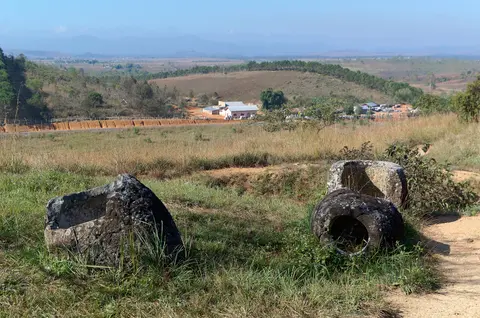
- The Unique Frogman Bas-Relief at Site 1: Search the cluster at Ban Ang for the sole stone jar bearing exterior relief sculpture. Its raised-arm human motif echoes 500 BCE to 200 CE Huashan rock art in Guangxi, China.
- Flat Burial-Marker Discs Around Jar Clusters: Inspect carved stone discs lying flat beside sandstone jars rather than atop rims. Spread-eagle figures, tigers and monkeys on flat stones marked secondary burial pits underground.
- Partially Hewn Quarry Jars Near Sites 2 and 3: Examine sandstone outcrops near southern Phonsavan clusters for unfinished jars locked in bedrock. These quarries show how artisans shaped vessels before hauling them up to eight kilometres.
Plain of Jars Tours, How to Get There, and Hanoi Connections
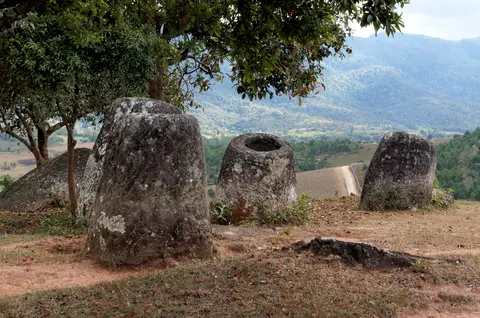
Answers to plain of jars laos how to get there and how to get to plain of jars laos centre on Phonsavan, capital of Xiengkhuang Province. Most international flyers arrive at Luang Phabang International Airport (LPQ), 123 kilometres west straight-line, before crossing winding mountain highways eastward onto the Xiangkhoang Plateau. Regional provincial roads link Phonsavan outward toward rural jar districts, while cooler dry months keep unpaved country tracks toward outer Sites 16, 23 and 25 passable and keep highland grass shorter around stone clusters.
Planning plain of jars laos tours works smoothly by touring cleared Sites 1, 2 and 3 in half a day out of Phonsavan, leaving time to view nearby quarries before venturing farther afield. Whereas rural roads connect Sites 1, 2 and 3 along easy valley loops, visiting 392-jar Site 52 beside a traditional Hmong village requires walking mountain footpaths exclusively on foot with licensed local guides. Because uncleared wartime munitions persist across surrounding countryside beyond heritage fences, staying strictly inside UXO-cleared zones remains essential, while gate tickets under Decree 995 fund village site maintenance.
Regional itineraries answering how to get from laos to hanoi link central Laos directly over the Annamite Range into northern Vietnam. Mountain road crossings connect Xiengkhuang northeast toward Hanoi (327 kilometres northeast straight-line), uniting Laos's megalithic burial fields with wider Mekong and Red River archaeological routes. Explore additional prehistoric landscapes across Asia inside our UNESCO World Heritage Atlas.