


























Tretyakov Gallery, Pushkin Museum of Fine Arts and Christ the Saviour
Guide to Moscow's premier art museums on opposite banks of the Moskva River, plus the Cathedral of Christ the Saviour and Patriarshy Bridge.
Moscow's two greatest fine-art collections face each other across the Moskva River just southwest of the Moscow Kremlin, linked by the pedestrian Patriarshy Bridge. Together with the reconstructed Cathedral of Christ the Saviour, they form a full-day cultural route through the Khamovniki and Yakimanka districts.
State Tretyakov Gallery on Lavrushinsky Lane
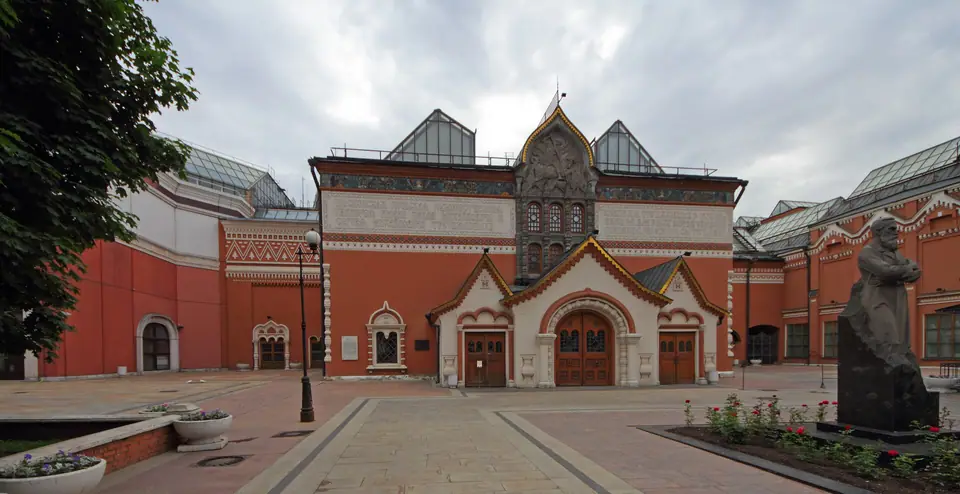
Located in a quiet network of lanes south of the Vodootvodny Canal in Zamoskvorechye (closest Metro stations: Tretyakovskaya and Novokuznetskaya), the State Tretyakov Gallery traces its origins to 1856, when Moscow industrialist Pavel Mikhailovich Tretyakov began systematically acquiring canvases by contemporary Russian painters. In 1892, Tretyakov donated his collection of roughly 2,000 works (including 1,362 paintings and 526 drawings) to the nation. Between 1902 and 1904, painter Viktor Vasnetsov designed the building's distinctive red-and-white Russian fairy-tale facade crowned by a relief of Saint George slaying the dragon.
Today the Lavrushinsky Lane complex spans more than 60 chronological rooms holding Russian art from the eleventh to the early twentieth century. Highlights include the icon galleries connected to the seventeenth-century museum-church of Saint Nicholas in Tolmachi, Alexander Ivanov's monumental canvas The Appearance of Christ Before the People, landscapes by Ivan Shishkin and Isaac Levitan, historical paintings by Ilya Repin and Vasily Surikov, and Mikhail Vrubel's Demon Seated.
New Tretyakov Gallery at Krymsky Val
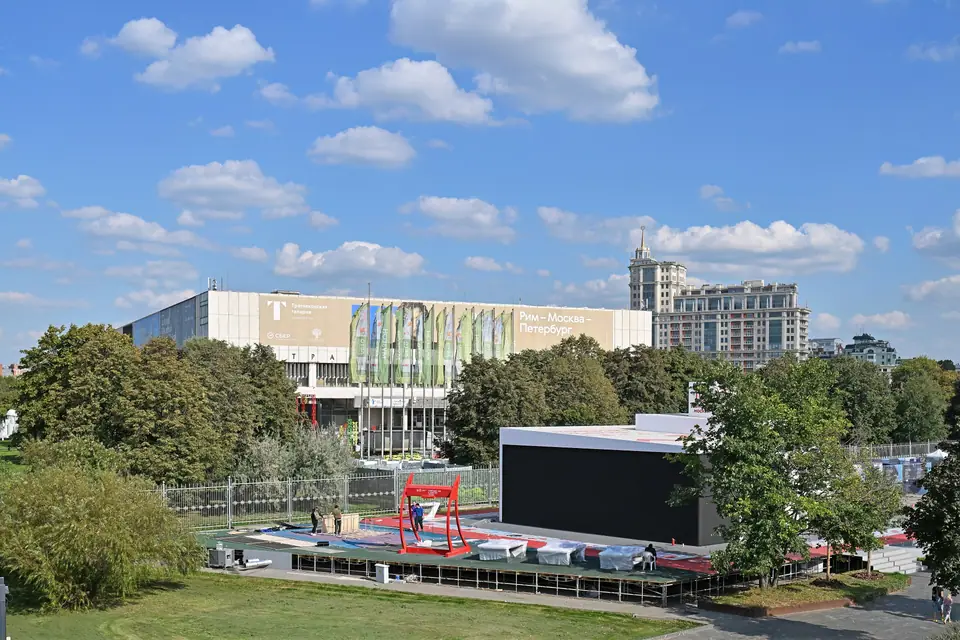
Southwest along the river (one stop to Park Kultury or Oktyabrskaya Metro), the New Tretyakov Gallery occupies a sweeping Soviet modernist building completed in 1983 at 10 Krymsky Val inside Muzeon Art Park, across the road from Gorky Park. Dedicated to twentieth- and twenty-first-century movements, its permanent holdings cover the Russian Avant-Garde (Kazimir Malevich, Wassily Kandinsky, Vladimir Tatlin, and Marc Chagall) alongside Socialist Realism and Nonconformist art. Note that the main Krymsky Val building is undergoing major reconstruction scheduled from 2023 through 2027 to 2028; check the official site before visiting to see which exhibitions are hosted in the neighboring Kadashevskaya Embankment wing or Lavrushinsky Lane.
Pushkin State Museum of Fine Arts on Volkhonka Street
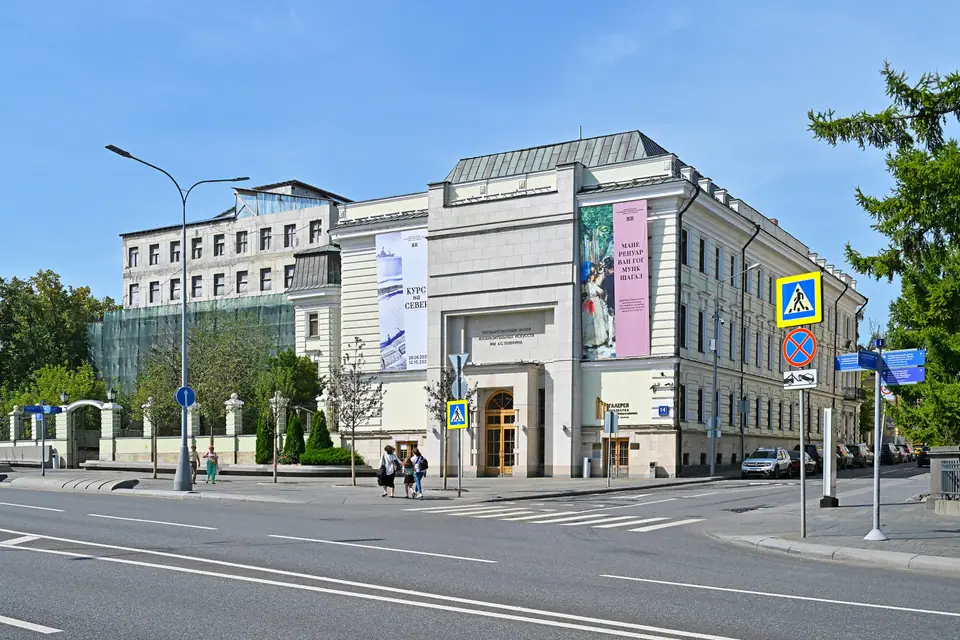
North of the river at 12 Volkhonka Street (Metro Kropotkinskaya), the Pushkin State Museum of Fine Arts is Moscow's largest museum of European and world art. Founded in 1912 by Professor Ivan Tsvetaev (father of poet Marina Tsvetaeva) with financial backing from philanthropist Yuriy Nechaev-Maltsov and designed in neoclassical style by architect Roman Klein, the Main Building features a grand Ionic colonnade, Egyptian and Assyrian antiquities, medieval and Renaissance plaster casts, and paintings by Rembrandt, Botticelli, and Canaletto. Next door at 14 Volkhonka Street, the Gallery of 19th- and 20th-Century European and American Art displays canvases assembled by Moscow collectors Sergei Shchukin and Ivan Morozov, including works by Claude Monet, Edgar Degas, Pierre-Auguste Renoir, Paul Cézanne, Vincent van Gogh, Paul Gauguin, Henri Matisse, and Pablo Picasso. Both museum buildings close on Mondays; check the official site for separate or combined ticket options.
Cathedral of Christ the Saviour and Patriarshy Bridge
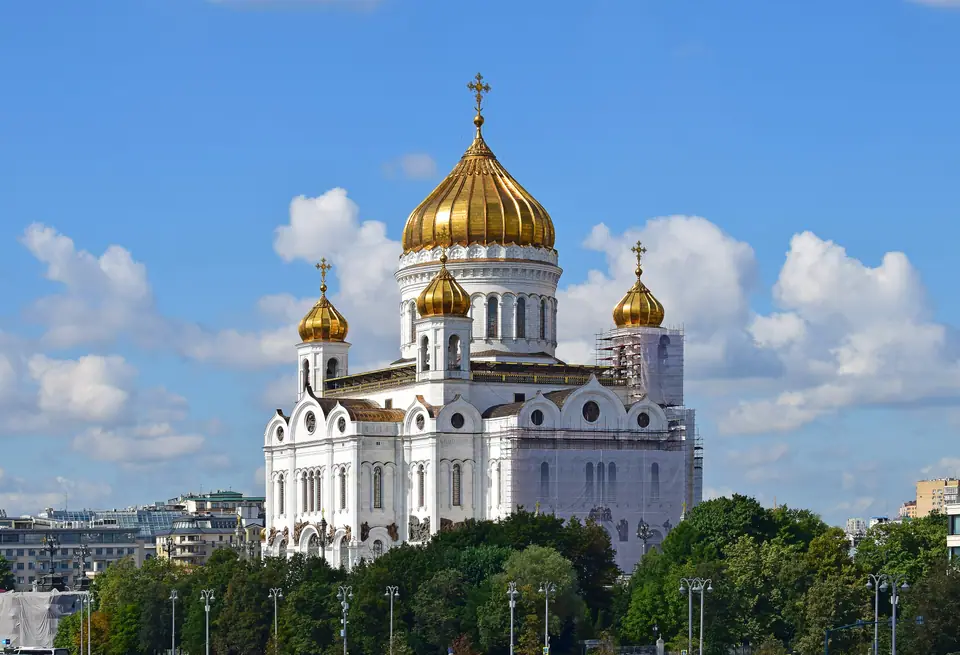
Directly across Volkhonka Street from the Pushkin Museum stands the white-marble Cathedral of Christ the Saviour, rising 103 metres to its central cross. Originally constructed over four decades in the nineteenth century to commemorate the 1812 campaign against Napoleon and demolished in 1931 for the unbuilt Palace of the Soviets, the cathedral was rebuilt on the site between 1995 and 2000. From its southern terrace, the pedestrian Patriarshy Bridge spans the Moskva River and Vodootvodny Canal, offering one of the clearest elevated views toward the Kremlin embankments.
Traveller tips
Real advice from people who have been to Tretyakov Gallery, Pushkin Museum of Fine Arts and Christ the Saviour. Every tip is read by our team before it goes live.
No tips yet. Been here? Yours could be the first.
Thank you! Your tip will appear here after a quick review.
More in Moscow
Continue exploring Moscow with related neighbourhood, food, and planning guides
How to get to Moscow: airports, Aeroexpress trains and rail terminals
Moscow, Russia
Where to stay in Moscow: best neighbourhoods for sightseeing
Moscow, Russia
Best time to visit Moscow: monthly weather, daylight and seasons
Moscow, Russia
Moscow 3-day itinerary: Kremlin, art museums, Metro and VDNKh
Moscow, Russia
