A 100-stop route along Beijing’s UNESCO-listed Central Axis, courtyard hutongs, imperial sacrificial altars, royal lake gardens, and the Ming Great Wall.
Kublai Khan’s Dadu Grid and Five Centuries of Ming-Qing Ritual Order
Occupied since the first millennium BC as the capital of the ancient State of Yan (Ji), Beijing rose to imperial prominence as the Khitan Liao southern capital, the Jurchen Jin central capital, and Kublai Khan's thirteenth-century Yuan Dynasty metropolis of Khanbaliq (Dadu), described in detail by Marco Polo. Kublai Khan's planners established the north-south Central Axis and grid of grey-brick courtyard alleys known as hutongs that still define Old Beijing today.
Between 1406 and 1420, the Ming Yongle Emperor constructed the Forbidden City and the Temple of Heaven, creating the ceremonial heart of both the Ming and Qing empires for five hundred years until the founding of the republic in 1912.
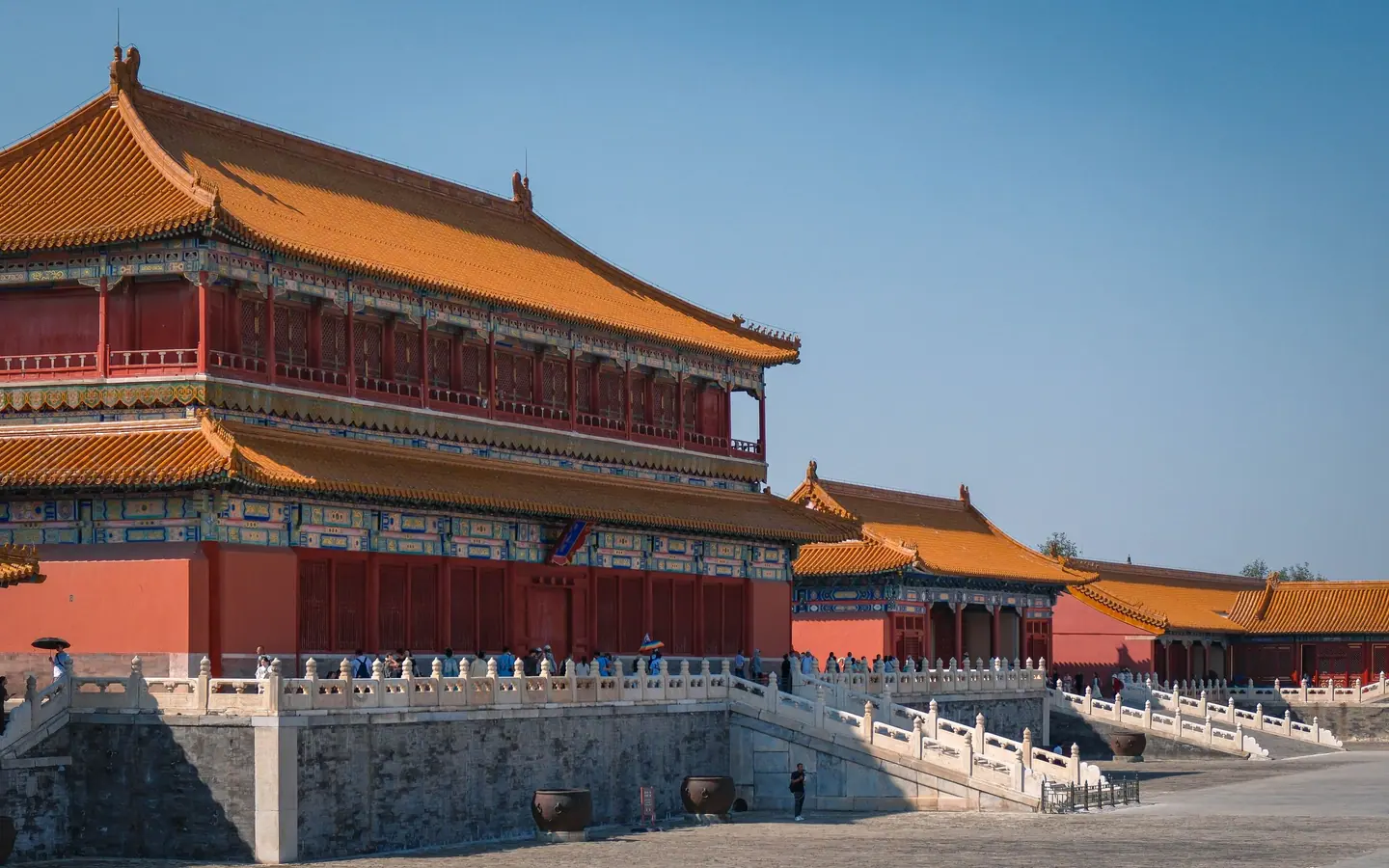
Forbidden City, Jingshan Hill & Tiananmen Central Axis
Meridian Gate, Hall of Supreme Harmony, Palace of Heavenly Purity, Imperial Garden, Treasure Gallery Nine-Dragon Screen, Jingshan Park Wanchun Pavilion, Tiananmen Square, National Museum of China, and Zhengyangmen Qianmen
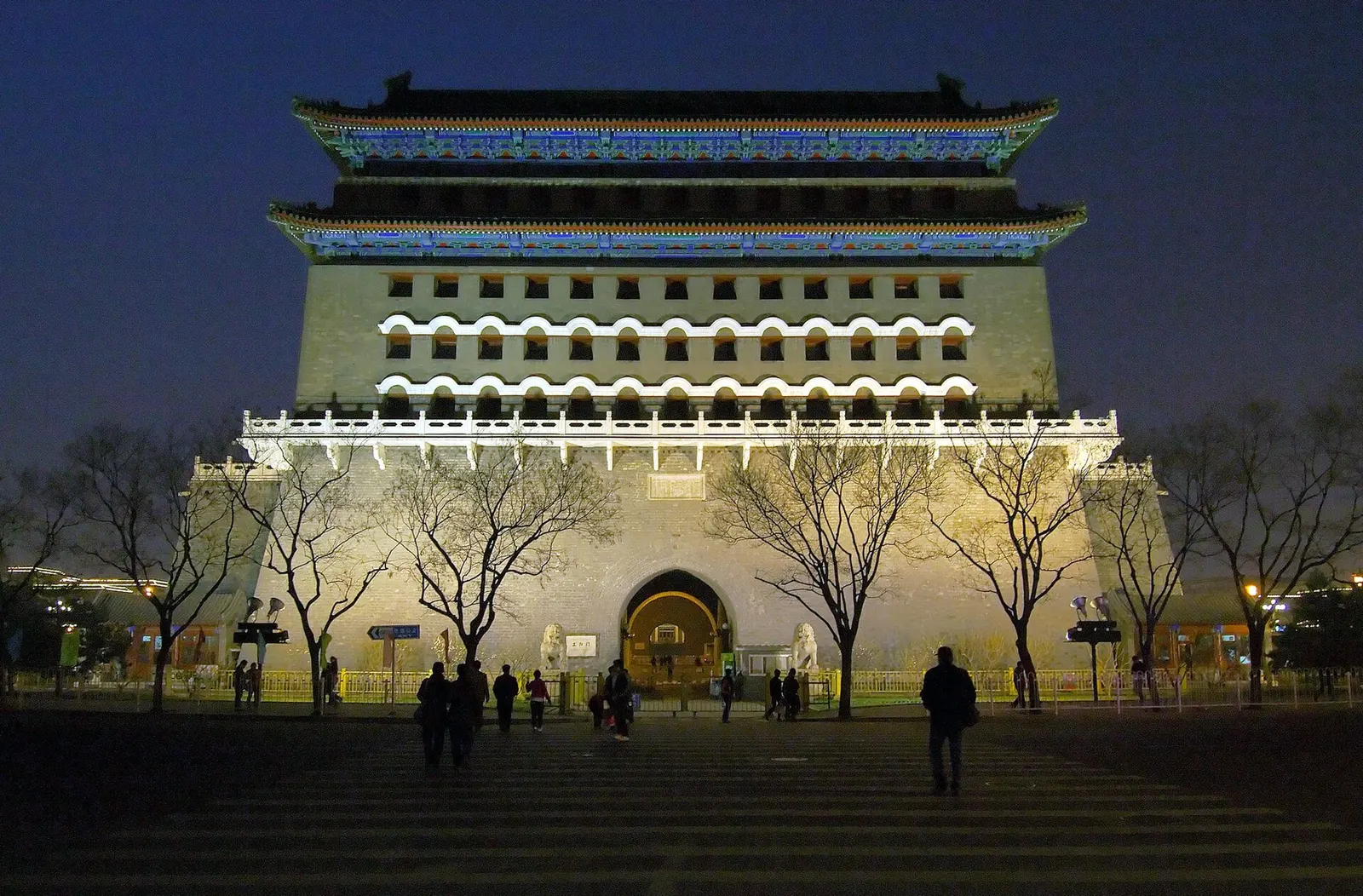
Zhengyangmen Arrow Tower
Standing prominently at the southern end of the central axis, this fortified gatehouse defended the inner city from the Ming dynasty onwards. Its multi-tiered grey brick facade features multiple tiers of archery windows designed for military vantage. Travellers can examine the heavy masonry base and surrounding plaza that anchored historical troop movements.
Zhengyangmen Gatehouse
Commonly known as Qianmen, this grand gatehouse served as the formal passage exclusively reserved for the emperor. The timber superstructure rests on massive stone battlements, rebuilt in the early twentieth century after fires. It houses an exhibition centre chronicling urban cartography and the evolution of the capital wall network.
Chairman Mao Memorial Hall
Constructed in 1976 and 1977, this monumental pavilion occupies the southern quadrant of the central public plaza. Forty-four yellow granite pillars support the flat roof above white stone porticoes, framed by monumental sculpture groups depicting revolutionary milestones. Visitors observe the glass crystal sarcophagus resting within the central ceremonial chamber.
Monument to the People's Heroes
Erected in the centre of the square, this ten-storey obelisk was completed in 1958 using stone quarried from Shandong province. The base features eight white marble friezes carved with bas-reliefs illustrating pivotal political campaigns from the Opium Wars to 1949. The calligraphy etched into the northern face honours fallen historical figures.
Tiananmen Square
Expanded substantially during the mid-twentieth century, this enormous paved expanse serves as the principal public assembly ground of the nation. Flagstone pavers stretch between major civic institutions, oriented along the imperial north-south axis. Large crowds assemble at dawn and dusk to observe military flag-raising ceremonies held opposite the gate.
National Museum of China
Flanking the eastern boundary of the square, this immense colonnaded building resulted from the merger of the historical and revolutionary museums. Its galleries display essential cultural treasures, including Shang dynasty ritual bronzes, jade burial suits, and Tang ceramics. The central hall provides panoramic views across the paved civic grounds.
Great Hall of the People
Built in just ten months during 1959 to mark the tenth anniversary of the republic, this neoclassical complex serves as the national parliament. Twelve colossal marble pillars front the facade, leading to grand conference rooms dedicated to China's provinces. The interior auditorium seats ten thousand delegates beneath an illuminated ceiling.
Tiananmen Gate
Known as the Gate of Heavenly Peace, this red bastion formed the primary southern entry to the Imperial City. Five marble bridges span the Golden Water River, fronting the central portal beneath the official state portrait. Imperial edicts were once lowered from the elevated wooden gallery inside a gilded box shaped like a phoenix.
Duanmen Gate
Constructed in 1420 during the Yongle Emperor's reign, this imposing structure mirrors Tiananmen in scale and design. The elevated red rampart features five arched tunnels that once regulated ceremonial processions moving towards the palace interior. It now houses historical display spaces explaining Ming court rituals and axial architecture.
Meridian Gate
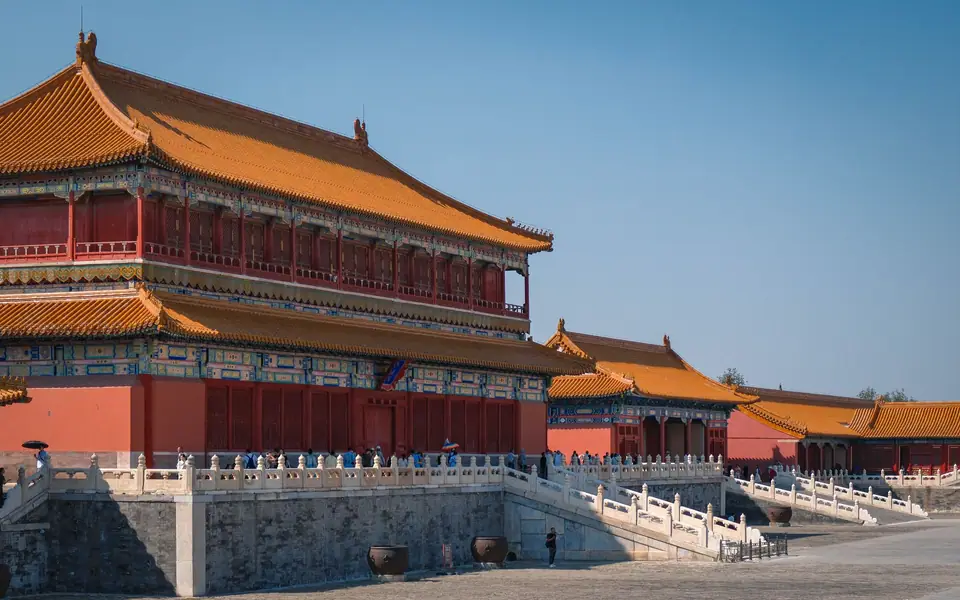
Serving as the principal entry to the palace, this colossal bastion features two protruding wings enclosing a ceremonial courtyard. Five pavilions crown the ramparts, an arrangement historically nicknamed the Five Phoenix Pavilions. Military reviews and calendar distributions were staged here, directing entry into the formal outer court.
Inner Golden Water River Bridges
Spanning an engineered canal shaped like an archer's bow, these five white marble bridges lead directly to the Gate of Supreme Harmony. The central bridge, adorned with carved dragon motifs along its balustrades, was reserved solely for the monarch. Below, water channelling supplied fire suppression resources for the surrounding timber compounds.
Gate of Supreme Harmony
Guarded by two large bronze lions cast in the Ming dynasty, this substantial building fronts the palace's largest open courtyard. The male lion on the eastern plinth rests his paw on an embroidered ball, symbolising territorial unity. The portal forms an architectural prelude to the grand state halls situated further north.
Hall of Supreme Harmony
Elevated upon a three-tiered marble terrace, this immense hall was the site of imperial coronations, weddings, and state ceremonies. Intricate bracket sets support double-eaved roofs finished with imperial yellow glazed tiles. Inside, the lacquered dragon throne rests on an elevated dais beneath an ornate caisson ceiling containing a suspended bronze sphere.
Hall of Central Harmony
Positioned between the Supreme and Preserving Harmony halls, this compact square structure functioned as an imperial staging room. The sovereign rested here, reviewed official agricultural treatises, and greeted officials before leading major religious or civil rites. A modest gilded throne is surrounded by ceremonial incense burners crafted from bronze.
Hall of Preserving Harmony
This expansive hall hosted major imperial banquets celebrating foreign envoys and ethnic chieftains, before housing the final rounds of the imperial examinations from 1789. Behind the hall lies the Great Stone Carving, a 250-tonne marble slab etched with dragons and clouds. The monolith was transported on ice sheets during winter.
Palace of Heavenly Purity
Serving as the sovereign's principal residence throughout the Ming period, this double-eaved hall later accommodated court audiences under the Qing. A famous plaque inscribed 'Open and Upright' hangs above the central throne, behind which secret succession decrees were stored in a locked box. The structure represents the core of the Inner Court.
Hall of Union
Designed as a square hall reflecting the Hall of Central Harmony, this building symbolised the union of heaven and earth. Qianlong selected it to store the twenty-five hereditary jade seals of the empire, which remain preserved inside lacquered caskets. A mechanical water clock alongside an eighteenth-century chiming clepsydra highlights court chronometry.
Imperial Garden, Forbidden City
Laid out behind the Inner Court, this classical green enclave features ancient twisted cypress trees, decorative stone courtyards, and ornate pavilions. The Hill of Accumulated Elegance, an artificial grotto constructed entirely from porous Taihu limestone, dominates the northern quadrant. Intricate mosaic pebble pathways illustrate traditional folk scenes underfoot.
Nine-Dragon Screen, Beijing
Installed in 1772 in the eastern palace sector, this twenty-nine-metre glazed tile wall acted as a spirit barrier against malevolent influences. Nine distinct dragons writhe across waves and clouds, fashioned from 270 individual ceramic pieces. One belly section contains a painted wooden replacement fitted hurriedly by ancient artisans after firing fractures occurred.
Wanchun Pavilion, Jingshan Park
Perched on the summit of an artificial hill raised from moat excavation soil, this triple-eaved pavilion occupies the absolute centre of historical Beijing. Travellers gain an unobstructed perspective looking south across the vast yellow-tiled roofs of the Forbidden City. Five separate pavilions line the ridge, each originally housing bronze Buddha statues.
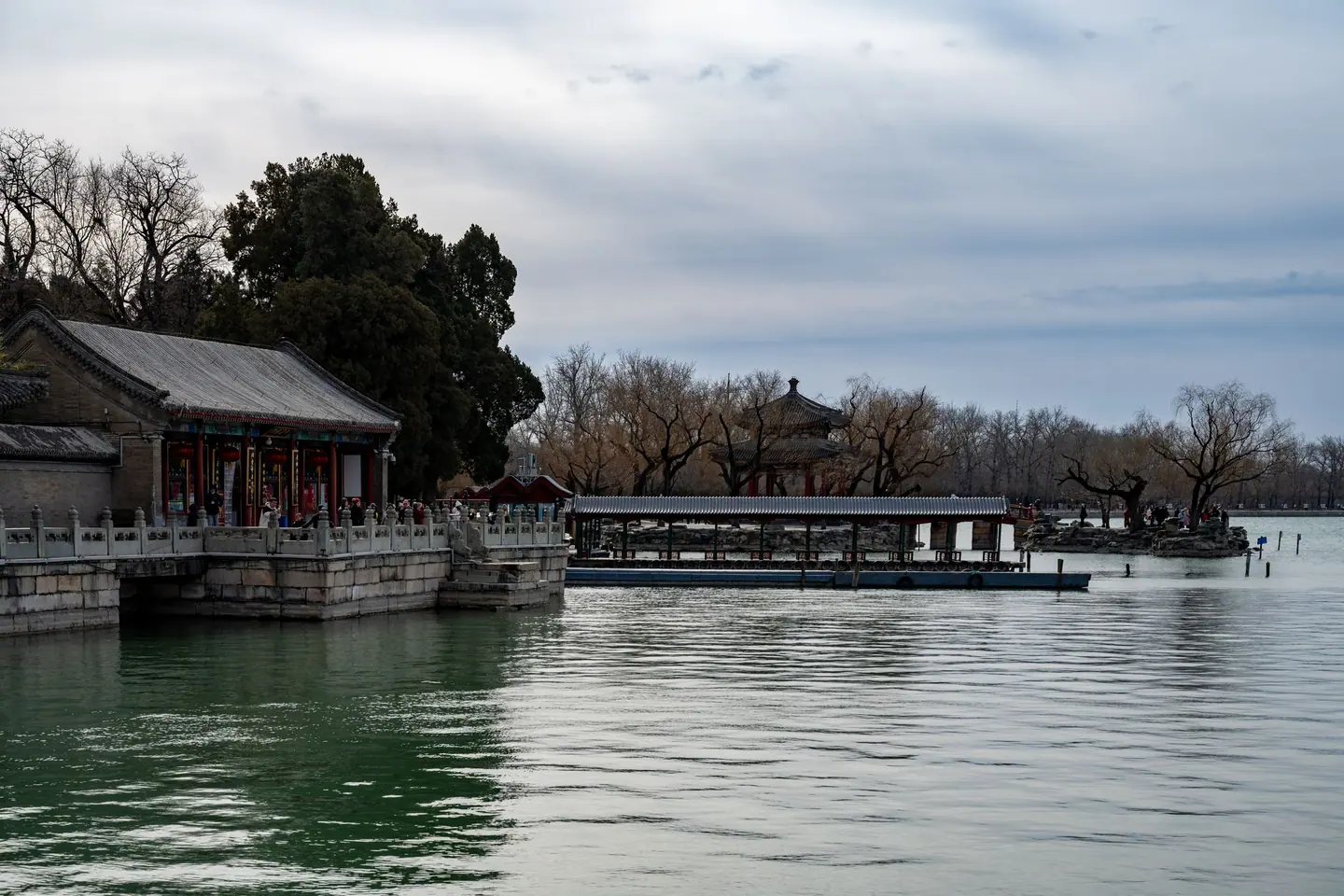
Beihai Park, Shichahai Lakes, Bell & Drum Towers
Beihai Park White Dagoba, Nine-Dragon Wall Beihai, Prince Gong’s Mansion, Qianhai and Houhai Lakes, Silver Ingot Bridge Yinding Bridge, Nanluoguxiang Hutong, Drum Tower of Beijing, and Bell Tower of Beijing
White Dagoba of Beihai Park
Erected in 1651 to honour the visit of the fifth Dalai Lama, this chalk-white Buddhist reliquary towers over the imperial lake. Built on the summit of Qionghua Island, it features engraved flame patterns and bronze bells beneath its parasol canopy. We recommend examining the stone steps and inscribed stele pavilions flanking the main terrace.
Circular City
Enclosed by high battlement walls south of Beihai Lake, this raised enclosure preserves remnants of the Mongol Yuan dynasty court. Within Chengguang Hall sits a white jade Buddha gifted from Burma during the late Qing era. Travellers can also view a massive carved jade wine bowl that belonged to Kublai Khan.
Nine-Dragon Wall of Beihai
Constructed in 1756, this free-standing screen stretches twenty-seven metres and features multi-coloured glazed tiles on both faces. Exactly nine interlocking dragons writhe above waves and clouds on each side, designed to ward off evil spirits from neighbouring pavilions. Pay close attention to the intricate ridged roof and glazed tile joins.
Five-Dragon Pavilions
Built during the Ming dynasty in 1602, these timber kiosks extend into the northern waters of Beihai Park via zigzagging stone walkways. Imperial rulers and court officials gathered here for angling and watching fireworks displays across the lake. The central pavilion, Longze, features a distinctive double-eaved circular roof lined with yellow glazed tiles.
Jingxinzhai
Known as the Studio of Clear Heart, this refined enclave was built in 1757 as an imperial study retreat for the Qianlong Emperor. The compound contains miniature rockeries, winding covered walkways, lotus ponds, and delicate timber halls. It offers visitors an authentic taste of traditional Jiangnan landscape design inside the northern capital.
Prince Gong's Mansion
Originally constructed in 1777 for the corrupt Qing official Heshen, this sprawling estate later became the residence of Prince Gong. It ranks among the best-preserved princely mansions in China, boasting multiple courtyards, grand reception halls, and an extensive rear garden. Look for the Western-style marble gate and the secret character stele housed inside artificial caverns.
Mansion of Prince Chun
This expansive estate served as the birthplace of Puyi, the final emperor of the Qing dynasty, and his predecessor the Guangxu Emperor. Set behind high grey walls along the northern edge of Houhai, the complex combines formal ceremonial residences with secluded family gardens. Today, parts of the grounds house historical research institutes and commemorative displays.
Former Residence of Soong Ching-ling
Situated within the former western gardens of Prince Chun's mansion, this tranquil compound was the long-time home of Soong Ching-ling, wife of Sun Yat-sen. The site preserves her personal living quarters, official library, and private gardens with century-old ginkgo trees. Visitors can examine diplomatic gifts, historical photographs, and period furnishings from mid-twentieth century Chinese politics.
Former Residence of Guo Moruo
Located just south of Qianhai, this spacious multi-courtyard quadrangle was once part of Prince Gong's stable grounds before housing the polymath Guo Moruo. A bronze statue of the writer stands amid leafy pathways, surrounded by ginkgo trees he planted personally. The interior rooms remain arranged as they were during his residence, with manuscripts and books on display.
Silver Ingot Bridge
Dating back to the Ming dynasty, this small single-span bridge earned its name from its resemblance to an overturned silver ingot. Historically, standing here afforded a celebrated view towards the Western Hills across the open water. The surrounding quayside remains a traditional focal point for travellers navigating the Shichahai waterways.
Wansheng Canal and Shichahai
Comprising Qianhai, Houhai, and Xihai, this interconnected water network served as the northern commercial shipping hub of the Grand Canal during the Yuan dynasty. Willow-lined stone embankments and historic residential quarters define the shores today. Travellers walking along the perimeter pass historic stone moorings, imperial boathouses, and traditional single-storey grey brick dwellings.
Guanghua Temple
Founded in the Yuan period, this operational Buddhist monastery stands discreetly within the residential lanes north of Houhai Lake. The complex comprises several sequential courtyards, ancient stone steles, and classical timber prayer halls containing bronze Buddha images. We note the peaceful atmosphere, where resident monks still conduct daily morning and evening chanting ceremonies.
Drum Tower of Beijing
Built in 1272 under Kublai Khan and reconstructed in 1420, this massive two-storey red timber edifice marked the northern terminal of the historical city axis. Its upper hall once contained twenty-five timekeeping drums that sounded the hours across the capital. Steep interior stairs lead visitors to expansive views over the surrounding grey tile hutong rooftops.
Bell Tower of Beijing
Standing directly north of the Drum Tower, this grey brick and stone structure was rebuilt in 1745 to prevent destruction by recurring fires. Inside hangs a colossal bronze bell cast during the Yongle reign, weighing more than sixty tonnes. Its deep acoustic resonance could once be heard dozens of li across the walled capital.
Nanluoguxiang
Constructed during the Yuan dynasty, this eight-hundred-metre north to south thoroughfare retains its ancient fishbone urban plan, with eight symmetrical side lanes branching east and west. While the main lane features shops and eateries, the side branches protect tranquil courtyard residences and stone gate piers. Travellers can examine traditional carved brick lintels and carved carriage stoppers.
Former Residence of Mao Dun
Tucked away in the narrow Houyuan'ensi Hutong just off Nanluoguxiang, this preserved courtyard residence was the final home of the novelist Mao Dun. The front courtyard features a bronze bust and exhibition rooms displaying original drafts, letters, and photographs. The rear courtyard remains preserved in its 1970s state, including his modest study and bedroom.
Keyuan Garden
Constructed during the late Qing dynasty by the senior minister Wen Yu, this secluded private retreat ranks among the finest courtyard gardens in northern China. The layout integrates rockeries, pavilions, and stone bridges into a compact residential footprint. It reflects the taste of Qing nobility seeking the aesthetic leisure of southern Chinese scholars.
Former Residence of Wanrong
Located inside Mao'er Hutong, this substantial multi-courtyard mansion was the ancestral residence of Empress Wanrong before her marriage to Emperor Puyi in 1922. The complex originally contained elaborate private quarters, a bridal preparation hall, and miniature landscape gardens. Though predominantly residential today, the imposing grey entrance gateway and decorative eaves recall its imperial past.
Baitasi Temple
Dominating the western skyline near Shichahai, the white stupa of Miaoying Temple was constructed in 1279 during the reign of Kublai Khan. Designed by the Nepalese architect Araniko, this landmark is the oldest and largest Tibetan-style stupa in Beijing. The temple halls below house fine collections of Tibetan Buddhist statues, wooden altars, and gilt bronze scriptures.
Guangji Temple
Originally dating to the Jin dynasty, this active temple complex serves as the administrative seat of the Buddhist Association of China. The grounds feature serene stone courtyards shaded by ancient trees, alongside multiple ornate Ming dynasty shrine halls. Visitors can view a rare Ming multi-panel painted lacquer screen and a substantial library of historic Buddhist scriptures.
Lama Temple, Confucius Temple & Dongcheng Courtyard Lanes
Yonghe Temple Lama Temple, Temple of Confucius Beijing, Imperial Academy Guozijian, Wudaoying Hutong, Temple of Earth Ditan, Zhihua Temple, Ancient Observatory Beijing, and Wangfujing St Joseph’s Church
Yonghe Temple
Originally built as an imperial prince residence, this sprawling complex was converted into a Tibetan Buddhist lamasery in the eighteenth century. We find sweeping courtyard pavilions lined with yellow glazed roof tiles, intricate incense burners, and prayer wheels. Inside the Pavilion of Ten Thousand Fuhs stands an eighteen-metre sandalwood statue carved from a single trunk.
Beijing Temple of Confucius
Dating from the Yuan dynasty, this solemn sanctuary served as the premier location for imperial state sacrifices honoring Confucius. Shaded courtyards contain ancient cypress trees alongside hundreds of stone tablets recording the names of scholars who passed the imperial examinations. The central Dacheng Hall retains ceremonial musical instruments, ritual drums, and historical tablets inscribed by Qing emperors.
Guozijian
Situated adjacent to the Confucius Temple, this venerable institution trained high-ranking civil servants across three successive dynasties. At its centre stands the square Biyong Hall, surrounded by a circular moat crossed by four marble bridges where the emperor once lectured. Elaborate glazed-tile archways and engraved stone classics line the quiet cloistered corridors.
Wudaoying Hutong
Running parallel to the northern imperial wall, this narrow alleyway once housed soldiers stationed to protect the capital under the Ming dynasty. Today, traditional brick siheyuan courtyards stand alongside renovated grey-brick storefronts, displaying ornate wooden doorways and carved threshold stones. Visitors can observe typical northern domestic architecture while walking among quiet residential branches.
Temple of Earth
Constructed in 1530, this vast ceremonial complex balanced the Temple of Heaven according to ancient Chinese cosmology. Ming and Qing emperors visited the square Fangze Altar during the summer solstice to make offerings to the earth god. The park contains aged ginkgo groves, tranquil perimeter walls, and the restored imperial sacrifice pavilion.
Zhihua Temple
Founded by a powerful Ming court eunuch in 1444, this temple remains one of the few wood-frame timber complexes surviving from that era. Its black-glazed roof tiles indicate special imperial dispensation, while the interior houses a historic carved wooden octagonal rotating sutra cabinet. Hereditary musicians continue to perform traditional court-derived Buddhist music on traditional wind instruments.
Beijing Ancient Observatory
Mounted atop a brick tower that once formed part of the Ming city wall, this observatory operated from 1442 until the early twentieth century. Jesuit scholars collaborated with imperial astronomers here to cast elaborate bronze instruments decorated with dragons and celestial spheres. The adjoining ground-level courtyard displays historical armillary spheres, sundials, and star charts.
St. Joseph's Church, Beijing
Commonly known as Dongtang or the East Cathedral, this church was originally established in the seventeenth century by Jesuit missionaries. The current structure, reconstructed in 1904 following the Boxer Rebellion, features a Romanesque Revival facade with three arched bell towers and pilasters. The spacious stone public forecourt offers a popular gathering point along the commercial avenue.
Bailin Temple
Established in 1347, Bailin Temple was once one of the principal Buddhist monasteries within Beijing inner city. The complex retains multiple courtyards, substantial hall structures, and ancient cypress trees that predate the current Qing-era reconstructions. It served historically as a printing site for the complete Tibetan Buddhist canon during the reign of Emperor Qianlong.
Tong Jiao Temple
Originally founded during the Ming dynasty as a court eunuch residence, this peaceful compound was rebuilt in 1942 as a monastery for Buddhist nuns. The halls display grey-brick vernacular architecture, housing carved wooden statues and calligraphic couplets. It remains an active centre of religious practice within a surrounding maze of residential courtyard lanes.
Former Residence of Mao Dun
Located in Houyuanensi Hutong, this traditional residence was the home of author Mao Dun during his later years until his death in 1981. The compound presents classic northern domestic architecture, featuring carved brick entranceways, decorative screen walls, and quiet planted garden spaces. Rooms maintain their original twentieth-century furnishings alongside personal manuscripts and reference libraries.
Nanluoguxiang
Dating to the Yuan dynasty, this north-south thoroughfare is flanked by eight parallel lanes on either side, forming an ancient fishbone pattern. The surrounding streets contain residences of prominent Qing dynasty officials, artists, and scholars. Historic doorway stones, carved brick gate lintels, and shaded courtyards demonstrate centuries of local vernacular building traditions.
Senggelinqin Former Residence
This expansive residential site was the property of Sengge Rinchen, a renowned Mongol prince and military general of the late Qing dynasty. Although partitioned over decades into residential sectors, surviving portions preserve imposing stone door piers, brick screen walls, and timber roof trusses. The complex illustrates the immense scale of aristocratic compounds built in the inner imperial city.
Former Residence of Qi Baishi
The acclaimed twentieth-century painter Qi Baishi spent his twilight years in this quiet courtyard house in Yu'er Hutong. The traditional siheyuan contains his preserved studio, study, and central garden planted with wisteria vines. Exhibitions highlight his delicate ink-wash paintings of aquatic life, calligraphy tools, and classic scholar furniture.
Chongli Former Residence
Built during the Guangxu period of the Qing dynasty, this grand residence belonged to Chongli, a prominent Manchu general and minister. The property features intricate brick lattice decorations, decorative water features, and expansive inner gardens with rockeries. It remains one of the best-preserved examples of high-status residential courtyard architecture in Dongcheng.
Dongsi Mosque
Founded in 1447 during the Ming dynasty, this mosque demonstrates a graceful synthesis of Islamic spatial requirements and traditional Chinese timber construction. The prayer hall features heavy timber columns, carved Arabic calligraphy, and sweeping hip-and-gable tile roofs. The site also houses a historic library possessing valuable handwritten Quranic manuscripts dating from the Yuan dynasty.
Duan Qirui Government Building
Constructed in 1906, this Western-style red-brick building served as the naval ministry for the late Qing court and later as the executive headquarters of warlord Duan Qirui. The facade showcases neoclassical pediments, slate mansard roofs, and an imposing central clock tower. Today, the complex forms part of the Renmin University old campus.
Prince Fu Mansion
Constructed for Prince Fu, the ninth son of the Daoguang Emperor, this grand residence occupies a vast tract in central Dongcheng. The complex includes an imposing main hall, side pavilions, and extensive garden residences set behind high grey perimeter walls. The layout provides valuable architectural evidence of strict Qing sumptuary laws governing aristocratic homes.
Wenchang Hall of Beijing Confucius Temple
Standing within the northern quarter of the Confucius Temple precinct, this hall honours Wenchang Wang, the deity associated with literary achievement. The building displays traditional Ming-style bracket sets, carved stone banisters, and decorative ceiling caissons. Scholars traditionally visited this specific sanctuary to petition for academic success before participating in the imperial examinations.
Chongwenmen Church
Originally constructed in 1870 by the American Methodist mission, this historic church was rebuilt in 1904 following destruction during the Boxer conflicts. The structure uses rough-hewn grey granite stones and features Gothic pointed arches alongside an octagonal timber roof structure. It remains an active parish accommodating large congregations in southern Dongcheng.
Temple of Heaven, Dashilar & Southern Old City
Hall of Prayer for Good Harvests, Imperial Vault of Heaven, Echo Wall, Circular Mound Altar, Dashilar Historic Street, Liulichang Cultural Street, Fayuan Temple, Niujie Mosque, and White Cloud Temple
Hall of Prayer for Good Harvests
Constructed in 1420 under the Yongle Emperor, this circular building stands on a triple-tiered marble terrace without using nails. Ming and Qing monarchs conducted lavish ceremonies here to pray for abundant grain yields. Inside, observe four massive central pillars that represent the four seasons, encircled by twelve outer columns representing the months.
Imperial Vault of Heaven
Built in 1530 to store ceremonial stone tablets used in sacrificial rites, this octagonal structure features an ornate blue-tiled roof. The hall houses sacred tablets inscribed with names of ancestors alongside spirits of the sun, moon, and stars. We recommend inspecting the blue and green decorative brackets beneath the eaves.
Echo Wall
This smooth circular enclosure surrounds the Imperial Vault of Heaven, measuring roughly sixty-five metres in diameter. The finely laid perimeter brickwork reflects sound waves cleanly across long distances. Visitors often test the acoustic properties by whispering softly against the curved masonry wall towards companions standing on opposite sides.
Circular Mound Altar
Constructed in 1530 and rebuilt in 1749, this open-air platform hosted imperial winter solstice ceremonies. Every design element revolves around the celestial number nine, including the concentric rings of marble flagstones. Standing on the central Heaven's Heart Stone allows travellers to experience an acoustic resonance created by the surrounding balustrades.
Danbi Bridge
Stretching for three hundred and sixty metres, this elevated stone boulevard connects the southern altar to the northern prayer hall. The central path was reserved exclusively for the supreme deity, while emperors trod the flanking lane. Underneath runs a low-ceilinged vault originally used to drive sacrificial livestock towards the altar.
Fasting Palace
Surrounded by a double moat and protective walls, this complex served as the emperor's residence for three days of purification before sacrifices. The palace contains the Beamless Hall, built entirely of stone and brick without wooden rafters. A copper timekeeper statue and two stone watchtowers remain preserved inside the quiet courtyard.
Divine Music Administration
Established during the Ming dynasty, this western precinct trained court musicians and dancers for solemn imperial ceremonies. The restored halls display historical instruments, including ancient bronze chime bells, stone chimes, and traditional drums. Travellers can examine historical performance notation and learn how court music integrated with state sacrificial rites.
Dashilar Historic Street
Originating in the Yuan dynasty, Dashilar developed into a historic shopping centre south of Qianmen. The street retains decorative late Qing dynasty shopfronts featuring carved timber facades and iron gates. Several historic establishments operate here, including the famous Tongrentang herbal pharmacy and longstanding traditional silk, hat, and cloth merchants.
Liulichang Cultural Street
During the Qing dynasty, civil service examinees gathered here to purchase inkstones, scrolls, and scholarly texts. The pedestrianised street displays classical courtyard-style shopfronts selling Chinese paintings, brushes, ceramics, and antique woodblock prints. The famous Rongbaozhai stationery workshop offers a detailed look at centuries-old woodblock printing and mounting techniques.
Fayuan Temple
Founded in 645 by Emperor Taizong of Tang, this monastery commemorates soldiers who died in northern military campaigns. The quiet halls house fine bronze Buddhist sculptures, ancient stone stele inscriptions, and classic sutras. Each spring, the temple courtyards attract local visitors who come to admire blooming lilac groves.
Niujie Mosque
Founded in 996, this is Beijing's oldest and largest mosque, serving a sizable local Hui Muslim community. From the outside, the complex resembles a classical Chinese palace with timber eaves and sweeping tiled roofs. Inside, the prayer hall integrates Quranic calligraphy and Islamic geometric patterns with traditional Chinese beam work.
White Cloud Temple
Founded during the Tang dynasty, this temple functions as the headquarters of the Daoist Association of China. The sprawling grounds feature multi-layered courtyard halls dedicated to Daoist immortals, thunder deities, and the founder Qiu Chuji. Visitors traditionally touch carved stone monkeys hidden along the entry bridge to invite good fortune.
Temple of Agriculture
Directly west of the Temple of Heaven sits Xiannongtan, built in 1420 for imperial agricultural rituals. Emperors personally ploughed sacred plots of land here each spring to demonstrate the state's reliance on farming. Today, the complex houses the Beijing Museum of Ancient Architecture, showcasing elaborate carved timber ceiling caissons.
Yangmeizhu Xiejie
This diagonal alleyway cuts through the southern inner city, departing from Beijing's standard cardinal grid. During the Republican era, prominent writers, publishers, and scholars inhabited the lane's brick courtyard residences. Today, sympathetic restorations preserve early twentieth-century shopfronts, quiet residential doorways, and traditional stone lintels along the stone-paved route.
Huguan Guild Hall
Established in 1807, this guild hall offered lodging and camaraderie to scholars arriving from Hunan and Hubei provinces. Sun Yat-sen presided over significant political gatherings in the Grand Theatre during the early twentieth century. The restored timber-framed theatre remains an atmospheric space for appreciating traditional Peking opera performances.
Qianmen Street
Serving as the central approach to the Forbidden City, this broad boulevard historically accommodated imperial processions leaving the southern gates. Extensively reconstructed, the pedestrian street retains reconstructed Republican-era architecture and replica historic tram tracks. Branching side alleys preserve older vernacular brickwork alongside historic craft workshops and family-run dining institutions.
Zhengyici Peking Opera Theatre
Constructed in 1688 on the site of a Buddhist shrine, this two-storey wooden playhouse is one of China's oldest timber theatres. The venue features an intimate courtyard layout with second-floor balconies looking down on a square stage. Legendary opera master Mei Lanfang regularly performed classical roles within its carved timber interior.
Baoguo Temple
Founded in the eleventh century, this temple complex served as an intellectual meeting point for scholars during the Qing period. Its courtyards long hosted lively trade in antiquarian books, calligraphic rubbings, stamps, and ancient coins. Travellers can examine commemorative halls dedicated to the Ming loyalist scholar Gu Yanwu, who once lived here.
Grand View Garden
Constructed in the 1980s, this classical landscape garden recreates the fictional estate described in the classic novel Dream of the Red Chamber. The park incorporates traditional Qing design principles with winding waterways, artificial rockeries, courtyards, and ornamental pavilions. We recommend walking the winding lakeside paths to view the waterside pavilions and bamboo groves.
Taoranting Park
Built in 1695, the Joyous Pavilion inside this park served as a favourite retreat where scholars and poets composed verses. The surrounding park preserves tranquil lakes, willows, and several recreated pavilions representing historic architectural styles from across China. Memorials dedicated to early modern political reformers and revolutionaries also stand quietly along the tree-shaded paths.
Summer Palace, Old Summer Palace & Great Wall
Summer Palace Kunming Lake, Tower of Buddhist Incense, Long Corridor, Marble Boat, Seventeen-Arch Bridge, Old Summer Palace Yuanmingyuan, Fragrant Hills, Olympic Bird’s Nest, Mutianyu Great Wall, and Badaling Great Wall
Summer Palace
Dominated by Longevity Hill and Kunming Lake, this vast royal retreat served as the private resort of Emperor Qianlong and Empress Dowager Cixi. Its landscape combines classical pavilions, waterways, and wooded hills constructed to emulate traditional southern gardens. We can observe how court architects integrated formal palatial halls with expansive outdoor water features.
Tower of Buddhist Incense
Rising from a stone terrace on the southern slope of Longevity Hill, this octagonal three-storey pavilion serves as the central focal point of the Summer Palace. Originally constructed under Emperor Qianlong and rebuilt after nineteenth-century conflicts, it houses a gilded statue of Guanyin. Visitors can examine the intricate brackets and enjoy wide views across Kunming Lake.
Long Corridor
Stretching for over seven hundred metres along the northern bank of Kunming Lake, this covered promenade was built to provide shelter while admiring the landscape. Its wooden crossbeams feature thousands of distinct paintings depicting classical literature, folk tales, and natural landscapes. Walking its length provides an exceptional overview of traditional Qing decorative art.
Marble Boat
Also known as the Boat of Purity and Ease, this lakeside pavilion rests on a base of carved white stone. Built in 1755 and later restored by Empress Dowager Cixi, it incorporates Western architectural details such as stained-glass windows and decorative paddle wheels. The structure reflects the royal family's fascination with foreign design trends.
Seventeen-Arch Bridge
Connecting the eastern shore of Kunming Lake with South Lake Island, this bridge features seventeen arches arranged symmetrically around a central span. Its marble balustrades are adorned with more than five hundred individually carved stone lions, each with distinct expressions. The design draws inspiration from traditional arched crossings across southern Chinese waterways.
Suzhou Street
Constructed along the Back Lake, this replica of a traditional Jiangnan water town allowed Qing emperors to experience civilian commerce. Eunuchs and maids once played the roles of shopkeepers and patrons selling tea, fabrics, and antiques. Rebuilt in the late twentieth century, the canal features stone bridges and traditional shopfronts along the water.
Hall of Benevolence and Longevity
Situated near the East Palace Gate, this hall served as the principal location for handling state business during the court's residence. Empress Dowager Cixi and Emperor Guangxu held audiences here, surrounded by red sandalwood furniture and bronze incense burners. In the courtyard, a bronze mythical beast known as a Qilin stands guardian.
Old Summer Palace
Renowned for its extensive gardens and grand architecture, this palace complex served several Qing monarchs before its destruction in 1860. The surviving site comprises three distinct sections containing lakes, islands, and former administrative foundations. Visitors explore pathways flanked by weeping willows, discovering carved stone bases and remnants of an extraordinary imperial retreat.
Western Mansions
Commissioned by Emperor Qianlong and designed by Jesuit architects including Giuseppe Castiglione, these structures blended European Baroque architecture with Chinese ornamental motifs. Although destroyed during nineteenth-century campaigns, the surviving carved marble facades and fountain basins remain legible. We observe intricate Corinthian columns, decorative pediments, and fragments of ancient hydraulic systems.
Dashuifa
Standing as the most recognisable ruin in the Old Summer Palace, Dashuifa was once the centrepiece of the European garden pavilions. The structure featured elaborate water jets powered by a mechanical pumping system that expelled water into an ornate basin. Today, the monumental marble arches and stone plinths illustrate the grandeur of eighteenth-century court engineering.
Fragrant Hills Park
Covering hundreds of acres in Haidian District, this historic park was first developed during the Jin and Yuan dynasties as a mountain resort. Dense groves of smoke trees, pines, and cypresses cover the terrain, creating popular walking trails. The hillside contains classical pavilions, memorial halls, and lookout points overlooking the Beijing plain.
Biyun Temple
Founded in the fourteenth century, this hillside monastery is celebrated for its Hall of Arhats, which contains five hundred gilded wooden statues. At the rear of the complex stands the Diamond Throne Pagoda, a massive stone structure carved in the Tibetan architectural style. The temple also served briefly as the resting place for Sun Yat-sen.
Beijing National Stadium
Constructed as the focal venue for the 2008 Summer Olympic Games, this stadium features a complex structural exterior designed by Herzog & de Meuron. The circular form was inspired by traditional Chinese ceramics and bird nests, using massive curving steel columns for support. The structure now hosts sporting events, public tours, and cultural exhibitions.
Beijing National Aquatics Centre
Facing the National Stadium across the central Olympic Green, this rectangular pavilion is enveloped in light-transmitting ETFE polymer cushions. The exterior evokes the natural geometry of soap bubbles, creating an efficient structure that collects solar energy. Inside, the venue has hosted international aquatic competitions and now includes indoor leisure pools.
Olympic Forest Park
Extending over six hundred hectares, this ecological sanctuary forms the northern anchor of Beijing's modern central axis. It features forested hills, a broad central lake, and wetlands populated by native bird species. Walking paths criss-cross the park, offering quiet natural surroundings alongside grand views of the Olympic Tower.
Mutianyu
Located in Huairou District, this well-preserved section of the Great Wall was built during the Ming dynasty on foundations dating back to the Northern Qi. Granite slabs form defensive battlements, supported by twenty-two dense watchtowers along a high ridgeline. Surrounded by dense pine and chestnut forests, it provides an exceptional example of military engineering.
Badaling
Positioned at an elevation of around one thousand metres, Badaling protected the Juyongguan Pass and the northern entrance to Beijing during the Ming era. Broad, ramped roadways paved with stone blocks permitted cavalry and troops to march several abreast between towers. It was the earliest section of the Great Wall opened for modern tourism.
Juyongguan
Controlling a narrow mountain gorge northwest of Beijing, this fortified compound once formed a primary defensive ring around the imperial capital. At its centre stands the Cloud Platform, a fourteenth-century white marble gate base carved with Buddhist figures and inscriptions in six languages. Defensive towers climb the surrounding slopes to complete the perimeter.
Jiankou
Constructed across sharp dolomite cliffs, this un-restored Ming-era fortification is famous for its steep angles and weathered stonework. Key landmarks include the Zhengbei Tower and the precarious Sky Stairs, which scale sheer rocky ridges. The section provides clear evidence of original construction techniques without modern mortar or replacements.
Huanghuacheng
Constructed in the fifteenth century to protect imperial tombs, Huanghuacheng is distinguished by stone ramparts that dip directly into an artificial reservoir. Submerged segments cross the clear waters, while watchtowers rise up the neighbouring granite hills. The surrounding valley is known for its centuries-old chestnut orchards planted by Ming soldiers.
Courtyard Lanes and Great Wall Ridge Sections from Beijing
Before setting out, check local transit connections, museum booking notes and monthly weather data in our Beijing Forbidden City, Central Axis & Hutongs city guide, and compare other walking itineraries.