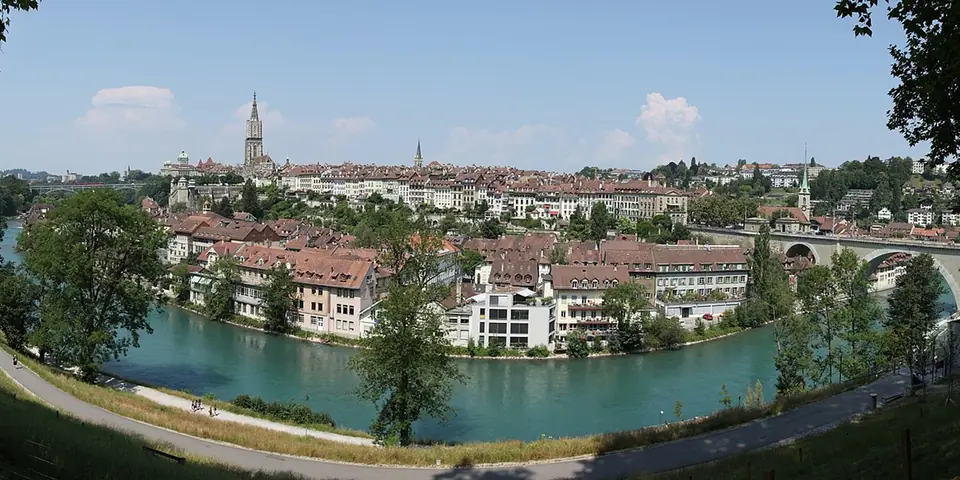
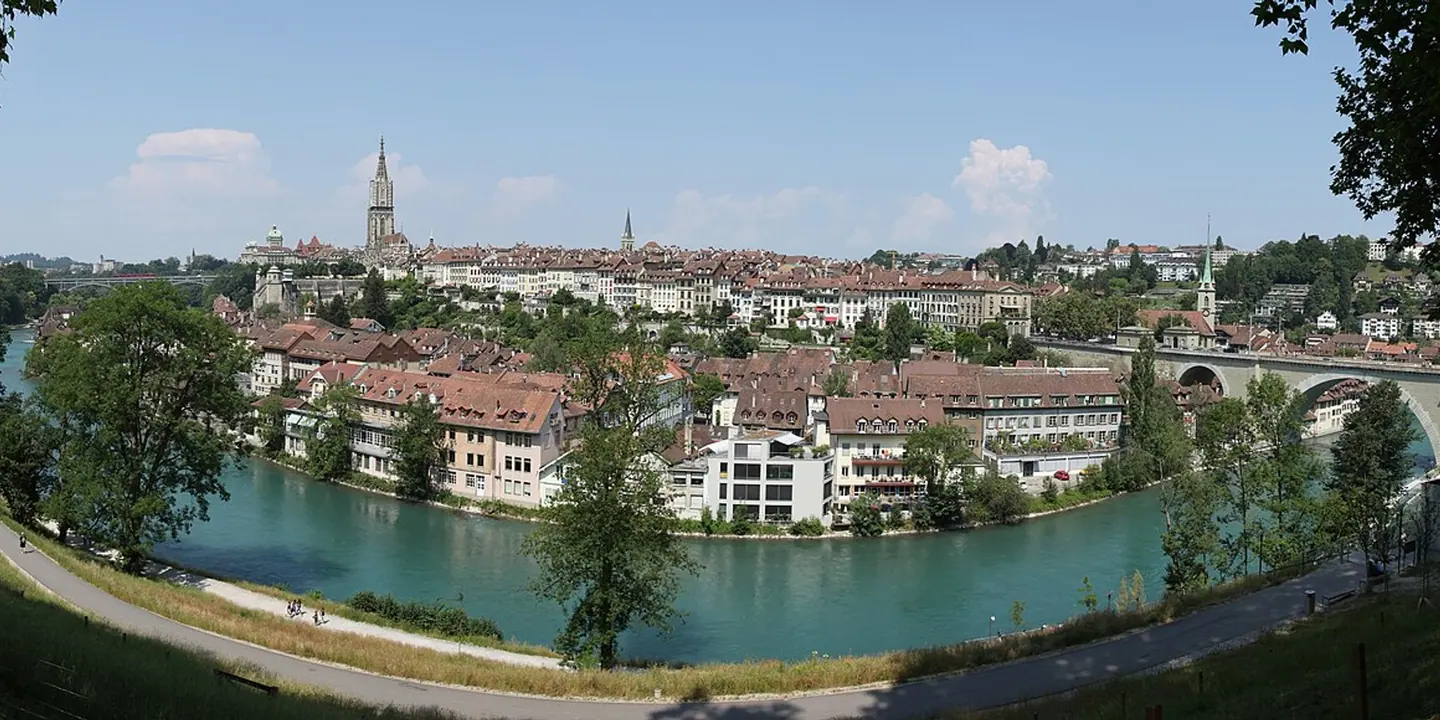
A detailed walking route through the UNESCO-listed medieval sandstone peninsula inside the turquoise loop of the River Aare: 6 km of Lauben arcades, Renaissance fountains, and Einstein’s flat.
Zähringen Peninsula Plan, the 1405 Rebuilding and Hans Gieng’s Fountains
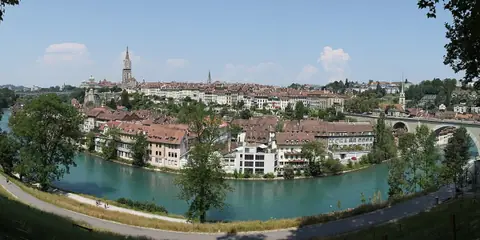
Founded in 1191 by Duke Berchtold V of Zähringen on a narrow forested ridge encircled on three sides by a deep horseshoe bend of the glacial River Aare, named, according to legend, after a bear (Bär) hunted in the surrounding woods, Bern became a Free Imperial City in 1218 and joined the Swiss Confederation in 1353. After a devastating timber fire in May 1405, the city was rebuilt entirely in green-grey local Berner Sandstein with six kilometres of continuous vaulted ground-floor arcades known as the Lauben.
Enriched in the 1540s with eleven painted allegorical fountains carved by Hans Gieng and chosen as the Federal City (Bundesstadt) of Switzerland in 1848, Kramgasse 49 is also where patent clerk Albert Einstein formulated Special Relativity during his 1905 Annus Mirabilis.
Spitalgasse, Marktgasse, Zytglogge & Kornhausplatz
Heiliggeistkirche Church of the Holy Ghost, Baldachin Glass Canopy, Bagpiper Fountain Pfeiferbrunnen, Prison Tower Käfigturm (1256 Gate), Anna Seiler Fountain, Shooter Fountain, Zytglogge Clock Tower & 1530 Astronomical Astrolabe, Kornhausplatz, Child-Eater Fountain Kindlifresserbrunnen, and Kornhaus Granary
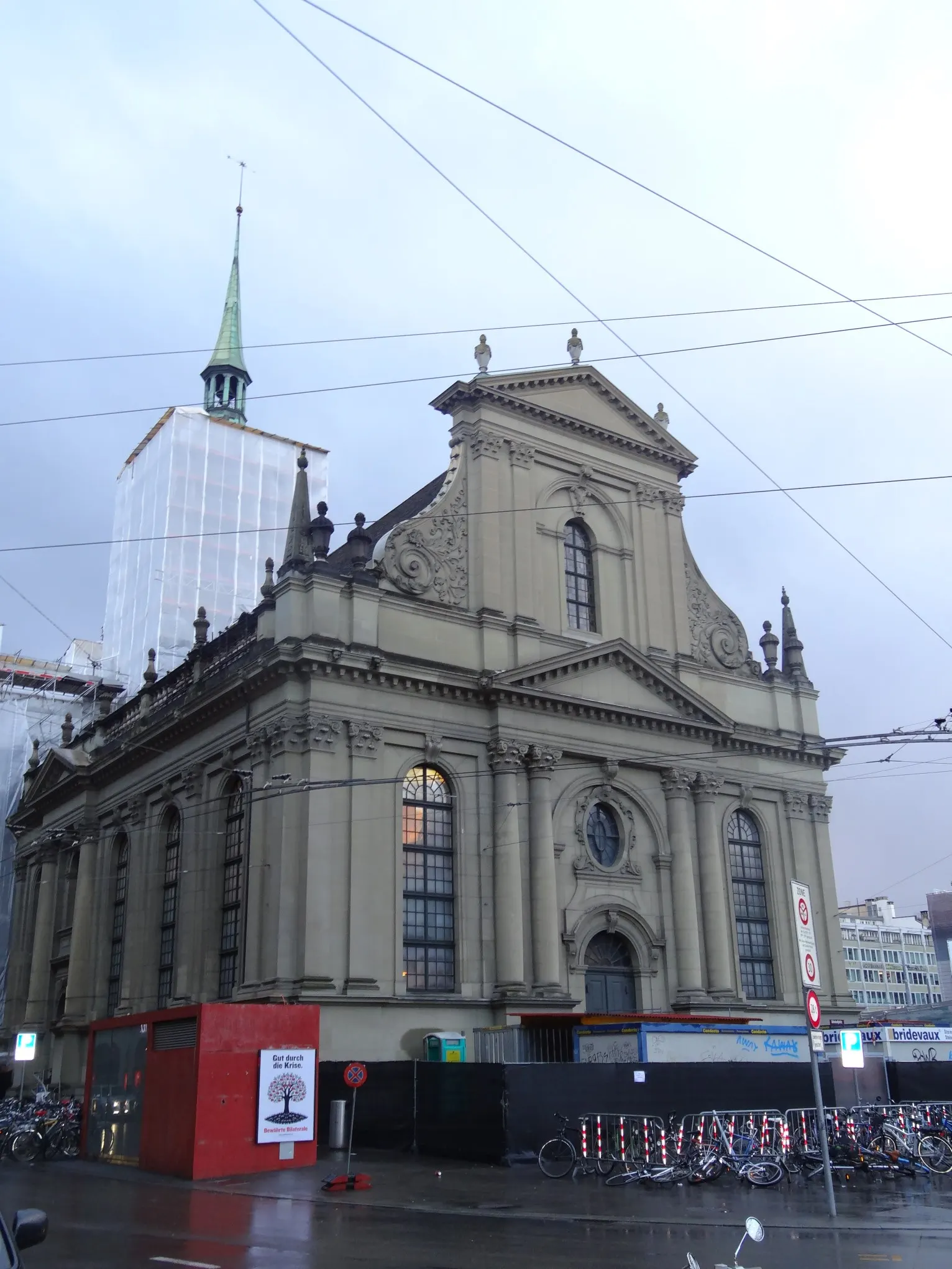
Heiliggeistkirche
Constructed between 1726 and 1729, this church represents one of Switzerland's finest Swiss Reformed baroque structures. Fourteen monolithic sandstone columns support the open interior, which accommodates extensive galleries and a lavish sandstone pulpit. Travellers should observe the monumental proportions designed by architect Albrecht Stürler.
Bahnhofplatz Baldachin
Engineered during the modern redevelopment of the railway station forecourt, this undulating glass canopy shields tram platforms beside the historical Heiliggeistkirche. Its curved steel framework and transparent panes offer a crisp architectural juxtaposition against surrounding sandstone facades. The sweeping roof reflects Bern's integration of modern transport infrastructure with historical streetscapes.
Pfeiferbrunnen
Erected around 1545 by Renaissance sculptor Hans Gieng, this colourful fountain figure stands prominently on Spitalgasse. The carving portrays a bagpipe player in vivid garments accompanied by a small monkey, drawing inspiration from Albrecht Dürer's earlier woodcut. Travellers can admire the ornate basin and gilded capital beneath the piper.
Käfigturm
Originally erected in 1256 during the city's second western expansion, the present tower was rebuilt between 1641 and 1643. It served for centuries as a municipal detention facility, complete with interrogation chambers and holding cells. Today, the monumental archway marks the boundary between Spitalgasse and Marktgasse, hosting exhibitions on civil society.
Bärenplatz
Laid out over the defensive moat fronting the Käfigturm, this wide square emerged after the fortifications were filled in during the sixteenth century. It historically accommodated bear pits before they moved eastward across the river. The space now features lively outdoor seating and civic gatherings right alongside the federal government quarter.
Waisenhausplatz
Positioned just north of the Käfigturm, this open square developed across former defensive works and timber yards. Its northern flank is anchored by the late baroque former orphanage, completed in the eighteenth century and now repurposed as police headquarters. Traditional open-air markets and seasonal fairs regularly occupy the expansive stone pavement.
Anna Seiler Fountain
Created by Hans Gieng in 1545, this colourful fountain statue honours Anna Seiler, who bequeathed her wealth to found Bern's civic hospital in 1354. The allegorical sculpture depicts Temperance pouring water from a pitcher into a small bowl. The classical pillar rests inside an octagonal basin along Marktgasse.
Schützenbrunnen
Standing near the eastern end of Marktgasse, this 1543 fountain honours the medieval guild of marksmen. The statue depicts a soldier in ornate armour bearing a guild banner, with a small armoured bear cub at his feet aiming a crossbow. The pillar showcases Renaissance ornamentation, capturing sixteenth-century Swiss civic pride.
Zytglogge
Serving as Bern's first western city gate from 1191 to 1256, this clock tower later anchored the municipal timekeeping system. Its eastern face displays an intricate astronomical clock and an automated carillon dating from 1530. Spectators gather beneath the arch to watch mechanical bears, Father Time, and a gilded rooster chime before the hour.
Zytglogge Astrolabe
Mounted directly onto the eastern facade of the Zytglogge, this astronomical clock dial dates from Caspar Brunner's 1530 mechanical overhaul. It displays the movements of the sun, moon phases, the zodiac constellations, and the day of the week according to the geocentric system. Travellers can decipher both solar and sidereal time from its painted concentric rings.
Kornhausplatz
Opening directly north of the Zytglogge, this public space assumed its current dimensions following the removal of medieval perimeter walls. Sandstone townhouses line the eastern side, while the opposite side is dominated by the monumental Kornhaus. It serves as an active social meeting place connecting Marktgasse with the high bridge over the Aare.
Kindlifresserbrunnen
Dating to roughly 1545, this striking sculpture by Hans Gieng stands in the centre of Kornhausplatz. It portrays a seated ogre swallowing an infant while holding a sack filled with more children. Historians debate its symbolism, linking it variously to Saturn, ritual folklore, or a cautionary warning for city youths.
Kornhaus
Built between 1711 and 1715 by Hans Jakob and Franz Dünz, this grand sandstone edifice originally stored grain to secure Bern's food supplies during shortages. The lower floor features a vaulted cellar adorned with historic frescoes of traditional Bernese costume. It now houses cultural halls, exhibition galleries, and a spacious restaurant.
Stadttheater Bern
Designed by architect René von Wurstemberger, this venue on Kornhausplatz opened in 1903 to provide a permanent stage for drama and opera. The facade displays dignified neoclassical pediments and carved stonework facing the approaches to the river. It remains the principal venue for municipal theatre productions, symphonic concerts, and ballet.
Kornhausbrücke
Constructed between 1895 and 1898, this steel viaduct links the old town directly to the Altenberg and Spitalacker quarters. The roadway spans roughly 382 metres, suspended nearly fifty metres above the water on graceful metal arches. Pedestrians enjoy extensive views across the river bend, the gothic minster spire, and distant Alpine ridges.
Theater am Käfigturm
Tucked away in the vaulted cellars of Spitalgasse right beside the Käfigturm, this private theatre has hosted Swiss performance art since 1967. The venue presents political satire, musical revues, and spoken-word performances beneath historic stone barrel arches. It remains a fixture for local dialect theatre and independent touring companies.
Marktgass-Passage
This through-building passageway connects Marktgasse directly to Zeughausgasse, illustrating the urban evolution of medieval merchant tenements. Shoppers move between historic facades into covered corridors illuminated by central glass lightwells. Such interior arcades complement the continuous exterior street arcades that shelter pedestrians from seasonal Alpine weather.
Zunfthaus zu Mittellöwen
Erected in the eighteenth century on historical guild ground, this building belonged to the guild of tanners and shoemakers. The symmetrical sandstone frontage exemplifies the restrained Louis XV architectural style prevalent in aristocratic Bernese construction. Carved stone insignia and classic window surrounds echo the civic prestige of the city's early merchant fraternities.
Amthaus Bern
Erected at the turn of the twentieth century south of Marktgasse along Amthausgasse, this monumental complex centralised canton-level judicial services. The sandstone facade exhibits severe neoclassical colonnades, detailed pediments, and pedimented window frames typical of federal-era architecture. It stands as an emblem of late-nineteenth-century bureaucratic modernisation in the old quarter.
Chindlifrässer Fountain Basin
Beneath the infamous Kindlifresser sculpture lies an octagonal limestone water trough adorned with carved heraldic motifs and gargoyle spouts. Historically, the basin functioned as an indispensable fresh water supply for neighbouring homes and horse teams traversing Kornhausplatz. Its finely chiselled rim demonstrates the functional artistry of Swiss Renaissance municipal engineering.
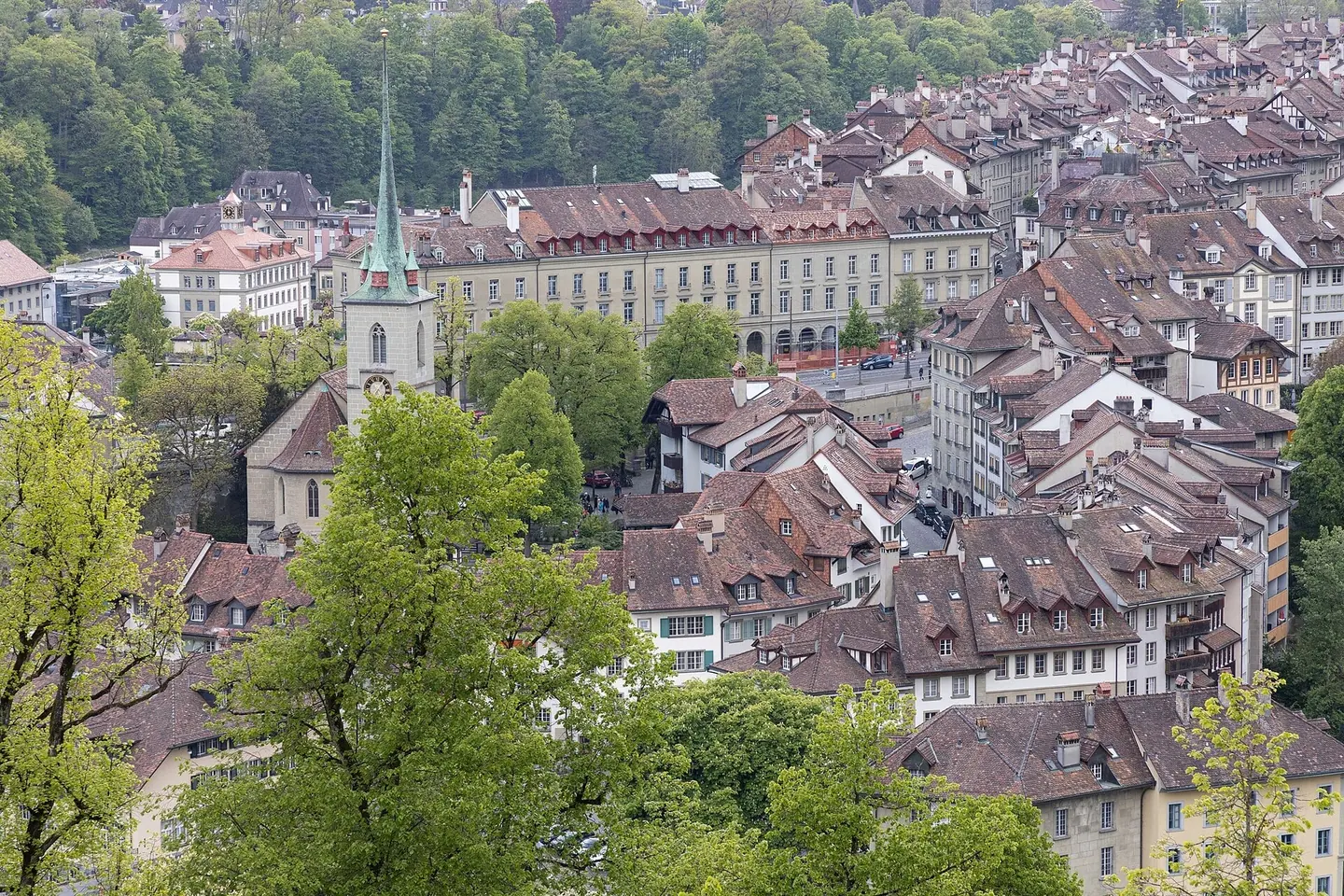
Kramgasse, Einstein House, Gerechtigkeitsgasse & Nydegg
Zähringer Fountain on Kramgasse, Einsteinhaus Kramgasse 49 (1903, 1905 Apartment), Samson Fountain, Rathaus (1406 Gothic Town Hall), Venner Fountain, Old Catholic Church of Saints Peter and Paul, Justice Fountain Gerechtigkeitsbrunnen (1543), and Nydegg Church & Untertorbrücke (1461 Stone Bridge)
Zähringer Fountain
Hans Gieng sculpted this polychrome stone fountain in 1535 near the Zytglogge. It depicts a bear in full armour holding a banner, accompanied by a small bear cub snacking on grapes. The monument pays tribute to Berthold V von Zähringen, who established the city in the late twelfth century.
Kramgasse
Forming the central spine of the Old City, Kramgasse boasts sandstone facades rebuilt after the devastating fire of 1405. Long stretches of vaulted arcades, known locally as Lauben, protect pedestrians along both flanks. Travellers walk above historic cellar doors that once stored merchandise traded by local guild merchants.
Einsteinhaus
Albert Einstein resided in this Kramgasse residence between 1903 and 1905 while employed at the Federal Patent Office. During his stay on the second floor, he formulated his revolutionary Annus Mirabilis papers on special relativity. Restored period furniture and scientific documents illustrate his domestic life and academic breakthroughs.
Samson Fountain
Erected in 1544 along Kramgasse, this fountain figure shows Samson prising open the jaws of a lion. The sculpture represents fortitude and the moral duty of the state to protect its citizens. Carved by Hans Gieng, the column stands above an octagonal water trough fed by natural springs.
Bern Rathaus
Constructed under master builder Heinrich von Gurnigel, the Rathaus serves as the political seat for both city and cantonal parliaments. A grand double staircase leads visitors up to the raised entrance hall beneath a steep hipped roof. Stone traceried windows and heraldic reliefs decorate the southern facade.
Rathausplatz
Rathausplatz offers an open public space surrounded by aristocratic townhouses and municipal administrative offices. The square evolved alongside the medieval city government as an assembly ground for citizens. Today, it connects Kramgasse via narrow alleys to the upper riverside terraces.
Venner Fountain
Standing directly in front of the Rathaus, this 1542 fountain by Hans Gieng depicts a medieval militia commander known as a Venner. The figure holds a banner displaying the city colours while wearing polished armour. The symbol reinforced the military preparedness and civic order of the republic.
Church of Saints Peter and Paul
Built between 1858 and 1864, this church was the first Catholic house of worship erected in Bern following the Reformation. Designed in the French Gothic style, it features tall lancet windows and a delicate openwork spire. The interior contains Art Nouveau stained glass crafted by French artist Maurice Denis.
Kreuzgasse
Kreuzgasse marks the historical boundary where Kramgasse transitions eastward into Gerechtigkeitsgasse. This compact passage features preserved seventeenth-century residential facades and cellar steps leading down to artisan workshops. It acts as an important north-south link between the Rathaus and the Münster.
Gerechtigkeitsgasse
Extending down toward the Aare loop, Gerechtigkeitsgasse formed part of the city expansion of 1255. Both sides display continuous covered arcades that shelter traditional craft shops, antiquarians, and small cafes. Richly decorated heraldic keystones and decorative drainpipes adorn the upper floors of its townhouses.
Justice Fountain
Hans Gieng completed this expressive fountain in 1543 at the centre of Gerechtigkeitsgasse. It shows the blindfolded figure of Justice holding a sword and scales, standing above busts of the Pope, Emperor, Sultan, and Mayor. The monument symbolised the universal rule of law over worldly powers.
Postgasse
Running parallel to Gerechtigkeitsgasse along the northern slope, Postgasse preserves an understated, residential atmosphere. The street was named after the cantonal postal headquarters that operated here during the eighteenth century. Its sandstone buildings feature traditional timber shutters, small courtyards, and narrow stone passages.
Junkerngasse
Junkerngasse served as the premier residential address for the Bernese patriciate from the sixteenth to eighteenth centuries. The quiet street is characterized by baroque palace facades with grand coach portals and rear gardens facing the river. It retains its historic cobblestones and lacks modern commercial shopfronts.
Erlacherhof
Constructed between 1745 and 1752 for Hieronymus von Erlach, this French-style palace stands on Junkerngasse. It features a sweeping horseshoe courtyard secured by ornate wrought-iron gates. General Brune established his headquarters here following the French invasion of 1798 before it became a government administrative building.
Läufer Fountain
Positioned near the eastern edge of the lower town, this 1545 fountain figure depicts a municipal runner carrying a dispatch pouch. A small bear sits at the messenger's feet, clutching a walking staff. The monument supplied fresh water to the neighbourhood surrounding the lower city gate.
Nydegg Church
Nydegg Church stands on the site of Nydegg Castle, the original twelfth-century fortress demolished during early city expansions. Built between 1341 and 1346, the church features a Gothic sandstone tower with a wooden belfry. The interior houses bronze relief panels designed by artist Marcel Perincioli.
Nydeggbrücke
Opened in 1844, this massive stone bridge opened direct road access across the Aare valley to the eastern hills. Its central arch was once the largest stone vault in Europe, flanked by smaller side arches. Travellers cross it to reach the Bärengraben while admiring views down to the riverbanks.
Untertorbrücke
Completed in 1461 to replace an earlier wooden structure, the Untertorbrücke carried all overland traffic into the city for centuries. Three heavy sandstone arches support the cobbled roadway above the emerald waters of the Aare. Walking across offers close perspectives of ancient riverside warehouses and timber-framed houses.
Nydeggstalden
This sloping thoroughfare leads down from Gerechtigkeitsgasse to the Untertorbrücke crossing. Historically, it saw merchants, heavily loaded carts, and foreign envoys enter the urban core through the lower toll gates. Its well-preserved facades house small workshops and historic tavern rooms.
Mattenenge
Mattenenge curves along the eastern bank of the Aare directly below the Nydegg cliff. This historic waterfront quarter was long home to tanners, fishermen, and boatmen who relied on the water current for industry. The street provides an exceptional vantage point looking up at the medieval stone church tower.
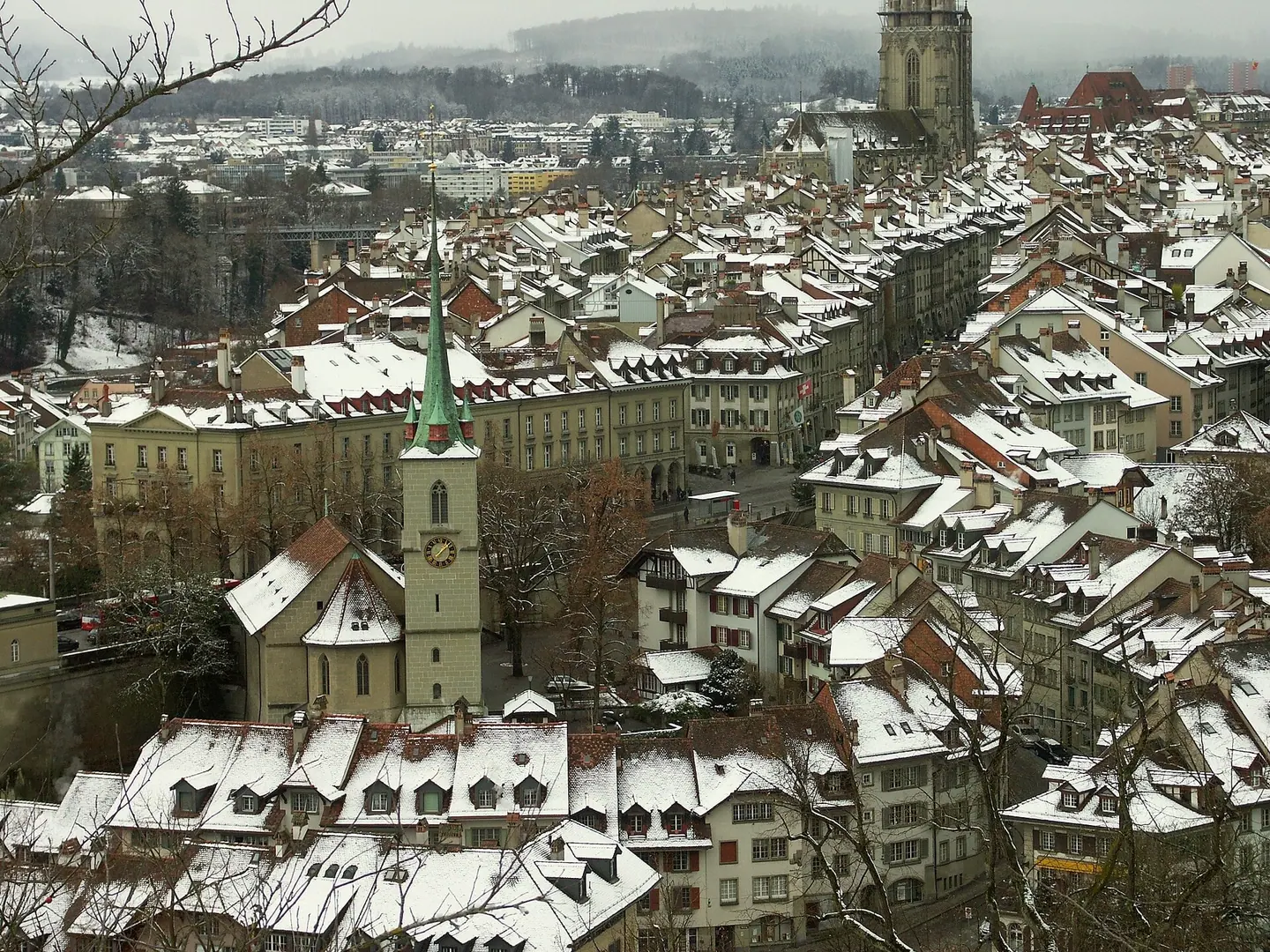
Bern Minster (Münster), Münsterplattform & Junkerngasse
Bern Minster (Switzerland’s Tallest Spire, 100.6m), Erhard Küng’s 234-Figure Last Judgment Portal, Moses Fountain, Münsterplattform Terrace above the Aare, Mattelift, Erlacherhof Patrician Palace, and Junkerngasse Arcades
Bern Minster
Construction began on this Reformed cathedral in 1421 and finished with the completion of the 100-metre spire in 1893. Inside, visitors encounter fifteenth-century choir stalls and magnificent stained-glass windows, including the Dance of Death cycle. The soaring sandstone vaulting displays the heraldic shields of influential Bernese patrician families.
Last Judgment Portal of Bern Minster
Sculptor Erhard Küng crafted this west portal during the late fifteenth century, depicting the separation of the righteous from the damned. It retains 234 carved figures, with the blessed clad in white on the left and horrific demons torturing the wicked on the right. The central tympanum survived the Protestant Reformation largely unscathed.
Moses Fountain
Standing directly in the Münsterplatz, this fountain was sculpted by Nikolaus Sporrer in the 1540s. Moses is depicted with beams of light projecting from his head, pointing directly to the Ten Commandments written in German. Water cascades into an octagonal stone basin that once served local townsfolk and passing traders.
Münsterplattform
Built between 1334 and the sixteenth century, this fortified terrace served as the cathedral burial ground before becoming a public promenade. Heavy sandstone buttresses support the platform high above the Matte neighbourhood, framed by lines of shady chestnut trees. Stone balustrades offer wide viewpoints across the turquoise river bend towards the Kirchenfeld district.
Mattelift
Constructed in 1897, this vertical public elevator travels inside an exposed steel-lattice tower. It ferries passengers over thirty metres down the sheer cliff edge between the elevated Minster grounds and the historic riverside wharves below. The lift remains an integral part of the municipal public transport network for local commuters.
Erlacherhof
Erected between 1745 and 1752 for patrician Hieronymus von Erlach, this grand residence reflects Parisian architectural design. It features an open cour d'honneur enclosed by an ornate wrought-iron screen and crowned pediments carved with family crests. Today, the complex functions as the official headquarters of Bern's municipal government.
Junkerngasse
Running parallel to the river on the southern slope of the peninsula, this street housed the wealthiest Bernese oligarchs for centuries. Stone arcades, vaulted cellar entrances, and decorated baroque facades line the roadway without modern shopfronts. Sandstone portals here bear intricate heraldic crests that celebrate long-established patrician dynasties.
Béatrice-von-Wattenwyl-Haus
Comprising several medieval residences united in the seventeenth century, this prestigious mansion presents an elegant facade along Junkerngasse. Its southern garden terraces overlook the river gorge with direct views toward the Alps. Bequeathed to the Swiss Confederation in 1934, it now hosts state summits between federal ministers and major political parties.
Münstergasse
This paved street links the cathedral precinct with the central lower town. The low vaulted arcades shelter specialty antique shops, bookshops, and wine cellars that occupy deep medieval footprints. Weekly produce markets have enlivened the stones outside these sandstone facades since the Middle Ages, offering regional cheese and flowers.
Münstergass-Bibliothek
Situated just north of the cathedral, this grand institution originated from the city college library founded in the sixteenth century. Reconstructed in the eighteenth century, the building features symmetrical sandstone facades and serene reading rooms. The library preserves cartographic treasures, incunabula, and centuries of administrative documents detailing Bernese territory.
Kreuzgassbrunnen
Positioned at the intersection of Kramgasse and Kreuzgasse, this fountain replaced an earlier Renaissance water outlet in 1778. The central sandstone obelisk rises above an open limestone basin, designed with restrained Neoclassical lines. In former centuries, the surrounding street corner served as an assembly point for city militia units.
Herrengasse
Herrengasse runs westward from Münsterplatz, distinguished by its broad road width and stately row houses. Built primarily in the seventeenth and eighteenth centuries, these houses feature classical pilasters and fine ironwork. Wealthy civil servants established their urban seats here, maintaining close proximity to the cantonal government chambers.
Vennerbrunnen
Erected in 1542 by sculptor Hans Gieng, this colourful fountain figure stands outside the Rathaus. The statue depicts a Venner, a powerful Bernese magistrate responsible for civil order and commanding neighbourhood military levies. Encased in Renaissance plate armour, the figure carries the cantonal battle standard above an ornate limestone basin.
Bern Town Hall
Constructed between 1406 and 1416 under architect Heinrich von Gurnigel, the Rathaus remains the political heart of Bern. Its broad double staircase leads to a grand covered porch supported by stone arches. Both the Cantonal Parliament of Bern and the city council assemble regularly within its restored historic chambers.
Antonierkirche
Dating to the late fifteenth century, this church was built by the Order of Saint Anthony to serve hospital patients. The single-nave structure displays late Gothic rib vaulting and pointed arch windows facing Postgasse. Following centuries of alternative civic use, it now accommodates services for the Russian Orthodox community.
Untertorbrücke
Completed in 1489 to replace a wooden crossing destroyed by floods, this multi-arched bridge anchored the city's eastern defences. Three robust limestone arches carry pedestrian traffic across the strong current of the Aare. For centuries, the fortified bridgehead served as the only land access into Bern from eastern Swiss territories.
Läuferbrunnen
Standing near the historic bridge gate, this Hans Gieng fountain dates from 1545. The figure represents an official city runner or messenger, carrying a letter pouch and hunting weapon, accompanied by a small bear. The stone column behind the runner displays classical scrollwork above an octagonal water trough.
Mattequartier
Occupying the flat river terrace beneath the Minster, the Matte functioned as Bern's historic industrial, milling, and shipping port. Craftsmen harnessed water power from artificial channels while transport guilds handled goods arriving along the river. Today, the preserved timber and stone warehouses accommodate architecture studios, craft workshops, and riverside homes.
Wasserwerk Matte
Dating back to industrial works installed in the early nineteenth century, this facility channels river water through heavy sluice gates. The site preserves early civil engineering structures that provided mechanical power to Bernese textile mills and tanneries. Modern turbines operate inside the preserved stone shells to generate municipal renewable electricity.
Altenbergsteg
Constructed in 1857, this slender iron-and-timber pedestrian walkway spans the river just north of the central peninsula. It affords clear sightlines towards the rising medieval skyline, the Münster spire, and steep riverside gardens. Travellers cross this tranquil route to link the lower medieval street grid with the northern residential banks.
Bundeshaus (Federal Palace), Kirchenfeld Bridge & Helvetiaplatz Museums
Casino Bern, Hotel Bellevue Palace, Bundeshaus Federal Palace Dome & Bundesplatz 26-Canton Water Fountains, Kleine Schanze Alpine Panorama, Kunstmuseum Bern, Kirchenfeldbrücke, Bern Historical Museum & Einstein Museum, Swiss Alpine Museum, and Museum of Communication
Federal Palace of Switzerland
Designed primarily by Hans Wilhelm Auer, this monumental seat of Swiss democracy was completed in 1902. The imposing central dome reaches sixty-four metres, flanked by the chambers of the National Council and the Council of States. Look up at the pediment sculptures and stained-glass cantonal coats of arms inside the central hall.
Bundesplatz
Redesigned in 2004 with durable Vals quartzite slabs, this spacious civic plaza fronts the Swiss parliament. A grid of twenty-six choreographed water jets rises directly from the stone pavement, each representing one of the Swiss cantons. The square regularly hosts traditional weekly markets and official national state ceremonies.
Bundesterrasse
Constructed along the southern flank of the parliament building, this broad stone terrace offers unobstructed views across the Marzili district. Visitors gather along the balustrades to observe the Bernese Alps across the river basin on clear days. The terrace also provides direct access down to the riverside paths via the Marzilibahn.
Marzilibahn
Operating since 1885, this compact funicular railway ranks among the shortest public transport lines in Europe, spanning just 105 metres. Originally powered by water ballast, the system was converted to electric power in the twentieth century. The bright red carriages shuttle passengers continuously between the federal quarter and riverside bathing lawns.
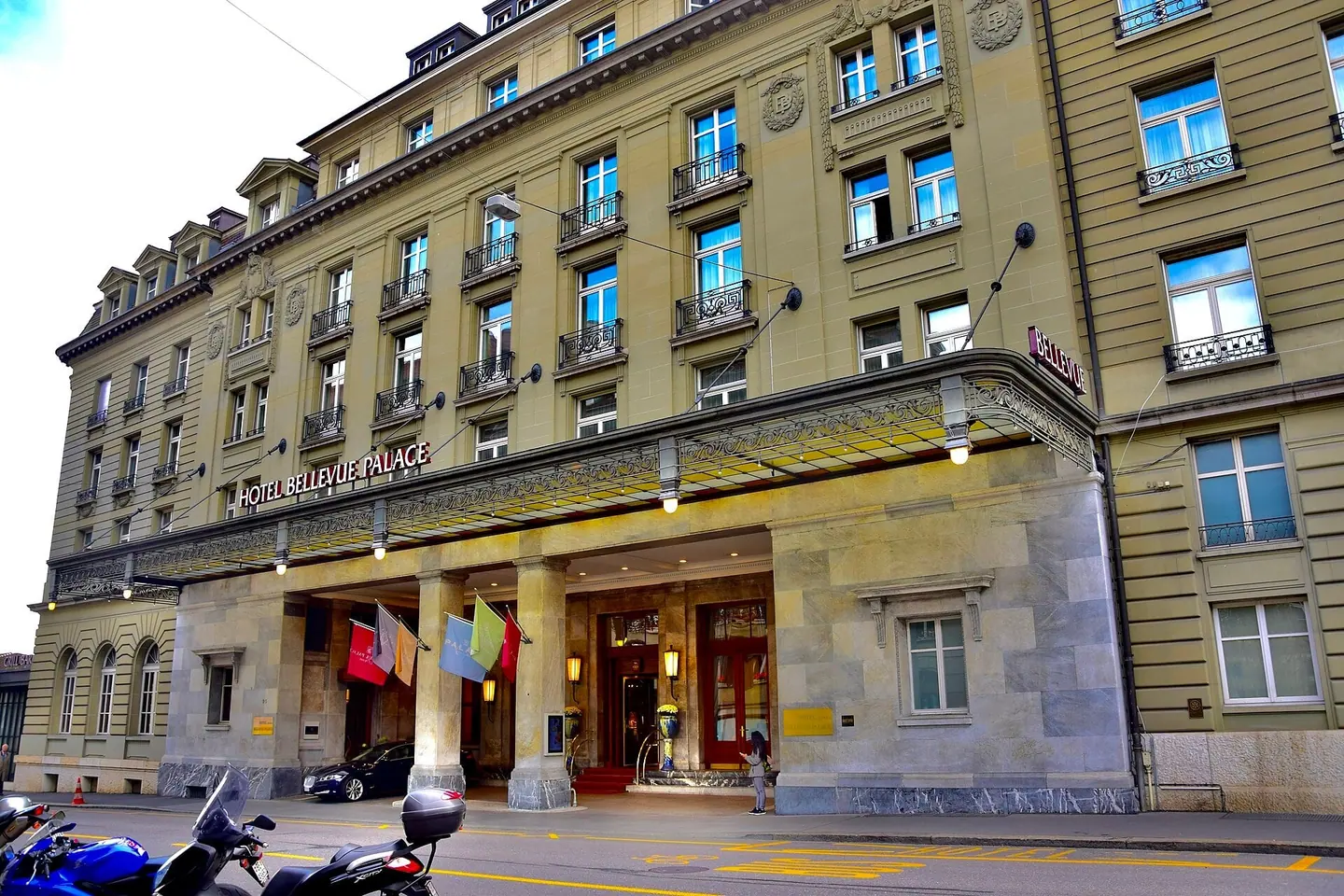
Hotel Bellevue Palace
Built in 1913 in the neoclassical style, this grand hotel serves as the official state residence for visiting heads of government. Its ornate salons, wrought-iron staircases and stained-glass atrium reflect pre-war European luxury. During the World Wars, the hotel functioned as an international diplomatic meeting ground and intelligence hub.
Casino Bern
Erected between 1906 and 1908 by architects Paul Lindt and Max Hofmann, this civic venue houses Bern's premier concert auditorium. The building features an ornate neo-Baroque facade, grand chandeliers and wood-panelled dining rooms. It serves as the primary performance home for the Bern Symphony Orchestra.
Kleine Schanze
Originally part of the city's seventeenth-century outer defensive fortifications, this hilltop park now provides open lawns and leafy paths. At its southern tip stands the monument honouring the Universal Postal Union, crafted by French sculptor Rene de Saint-Marceaux. The high rampart provides sweeping vistas of the Gurten and surrounding mountains.
Universal Postal Union Monument
Unveiled in 1909 on the Kleine Schanze, this expressive bronze sculpture commemorates the founding of the Universal Postal Union in Bern in 1874. It depicts five female figures dancing around a globe, symbolising the five continents linked through international correspondence. The sculpture rests upon an expansive granite base featuring flowing water.
Swiss National Bank Building Bern
Standing directly opposite the Federal Palace, this imposing stone structure opened in 1912 to anchor Switzerland's monetary policy. Designed by Eduard Joos, the building displays strong classical proportions, fluted pilasters and heavy bronze security gates. It continues to house executive offices and central banking administration for the Swiss Confederation.
Kirchenfeldbrücke
Spanning 229 metres across the Aare gorge, this double-arch iron bridge opened in 1883 to connect the medieval centre with the Kirchenfeld plateau. Designed by the engineering firm Gottlieb Ott, it was crucial to the city's southward expansion. Pedestrians crossing its pavements enjoy direct perspectives down to the river banks below.
Helvetiaplatz
Constructed in the late nineteenth century as the gateway to the Kirchenfeld district, this broad square functions as the focal point for major cultural institutions. Broad pavements, tram routes and civic monuments frame the open space. The plaza serves as an assembly point for cultural festivals and museum open-door events throughout the year.
Bern Historical Museum
Designed by architect Andre Lambert and completed in 1894, this castle-like structure borrows heavily from sixteenth-century Swiss architectural forms. The permanent galleries house significant archaeological relics, Celtic treasures and precious Burgundian tapestries captured during the fifteenth-century wars. Its grand turrets and stepped gables define the Helvetiaplatz skyline.
Einstein Museum
Integrated within the Bern Historical Museum, this specialised collection chronicles the life and breakthrough discoveries of Albert Einstein. The physicist spent formative years in Bern developing his Special Theory of Relativity while employed at the Swiss Patent Office. Displays include original manuscripts, domestic photographs and scientific models explaining relativity.
Swiss Alpine Museum
Housed in a Bauhaus-inspired building constructed in 1934, this institution shifts focus from mere peak ascents to Alpine climate change and mountain culture. The museum features interactive displays, contemporary artistic interpretations and historical mountaineering maps. The facility underwent extensive renovations to present temporary exhibits concerning environmental shifts in the Alps.
Museum of Communication Bern
Founded in 1907 as the Swiss Postal Museum, this site transitioned into a comprehensive institution documenting interpersonal and digital communication. The modern museum building houses historical telegraphs, early computers and one of Europe's most significant stamp collections. Experiential stations encourage visitors to test emerging technologies and examine changing media habits.
Natural History Museum of Bern
Occupying a purpose-built facility opened in 1936, this prominent research and educational venue holds over four million biological specimens. It is celebrated for its historic diorama displays showing indigenous African and Asian wildlife in natural postures. The museum also displays giant quartz crystals recovered from the Planggenstock mountain range.
Kunsthalle Bern
Constructed in 1918 by the Bern Art Association, this unadorned exhibition pavilion has long been a laboratory for modern art movements. It achieved international renown in 1969 under director Harald Szeemann with the exhibition When Attitudes Become Form. The venue produces temporary installations by emerging international painters, sculptors and conceptual artists.
Kunstmuseum Bern
Founded in 1879 with an imposing neoclassical structure by Eugen Stettler, this gallery represents eight centuries of art history. Its extensive holdings include notable works by Paul Klee, Ferdinand Hodler, Pablo Picasso and the Italian Trecento masters. We can study significant shifts from traditional Swiss landscape painting to mid-century modernism throughout its wings.
Christoffel Fountain
Situated on Bahnhofplatz near the central railway station, this open civic space commemorates the Christoffelturm gate tower demolished in 1865. The modern plaza incorporates remnants of the medieval bastion walls visible in the underground station concourse. Above ground, public transport lines converge near monuments recalling the historic defensive limits of the city.
Beatus Fountain
Dating back to the sixteenth century, this painted limestone fountain honours Saint Beatus, the patron saint of the Bernese Oberland. The carved column depicts the saint in traditional pilgrim attire atop an ornate Corinthian capital. Water pours through historic brass spouts into an octagonal stone basin utilised by locals for centuries.
Bear Park (BärenPark), Rosengarten, Marzili River Baths & Zentrum Paul Klee
BärenPark Riverbank Bear Enclosure, Altes Tramdepot, Rosengarten Rose Garden Panorama over the Old Town Peninsula, Matte Quarter & Schwellenmätteli Aare Weir, Marzili River Pool & Marzilibahn Funicular, Gurten Hill Funicular, and Zentrum Paul Klee by Renzo Piano
BärenPark
Opened in 2009 along the steep eastern banks of the Aare, this modern wildlife enclosure replaced the cramped concrete pits of the historic bear pit. The sloping park features a natural wooded hill and direct river access where the bears bathe. Visitors can observe the animals from elevated pathways and the neighbouring Nydeggbrücke.
Historic Bärengraben
Dating to 1857, these circular stone pits served as the traditional home for Bern's bears for over a century and a half. While the animals now roam the adjoining riverbank park, the restored heritage masonry remains accessible for public exploration. The deep sandstone basins illustrate older municipal approaches to displaying the civic heraldic mascot.
Altes Tramdepot
Constructed in 1889 to house Bern's first public transit vehicles, this brick industrial structure stands directly above the historic bear enclosure. Today it operates as a brewery and restaurant, retaining its vaulted industrial architecture and large windows. The terrace outside provides sweeping vantage points over the Aare loop and the medieval Old Town skyline.
Rosengarten
Occupying a high terrace that served as a municipal cemetery until 1877, the Rosengarten was converted into a public botanical park in 1913. It showcases hundreds of rose varieties, irises and rhododendrons alongside an extensive reading pavilion. The southern balustrade provides one of the finest panoramic views across the entire UNESCO listed Old Town peninsula.
Zentrum Paul Klee
Designed by Italian architect Renzo Piano and opened in 2005, this cultural institution resembles three undulating steel and glass waves rising from the surrounding farmland. It houses roughly four thousand works by painter Paul Klee, who spent much of his life in Bern. Inside, rotating exhibitions highlight Klee's diverse techniques alongside dynamic concert halls.
Schwellenmätteli Weir
Positioned just below the Matte Quarter, this historic timber weir has regulated the water level of the River Aare since the thirteenth century. It historically channelled rushing river water into industrial mill races that powered local craftsmen's wheels. Today, timber walkways permit visitors to walk directly above the foaming river cascade beside historic riverside restaurants.
Matte Quarter
Situated on the riverbank directly below the Cathedral platform, the Matte is Bern's oldest industrial quarter. For centuries it housed river boatmen, millers and labourers who developed their own distinct dialect, known as Mattenenglisch. Its narrow cobblestone alleys feature seventeenth century residential houses that contrast with the grand mansions on the upper terrace.
Mattenlift
Erected in 1897, this vertical public elevator links the riverbank Matte neighbourhood with the Münsterplatform above. Engineered to save residents the steep climb up public stairs, the steel tower has operated for over a century as part of the local transport network. Riding the lift affords brief, changing perspectives of the sandstone cliff face.
Untertorbrücke
Completed in 1489, this stone arch bridge served as Bern's sole pedestrian and vehicular river crossing until the nineteenth century. Built from solid molasse sandstone blocks, it replaced an earlier wooden crossing washed away by floods. The bridge incorporates fortified historical gatehouses and offers close views of the rushing alpine waters below.
Nydeggbrücke
Constructed between 1840 and 1844, this grand stone bridge spans the Aare with a central arch measuring over forty metres across. Engineered to provide direct access between the eastern road routes and the city centre, it bypassed the steep descents to the older river crossing. Four historic stone customs toll booths flank its road entrances.
Nydeggkirche
Erected between 1341 and 1346, the Nydegg Church stands on the site of Nydegg Castle, the twelfth century stronghold built by the city's founder, Duke Berthold V. The castle was destroyed during civil strife, and its stone was incorporated into this church and its spire. Inside, early bronze reliefs and carved wooden furnishings decorate the nave.
Marzili River Pool
Established in the late eighteenth century, this celebrated municipal outdoor bathing area occupies green lawns beside the flowing Aare. Swimmers enter the rapid current upstream and drift past city landmarks before exiting on designated safety steps. The complex also incorporates regulated swimming pools, diving boards and extensive lawns shaded by mature trees.
Marzilibahn
Operating since 1885, this funicular railway is among the shortest public rail systems in Europe, covering a track length of only 105 metres. Originally powered by water counterbalance, it was converted to modern electric drive in the early twentieth century. The red cars carry passengers up a steep gradient from the Marzili quarter to the Federal Palace terrace.
Dalmazibrücke
Erected in 1872, this historic iron truss footbridge connects the riverside Marzili district with the Kirchenfeld district across the Aare. Built to handle increasing commuter movements, the slender bridge provides direct access to riverside promenades. Pedestrians crossing the wooden deck enjoy uninterrupted views of the forested river bends and swimmers floating downstream.
Kirchenfeldbrücke
Engineered by the German firm Gutehoffnungshütte and opened in 1883, this monumental iron bridge carries road traffic over thirty metres above the river. Its construction facilitated the expansion of late nineteenth century residential and museum districts on the Kirchenfeld plateau. The intricate steel framework dominates the skyline when viewed from the valley floor below.
Altenbergsteg
Constructed in 1857, this historic suspension footbridge spans the northern bend of the Aare, linking the Old Town peninsula to the Altenberg neighbourhood. Featuring a timber floor supported by iron wire cables, it served commuters walking to local botanical gardens and river baths. The footbridge offers peaceful river perspectives away from major road traffic.
Münsterplattform
Constructed in the fourteenth century as the churchyard for Bern Cathedral, this elevated stone platform drops sheerly to the riverbank far below. It was converted in the eighteenth century into a formal public park lined with chestnut trees and stone benches. The retaining wall balustrades command sweeping vistas across the Aare weir and the roofs of the Matte quarter.
Wasserwerkgasse Waterworks
Running along the lower bend of the Matte quarter, this stone street preserves remnants of medieval water management. Fast flowing water diverted by the Schwellenmätteli weir still courses through narrow stone canals that once turned industrial waterwheels. Restored warehouses along the lane now house modern workshops, artist studios and heritage craft operations.
Gurten Funicular Lower Station
Located in the southern suburb of Wabern, this terminal marks the departure point for journeys up Bern's local mountain, the Gurten. Operating since 1899, the funicular railway ascends an incline of over thirty percent through wooded hillsides. The journey provides travellers with expanding aerial perspectives of the capital city and the snowcapped Bernese Alps beyond.
Gurten Kulm
Rising 858 metres above sea level, Gurten Kulm is the summit plateau overlooking the city of Bern and the Aare valley. A recreational destination for over a century, the summit includes open alpine meadows, a public observation tower and dining facilities. On clear days, visitors can view the sharp peaks of the Eiger, Mönch and Jungfrau.
River Terraces and Rose Garden Views in Bern
For neighbourhood accommodation notes, seasonal weather tables and airport transfer details, consult our Bern destination guide, or browse other city and regional walking routes across the atlas.