A 100-stop historical route across Cairo and Giza, connecting Old Kingdom pyramids, Coptic Babylon Fortress, Fatimid and Mamluk mosques along Al-Muizz Street, and Nile islands.
Memphis, Fustat and a Thousand Years of Minarets Above the Nile
Situated at the apex of the Nile Delta just north of ancient Memphis and the Old Kingdom necropolis of Giza, modern Cairo traces its urban origins to the Roman river fortress of Babylon and the first Islamic capital of Fustat founded by Amr ibn al-As in AD 641. In 969, the Fatimid Caliphate founded the royal walled enclosure of Al-Qahira (The Victorious) and established Al-Azhar, one of the oldest continuously operating universities in the world.
In the twelfth century, Saladin united Fustat and Al-Qahira behind defensive walls anchored by the Citadel of the Mountain, inaugurating three centuries of Ayyubid and Mamluk architectural splendour that earned Cairo the title City of a Thousand Minarets before nineteenth-century khedives laid out Parisian-style boulevards along the Nile.
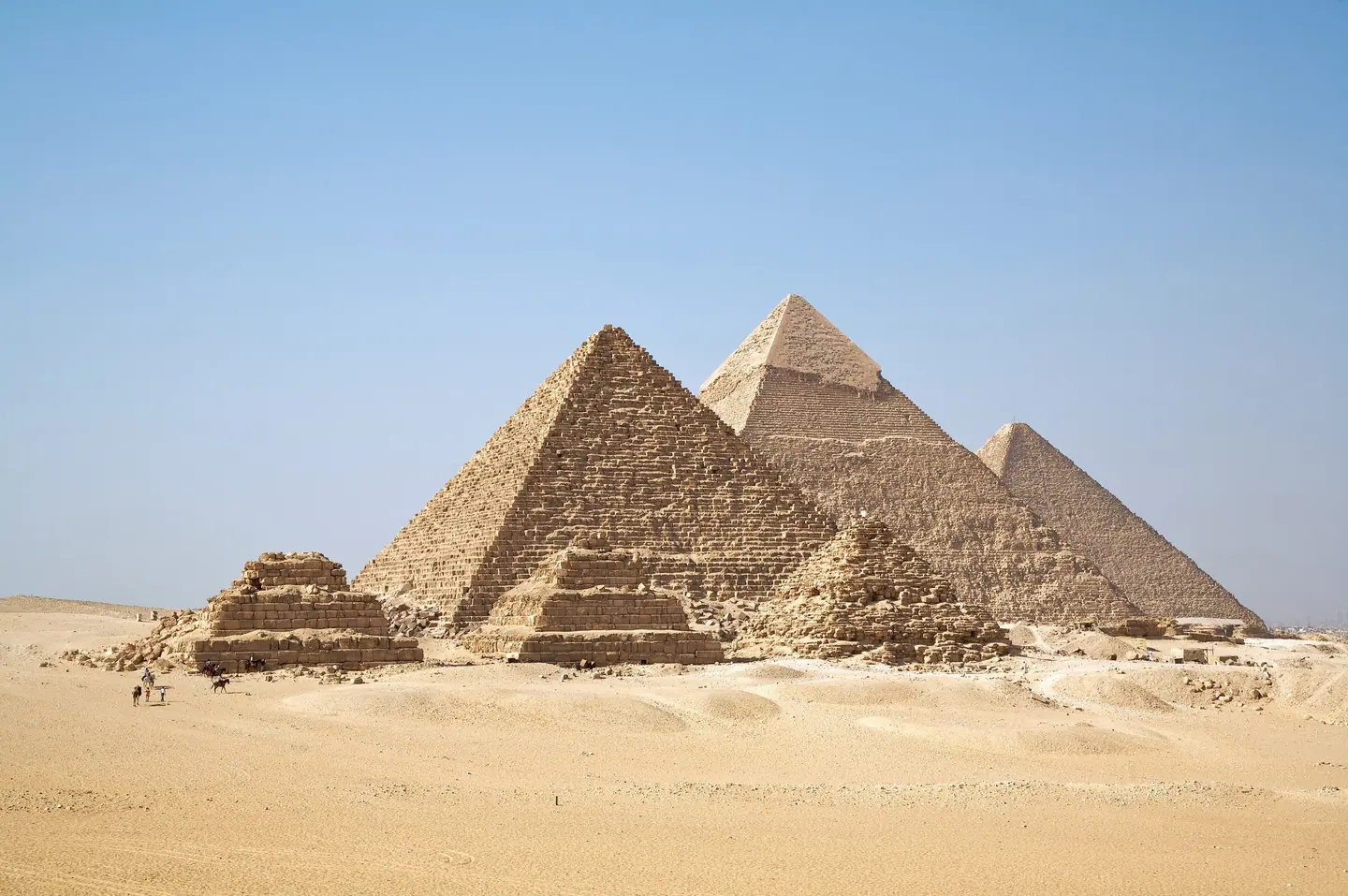
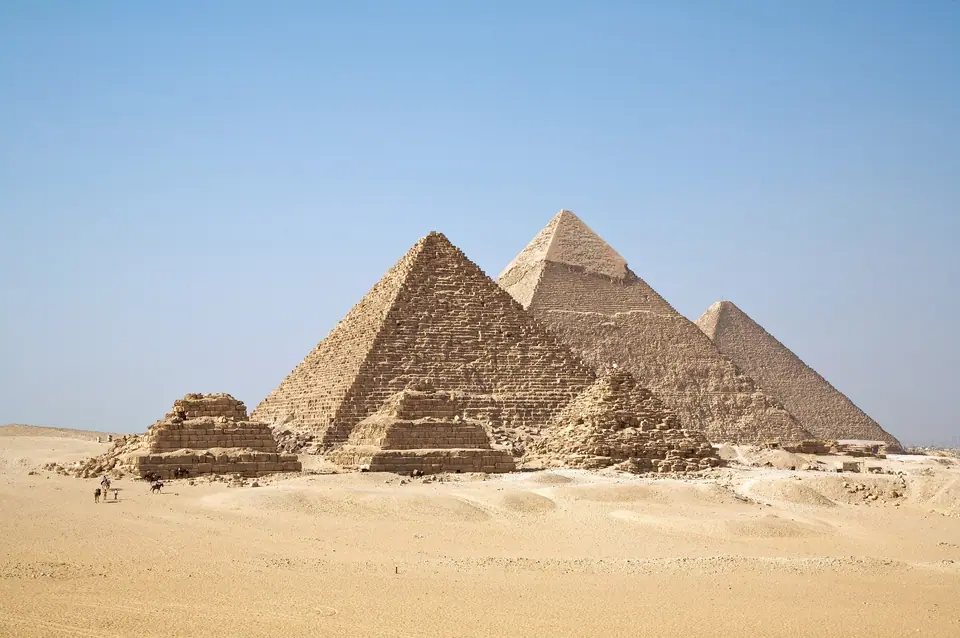
Giza Plateau, Great Sphinx & Saqqara Necropolis
Great Pyramid of Giza, Pyramid of Khafre, Pyramid of Menkaure, Great Sphinx of Giza, Valley Temple of Khafre, Grand Egyptian Museum, Step Pyramid of Djoser Saqqara, and Memphis Mit Rahina
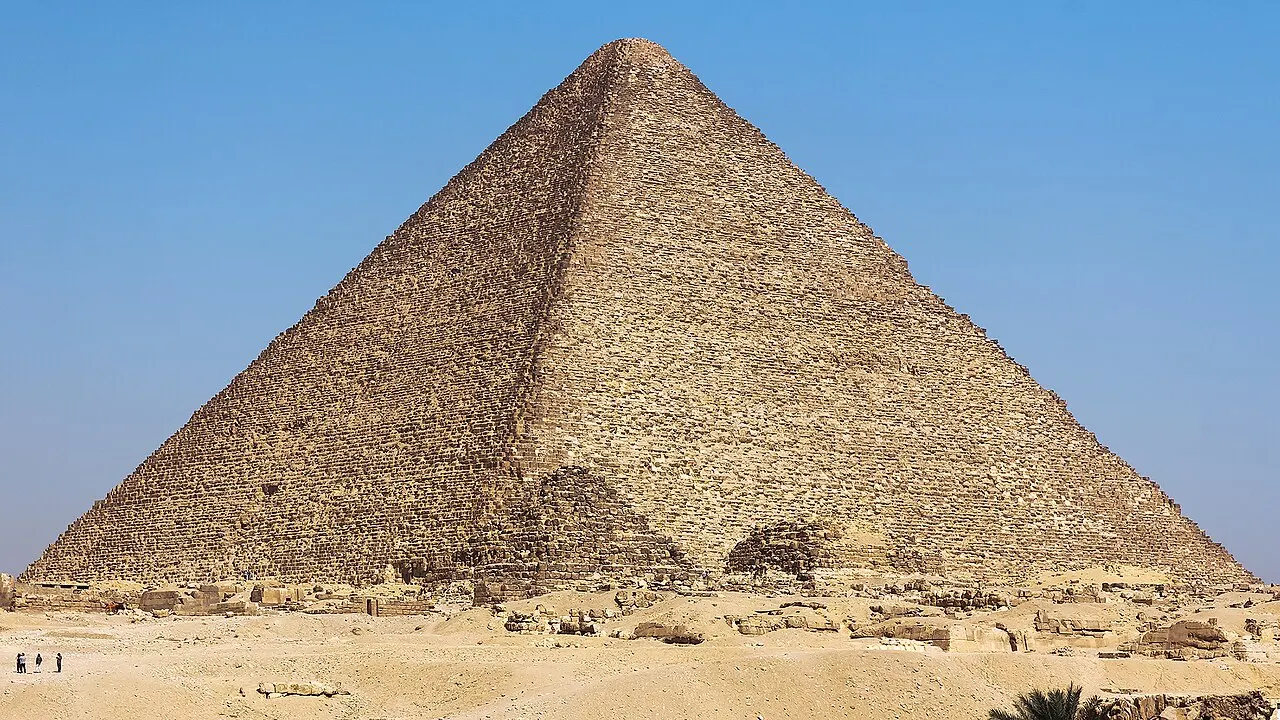
Great Pyramid of Giza
Constructed during the Fourth Dynasty, this colossal monument originally reached over 146 metres in height. It consists of roughly 2.3 million limestone blocks cut and transported from nearby quarries. Visitors can inspect the Grand Gallery, the King's Chamber, and the remaining smooth casing stones near the base.
Pyramid of Khafre
Erected for Pharaoh Khafre, this tomb appears taller than its neighbour due to being situated on higher bedrock. Distinctive casing stones still cling to its uppermost section, displaying the smooth finish that once covered the entire exterior. Two separate entrances lead into burial chambers cut deep into the limestone foundation.
Pyramid of Menkaure
Built for Pharaoh Menkaure, this structure represents the final major royal tomb constructed on the plateau. The lower courses feature red Aswan granite rather than Tura limestone, creating a striking contrast in materials. An exterior vertical gash remains visible today, carved during a sixteenth-century attempt to dismantle the pyramid.
Great Sphinx of Giza
Carved directly from a single ridge of limestone bedrock, this monumental statue features the body of a lion and the head of an Egyptian ruler. Historians generally attribute its construction to Pharaoh Khafre around 2500 BC. The Dream Stele of Thutmose IV remains fixed between its massive front paws.
Valley Temple of Khafre
Situated adjacent to the Great Sphinx, this megalithic structure played a central role in mummification rituals. Thick walls of polished pink Aswan granite enclose pillared courtyards paved with alabaster. Statues of Khafre were recovered from its interior pits, including the famous diorite sculpture now preserved in Cairo.
Giza Solar Boat Museum Site
Discovered sealed beneath limestone slabs south of the Great Pyramid, this ancient vessel was buried around 2500 BC to aid the pharaoh in the afterlife. The Lebanese cedar wood craft was assembled without nails, using vegetal ropes and pegs. While the original boat moved to new quarters, the pit reveals remarkable ancient preservation methods.
Tomb of Meresankh III
This Fourth Dynasty rock-cut tomb belonged to Queen Meresankh III, granddaughter of Khufu. Its subterranean chambers retain unusually bright wall paintings detailing daily court life, agricultural tasks, and metalworking. Sculpted statues of the queen and her female relatives stand carved directly into the eastern limestone walls.
Western Cemetery, Giza
Extending across the plateau west of Khufu's pyramid, this burial field contains tombs of royal courtiers, priests, and officials. Laid out in organized streets, the rectangular mastabas provide key insights into civil administration during the pyramid age. Intricate false doors and limestone offering tables remain preserved throughout the site.
Eastern Cemetery, Giza
This sector contains the tombs of Khufu's close family members, including sons, daughters, and multiple queens. Three subsidiary pyramids dominate the northern edge, each originally equipped with a modest mortuary chapel. Extensive mastaba complexes reveal detailed biographies inscribed along exterior entrance jambs and interior chapel walls.
Grand Egyptian Museum
Positioned just outside the main pyramid precinct, this vast contemporary cultural centre exhibits artefacts spanning thousands of years of Egyptian civilization. Its design features a grand atrium dominated by a colossal statue of Ramesses II. Floor-to-ceiling glass galleries frame direct views toward the ancient pyramids across the desert.
Pyramid of Djoser
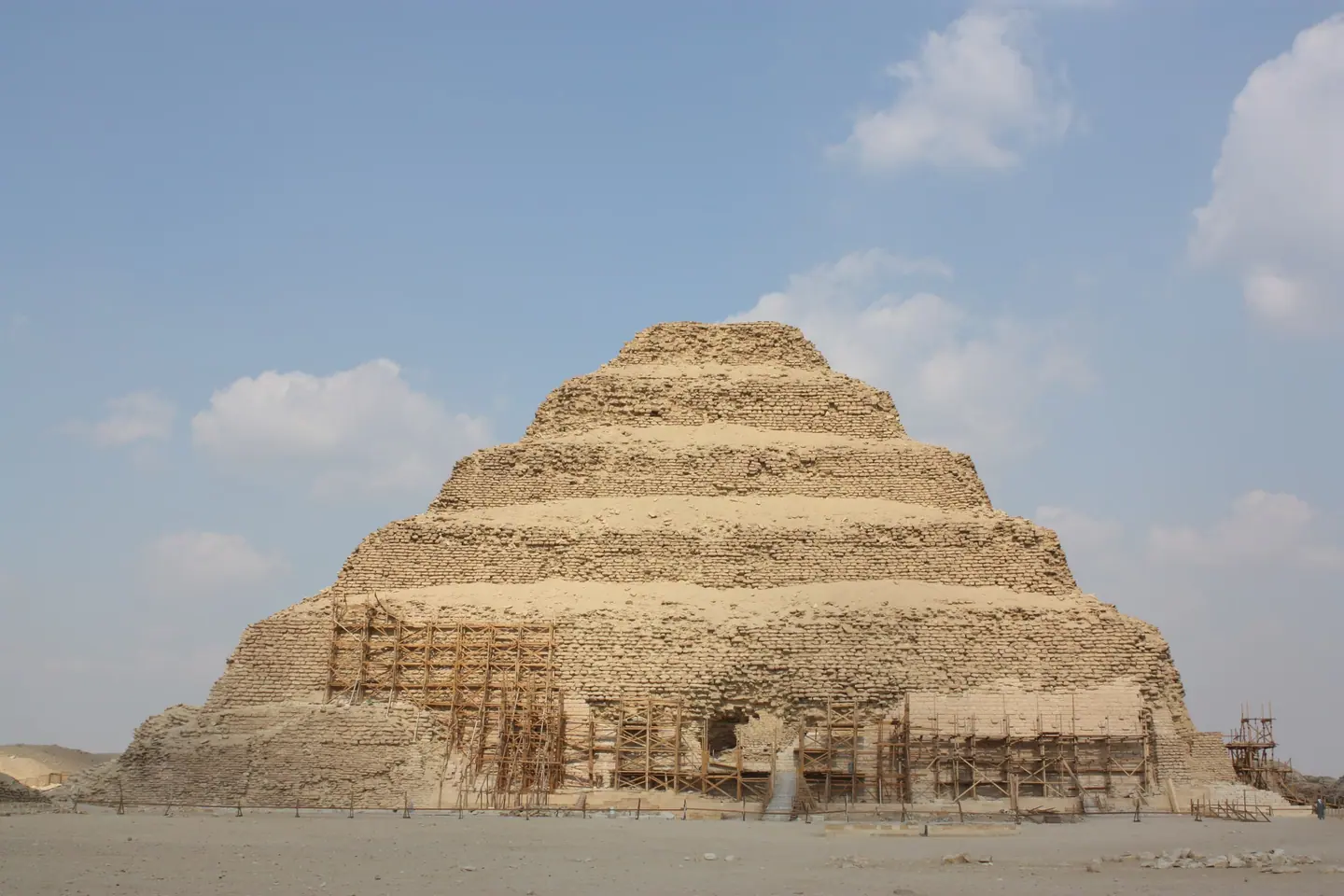
Designed by the architect Imhotep during the Third Dynasty, this revolutionary stepped monument transitioned Egyptian royal burial architecture from mudbrick mastabas to stone pyramids. Six tiers rise above an intricate maze of underground tunnels, galleries, and a granite burial chamber. A massive dry moat and stone enclosure wall surround the funerary precinct.
Heb-Sed Court
Located within the Djoser funerary complex, this oblong courtyard hosted the symbolic ceremonies that renewed the pharaoh's reign. Rows of dummy chapels with fluted engaged columns line both sides, representing regional shrines of Upper and Lower Egypt. The architecture preserves some of the earliest stone imitations of organic reed structures.
Pyramid of Unas
Though modest in external appearance, this Fifth Dynasty tomb is historically renowned for its subterranean burial chamber. The interior walls feature the earliest known Pyramid Texts, carved in turquoise-tinted hieroglyphic inscriptions meant to protect the sovereign in the afterlife. The ceiling displays carved golden stars over a dark night sky.
Serapeum of Saqqara
Carved deep beneath the desert plateau, this cavernous underground system served as the burial place for the sacred Apis bulls from the New Kingdom into Ptolemaic times. Long vaulted galleries contain twenty-four massive black basalt and granite sarcophagi, each weighing up to seventy tonnes. Dedicatory stelae provide crucial chronological data for ancient Egypt.
Mastaba of Ti
Regarded as one of the finest non-royal tombs in Saqqara, this complex belonged to Ti, a senior royal supervisor. The limestone reliefs display extraordinary detail, portraying cattle crossings, hippo hunts, carpentry, and agricultural routines. An open courtyard and serdab chamber allowed statues to receive spiritual offerings from visiting relatives.
Tomb of Mereruka
Serving Pharaoh Teti, Mereruka constructed the largest private mastaba in Saqqara, dividing thirty-three chambers among himself, his wife, and his son. The interior walls feature scenes of hunting in papyrus marshes, tax collection, and jewellery manufacturing. A life-sized statue of the vizier stands within a deep niche, stepping forward toward the altar.
Pyramid of Teti
Although reduced externally to a mound of rubble, this Sixth Dynasty pyramid provides access to exceptionally preserved substructures. Its underground rooms display extensive Pyramid Texts covering walls of fine limestone, surrounding a basalt sarcophagus that remains intact. The surrounding necropolis features tombs belonging to top royal administrators from Teti's reign.
Imhotep Museum
Located near the entrance to the Saqqara archaeological zone, this modern facility honours the architect Imhotep. Galleries display wooden coffins, mummified animals, surgical tools, and fragments of the faïence wall tiles from beneath the Step Pyramid. One prominent room showcases the personal library and field gear of French architect Jean-Philippe Lauer.
Colossus of Ramesses II at Memphis
Housed within an open-air pavilion in the village of Mit Rahina, this colossal sculpture measures over ten metres long despite missing its lower legs. The fine carving of the limestone features details of the pharaoh's royal regalia, breastplate, and dagger. A raised viewing platform allows visitors to study the facial carving from close range.
Alabaster Sphinx of Memphis
Discovered in 1912 within the ruins of ancient Memphis, this statue was carved from a single block of calcite alabaster. Believed to date to the reign of Amenhotep II, the sculpture measures eight metres in length and weighs roughly ninety tonnes. It stands beside the ruins of the Great Temple of Ptah, once the city's religious core.
Al-Muizz Street, Khan el-Khalili & Fatimid Cairo
Bab al-Futuh, Bab al-Nasr, Mosque of al-Hakim, Qalawun Complex, Madrasa of Barquq, Beit al-Suhaymi, Khan el-Khalili, Al-Hussein Mosque,Al-Azhar Mosque, and Bab Zuweila
Bab al-Futuh
Constructed in 1087, this massive stone portal defended the northern entrance to the Fatimid royal enclosure. Two rounded semicircular towers flanked the entrance, pierced by arrow slits and crowned by machicolations. We can still inspect the carved stone vaults and defensive arrow loops that protected medieval soldiers during military sieges.
Bab al-Nasr
Commissioned alongside Bab al-Futuh in the late eleventh century, Bab al-Nasr features rectangular defensive towers rather than curved ones. Relief carvings of shields and swords decorate the exterior friezes, celebrating Fatimid military victories. French soldiers serving under Napoleon Bonaparte later carved their names into the upper battlements during their occupation.
Mosque of al-Hakim
Started by Caliph Al-Aziz Billah and completed by his son Al-Hakim bi-Amr Allah, this hypostyle mosque covers an immense courtyard. Its most striking features are the two corner minarets encased in monumental square stone bastions. The interior displays pointed brick arcades decorated with elegant carved stucco bands bearing early Kufic script.
Wekalet al-Bazaraa
This Ottoman-era commercial building provided ground-floor storage vaults for valuable spices alongside multi-storey living quarters for visiting traders. The central open courtyard features timber lattice windows, known locally as mashrabiya, projecting from the upper domestic levels. Restorations have revealed the original stone arches, internal water cisterns, and decorative ceiling beams.
Bayt al-Suhaymi
Dating originally from 1648 and expanded in 1796, this residence represents classic Cairene domestic architecture. The house divides strictly into public reception areas, called salamlik, and private family rooms, known as the haramlik. Visitors can wander through airy reception halls cooled by marble fountains, viewing intricate wooden mashrabiya work and lush inner courtyards.
Mosque of al-Aqmar
Erected in 1125 by the vizier al-Ma'mun al-Bata'ihi, this monument features the earliest decorated stone facade found in Cairo. The street wall deliberately shifts its angle to conform to the thoroughfare while keeping the interior prayer hall oriented towards Mecca. Finely chiselled stalactite niches, ribbed medallions, and early Kufic inscriptions cover the exterior stonework.
Sabil-Kuttab of Katkhuda
Erected by the Mamluk amir Abd al-Rahman Katkhuda in 1744, this structure occupies a prominent fork along the historic route. The ground floor dispensed fresh drinking water to passers-by through ornate bronze grilles, while an open-loggia schoolhouse taught local orphans on the floor above. Glazed Iznik tiles, polychrome marble, and gilded timber cover the ceilings.
Mosque-Madrasa of Sultan Barquq
Founded in 1386 by Sultan Barquq, the first Burji Mamluk ruler, this grand complex accommodated students of all four Sunni legal schools. The building contains an open courtyard framed by four vaulted halls, an octagonal minaret, and a ribbed stone dome. Stained-glass stucco windows and inlaid porphyry marble decorate the sanctuary prayer hall.
Madrasa of al-Nasir Muhammad
Completed in 1304, this religious school showcases a striking pointed Gothic doorway, taken as a war trophy from a Crusader church in Acre. The complex also features an ornate stucco minaret decorated with delicate geometric tracery and Moorish horseshoe arches. Within the main courtyard lie the remains of student cells and richly decorated prayer halls.
Complex of Sultan Qalawun
Sultan al-Mansur Qalawun constructed this massive monument between 1284 and 1285 on the site of a Fatimid palace. Its mausoleum chamber incorporates Roman granite columns supporting a magnificent dome, surrounded by carved stucco and marble mosaics. The adjacent ruins show the layout of the medieval bimaristan, which served as a premier teaching hospital.
Madrasa of al-Salih Ayyub
Erected by the last major Ayyubid sultan between 1242 and 1244, this institution broke ground by teaching all four Sunni legal rites simultaneously. The sultan's widow, Shajar al-Durr, added his domed tomb to the complex following his death in battle. A notable brick minaret, topped with an incense-burner shaped finial, rises above the carved wooden entrance doors.
Sabil-Kuttab of Tusun Pasha
Commissioned in 1820 to honour Muhammad Ali's deceased son Tusun, this building reflects Ottoman-baroque stylistic influences. Its bowed facade includes large bronze screens where street attendants distributed chilled water, framed by classical European pilasters and leaf mouldings. An upper floor with shuttered arched windows historically housed an elementary school for young boys.
Khan el-Khalili
Originally developed in 1382 by Amir Jarkas al-Khalili as a large caravanserai, this market quickly became Cairo's principal mercantile centre. Narrow covered alleys branch past workshops dedicated to hand-beaten copper, silver jewellery, leather goods, and fragrant spices. Several original Mamluk stone gateways and vaulted chambers still anchor the surrounding commercial lanes.
Wekalet al-Ghouri
Commissioned by Sultan Qansuh al-Ghouri in 1504, this well-preserved trade complex accommodated international textile merchants. Built around a wide rectangular courtyard, the ground level provided stone warehouses while the upper tiers housed private guest rooms behind mashrabiya woodwork. Today, the central atrium operates as a cultural arts centre hosting regular heritage performances.
Complex of Sultan al-Ghouri
Built between 1503 and 1505, this architectural pair comprises a mosque-madrasa on the western side and a mausoleum, khanqah, and sabil on the eastern side. A towering wooden roof originally bridged the roadway between them, creating a sheltered market passage. The mosque boasts red and white striped masonry, fine marble marquetry, and a square minaret.
Al-Hussein Mosque
Standing alongside the Khan el-Khalili square, this sacred site originated in 1154 when the head of Husayn ibn Ali was transferred to Cairo for protection. Although largely rebuilt in the nineteenth century with neo-Gothic elements, the site preserves its Fatimid foundation. The shrine room features an ornate silver lattice enclosure that draws pilgrims from across the region.
Al-Azhar Mosque
Founded by the Fatimid general Jawhar al-Siqilli in 970 alongside the creation of Cairo, Al-Azhar remains one of the oldest operating educational institutions. The central marble courtyard displays stucco rosettes, keel-shaped arcades, and minarets added by successive Mamluk and Ottoman sultans. Scholars and students continue to gather in the carpeted hypostyle sanctuary for theological discourse.
Mosque of Mahmud Muharram
Constructed in 1792 by a wealthy local merchant, this mosque serves as a late example of traditional Cairene Islamic architecture. The building contains an elevated prayer hall built over shops, reached by a wide stone staircase from street level. Carved wooden ceilings, painted floral patterns, and delicate plaster tracery adorn the quiet interior.
Mosque of Sultan al-Mu'ayyad
Erected by Sultan al-Mu'ayyad Shaykh between 1415 and 1421, this complex replaced an infamous medieval prison where the sultan was once incarcerated. Its twin minarets stand dramatically on top of the neighbouring Bab Zuweila stone gate towers. Inside, the prayer hall contains carved marble wall panels, gilded ceilings, and massive bronze-plated doors taken from Sultan Hasan's mosque.
Bab Zuweila
Erected in 1092 under the vizier Badr al-Jamali, Bab Zuweila formed the southern defense portal of the walled royal city. Two massive rounded stone bastions flank the entry arch, each capped with an open spiral staircase leading to the upper ramparts. From the parapets, we look out across the dense rooftops, domed mausoleums, and minarets of old Cairo.
Saladin Citadel, Sultan Hassan & Ibn Tulun
Cairo Citadel, Mosque of Muhammad Ali, Sultan al-Nasir Muhammad Mosque, Mosque-Madrasa of Sultan Hassan, Al-Rifa’i Mosque, Mosque of Ibn Tulun, Gayer-Anderson Museum, and Al-Azhar Park
Cairo Citadel
Saladin commissioned this vast defensive complex in 1176 to protect the capital against Crusader incursions. Perched atop the Mokattam Hills, the fortified perimeter incorporates layers of Ayyubid, Mamluk, and Ottoman military engineering. Travellers can examine heavy limestone bastions, vaulted sentry corridors, and broad terraces commanding strategic views over the city below.
Mosque of Muhammad Ali
Erected between 1830 and 1848, this prominent sanctuary honours Prince Tusun Pasha and mimics classical Ottoman imperial designs. Its twin pencil minarets rise high above multi-tiered domes lined with imported Egyptian alabaster. Within the prayer hall, ornate brass lamps hang over plush carpets, while an elaborate monumental clock sits in the central courtyard.
Al-Nasir Muhammad Mosque
Built in 1318 by Sultan al-Nasir Muhammad, this hypostyle complex served as the royal mosque of the Citadel. Its spacious open courtyard features recycled Pharaonic, Roman, and Byzantine granite columns supporting horseshoe arches. The exterior minarets stand out for their unusual bulbous crowns covered in Persian-style green and blue glazed ceramic tiles.
National Military Museum Egypt
Housed within the nineteenth-century Haram Palace, this museum charts Egypt's military chronology from antiquity to modern conflicts. The building showcases grand painted reception halls and Ottoman-rococo interior plasterwork. Exhibits display historic weaponry, royal ceremonial uniforms, artillery pieces, and bronze statues of commanders who shaped regional defence over millennia.
National Police Museum
Positioned near the northern terrace of the Citadel, this dedicated gallery traces national policing and famous criminal trials. Rooms display historic assassination records, antique uniforms, and colonial-era weaponry. The adjacent stone terrace provides an exceptional vantage point looking out towards Islamic Cairo and the Giza plateau on clear mornings.
Well of Joseph
Engineered under Saladin's vizier Qaraqush in the late twelfth century, this massive shaft descends nearly eighty-five metres into solid limestone bedrock. A spiralling ramp allowed oxen to descend halfway down to power a continuous water-wheel system fed by Nile seepage. It provided an uninterrupted water supply during prolonged medieval sieges.
Bab al-Azab
Constructed in 1754 by Radwan Katkhuda, this imposing stone gateway faces Sultan Hassan Square with flanking rounded towers. The narrow walled passage behind the gate served as the historic ambush site where Muhammad Ali orchestrated the 1811 massacre of Mamluk beys. Its massive wooden doors and crenellated battlements reflect late Ottoman defensive design.
Sulayman Pasha Mosque
Dating to 1528, this sanctuary within the northern enclosure was the earliest classical Ottoman mosque constructed in Cairo. Built for the Citadel's Janissary garrison, it features a central dome flanked by three semi-domes and pencil minarets. The interior exhibits fine Ottoman floral tilework, carved marble inscriptions, and an open ablution courtyard.
Burg al-Zafar
Positioned at the northeastern corner of the medieval enclosure, this massive round bastion protected the Citadel from eastern advances. The tower contains vaulted arrow slits, subterranean troop chambers, and heavy ashlar masonry characteristic of twelfth-century Ayyubid fortification. It connects directly with the restored eastern city walls extending towards Islamic Cairo.
Mosque-Madrasa of Sultan Hassan
Built between 1356 and 1363, this colossal Mamluk complex features an enormous stone entrance portal and high exterior walls. Inside, four monumental iwans open onto a square central courtyard, each originally dedicated to one of the four Sunni legal schools. The lofty domed mausoleum behind the qibla wall contains intricate stucco bands.
Al-Rifa'i Mosque
Commissioned in 1869 by Khushyar Hanim and completed in 1912, this Neo-Mamluk sanctuary balances Sultan Hassan across a pedestrianised lane. The lavish interior contains carved marble columns, German chandeliers, and gilded ceilings. It functions as the royal necropolis for Egypt's Muhammad Ali dynasty, containing the tombs of King Farouk and the last Shah of Iran.
Midān Salāh ad-Dīn
Originally an open polo ground and horse market under the Mamluk sultans, this expansive public square sits directly below the Citadel's ramparts. The space links Cairo's military acropolis with the city's monumental mosques. Travellers gather here to appreciate the imposing stone scale of Sultan Hassan and Al-Rifa'i rising beside the roadway.
Mosque of Amir Akhur
Erected in 1503 by Amir Qanibay, the Sultan's master of the horse, this late Burji Mamluk structure overlooks Midan Salah ad-Din. The building features an intricate double-headed minaret top, carved limestone stalactite cornices, and a decorated stone dome. Its raised position on sloping bedrock makes the entrance stairway and facades prominent landmarks.
Mosque of Mahmud Pasha
Constructed in 1567 by the Ottoman governor Mahmud Pasha, this compact sanctuary stands directly southwest of the Citadel. The exterior features a single pencil-thin minaret and carved stone details reflecting a fusion of Mamluk massing and Ottoman decoration. Its elevated prayer hall contains quiet arched windows overlooking the nearby medieval streets.
Mosque of Ibn Tulun
Completed in 879 by Ahmad ibn Tulun, this vast brick-and-stucco sanctuary is Cairo's oldest surviving mosque retaining its original design. An enormous arcaded courtyard is framed by carved stucco friezes featuring Samarran geometric patterns. Visitors can ascend the unique external spiral minaret to view the geometric layout and surrounding historic urban fabric.
Gayer-Anderson Museum
Adjoining the exterior wall of Ibn Tulun Mosque, this museum consists of two connected seventeenth-century domestic residences restored by an eccentric British military doctor. The property features carved mashrabiya lattice windows, secluded rooftop terraces, and shaded reception rooms. Inside, curated rooms showcase historic Middle Eastern, Indian, and East Asian decorative arts.
Sabil-Kuttab of Umm Abbas
Commissioned in 1867 by the mother of Khedive Abbas Hilmi I, this charity foundation combines a public water dispensary with a traditional Quranic school. The building displays a curved street facade, Ottoman-rococo carved marble motifs, and ornate bronze window grilles. Fine gilded calligraphy bands encircle the exterior, offering prayers for the patroness.
Madrasa of Sarghitmish
Built in 1356 by Amir Sarghitmish, this Mamluk school sits immediately northwest of Ibn Tulun Mosque. The structure features a prominent pointed ribbed stone dome covering the founder's mausoleum and an elegant minaret with carved detailing. Within, a quiet courtyard with student cells surrounds an open prayer hall dedicated to Hanafi legal scholarship.
Mosque of Qaytbay at Qal'at al-Kabsh
Commissioned in the late fifteenth century by Sultan al-Ashraf Qaytbay, this complex crowns the rocky ridge of Qal'at al-Kabsh. The facade features precise stone masonry, decorative ablaq stripes, and a slender carved minaret. Its position atop steep residential staircases offers travellers a tranquil courtyard environment rarely disturbed by modern vehicular traffic.
Al-Azhar Park
Developed by the Aga Khan Trust for Culture over a centuries-old landfill, this thirty-hectare park opened in 2005. Formal sunken gardens, irrigation fountains, and shaded walkways are inspired by classical Islamic landscape traditions. The western promenade provides panoramic sightlines directly across to the Citadel, the minarets of Old Cairo, and distant desert horizons.
Coptic Cairo, NMEC & Roda Island Nilometer
Babylon Fortress, Hanging Church Al-Muallaqa, Coptic Museum, Church of Saints Sergius and Bacchus, Ben Ezra Synagogue, Mosque of Amr ibn al-As, NMEC Royal Mummies, and Nilometer on Roda Island
Babylon Fortress
Built by Roman emperors Trajan and Arcadius, this fortified citadel guarded the boundary between Middle and Lower Egypt. Its banded brick and limestone towers now support subsequent Christian shrines. Travellers can examine the defensive bastions near the Mar Girgis metro station that withstood the Arab siege of 640.
Hanging Church
Dedicated to the Virgin Mary, this third-century sanctuary earned its title from being suspended over the southern gatehouse of Babylon Fortress. Visitors cross an open courtyard to enter a vaulted interior supported by marble columns, notable for its timber roof constructed in the shape of Noah's Ark and ornate ebony screens inlaid with ivory.
Church of Saints Sergius and Bacchus
Traditionally constructed atop the cave where the Holy Family rested during their flight into Egypt, this ancient church functions as an important pilgrimage destination. The central nave features twelve marble pillars, alongside a medieval wooden altar screen. Below the sanctuary floor lies the subterranean crypt, occasionally inundated when Nile water tables rise.
Church of Saint Barbara
Restored in the eleventh century following fires, this ancient church honours Saint Barbara, whose relics are preserved in an adjacent chapel. The layout follows a classical basilican design with aisles separated by Corinthian columns reclaimed from earlier Roman structures. Admire the intricately carved wooden sanctuary screens and painted Byzantine icons flanking the altar.
Church of Saint George
This prominent Greek Orthodox church is one of the few round churches in Egypt, built directly on top of an ancient Roman tower. Rebuilt following a devastating fire in 1904, the sanctuary features stained glass and gilded iconostasis woodwork. Steps lead down to historic chambers where pilgrims venerate chains attributed to Saint George.
Coptic Museum
Founded by Marcus Simaika Pasha in 1908, this institution bridges Pharaonic, Roman and Islamic heritage through Christian artefacts. Its galleries feature carved wooden mashrabiya ceilings, painted frescoes, textiles, metalwork and the famous Nag Hammadi manuscripts. The museum gardens preserve quiet paths bounded by the remains of the Roman fortress.
Ben Ezra Synagogue
Occupying a site that served as a Coptic church before being acquired by Rabbi Abraham ibn Ezra in the ninth century, this synagogue showcases elegant Arabesque motifs. It gained international fame after scholars discovered the Cairo Genizah, thousands of medieval secular and religious manuscripts in its attic. Restored marble pavilions define the interior.
Monastery of Saint George
Adjoining the rotunda church, this sprawling monastery complex serves as the seat of the Greek Orthodox Patriarchate of Alexandria. High walls enclose shaded pathways, administrative cloisters and a centuries-old cemetery where notable diplomatic and trading families rest. A dedicated chapel contains chains that visitors hold in hope of healing.
Church of Saint Menas
Situated just north of the central Coptic compound near the historic canal, this venerable church traces its foundation to the sixth century. Reconstructed in the eighth century, the interior holds valuable icons and relics of Saint Menas, revered for military martyrdom. The surrounding quiet quarter offers views of traditional stone residential masonry.
Monastery of Saint Mercurius Abu Seifein
Located in an enclave north of the main fortress, this complex includes three historic sanctuaries dedicated to Saint Mercurius, known locally as Abu Seifein. The primary cathedral contains one of the largest collections of Coptic icons in Egypt, alongside marble pulpits and inlaid mother-of-pearl woodwork. An active community of nuns preserves the compound.
Church of the Virgin Mary Haret Zuweila
Built during the Fatimid era, this church functioned as the official seat of the Coptic Pope from 1300 until the seventeenth century. Sunk several metres below modern street levels, the sanctuary houses ancient icons depicting the Annunciation and early martyrs. Adjoining chapels and convents form a historic monastic retreat within medieval street passages.
Mosque of Amr ibn al-As
Founded in 641 by the Arab commander Amr ibn al-As, this historic prayer hall marks the original heart of the early garrison city of Fustat. Although enlarged and rebuilt repeatedly over centuries, the expansive hypostyle prayer hall retains hundreds of marble columns. The vast courtyard provides quiet space amidst the southern quarter of modern Cairo.
Archaeological Remains of Fustat
Extending east of the Roman fortress, this archaeological park reveals the residential grid of the early Islamic capital. Visitors can walk between excavated mudbrick walls, stone floorplans, domestic courtyards and intricate early plumbing networks that date from the seventh to twelfth centuries. These ruins illuminate domestic life before the Fatimids established northern Cairo.
National Museum of Egyptian Civilization
Opened fully in 2021, this modern museum outlines the full trajectory of Egyptian history from prehistoric eras to modern times. Its grand hall displays artefacts across dynastic, Greco-Roman, Coptic and Islamic epochs. Large glass facades frame panoramic views across the restorative waters of neighbouring Lake Ain el-Sira.
NMEC Royal Mummies Hall
Designed to evoke the subterranean royal tombs of the Valley of the Kings, this climate-controlled crypt houses twenty-two royal mummies moved during the 2021 Golden Parade. Travellers encounter legendary rulers including Hatshepsut, Thutmose III and Ramesses II resting inside individual display chambers, alongside their funerary linens and clinical radiographic analyses.
Nilometer on Roda Island
Commissioned by the Abbasid Caliph al-Mutawakkil in 861, this stone structure is one of Cairo's oldest surviving Islamic monuments. It consists of a stone-lined pit containing a central octagonal column divided into cubits, used to regulate taxation based on river inundation. A conical wooden dome crowns the chamber, decorated with fine Qur'anic kufic inscriptions.
Manasterly Palace
Built in 1851 by Hassan Fuad Pasha al-Manasterly, this rococo-influenced retreat sits at the southern tip of Roda Island. The palace features ornate timber ceilings, painted cornices and sweeping marble verandas overlooking the Nile waters. Today it serves as a musical recital hall and incorporates a dedicated exhibition honoring singer Umm Kulthum.
Umm Kulthum Museum
Housed within an outbuilding of the Manasterly Palace, this exhibition celebrates the life of Egypt's revered singer, Umm Kulthum. The display rooms contain her signature stage gowns, diamond-studded crescent brooches, trademark dark spectacles and preserved handwritten musical scores. Audiovisual archives allow visitors to hear recordings of her monthly Thursday evening concerts.
Manial Palace and Museum
Built for Prince Mohammed Ali Tewfik in the early twentieth century, this residence blends Ottoman, Moorish, Persian and European rococo styles. The compound comprises a reception palace, clock tower, private residence, hunting museum and private mosque adorned with blue Iznik tiles. Towering banyan and palm trees shelter the surrounding estate.
El-Giza Bridge
Also known as the Abbas Bridge, this iron crossing facilitates movement between southern Roda Island and the university districts of western Giza. Pedestrians can cross its pavements for views of feluccas navigating the Nile channel against Cairo's skyline. The river embankments here preserve remnants of early twentieth-century boating clubs and gardens.
Tahrir Square, Downtown Belle Époque & Zamalek Nile Island
Egyptian Museum Tahrir, Abdeen Palace, Qasr el-Nil Bridge, Talaat Harb Square, Cairo Tower, Cairo Opera House, Aisha Fahmy Palace, Manial Palace, and Baron Empain Palace
Tahrir Square
Originally named Ismailiya Square after Khedive Ismail, this vast public plaza was redesigned in the mid nineteenth century following Haussmann principles. It serves as the geographic heart of modern Cairo, anchored by the central obelisk of Ramesses II and surrounded by landmark civic buildings.
Egyptian Museum in Tahrir
Designed by French architect Marcel Dourgnon and opened in 1902, this distinctive terracotta red palace remains an essential institution of world archaeology. Inside, two expansive floors showcase thousands of statues, papyri, mummies, and sarcophagi that trace ancient Egyptian dynasties from the Old Kingdom through the Roman era.
Mogamma
Completed in 1949 by architect Kamal Ismail, this monolithic fourteen-storey structure represents Soviet influenced modernist administrative architecture in Egypt. Long notorious as the central seat of Egyptian state bureaucracy, its curved facade dominates the southern flank of Tahrir Square.
Umar Makram Mosque
Named after the popular leader of the Cairo rebellion against Napoleonic forces, this mid-twentieth-century mosque was designed by Italian architect Mario Rossi. It features a slender minaret and ornate stone carving, serving as a revered civic landmark for national commemorations.
Talaat Harb Square
This circular junction reflects Khedive Ismail's grand nineteenth-century urban expansion, modelled after Paris's Place de l'Étoile. At its centre stands a bronze statue of national financier Talaat Harb, surrounded by radial streets lined with neoclassical and art deco apartment blocks.
Groppi Tearoom
Founded in the late nineteenth century by Swiss confectioner Giacomo Groppi, this establishment served as the pre-eminent salon for Cairo's cosmopolitan elite. Visitors still admire its intricate mosaic entryway, polished wood interiors, and brass accents that evoke the city's early-twentieth-century cafe culture.
Yacoubian Building
Constructed in 1934 for an Armenian businessman, this ten-storey block epitomises Downtown Cairo's blend of Art Deco ornamentation and classical grandeur. The building achieved international literary fame as the setting for Alaa Al Aswany's novel detailing Egyptian society across diverse social strata.
Abdeen Palace
Built between 1863 and 1873 by French architect Léon Rousseau, this grand complex replaced the Citadel as the royal seat of government. Today, several lavish wings are open as museums, displaying royal weaponry, diplomatic gifts, antique clocks, and imperial silver.
Museum of Islamic Ceramics
Housed within the 1921 palace of Prince Amr Ibrahim, this institution displays exceptional ceramics spanning Fatimid, Mamluk, Ottoman, and Persian traditions. The building itself exhibits intricate stucco, stained-glass windows, and fine zellige tilework characteristic of the neo-Mamluk revival.
Qasr El Nil Bridge
Opened in 1931 to replace an older nineteenth-century crossing, this steel swing bridge connects Downtown Cairo to Gezira Island. It is famous for four majestic bronze lion statues sculpted by French artist Henri Alfred Jacquemart, which guard the western and eastern approaches.
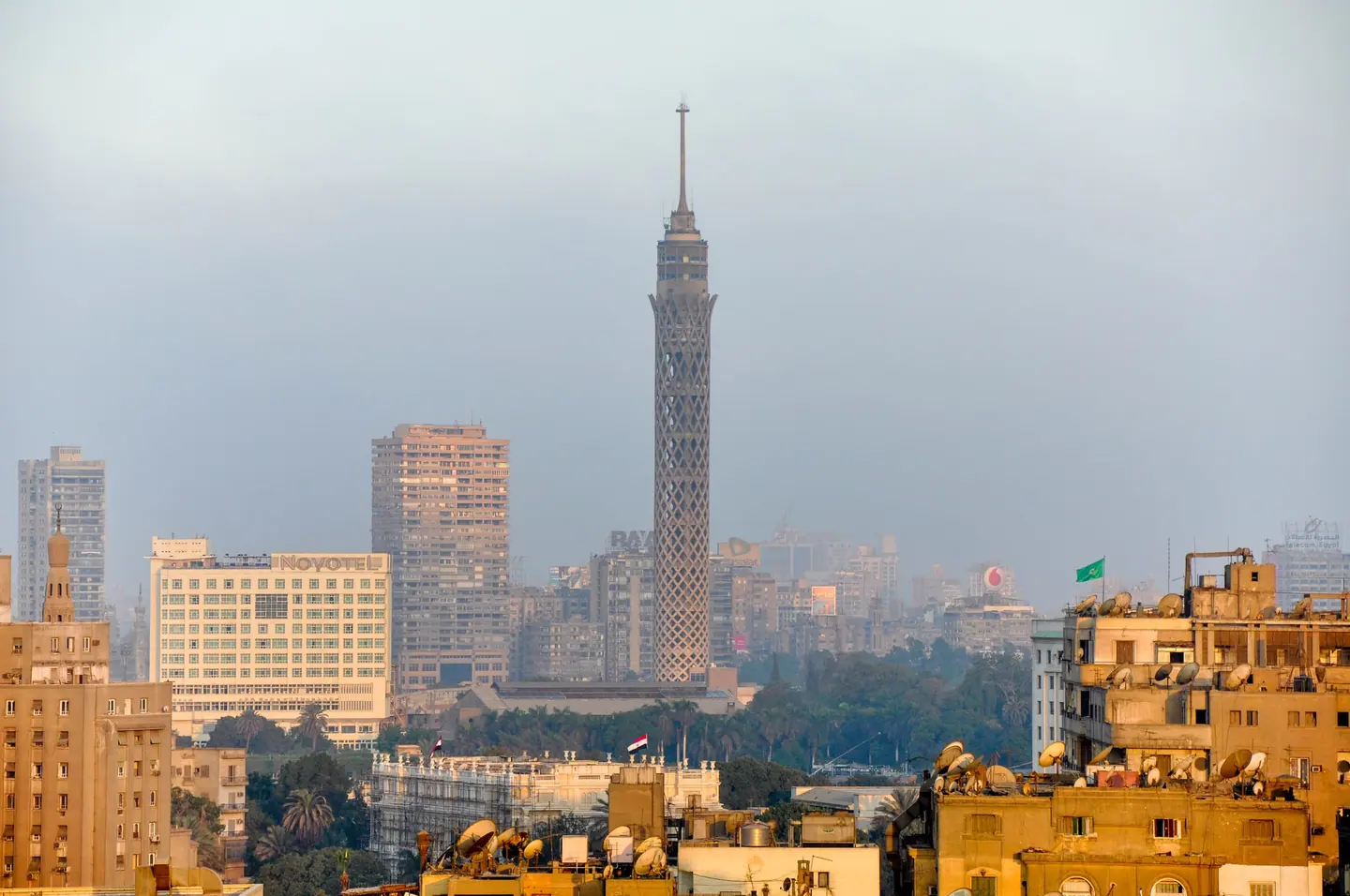
Cairo Tower
Erected between 1956 and 1961 by Egyptian architect Naoum Shebib, this 187-metre concrete tower stands as a symbol of post-revolutionary modernism. Its open-work lattice design echoes a pharaonic lotus blossom, offering panoramic views across the Nile and the surrounding metropolis.
Cairo Opera House
Inaugurated in 1988 as a gift from Japan, this cultural complex replaced the Khedivial Opera House that was destroyed by fire in 1971. Built in an elegant Islamic-modernist style, it houses multiple performance halls, art galleries, and the Museum of Modern Egyptian Art.
Museum of Modern Egyptian Art
Located within the National Cultural Centre grounds on Gezira Island, this museum traces the evolution of twentieth-century Egyptian art. Its vast collection showcases pioneering works by artists including Mahmoud Mokhtar, Ragheb Ayad, and Inji Efflatoun across sculpture, painting, and graphic arts.
Mahmoud Mokhtar Museum
Designed by celebrated architect Ramses Wissa Wassef, this museum houses the definitive collection of works by sculptor Mahmoud Mokhtar. The galleries display expressive bronze, stone, and plaster sculptures that blend classical pharaonic aesthetics with early-twentieth-century European formalism.
Aisha Fahmy Palace
Erected in 1907 by Italian architect Antonio Lasciac for an aristocratic family, this mansion overlooks the Nile in Zamalek. It features elaborate frescoed ceilings, fine parquet floors, and an authentic Japanese room lined with ornate gilded panels.
All Saints' Cathedral
Consecrated in 1988, this striking concrete cathedral is the seat of the Anglican-Episcopal Diocese of Egypt. Designed by Egyptian architects, its roof slopes upwards to evoke the petals of an opening lotus flower, creating an airy and light-filled interior sanctuary.
Aquarium Grotto Garden
Established in 1867 by Khedive Ismail, this historic park in Zamalek was constructed using clay formations shaped into cavernous labyrinthine grottos. While the aquatic tanks are modest, the peaceful grounds showcase mature ficus trees and unusual subterranean stonework.
Manial Palace and Museum
Constructed in the early twentieth century for Prince Mohammed Ali Tewfik on Rhoda Island, this walled estate blends Ottoman, Moorish, and Persian design. The complex comprises residential pavilions, an exquisite mosque, a throne hall, and rare botanical gardens gathered from worldwide travels.
Rhoda Island Nilometer
Constructed in 861 under the direction of Abbasid astronomer Al-Farghani, this stone-lined well on the southern tip of Rhoda Island measured seasonal Nile flood levels. A central octagonal column graded in cubits determined agrarian tax rates across Egypt for over a millennium.
Baron Empain Palace
Commissioned by Belgian industrialist Édouard Empain and completed in 1911 by French architect Alexandre Marcel, this residence mirrors the temples of Angkor Wat and Odisha. Its tiered exterior features intricate concrete reliefs of mythical beasts, deities, and serpents.
Navigating Giza, Old Cairo and Nile Islands
For neighbourhood accommodation notes, seasonal weather tables and airport transfer details, consult our Cairo Pyramids, Islamic Cairo & Coptic Quarter destination guide, or browse other city and regional walking routes across the atlas.