All 100 essential sights across Edinburgh Castle, the Royal Mile, Grassmarket, Holyrood, Arthur Seat, the Georgian New Town, Dean Village and Leith mapped in walking order.
Castle Rock Crag-and-Tail, the Scottish Enlightenment and Craig’s Grid
Shaped by ancient glaciers that carved a steep crag-and-tail ridge from the basalt plug of Castle Rock down to Holyrood at the foot of Arthur Seat, Edinburgh grew from the early medieval fortress of Din Eidyn into the royal burgh chartered by King David I in the twelfth century. Hemmed in by defensive walls and the marshy Nor Loch, the medieval Old Town built upward into multi-storey stone tenements ("lands") honeycombed with narrow wynds and closes branching off the spine of the Royal Mile between Edinburgh Castle and the Palace of Holyroodhouse.
In 1767, at the height of the Scottish Enlightenment led by David Hume, Adam Smith and Robert Adam, the city drained the Nor Loch to lay out Princes Street Gardens and the symmetrical neoclassical squares, crescents and circuses of the Georgian New Town. Together, the medieval Old Town and Georgian New Town form one of Europe most dramatic UNESCO World Heritage cityscapes.
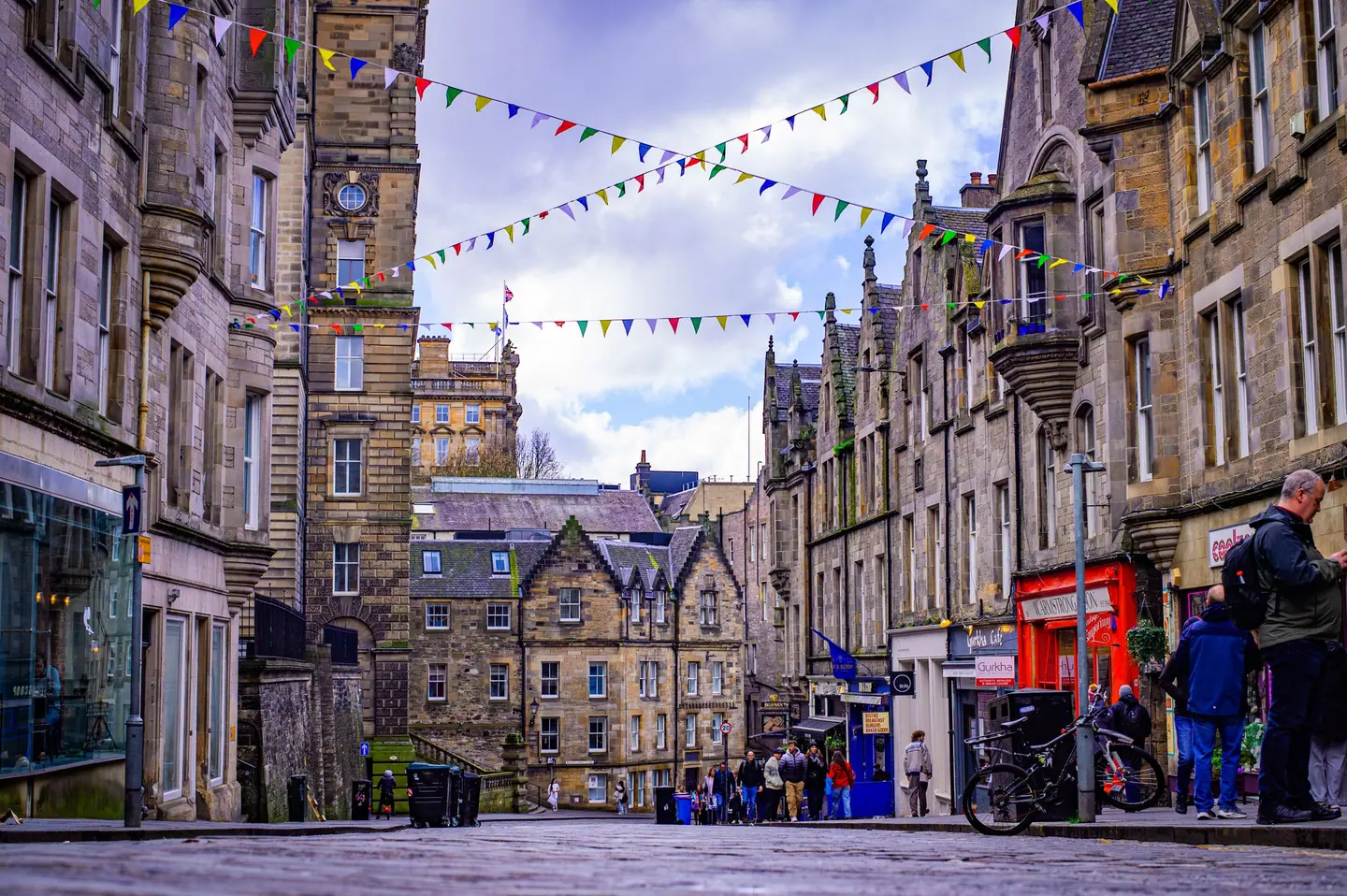
Edinburgh Castle, Castlehill, Lawnmarket & St Giles Cathedral
Begin on the volcanic summit of Edinburgh Castle and walk down the upper Royal Mile past the Writers Museum, Gladstone Land and St Giles Cathedral.
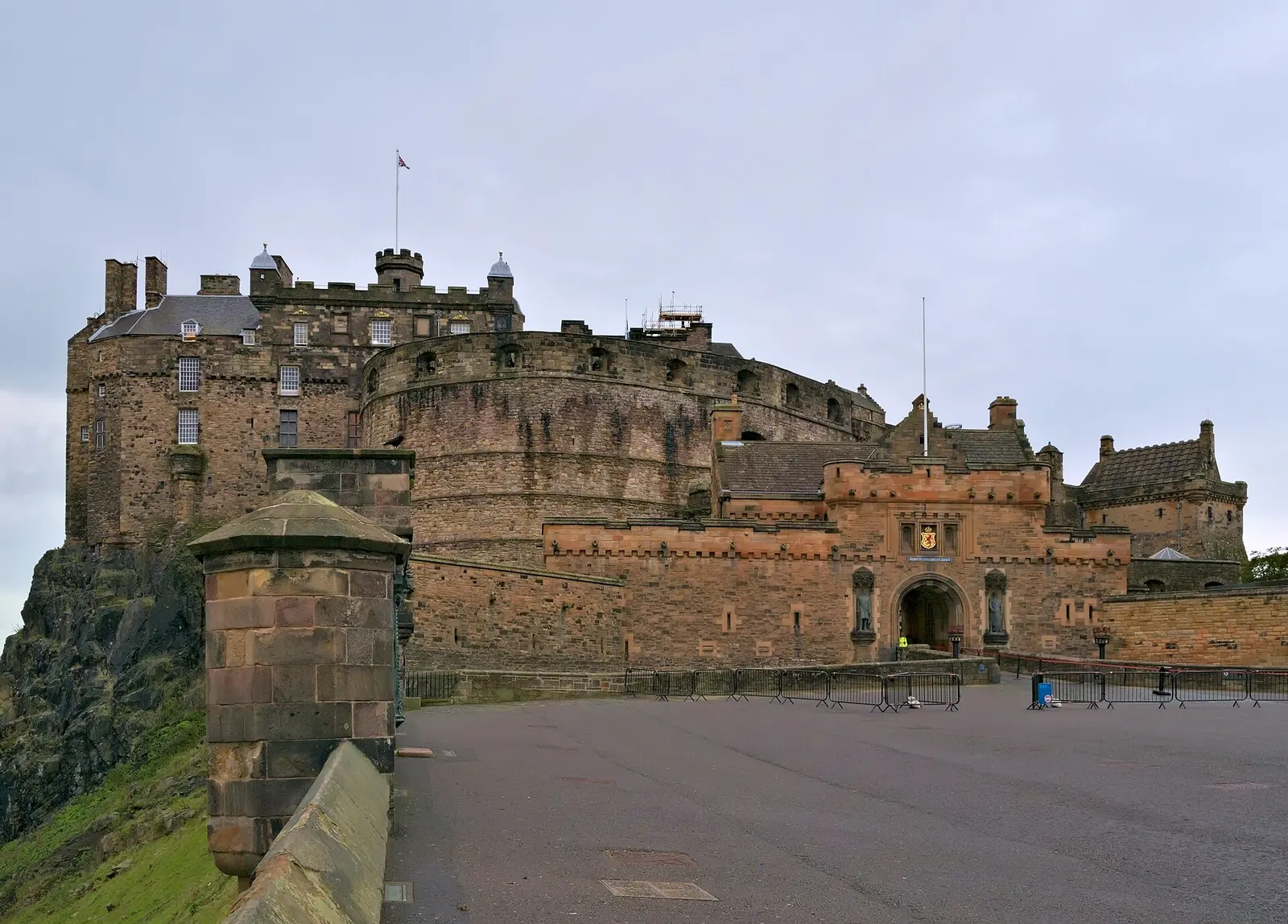
Edinburgh Castle
Dominating the city skyline, this stronghold has sheltered Scottish monarchs and withstood numerous sieges across nine centuries. Visitors can explore ancient defensive walls, royal apartments, and military barracks constructed from native sandstone. The site offers expansive viewpoints across the Firth of Forth and the Georgian New Town.
St Margaret's Chapel
Erected by King David I around 1130 in honour of his mother, this Romanesque sanctuary survived the deliberate slighting of the fortress in 1314. The modest interior features a barrel-vaulted nave and a decorated chancel arch with chevron carvings. Stained glass windows depict prominent Scottish historical figures including Saint Columba and William Wallace.
Mons Meg
Presented to King James II of Scotland in 1457, this formidable piece of artillery could propel gunstones weighing over one hundred and fifty kilograms. Constructed from forged iron staves and hoops, the cannon was employed in border conflicts before retiring to ceremonial service. It stands mounted on a replica carriage overlooking the northern ramparts.
Scottish National War Memorial
Designed by architect Sir Robert Lorimer, this stone memorial opened in 1927 within Crown Square. It incorporates portions of older castle barracks into a solemn sanctuary decorated with friezes, bronzes, and regional heraldry. Inside, handwritten rolls of honour rest within bronze caskets beneath a suspended sculpture of Saint Michael.
Crown Room and Honours of Scotland
Located within the Royal Palace on Crown Square, this vaulted chamber houses the crown, sceptre, and sword of state used during monarchical coronations. First assembled in the early sixteenth century, the regalia were concealed during the Cromwellian invasion and recovered centuries later. The nearby Stone of Scone rests alongside these historical treasures.
Castle Esplanade
Constructed in the mid-eighteenth century as a military parade area, this broad expanse connects the fortress entrance to Castlehill. The perimeter is lined with stone monuments dedicated to Scottish military regiments, foreign campaigns, and prominent civic leaders. Each August, grand temporary grandstands host military tattoos beneath the floodlit castle walls.
Witches' Well
Affixed to an esplanade wall, this relief fountain was designed by artist John Duncan and erected in 1894. It marks the approximate site where hundreds of accused persons were burned at the stake between the sixteenth and eighteenth centuries. The imagery depicts the Roman goddess of health beside the head of evil intertwined with Foxglove.
Camera Obscura and World of Illusions
Founded by entrepreneur Maria Theresa Short in 1835, this rooftop installation projects moving live panoramas of the city onto a concave viewing table. The building was later adapted by town planner Patrick Geddes as a civic observatory and sociological laboratory. Today, several floors showcase historical holograms, optical trickery, and elevated terrace views.
The Scotch Whisky Experience
Housed within the former Castlehill School, this educational venue documents the production methods and distinct geographical regions of Scotch whisky. The building contains a vast collection comprising thousands of sealed historical bottles gathered over decades. Exhibits explain the chemistry of distillation, barrel maturation, and the craft of master blenders.
The Hub
Completed in 1845 as the Assembly Hall for the Church of Scotland, this building features the highest church spire in central Edinburgh. Architects James Gillespie Graham and Augustus Pugin collaborated on its rich Gothic Revival ornamentation and lancet windows. It now functions as the operational headquarters and ticket centre for the Edinburgh International Festival.
Assembly Hall
Perched on Mound Place overlooking the Lawnmarket, this substantial stone complex was built in 1859 for the Free Church of Scotland. Designed by David Bryce, the quadrangular building incorporates twin decorative towers and a large central debating chamber with wrap-around galleries. Between 1999 and 2004, it served as the temporary home of the reconvened Scottish Parliament.
Cannonball House
This vernacular stone dwelling dates from the seventeenth century and retains historic crow-stepped gables. In its western exterior wall, a cannon shot remains firmly lodged in the masonry, reputedly fired from the castle during the Jacobite occupation of 1745. The initials of Alexander Mure and his wife, carved above an entry doorway, date to 1630.
Mylne's Court
Erected by master mason Robert Mylne between 1684 and 1690, this enclave represents one of the earliest planned residential developments on the Royal Mile. The tall stone tenements replaced chaotic timber dwellings, introducing open interior courts and uniform facades. Restored in the mid-twentieth century, the buildings currently provide accommodation for postgraduate university students.
Gladstone's Land
Purchased in 1617 by merchant Thomas Gledstanes, this six-storey property illustrates residential and commercial life during Edinburgh's early modern period. Surviving stone arcades on the ground floor sheltered street traders, while painted timber ceilings decorate the apartments above. Preserved by the National Trust for Scotland, the rooms demonstrate domestic conditions across different social strata.
Brodie's Close
This passageway was home to Deacon William Brodie, a respected city councillor and tradesman who led a double life as a burglar until his hanging in 1788. His deceitful career influenced Robert Louis Stevenson's famous novella on duality. The cobbled lane features historic stone door lintels and connects the upper thoroughfare to southern residential courtyards.
The Writers' Museum
Occupying a 1622 stone townhouse rebuilt in romantic style in the late nineteenth century, this museum celebrates Robert Burns, Sir Walter Scott, and Robert Louis Stevenson. Exhibits include rare first-edition books, personal correspondence, printing equipment, and personal effects such as Scott's childhood rocking horse. The exterior courtyard is surrounded by inscribed paving slabs.
Makar's Court
Situated immediately outside Lady Stair's House, this paved precinct commemorates centuries of Scottish literary history. Flagstones set into the ground are carved with quotations, names, and dates of major poets and authors ranging from medieval bards to contemporary figures. The open space provides a tranquil retreat from the primary street traffic of the Lawnmarket.
Upper Bow
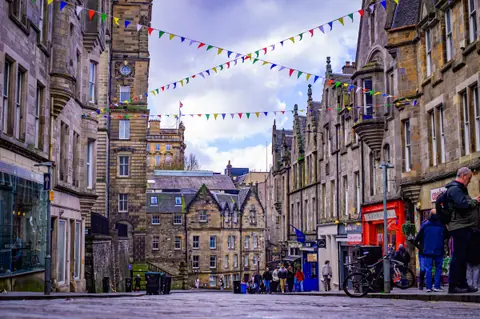
This raised pavement preserves the northernmost trajectory of the West Bow, the principal medieval approach road to the town from the Grassmarket. Remodelling during the 1830s severed the original steep descent to create higher-level arterial routes. Today, the pedestrian terrace offers elevated vistas over the curved, colourful shopfronts of Victoria Street below.
Parliament Square
Laid out around the southern perimeter of St Giles, this square once served as a medieval churchyard before becoming the administrative core of Scotland. It is bordered by Parliament House, which held the national assembly until 1707 and now serves the supreme courts. An equestrian statue of King Charles II, cast in lead, stands at its centre.
St Giles' Cathedral
Serving as the mother church of Presbyterianism, this cathedral has dominated the Royal Mile since the fourteenth century. The exterior is distinguished by its central tower crowned with stone flying buttresses. Inside, visitors can observe stone rib vaulting, the ornate Gothic woodwork of the Thistle Chapel, and numerous monuments honouring distinguished Scottish figures.
Victoria Street, Grassmarket, Greyfriars Kirkyard & National Museum of Scotland
Curve down colourful two-tier Victoria Street into the Grassmarket, Greyfriars Kirkyard, Old College and the rooftop terrace of the National Museum of Scotland.
Victoria Street
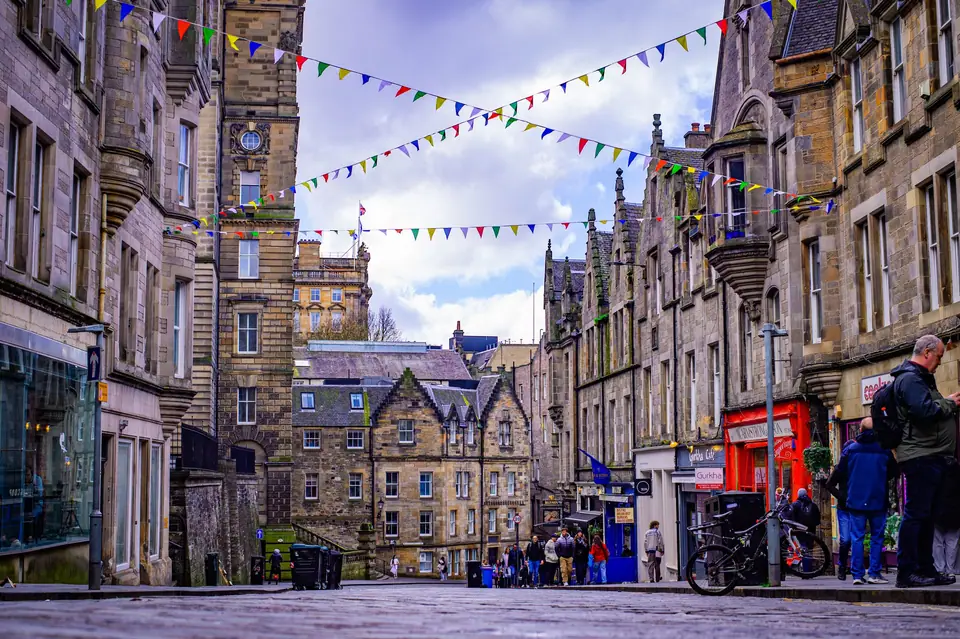
Engineered between 1829 and 1834 by Thomas Hamilton, this graceful curving street replaced old medieval wynds to improve city access. We can observe bright stone arches, painted facades, and an upper pedestrian terrace directly above the lower carriage road. The varied masonry displays neo-classical motifs and Scottish Baronial detailing.
Victoria Terrace
Forming the upper deck of Hamilton's western approach road, Victoria Terrace sits directly atop the street-level shops. The walkway offers an excellent vantage point across the lower rooftops towards the Grassmarket. Along the path, historic stone tenements and the former St John's Church create a distinctive architectural boundary.
West Bow Well
Built in 1681 as part of the first piped gravity-fed water system in Edinburgh, this stone public well served local households. Robert Mylne, master mason to the Crown, designed the classical structure which features carved pilasters and an inscription. It stands where the steep West Bow curves down into the Grassmarket basin.
The Grassmarket
Established in 1477 by royal charter of King James III, this wide rectangular basin served as a historic trade hub for drovers. The cobbled square also witnessed grim public hangings, including the executions of over a hundred Covenanters during the seventeenth century. Today, preserved stone tenements line the open plaza beneath the castle crag.
Covenanters' Memorial
Positioned at the western end of the Grassmarket, this circular pavement marker and standing stone commemorate those executed here during the Killing Times. Between 1661 and 1688, numerous Presbyterian Covenanters were put to death on this exact spot. The stone is carved with an open Bible and commemorative verses detailing their sacrifice.
Flodden Wall at the Vennel
Constructed in 1513 following the disastrous Scottish defeat at the Battle of Flodden, this defensive rampart guarded the southern boundary of Edinburgh. Walking up the steep Vennel steps brings us to the surviving section, complete with crenellations and the sole remaining watchtower. The stonework frames celebrated views looking back toward Edinburgh Castle.
The Vennel Steps
This narrow public right of way climbs sharply up the southern valley slope from the Grassmarket. Lined by rubble-built boundary walls and tenement gable ends, the pathway has guided pedestrians since the Middle Ages. Its summit provides a clear sightline of the castle rock towering directly over the Old Town rooftops.
George Heriot's School
Founded through a bequest from George Heriot, goldsmith to King James VI, construction of this palatial school began in 1628. Master mason William Wallace designed the sandstone building around an inner courtyard, featuring turrets, decorative gargoyles, and over two hundred unique window pediments. The institution originally educated orphaned children before expanding into a premier academy.
Magdalen Chapel
Erected between 1541 and 1544 by merchant Michael Macquhan, this small Cowgate chapel survived the iconoclasm of the Scottish Reformation. It incorporates the only pre-Reformation stained glass panels remaining in situ across Scotland, displaying royal heraldic badges. The interior preserves the carved oak table and furnishings used by the Incorporation of Hammermen.
Greyfriars Bobby Fountain
Commissioned by philanthropist Baroness Burdett-Coutts and cast by sculptor William Brodie, this small bronze statue honours the famous Skye Terrier. The loyal dog reportedly kept watch over the grave of his master, John Gray, for fourteen years until his death in 1872. The granite base originally served both humans and horses as a public water fountain.
Greyfriars Kirk
Consecrated on Christmas Day in 1620 on the former grounds of a Franciscan friary, this church was the first built after the Reformation. In 1638, citizens and nobles gathered here to sign the National Covenant in protest against royal liturgical interference. The building combines gothic tracery with classical additions completed after an accidental gunpowder explosion in 1718.
Greyfriars Kirkyard
Established in 1562 under Queen Mary, this hillside graveyard holds the remains of many prominent Scottish intellectuals, civic leaders, and churchmen. Visitors can inspect classical stone monuments decorated with mortality symbols, including skulls, hourglasses, and shroud-wrapped skeletons. The grounds illustrate the evolution of Scottish funerary architecture from the sixteenth to nineteenth centuries.
Covenanters' Prison
Following the Battle of Bothwell Brig in 1679, authorities converted this southern section of the cemetery into an open-air detention camp. Over a thousand captured Covenanters were imprisoned behind its iron gates for four months without shelter and on starvation rations. Today, classical eighteenth-century burial vaults enclose the sorrowful ground.
Tomb of Sir George Mackenzie
This circular temple-like tomb was erected in 1691 for Sir George Mackenzie of Rosehaugh, King's Advocate during the late Stuart reign. Known to contemporaries as 'Bluidy Mackenzie' for prosecuting Covenanters, his neoclassical sepulchre features Corinthian pilasters, floral swags, and a domed roof. It is considered one of the finest classical mausoleums in the cemetery.
Bedlam Theatre
Originally built between 1845 and 1848 as the New North Free Church, this striking neo-gothic building was designed by architect Thomas Hamilton. It occupies the former site of the city mental asylum, from which the modern theatre took its name. Pointed arch windows and pinnacles define the facade, which now welcomes experimental drama productions.
National Museum of Scotland
Formed by amalgamating the Victorian Industrial Museum and the modern Museum of Scotland, this vast institution covers global history, science, and natural wonders. The older section features a cast-iron Grand Gallery, while the 1998 sandstone wing evokes Scottish defensive tower houses. Highlights include the Lewis chessmen and medieval Monymusk Reliquary.
Grand Gallery at the National Museum
Designed by Captain Francis Fowke and completed in 1866, this airy hall draws heavy inspiration from London's Great Exhibition. Birdcage cast-iron pillars support tiered galleries and a broad glass roof that floods the cavernous interior with natural light. Displays placed around the floor include ceremonial statues, historic machinery, and whale skeletons.
National Museum Rooftop Terrace
Accessible by lifts in the modern wing, the seventh-floor roof terrace affords exceptional three-hundred-and-sixty-degree vistas across Edinburgh. From this vantage point, we observe Edinburgh Castle, the spires of the Royal Mile, Arthur's Seat, and the Firth of Forth. The terrace is landscaped with native Scottish flora, creating a calm urban garden high above Chambers Street.
University of Edinburgh Old College
Begun in 1789 to designs by neoclassical master Robert Adam, Old College was later modified and finished by William Henry Playfair in 1827. A massive entrance archway crowned by a dome added by Robert Rowand Anderson leads into an expansive stone quadrangle. The complex currently houses the university law school and the historic Talbot Rice Gallery.
Talbot Rice Gallery
Established in 1975, this public art space is situated in the north-east corner of Robert Adam's Old College. The gallery occupies the former university museum hall, originally designed by William Henry Playfair with barrel-vaulted ceilings and classical columns. It presents rotating exhibitions of contemporary international art alongside historic university collections.
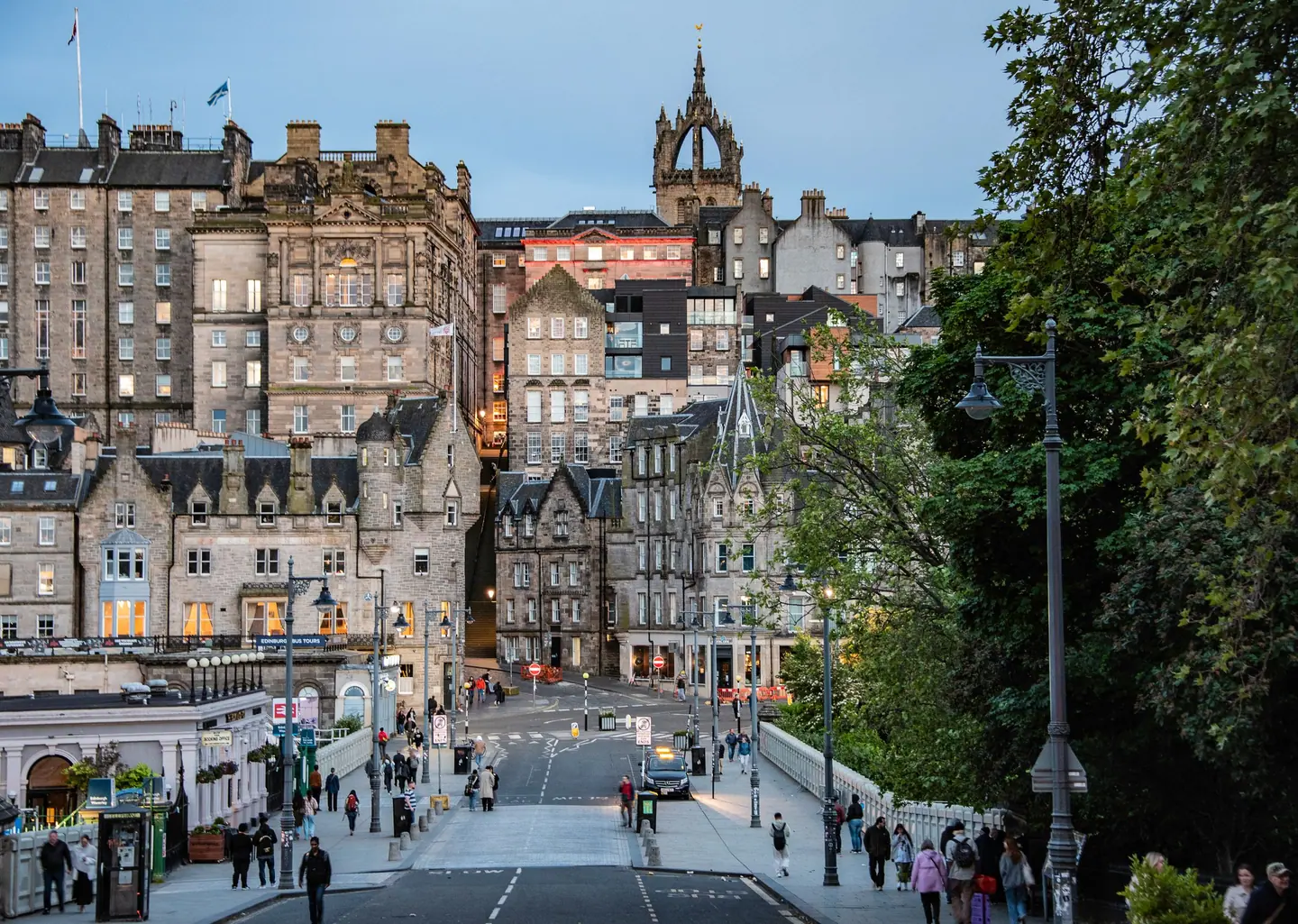
Lower Royal Mile (Canongate), Scottish Parliament, Holyrood Palace & Arthur Seat
Descend the Canongate to the Scottish Parliament, the Palace of Holyroodhouse and Holyrood Abbey before climbing Salisbury Crags and Arthur Seat.
Moray House
Built around 1625 for Mary, Countess of Home, this refined stone mansion retains rare Renaissance plaster ceilings and an elevated stone balcony. Oliver Cromwell lodged here during his campaigns in Scotland, and the Treaty of Union was reputedly drafted in its summerhouse. Visitors can view its austere facade and historic gateway from the street.
Canongate Tolbooth
Constructed in 1591, this landmark served as the municipal courthouse, council chamber, and jail for the independent burgh of Canongate. Its turreted spire, corbelled bartizans, and projecting brass clock face present classic Scottish baronial features. The building now houses The People's Story Museum, displaying everyday working-class history.
The People's Story Museum
Housed inside the historic Canongate Tolbooth, this civic museum charts the social history of ordinary Edinburgh citizens from the late eighteenth century onwards. Exhibits recreate historical workshops, tenement rooms, and prison cells using oral histories and period artefacts. The collection provides a stark counterpoint to the city's grand royal narratives.
Canongate Kirk
Commissioned by King James VII and completed in 1691, Canongate Kirk features an unusual curvilinear Dutch gable crowned with the golden antlers of a stag. The luminous interior retains a dignified Reformed layout with royal box seating. Notable figures including economist Adam Smith and poet Robert Fergusson are buried in the churchyard.
Adam Smith Grave at Canongate Kirkyard
Located in the sloped cemetery behind Canongate Kirk, this imposing stone tomb commemorates Adam Smith, author of The Wealth of Nations. The burial ground contains several significant monuments dating from the late seventeenth through nineteenth centuries. A nearby statue of Robert Fergusson stands outside the entrance gate to honour the vernacular poet.
Bakehouse Close
Regarded as one of the most complete historical closes along the Royal Mile, this secluded precinct features timber-fronted harled buildings dating from the 1570s. The entrance pend opens into Acheson House, built in 1633 for a Scottish baronet. Its authentic stone steps and preserved masonry offer insight into pre-modern Edinburgh urban architecture.
Dunbar's Close Garden
Tucked behind a narrow tenement archway, this tranquil walled enclave was redesigned in the 1970s to evoke a seventeenth-century knot garden. Clipped box hedges, gravel alleys, stone benches, and aromatic herbs recreate the private pleasure grounds of Stuart Edinburgh. It offers quiet respite from the bustle of the Royal Mile.
Museum of Edinburgh (Huntly House)
Occupying a complex of joined merchant townhouses with timber-gabled facades, the museum chronicles Edinburgh's history through decorative arts and archaeology. Collections include original Scottish glass, local silver, architectural fragments, and the 1638 National Covenant document. The exterior retains original plaster coats of arms and an authentic stone pend leading inside.
Panmure House
This seventeenth-century stone tenement building was the home of Adam Smith from 1778 until his death in 1790. Restored by Heriot-Watt University, it preserves classic Scottish stone crow-stepped gables and panelled interior meeting rooms. The building now operates as an educational institute celebrating Enlightenment debate, economic theory, and Scottish intellectual history.
White Horse Close
Positioned at the eastern end of the Canongate, this courtyard was once the departure hub for stagecoaches bound for London. Extensively restored in the 1960s, the surrounding tenements display external stone forestairs, harled rubble walls, and dormer windows. The close retains the atmosphere of Edinburgh's historic northern coaching terminals.
Scottish Parliament Building
Opened in 2004, Enric Miralles' striking architectural complex incorporates motifs drawn from Scottish landscape paintings, upturned fishing boats, and leaf forms. The campus includes granite, oak, and sycamore structures surrounding the Main Debating Chamber and Queensberry House. Travellers can explore the public foyer and view debates from the gallery.
Queensberry House
Constructed in 1681 for Charles Maitland and later expanded by the Duke of Queensberry, this classical mansion was once a grand private residence. It was controversially linked to the political deals that facilitated the 1707 Act of Union. Today the restored stone structure houses offices for the Presiding Officer of the Scottish Parliament.
Palace of Holyroodhouse
Founded as a monastery guesthouse and transformed into a royal palace by James IV and Charles II, Holyroodhouse boasts grand neoclassical quadrangles. The surviving sixteenth-century north-west tower retains the private chambers of Mary, Queen of Scots, and the site of David Rizzio's murder. The palace continues to host royal ceremonies and state events.
Holyrood Abbey
Founded in 1128 by King David I, this abbey flourished for centuries as one of Scotland's grandest monastic foundations. Its roof collapsed during the eighteenth century, leaving an evocative Gothic nave, ornate Romanesque processional doorways, and monumental arcade arches open to the sky. Several Scottish monarchs were crowned and buried within these ruins.
Queen's Gallery, Edinburgh
Situated at the entrance to the Palace of Holyroodhouse inside a converted nineteenth-century church and school, this gallery hosts rotating exhibitions from the Royal Collection. Visitors can inspect master paintings, drawings, furniture, and rare decorative metalwork. The entrance pavilion features classical stone pillars and contemporary bronze architectural detailing.
Abbey Strand
This short roadway marked the boundary where debtors could claim legal sanctuary within Holyrood Abbey's jurisdiction until the late nineteenth century. The distinctive corner building features sixteenth-century rubble masonry, barrel vaulting, and crow-stepped gables. It now houses the learning centre and botanical gardens of the Palace of Holyroodhouse.
St Margaret's Well
Dating to the late fifteenth century, this vaulted stone shrine originally stood at Restalrig before railway construction necessitated its relocation in 1860. The structure features a groined roof, central stone boss, and carved grotesque water spouts. Fed by natural springs, it forms an understated Gothic landmark along the Queen's Drive footpath.
Salisbury Crags
These sheer dolerite cliffs rise steeply above Holyrood Park, created millions of years ago by volcanic intrusions and subsequent glacial erosion. The Radical Road, cut along the base of the cliffs by unemployed weavers in 1820, provides sweeping viewpoints across Old Town tenements. Geologist James Hutton used the exposed rock faces to develop modern geological science.
St Anthony's Chapel
Perched dramatically on a windswept volcanic outcrop above St Margaret's Loch, this solitary ruined wall is all that remains of a medieval chapel. Believed to have served pilgrims and provided a beacon for sailors in the Firth of Forth, the rubble stonework incorporates an arched alcove. The site offers open views over the city towards Leith.
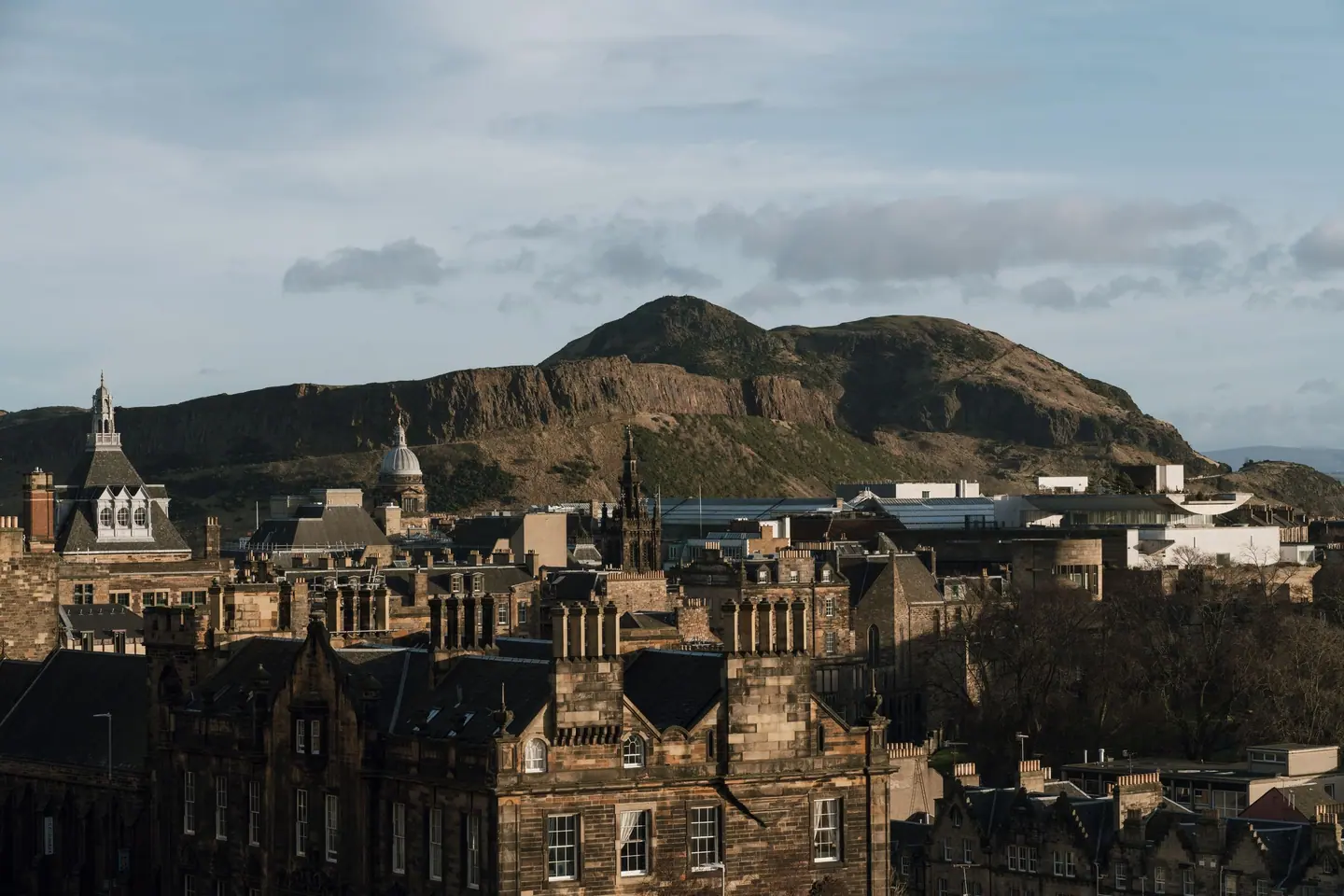
Arthur's Seat
Rising 251 metres above sea level, Arthur's Seat is the central peak of an extinct volcano that dominates Edinburgh's eastern skyline. Traces of ancient hillfort ramparts and prehistoric cultivation terraces remain visible along its windswept slopes. The rocky summit delivers panoramic 360-degree vistas across Edinburgh, the Pentland Hills, and the Firth of Forth.
Princes Street Gardens, Scott Monument, Georgian New Town & Calton Hill
Cross to the Scottish National Gallery, Scott Monument, Charlotte Square and the Classical monuments atop Calton Hill.
Scottish National Gallery
Designed by William Henry Playfair, this grand temple-like structure opened to the public in 1859. The museum displays fine international and Scottish paintings, including masterpieces by Ramsay, Raeburn, and European masters. Travellers should observe the refined Ionic porticoes that harmonize with the neighbouring Royal Scottish Academy.
Royal Scottish Academy Building
Also designed by William Henry Playfair, this Doric sandstone pavilion was completed in 1826 as the Royal Institution. Topped by a statue of Queen Victoria carved by John Steell, it hosts rotating visual art exhibitions. Notice the striking fluted columns and carved sphinxes perched along the pediment corners.
Princes Street Gardens
Formed in two sections following the draining of the Nor Loch, these landscaped sunken grounds separate the Old and New Towns. Dotted with military memorials, floral displays, and mature trees, the gardens provide clear views of the castle ramparts above. We can follow the winding paths that trace the former loch bed.
Ross Fountain
Manufactured at the Durenne iron foundry in Sommevoire, France, this elaborate fountain was purchased by gunsmith Daniel Ross and presented to Edinburgh in 1869. The structure features sculpted allegorical figures representing science, arts, poetry, and industry. Restored painted details gleam brightly against the rugged castle rock directly behind.
Floral Clock
Commissioned in 1903 by Edinburgh park superintendent John McHattie, this is the oldest functioning floral clock in the world. Its mechanical movement was installed inside the base of the Allan Ramsay statue, while the face features intricate seasonal bedding plants. Look for the rotating floral hands tracking real time.
Scott Monument
Rising over two hundred feet above Princes Street, this soaring Gothic tower was designed by carpenter-turned-architect George Meikle Kemp. Carved from Binny sandstone, the monument features statues of characters from Scott's novels, alongside a white marble figure of the author and his hound Maida. Narrow spiral stairs lead to elevated platforms.
Wojtek the Bear Memorial
Unveiled in 2015, this bronze tribute commemorates the Syrian brown bear adopted by soldiers of the Polish II Corps during the Second World War. Wojtek assisted the artillery corps at Monte Cassino and lived out his final years at Edinburgh Zoo. The monument depicts Wojtek alongside a Polish soldier.
St John's Episcopal Church
Completed in 1818 to designs by architect William Burn, this Episcopal sanctuary features a prominent pinnacled tower and fan-vaulted plaster ceilings inspired by Westminster Abbey. The interior contains stained glass panels created by English and Scottish masters. The crypt beneath the chancel accommodates quiet burial vaults.
The Balmoral Hotel
Originally opened in 1902 as the North British Station Hotel, this grand Renaissance-style building was designed by William Hamilton Beattie. Its prominent clock tower famously runs two minutes fast to ensure rail passengers catch their trains at neighbouring Waverley Station. Rich stone masonry and classical balconies adorn the exterior.
General Register House
Started in 1774, this Neoclassical archive building was designed by Robert Adam to safeguard the public records of Scotland. The square ashlar building features corner pavilions, a Corinthian portico, and a central domed rotunda with a large statue of George III. It remains one of the oldest purpose-built record repositories.
Charlotte Square
Conceived as the grand western counterpart to St Andrew Square, this unified residential square was designed by Robert Adam in 1791. Uniform palace fronts with rusticated ground floors, coupled pilasters, and central pediments line its north and south sides. In the central garden stands the Albert Memorial monument.
The Georgian House
Located at No. 7 Charlotte Square, this four-storey townhouse has been faithfully furnished to reflect domestic life around 1800 under its first resident, John Lamont. Restored period rooms display silverware, porcelain, family portraits, and functional kitchens in the basement. It reveals the domestic arrangements of Edinburgh's high society.
Bute House
Occupying the central pavilion of Charlotte Square's north range, No. 6 Bute House serves as the working residence of Scotland's First Minister. Designed by Robert Adam, its ashlar facade features Corinthian pilasters and an elaborate fanlight entrance. Inside, classical drawing rooms accommodate Cabinet meetings and official state functions.
St Andrew Square
Laid out from 1772, this large square was one of the earliest residential sections constructed in Edinburgh's New Town. Today largely converted to prestigious financial headquarters and restaurants, the square surrounds a leafy public garden. Classical stone facades frame the perimeter, maintaining the symmetry of the original plan.
Melville Monument
Erected in 1821 in the centre of St Andrew Square, this monumental Roman column rises one hundred and fifty feet into the sky. Modelled on Trajan's Column in Rome, it is crowned by a colossal statue of Henry Dundas, 1st Viscount Melville. Plaques at the base provide historical context regarding his controversial career.
Calton Hill
Rising east of the New Town, this volcanic hill provides expansive panoramas across the Firth of Forth, Arthur's Seat, and the city below. Developed as a public park and Acropolis-inspired acme, it embodies Edinburgh's nickname as the Athens of the North. Grass paths link several nineteenth-century architectural landmarks.
National Monument of Scotland
Designed by Charles Robert Cockerell and William Henry Playfair, this ambitious memorial was planned as a full-scale replica of the Parthenon in Athens. Construction began in 1826 but ground to a halt three years later when funds ran out, leaving twelve massive Craigleith sandstone columns standing against the Edinburgh skyline.
Nelson Monument
Built between 1807 and 1815, this battlemented stone tower honours the British naval victory at the Battle of Trafalgar. Shaped like an upturned spyglass, the structure includes a mechanical time ball installed in 1853 to signal Greenwich Mean Time to ships in Leith harbour. A viewing gallery crowns the summit.
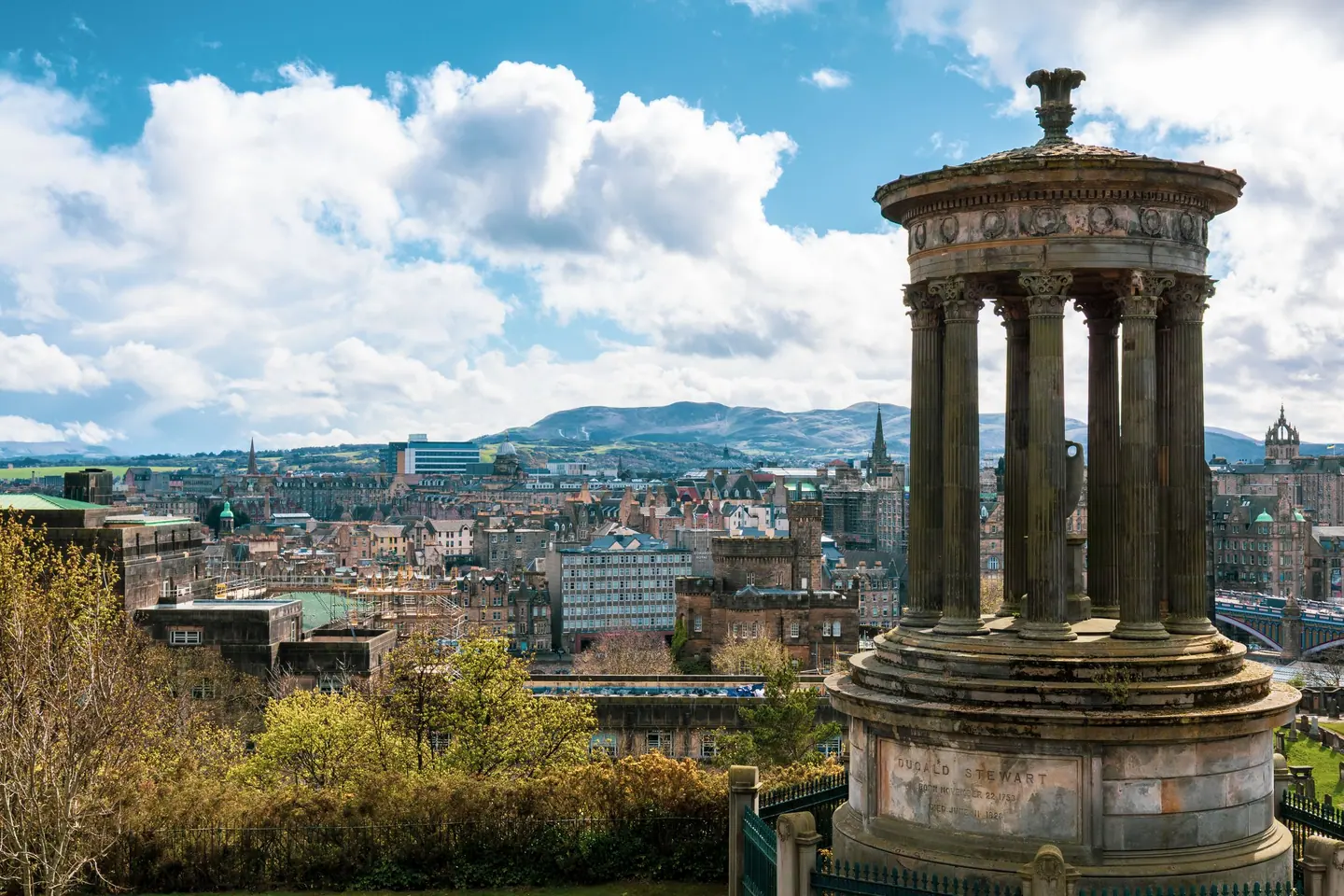
Dugald Stewart Monument
Completed in 1831 to designs by William Henry Playfair, this elegant circular temple commemorates the Scottish Enlightenment philosopher Dugald Stewart. Modelled closely on the Choragic Monument of Lysicrates in Athens, its nine fluted Corinthian columns support an urn-topped cupola. It frames one of the city's classic views towards Princes Street.
City Observatory
Founded by the Edinburgh Astronomical Institution, the central Playfair Building opened in 1818 styled as a Greek Doric cross with four temple porticoes. Restored as an arts centre, the compound houses exhibition spaces alongside historical telescope domes and the Gothic transit house. The hilltop grounds offer quiet vistas towards the sea.
Dean Village, Water of Leith, Stockbridge, Royal Botanic Garden & Leith Shore
Follow the wooded Water of Leith walkway through picturesque Dean Village and Stockbridge to the Royal Botanic Garden and the historic port of Leith.
Dean Village
Originally known as the Water of Leith Village, this quiet enclave operated grain mills powered by the river for several centuries. Visitors can observe preserved millstones embedded in cottage walls and timber-fronted residential terraces. The yellow sandstone architecture contrasts sharply with the Victorian city rising immediately above.
Well Court
Commissioned in the 1880s by Scotsman newspaper owner John Ritchie Findlay, this red sandstone development provided sanitary homes for local labourers. Architect Sydney Mitchell incorporated picturesque Scottish Baronial turrets, communal courtyards and an adjoining clock tower hall. Today, the courtyard remains a prime example of late Victorian philanthropic social housing.
Dean Bridge
Designed by celebrated civil engineer Thomas Telford and completed in 1831, this dramatic bridge spans the river gorge at a height of over one hundred feet. Its four soaring stone arches carry the main roadway leading towards Queensferry and the north. Walkers along the riverside path below get an impressive view of its massive masonry piers.
Dean Cemetery
Laid out in 1846 on the former grounds of Dean House, this garden cemetery serves as the resting place for eminent Scottish judges, scientists, and artists. The landscaped paths feature elaborate Victorian sculptures, Celtic crosses and neoclassical family tombs. Notable burials include architect William Henry Playfair and painter John Pettie.
Scottish National Gallery of Modern Art (Modern One)
Housed within an imposing 1820s neoclassical building originally designed by William Burn as John Watson's Hospital, this gallery showcases twentieth-century art. Out front lies a stepped, serpentine earthwork and water installation created by landscape architect Charles Jencks. The permanent indoor collection features seminal works by European and Scottish modern masters.
Modern Two
Built in 1831 as the Dean Orphanage, this twin-towered building was converted into an auxiliary gallery for modern art in 1999. Inside, visitors find a large recreation of Eduardo Paolozzi's studio alongside his colossal Vulcan sculpture in the main entrance hall. The quiet grounds include landscaped terraces and modern outdoor sculptures.
St Bernard's Well
Constructed in 1789 by Lord Gardenstone over a natural mineral spring, this elegant circular temple was designed by painter Alexander Nasmyth. Modelled on the Temple of Vesta at Tivoli, it features Doric columns surrounding a marble statue of Hygieia, goddess of health. The river walkway passes directly alongside its decorative wrought-iron railings.
Stockbridge Market
Operating every Sunday in Saunders Park near the riverbank, this community market features independent farmers, bakers and local artisans. Stalls offer freshly prepared Scottish dishes, continental cheeses and handmade crafts. It sits adjacent to the historic stone bridge that gave the Stockbridge neighbourhood its name.
Stockbridge Market Arch
Erected in 1825, this preserved classical entrance archway is all that remains of the original Stockbridge butcher and poultry market. Designed by Archibald Elliot, it features Doric pilasters, a pediment and carved relief panels depicting livestock. It stands as an architectural curiosity leading onto a quiet cobbled residential lane.
St Stephen's Church, Edinburgh
Built between 1827 and 1828, this massive neoclassical church forms a dramatic focal point at the foot of St Vincent Street. Designed by William Henry Playfair, the structure features an imposing 162-foot square clock tower said to house the longest pendulum in Europe. It now functions as a community arts venue.
Inverleith Park
Acquired by the city corporation in 1889, this major public park encompasses sixty acres of manicured sports pitches, tree-lined avenues and a boating pond. From the elevated southern path, visitors enjoy clear panoramic views looking toward Edinburgh Castle and the New Town. The park borders the western gate of the neighbouring botanical gardens.
Royal Botanic Garden Edinburgh
Founded in 1670 as a physic garden near Holyrood, the institution relocated to its expansive Inverleith site in the 1820s. Today, seventy acres accommodate world-renowned living plant collections, an extensive rock garden and an arboretum. It remains a key global centre for botanical research and international plant conservation programmes.
Palm House, Royal Botanic Garden
Erected in two phases during 1834 and 1858, this imposing glasshouse stands over seventy feet tall to accommodate mature palm trees. The elegant sandstone facade fronts an intricate cast-iron framework engineered by Robert Matheson. It anchors a wider complex of interconnected glasshouses displaying botanical specimens from various climatic zones.
Inverleith House
Constructed in 1774 for the Rocheid family, this Georgian mansion sits on the highest ground within the botanical gardens. Designed by architect James Henderson, the building served as the founding home of the Scottish National Gallery of Modern Art during the 1960s. Today, it presents rotating contemporary art and botanical history exhibitions.
Tanfield
Located beside the Water of Leith, this district was home to the Tanfield Hall complex where the Church of Scotland divided during the Disruption of 1843. Ministers walked from the city centre to form the Free Church of Scotland in this former industrial hall. The redeveloped office campus preserves historical plaques marking this religious watershed.
Water of Leith Walkway (Warriston Section)
This peaceful off-road route follows the gentle course of the river along former Caledonian Railway trackbeds. Flanked by mature birch and sycamore trees, the pathway passes old industrial weirs, mill races, and red-stone railway bridges. It provides a traffic-free corridor connecting north Edinburgh neighbourhoods directly down to the coast.
Warriston Cemetery
Opened in 1843, this garden cemetery covers fourteen wooded acres and was the first private burial ground established outside Edinburgh's central parish. It contains dramatic sunken sandstone catacombs, Gothic crypts and the tomb of anatomist Sir James Young Simpson. Dense ivy, tall ferns and mature woodland canopy now envelope many monuments.
Custom House, Leith
Designed by Robert Reid in the Greek Revival style, this sturdy stone building opened in 1812 to process maritime trade duties. Its facade features a prominent Doric portico bearing the British royal arms. Today, the building serves as a thriving community cultural hub, craft workshop centre and events space.
The Shore, Leith
Running along the final tidal stretch of the Water of Leith, this quay formed Scotland's primary seaport from medieval times until modern dock developments. The cobblestone promenade features seventeenth-century stone tenements, historic sailmakers' lofts and maritime signal lights. We find numerous restored warehouses that now house seafood bistros and neighbourhood public houses.
Lamb's House
Dating from around 1610, this distinctive four-storey stone residence was built for affluent merchant trader Andrew Lamb. With steep crow-stepped gables and small window apertures, it represents one of the finest surviving examples of Jacobean domestic architecture in Scotland. Following a comprehensive twenty-first-century restoration, it remains an essential landmark of Old Leith.
Hill Walks and Coastal Extensions in Edinburgh
Pair this route with the practical neighbourhood breakdowns, climate charts and transport advice in our Edinburgh travel overview, alongside additional mapped city walks.