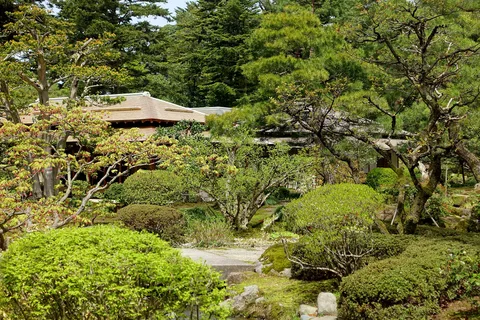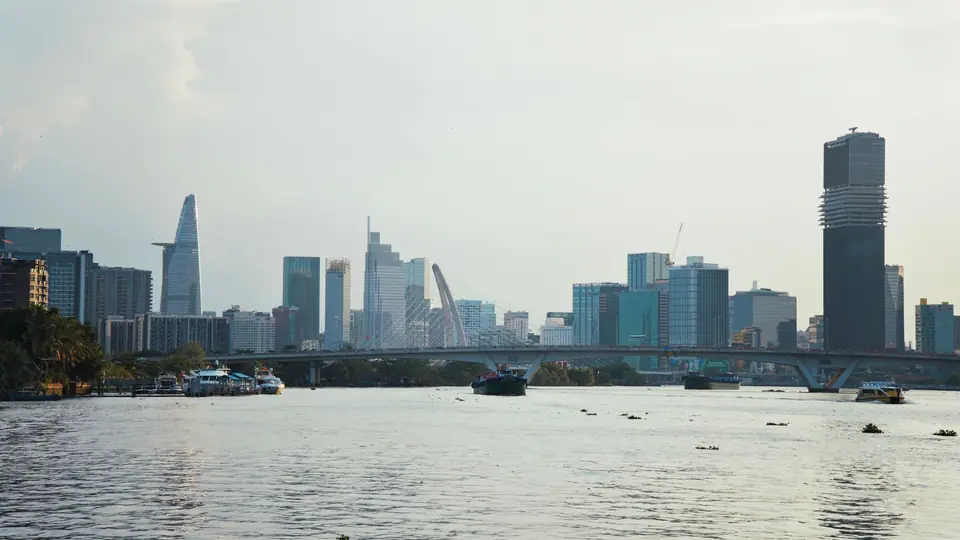
A detailed architectural and cultural route through District 1’s historic Saigon boulevards, Da Kao pagodas, the incense-spiral temples of Cholon (District 5), and the Saigon River.
River Bend of Gia Định, Minh Hương Merchants in Cholon and Colonial Saigon
Rising on a bend of the Saigon River that was once the Khmer river port of Prey Nokor, the settlement became known as Gia Định and Sài Gòn in 1698 when Lord Nguyễn Hữu Cảnh established Vietnamese administrative rule across the Mekong Delta Gateway. Nearby, Chinese Minh Hương merchants founded the twin commercial town of Chợ Lớn (Big Market), filling District 5 with Cantonese, Teochew, and Fujianese guildhalls and temples.
Captured by France in 1859 as the capital of Cochinchina, central Saigon was laid out with tree-lined boulevards, Gustave Eiffel's vaulted Central Post Office, and the Saigon Opera House, before serving as capital of South Vietnam and taking the name Ho Chi Minh City after reunification in 1975-1976.
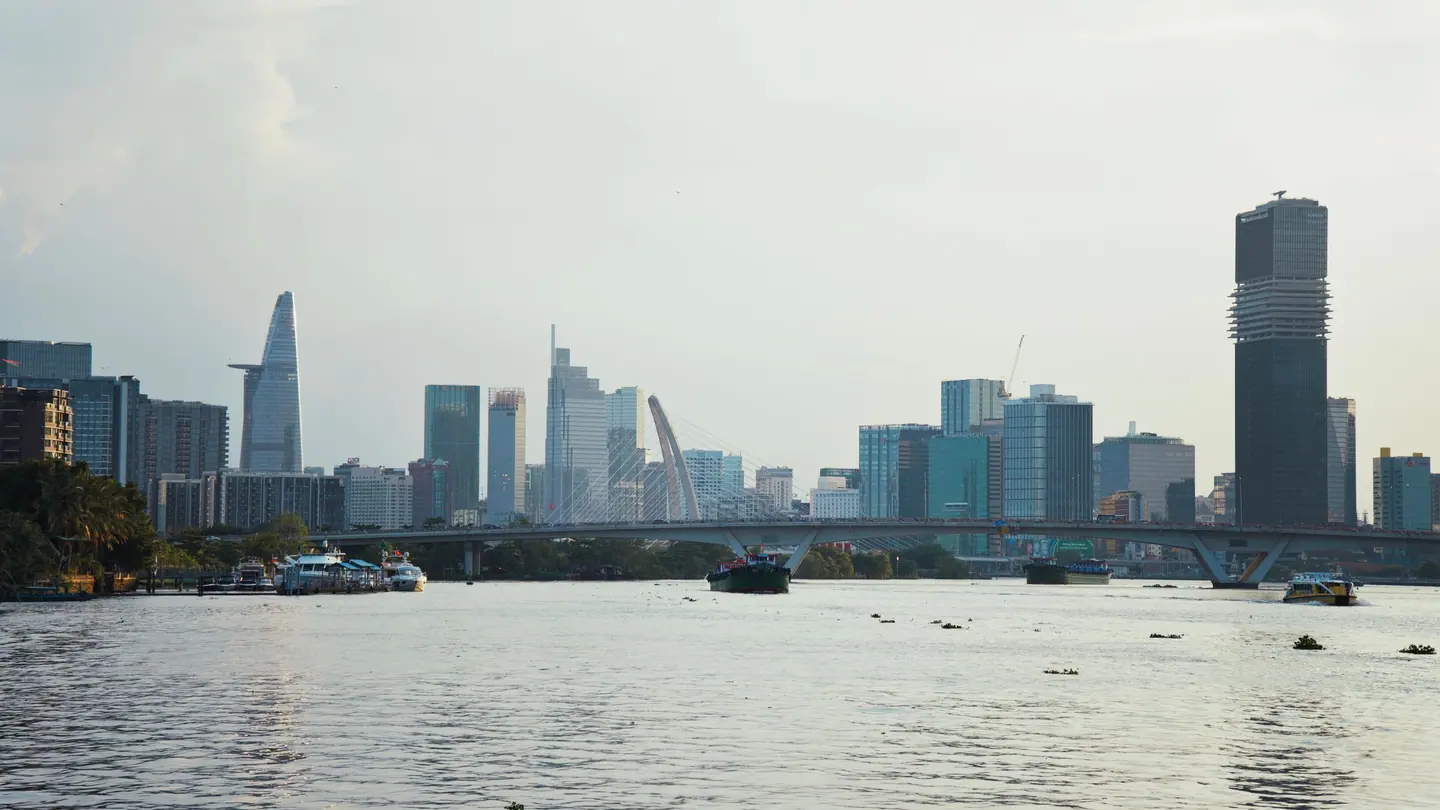
Dong Khoi, Notre-Dame & Historic District 1 Core
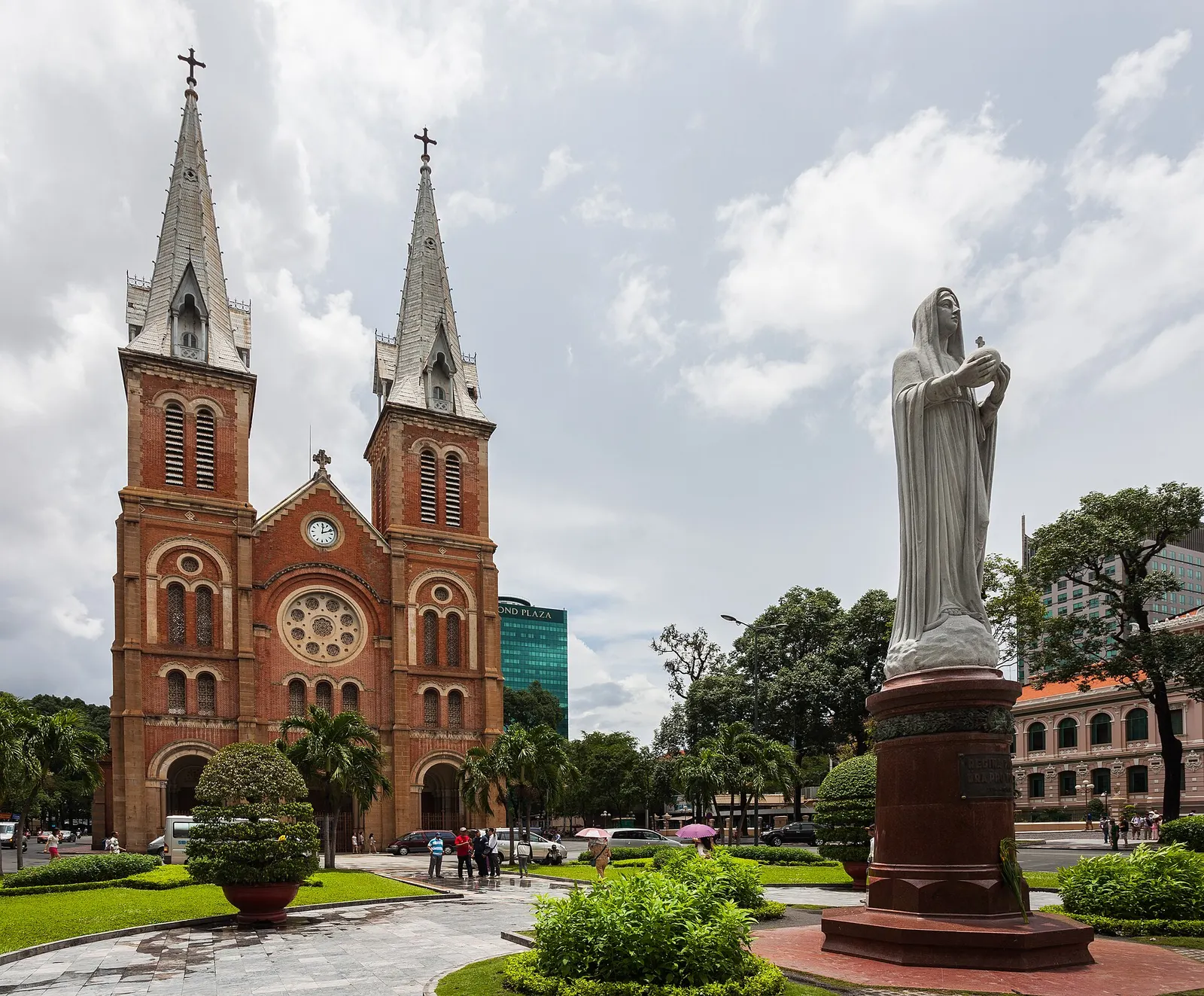
Saigon Notre-Dame Basilica, Saigon Central Post Office, Book Street Nguyen Van Binh, Independence Palace Reunification Palace, 30/4 Park, People’s Committee Building City Hall, Saigon Opera House, Hotel Continental, and Nguyen Hue Walking Street
Saigon Notre-Dame Basilica
Constructed between 1863 and 1880, this Catholic cathedral anchors Paris Square with twin bell towers that reach sixty metres into the sky. The exterior is notable for its unplastered red facade, which retains its distinctive hue. Visitors should look for the statue of Our Lady of Peace standing quietly in the gardens outside the front entrance.
Saigon Central Post Office
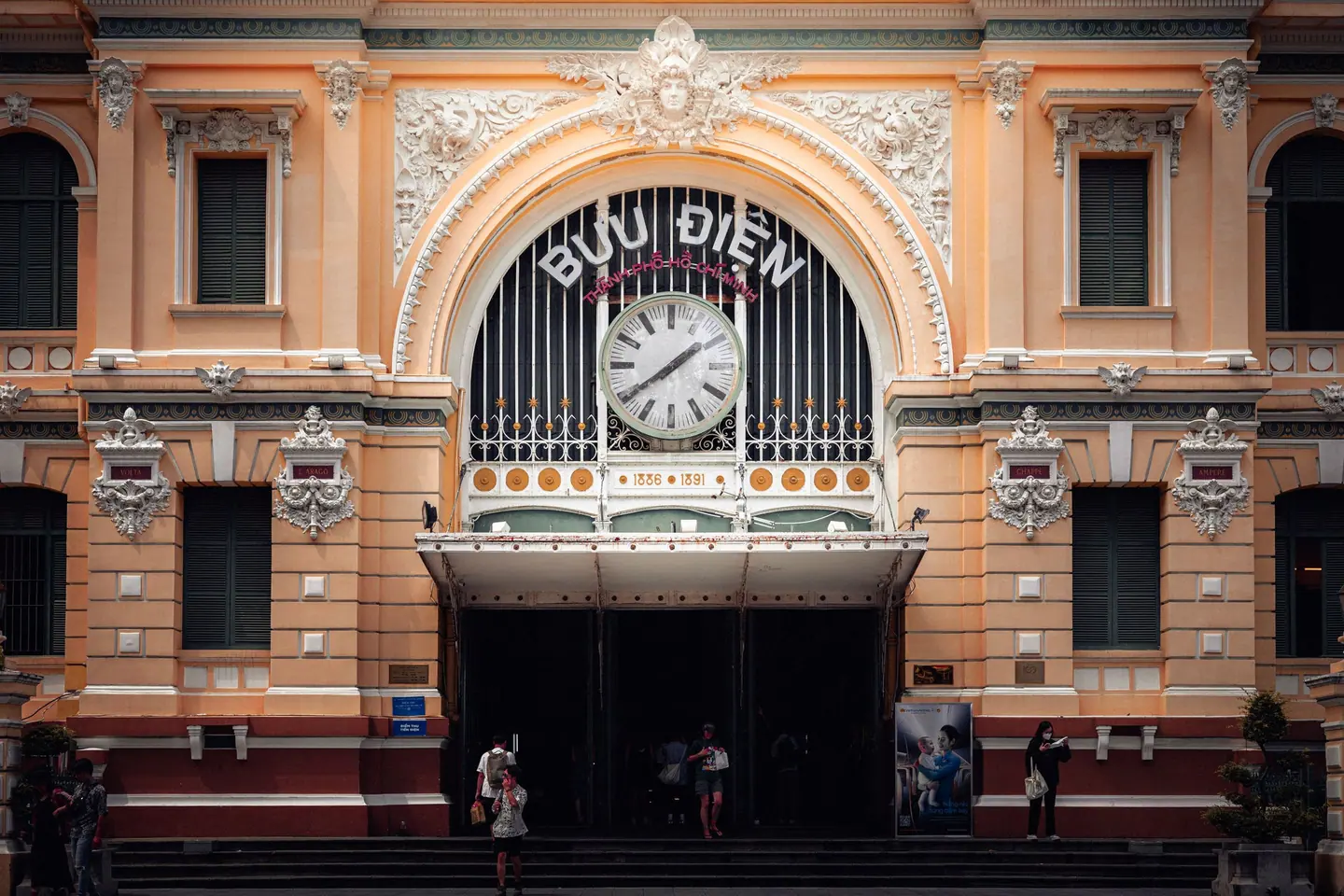
Designed by architect Alfred Foulhoux and completed in 1891, this functional postal hall combines French classical elements with Gothic detailing. Inside, arched metal barrel vaults rest on iron pillars, framing large painted maps of historic telegraph lines. Wooden writing desks, antique telephone booths, and a central portrait of Ho Chi Minh continue to serve everyday visitors.
Independence Palace
Designed by architect Ngo Viet Thu and opened in 1966, this modernist complex served as the home and workplace of the South Vietnamese president. The facade features stone screens reminiscent of traditional bamboo sections, while the interior preserves reception halls, a private cinema, and fortified underground command bunkers. Soviet tanks notably breached its iron perimeter gates on 30 April 1975.
Ho Chi Minh City Hall
Completed in 1909 as the Hotel de Ville, this ornate administrative seat was designed by French architect Paul Gardes. The building showcases refined bas-reliefs, floral carvings, and a central clock tower inspired by European town halls. Although the interior remains closed to casual tourism as an active government office, the illuminated facade overlooks a statue of Ho Chi Minh.
Municipal Theatre of Ho Chi Minh City
Erected in 1897 by architect Eugene Ferret, this theatrical venue served as the Lower House assembly building before reverting to its original performing arts purpose. The exterior features ornate stone carvings, caryatids, and an arched entryway that echo Parisian architecture of the period. Inside, an elevated auditorium hosts regular orchestral concerts, traditional dance, and circus theatre productions.
Hotel Continental Saigon
Built by French entrepreneur Pierre Cazeau, this heritage lodging hosted foreign correspondents, politicians, and authors including Graham Greene throughout the twentieth century. The classical white building incorporates thick masonry walls, high ceilings, and double-brick tile roofs designed to disperse tropical heat. Its central courtyard garden features frangipani trees that have stood for more than a century.
Nguyen Hue Walking Street
Originally an inland shipping canal before being filled during the late nineteenth century, this wide thoroughfare is paved in smooth granite slabs. It stretches from City Hall down to the riverbank, functioning as a civic gathering place for festivals and community displays. Rows of vintage apartment blocks and street trees flank both sides of the promenade.
April 30 Park
Named to commemorate the end of the war in 1975, this leafy parkland occupies two central city blocks under a dense canopy of heritage dipterocarp trees. Paved pathways, park benches, and wide lawns draw students and coffee drinkers who gather to socialise outdoors. It provides a quiet natural corridor between the neighbouring administrative and religious monuments.
Nguyen Van Binh Book Street
Running along the northern flank of the Central Post Office, this tree-lined pedestrian avenue opened in 2016 as a permanent literary hub. Wooden kiosks line both sides of the lane, stocking Vietnamese literature, academic titles, art prints, and translated foreign books. Small outdoor reading terraces provide sheltered spots to browse beside historic French residences.
Caravelle Hotel
Opened in late 1959, the Caravelle was designed with Italian marble, bulletproof glass, and an early private air conditioning system. The building served as the operational base for major international news networks, including CBS, ABC, and Reuters, during the conflict in Indochina. Its open-air rooftop bar still commands views directly over the Opera House and Lam Son Square.
Ho Chi Minh City Museum
Constructed in 1890 as the Palace of the Lieutenant Governor of Cochinchina, this mansion fuses neoclassical columns with traditional Asian roof motifs. The museum galleries showcase archaeological finds, maps, ethnographic artefacts, and wartime memorabilia. Beneath the manicured gardens, an extensive network of reinforced concrete escape tunnels once connected directly to the presidential grounds.
Grand Hotel Saigon
Established in 1930 along the lower section of Dong Khoi Street, this hotel began as a small beverage shop before expanding into luxury hospitality. The property showcases Art Deco influences, featuring a stone facade, arched windows, and high, decorated ceilings. The historic wing preserves French colonial corridors that wrap around a central paved swimming courtyard.
Saigon Tax Trade Centre Site
First opened in 1924 as a department store, this famous retail junction at Nguyen Hue and Le Loi anchored city shopping for nearly a century. While the original structure was dismantled for transport infrastructure, its historic main staircase and mosaic tiles were preserved for museum heritage. The surrounding street corner remains an essential orientation point in District 1.
General Sciences Library of Ho Chi Minh City
Completed in 1971, this primary public library stands on ground previously occupied by the Maison Centrale de Saigon. The architecture balances functional modernist lines with cast concrete louvres that filter natural light while deflecting tropical heat. The institution houses an extensive collection of rare Indochinese manuscripts, historic regional newspapers, and administrative maps.
Ho Chi Minh City Museum of Fine Arts
Originally built during the late 1920s as the private residence of merchant Hui Bon Hoa, this yellow mansion complex features stained glass, patterned floor tiles, and open courtyards. The galleries house traditional lacquer paintings, silk scrolls, and war sketches alongside Cham and Funan stone sculptures. The property retains one of the earliest working cage lifts installed in the city.
Ben Thanh Market
Constructed by the French firm Brossard et Maupin and opened in 1914, this sprawling market complex anchors the western approach to the historic core. The southern entrance is crowned by a three-sided clock tower over a wide arched portal. Beneath its clay-tile roof, merchants sell textiles, dry goods, coffee, and regional southern dishes within long parallel aisles.
Bach Dang Wharf
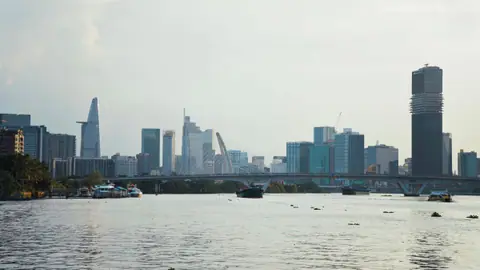
Stretching along the Saigon River, this riverside promenade serves as a major docking hub for passenger ferries and river transport. Named after the historic river naval battle of 1288, the wharf area has been upgraded with wide walking plazas, water bus terminals, and public gardens. It offers sweeping viewpoints across the water toward the modern Thu Thiem peninsula.
Tran Hung Dao Statue
Dominating the centre of Me Linh Square near the riverbank, this statue depicts General Tran Hung Dao pointing decisively toward the water. Erected in the late 1960s, the monument stands atop an elevated stone pedestal decorated with relief panels depicting medieval naval warfare. The surrounding roundabout connects the commercial ends of Dong Khoi, Hai Ba Trung, and Ton Duc Thang streets.
Sri Thendayuthapani Temple
Established in the late nineteenth century on Ton That Thiep Street, this temple is dedicated to the Hindu deity Murugan. The sanctuary interior features a brightly painted entrance gopuram, glazed floor tiles imported from Europe, and carved teak pillars. It continues to serve local Hindu worshippers and visitors from the neighbouring business district.
Bitexco Financial Tower Skydeck
Designed by American architect Carlos Zapata, this 262-metre glass tower draws visual inspiration from the curved petals of a closed lotus blossom. The cantilevered observation deck on the forty-ninth floor projects outward from the main building shaft. It provides uninterrupted viewing angles over the French colonial street grid, the Saigon River bends, and the surrounding urban plains.
Ben Thanh, Fine Arts Museum & Saigon Riverfront
Cafe Apartments 42 Nguyen Hue, Bitexco Skydeck, Bach Dang Wharf, Nha Rong Wharf Museum, Ho Chi Minh City Museum of Fine Arts, Ben Thanh Market, Mariamman Hindu Temple, and Tao Dan Park
Ben Thanh Market
Constructed in 1914 by the French colonial administration, this market remains an enduring city landmark. Its distinctive south entrance features a four-sided clock tower facing Quach Thi Trang Square. Inside, visitors can navigate narrow aisles packed with local spices, silk garments, and regional foodstuffs beneath high wooden rafters.
Ho Chi Minh City Museum of Fine Arts
Set within a 1929 mansion built for merchant Hui Bon Hoa, this complex harmonises French Art Deco details with Chinese tiled motifs. The galleries display Champa stone carvings, traditional lacquer paintings, and mid-century wartime sketches. Visitors should take note of the stained glass windows and the original cage lift operating in the central courtyard.
Mariamman Hindu Temple
Erected in the late nineteenth century by Chettiar merchants, this temple honours Mariamman, the South Indian goddess of rain and fertility. The entrance is marked by a twelve-metre rajagopuram tower adorned with sculpted Hindu deities. Within the sanctuary, devotees and local worshippers make offerings along tiled corridors surrounded by colourful stone shrines.
Nha Rong Wharf
Built in 1863 as the headquarters of the Messageries Maritimes shipping company, this building features two stone dragons resting on its rooftop ridge. It is famous as the departure point of Ho Chi Minh aboard an ocean liner in 1911. Today, the maritime halls exhibit personal documents, archival photographs, and revolutionary memorabilia.
Bach Dang Wharf
Spanning over a kilometre along the Saigon River, this historical dock has long served as a commercial hub for boats arriving from the Mekong Delta. The recently updated park includes stone paths, open seating, and historic maritime monuments. From the waterside platforms, observers can watch commuter waterbuses and river cargo ships navigating the bend.
Bitexco Financial Tower Skydeck
Designed by architect Carlos Zapata to evoke the shape of a lotus bulb, this 262-metre tower dominated the river skyline upon completion in 2010. The public observation deck on the 49th floor offers three-hundred-and-sixty-degree views through floor-to-ceiling glass panels. Binoculars and interactive touchscreens outline the evolution of the city along the winding waterway below.
Tao Dan Park
Covering ten hectares behind the Reunification Palace, this green space is shaded by stands of mature mahogany and dipterocarp trees. The grounds contain a miniature Cham temple, a memorial to King Hung, and regular morning gatherings of local songbird enthusiasts. It provides an instructive snapshot of daily exercise routines and open-air leisure.
Cafe Apartments at 42 Nguyen Hue
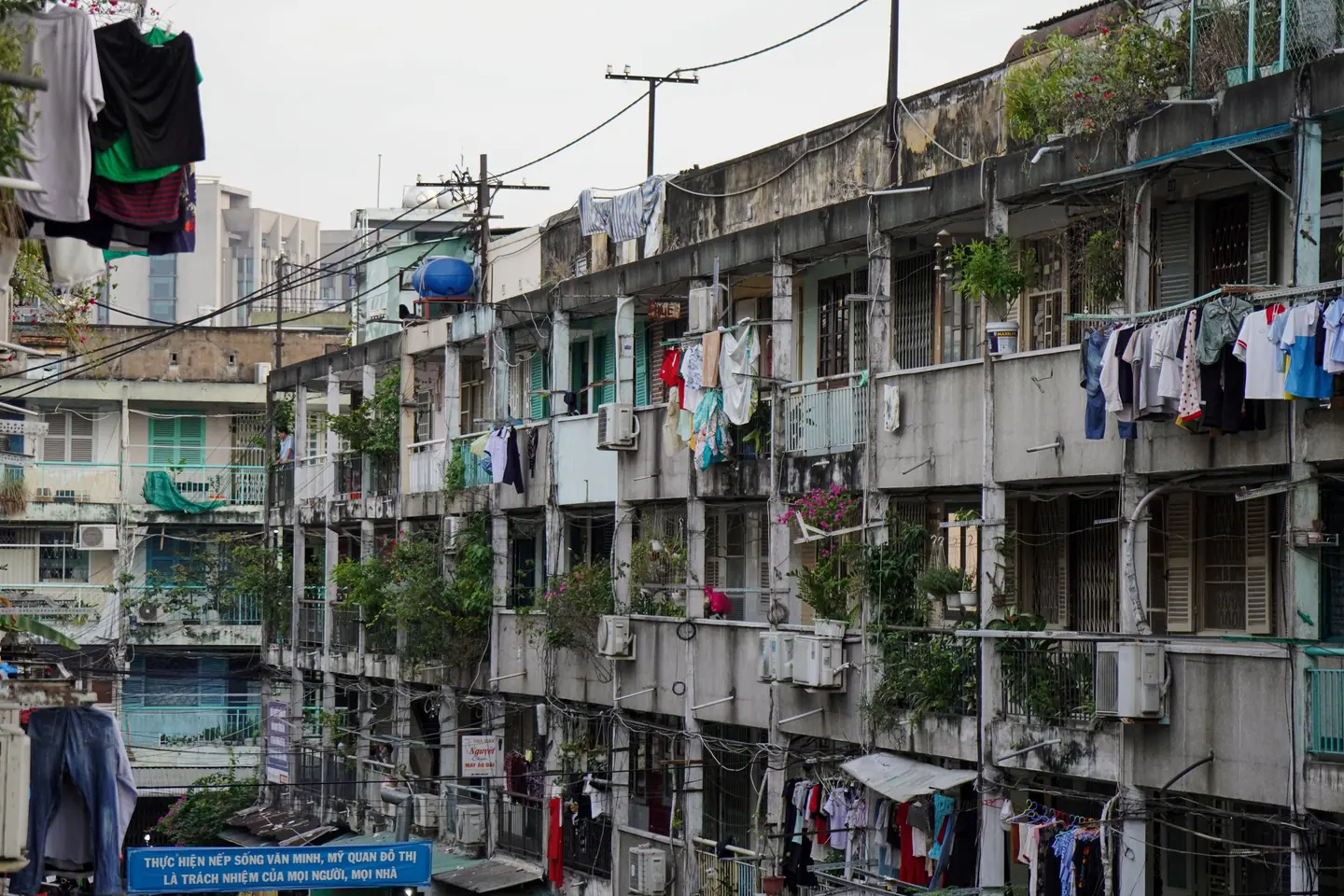
Constructed in the 1960s to house military officers and government officials, this nine-storey concrete block overlooks the Nguyen Hue pedestrian esplanade. Over recent years, tenants have transformed the original apartments into a dense grid of independent teahouses, studios, and boutiques. Each balcony showcases unique light fixtures and plant displays, offering an unconventional architectural collage.
Ho Chi Minh City Museum
Completed in 1890 as the French Governor Palace, this neoclassical building features ionic columns, high pediments, and a grand wooden staircase. The permanent galleries trace the geographical and social history of Saigon from ancient settlements through the twentieth century. In the rear garden, visitors can inspect vintage fighter planes and the entrance to an underground emergency bunker.
Saigon Opera House
Opened in 1900 to entertain the French colonial elite, this ornate theatre was designed by architect Eugene Ferret. Its white stone facade features relief sculptures and classical inscriptions modeled on the Petit Palais in Paris. Still operating as a premier performing arts venue, the hall stages classical symphonies, traditional opera, and contemporary acrobatic productions.
Sri Thendayuthapani Temple
Constructed in the late nineteenth century by the Nattukottai Chettiar community, this Hindu temple is dedicated to Lord Murugan. The temple interior is renowned for its walls lined with hundreds of colourful glazed tiles imported from Japan and Britain. Sculpted peacocks and painted ceiling panels decorate the roofed walkways around the central prayer sanctum.
Phung Hung Market
Operating since the mid-twentieth century, this morning street market provides fresh groceries and medicinal herbs to the local Cantonese community. Vendors assemble under canvas awnings, selling fresh tropical fruit, live seafood, and handmade dim sum. The sights offer an unfiltered perspective on everyday domestic commerce away from modern retail complexes.
Saigon Central Mosque
Constructed in 1935 on the site of an earlier wooden prayer house, this mosque served the community of South Asian Muslim traders living along the riverfront. The building is distinguished by slender minarets, domed pavilions, and a peaceful colonnaded courtyard floored in cooling marble. It remains an active spiritual centre for the local Cham and international Muslim communities.
Mong Bridge
Commissioned in 1893 by the Messageries Maritimes and designed by the French engineering firm Levallois-Perret, this curved green bridge spans the Ben Nghe Canal. It is one of the oldest surviving vehicular bridges in the city, though it is now reserved exclusively for pedestrians. The structure features cast-iron rivets and offers clear vantage points of riverside colonial architecture.
State Bank of Vietnam Building
Constructed in 1929 as the Saigon branch of the Bank of Indochina, this monumental structure stands near the confluence of the river and canal. Its design blends French Art Deco geometry with traditional Khmer and Cham relief sculptures on the pediments. The exterior displays heavy stone pillars, carved window grates, and grand bas-relief emblems.
Ton Duc Thang Museum
Located along the riverside, this museum occupies a colonial building that formerly housed French naval administrative offices. It chronicles the life of Ton Duc Thang, who led early maritime labour strikes along the Saigon docks before becoming head of state. The collection exhibits archival naval tools, photographs of dockyard revolts, and his personal transport vehicles.
Ba An Temple
Established by early Cantonese immigrants near the Ben Nghe waterway, this traditional temple is dedicated to the sea goddess Mazu. The entrance is framed by stone couplets and carved wooden doors that lead into an open-air central lightwell. Inside, hanging incense coils scent the halls, where elaborate gilded altars honour patron deities of sea travel.
Statue of Tran Hung Dao
Rising from the centre of Me Linh Square near the riverbank, this striking statue commemorates the thirteenth-century military commander who repelled Mongol invasions. Sculpted by Pham Thong in 1967, it depicts the general pointing toward the river with an outstretched hand. The pedestal features bas-relief panels illustrating significant naval victories at the historic Bach Dang River.
General Sciences Library
Constructed between 1968 and 1971 on the site of the old French colonial Maison Centrale prison, this library exemplifies tropical modernism. Architects Nguyen Huu Thien and Bui Quang Hanh integrated decorative concrete sun-screens, reflecting pools, and open courtyards to facilitate passive cooling. The institution preserves rare southern Vietnamese manuscripts, French cartographic surveys, and historical newspapers.
Reunification Palace
Designed by architect Ngo Viet Thu and completed in 1966, this landmark served as the home and workplace of the South Vietnamese president. The exterior features concrete louvres shaped like bamboo stalks, while the interior preserves preserved state reception rooms, an underground telecommunications bunker, and period furniture. In 1975, the crash of tanks through its front gates marked the war end.
District 3, War Remnants Museum & Da Kao Pagodas
War Remnants Museum, Museum of Vietnamese History, Saigon Zoo and Botanical Gardens, Temple of Hung Kings, Jade Emperor Pagoda Ngoc Hoang, Tan Dinh Pink Church, Vinh Nghiem Pagoda, and Le Van Duyet Mausoleum
War Remnants Museum
Established in 1975, this major cultural institution presents the grim realities of the Second Indochina War through graphic photographic collections and personal accounts. The outdoor courtyard displays captured American military aircraft, armoured vehicles, and artillery, while indoor galleries examine the lasting human impact of chemical defoliants across the countryside.
Jade Emperor Pagoda
Constructed in 1909 by the Cantonese community, this atmospheric shrine venerates the supreme Taoist deity Ngoc Hoang. Visitors observe detailed timber reliefs, ornate roof ceramics, and darkened chambers filled with wafting incense smoke. The inner sanctum features fierce hall guardians and representations of the Taoist ten hells carved directly into wood.
Museum of Vietnamese History
Built in 1929 by architect Auguste Delaval, this structure blends French neoclassical geometry with regional Asian rooflines. Inside, chronologically arranged galleries preserve prehistoric tools, Dong Son bronze drums, Cham stone sculptures, and imperial ceramics. The grounds also host traditional water puppet performances that celebrate rural folk customs.
Saigon Zoo and Botanical Gardens
Commissioned by French colonial administrators in 1864, this extensive urban park remains one of the oldest botanical institutions on the globe. Shaded paths wind past centenarian mahogany trees, orchid nurseries, and historical animal enclosures. We can observe classical architectural elements from the French era preserved alongside varied botanical specimens.
Temple of King Hung
Erected in 1926 opposite the historical museum, this traditional sanctuary pays tribute to the semi-mythical Hung dynasty. The building features sweeping curved eaves, carved wooden pillars, and painted dragon motifs along the roof ridge. It serves as an active ceremonial centre where locals gather each spring to honour ancestral heritage.
Tan Dinh Church
Completed in 1876, this parish church is distinguished by its vivid salmon-pink exterior and dramatic fifty-two-metre bell tower. Architectural highlights include delicate Italian marble altars, rounded Romanesque arches, and Gothic decorative pinnacles. The interior arcade displays intricate plaster capitals and stained glass panels imported directly from France.
Vinh Nghiem Pagoda
Constructed between 1964 and 1971, this spacious complex was the first in Vietnam designed using modern concrete while retaining traditional northern Buddhist aesthetics. A seven-storey stone pagoda, known as the Quan Am tower, dominates the central courtyard. The sanctuary contains expansive prayer halls lined with golden Buddha statues and polished timber furnishings.
Lang Le Van Duyet
This expansive walled enclosure holds the resting place of Le Van Duyet, the imperial governor who consolidated southern Vietnam under the Nguyen dynasty. Shaded courtyards lead to the burial mound and an ornate cult hall decorated with broken ceramic mosaics and gilded lacquered timber. Devotees visit regularly to burn incense and seek spiritual counsel.
Xo Viet Nghe Tinh Bridge
Connecting central District 1 with the Da Kao and Binh Thanh areas, this crossing point overlooks the winding Thi Nghe waterway. The surrounding embankment features leafy pedestrian promenades that follow the canal towards the Saigon River. It provides clear views of daily boat traffic and the evolving urban skyline across both banks.
Southern Vietnam Women's Museum
Established in 1985 within a former residential mansion, this museum chronicles female leadership, wartime resistance, and cultural labour in the southern provinces. Exhibits display traditional ao dai garments, intricate ethnic textiles, personal wartime diaries, and domestic tools. The galleries offer an insightful look into family lineage and matrilineal traditions across centuries.
Monastery of Saint Paul
Constructed in 1864 by the Sisters of Saint Paul of Chartres, this quiet religious enclave preserves some of the oldest brick buildings in the city. The compound features a classical chapel, quiet inner cloisters, and louvred timber shutters painted in traditional green. It remains an active religious house dedicated to charitable education and community health.
Phap Hoa Pagoda
Founded in 1928, this multi-level temple stands directly on the embankment of the Nhieu Loc Canal in District 3. The main sanctuary houses a central Sakyamuni Buddha surrounded by tiers of carved prayer tablets and bronze bells. During religious festivals, monks and worshippers line the adjacent water steps to release glowing paper lanterns into the river.
Chantarangsay Pagoda
Built in 1946, this shrine is notable as the primary Khmer Theravada temple located within central Ho Chi Minh City. Distinct from Mahayana temples nearby, it displays slender golden spires, historic murals depicting the life of the Buddha, and depictions of mythological Garuda figures. The hall serves as an essential cultural anchor for the local Khmer diaspora.
Archbishop's Palace of Saigon
Originally erected in 1911, this yellow-hued administrative palace serves as the seat of the Roman Catholic Archdiocese. Hidden within the leafy grounds is a wooden chapel built in 1799 for Prince Canh, the eldest son of Emperor Gia Long. The complex demonstrates a mixture of indigenous southern carpentry techniques and classical French symmetry.
Tan Dinh Market
Operating since 1926, this covered municipal market features an imposing plaster facade adorned with classical relief medallions and three entry arches. The interior contains tightly packed aisles selling bolts of silk, tailored clothing, dried spices, and southern street foods. It presents an authentic glimpse into neighborhood mercantile activity that has continued uninterrupted for a century.
Hoa Nghiem Pagoda
This urban sanctuary provides a quiet place of contemplation within a residential quarter of District 3. The grounds house a tall stone pagoda tower, open meditation halls, and well-tended bonsai courtyards. Intricate relief sculptures line the prayer halls, illustrating key parables from the Lotus Sutra across lacquered screens and ceramic panels.
Monument to the Venerable Thich Quang Duc
Located at the intersection of Cach Mang Thang Tam and Nguyen Dinh Chieu streets, this monument marks where the monk Thich Quang Duc protested religious persecution in 1963. A monumental bronze relief illustrates the event against a backdrop of stylised flames, while manicured garden beds surround the square. The site offers a sober place for reflection on civil rights history.
Dien Bien Phu Street Axis
This tree-lined boulevard serves as the central spine of the Da Kao neighbourhood, connecting District 3 to District 1 and the eastern bridges. Many surviving French-period villas, private courtyards, and mid-century modern residences line the avenue beneath mature tamarind trees. Walking along the pavement reveals how administrative zoning gradually gave way to commercial offices and independent galleries.
Thi Nghe Market
Positioned just over the historical canal border from the Saigon Zoo, this market preserves the pace of everyday neighborhood commerce. Open stalls spill out towards the waterfront, laden with fresh river fish, exotic fruits, and fresh morning herbs. The market perimeter retains traditional shophouse architecture typical of early twentieth-century trade settlements along southern waterways.
Da Kao Central Square
Centred around the intersection of Dinh Tien Hoang and Nguyen Dinh Chieu streets, this sector retains an intriguing mix of Indochinese villas and modernist concrete facades. Pedestrians can discover quiet residential alleyways, local tea stalls, and small neighbourhood shrines tucked behind main commercial frontages. The area demonstrates the seamless evolution of Saigon from colonial suburb to dense urban district.
Cholon (District 5) Temples, Guildhalls & Markets
Binh Tay Market, Thien Hau Temple Lady of the Sea, Nghia An Hoi Quan, Ha Chuong Hoi Quan, Quan Am Pagoda, Tam Son Hoi Quan, Cha Tam Church, Hao Sy Phuong Alley, and Lantern Street Luong Nhu Hoc
Binh Tay Market
Constructed in the late 1920s by Chinese merchant Quach Dam, this sprawling trading complex displays a distinctive blend of French and Chinese architectural techniques. Visitors can inspect the central courtyard featuring a memorial altar to its benefactor alongside rows of stalls supplying dry spices, textiles and regional foodstuffs beneath sweeping terracotta eaves.
Thien Hau Temple
Founded in 1760 by Cantonese immigrants, this sacred site honours the protector of seafarers. Elaborate ceramic dioramas crafted in Shiwan adorn the roofline, depicting mythical scenes and traditional opera motifs. We recommend observing the large coils of incense suspended from the exposed rafters throughout the open central courtyard.
Nghia An Hoi Quan Pagoda
This ornate complex serves as an assembly hall for the local Teochew community, devoted primarily to the deified warrior Guan Yu. The interior features monumental gilded carvings, heavy timber beams and painted relief panels that commemorate classic tales from the Romance of the Three Kingdoms. Distinctive stone guardians flank the main gateway.
Ha Chuong Hoi Quan
Constructed by immigrants from Zhangzhou in Fujian province, this complex features monolithic granite pillars sculpted into coiled dragons. Traditional timber roof brackets support sweeping tiled canopies, while interior sanctuaries honour Mazu and other protector deities. Intricate woodcarvings and stone reliefs display naval voyages undertaken by early settlers.
Quan Am Pagoda
Believed to be one of the oldest Chinese assembly halls in District 5, this sanctuary honours Guanyin alongside local folk deities. Gold-leaf panels, ornamental lacquer and detailed ceramic roof crests define its southern Chinese architectural character. Incense burners and inscribed ancestral tablets fill the atmospheric interior chambers.
Tam Son Hoi Quan
Erected in the nineteenth century by immigrants from Fuzhou, this smaller assembly hall honours the fertility goddess Meizhou alongside Mazu. Its compact structure retains traditional Chinese courtyard arrangements, highlighted by carved stone lions and weathered calligraphic couplets. Local families frequent the site to offer prayers for health and children.
Cha Tam Church
Completed in 1902, Saint Francis Xavier Church incorporates European Gothic arches alongside Chinese decorative features, such as yin-yang roof tiles and calligraphy scrolls. The structure gained political significance in 1963 as the refuge of President Ngo Dinh Diem before his capture. A statue of priest Pierre D'Assonville stands outside.
Hao Sy Phuong Alley
Dating from the early twentieth century, this enclosed residential cul-de-sac consists of two-storey apartment blocks connected by external wooden balconies. Residents maintain small domestic altars outside their doors, which feature painted pastel shutters and Chinese couplets. The architecture reflects the communal living traditions developed by early dockworkers and traders.
Luong Nhu Hoc Lantern Street
This narrow street in the heart of District 5 is renowned as a focal centre for traditional artisans crafting mid-autumn and lunar new year decorations. Rows of shops display cellophane, paper and silk lanterns alongside festive calligraphy. It offers travellers a direct look at the enduring Chinese craft heritage in Cholon.
On Lang Hoi Quan
Established in the early nineteenth century by migrants from Quanzhou, this hall is celebrated for its distinctive rituals honouring the White Tiger deity to dispel misfortune. The main hall contains gilded timber columns, brass censers and painted wall reliefs depicting traditional folk tales. Intricate ceramic tiles line the inner roof trusses.
Phuoc An Hoi Quan
Constructed in 1902, this hall displays a wealth of ornamentation, from brass lanterns to ceramic figurines produced in southern China. It honours Lord Guan and displays a ceremonial wooden horse near the entry, which devotees stroke for fortune and safe journeys. Carved timber eaves hang gracefully across the courtyard space.
Cho Lon Post Office
Positioned near the commercial core of District 5, this post office demonstrates classic French colonial civic architecture. The building features arched windows, yellow plaster facades and decorative plaster mouldings from the early twentieth century. It remains an active regional communications station serving local merchants and residential quarters.
Phung Hung Market
Operating as a lively street-level trading lane, this market offers traditional herbal teas, roast meats and hand-pulled noodles. Shoppers navigate rows of fresh produce stalls and medicinal roots sourced from southern China. The environment provides a clear snapshot of day-to-day culinary life within the Cantonese neighbourhood.
Hai Thuong Lan Ong Traditional Medicine Street
Named after a renowned eighteenth-century Vietnamese physician, this historic avenue is lined with heritage shophouses dispensing dried medicinal herbs. Wooden drawers filled with roots, bark and dried fungi cover the walls of family-run practices. Travellers can observe practitioners weighing remedies on handheld counterweight scales.
Soái Kình Lâm Fabric Market
This expansive commercial hall stands as one of the oldest wholesale textile markets in southern Vietnam. Hundreds of compartmentalised stalls house rolls of silk, satin, brocade and cotton originating across Asia. The market retains an unvarnished commercial atmosphere where merchants conduct trade on an extensive scale.
Cho Quan Church
Serving as one of the oldest Catholic foundations in the city, this church was rebuilt several times following natural disasters and conflict before taking its current form in 1896. Its tall yellow bell tower dominates the local skyline, housing bells imported from France. The interior includes quiet colonnades and stained glass.
Kien An Cung Assembly Hall
Established by descendants of early Chinese migrants who integrated into Vietnamese society, this hall preserves unique ceremonial customs. The building features fine gold-painted timber screens, altars dedicated to communal pioneers and stone commemorative steles. Its restrained architectural proportions reflect early settlements along the historic canal routes.
An Dong Market
Constructed in the mid-twentieth century, this modernised multi-level trading complex serves as an important hub for garment retail and wholesale dried seafood. The lower level offers regional delicacies, bird's nests and dried mushrooms, while upper floors contain textile vendors. It represents the post-war commercial evolution of District 5.
Van Phat Pagoda
Known colloquially as the Temple of Ten Thousand Buddhas, this tall religious structure was established in 1959. The main upper sanctuary holds thousands of miniature gilded Buddha figures lining every wall surface in strict alignment. The ground levels contain traditional funeral shrines and carved lotus pedestals.
District 5 Cultural Centre
Housed in a mid-twentieth-century civic structure, this municipal facility coordinates traditional lion dance troupes, calligraphy clubs and Cantonese opera performances. Photographic displays depict the historic evolution of Cholon from a canal trading port into a modern district. Public courtyards host cultural exhibitions during major festive periods.
Giac Lam Pagoda,Phu My Hung, Landmark 81 & Cu Chi
Giac Lam Pagoda (1744),FITo Museum of Traditional Vietnamese Medicine,Phap Hoa Pagoda along Nhieu Loc Canal, Ba Thien Hau District 1, Landmark 81 Vinhomes Park, Thao Dien Riverfront, and Cu Chi Tunnels Ben Duoc Memorial
Giac Lam Pagoda
Built in 1744, this historic sanctuary displays classic southern wooden architecture supported by ninety-eight carved pillars. We recommend inspecting the Bodhi tree in the front courtyard, gifted by a Sri Lankan monk in 1953, and the multi-tiered hexagonal stupa rising behind the main prayer hall.
Museum of Traditional Vietnamese Medicine
Housed within a six-storey building constructed from antique timber retrieved across northern Vietnam, this collection holds over three thousand historical artefacts. Visitors can observe ceramic preparation jars, scales, and stone mortars dating from the Stone Age through the nineteenth-century royal courts.
Phap Hoa Pagoda
Founded in 1928 along the Nhieu Loc Canal, this temple showcases ornate tiered roofs and colourful ceramic dragons. During the annual Vesak celebrations commemorating the birth of Buddha, thousands of visitors gather on the water's edge to float paper candle lanterns onto the canal.
Vinhomes Central Park
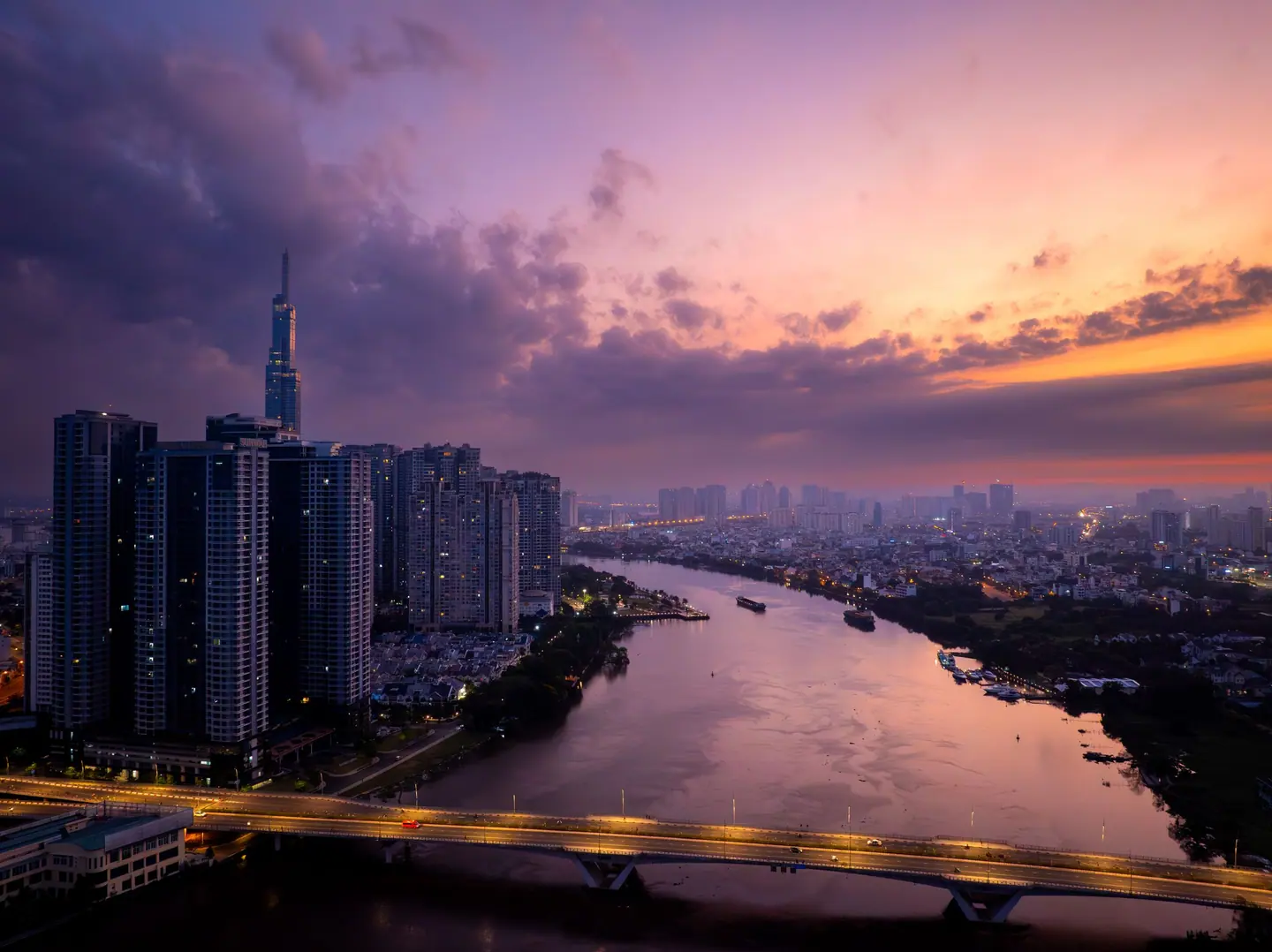
Inspired by New York's Central Park, this forty-hectare riverfront zone borders the foot of the tallest skyscraper in Vietnam. The grounds feature landscaped lawns, ornamental footbridges, water fountains, and paved promenades designed for evening walks alongside river traffic.
Thao Dien Riverfront
Occupying a prominent bend in the Saigon River, Thao Dien evolved from an orchard village into a cosmopolitan enclave. Walking along Nguyen Van Huong street reveals modern art galleries, repurposed colonial villas, and quiet riverside verandas overlooking passing container barges.
Ben Duoc Tunnels
Located deeper in the countryside than Ben Dinh, this sector provides access to original, less-widened passages used by the National Liberation Front. Visitors explore three levels of subterranean tunnels, command kitchens, and trapdoor systems hidden within dense bamboo foliage.
Ben Duoc Memorial Temple
Erected in 1993, this large sanctuary features traditional tiered roofs covered in red tiles and an imposing nine-storey memorial tower. Inside, the walls bear the carved names of more than forty-four thousand soldiers who died in the Saigon and Gia Dinh military zones.
Phu My Hung Urban Area
Established in the late 1990s as a model township, this district features wide tree-lined boulevards and modern apartment towers. We find open canal walks, public parks, and orderly residential grids that present a sharp architectural contrast to the historical core.
Starlight Bridge
Spanning one hundred and seventy metres across Crescent Lake, this modern pedestrian bridge is illuminated by thousands of solar-powered lights embedded in the pavement. Modern fountains cascade from both sides into the canal, illuminated by rotating coloured spotlights.
Crescent Mall Promenade
This paved promenade traces the arc of Crescent Lake, offering open pedestrian space lined with palm trees and modern restaurants. It serves as an open civic plaza where local residents gather for community art displays and seasonal flower festivals.
Phu My Bridge
Completed in 2009, this major engineering structure spans over two thousand metres across the Saigon River. With twin H-shaped pylons rising one hundred and forty-five metres, it carries regional ring-road traffic while offering views across the mangrove channels.
Vinh Nghiem Pagoda
Constructed between 1964 and 1971, this temple is notable for employing reinforced concrete to replicate traditional curved wooden roofs. The complex includes an imposing seven-storey, forty-metre stone stupa dedicated to Avalokiteshvara, which remains one of the city's largest.
Saigon Outcast
Located in Thao Dien, this venue features repurposed cargo crates, graffiti murals, and open-air performance spaces. The site hosts community farmers markets, live indie concerts, and climbing competitions, reflecting the neighbourhood's alternative cultural identity.
Giac Vien Pagoda
Founded in 1798 as a branch of Giac Lam, this quiet temple retains dozens of ornate wooden statues carved during the Nguyen Dynasty. The main altar hall contains detailed mother-of-pearl engravings and century-old ceramic roof tiles depicting southern folk motifs.
Tan Binh Exhibition and Convention Centre
Operating as a commercial hub in Tan Binh district, this venue hosts industrial expos, textile fairs, and agricultural forums. The facility showcases modern utilitarian design built to accommodate high-volume trade events away from the crowded riverfront core.
Phap Vien Minh Dang Quang
Spanning nearly four hectares along the Hanoi Highway, this modern complex serves as a central monastery for the mendicant Buddhist tradition. Four monumental corner stupas frame a cavernous octagonal meditation hall adorned with bronze statues and stone balustrades.
Ba Thien Hau Temple District 1
Tucked along Nguyen Cong Tru street, this temple serves the Chinese diaspora living in central District One. Travellers can inspect intricately glazed ceramic friezes on the roof ridges and large incense coils suspended from the central courtyard rafters.
Tan Dinh Church
Built during the French colonial administration in 1876, this church features Romanesque arches, Gothic windows, and a prominent sixty-metre bell tower. Its distinctive salmon-pink paintwork, applied inside and out during later renovations, makes it an architectural landmark along Hai Ba Trung street.
Cu Chi Wildlife Rescue Station
Located near the historic Ben Duoc tunnels, this facility operates rehabilitation enclosures for sun bears, gibbons, and pangolins. Educational signs describe efforts by wildlife authorities to treat confiscated animals before releasing them into national parks.
Nhieu Loc Canal Promenade
Following a multi-year urban cleanup project, this eight-kilometre waterway was transformed into a linear park flanked by Hoang Sa and Truong Sa streets. Pedestrians can walk beside restored stone embankments, observe small rowing skiffs, and visit traditional cafes.
Connecting Central Saigon with Cholon and the Riverfront
Our main Ho Chi Minh City guide covers airport arrivals, neighbourhood bases and multi-day pacing to complement this walk; see also our full collection of city route guides.