All 100 essential sights across Westminster, St James, Covent Garden, Bloomsbury, the City of London, Tower Bridge and the South Bank mapped in walking order.
Two Millennia Along the Tidal Thames: Londinium to Modern Metropolis
Founded by the Romans around 47 AD as Londinium at the lowest bridgeable point of the tidal River Thames, the walled trading port quickly became the capital of Roman Britannia. In the eleventh century, King Edward the Confessor and William the Conqueror established the dual geometry that still defines central London today: the commercial City of London ("the Square Mile") anchored in the east by the white stone keep of the Tower of London, and the royal and parliamentary seat of Westminster two miles upstream around Westminster Abbey and Westminster Hall.
After the Great Fire of 1666 destroyed four-fifths of the medieval timber City, Sir Christopher Wren rebuilt more than fifty parish churches and raised the baroque dome of St Paul Cathedral. During the Georgian and Victorian eras, London expanded into a global metropolis of grand museum campuses, royal parks, cast-iron railway termini and Thames embankment bridges.
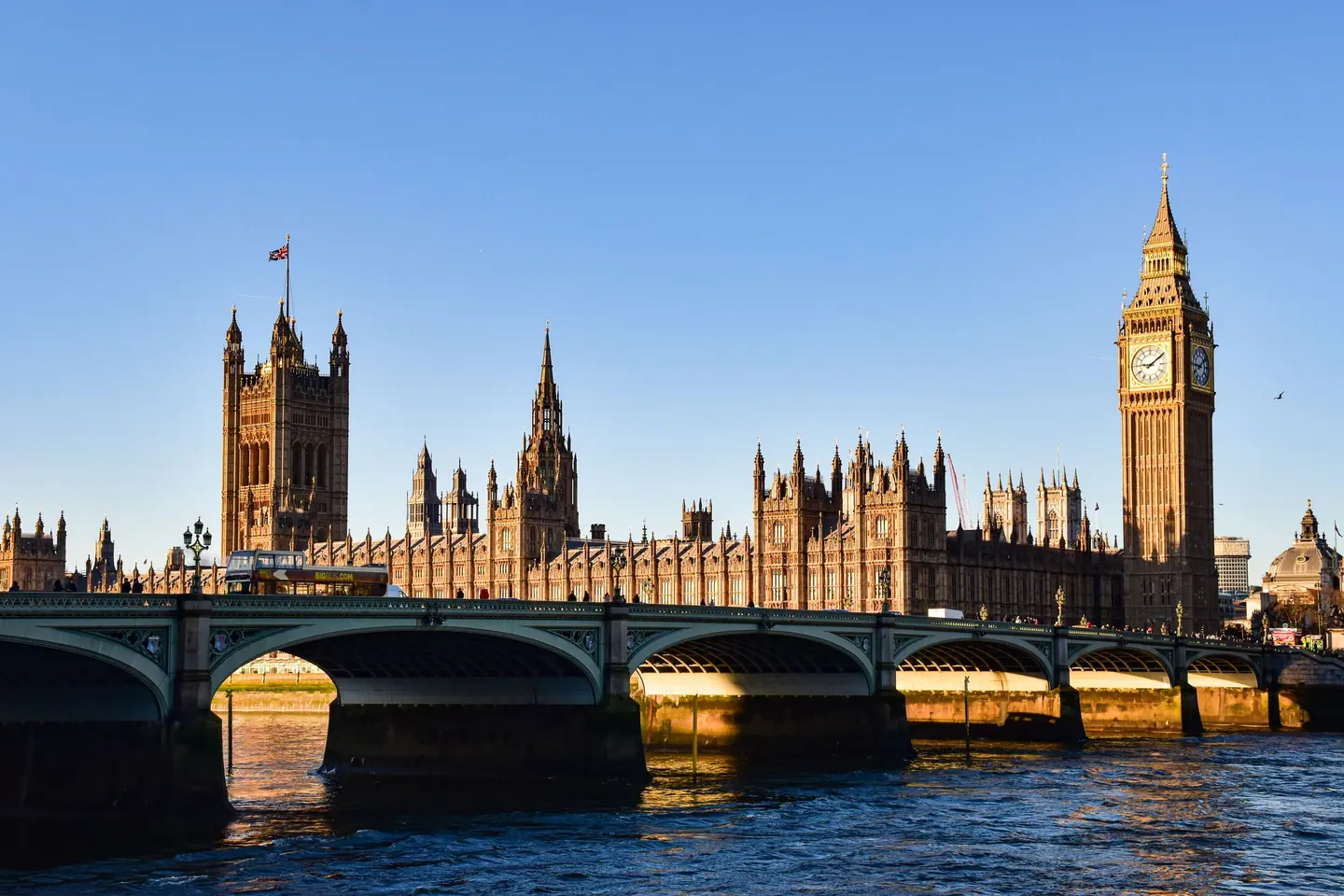
Westminster, Whitehall, Buckingham Palace & Royal Parks
Begin at Big Ben, the Houses of Parliament and Westminster Abbey, then walk up Whitehall and along The Mall through St James Park to Buckingham Palace.
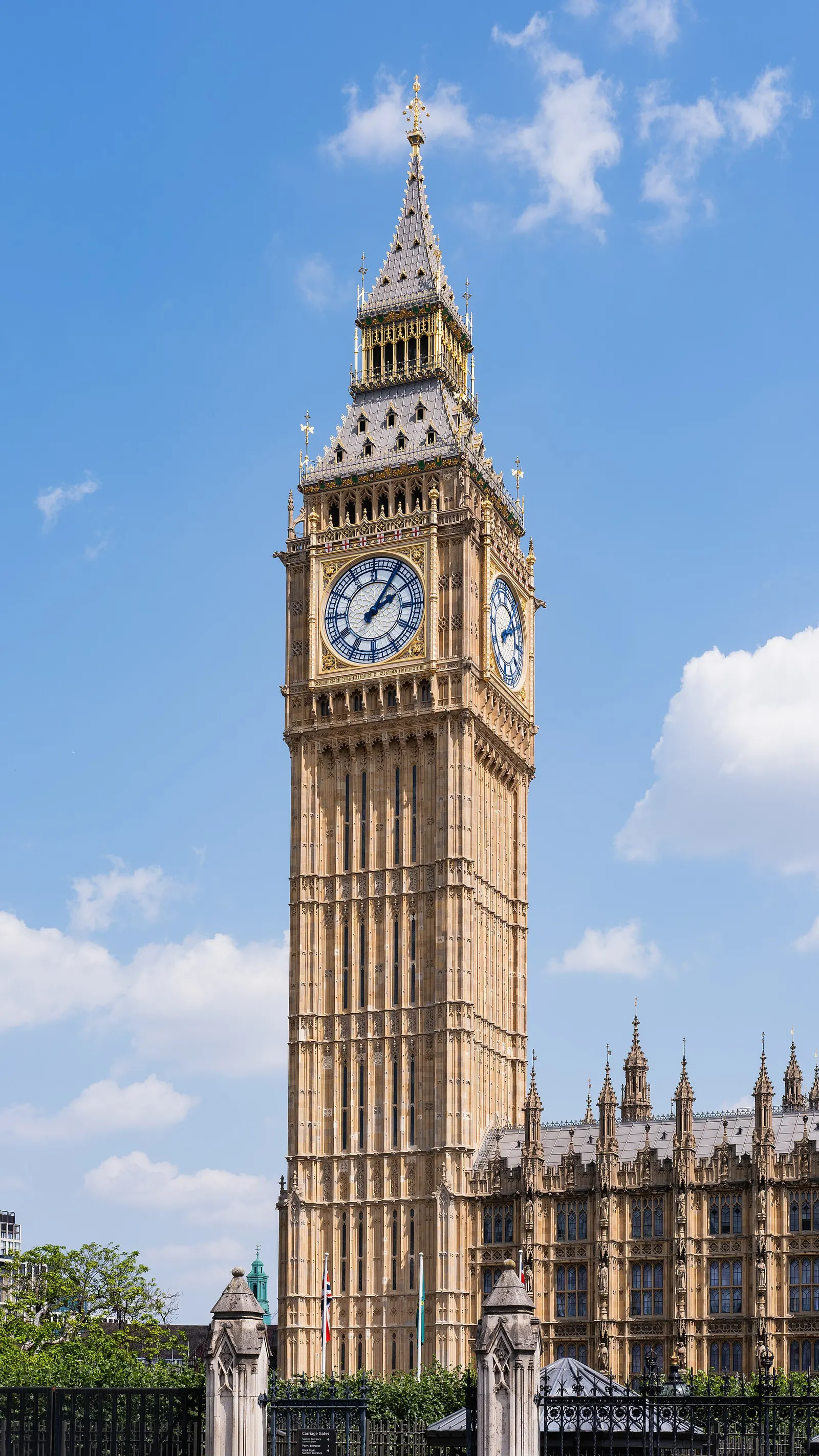
Elizabeth Tower
Designed by Charles Barry and Augustus Pugin, this neo-Gothic clock tower was completed in 1859 following the destruction of the old Palace of Westminster. The structure rises above the Thames with four ornate dials and houses the famous Great Bell. Visitors can observe the intricate stone tracery and gilded ironwork that define Victorian civic architecture.
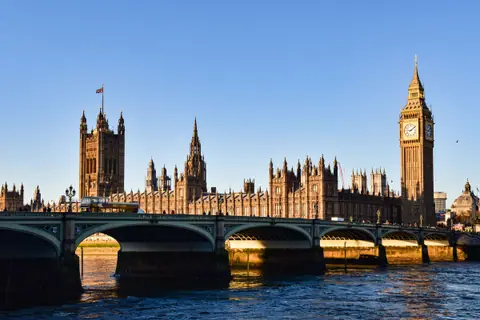
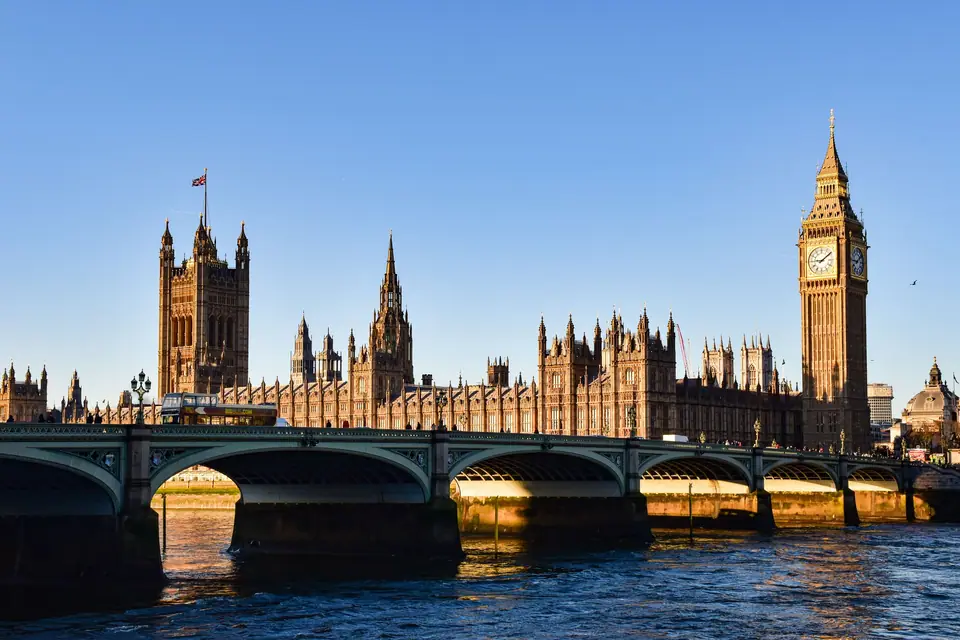
Palace of Westminster
Serving as the meeting place of both Houses of Parliament, this expansive complex features the surviving eleventh-century Westminster Hall alongside Barry and Pugin's Perpendicular Gothic rebuild. Its river façade presents an array of pinnacles, carved heraldry and monumental towers. St Stephen's Porch offers views into the political history of the United Kingdom.
Westminster Abbey
Founded by Edward the Confessor and rebuilt by Henry III, this Gothic abbey church has hosted royal coronations since 1066. The building features soaring stone vaulting, the delicate fan-vaulted ceiling of Henry VII's Lady Chapel, and Poets' Corner. Hundreds of monarchs, statesmen and writers lie commemorated or buried within its hallowed walls.
St Margaret's Church, Westminster
Standing directly between the Abbey and the Palace of Westminster, this fifteenth-century church serves as the parish church of the House of Commons. Rebuilt in the Perpendicular style, it houses a notable Flemish stained-glass window commissioned to celebrate Catherine of Aragon's marriage. Sir Walter Raleigh lies buried near the high altar.
Jewel Tower
Erected around 1365 for Edward III, this stone tower is one of only two complete surviving structures from the medieval Palace of Westminster. Built to house personal royal treasures and wardrobe items, it retains its original ribbed vaulting on the ground floor. It later served as the testing facility for the national standards of weights and measures.
Victoria Tower Gardens
This public green space extends southwards from the Victoria Tower along the Thames embankment. The park features Auguste Rodin's bronze sculpture of The Burghers of Calais, presented to the nation in 1914, alongside a monument to suffragette leader Emmeline Pankhurst. The Buxton Memorial Fountain commemorates the abolition of slavery across the British Empire.
Parliament Square
Laid out in 1868 by Charles Barry to improve traffic flow and visual approaches to Parliament, this landscaped square stands at the centre of British civic life. Bronze statues of prominent statesmen, including Winston Churchill, Abraham Lincoln, Nelson Mandela and Millicent Fawcett, encircle the central lawn. It directly faces the Supreme Court and Whitehall.
Supreme Court of the United Kingdom
Housed within the Middlesex Guildhall on Parliament Square, this early twentieth-century Gothic-revival building became the seat of the nation's highest court in 2009. The stone façade displays intricate carvings depicting historical trials and signing ceremonies. Inside, visitors can examine open public courtrooms featuring bespoke carpets designed by Peter Blake.
Churchill War Rooms
Hidden beneath the Treasury building, this subterranean network sheltered the British cabinet and military staff during the Blitz. The Map Room remains precisely as it was left on the day the lights were switched off in 1945, with wall charts detailing global military movements. The site includes Winston Churchill's bedroom and transatlantic telephone room.
Foreign, Commonwealth and Development Office
Designed by George Gilbert Scott and completed in the 1870s, this massive government building exemplifies the Italianate Renaissance style. Its stone façade incorporates statues of explorers, statesmen and allegorical figures celebrating British global diplomacy. The interior boasts the lavish Locarno Suite and a grand central courtyard decorated with classical friezes.
The Cenotaph
Erected in Portland stone to replace a temporary wood-and-plaster structure, this monument by Edwin Lutyens stands in the centre of Whitehall. Dedicated simply to 'The Glorious Dead', its classical pylon displays subtle optical refinements with curved vertical surfaces. It serves as the centrepiece for the annual National Service of Remembrance every November.
Downing Street
Number 10 Downing Street has served as the official residence and office of British prime ministers since Sir Robert Walpole took occupancy in 1735. The black panelled door, framed by a Georgian fanlight and iron lamp, marks one of the most familiar political addresses in the world. Wrought-iron security gates restrict public access from Whitehall.
Banqueting House, Whitehall
Completed in 1622 by Inigo Jones, this hall is the only substantial surviving component of the lost Palace of Whitehall. It introduced revolutionary classical Palladian proportions to English architecture, finished with Portland stone and classical pilasters. Inside, the grand hall features a monumental ceiling canvas painted by Peter Paul Rubens for King Charles I.
Horse Guards
Designed by William Kent and finished in 1759, this Palladian stone structure functions as the ceremonial entrance to St James's Palace and Buckingham Palace. Mounted sentries from the Household Cavalry keep guard beneath the street arches on Whitehall. Passing through the central clock-tower arch leads directly into the vast gravel expanse of Horse Guards Parade.
Horse Guards Parade
This expansive parade ground stands on the former site of the Palace of Whitehall's royal tiltyard. It hosts the sovereign's official birthday parade, known as Trooping the Colour, along with the Beating Retreat military musical ceremonies. The perimeter features historic cannons, the Cadiz Memorial mortar and the Guards Memorial commemorating casualties from both world wars.
Admiralty Arch
Commissioned by Edward VII in memory of his mother, Queen Victoria, this curved neo-classical building was designed by Sir Aston Webb and completed in 1912. Five stone arches span the roadway, with the central arch reserved exclusively for royal processions. The structure historically housed naval offices and the official residence of the First Sea Lord.
The Mall, London
Designed as a grand processional route by Sir Aston Webb in the early twentieth century, this broad boulevard is paved with red asphalt to evoke a vast red carpet. London plane trees border both sides, running past St James's Park and aristocratic mansions. It forms the primary route for state visits, coronations and national royal celebrations.
St James's Park
Acquired by Henry VIII as a deer park, this royal green space was later landscaped into its romantic naturalistic layout by John Nash in the 1820s. A central lake contains Duck Island and supports a colony of resident white pelicans, a tradition begun in 1664. The blue footbridge offers clear vantage points across the water toward Whitehall.
Victoria Memorial, London
Standing before Buckingham Palace, this monument designed by Sir Thomas Brock was unveiled in 1911. Carved from white Carrara marble, it features a seated statue of Queen Victoria flanked by allegorical depictions of Justice, Truth and Motherhood. A gilded bronze figure of Winged Victory crowns the central pylon, surrounded by nautical friezes celebrating maritime prowess.
Buckingham Palace
Originally built as a townhouse for the Duke of Buckingham in 1703, the residence was transformed into a royal palace by John Nash and Edward Blore during the nineteenth century. Sir Aston Webb refaced the east front in 1913 using Portland stone, framing the balcony used for royal appearances. The courtyard regularly stages the Changing the Guard ceremony.
Trafalgar Square, Covent Garden, Soho & Bloomsbury Museums
Explore the National Gallery on Trafalgar Square, Covent Garden Piazza, the historic theatres of the West End and the world collections of the British Museum.
Trafalgar Square
Designed by John Nash in the 1830s, this grand public space commemorates Lord Nelson's victory over the combined French and Spanish fleets. Nelson's Column dominates the centre, guarded by four bronze lions sculpted by Sir Edwin Landseer. We can also view the Fourth Plinth, which showcases a rotating programme of contemporary sculpture.
National Gallery
Founded in 1824, this imposing institution occupies a neoclassical building designed by William Wilkins overlooking Trafalgar Square. The collection holds over two thousand paintings, ranging from the medieval era through the post-impressionist period. Visitors can study masterworks by Leonardo da Vinci, Rembrandt, Turner and Van Gogh across expansive top-lit galleries.
St Martin-in-the-Fields
Constructed between 1722 and 1726, this church broke architectural conventions by combining a classical Corinthian portico with a soaring steeple. Its innovative design served as a blueprint for colonial churches throughout North America. The subterranean brick crypt functions as an active community space, hosting regular chamber music concerts alongside brass rubbing facilities.
National Portrait Gallery
Established in 1856, this gallery collects portraits of historically important British figures rather than solely celebrating artistic prestige. The Tudor galleries showcase renowned depictions of Henry VIII and Elizabeth I, including the famous Chandos portrait of William Shakespeare. The building reopened after a major refurbishment that reoriented its historic entrance towards the north.
Admiralty Arch
Commissioned by King Edward VII in memory of his mother, Queen Victoria, this grand Portland stone structure was completed in 1912. Designed by Sir Aston Webb, the building features five arches, with the central passageway reserved strictly for royal processions. It served government and naval offices for a century before being slated for hospitality redevelopment.
Coliseum Theatre
Built by theatrical architect Frank Matcham in 1904, this magnificent auditorium was originally designed as a high-end music hall. An illuminated spinning globe crowns the exterior tower, marking its presence above St Martin's Lane. Inside, the theatre retains an opulent Roman-inspired interior with the widest proscenium arch in London.
Covent Garden Market
Originally developed as a residential square by Inigo Jones in the 1630s, the area later transformed into London's principal fruit and vegetable market. Charles Fowler designed the surviving neo-classical iron and glass arcade in 1830. Today, the pedestrianised piazza accommodates antique stalls, craft traders and licensed street performers who entertain crowds daily.
St Paul's Church, Covent Garden
Completed in 1633, this austere Tuscan-style temple was the first entirely new Anglican church built in London since the English Reformation. Its imposing eastern portico frames the western side of the market piazza, although the main entrance lies through quiet gardens to the west. Interior walls display memorial plaques honouring hundreds of British theatrical luminaries.
Royal Opera House
The current building is the third theatre on this site, following catastrophic fires in 1808 and 1856. Architect Edward Middleton Barry designed the grand classical facade and horseshoe auditorium that opened in 1858. The complex integrates the adjacent iron-and-glass Paul Hamlyn Hall, formerly the Floral Hall, which now serves as a light-filled reception space.
London Transport Museum
Housed within the former Victorian Flower Market on the eastern flank of Covent Garden, this museum preserves the heritage of London's transit network. Displays range from Victorian horse-drawn omnibuses to early underground carriages and mid-century red double-decker buses. Interactive exhibitions explain how transport infrastructure guided the urban expansion of suburban London.
Theatre Royal, Drury Lane
Holding royal patents from King Charles II, this is the oldest theatre site in London that remains in continuous use. The current Georgian building opened in 1812, designed by Benjamin Dean Wyatt, following several devastating fires that destroyed earlier structures. Its stately rotunda, paired staircases and vast auditorium continue to host large-scale musical productions.
Somerset House
Designed by Sir William Chambers in 1776, this vast neoclassical complex replaced a Tudor palace beside the River Thames. Originally home to government offices, the Navy Board and the Royal Academy, it now functions as a major cultural centre. The central courtyard features dancing water fountains in summer and converts into an open-air ice rink during winter.
Seven Dials
Laid out by politician Thomas Neale in the early 1690s, this clever street plan was devised to maximise building frontage and rental yields. A central Doric pillar features six sundials, with the column itself serving as the gnomon for the seventh. The surrounding brick townhouses now host independent fashion boutiques, coffee houses and small theatres.
Palace Theatre
Commissioned by impresario Richard D'Oyly Carte as the Royal English Opera House, this grand structure opened in 1891 to showcase English grand opera. Architect Thomas Edward Collcutt applied an ornate Spanish Renaissance style using red terracotta and brick. The lavish interior features grand marble staircases and ornate plasterwork designed to handle high-capacity crowds.
Soho Square
Established in the late 1670s under King Charles II, this square was initially fashionable among the nobility before becoming a commercial centre for publishing and film companies. At its centre stands a half-timbered, mock-Tudor gardener's shed built in 1925 above an electricity substation. The surrounding green space provides a peaceful respite from neighbouring Oxford Street.
St Anne's Church, Soho
Consecrated in 1686, St Anne's served a diverse parish that included thousands of French Huguenot refugees escaping persecution. The main building suffered direct bomb damage during the Blitz, but the unusual Portland stone tower added by S.P. Cockerell in 1803 survived. Today, the rebuilt complex houses a community centre, chapel and a quiet public churchyard garden.
British Museum
Established in 1753 around the collections of Sir Hans Sloane, this museum occupies a monumental Greek Revival building designed by Sir Robert Smirke. Norman Foster's Great Court encloses the central courtyard under a spectacular glass-and-steel tessellated roof around the historic Round Reading Room. Key antiquities include the Rosetta Stone, the Parthenon Sculptures and ancient Egyptian mummies.
Sir John Soane's Museum
The former home of master architect Sir John Soane brings together architectural models, antiquities and fine art across three interconnected townhouses. Soane carefully orchestrated skylights, concealed mirrors and hinged wall panels to display treasures such as the alabaster sarcophagus of Pharaoh Seti I. By Act of Parliament, the interior remains exactly as it stood at his death.
Lincoln's Inn Fields
Laid out during the 1630s, this expansive public square is bordered by historic legal associations, academic institutions and private residences. Mature London plane trees, open lawns and tennis courts fill the grounds, which once served as a place for public executions. The surrounding perimeter retains fine Georgian and Victorian buildings, including the Royal College of Surgeons.
Senate House
Designed by Charles Holden and completed in 1937, this monumental Portland stone tower was one of London's earliest skyscrapers. During the Second World War, it housed the Ministry of Information, inspiring George Orwell's depiction of the Ministry of Truth in his novel Nineteen Eighty-Four. The structure remains an outstanding example of interwar classical modernism in Bloomsbury.
Legal London, Fleet Street, St Paul Cathedral & Guildhall
Walk east through the quiet courtyards of the Inns of Court and Temple Church along Fleet Street to Sir Christopher Wren St Paul Cathedral and the medieval Guildhall.
Royal Courts of Justice
George Edmund Street designed this sprawling Victorian Gothic complex, opened by Queen Victoria in 1882 to house the High Court and Court of Appeal. The towering central hall features vaulted stone ceilings, intricate mosaic floors, and displays of historical legal costume. We can wander the cavernous public galleries to observe British justice in session.
Twinings 216 Strand
Thomas Twining established this historic tea house in 1706, making it one of the oldest continually operating businesses in London. The narrow doorway on the Strand retains its original pediment adorned with two Chinese figures and a golden lion. Inside, a small museum counter displays antique tea caddies alongside hundreds of packaged blends.
Middle Temple Hall
Completed in the 1570s, this grand Elizabethan dining hall remains the ceremonial heart of the Middle Temple legal society. Its double hammerbeam roof of carved English oak survived the Blitz, and William Shakespeare is recorded to have staged Twelfth Night here in 1602. The heraldic stained-glass windows commemorate distinguished barristers and royal benchers across centuries.
Temple Church
Consecrated in 1185 by the Patriarch of Jerusalem, this round church served as the English headquarters for the Knights Templar. The circular nave was designed to evoke the Church of the Holy Sepulchre, sheltering life-sized stone effigies of medieval knights on the floor. Christopher Wren and later Victorian restorers repaired the adjacent chancel after wartime bomb damage.
Inner Temple Gardens
These manicured lawns have provided a quiet refuge for barristers since the fourteenth century. Shakespeare immortalised the grounds in Henry VI as the location where the white and red roses of York and Lancaster were first plucked. Broad herbaceous borders, mature plane trees, and eighteenth-century wrought-iron gates frame views across the legal precinct.
Prince Henry's Room
Constructed in 1610 as a tavern called the Prince's Arms, this timber-framed townhouse survived the Great Fire of 1666. The first-floor room features a Jacobean plaster ceiling decorated with the feathers of Prince Henry, eldest son of King James I. Its overhanging jetty and leaded casement windows offer a rare glimpse of pre-fire street architecture.
St Dunstan-in-the-West
Rebuilt by John Shaw in the 1830s with an octagonal nave and neo-Gothic tower, this church preserves a distinctive seventeenth-century bracket clock. Two carved wooden giants strike bells on the quarter hour above the pavement of Fleet Street. The interior serves both an Anglican congregation and the Romanian Orthodox community, displaying an ornate gilded iconostasis.
Dr Johnson's House
Located in Gough Square off Fleet Street, this late seventeenth-century brick townhouse was home to Samuel Johnson between 1748 and 1759. Johnson compiled his landmark Dictionary of the English Language in the timber-beamed garret, assisted by six copyists. Visitors can explore period parlours, personal artefacts, and early printed folios from the writer's circle.
Ye Olde Cheshire Cheese
Rebuilt shortly after the Great Fire of 1666, this historic chop house is legendary for its maze of wood-panelled rooms and sawdust floors. Charles Dickens, Samuel Johnson, and Mark Twain all drank within its shadowy vaulted cellars. The dark interior retains open fireplaces, oil paintings, and original seating unchanged since Victorian days.
St Bride's Church
Rebuilt by Sir Christopher Wren after 1666, St Bride's has long been recognised as the spiritual home of the British newspaper industry. Its tiered white spire inspired the design of the traditional tiered wedding cake. Post-war excavations revealed an ancient Roman pavement and medieval crypts, which are now curated as an underground archaeological museum.
Ludgate Circus
Engineered in the 1860s and 1870s, this circular road junction stands directly above the subterranean course of the River Fleet. Black marble and stone Victorian facades mark the four curved quadrants where Fleet Street meets Farringdon Street. Looking east up Ludgate Hill, travellers enjoy an aligned view towards the western facade of St Paul Cathedral.
Stationers' Hall
Stationers' Hall was rebuilt between 1670 and 1673 following the Great Fire, serving the ancient livery company of printers, bookbinders, and publishers. The Stationers' Hall register legally established English copyright protection for major plays and books, including works by Shakespeare. The interior features a carved oak screen, stained-glass medallions, and a quiet courtyard garden.
St Martin, Ludgate
Sir Christopher Wren completed this parish church in 1684, deliberately providing it with a slender black spire to contrast against the soaring white dome of St Paul. The church occupies the site of the ancient western gate of the Roman and medieval city walls. Inside, notable Grinling Gibbons wood carvings and an elevated brass chandelier decorate the hall.
Paternoster Square
Completely redeveloped in 2003, Paternoster Square centres on a classical Corinthian column topped with a gilded flaming urn. The precinct houses the London Stock Exchange and features public sculpture, including Elisabeth Frink's bronze Paternoster shepherd and sheep. It connects directly with the cathedral precinct through Temple Bar, which was relocated here in 2004.
Temple Bar Memorial
Originally designed by Sir Christopher Wren in 1672 to control entry from Westminster into the City of London, this Portland stone gate stood across Fleet Street until 1878. Dismantled and reconstructed in Hertfordshire for a century, it was returned to the capital in 2004. Its rusticated archways now form an elegant ceremonial entrance to Paternoster Square.
St Paul's Cathedral
Erected between 1675 and 1710 on Ludgate Hill, this monumental cathedral stands as Sir Christopher Wren greatest architectural achievement. Its double-shelled dome dominates the City skyline, while the interior houses the Whispering Gallery and ornate Victorian ceiling mosaics. In the vast crypt beneath, national heroes including the Duke of Wellington and Admiral Nelson lie interred.
St Vedast Foster Lane
Restored by Sir Christopher Wren after 1666 and re-engineered internally by Nicholas Hawksmoor, this church features one of the most inventive spires in the City. The stone steeple relies on contrasting concave and convex stone surfaces to create play of light and shade. A secluded fountain courtyard leads into a serene collegiate-style interior lined with dark wooden pews.
Guildhall
Commenced in 1411, the Great Hall is the only secular stone civic building from the medieval period still standing in the City. It retains its fifteenth-century stone undercroft and grand stained-glass windows, alongside statues of the mythic giants Gog and Magog. It continues to host state banquets and meetings of the Court of Common Council.
St Mary-le-Bow
Tradition dictates that a true Cockney must be born within hearing range of the bells of St Mary-le-Bow on Cheapside. Wren built the present church over an eleventh-century Norman crypt with bowed arches, crowned by an elaborate Portland stone steeple. The spacious interior features clean classical proportions and a modern stained-glass window honouring German resistance during wartime.
London Mithraeum
Unearthed in 1954 during post-war clearance, this third-century Roman temple was dedicated to the mystery cult of Mithras along the River Walbrook. Now restored seven metres beneath the modern street level inside the Bloomberg European headquarters, the site uses mist and light installations to recreate the ritual space. A gallery above displays hundreds of rare Roman artefacts.
Bank, Leadenhall, Monument, Tower of London & Tower Bridge
Discover the ancient heart of the Square Mile from the Roman Mithraeum, Bank of England and Leadenhall Market to the Monument, Tower of London and Tower Bridge.
London Mithraeum
Constructed beside the lost River Walbrook around AD 240, this Roman sanctuary was uncovered during post-war rebuilding in 1954. Relocated to its original depth beneath Bloomberg's European headquarters, the display pairs authentic masonry foundations with atmospheric light and sound installations. Visitors can examine excavated Roman artefacts, including leather shoes, writing tablets and votive statuary.
Bank of England Museum
Housed within the central bank of the United Kingdom, this museum reveals the history of paper currency and national finance since 1694. The galleries reconstruct Soane's grand Stock Office, featuring neoclassical stone vaults and Roman urns. Exhibits include historic banknotes, royal charters, forged notes and an authentic gold bar that guests may lift.
Royal Exchange, London
Founded by merchant Sir Thomas Gresham in 1565, the current structure represents the third iteration on site, designed by Sir William Tite in 1844. Its pediment sculptures symbolise British trade across continents, topped by a famous golden grasshopper weathervane. Inside, the arcaded courtyard now hosts boutiques alongside frescoes illustrating medieval and early modern civic history.
St Michael, Cornhill
Standing over Roman forum ruins, this parish church was reconstructed after the Great Fire of 1666. Christopher Wren rebuilt the body of the church, while Nicholas Hawksmoor added the distinctive Gothic Revival tower decades later. Inside, visitors encounter rich Victorian woodcarvings crafted by William Gibbs Rogers and a fine Father Willis organ.
St Peter upon Cornhill
Tradition asserts that King Lucius established a church here in the second century, making it London's earliest Christian foundation. The present red-brick edifice was built by Sir Christopher Wren between 1677 and 1687. Within its quiet interior, notice the carved oak rood screen, designed by Wren and his daughter, which remains one of few surviving examples.
Leadenhall Market
Trading on this site dates to the fourteenth century, when it served as a meat and poultry market in the centre of Roman Londinium. Sir Horace Jones designed the current wrought-iron and glass structure in 1881, painted in maroon, green and cream. Cobbled avenues cross beneath high arched vaults lined with traditional butcher shops, taverns and eateries.
St Helen's, Bishopsgate
This expansive medieval hall church originated as a dual foundation for parishioners and Benedictine nuns, separated by an internal arcade. Having survived both the Great Fire and modern bombing, it contains London's largest collection of pre-fire monuments outside Westminster Abbey. Look for the tomb of Elizabethan financier Sir Thomas Gresham and the memorial to explorer Sir John Spencer.
St Andrew Undershaft
Constructed in 1532, this rare surviving late-Perpendicular Gothic church takes its name from the tall Maypole shaft once erected across the street. The interior contains sixteenth-century stained glass and original wooden nave ceilings. It houses the terracotta tomb of London historian John Stow, whose quill pen is renewed annually in a formal civic ceremony.
St Mary Axe
Designed by Foster and Partners and opened in 2004, this aerodynamic forty-storey tower stands on the site of a medieval parish church demolished in 1561. The structural steel diagrid exterior curves outward before tapering at the apex to maximise daylight and wind efficiency. The plaza below incorporates granite benches, public art pieces and traces of ancient Roman burials.
St Katharine Cree
Consecrated in 1631 by Archbishop William Laud, this church represents an uncommon architectural transition between Gothic structural framing and classical Renaissance motifs. Inside, Corinthian stone columns support rib-vaulted plaster ceilings displaying coats of arms. The eastern wall is illuminated by an immense rose window modelled after the wheel window of Old St Paul's Cathedral.
St Olave Hart Street
Dedicated to King Olaf of Norway, this modest fifteenth-century church escaped the Great Fire when the Navy Board blew up neighbouring buildings. Samuel Pepys attended services here regularly, and both he and his wife Elizabeth are buried beside the high altar. The churchyard entrance features a sinister stone gate adorned with carved skulls and spikes added in 1658.
St Dunstan in the East
Originally built around 1100, the church received a Gothic spire from Sir Christopher Wren after the Great Fire destroyed the medieval nave. Severe damage during the 1941 Blitz left only Wren's tower and outer stone walls standing. The City converted the ruined arches and tracery windows into a public garden planted with wall shrubs, vines and climbing hydrangeas.
Monument to the Great Fire of London
Designed by Sir Christopher Wren and Robert Hooke, this 61-metre Portland stone column stands exactly 61 metres from the bakery in Pudding Lane where the disaster started. Completed in 1677, its summit features a gilded copper urn with spewing flames. A cantilevered spiral staircase of 311 stone steps leads travellers to an open-air observation platform.
St Magnus-the-Martyr
For centuries, the main roadway leading pedestrians onto Old London Bridge ran directly through the stone archway underneath this church tower. Rebuilt by Sir Christopher Wren between 1671 and 1687, the church boasts an elegant classical interior lined with carved woodwork. Inside stands a celebrated four-metre scale model of medieval London Bridge complete with shops, chapel and houses.
Custom House, London
Dating from 1817 and redesigned by Sir Robert Smirke after foundation subsidence, this neoclassical complex long governed trade taxes along the Thames. Its southern facade presents an expansive Portland stone colonnade facing the river walkway. The vast Long Room inside historically accommodated maritime merchants and customs clerks processing imported goods from across the globe.
All Hallows-by-the-Tower
Founded by the Abbey of Barking in 675, this venerable sanctuary preserves an authentic Saxon stone arch made from recycled Roman tiles. William Penn was baptised here, and John Quincy Adams celebrated his marriage in the nave. The crypt museum exhibits domestic Roman pottery, a tessellated floor and early medieval religious carving fragments.
Tower Hill Memorial
Set within Trinity Square Gardens, this monument honours civilian sailors and fishermen who died during both World Wars with no known grave. Sir Edwin Lutyens designed the vaulted First World War classical temple, while Sir Edward Maufe added the sunken garden for Second World War casualties. Bronze plaques list tens of thousands of mariners organised by ship name.
Tower of London
William the Conqueror founded the fortress in 1066 to secure the city, building the monumental White Tower in Caen stone. Over nine centuries, it served as an armoury, royal mint, zoo and prison for high-profile figures like Anne Boleyn. Today, the fortress preserves the Crown Jewels in the Waterloo Block and hosts the Yeoman Warders.
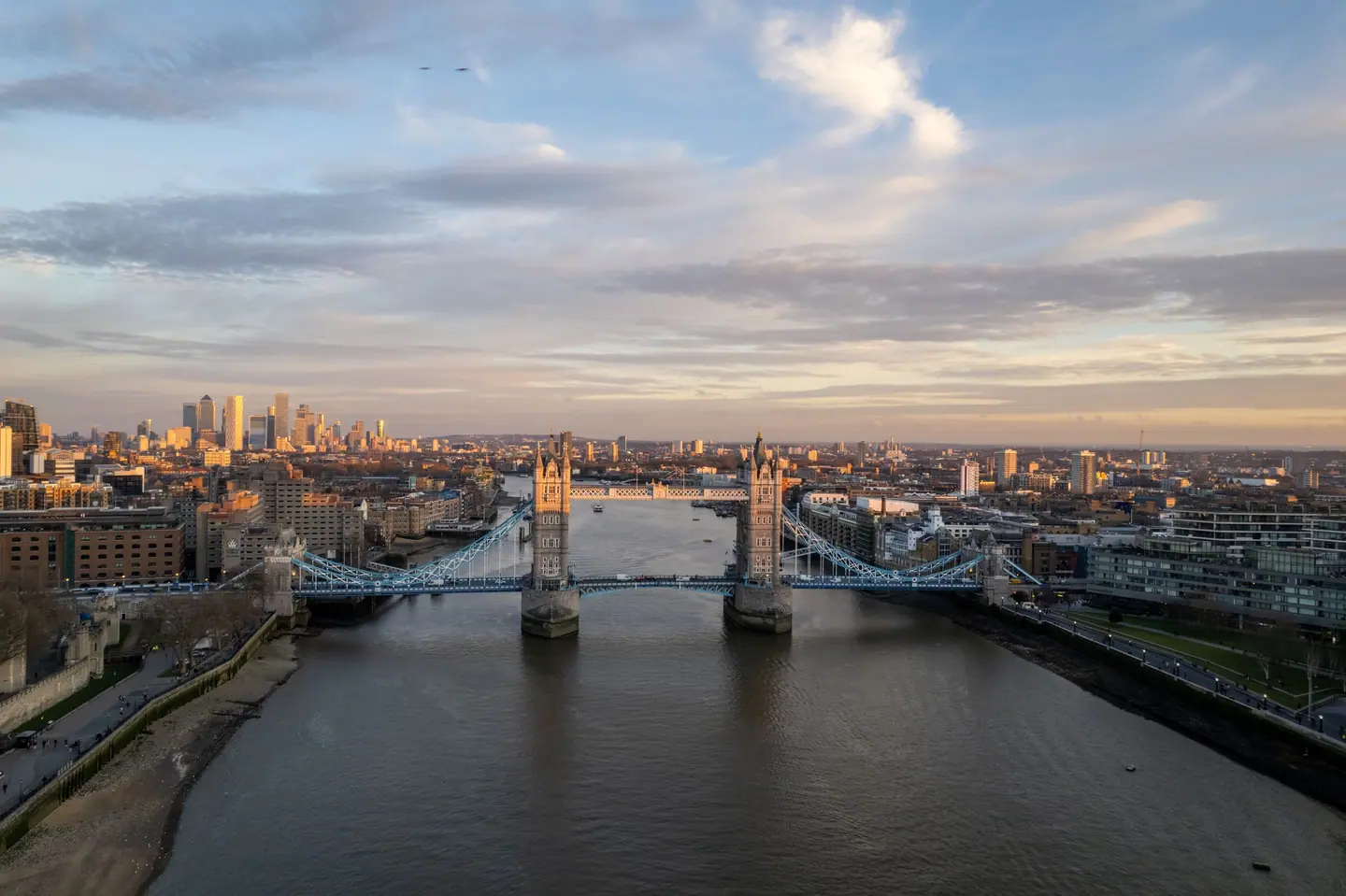
Tower Bridge
Completed in 1894 by Sir John Wolfe Barry and Sir Horace Jones, this river crossing combines steel frameworks clad in Cornish granite and Portland stone. Its twin Gothic towers anchor suspension spans, while central bascules still open to permit masted ships passage into the Upper Pool. High-level walkways feature glass floors, providing vertical views of passing river traffic.
HMS Belfast
Permanently moored on the south bank opposite the Tower, this 1938 Town-class cruiser played critical roles in the Arctic Convoys and the Normandy landings. Operated by the Imperial War Museum, the ship allows visitors to inspect nine decks, including the bridge, boiler rooms and interactive operations room. Massive triple-gun turrets frame views across the pool towards the ancient city.
South Bank, Borough Market, Tate Modern, Southwark & Kensington
Follow the Thames Queen Walk from Borough Market, Southwark Cathedral, the Golden Hinde, Shakespeare Globe and Tate Modern to the London Eye and South Kensington museums.
Borough Market
Operating near London Bridge since at least the twelfth century, this market retains elegant Victorian cast-iron roofing and Art Deco entrance features. Traders supply regional British produce alongside international imports beneath railway viaducts. We notice original architectural ironwork alongside brass nameplates marking historic wholesale stands.
Southwark Cathedral
Standing on the south bank of the Thames, this site supported Christian worship for over a thousand years. The current structure exhibits fine thirteenth-century Gothic choir arches and restored nineteenth-century nave arcades. Inside, visitors find a memorial to William Shakespeare and the Harvard Chapel commemorating the founder of Harvard College.
The Golden Hinde
Moored in St Mary Overie Dock, this seaworthy replica commemorates Sir Francis Drake's circumnavigation of the globe between 1577 and 1580. Built in Devon during the 1970s, the ship completed its own global voyage covering more than one hundred thousand miles. Visitors can board the wooden decks to examine period rigging and cannons.
Winchester Palace
Dating from the early thirteenth century, this palace served the wealthy Bishops of Winchester who controlled Southwark throughout the Middle Ages. The surviving ruins reveal the south wall of the great hall, distinguished by an intricate fourteenth-century rose window. Beneath the stonework, vaulted cellar foundations give insight into medieval domestic planning.
The Clink Prison Museum
Operated by the Bishop of Winchester from the twelfth century until 1704, this penitentiary housed debtors, heretics, and unruly locals. Its notorious reputation loaned the word clink to common English parlance as slang for imprisonment. The museum displays archaeological artefacts, replica holding cells, and historical restraint devices.
The Anchor, Bankside
Rebuilt following a serious fire in the late eighteenth century, this riverside public house occupies ground linked to Bankside theatrical history. Samuel Pepys watched the Great Fire of London consume the opposite bank from this vantage point in 1666. The building features low-beamed timber ceilings and multi-level outdoor seating terraces overlooking the river.
Shakespeare's Globe
Conceived by American actor Sam Wanamaker, this faithful reconstruction opened in 1997 just yards from the original 1599 playhouse site. Built using English oak timber frames, lime plaster, and a water-reed thatched roof, it presents plays in open daylight. Groundlings stand in the central yard, surrounded by three tiers of wooden gallery benches.
Tate Modern
Architects Herzog and de Meuron converted Sir Giles Gilbert Scott's Bankside Power Station into this contemporary arts museum in 2000. The vast Turbine Hall accommodates monumental sculpture commissions beneath sheer industrial brickwork. In 2016, the Blavatnik Building extension added a dramatic pyramid-like brick tower offering expansive views across London.
Millennium Bridge
Designed by Foster and Partners alongside sculptor Sir Anthony Caro and engineer Arup, this footbridge opened in 2000. Its shallow steel cables sit entirely below deck level, maintaining an unobstructed sightline between Tate Modern and St Paul's Cathedral. Walkers cross the river while observing fine vistas of London's bridges and water traffic.
Oxo Tower
Constructed in the 1920s as a cold-storage warehouse for the Liebig Extract of Meat Company, the building features an Art Deco tower. Its vertical windows spell out the company's trademark product to bypass riverside skyline advertising bans. Today, the complex houses design studios, independent craft workshops, and river-facing public viewing platforms.
National Theatre
Opened in 1976, this concrete landmark contains three distinct auditoriums: the Olivier, the Lyttelton, and the Dorfman. Architect Sir Denys Lasdun layered shuttered board-marked concrete terraces to create an urban landscape resembling riverside geological strata. We can wander through the public foyers to view free exhibitions, river terraces, and bookstalls.
Southbank Centre
Anchored by the Royal Festival Hall, built for the 1951 Festival of Britain, this cultural complex includes the Hayward Gallery and Queen Elizabeth Hall. The architecture illustrates post-war Scandinavian design and raw British Brutalism, connected by high-level concrete walkways. The undercroft beneath the Queen Elizabeth Hall has served as a global focal point for street skateboarding since the 1970s.
London Eye
Erected in 1999 to mark the millennium, this 135-metre cantilevered observation wheel dominates the South Bank skyline. Designed by architects Marks Barfield, its thirty-two sealed passenger capsules carry observers on a gradual thirty-minute rotation. The structure offers expansive panoramic perspectives over the Houses of Parliament, Big Ben, and the wider metropolis.
County Hall
Designed by Ralph Knott and opened by King George V in 1922, this colossal Portland stone building served as headquarters for London's regional government until 1986. The facade faces the river with an imposing curved central colonnade and classical pediments. Today, the historic chambers host hotels, exhibition spaces, and the London Aquarium.
Victoria and Albert Museum
Founded in 1852 following the Great Exhibition, this South Kensington museum occupies an expansive Victorian and Edwardian complex designed by Aston Webb. Its galleries contain over two million objects spanning five millennia of art, ceramics, textiles, and furniture. Highlights include the Cast Courts and the modern Exhibition Road Quarter courtyard designed by Amanda Levete.
Natural History Museum
Alfred Waterhouse designed this landmark, completed in 1881, using ornate terracotta cladding to resist London's Victorian coal smoke. The cavernous central Hintze Hall features soaring arches and the suspended skeleton of a female blue whale. Architectural carvings throughout depict extinct creatures on the eastern wing and living species on the western wing.
Science Museum
Established in 1857, this South Kensington institution documents British and global scientific progress through historic machinery and instruments. Galleries showcase Stephenson's Rocket locomotive, the Apollo 10 command module, and Charles Babbage's early mechanical computing engines. The East Hall reveals steam engines from the Industrial Revolution preserved in operating condition.
Royal Albert Hall
Opened in 1871, this circular auditorium features a distinctive dome composed of wrought iron and glazed panels. Around the exterior runs an 800-foot terracotta mosaic frieze depicting the advancement of arts, sciences, and world civilisations. It remains home to the annual BBC Proms classical music festival and numerous public performances.
Albert Memorial
Commissioned by Queen Victoria and designed by Sir George Gilbert Scott, this gilded canopy stands in Kensington Gardens facing the Royal Albert Hall. Completed in 1872, the monument features a central bronze statue of Prince Albert holding the Great Exhibition catalogue. Intricate marble corner sculptures represent the Victorian continents alongside personifications of nineteenth-century industrial arts.
Kensington Palace
Purchased by King William III and Queen Mary II in 1689, this residence was enlarged by Sir Christopher Wren and William Kent. The palace served as the childhood home of Queen Victoria, who was born here in 1819. Visitors can inspect the King's State Apartments, the Sunken Garden, and displays of royal dress collections.
Where to Base Yourself in London
You can combine these stops with the district-by-district where-to-stay notes and seasonal planning tables on our London destination page, or explore further regional and neighbourhood guides.