A 100-stop route across Mexico City, from the Aztec ruins of Tenochtitlan and Diego Rivera murals around the Zócalo to Chapultepec Forest, Roma-Condesa, Coyoacán, and Xochimilco.
Island Causeways of Lake Texcoco, Tezontle Palaces and Twentieth-Century Muralism
In 1325 the Mexica (Aztecs) founded Tenochtitlan on an island in the middle of Lake Texcoco, engineering causeways, aqueducts, and floating chinampa gardens around the twin-shrined Templo Mayor until the lakeside metropolis housed over two hundred thousand people. Following the Spanish conquest in 1521, Viceroy Antonio de Mendoza and colonial architects built the capital of New Spain directly atop the Aztec ceremonial precinct using volcanic tezontle stone.
Adorned with Churrigueresque palaces in the eighteenth century, Porfirian Beaux-Arts avenues along Paseo de la Reforma in the late nineteenth century, and monumental public murals by Diego Rivera, José Clemente Orozco, and David Alfaro Siqueiros after the Mexican Revolution, Mexico City layers seven centuries of urban history.
Zócalo, Templo Mayor & Centro Histórico East
Plaza de la Constitución Zócalo, Mexico City Metropolitan Cathedral, Templo Mayor Museum, National Palace Diego Rivera Murals, Antiguo Colegio de San Ildefonso, SEP Murals, and Plaza Santo Domingo
Plaza de la Constitución
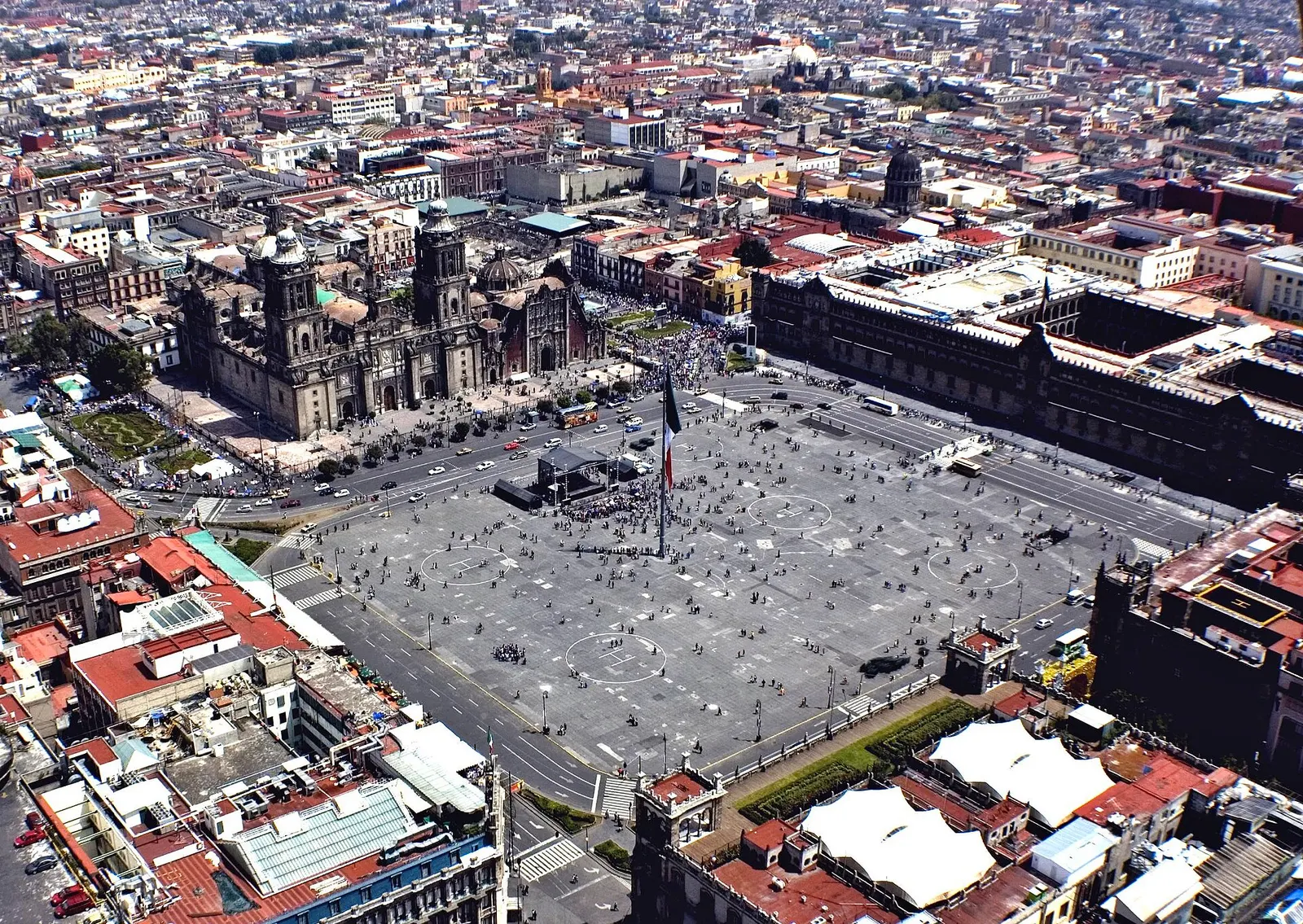
Commonly known as the Zócalo, this vast public plaza occupies the ceremonial heart of the former Aztec capital Tenochtitlan. It has hosted political rallies, religious ceremonies and cultural gatherings for centuries. Visitors should observe the colossal national flag raised daily at its centre, surrounded by the country's most significant governing and ecclesiastical institutions.
Mexico City Metropolitan Cathedral
Constructed in sections between 1573 and 1813 over former Aztec sacred precincts, this cathedral synthesises Gothic, Baroque, Churrigueresque and Neoclassical styles. Inside, travellers can examine the gilded Altar of the Kings, ornate choir stalls and historic organs. Notice the heavy stone pendulum suspended from the dome, installed to monitor the building's gradual subsidence into the soft lakebed.
Mexico City Metropolitan Tabernacle
Designed by Andalusian architect Lorenzo Rodríguez between 1749 and 1760, this parish church stands adjacent to the cathedral. Its exterior walls showcase intricate reliefs carved from dark red volcanic tezontle and pale chiluca limestone. The facade serves as a textbook example of Mexican Ultra-Baroque carving, crowded with statues of apostles, Church Fathers and hovering angels.
Templo Mayor
This archaeological complex reveals seven superimposed building phases of the main temple dedicated to Huitzilopochtli and Tlaloc. Unearthed accidentally by utility workers in 1978, the open-air site contains serpent carvings, ancient sacrificial stones and plaster platforms. Walkways guide visitors directly above centuries of Aztec civic construction that lay buried beneath Spanish colonial buildings.
Templo Mayor Museum
Designed by architect Pedro Ramírez Vázquez, this eight-room museum houses thousands of artefacts recovered from the neighbouring ceremonial enclosure. Highlights include the massive stone disc of the moon goddess Coyolxauhqui and the monolithic relief of the earth god Tlaltecuhtli. Exhibitions clearly illustrate the ritual warfare, tribute systems and daily customs of pre-Hispanic central Mexico.
National Palace
Occupying the entire eastern flank of the Zócalo, this massive red-tezontle palace stands on the site of Moctezuma II's New Palaces. It has accommodated viceroys, emperors and presidents since the colonial era. The main courtyard leads visitors to Diego Rivera's epic staircase fresco, The History of Mexico, which illustrates political struggles across pre-Columbian and modern eras.
Old Portal of Mercaderes
Dating back to sixteenth-century commercial grants, these continuous arcades originally accommodated silk merchants, scribes and money lenders. Today, the street-level loggias host jewellery shops and traditional opticians below boutique hotels. Visitors strolling beneath the heavy stone arches obtain shaded sightlines across the entire expanse of the Zócalo towards the National Palace.
Old City Hall
Erected in the eighteenth century and restored in 1906, this administrative edifice features neoclassical arcades and talavera-tile plaques along its exterior facade. The interior includes the prestigious Salón de Cabildos, decorated with portraits of past governors and historic mayors. The building remains a functioning seat of local executive power facing the southern side of the plaza.
Nacional Monte de Piedad
Founded in 1775 by the Count of Regla, this grand institution rests on the site of the Palace of Axayácatl, where Hernán Cortés initially lodged. The building retains thick stone walls, classical pediments and quiet interior courtyards. It continues to provide micro-loans against household goods, maintaining an unbroken tradition of public financial assistance.
Supreme Court of Justice of the Nation
Completed in 1941 in a restrained neo-colonial style, this judicial palace stands on the former colonial marketplace of El Volador. The interior vestibules and stairwells display dramatic, hard-hitting murals painted by José Clemente Orozco, George Biddle and Héctor Cruz. Orozco's paintings critique state corruption and champion true legal integrity through aggressive, Expressionist forms.
Museo José Luis Cuevas
Set within the restored seventeenth-century Convent of Santa Inés, this museum displays Latin American modern art centred around the drawings and sculptures of José Luis Cuevas. In the central patio stands Cuevas's bronze female figure titled La Giganta, weighing eight tonnes. The gallery rooms display works by members of the mid-twentieth-century Breakaway Generation.
Iglesia de Santa Inés
Founded in 1600 as a sanctuary for aristocratic nuns, this church retains its single-nave plan and stone portals carved with figures of Saint Agnes. The austere exterior of red tezontle contrasts with classical interior altars and an impressive choir screen. The building offers visitors a quiet sanctuary showcasing religious life in viceregal New Spain.
Antiguo Colegio de San Ildefonso
This sprawling colonial school, constructed with three arcaded courtyards, operated as an elite Jesuit seminary and later as the National Preparatory School. In the 1920s, government patronage invited Diego Rivera, José Clemente Orozco and David Alfaro Siqueiros to cover its corridors in pioneering revolutionary murals. The General Amphitheatre contains Rivera's early encaustic masterpiece, Creation.
Secretariat of Public Education Murals
Occupying a transformed colonial convent complex, this ministry houses one of the most comprehensive mural projects of the twentieth century. Between 1923 and 1928, Diego Rivera painted over two hundred fresco panels illustrating agrarian labour, industrial processes and popular folk festivals. The vast arcaded courtyards allow visitors to examine the evolution of post-revolutionary artistic pedagogy.
Plaza de Santo Domingo
Second in historical importance only to the Zócalo, this open square sits ringed by grand viceregal institutions. Along its western flank, the Portal de Evangelistas still accommodates traditional typists and printers operating mechanical presses for legal stationery and invitations. In the centre stands a bronze statue of Josefa Ortiz de Domínguez, an influential insurgent of Mexican Independence.
Church of Santo Domingo
Completed in 1736 under the direction of Pedro de Arrieta, this church represents Mexican Baroque at its peak maturity. The exterior displays alternating dark tezontle stone and pale cantera reliefs depicting Saint Dominic receiving the rosary. Inside, travellers can view the neoclassical main altar designed by Manuel Tolsá and the Chapel of the Lord of Expira.
Palace of the Inquisition
Designed by Pedro de Arrieta and completed in 1737, this monumental corner building served as the seat of the Holy Office tribunal until Mexican Independence. Notable for its bevelled entrance corner and hanging arches supported without corner columns, the interior courtyard demonstrates sophisticated baroque geometry. The rooms now house exhibits charting the development of Mexican medical science.
Museo de la Charrería
Housed within the seventeenth-century church complex of Our Lady of Montserrat, this collection celebrates Mexico's national equestrian tradition. Visitors will find ornate silver saddles, traditional charro suits, lasso equipment and weapons once belonging to figures like Emiliano Zapata. The exhibits explain the rural horsemanship skills and code of honour that evolved into an official national sport.
Museum of the City of Mexico
Formerly the palace of the Counts of Santiago de Calimaya, this late-eighteenth-century residence incorporates a pre-Hispanic stone serpent head as its cornerstone. Designed by Francisco Antonio de Guerrero y Torres, the building surrounds a grand courtyard with carved fountain basins. The upper floors preserve period furnishings and host rotating exhibitions on the capital's social and architectural history.
Church of San Bernardo
Consecrated in 1690, this church survived the demolition of its adjacent convent during nineteenth-century urban reforms. Its main entrance features intricate reliefs of Saint Bernard and the Virgin Mary set within niche pilasters. The interior preserves gilded baroque reredos, offering an authentic glimpse of the religious environments patronised by New Spain's wealthy commercial families.
Palacio de Bellas Artes, Alameda Central & Madero Corridor
Casa de los Azulejos House of Tiles, Church of San Francisco, Torre Latinoamericana, Palacio Postal, National Museum of Art MUNAL, Palacio de Bellas Artes, Alameda Central, and Museo Mural Diego Rivera
Casa de los Azulejos
Originally built as the residence of the Counts of the Valley of Orizaba, this palace features an exterior covered in blue-and-white Talavera tiles. Inside, visitors can examine a sweeping central courtyard, stone arches, and a monumental staircase decorated with a mural created by painter Jose Clemente Orozco.
Church of San Francisco
Serving as the Franciscan order headquarters in New Spain, the complex once occupied an enormous tract of the capital. The surviving church stands below modern street level, exhibiting an elaborate Churrigueresque stone portal, an austere nave, and historic altarpieces rescued from earlier monastic structures.
Torre Latinoamericana
Completed in 1956, this modernist skyscraper was the tallest building in the city for decades and earned worldwide renown for surviving major tremors. An observation deck near the summit offers sweeping panoramic vistas across the entire valley, while lower museum floors display artefacts detailing its deep foundation design.
Church of San Felipe Neri
Built during the seventeenth and eighteenth centuries by the Oratorians, this building survived multiple earthquakes that reshaped its interior structure. Its dynamic baroque exterior features intricate stonework, while the transformed interior has served varied cultural functions including housing the historic collections of the Lerdo de Tejada Library.
Palacio de Iturbide
Designed by architect Francisco Antonio de Guerrero y Torres, this residence served briefly as the palace of Emperor Agustin de Iturbide in 1822. The structure displays carved tezontle and cantera stone, a four-storey arched patio, and modern galleries devoted to Mexican folk art and historical exhibitions.
Museo del Estanquillo
Housed within the historic La Esmeralda commercial building, this institution exhibits thousands of personal objects, political cartoons, photographs, and folk art items gathered by writer Carlos Monsivais. The building itself exhibits ornate nineteenth-century French architectural detailing and features an open roof terrace overlooking Calle Madero.
Palacio Postal
Designed by Italian architect Adamo Boari and completed in 1907, the building functions as an active central post office. Visitors should observe the gilded cast-iron staircases produced in Florence, intricate plaster mouldings, and an ornamental glass ceiling that illuminates the main postal counter hall.
National Museum of Art MUNAL
Formerly the Palace of Communications and Public Works, this massive building was designed by Silvio Contri and inaugurated in 1912. Inside, travellers can climb the sweeping double staircase with wrought-iron banisters, wander gilded salons, and view significant masterworks ranging from colonial paintings to early modernists.
Plaza Manuel Tolsa
Named after the prominent Spanish-born sculptor and architect, this paved civic space is framed by both the MUNAL and the Palacio de Mineria. The plaza contains El Caballito, an eighteenth-century bronze equestrian statue of King Charles IV that remains one of the finest bronze castings from the viceregal era.
Palacio de Mineria
Constructed between 1797 and 1813 to house the Royal Mining Seminary, this building stands as a triumph of Spanish Neoclassical architecture. The cavernous main courtyard features robust Doric columns, sweeping galleries, and a vestibule containing heavy historic meteorites recovered from across Mexico during the nineteenth century.
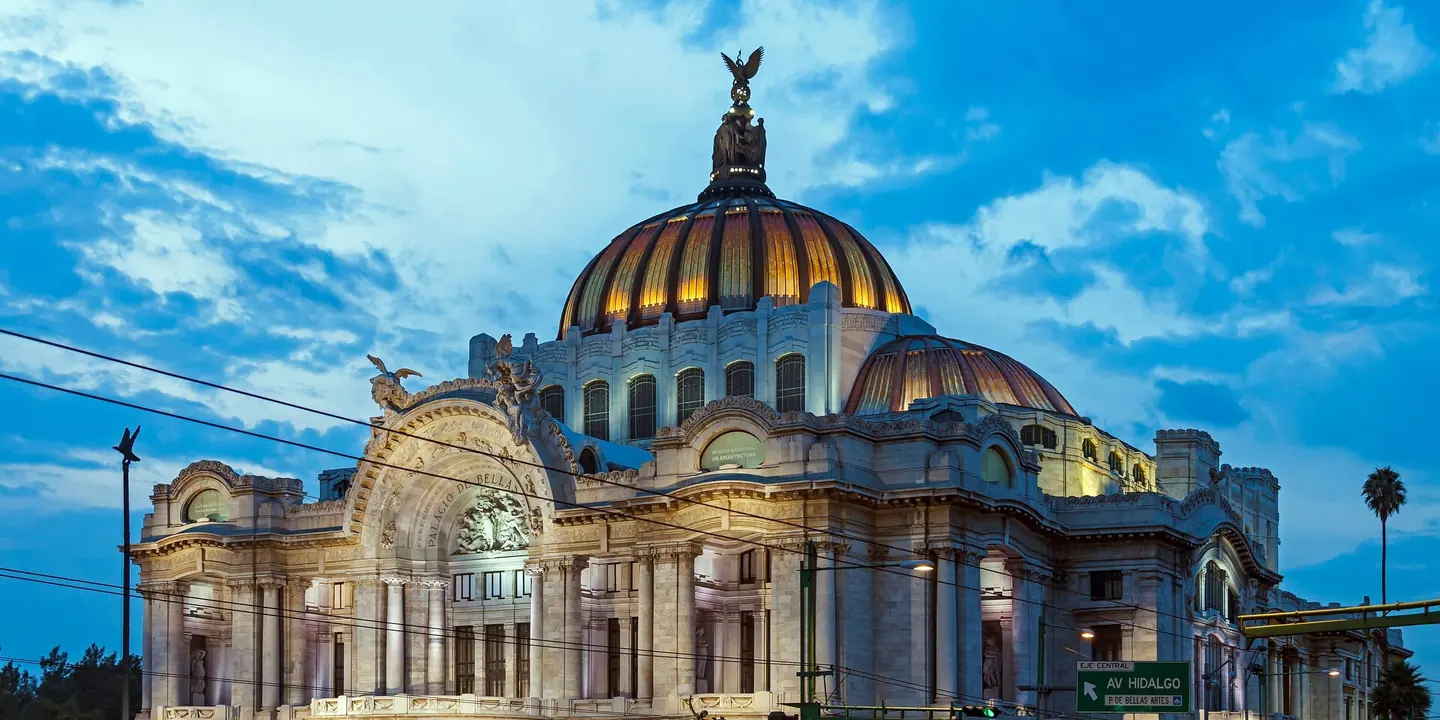
Palacio de Bellas Artes
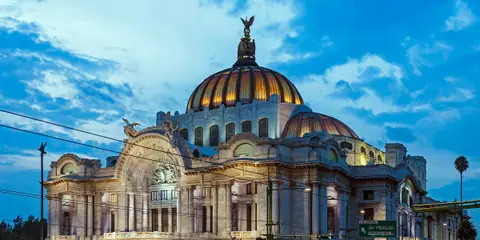
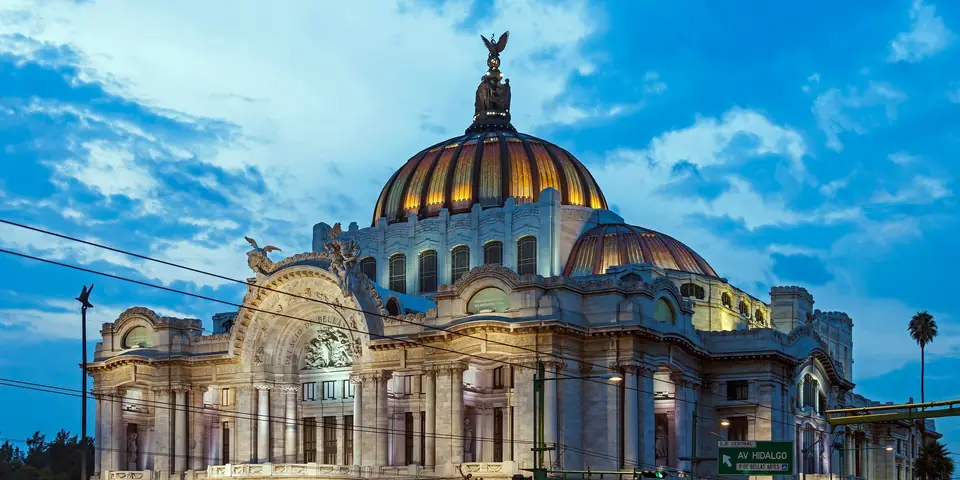
Begun under Adamo Boari and finished by Federico Mariscal in 1934, this cultural complex features Carrara marble facades beneath a domed bronze roof. The opulent interior features geometric Art Deco detailing alongside major murals executed by Diego Rivera, David Alfaro Siqueiros, and Rufino Tamayo.
Alameda Central
Established in 1592 by Viceroy Luis de Velasco, this is the oldest public municipal park in the Americas. Shaded pathways follow symmetrical European garden plans, leading visitors past centuries-old poplar and ash trees, decorative fountains topped by classical figures, and broad paved plazas.
Hemiciclo a Juarez
Inaugurated in 1910 during centenary celebrations for Mexican independence, this semicircular monument commemorates reformist president Benito Juarez. Designed by architect Guillermo Heredia, the monument features towering Doric columns, a central seated sculpture of Juarez flanked by allegorical figures, and two protective marble lions.
Museo Mural Diego Rivera
This museum was constructed specifically to protect Diego Rivera's 1947 fresco, Dream of a Sunday Afternoon in the Alameda Central, rescued from the earthquake-ruined Hotel del Prado. The composition depicts over four centuries of prominent historical figures gathered along the neighbouring garden's tree-lined avenues.
Museo Franz Mayer
Occupying the former sixteenth-century Hospital de San Juan de Dios, this institution displays an extensive collection of furniture, silver, ceramics, and textiles assembled by collector Franz Mayer. The peaceful inner courtyard retains stone archways and a central fountain surrounded by native plant species.
Church of San Juan de Dios
Positioned opposite the northern rim of Alameda Central, this church formed part of a historic monastic hospital complex. Its remarkable facade curves inward in a concave baroque design, presenting stone reliefs of various saints alongside ornamental niches framing a historic doorway.
Museo Nacional de la Estampa
Located on the Plaza de la Santa Veracruz, this museum preserves a significant national archive of engravings, woodcuts, and lithographs. The rotating exhibitions feature technical prints by colonial masters, the satirical engravings of Jose Guadalupe Posada, and twentieth-century political prints produced by the Popular Graphic Workshop.
Church of the Santa Veracruz
Originally established in 1526 by an aristocratic brotherhood, the current structure represents eighteenth-century Churrigueresque styling executed in dark volcanic stone and carved cantera. The uneven sinking of the foundation creates dramatic visual tilts, while the interior preserves burial markers of distinguished figures, including architect Manuel Tolsa.
Teatro de la Ciudad Esperanza Iris
Opened in 1918 by singer Esperanza Iris, this performance venue displays early twentieth-century neoclassical lines inspired by European opera houses. The auditorium features tiered seating boxes, neoclassical murals, and gilded mouldings, continuing to host major dance and musical performances in the historic city centre.
Antiguo Colegio de San Ildefonso
Founded in 1588, this sprawling complex comprises several arcaded colonial courtyards made of dark tezontle stone. During the 1920s, the Mexican government commissioned artists including Diego Rivera, Jose Clemente Orozco, and Jean Charlot to paint the interior walls, initiating the modern public mural movement.
Paseo de la Reforma, Chapultepec Castle & Anthropology Museum
Monument to the Revolution, Angel of Independence, Chapultepec Castle, National Museum of Anthropology, Museo Tamayo, Museo de Arte Moderno, Soumaya Museum, and Museo Jumex
Monument to the Revolution
Originally planned by French architect Émile Bénard as the central cupola of a grand legislative palace, the unfinished metal frame was repurposed after 1910 into an Art Deco mausoleum. Visitors can ascend via a panoramic glass lift to the observation deck beneath the copper double dome, which honours heroes of the Mexican Revolution.
Frontón México
Constructed in 1929 on the northern perimeter of Plaza de la República, this building stands as an archetype of streamlined Art Deco architecture with red tezontle cladding and geometric reliefs. Originally erected for jai alai matches, the restored arena continues to host fast-paced Basque pelota tournaments alongside theatrical productions.
Monument to Cuauhtémoc
Sculpted by Miguel Noreña and unveiled in 1887, this grand monument celebrates the final Aztec emperor who defended Tenochtitlan against Spanish forces. The pedestal displays intricate Mesoamerican friezes, basalt carvings, and bronze bas-reliefs depicting Cuauhtémoc's torture by conquistadors seeking hidden gold reserves.
The Angel of Independence
Inaugurated in 1910 by President Porfirio Díaz to commemorate the centenary of the independence struggle, this Corinthian column is crowned by a seven-metre gilded bronze sculpture of Nike. A marble mausoleum at the base contains the remains of key insurgent figures, guarded by carved statues representing war, peace, law, and justice.
Fuente de la Diana Cazadora
Designed by architect Vicente Mendiola and sculptor Juan Fernando Olaguíbel, this fountain was unveiled in 1942 along the grand central thoroughfare. The bronze figure of the Roman goddess Diana aiming her bow drew conservative protests in its early decades, prompting the temporary addition of welded drapery that was later removed.
Puerta de los Leones
Dating from the early twentieth century, this grand portal forms the primary ceremonial entrance to the first section of Chapultepec Park from Paseo de la Reforma. Two colossal cast-bronze lion statues flank the iron gates, guiding visitors down the shaded calzada toward the historic military monument and castle hill.
Altar a la Patria
Architect Enrique Aragón Echeagaray designed this sweeping semicircular monument of six fluted Carrara marble columns in 1952. Each pillar commemorates one of the young military cadets who perished during the 1847 Battle of Chapultepec, with a central niche holding the remains of the fallen defenders beneath an eternal flame.
Chapultepec Castle
Constructed in the late eighteenth century as a viceregal summer home, this hilltop complex served as a military academy and imperial residence for Emperor Maximilian I and Empress Carlota. Today it houses the National Museum of History, featuring neoclassical state rooms, manicured rooftop gardens, and murals by David Alfaro Siqueiros.
Museo del Caracol
Conceived by architect Pedro Ramírez Vázquez in 1960, this snail-shaped building descends gently down the slopes of Chapultepec hill. The exhibition spaces guide visitors through dioramas, three-dimensional models, and audio recreations that narrate pivotal moments from the final years of the viceroyalty through to the 1917 Constitution.
Baths of Moctezuma
These stone-lined reservoirs at the base of Chapultepec hill formed an integral part of Tenochtitlan's sophisticated fresh water supply system, developed under Aztec rule. Stone basins once stored mineral water for the recreation of Aztec rulers and channelled drinking water into the imperial capital via the historic Chapultepec aqueduct.
Audiorama Chapultepec
Inaugurated in 1972 on the southern slope of the castle hill, this tranquil outdoor enclosure is dedicated to reading and contemplative music appreciation. Benches rest amid dense ferns and volcanic rock outcroppings near the historic Cincalco cavern, with hidden speakers playing programmes of classical compositions and traditional pieces.
Museo de Arte Moderno
Opened in 1964 and designed by Pedro Ramírez Vázquez with Rafael Mijares, this organic structure features curved glass curtain walls and polished amber-toned domes. The permanent collection includes seminal twentieth-century works by Frida Kahlo, Remedios Varo, and Diego Rivera, surrounded by an outdoor sculpture garden shaded by jacaranda trees.
Museo Tamayo
Architects Teodoro González de León and Abraham Zabludovsky designed this stepped concrete pavilion, which blends into the surrounding parkland like an ancient pyramid. Established by painter Rufino Tamayo, the gallery preserves his private collection of international twentieth-century masters alongside rotating temporary installations of avant-garde visual arts.
National Museum of Anthropology
This cultural institution features twenty-three exhibition halls arranged around an expansive courtyard dominated by an enormous concrete umbrella supported by a single carved bronze pillar. The museum exhibits significant archaeological treasures, including the Aztec Sun Stone, Olmec colossal heads, and the jade-filled royal tomb of Pakal the Great.
Jardín Botánico de Chapultepec
Spanning over five hectares opposite the anthropology museum, these curated gardens showcase regional Mexican biomes with extensive collections of agaves, cacti, and wetland plants. A central glass greenhouse cultivates exotic native orchids, while signposted gravel paths introduce conservation programmes aimed at protecting indigenous pollinators and endemic succulents.
Lago Mayor Chapultepec
Created during the twentieth-century expansion of Chapultepec, this large reservoir serves as the recreational focal point of the second section. Pedalo craft traverse the water against views of surrounding cypress trees, while broad walking paths trace the perimeter towards historic water treatment works and mid-century architectural pavilions.
Cárcamo de Dolores
Constructed in 1951 by Ricardo Rivas to celebrate the Lerma hydraulic system, this functional monument combines engineering with fine art. Outside, a massive tiled fountain portrays the rain deity Tlaloc, while inside, Diego Rivera's submerged mural 'Water, the Origin of Life' covers the floor and walls of the intake tank.
Auditorio Nacional
Originally built in 1952 and extensively remodelled in 1991 by Teodoro González de León and Abraham Zabludovsky, this colossal auditorium seats ten thousand spectators. Its monolithic chiselled-concrete facade overlooks Paseo de la Reforma, fronted by monumental bronze sculptures by modern Mexican artists, including Manuel Felguérez and Juan Soriano.
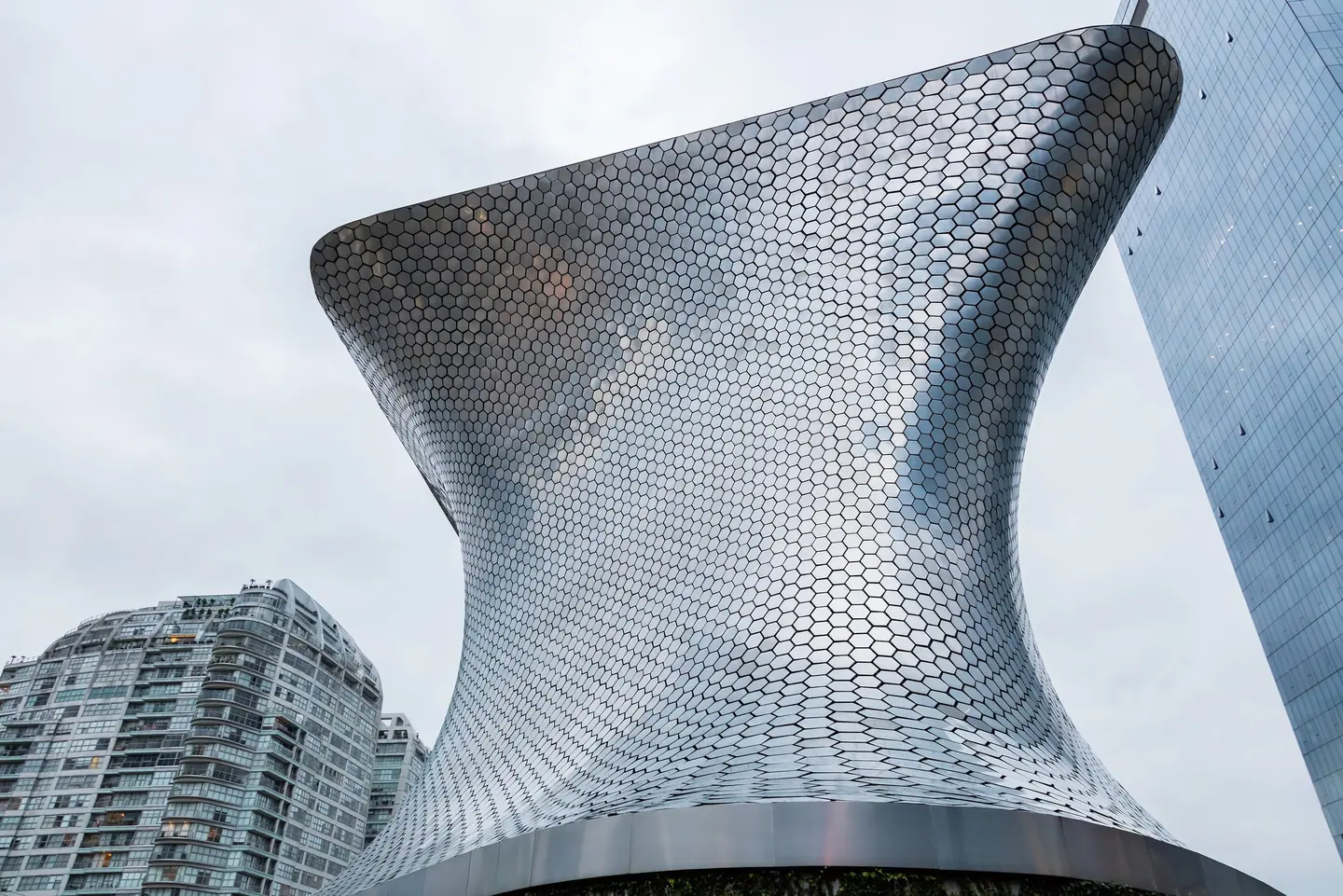
Museo Soumaya
Designed by architect Fernando Romero and opened in 2011, this sculptural building features an asymmetrical hourglass shape wrapped in sixteen thousand hexagonal aluminium plates. The interior spiral ramp ascends six levels of galleries displaying Old Master European paintings, pre-Hispanic coins, and the largest Rodin bronze collection outside France.
Museo Jumex
Completed in 2013 by British architect David Chipperfield, this travertine-clad gallery sits directly across the plaza from Museo Soumaya. The distinctive sawtooth roof channels natural northern daylight into upper gallery spaces, which house temporary exhibitions alongside rotating selections from the extensive contemporary art holdings of Fundación Jumex.
Roma Norte, Condesa & San Ángel Courtyards
Plaza Río de Janeiro, Casa Lamm, Fuente de Cibeles, Parque México, Parque España, Biblioteca Vasconcelos, Diego Rivera and Frida Kahlo Studio Museum, and San Ángel Inn Ex-Convento del Carmen
Plaza Río de Janeiro
Laid out during the Porfirian development of Colonia Roma, this shaded public garden is known for its central bronze replica of Michelangelo's David. Surrounding mansions reflect French eclectic styles of the early twentieth century. We find the eccentric Casa de las Brujas overlooking the eastern side with its distinctive pointed roof.
Casa Lamm
Erected in 1911, this stately home exemplifies the aristocratic residences that once defined Colonia Roma. Rescued from decay in the 1990s, the mansion now accommodates gallery spaces, gardens, and a cultural institute. Visitors can admire the preserved neoclassical facade, ornamental plasterwork, and courtyard exhibitions showcasing modern art.
Fuente de Cibeles
Inaugurated in 1980, this bronze monument is an exact replica of the neoclassical Madrid landmark. It depicts the Phrygian goddess Cybele riding a chariot drawn by lions. The surrounding traffic circus connects Roma Norte with the neighbouring financial corridor, serving as a popular gathering point during civic events.
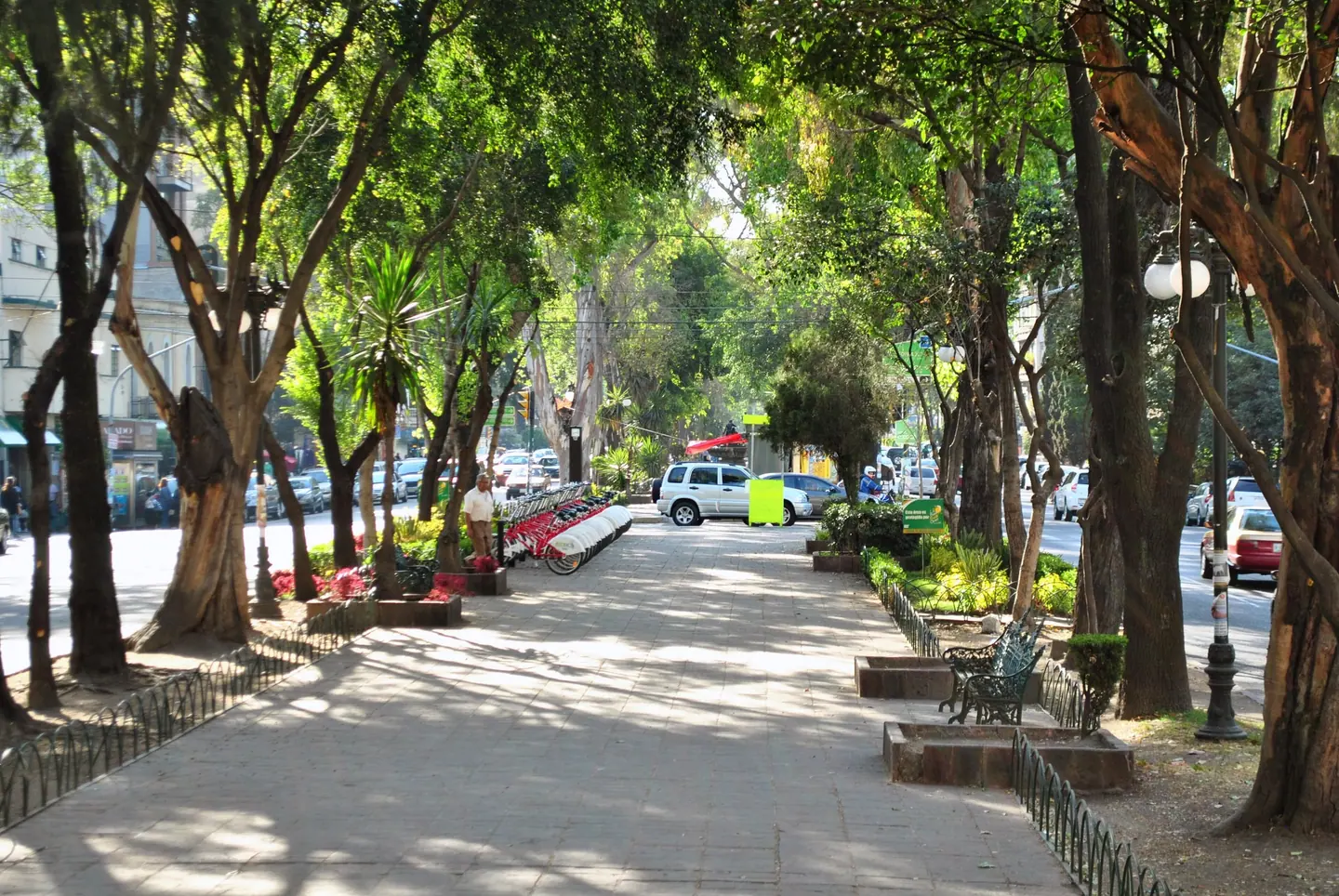
Parque México
Established in 1927 within Colonia Condesa, this park follows the oval contours of the former Jockey Club horse track. Designed by architect Leonardo Noriega, it features Art Deco pergolas, ponds, and walkways shaded by dense canopy. The open-air Charles Lindbergh Forum features monumental concrete pillars decorated with relief sculptures.
Parque España
Dedicated in 1921 to celebrate the centenary of Mexican independence, this tranquil park bridges the Condesa and Roma neighbourhoods. Winding gravel paths traverse lush gardens filled with jacaranda trees and willow groves. A prominent monument inside commemorates Lázaro Cárdenas and his administration's support for Spanish republican refugees.
Parroquia de la Sagrada Familia
Construction began on this imposing Jesuit church in 1906, directed by architect Manuel Gorozpe. The building combines neo-Romanesque and neo-Gothic elements with striking stained-glass windows produced in Mexico City. Inside, the nave holds the tomb of the Catholic priest Father Miguel Pro, executed during the Cristero War.
Parroquia de Santa Rosa de Lima
Built during the late 1920s, this parish church reflects the distinct residential architecture that characterizes Colonia Condesa. Its clean geometric exterior combines concrete construction with delicate vertical relief lines. Inside, the quiet sanctuary features stained glass and marble appointments typical of the early modern ecclesiastical style in the capital.
Edificio Basurto
Architect Francisco J. Serrano designed this monumental residential building using an ingenious cross-shaped floor plan that maximizes natural light. Rising above neighbouring streets, it survived major earthquakes intact due to its innovative reinforced concrete frame. The lobby and interior staircases showcase curving geometries celebrated by architectural historians.
Plaza Popocatépetl
This circular square sits at the intersection of quiet residential avenues in Hipódromo Condesa. Constructed around 1926, its central feature is an elaborate Art Deco tile fountain and shaded domed kiosk. Tall ash trees encircle stone benches, providing a serene rest stop within the urban grid.
Biblioteca Vasconcelos
Designed by architect Alberto Kalach and opened in 2006, this steel and glass complex stands within a sprawling botanical garden. The interior nave features cantilevered book stacks that appear to float mid-air beneath transparent walkways. Gabriel Orozco's painted whale skeleton sculpture is suspended centrally along the main hall.
Museo Casa Estudio Diego Rivera y Frida Kahlo
Completed in 1932, this complex represents one of Latin America's earliest examples of functionalist architecture. Juan O'Gorman built twin houses connected by a rooftop bridge, surrounded by an organic fence of organ pipe cactus. Inside, visitors can view Rivera's personal folk art collection, pigments, and original easel paintings.
Museo de El Carmen
Founded in 1615 by Carmelite friars, this monastery features vaulted cloister walkways, tiled domes, and extensive orchard grounds. The museum displays colonial viceregal paintings, gilded wooden altarpieces, and historical monastic furnishings. In the crypt beneath the chapel, visitors can view preserved mummified remains dating from the seventeenth and eighteenth centuries.
San Ángel Inn
Originally functioning as the Carmelite monastery's neighbouring ranch and later as a pulque hacienda, this property dates back to the seventeenth century. The central courtyard features stone fountains, lush flowering bougainvillea, and traditional colonial colonnades. During the Mexican Revolution, Emiliano Zapata and Pancho Villa met here to plan military campaigns.
Plaza San Jacinto
This cobbled plaza forms the historical core of San Ángel, surrounded by colonial mansions and flowering jacarandas. A bronze plaque commemorates the Saint Patrick's Battalion, Irish soldiers who fought alongside Mexican troops in 1847. On Saturdays, local painters and sculptors gather here to display their work beneath the trees.
Templo de San Jacinto
Constructed between 1564 and 1614, this former Dominican monastery remains one of the oldest religious structures in southern Mexico City. Its stark stone facade leads into an interior adorned with gilded churrigueresque retablos and carved wooden pulpits. Outside, the churchyard contains carved pre-Hispanic stones integrated into the monastery's perimeter walls.
Casa del Risco
Facing Plaza San Jacinto, this colonial mansion houses the Centro Cultural Isidro Fabela. The inner courtyard contains a remarkable ultra-baroque fountain built from broken porcelain plates, Chinese porcelain bowls, abalone shells, and Talavera tile fragments. Interior galleries exhibit European and Mexican colonial painting collections donated by the Fabela family.
Casa Jaime Sabines
Named after the acclaimed Chiapas poet Jaime Sabines, this municipal cultural house occupies an expansive seventeenth-century estate. The complex features traditional tiled courtyards, wooden balconies, and arched corridors surrounding central stone fountains. It provides community workshops, a public library, and temporary art galleries celebrating Mexican literary and visual arts.
Museo Soumaya de Plaza Loreto
Situated within an eighteenth-century industrial paper mill compound, this south campus preceded the better-known Polanco branch. Its courtyards combine old brick smokestacks with modern exhibition galleries. Inside, visitors can view permanent exhibitions of historical coins, colonial portraits, and European sculpture collections set against industrial stone walls.
Puente del Carmen
Constructed by Carmelite builders during the seventeenth century, this arched stone bridge linked the El Carmen monastery to agricultural lands across the river. Though the original river course is now channelled underground, the stone parapets and arches remain preserved. It stands as an enduring relic of colonial engineering in San Ángel.
Callejón del Aguacate
Located near the southern residential perimeter, this narrow cobblestone alley is flanked by thick colonial adobe walls and overhanging trees. At the centre of the alley sits an antique street shrine containing a stone cross and image of the Virgin. It is celebrated in local history and folklore for centuries of ghost legends.
Coyoacán, UNAM, Xochimilco & Teotihuacan Pyramids
Frida Kahlo Museum Casa Azul, Jardín Centenario Coyoacán, Leon Trotsky House Museum, UNAM Central Library Mosaic, Anahuacalli Museum, Xochimilco Canals, Basilica of Guadalupe, and Teotihuacan Pyramids of the Sun and Moon
Frida Kahlo Museum (Casa Azul)
Known as the Blue House, this historic residence in Coyoacán is where Frida Kahlo was born, lived and died. We explore rooms preserved with her personal belongings, folk art collections and studio equipment. The central courtyard displays pre-Hispanic sculptures collected by Kahlo and her husband Diego Rivera alongside native cacti.
Jardín Centenario
Named to commemorate the centenary of Mexican independence, this public garden forms the historic heart of Coyoacán. At its centre stands a bronze fountain depicting two coyotes, reflecting the Nahuatl meaning of the district name. Visitors can walk shaded stone paths bordered by colonial arcades, traditional cafés and centuries-old trees.
Church of San Juan Bautista
Erected by Franciscan friars between 1522 and 1552, this church ranks among the oldest Christian temples in the Valley of Mexico. The interior features ornate Baroque altarpieces, gilded wooden details and an impressive vaulted ceiling painted with biblical scenes. Outside, the open chapel and quiet cloisters offer insights into early colonial evangelisation architecture.
Leon Trotsky House Museum
This preserved domestic fortress stands as a solemn monument to the final months of Leon Trotsky, who lived here in political asylum until his assassination in 1940. Guard towers, thick brick walls and bullet-scarred plaster testify to the perilous conditions of his exile. The grounds house his study, personal library and simple tomb in the garden.
National Museum of Popular Cultures
Founded in 1982 by anthropologist Guillermo Bonfil Batalla, this museum celebrates the diverse ethnic expressions of Mexico. The galleries host rotating exhibitions featuring indigenous textiles, ceramics, wooden masks and seasonal ceremonial installations such as Day of the Dead altars. Open courtyards frequently host regional artisan fairs and traditional music performances.
Viveros de Coyoacán
Established in the early twentieth century by engineer Miguel Ángel de Quevedo, this public park functions as both a peaceful recreational woodland and an active municipal nursery. Paths bisect neatly arranged rows of eucalyptus, pine and sweetgum trees that supply reforestation projects across the capital. Runners and nature enthusiasts frequent its tree-lined avenues.
Anahuacalli Museum
Designed by Diego Rivera and architect Juan O'Gorman, this imposing structure resembles an ancient Mesoamerican pyramid built from dark volcanic basalt. It houses thousands of indigenous antiquities gathered by Rivera, categorised according to ancient civilisations. The upper terrace provides expansive views across the surrounding lava fields of the Pedregal district.
UNAM Central Library
Standing as the visual centrepiece of the National Autonomous University of Mexico, this ten-storey tower features Juan O'Gorman's monumental stone mosaic, 'Historical Representation of Culture'. Created using naturally coloured stones sourced across Mexico, each facade depicts a distinct era of the nation's history. The building remains a landmark of modernist Latin American architecture.
Estadio Olímpico Universitario
Built into a crater formed by volcanic rock, this stadium opened in 1952 and served as the primary arena for the 1968 Summer Olympic Games. The exterior slope is decorated with a high-relief stone mural by Diego Rivera titled 'The University, the Mexican Family, Peace and Youth Sports'. It serves as the home ground for university athletic teams.
University Museum of Contemporary Art (MUAC)
Constructed by architect Teodoro González de León, this museum occupies the University Cultural Centre at UNAM. The sleek geometric building features an inclined glass facade, luminous open galleries and specialized archives dedicated to contemporary visual culture from 1952 onwards. Its rotating exhibitions present experimental installations, sculpture and conceptual works by international and Mexican artists.
Espacio Escultórico
Inaugurated in 1979 by an artistic collective that included Helen Escobedo and Mathias Goeritz, this land-art monument consists of sixty-four concrete wedges arranged in an immense circle. The ring encloses an undisturbed expanse of jagged volcanic rock produced by the ancient eruption of Mount Xitle. It offers a meditative encounter between modern geometry and raw geological nature.
Cuicuilco Archaeological Zone
Dating back to 800 BC, Cuicuilco is one of the earliest urban centres in the Valley of Mexico, flourishing centuries before Teotihuacan. Its primary monument is an unusual circular pyramid constructed from river stones and volcanic clay, partially encased by lava from the Mount Xitle eruption around 400 AD. An on-site museum displays artefacts recovered during excavations.
Xochimilco Canals
Recognised as a UNESCO World Heritage site, the waterways of Xochimilco represent the last remaining vestiges of the pre-Hispanic lacustrine transport system. Passengers board painted wooden flat-bottomed boats called trajineras to cruise past traditional agricultural plots known as chinampas, or floating gardens. The canals remain a living testament to indigenous farming engineering and communal leisure.
Dolores Olmedo Museum
Occupying the former Hacienda La Noria in Xochimilco, this stone estate once housed the private collection of philanthropist Dolores Olmedo. The grounds are famous for roaming native xoloitzcuintle hairless dogs and peacocks strolling through lush courtyards. Inside, galleries historically preserved comprehensive holdings of Diego Rivera's oil paintings, Frida Kahlo's early portraits and pre-Columbian ceramics.
Basilica of Our Lady of Guadalupe
This expansive complex at the base of Tepeyac Hill ranks among the most visited Catholic pilgrimage sites globally. The modern basilica, designed by Pedro Ramírez Vázquez, features a suspended circular roof that allows thousands of pilgrims to view the sacred sixteenth-century cloak of Juan Diego. Adjacent stands the sinking Old Basilica, an eighteenth-century Baroque monument.
Capilla del Cerrito
Perched on the summit of Tepeyac Hill above the main modern shrine, this historic chapel marks the traditional location where the Virgin Mary was believed to have appeared in 1531. Visitors climb landscaped stone staircases past sculptures and formal terraced gardens to reach the summit. The terrace rewards travellers with panoramas looking across the northern sector of Mexico City.
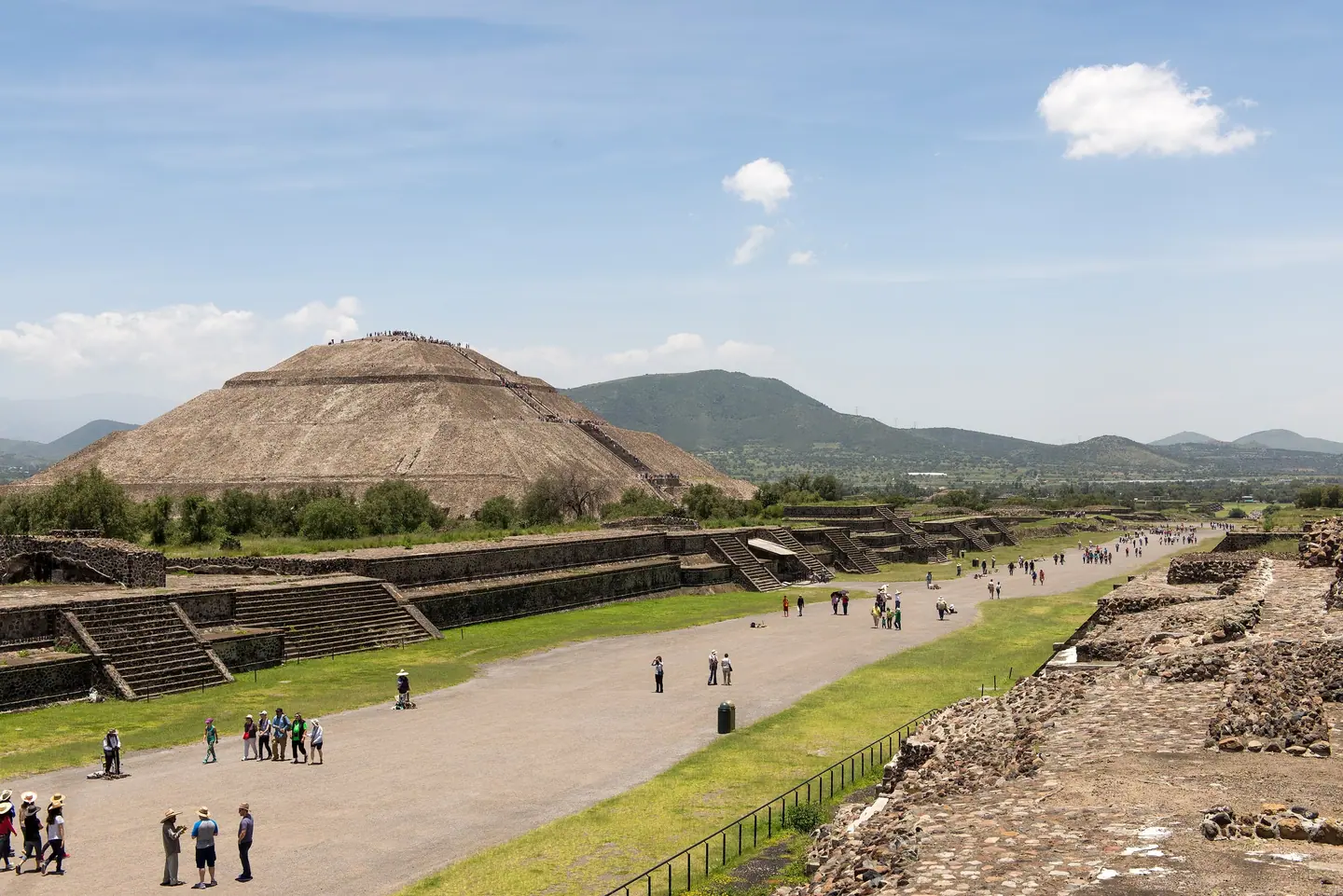
Pyramid of the Sun
Constructed around 200 AD, this monumental stepped structure is the largest building at Teotihuacan and one of the grandest in ancient Mesoamerica. Rising over sixty metres in height along the eastern edge of the Avenue of the Dead, it reflects advanced astronomical alignments. Excavations beneath its stone core revealed an ancient multi-chambered sacred cave system.
Pyramid of the Moon
Anchoring the northern terminus of the Avenue of the Dead, this imposing pyramid mirrors the contours of nearby Cerro Gordo peak. The structure grew over several building phases between 100 and 450 AD, serving as a platform for sacrificial rites and astronomical ceremonies. From its frontal plaza, observers gain direct perspective down the entire central spine of the ancient city.
Avenue of the Dead
This broad axial boulevard spans more than two kilometres, connecting the northern Moon Plaza with the Citadel complex to the south. Flanked by residential palaces, ceremonial altars and talud-tablero stone platforms, the thoroughfare established the urban grid of Teotihuacan. Walking its length reveals the deliberate scale and sophisticated urban planning developed by the early metropolis.
Temple of the Feathered Serpent
Situated within the vast sunken courtyard of the Citadel, this third-largest monument at Teotihuacan features intricate sculptural stone facades. Alternating relief carvings depict the feathered serpent deity Quetzalcoatl alongside a reptilian figure interpreted as Tlaloc or Cipactli, emerging from sea shells. Archaeological investigations have documented mass sacrificial burials dedicated during the monument's initial construction.
Moving Between Centro Histórico, Chapultepec and the South
For neighbourhood accommodation notes, seasonal weather tables and airport transfer details, consult our Mexico City Zócalo, Chapultepec & Coyoacán destination guide, or browse other city and regional walking routes across the atlas.