A 100-stop walking route down Porto’s granite hills to the Douro River, linking blue-and-white azulejo churches, medieval Ribeira alleys, Eiffel-school bridges, and Port wine lodges.
Portucale on the Douro, Age of Discovery Shipyards and the Wine Trade
Growing out of the Roman twin settlements of Portus and Cale overlooking the Douro estuary, the city gave its name to the medieval County of Portucale and ultimately to the entire nation of Portugal. In 1394 Prince Henry the Navigator was born in Porto's Casa do Infante, where citizens famously donated all their best meats to outfit the 1415 fleet to Ceuta, keeping only tripe for themselves and earning the enduring nickname Tripeiros.
Following the 1703 Methuen Treaty with Britain, fortified wine shipped down the Douro on flat-bottomed rabelo boats turned Porto and Vila Nova de Gaia into a prosperous mercantile hub, adorning its granite churches and train stations with baroque gilding (talha dourada) and monumental blue-and-white azulejo tile murals.
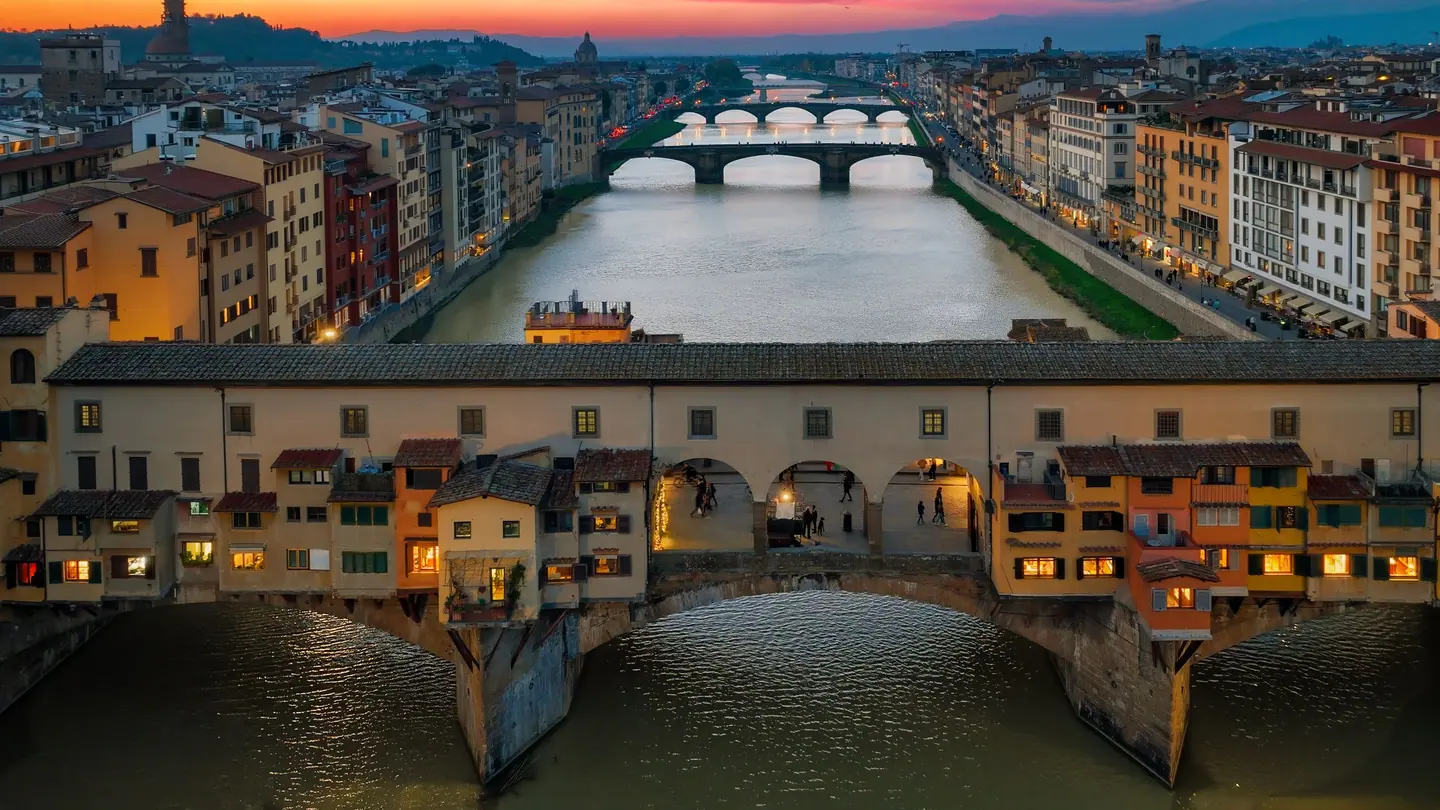
Ribeira Waterfront, Sé Cathedral & Dom Luís I Bridge
Cais da Ribeira, Dom Luís I Bridge, Porto Cathedral Sé do Porto, Paço Episcopal, Pelourinho, Muralha Fernandina, Church of São Lourenço Grilos, and Morro da Sé
Cais da Ribeira
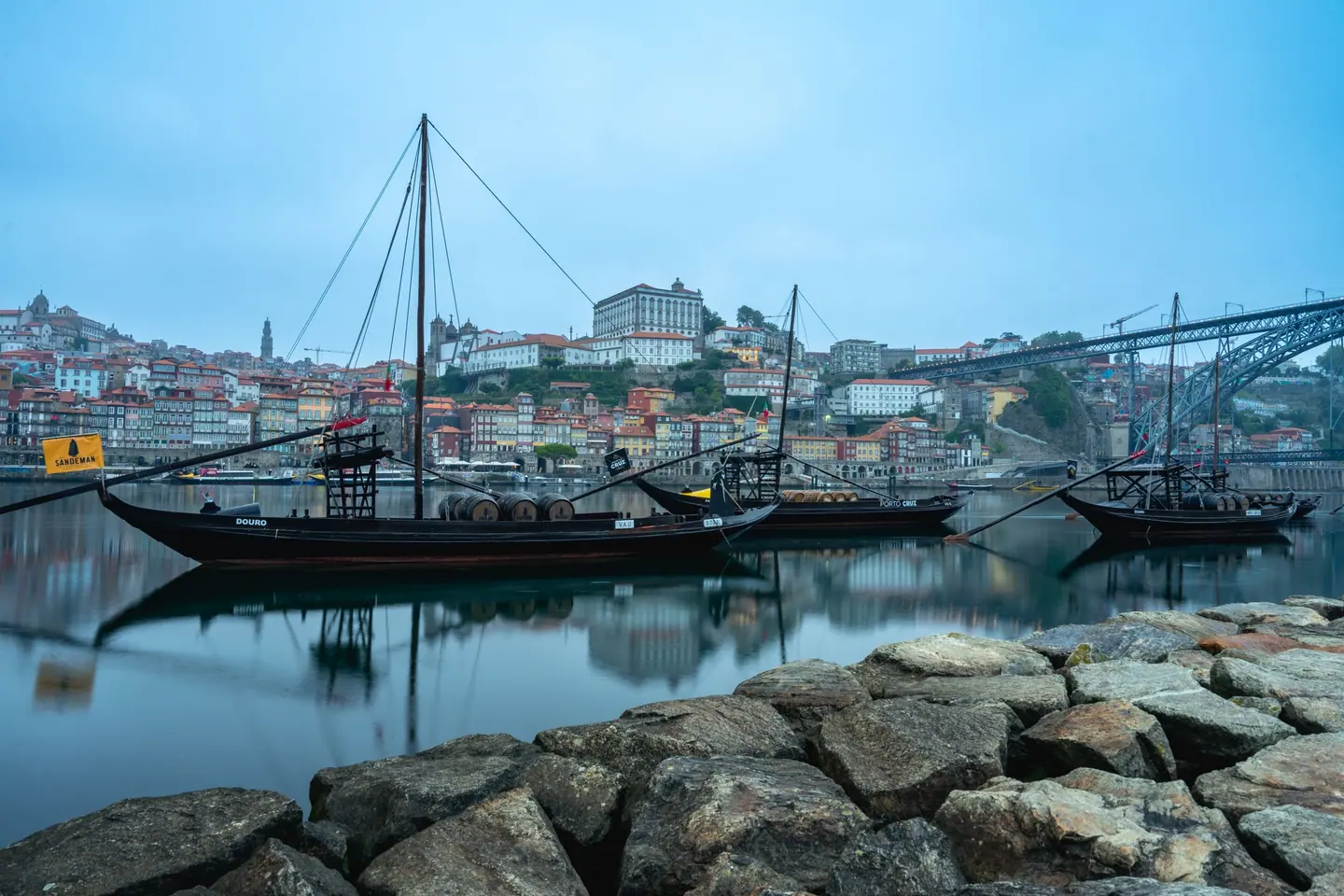
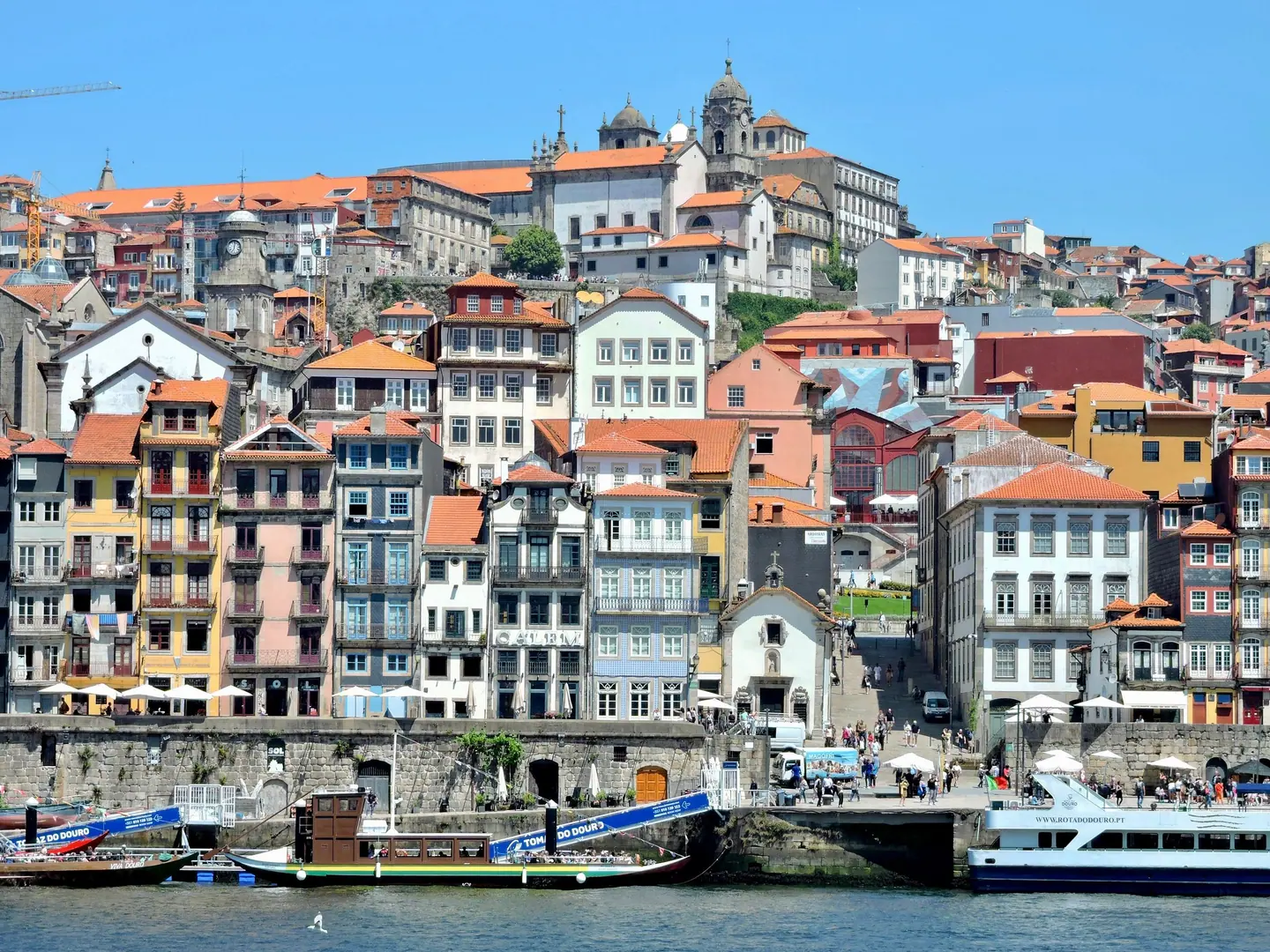
This paved riverfront promenade served as the traditional centre of maritime commerce and unloading for centuries. Travellers observe tall granite houses with colourful tiled facades, medieval arcades, and traditional rabelo boats moored alongside the stone riverbank.
Praça da Ribeira
Dating back to the Middle Ages, this square was once the commercial hub of maritime trade. The northern wall displays an elaborate eighteenth-century granite fountain adorned with the Portuguese royal coat of arms and a contemporary bronze sculpture of Saint John the Baptist.
Postigo do Carvão
This granite passageway remains the only preserved gateway among the original eighteen access portals of the fourteenth-century defensive wall. It historically permitted the transfer of coal and river freight directly from arriving boats into the fortified quarters of the medieval town.
Dom Luís I Bridge
Spanning the Douro to link Porto with Vila Nova de Gaia, this iron bridge opened in 1886. Seyrig, a disciple and former business partner of Gustave Eiffel, designed the massive riveted arch, which carries local traffic below and urban metro trains above.
Alminhas da Ponte
Created by sculptor Teixeira Lopes in 1897, this granite and bronze street shrine recalls the 1809 collapse of the Ponte das Barcas. Hundreds of fleeing residents drowned in the Douro during the Napoleonic invasion, and local people still light votive candles here.
Casa do Infante
Established in 1325 by King Afonso IV, this fortified granite mansion operated as the royal customs post and mint. Prince Henry was born here in 1394, and the site now houses municipal historical archives alongside excavated Roman mosaics preserved beneath the flagstones.
Church of São Nicolau
Rebuilt after a severe fire in 1758, this church features a single nave, a blue azulejo exterior facade, and gilded woodcarvings designed by Manuel dos Santos Cruz. It served the spiritual needs of river seamen and merchants living across the surrounding riverside alleys.
Muralha Fernandina
Completed in 1376, these towering stone walls replaced the smaller high-medieval Romanesque enclosure. Travellers walking along the crenellated parapets observe square defensive towers, commanding perspectives of the river gorge, and the steep granite slopes running down to the Guindais ravine.
Funicular dos Guindais
Originally built in 1891 and modernised in 2001, this railway ascends a steep rock face flanking the Fernandina fortifications. The glass-fronted cabins scale a sixty-metre height difference in minutes, revealing details of the medieval stone curtain and the lower iron bridge deck.
Escadas dos Guindais
This steep flight of granite steps runs parallel to the eastern medieval ramparts, cutting through residential terraces. It offers direct pedestrian access between the riverfront and the cathedral district, framed by hanging clotheslines, small family taverns, and vertical stone walls.
Church of Santa Clara
Founded in 1416, this Gothic convent church conceals an interior entirely lined with golden talha dourada crafted during the seventeenth and eighteenth centuries. Fine examples of Portuguese National Baroque woodwork cover the walls, ceiling vaults, and the ornate choir stalls used by Franciscan nuns.
Porto Cathedral
Constructed as a fortified cathedral under Bishop Hugo, this monumental building displays twin Romanesque bell towers, crenellations, and a baroque portal added by Nicolau Nasoni. The Gothic cloister inside features blue-and-white azulejo tile panels illustrating scenes from the biblical Song of Solomon.
Paço Episcopal do Porto
Redesigned in the late eighteenth century by architect Nicolau Nasoni, this palace stands opposite the cathedral. The facade incorporates classical pediments and carved granite window frames, while the interior is noted for its grand monumental staircase and painted hall ceilings.
Pelourinho do Porto
Standing in the centre of the Terreiro da Sé, this granite pillory was sculpted in the 1940s to evoke medieval judicial authority. Raised on an octagonal base, the carved column features decorative rope-work patterns and offers sweeping outlooks over the city rooftops.
Statue of Vímara Peres
Erected in 1968 outside the cathedral entrance, this sculpture depicts the Galician noble knight Vímara Peres on horseback. Peres expelled Moorish forces from Portus Cale in 868 and became the first ruler of the County of Portugal, helping establish modern regional boundaries.
Torre da Rua de Baixo
This fortified stone tower was discovered inside demolished domestic structures during municipal clearance works in the 1940s. It exemplifies private patrician dwellings from the thirteenth century and now houses the local municipal tourism office, demonstrating early residential defence architecture.
Church of São Lourenço
Begun in 1577 by the Society of Jesus, this imposing stone church showcases early Mannerist and Counter-Reformation architecture. After the Jesuit expulsion in 1759, the building passed to the Augustinian Hermits, gaining its moniker Grilos from their distinct dark habit.
Miradouro da Rua das Aldas
Located along one of Porto's oldest thoroughfares, this granite parapet gives travellers clear views across the cascading riverside district. It allows visitors to examine medieval street alignments, the bell towers of the lower city, and boat traffic along the Douro.
Escadas das Verdades
This ancient granite stairway descends sharply from the episcopal terraces towards the riverside quays. Lined with weathered stone facades, decorative wrought-iron railings, and small domestic courtyards, the route follows historic pedestrian tracks used by church officials and dock labourers for centuries.
Morro da Sé
This granite knoll has witnessed human settlement continuously from the Bronze Age through Roman and Suebi periods. Walking through its maze of narrow cobbled lanes, travellers encounter communal washhouses, preserved medieval property plots, and layered stone foundations underpinning the episcopal quarter.
Palácio da Bolsa, São Francisco & São Bento Station
Palácio da Bolsa, Arab Room, Church of São Francisco Porto, Casa do Infante, Mercado Ferreira Borges, São Bento Railway Station, Igreja dos Congregados, and Avenida dos Aliados
Palácio da Bolsa
Commissioned by the Porto Commercial Association on the site of a ruined Franciscan cloister, this grand neoclassical building reflects the mercantile wealth of northern Portugal. Construction began in 1842 under architect Joaquim da Costa Lima Júnior. Visitors admire the sweeping granite staircase, monumental courtyards, and ornate official meeting rooms.
Arab Room of Palácio da Bolsa
Designed by architect Gustavo Adolfo Gonçalves e Sousa, this lavish Moorish Revival chamber took nearly two decades to finish before opening in 1880. Intricate stucco tracery, gold leaf ornamentation, and stained glass windows draw inspiration from the Alhambra palace in Granada. The hall remains an active venue for official state receptions.
Patio das Nações
Serving as the central entrance hall of the Palácio da Bolsa, this courtyard occupies the footprint of the former monastery cloisters. A grand glass and iron octagonal cupola illuminates the surrounding walls, which display painted armorial shields representing nations that maintained active trading treaties with Portugal during the nineteenth century.
Church of São Francisco
Constructed in the fourteenth century under Franciscan patronage, this church retains its austere Gothic exterior and rose window. The interior underwent a dramatic transformation during the seventeenth and eighteenth centuries, when master craftsmen layered baroque gilded wood carvings across vaults, pillars, and altars, including the famous polychrome Tree of Jesse.
Catacombs of São Francisco
Located beneath the church floor, these historic catacombs served as a cemetery for members of the Franciscan Order and noble benefactors between the eighteenth and nineteenth centuries. Rows of crypts line the corridors alongside a secure ossuary room, visible through glass panels, containing thousands of human bones accumulated over generations.
Praça do Infante Dom Henrique
This leafy urban square connects the Palácio da Bolsa to the lower riverfront district. At its centre stands a bronze statue of Prince Henry the Navigator, erected in 1894 to mark the fifth centenary of his birth in Porto. Neoclassical buildings and landscaped parterres frame the wide open space.
Mercado Ferreira Borges
Constructed in 1885 to replace the congested open-air market of Ribeira, this ironwork structure stands as a prime example of nineteenth-century industrial architecture. Named after jurist José Ferreira Borges, the red-painted pavilion features vast vaulted spaces that now operate as a municipal cultural centre, hosting live music and exhibitions.
Casa do Infante
Originally built in 1325 as the royal customs house, this fortress-like stone complex is traditionally identified as the birthplace of Prince Henry the Navigator. Excavations have revealed Roman mosaics beneath its medieval foundation. Today the building accommodates the municipal historical archives and an informative museum detailing Porto's maritime commerce.
Church of São Nicolau
Rebuilt in 1758 following a destructive fire, this riverside church blends neoclassical and baroque elements. Its single-tower facade is clad in traditional blue-and-white azulejo tiles added in the nineteenth century. Inside, fine wood carvings created by master sculptor Frei Manuel dos Reis adorn the main altar and side chapels.
Largo do Terreiro
This modest historic square served for centuries as a gathering place for fishermen and dock workers beside the Douro. Framed by tall, colourful granite houses, the square features traditional stone water fountains and steep stairways leading uphill toward the upper cathedral quarter, offering views of the riverfront activity.
Church of Nossa Senhora da Vitória
Reconstructed following an 1804 fire, this parish church stands on the historical grounds of the medieval Olival Jewish quarter. The interior contains ornate gilded altarpieces and paintings depicting scenes of the Virgin Mary. The adjacent viewpoint affords expansive vistas across the red-tiled rooftops of the historic city centre.
Miradouro da Vitória
Perched on a high granite terrace, this open viewpoint offers sightlines across the Douro river, Dom Luís I Bridge, and the historic port wine lodges of Vila Nova de Gaia. The location provides photographers with an ideal vantage point for studying Porto's tightly packed medieval urban layout.
Igreja de Santa Clara
Completed in 1457 for Franciscan nuns, this church presents a modest Gothic exterior entered through a Renaissance portal. In contrast, the interior displays one of Portugal's finest examples of talha dourada (gilded woodwork), installed during the eighteenth century to cover every wall, ceiling, and archway in shimmering gold leaf.
Muralha Fernandina
Ordered by King Afonso IV and completed during the reign of King Ferdinand I in 1376, these medieval fortifications replaced the older Roman defences. A well-preserved crenellated section runs steeply down the cliffside from Santa Clara toward the river, featuring stone towers that offer commanding vistas of the Douro gorge.
São Bento Railway Station
Inaugurated in 1916 on the site of a Benedictine convent, this Beaux-Arts terminal was designed by architect José Marques da Silva. The central vestibule contains approximately twenty thousand ceramic tiles created by Jorge Colaço, depicting defining historical events such as the Battle of Valdevez alongside traditional Portuguese rural life.
Igreja dos Congregados
Erected in 1703 by the Congregation of the Oratory of Saint Philip Neri, this baroque church sits prominently opposite São Bento Station. Its stone facade is adorned with twentieth-century blue-and-white azulejo tiles illustrating scenes from the life of Saint Anthony, framed by classical pediments and an elegant bell tower.
Praça de Almeida Garrett
This historic public space fronts the western facade of São Bento Station, honouring the nineteenth-century romantic writer Almeida Garrett. The square acts as a major transport junction where commuters meet historic tramways and urban bus networks, surrounded by granite townhouse facades and hillside commercial avenues.
Avenida dos Aliados
Laid out in 1916 following urban reforms, this wide monumental boulevard honours the Allied nations of World War I. Granite buildings displaying Beaux-Arts, Art Deco, and neoclassical styles frame both sides of the central pedestrian promenade, which hosts national civic celebrations and festive civic gatherings throughout the year.
Praça da Liberdade
Acting as the southern anchor of Avenida dos Aliados, this historic square was developed in the early eighteenth century as a civic focal point. In 1866, an equestrian bronze statue of King Peter IV holding the Constitutional Charter was installed at the centre, celebrating the triumph of constitutionalism in Portugal.
Porto City Hall
Standing at the northern summit of Avenida dos Aliados, this monumental granite palace was designed by architect Correia da Silva in 1920. Its symmetrical facade rises to a seventy-metre central bell tower featuring a carillon of forty-nine bells, while the interior houses ornate council chambers and municipal administrative offices.
Clérigos Tower, Livraria Lello & Carmo Azulejos
Clérigos Church and Tower, Livraria Lello, Igreja do Carmo, Igreja dos Carmelitas, Cordoaria Garden, Portuguese Centre of Photography, Soares dos Reis National Museum, and Crystal Palace Gardens
Clérigos Church
Commissioned by the Brotherhood of the Clergy, this baroque church was completed in 1748. Architect Nicolau Nasoni introduced Italianate motifs, including an elliptical nave and an elaborate marble altarpiece sculpted by Manuel dos Santos Porto. We observe intricate granite carvings across the facade, which set a new standard for religious architecture across northern Portugal.
Clérigos Tower
Erected between 1754 and 1763, this granite campanile served as a navigational landmark for ships entering the Douro River estuary. Visitors climb 225 spiral steps past six internal storeys to reach the double belfry. The upper viewing platform offers sweeping panoramas across the historic quarter, the river, and the Atlantic coast.
Livraria Lello
Opened in 1906 by brothers José and António Lello, this bookshop displays a flamboyant neo-Gothic facade designed by Xavier Esteves. Inside, an ornate crimson staircase curves through the main hall beneath an intricate stained-glass skylight bearing the firm's motto, Decus in Labore. Painted plaster panels mimicking carved timber frame thousands of Portuguese and international volumes.
Praça de Lisboa
Following a comprehensive redevelopment in 2013, this split-level civic space combines a subterranean commercial arcade with an elevated green roof planted with olive trees. The square stands directly opposite Livraria Lello and Clérigos Church, providing pedestrian connections between key university quarters. Visitors gather on the sloped lawns to observe the surrounding eighteenth-century stone facades.
Igreja dos Carmelitas Descalços
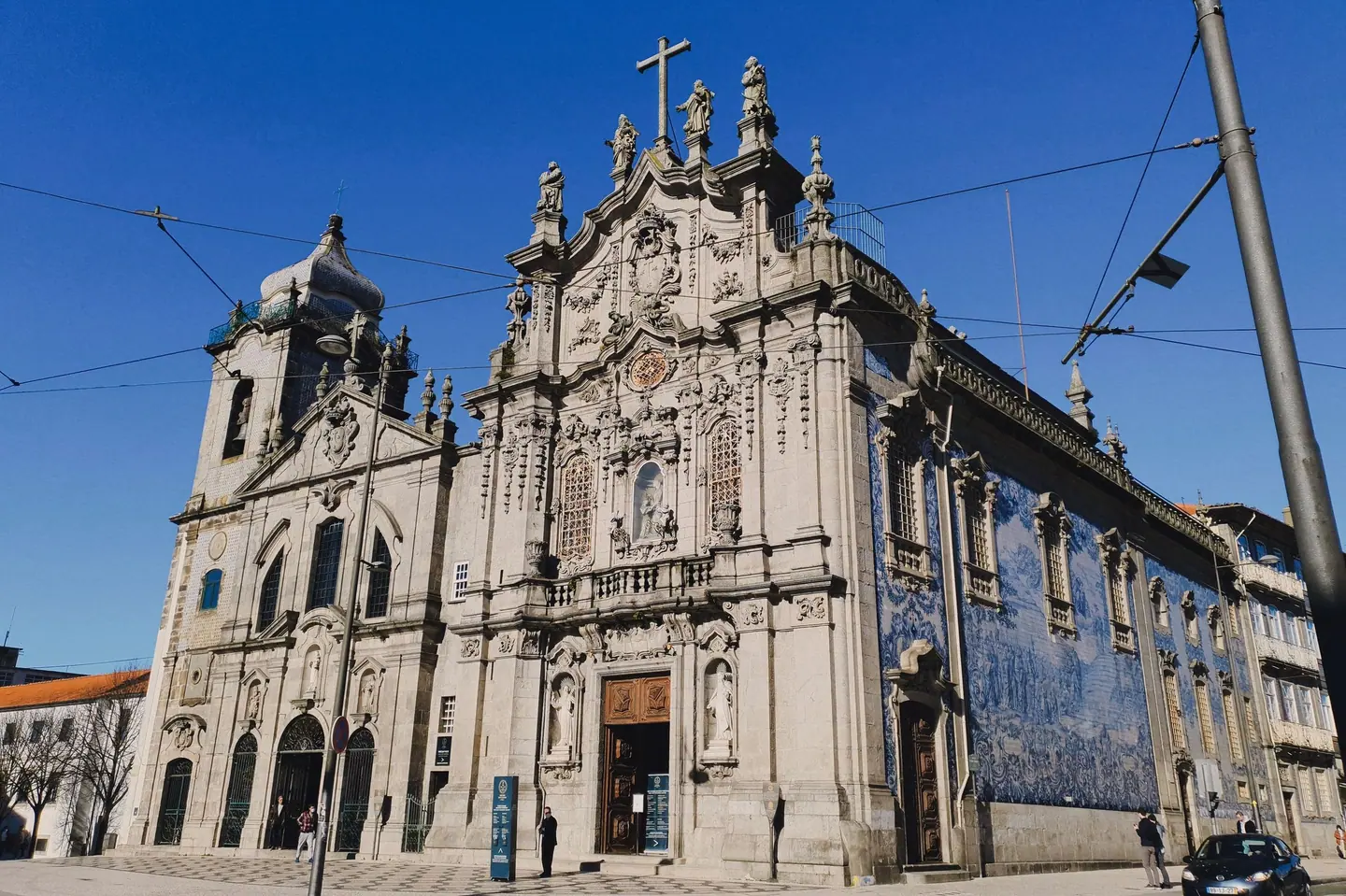
Built between 1616 and 1628 for the Discalced Carmelite Order, this church features a classical granite facade topped with statues of Saint Teresa and Saint Joseph. The single-nave interior contains gilded wood carvings executed in the national baroque style. A single bell tower on the left side is adorned with blue and white ceramic tiles added in 1840.
Igreja do Carmo
Constructed between 1756 and 1768 by the Third Order of Our Lady of Mount Carmel, this rococo temple features an ornate facade attributed to architect José de Figueiredo Seixas. The entire eastern flank is covered by a monumental azulejo panel composed of thousands of glazed tiles added in 1912. The mural illustrates the founding of the Carmelite Order.
Casa Escondida
Measuring just one metre in width, this three-storey residence was erected to separate the Igreja dos Carmelitas and the Igreja do Carmo. Local laws prevented two churches from sharing a party wall while ensuring Carmelite monks and Carmo nuns remained divided. The restored interior contains period furnishings and once accommodated the church bell-ringer and secret political meetings.
Fonte dos Leões
Cast at the Val d'Osne foundry in France and installed in 1882, this ornate iron fountain anchors Praça de Gomes Teixeira. The multi-tiered structure features winged lions supporting water basins beneath classical allegorical figures. The fountain was initially built to supply water to the surrounding western neighbourhoods before modern domestic plumbing systems were installed.
Reitoria da Universidade do Porto
Occupying a monumental neoclassical edifice started in the late eighteenth century for the Royal Navy Academy, this building now houses the central university administration. The symmetrical stone facade defines the northern boundary of the square. Inside, grand staircases lead to historical archives, the university museum, and ceremonial halls used for academic convocations.
Jardim da Cordoaria
Historically used by rope-makers producing cordage for Portuguese vessels, this public park was redesigned in 1866 by German landscape architect Émile David. The central avenues are lined with century-old plane trees displaying unusual bulbous trunks caused by grafting diseases. Several bronze sculptures dot the pathways, including works by Portuguese sculptor Juan Muñoz.
Portuguese Centre of Photography
Established within the monumental Cadeia da Relação prison complex built in 1796, this national museum displays photographic equipment and rotating historical exhibitions. Visitors walk through former cell blocks and exercise courtyards where writer Camilo Castelo Branco was once incarcerated. The top floor houses an extensive collection of historical cameras dating from the nineteenth century.
Palácio da Justiça
Inaugurated in 1961 during the Estado Novo regime, this massive granite courthouse reflects the austere monumentalism typical of mid-century Portuguese public works. Designed by architect Raul Rodrigues Lima, its entrance is flanked by an imposing seven-metre bronze statue of Justice sculpted by Leopoldo de Almeida. Bas-relief stone panels line the facade, depicting allegories of legal authority.
Hospital de Santo António
Commissioned in 1779 and designed by English architect John Carr of York, this hospital is one of the earliest examples of pure Palladian neoclassicism in Portugal. The grand granite exterior displays Doric porticoes, pedimented windows, and symmetrical courtyards. Built for the Santa Casa da Misericórdia, it remains a working public healthcare institution and medical teaching facility.
Largo Amor de Perdição
This open plaza stands directly in front of the historic Cadeia da Relação prison. It takes its name from the celebrated 1862 novel written by Camilo Castelo Branco during his confinement here for adultery. A bronze sculpture by Francisco Simões stands in the square, depicting the author embracing his lover Ana Plácido.
Miradouro da Vitória
Positioned atop the historic Jewish quarter of Olival, this unpaved terrace provides unobstructed vistas across the terracotta rooftops of Miragaia and Ribeira. Visitors look directly down upon the Douro River, the Dom Luís I Bridge, and the port wine lodges of Vila Nova de Gaia. The site sits beside the seventeenth-century Church of Nossa Senhora da Vitória.
Igreja de Nossa Senhora da Vitória
Reconstructed following a devastating fire in 1755, this church marks the location of the former Jewish cemetery and synagogue quarter established in 1386. The exterior displays late baroque architectural elements, while the interior features an altarpiece crafted by celebrated woodcarver Frei Manuel dos Reis. Shell damage sustained during the nineteenth-century Siege of Porto remains visible on parts of the masonry.
Soares dos Reis National Museum
Founded in 1833, this is Portugal's oldest public art museum, installed in the neoclassical Palácio dos Carrancas. The galleries display extensive collections of nineteenth-century Portuguese sculpture and painting, with pride of place given to works by master sculptor António Soares dos Reis. Additional holdings include fine examples of decorative arts, ceramics, jewellery, and seventeenth-century Portuguese furniture.
Crystal Palace Gardens
Designed in the 1860s by Émile David, these landscaped grounds originally surrounded a cast-iron exhibition hall modelled on London's Crystal Palace. The original glass pavilion was replaced in 1951 by a domed arena, now known as the Super Bock Arena. Terraced walkways, rose gardens, fountains, and resident peacocks line the cliffside paths offering views across the Douro.
Capela de Carlos Alberto
Set amid the woodland section of the Crystal Palace Gardens, this modest chapel was built in 1854 by Princess Augusta of Montléart. It commemorates her half-brother, King Charles Albert of Sardinia, who abdicated following his defeat at Novara and died in exile in Porto in 1849. The small granite structure features classical pilasters and commemorative stone inscriptions.
Torre da Marca
Standing on a rocky spur overlooking the river bend, this site once held a sixteenth-century beacon used by navigators crossing the dangerous sandbar at the Douro mouth. While the original stone watchtower was demolished in the nineteenth century, the location is preserved within the botanical terraces. A viewpoint here provides an unobstructed vantage point towards the Arrábida Bridge.
Bolhão, Santa Catarina, Majestic Café & Fontainhas
Capela das Almas, Mercado do Bolhão, Rua de Santa Catarina, Café Majestic, Church of Santo Ildefonso, Batalha Square, São João National Theatre, and Miradouro das Fontainhas
Mercado do Bolhão
Inaugurated in 1914, this bi-level market hall was designed by architect António Correia da Silva. Its central open courtyard is lined with traditional stalls selling regional produce, fresh fish, and flowers. Visitors can observe the preserved perimeter wrought-iron galleries, restored after an extensive conservation project completed in 2022.
Capela das Almas
Dedicated to Saint Catherine, this church dates from the late eighteenth century but gained its distinctive exterior in 1929. Ceramicist Eduardo Leite covered the exterior walls with nearly sixteen thousand glazed azulejo tiles. The detailed blue-and-white panels depict scenes from the lives of Saint Francis of Assisi and Saint Catherine of Alexandria.
Rua de Santa Catarina
Stretching northward from Batalha Square, this paved thoroughfare has served as Porto's commercial core since the nineteenth century. Lined with art nouveau shop fronts, cast-iron street lamps, and heritage department stores, it provides an authentic streetscape. Walking along the stone paving reveals a mix of early twentieth-century architecture and lively urban activity.
Café Majestic
Designed by architect João Queirós and opened in 1921 under the name Elite, this coffeehouse exemplifies Art Nouveau grandeur. The facade features curved marble mouldings, while the interior retains original leather upholstery, Flemish mirrors, and carved plaster cherubs. Historically, writers, intellectuals, and politicians gathered here for afternoon debates.
Church of Santo Ildefonso
Completed in 1739, this granite church stands atop a raised terrace overlooking Batalha Square. Its facade was embellished in 1932 with approximately eleven thousand azulejos by Jorge Colaço, depicting the life of Saint Ildefonso. Inside, the chancel houses an intricate baroque retable carved by master sculptor Miguel Francisco da Silva.
Praça da Batalha
This expansive public space occupies high ground that witnessed a tenth-century conflict between the Moors and the local Christian population. Today, the square is paved with traditional Portuguese calcada and framed by historic townhouses and cultural institutions. A prominent bronze monument dedicated to King Pedro V stands in the centre.
São João National Theatre
Erected between 1911 and 1918 to replace an earlier opera house destroyed by fire, this theatre was designed by Marques da Silva. The monumental facade displays allegorical relief sculptures representing music, drama, comedy, and tragedy. The interior horseshoe auditorium features elaborate gilded plasterwork and ceiling frescoes by Acácio Lino.
Palácio das Cardosas
Constructed on the grounds of a former monastic complex, this monumental palace was completed in the mid-nineteenth century by Manuel Cardoso dos Santos. The symmetrical facade features tall sash windows, pediments, and classical stonework overlooking Liberdade Square. The building now functions as a luxury hotel while maintaining its historic exterior proportions.
Cinema Batalha
Inaugurated in 1947, this cultural venue stands as a milestone of Portuguese modernist architecture. The geometric concrete exterior features relief sculptures by Américo Gomes and original bas-reliefs that faced political censorship during the Estado Novo regime. Thoroughly restored, it now houses the Batalha Centro de Cinema film heritage centre.
Church of Santa Clara
Founded in 1416 alongside the medieval city walls, this Franciscan convent church presents a modest Renaissance portal within an enclosed courtyard. Step inside to see one of Portugal's finest examples of talha dourada, where hundreds of kilograms of gold leaf cover the walls and altars. The choir stalls and polychrome woodwork date from the eighteenth century.
Muralha Fernandina
Commissioned by King Afonso IV and completed during the reign of King Fernando I, this defensive rampart replaced older medieval fortifications. The surviving masonry sections near Santa Clara feature crenellated stone towers and a walkable patrol path. Looking outward, the wall offers sweeping vantage points across the Douro river gorge and southern slopes.
Miradouro das Fontainhas
Perched high above the river on the eastern edge of the historical centre, this viewpoint provides direct angles toward the Ponte Maria Pia and Ponte do Infante. The surrounding district features traditional red-tiled worker tenements and narrow terraced streets. The site is a focal gathering area during the annual Festa de São João festivities.
Maria Pia Bridge
Completed in 1877 under the supervision of Gustave Eiffel and Théophile Seyrig, this pioneering bridge carried the northern railway line across the Douro. Its single parabolic wrought-iron arch spans one hundred and sixty metres without river piers, representing a triumph of Victorian engineering. Retired in 1991, the graceful structure remains preserved as a national monument.
Ponte do Infante
Named in honour of Prince Henry the Navigator, this road bridge was built between 1999 and 2003 to replace road traffic on the upper deck of Dom Luís I. Designed by engineer Adão da Fonseca, its shallow prestressed concrete arch spans two hundred and eighty metres. It ranks among the longest concrete arch bridges in the world.
Largo do Padrão
Positioned between the commercial core and the Fontainhas riverbank, this square highlights ordinary nineteenth-century urban growth in Porto. The plaza features residential architecture with wrought-iron balconies and ground-floor taverns frequented by local residents. It provides a peaceful contrast to the busier shopping streets situated only a few hundred metres westward.
Church of Nossa Senhora da Esperança
Constructed in the mid-eighteenth century for the Recolhimento dos Órfãos, this religious complex features design elements by the Italian architect Nicolau Nasoni. The granite facade displays characteristic late baroque volutes and window surrounds. The compact interior contains carved altarpieces and historical references to the institution's role in housing and educating local orphan girls.
Fontainhas Washhouses
Situated on the steep slopes beneath the Alameda das Fontainhas, these covered public washhouses served riverside families for generations before modern domestic plumbing. The stone basins are supplied by natural hillside springs that drain towards the Douro. The preserved complex offers architectural evidence of Porto's working-class communal domestic history.
Pérola do Bolhão
Established in 1917 on Rua Formosa just outside the main market gates, this traditional grocery store retains its original painted wooden sign and tiled exterior. The facade panels depict ships and exotic spices, reflecting Portugal's maritime trading history. Shelves inside are packed with regional cheeses, cured hams, dried fruits, and Port wines.
Teatro Carlos Alberto
Opened in 1897 to provide theatrical performances for working-class audiences, this theatre was dedicated to King Charles Albert of Sardinia, who died in Porto in 1849. The venue underwent complete structural refurbishment in the early 2000s under architect Nuno Lacerda Lopes. It now serves as an intimate secondary stage for the national theatre company.
Ateneu Comercial do Porto
Founded in 1869 by merchants and scholars, this private cultural society occupies an imposing townhouse on Rua Passos Manuel. The interior contains one of the largest private book collections in northern Portugal, along with grand salons, antique billiards rooms, and oil portraits. Its ornate ballroom frequently hosts chamber music concerts, lectures, and cultural exhibitions.
Vila Nova de Gaia Port Lodges, Serralves & Foz do Douro
Mosteiro da Serra do Pilar, Jardim do Morro, Cais de Gaia, Sandeman Cellars, Taylor’s Port, WOW Cultural District, Serralves Museum and Villa, Casa da Música, Castelo do Queijo, and Foz do Douro Lighthouse
Mosteiro da Serra do Pilar
Perched high on the Gaia bluffs, this sixteenth-century monastery features an unusual circular church and a matching circular cloister supported by thirty-six Ionic columns. Its terrace offers expansive views across the Dom Luis I Bridge and Porto old town. Military forces used the complex as an artillery stronghold during the Siege of Porto in the nineteenth century.
Jardim do Morro
Laid out in 1927, this elevated public park sits right at the exit of the upper deck of the Dom Luis I Bridge. Lined with palm trees and grassy tiers, it serves as an open gathering space with unobstructed panoramas of Porto riverside. A cable car station connects the garden directly down to the riverfront quay below.
Cais de Gaia
This wide riverfront promenade hugs the south bank of the Douro, facing the historic Ribeira quarter of Porto. Wooden rabelo cargo boats, once used to navigate the river rapids carrying barrels from the Douro wine valley, moor along the stone quays. The waterfront strip provides access to numerous port wine lodges and open-air riverside cafes.
Caves Sandeman
Housed in a granite building dating to 1797, this historic wine lodge displays the famous silhouette of the Sandeman Don. The cavernous aging cellars hold thousands of oak casks where vintage and tawny ports mature in cool, humid conditions. An on-site museum exhibits antique bottles, barrel-making tools, and archival documents tracking British trade connections.
Caves Ferreira
Established in 1751, this is one of the oldest Portuguese-owned port wine companies, shaped prominently by Dona Antonia Adelaide Ferreira in the nineteenth century. Built over a former convent, the sprawling lodge features thick granite walls and massive wooden vats known as balseiros. The museum wing displays personal artefacts, nineteenth-century business ledgers, and historic copper distilling equipment.
Caves Ramos Pinto
Founded in 1880, Casa Ramos Pinto made its name through innovative marketing and exports to South America. The premises include the Casa Ramos Pinto Museum, which preserves the original Art Nouveau administrative offices with vintage woodwork, wall murals, and period furnishings. Visitors can inspect original advertising posters illustrated by European artists alongside long rows of aging barrels.
Caves Calem
Positioned right beside the lower span of the Dom Luis I Bridge, Calem was founded in 1859 and remains one of the most prominent names along Cais de Gaia. Its barrel storage halls showcase large wooden vats containing red and white ports. The visitor route includes an interactive museum detailing regional soil profiles, grape varieties, and cooperage techniques.
Taylor's Port Cellars
Founded in 1692, Taylor Fladgate operates vast, quiet cellars on the slopes rising behind the riverbank. Visitors walk beneath dark timber rafters among huge oak vats and smaller casks containing maturing tawnies. The complex includes leafy garden courtyards and terrace views that look directly across the Douro basin toward the Clérigos Tower.
Caves Cockburn's
Located slightly inland in Gaia, Cockburn's holds the largest collection of oak casks in the historic port lodge district. The warehouse possesses an active, dedicated cooperage workshop where master coopers repair and maintain seasoned wooden barrels by hand. Walking through the dim granite naves reveals endless rows of maturing wine and historic archival artifacts.
WOW Porto (World of Wine)
This expansive cultural project transformed old port lodge storehouses into an integrated complex of museums, restaurants, and retail spaces. It hosts dedicated exhibitions covering the history of wine, Portuguese cork, regional textiles, drinking vessels, and cacao. An open central plaza provides broad vistas of the Porto skyline across the river.
The Bridge Collection at WOW
Housed within the WOW complex, this museum displays an extensive private collection of drinking vessels spanning nine millennia. Items range from ancient Mesopotamian and Greek pottery to delicate Roman glassware and ornate Renaissance gold chalices. Each gallery chronicles the social customs, rituals, and artistic techniques tied to alcohol consumption throughout human civilization.
Casa da Musica
Designed by the Dutch architect Rem Koolhaas and opened in 2005, this multifaceted concrete and glass monolith stands on Rotunda da Boavista. Inside, the main auditorium features corrugated glass walls and gold-leaf wood paneling engineered for premier acoustic clarity. The building hosts classical, contemporary, and electronic concerts alongside architectural tours.
Rotunda da Boavista
Officially named Praca Mouzinho de Albuquerque, this circular landscaped roundabout serves as a major traffic hub and civic park. In the centre rises the Monument to the Heroes of the Peninsular War, an imposing granite column topped by a Portuguese lion crushing a Napoleonic eagle. Mature trees and pedestrian paths surround the central lawn.
Serralves Museum of Contemporary Art
Inaugurated in 1999, this clean-lined, minimalist museum was designed by Pritzker Prize laureate Alvaro Siza Vieira to blend naturally into the surrounding estate. Its airy white galleries host revolving exhibitions of Portuguese and international contemporary art. Large picture windows thoughtfully frame views of the surrounding parkland and mature native trees.
Casa de Serralves
Constructed between 1925 and 1944 for the second Count of Vizela, this pink villa stands as an exceptional example of Streamline Moderne and Art Deco domestic architecture. Leading European designers contributed to its interiors, which feature Lalique glassware, marble fireplaces, and geometric parquet. Outside, formal parterres and fountain basins slope downward into woodland.
Parque de Serralves
Spanning eighteen hectares, Serralves Park includes formal French gardens, woodland trails, pastures, and a working educational farm. Site-specific sculptures by artists such as Richard Serra, Claes Oldenburg, and Alberto Carneiro punctuate the landscape. A raised wooden walkway enables visitors to stroll high within the canopy of century-old trees.
Castelo do Queijo
Properly known as the Fort of Sao Francisco do Queijo, this small pentagonal sea fortification was constructed in the 1660s to repel pirate raids. It takes its popular name from the rounded granite outcrop resembling a cheese wheel upon which it rests. Travellers can explore its watchtowers, restored ramparts, historic cannons, and an internal military museum.
Farol de Felgueiras
Guarding the mouth of the Douro River, this dark granite lighthouse was completed in 1886 at the end of a stone jetty. The octagonal tower features a red lantern gallery and an attached keeper house facing the Atlantic swells. The long stone breakwater serves as a popular promenade during calm tides, surrounded by ocean spray.
Foz Velha
Foz Velha preserves the historic village character of Foz do Douro before it was absorbed into the expanding municipality of Porto. The district features steep cobblestone alleys, small plazas, and nineteenth-century townhouses clad in ceramic tiles and wrought-iron balconies. It provides a peaceful atmosphere away from the historic city centre, rich with maritime heritage.
Forte de Sao Joao Baptista da Foz
Beginning in the sixteenth century around an existing medieval church, this formidable fortress was expanded with star-shaped bastions in the seventeenth century to protect maritime access to Porto. Its masonry walls overlook both the river channel and the Atlantic ocean. Visitors can walk the elevated ramparts and admire the historic masonry gates framing the river mouth.
Crossing the Douro Bridges in Porto
You can combine these stops with the district-by-district where-to-stay notes and seasonal planning tables on our Porto Ribeira, Azulejo Churches & Douro Wine Cellars destination page, or explore further regional and neighbourhood guides.