A detailed Silk Road architectural route through Timur and Ulugh Beg’s turquoise-domed capital: Registan Square, Gur-e-Amir, Bibi-Khanym, Shah-i-Zinda, and ancient Afrasiab.
Sogdian Marakanda to Amir Timur and Ulugh Beg’s Renaissance
Oasis crossroads of the Silk Road in the fertile Zeravshan River valley, Samarkand was founded in the eighth century BC as the Sogdian capital of Afrasiab (Marakanda), conquered by Alexander the Great in 329 BC, who declared that everything he had heard of Marakanda was true except that it was more beautiful than he had imagined. After the Mongol sack of 1220, Amir Timur (Tamerlane) chose Samarkand in 1370 as the imperial capital of his empire stretching from Delhi to Damascus.
Bringing master ceramicists, calligraphers, and architects from Persia, Khwarazm, and India, Timur and his astronomer-grandson Ulugh Beg raised ribbed azure domes, majolica-tiled portals (pishtaqs), and the monumental sextant of the 1420s Ulugh Beg Observatory.
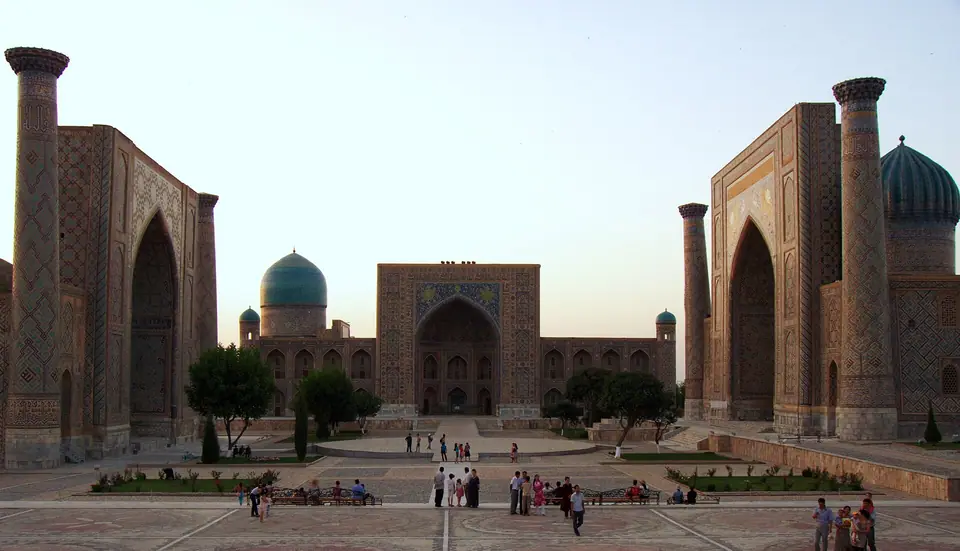
Registan Square & the Three Grand Madrasas
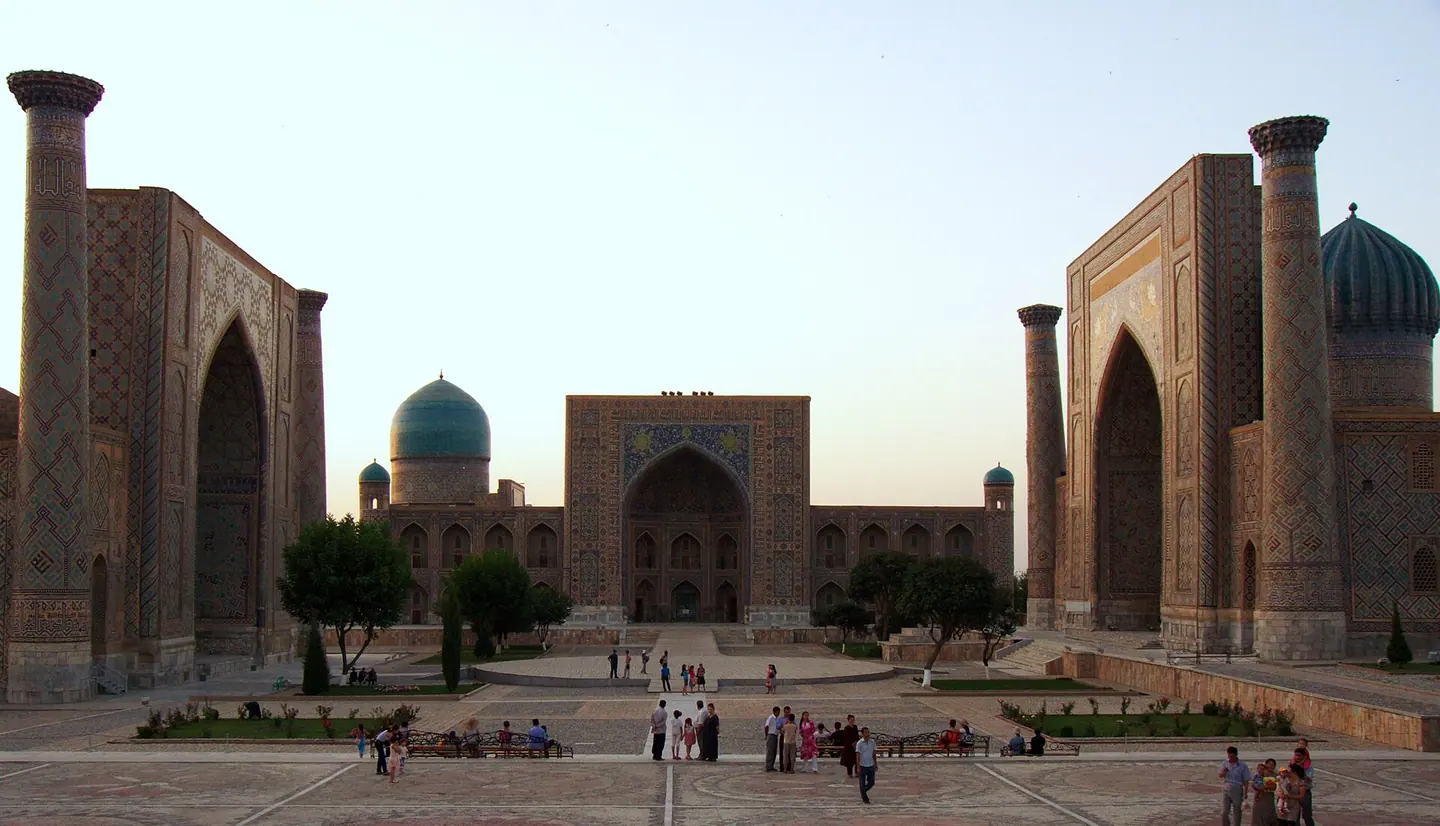
Registan Square, Ulugh Beg Madrasa (1417, 1420) Star Portal, Ulugh Beg Mosque & Lecture Courtyards, Sher-Dor Madrasa (1619, 1636) Tiger-Sun Mosaic, Tilya-Kori Madrasa (1646, 1660) Gilded Mosque Dome, Chorsu Trading Dome, and Shaybanids Mausoleum
Registan Square
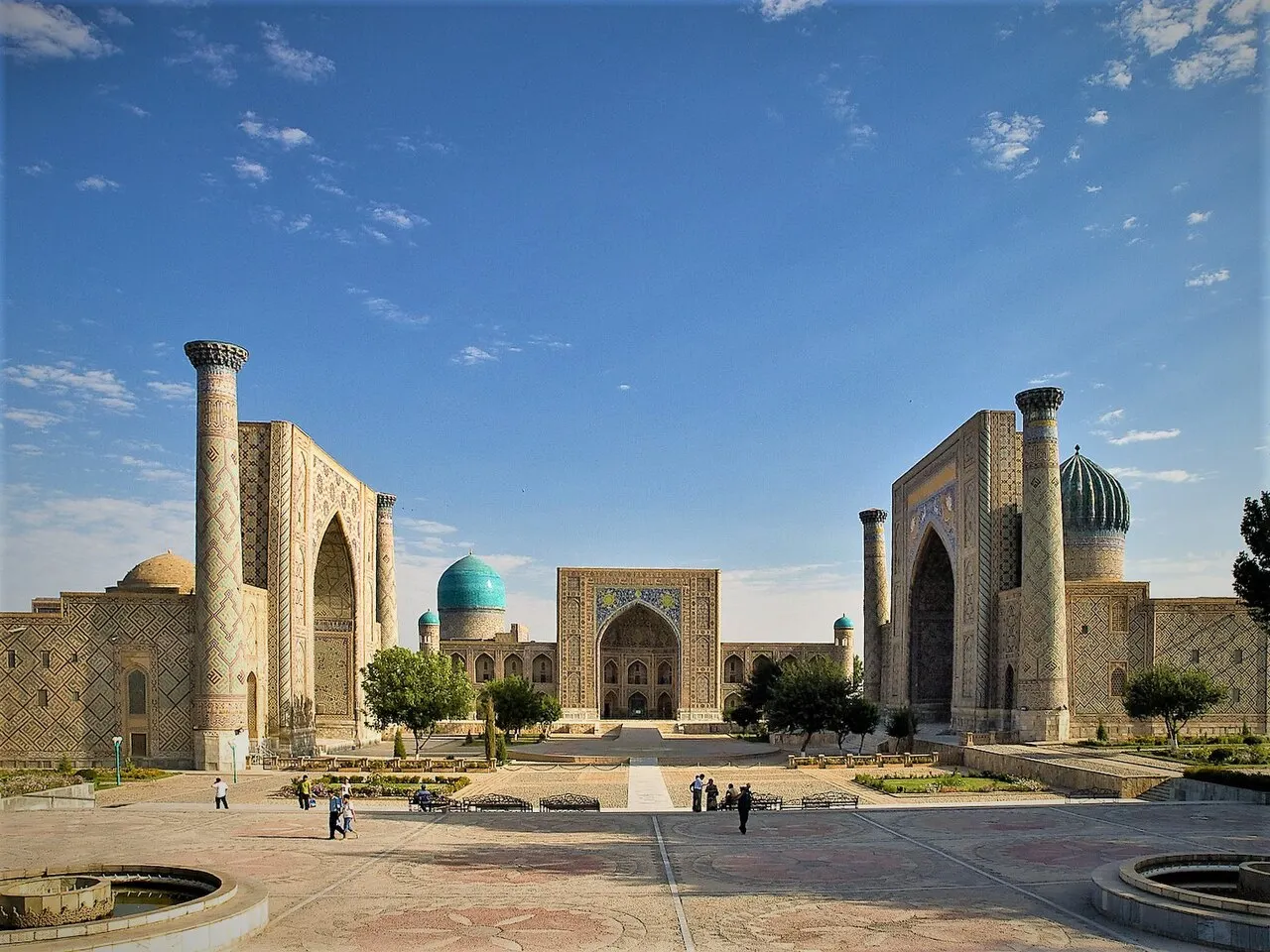
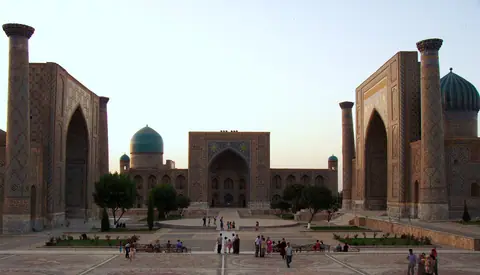
Registan was the public centre of medieval Samarkand, serving as a gathering ground for royal proclamations, executions, and trade. Flanked by three immense madrasas, the wide paved plaza showcases centuries of Timurid and Janid architecture. Visitors can observe the harmonised proportions, towering minarets, and intricate mosaic tilework that anchor the city skyline.
Ulugh Beg Madrasa Star Portal
Constructed between 1417 and 1420 by the astronomer-ruler Ulugh Beg, this massive iwan portal faces the western flank of Registan. Its facade displays glazed ceramic tiles arranged in complex polygonal stars, reflecting Ulugh Beg's passion for astronomy and mathematics. Notice the calligraphic inscriptions framing the arched gateway and the deep vaulted recess.
Ulugh Beg Madrasa Courtyard
Stepping through the portal reveals a tranquil square courtyard bordered by two storeys of vaulted dormitory cells, known as darskhanas. Scholars once studied theology, mathematics, logic, and astronomy in these rooms under leading Islamic thinkers. Four large iwans puncture the perimeter walls, displaying majolica tiles and carved marble dado bases.
Ulugh Beg Madrasa Mosque
Located in the rear corner of the madrasa, this domed prayer hall served resident students and instructors for daily prayers. The interior features restored muqarnas vaulting, finely painted plasterwork, and a marble mihrab facing Mecca. Exhibitions on medieval science and Ulugh Beg's astronomical discoveries occupy several of the adjacent converted chambers.
Sher-Dor Madrasa Tiger-Sun Mosaic
Built between 1619 and 1636 by governor Yalangtush Bakhodur, the eastern madrasa features a portal that boldly flouts traditional Islamic taboos against depicting living creatures. The tympanum displays two feline figures, often described as tigers or lions, chasing white stags beneath rising human-faced suns. These symbols evoke ancient Persian heraldry and royal power.
Sher-Dor Madrasa Courtyard
The internal courtyard of Sher-Dor mirrors the layout of its Timurid neighbour across the square, though executed with early Janid styling. Two tiers of pointed student arches surround the perimeter, interspersed with high vaulted classrooms. Bright yellow, green, and turquoise glazed tiles coat the walls, showcasing the evolving ceramic palette of seventeenth-century Central Asian artisans.
Sher-Dor Ribbed Domes
Rising above the frontal wings of Sher-Dor Madrasa, two turquoise fluted domes rest upon tall cylindrical drums decorated with kufic calligraphy. These double-shelled masonry domes emulate Timurid engineering, using timber bracing systems within the cavity to withstand regional earthquakes. Travellers should observe the vivid geometric diamond patterns banding each vertical flute.
Tilya-Kori Madrasa Facade
Commissioned in 1646 by Yalangtush Bakhodur to close the northern side of Registan, Tilya-Kori presents a wider facade than its neighbours. Rows of open arched loggias flank the main central portal, creating an expansive two-storey gallery effect. The tilework combines floral arabesques and geometric strapwork rendered in dark cobalt, turquoise, and white glaze.
Tilya-Kori Gilded Mosque
Occupying the western side of the complex, this mosque was built to serve as Samarkand's principal Friday gathering space following the decay of Bibi-Khanym. The name Tilya-Kori translates to gilded, which reflects the abundant gold leaf layered over the relief plasterwork. The intricate trompe l'oeil ceiling mimics an inner dome on a flat surface.
Tilya-Kori Courtyard Garden
Unlike the paved courtyards of the neighbouring madrasas, Tilya-Kori features a central garden space framed by brick walkways and shady trees. The surrounding two-storey perimeter provided lodgings for scores of scholars, while also containing smaller study halls. Intricate mosaic medallions decorate the spandrels above every arched student cell doorway.
Tilya-Kori Mosque Dome Exterior
The large exterior dome of the Tilya-Kori mosque was left incomplete for centuries before being finished during extensive twentieth-century restoration efforts. Covered in glossy turquoise ceramic tiles, the hemispherical shell sits on an elevated drum lined with tall calligraphic bands. It offers an impressive focal point when viewed from the square's south-western corner.
Chorsu Trading Dome
Standing just northeast of Sher-Dor, this domed pavilion was built in the fifteenth century and rebuilt during the eighteenth century as a merchant crossroads. Its central dome surmounts eight radiating arches that historically accommodated vendors of hats, textiles, and spices. Today the restored interior serves as a gallery displaying works by regional Uzbek painters and sculptors.
Shaybanids Mausoleum
Located immediately east of Tilya-Kori Madrasa, this open-air raised marble platform holds a dense cluster of carved stone tombs. It contains the resting places of several rulers from the Shaybanid dynasty, who conquered Samarkand from the Timurids in 1500. The grey marble slabs are covered with fine Arabic epitaphs, Qur'anic verses, and detailed genealogical records.
Registan South Viewing Platform
Positioned opposite Tilya-Kori along the southern rim of the square, this raised stone terrace offers an unobstructed perspective of the architectural ensemble. It is the premier position for observing the symmetrical balance between Ulugh Beg Madrasa and Sher-Dor Madrasa across the paved plaza. Travellers gather here at dusk when evening floodlights illuminate the intricate tiled facades.
Ulugh Beg Minaret
Anchoring the northern corner of Ulugh Beg Madrasa, this 33-metre minaret is famous for its deliberate structural engineering and visible historic lean. Decorated with geometric patterns of unglazed and blue glazed bricks, it was righted using complex hydraulic jack systems in the twentieth century. From its base, visitors can admire the intricate diagonal brick courses.
Sher-Dor Southern Minaret
Flanking the right corner of the Sher-Dor facade, this cylindrical minaret rises to match the vertical height of Ulugh Beg's opposite tower. Its exterior skin displays spiral patterns of glazed faience bricks terminating in an arched decorative balcony. Small vertical windows punctuate the shaft, designed historically to illuminate the internal spiral masonry staircase.
Registan History Museum
Housed within several restored rooms on the ground floor of Ulugh Beg Madrasa, this collection chronicles the square's evolution and preservation. Exhibits display original glazed tile segments, calligraphic blueprints, and historical photographs documenting the dilapidated state of the monuments before twentieth-century conservation. Detailed models explain the mathematical principles used by Timurid engineers.
Tilya-Kori Corner Minarets
Unlike the tall free-standing minarets of the flanking madrasas, Tilya-Kori terminates with shorter, rounded corner towers integrated directly into the perimeter wall. Termed guldastas, these robust brick turrets are capped with green and blue glazed tile lanterns. They provide structural buttressing to the outer wings while framing the broad facade.
Islam Karimov Monument
Located in a landscaped park just south of Registan Square, this monumental bronze sculpture honours Samarkand-born Islam Karimov. Unveiled in 2017, the monument depicts the former leader seated upon a carved stone plinth, surrounded by manicured flowerbeds and granite footpaths. The site provides a quiet vantage point facing the rear facade of the ancient square.
Registan Craftsmen Workshops
The ground-floor cells of Sher-Dor Madrasa now accommodate master craftspeople continuing classical Central Asian artistic traditions. Inside these barrel-vaulted chambers, visitors can observe woodcarvers shaping walnut bookstands, calligraphers painting on Samarkand mulberry paper, and metalsmiths engraving brass trays. The artisans often explain the historical techniques passed down across generations.
Gur-e-Amir, Rukhobod & Aksaray Timurid Royal Quarter
Gur-e-Amir Mausoleum of Amir Timur, Jade Nephrite Cenotaph of Timur, Tomb of Ulugh Beg, Aksaray Mausoleum, Rukhobod Mausoleum, University Boulevard Russian Turkestan Architecture, Amir Timur Monument, and St Alexius Cathedral
Gur-e-Amir Mausoleum
Commissioned by Amir Timur in 1403 following the death of his grandson Muhammad Sultan, this mausoleum became the imperial family crypt. Its 64-ribbed melon dome shines with deep blue glazed bricks above an octagonal chamber. Inside, the ceiling features pressed paper gilded ornamentation, while ornamental screens surround the cenotaphs.
Nephrite Cenotaph of Amir Timur
Positioned at the centre of the inner hall, this monolithic dark green nephrite jade block commemorates Amir Timur. Ulugh Beg brought the stone from Chinese Turkestan in 1425 to serve as a regal gravestone. Arabic and Persian inscriptions trace Timur's lineage back through Mongol ancestry, warning visitors against disturbing his resting place.
Cenotaph of Ulugh Beg
Ulugh Beg rests beside his grandfather under a distinct grey marble cenotaph carved with extensive calligraphy. The epitaph recounts his violent death in 1449 at the instigation of his rebellious son Abd al-Latif. The actual burial crypt below the main chamber confirms his burial in the garments of a martyr.
Cenotaph of Mir Said Baraka
Amir Timur requested to be buried at the feet of Mir Said Baraka, a Sufi scholar and his spiritual guide from Medina. Baraka's cenotaph occupies a privileged position beneath the dome, elevated above neighbouring sarcophagi. A high pole bearing horsehair, a traditional Central Asian sacred marker, stands nearby to indicate his holy status.
Gur-e-Amir Crypt
Directly below the opulent upper showroom lies the austere subterranean crypt constructed from burnt brick. The authentic skeletal remains of Timur, his sons Shah Rukh and Miran Shah, and his grandsons reside here under simple stone flags. Soviet anthropologist Mikhail Gerasimov opened these masonry vaults during famous forensic excavations in 1941.
Gur-e-Amir Entrance Portal
Master craftsman Muhammad ibn Mahmud of Isfahan completed this ornate brick portal in the early fifteenth century. Delicate mosaic work and floral girih tile patterns decorate the pointed archway leading into the courtyard. The surviving calligraphic frieze proclaims the complex as the tomb of Sultan Muhammad, grandson of Amir Timur.
Rukhobod Mausoleum
Built by Amir Timur around 1380, this unglazed brick structure stands north of Gur-e-Amir along the ancient ceremonial road. It houses the remains of Islamic mystic Burhan al-Din Sagharji, whose casket allegedly enclosed seven hairs of the Prophet Muhammad. Its cubical base transitions into an octagonal drum surmounted by a conical dome.
Aksaray Mausoleum
Situated immediately southeast of Gur-e-Amir, this quiet fifteenth-century crypt was constructed for the male descendants of Sultan Abu Sa'id. The cross-shaped interior displays sophisticated structural arches called squinches alongside restored blue-and-gold kundal wall paintings. Beneath the decorative hall, visitors can inspect a marble-faced subterranean burial chamber via modern access steps.
University Boulevard
Designed during the late nineteenth century by Russian military topographers, this radial boulevard forms the boundary of Tsarist Samarkand. Towering oak and plane trees shade pedestrian avenues flanked by administrative structures built with local yellowish brick. It remains a leafy, civic thoroughfare linking medieval Timurid monuments to Samarkand State University.
Amir Timur Monument
Sculpted by Ilkhom Jabbarov and unveiled in 1996, this monumental bronze figure shows Amir Timur seated on an imperial throne. Located at the intersection of University Boulevard and Bustonsaroy Street, the monument occupies the former site of Soviet administrative statues. The base bears Timur's historic state motto: Strength is in Justice.
Church of St Alexius
Constructed in 1912 for the Russian Imperial military garrison, this historic brick cathedral features traditional Russian-Byzantine architectural details. Architect Fedor Verzhbitsky included prominent kokoshnik arches, tall cross-bearing bell towers, and ornamental pilasters along its facade. Returned to the Russian Orthodox diocese in 1996, its high interior displays restored liturgical frescoes and brass iconostases.
Samarkand Regional Studies Museum
Housed within the early twentieth-century eclectic mansion of Jewish merchant Abram Kalantarov, this regional museum exhibits local craft traditions and antiquities. The interior chambers feature ornate carved plaster ganche ceilings and hand-painted tile panels blending European and Central Asian craftsmanship. Galleries showcase local bronze weapons, traditional ceramics, suzani embroideries, and historic Tsarist-era photography.
Former Governor's Mansion
Constructed in the 1880s for the military governors of the Samarkand Region, this two-storey mansion reflects classic Tsarist colonial architecture. Its facade features whitewashed stucco, symmetrical arched windows, and decorative cornices typical of Russian Turkestan. Now integrated into the university grounds, the building highlights the transformation of Samarkand after the 1868 Russian annexation.
Samarkand State University Main Building
Established formally in 1927 as the Uzbek Pedagogical Institute, this campus traces educational heritage back to Ulugh Beg's intellectual circle. The main faculty block overlooks the central garden strip of University Boulevard, surrounded by research institutes and botanical plantings. Academic statues and commemorative plaques across the frontage honour prominent Uzbek scientists and Central Asian literary figures.
Alisher Navoi Central Park
Laid out during the late nineteenth century as an imperial public garden, this urban park extends north of University Boulevard. Mature plane, willow, and chestnut trees provide deep shade over broad walking pathways and seasonal ornamental fountains. The park contains open-air performance pavilions, local amusement areas, and quiet gardens popular with local residents.
Church of St John the Baptist
Built in 1915 by Polish, Lithuanian, and German soldiers and railway engineers exiled to Russian Turkestan, this church features red-brick Gothic revival architecture. A slender pointed bell tower and arched lancet windows define the exterior facade. Following decades of secular use, the parish reopened for religious services during the late twentieth century.
Church of the Intercession of the Mother of God
Constructed in 1903 to serve the growing civilian population of European Samarkand, this brick church preserves a traditional cruciform plan. The exterior features decorative window surrounds and a classic Russian tented bell-gable roofline. Inside, the quiet nave houses historic icons and provides services to the city's longstanding Slavic congregation.
Abul Qasim Madrasah Ruins
These understated masonry ruins represent one of the smaller traditional educational madrasahs surrounding the royal mausoleums. The structure retained a central courtyard framed by vaulted student cells called hujras and an intimate corner prayer chamber. While largely overshadowed by royal monuments, the site illustrates the everyday religious scholarship of pre-modern Samarkand.
Registan South Axis Viewpoint
Situated on the pedestrian approach from Gur-e-Amir toward the central square, this open terrace offers perspectives across southern Samarkand. From here, travellers can study how the Timurid urban plan linked the dynastic royal cemetery with urban markets and colleges. Sightlines reveal the contrast between fourteenth-century majolica domes and broad, modern municipal avenues.
Tashkent Street Pedestrian Promenade
This pedestrian street runs north from the monumental zone towards the historic bazaars and Bibi-Khanym Mosque. Electric visitor carts share the stone flagstones with strolling travellers examining artisan craft workshops, carpet galleries, and teahouses. The avenue serves as a principal transit spine linking ancient residential mahallas to the restored public squares.
Tashkent Road, Bibi-Khanym Mosque & Siab Bazaar
Islam Karimov Pedestrian Avenue, Bibi-Khanym Mosque Giant Pishtaq, Marble Quran Lectern of Ulugh Beg, Bibi-Khanym Mausoleum, Siab Bozori Samarkand Bread & Dried Fruit Market, and Hazrat Khizr Mosque Panorama
Bibi-Khanym Mosque Main Pishtaq
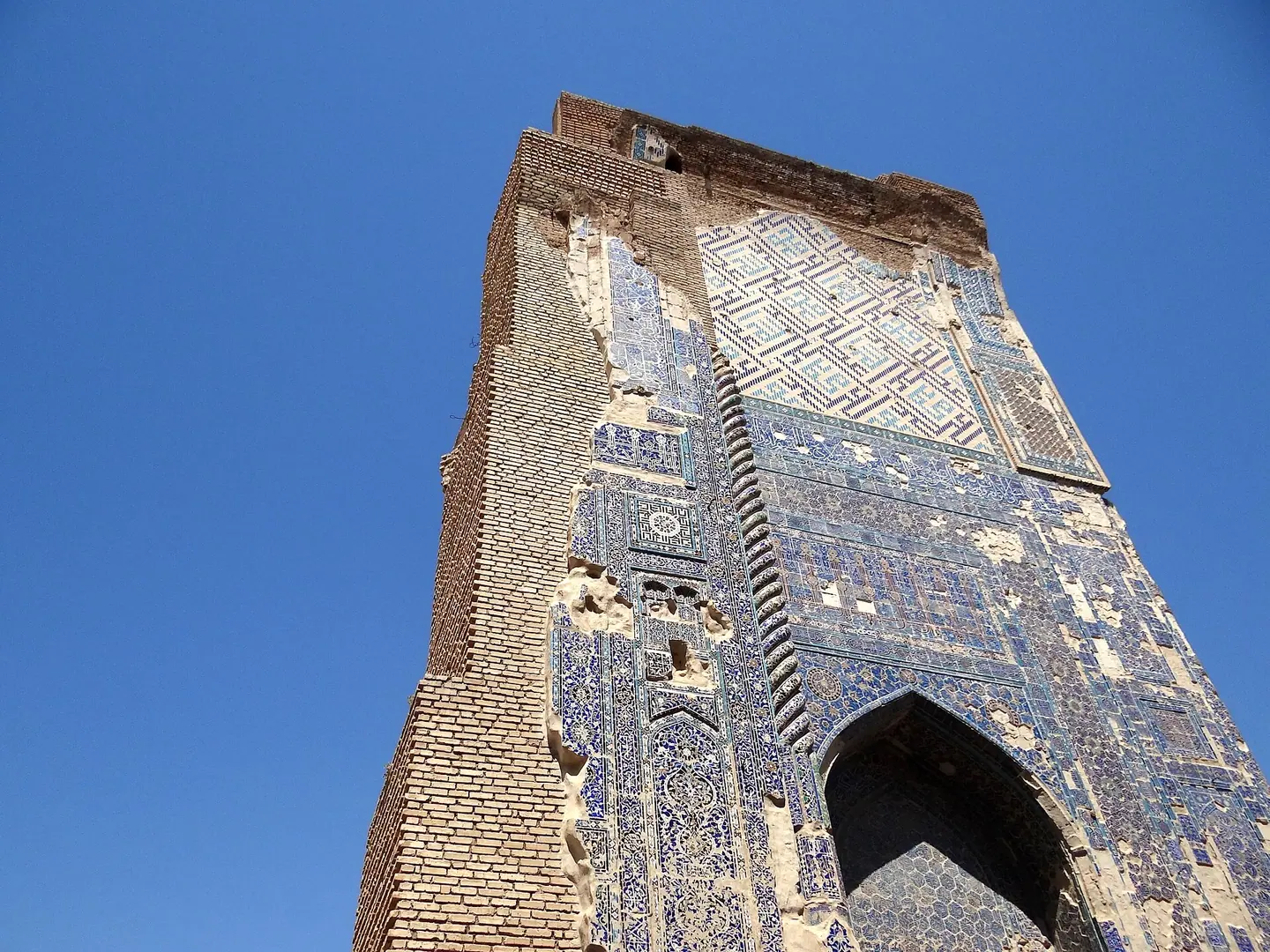
Commissioned in 1399, this enormous portal was built to overawe visitors approaching from the main market street. Timur demanded towering dimensions, which caused structural fissures almost immediately after completion. Today, the preserved ceramic tiles display intricate geometrical calligraphy, majolica panels, and restored stalactite vaulting above the entrance.
Marble Quran Lectern of Ulugh Beg
Carved from a huge block of grey marble, this monumental stone stand occupies the centre of the mosque courtyard. Commissioned by Timur's grandson Ulugh Beg, it held the colossal eighth-century Uthman Quran for centuries. The lectern rests on nine stone supports, covered in fluid Thuluth inscriptions and delicate floral reliefs.
Bibi-Khanym Main Sanctuary Dome
Rising more than forty metres above ground, the central turquoise cupola remains a defining landmark across the historic district. The double dome construction relies on internal brick pendentives and exterior melon-fluted tiling. The restored interior contains remnants of original plaster reliefs, painted floral motifs, and gilded papier-mache ornamentation.
Bibi-Khanym North Side Mosque
Constructed alongside the central prayer hall, this smaller sanctuary provided sheltered prayer space during harsh weather. The structure features an octagonal base supporting an azure drum and ribbed dome. Visitors can examine exposed historical brickwork alongside careful Soviet and Uzbek reconstructions of external glazed terracotta friezes.
Bibi-Khanym South Side Mosque
Mirroring its northern counterpart, this domed hall balances the classic four-iwan layout of Timur's imperial complex. Its exterior reveals deep turquoise geometric patterns that spell out sacred phrases in Kufic script. Inside, researchers uncovered original drainage channels and foundation footings that demonstrated how medieval engineers stabilized such massive loads.
Bibi-Khanym Minaret
Anchoring the corner of the mosque complex, this soaring tower originally assisted in calling the faithful across the imperial capital. While the upper section collapsed in historic earthquakes, the lower shaft retains fine bands of glazed tilework forming complex girih geometries. It illustrates the daring height-to-base ratios that fourteenth-century builders attempted.
Bibi-Khanym Mausoleum
Located opposite the grand mosque across the historic thoroughfare, this fourteenth-century mausoleum houses the crypt of Timur's chief empress, Saray Mulk Khanum. The octagonal exterior hides a cruciform interior adorned with stalactite stucco and delicate wall frescoes. Excavations in the subterranean crypt revealed marble sarcophagi containing members of the imperial female dynasty.
Islam Karimov Street Pedestrian Avenue
Formerly Tashkent Road, this broad pedestrian boulevard connects Samarkand's premier archaeological and religious monuments. Paved in granite and flanked by plane trees, it accommodates electric visitor shuttles and souvenir workshops. Walking along this path offers uninterrupted views towards the soaring portals of both the Registan and the Bibi-Khanym complex.
Islam Karimov Monument
Erected near the pedestrian promenade close to his birthplace, this bronze memorial depicts Islam Karimov in reflective contemplation. The statue stands on a polished granite plinth inside a manicured park with water features. Local residents frequently gather here to lay floral tributes before continuing toward the historic bazaar.
Siab Bazaar Main Domed Hall
Serving as the principal trading centre of Samarkand for centuries, Siab Bazaar sits immediately north of Bibi-Khanym Mosque. The central concrete dome shelters long counters laden with mountain herbs, seasonal vegetables, and dried fruits. Farmers from surrounding Zarafshan Valley villages transport their harvests here every morning to sell directly to shoppers.
Siab Bread Rows
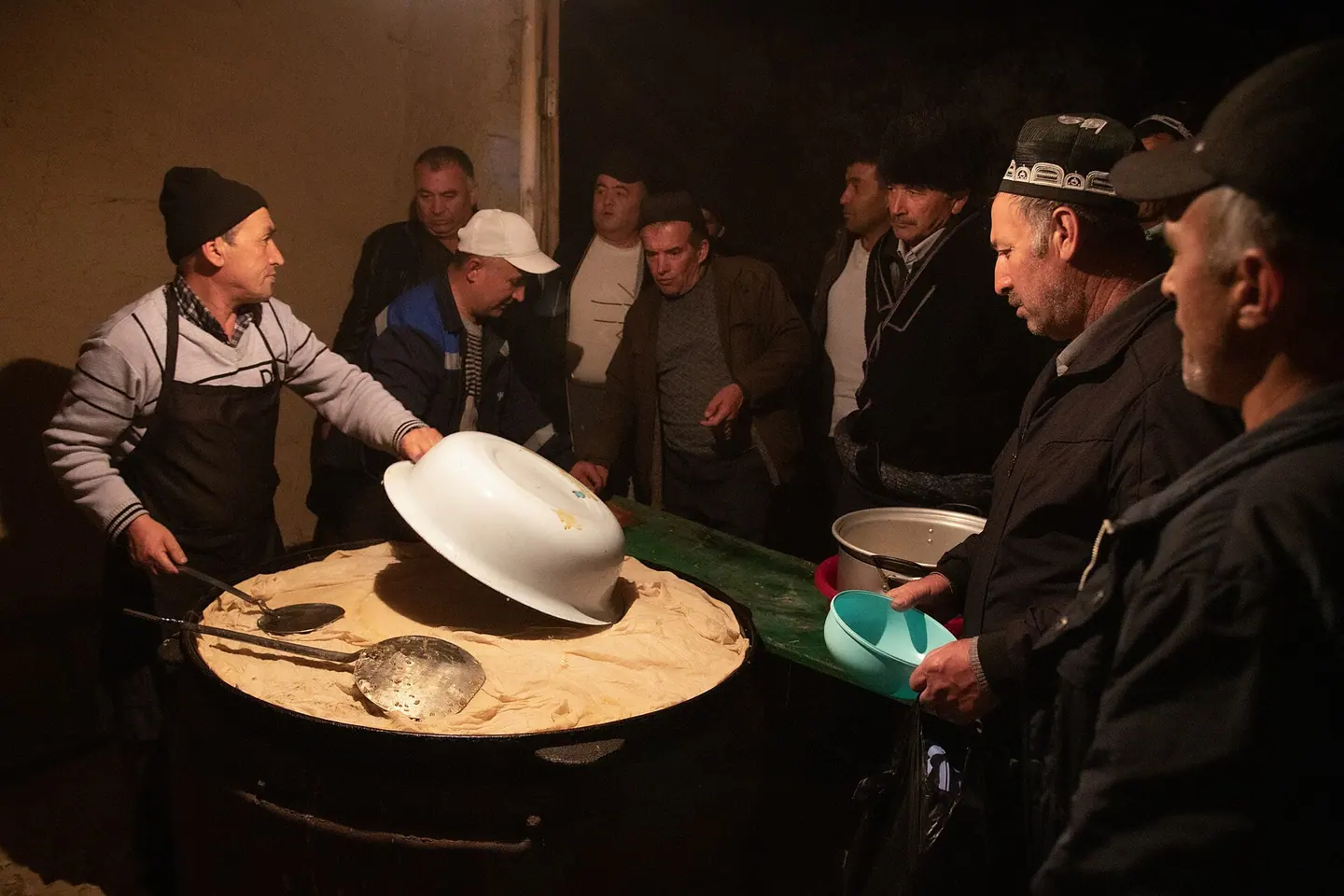
This specific section of Siab Bazaar is renowned for Samarkand non, the dense, glossy sourdough bread baked in clay tandoors. Bakers stamp intricate floral patterns onto each loaf using metal-tipped tools called chekich before baking. The loaves, renowned for staying fresh for months, are stacked high along wooden display tables.
Siab Dried Fruit and Nut Quarter
Centuries of Silk Road commerce survive in this fragrance-filled quadrant of the market. Vendors stack pyramids of black and golden Kishmish raisins, dried apricots stuffed with almonds, and salted apricot seeds baked in hot ashes. The stalls provide insight into traditional food preservation methods refined across Central Asian oases.
Hazrat Khizr Mosque
Perched on a natural promontory above Siab Bazaar, this sanctuary traces its origins to the earliest Islamic arrivals in Transoxiana. Destroyed by Genghis Khan in 1220, the current building was restored in 1854 with an ornate wooden aivan and carved cedar columns. The painted ceilings exhibit exceptional nineteenth-century decorative lacquerwork and gilded geometrical borders.
Hazrat Khizr Panorama Point
The raised viewing terrace outside the mosque provides an open visual axis across northern Samarkand. Looking south, we observe the domes of Bibi-Khanym towering above the Siab market stalls. To the north lie the rolling loess mounds of ancient Afrasiab, making this spot ideal for comprehending the city's geographical evolution.
Islam Karimov Mausoleum
Completed in 2018, this mausoleum stands above the final resting place of Uzbekistan's first president. The structure incorporates traditional Timurid design, featuring an azure dome, white marble facing, and intricate gold leaf gilding. Inside, master craftsmen utilized semiprecious stone inlays and hand-carved calligraphic bands quoting verses from the Quran.
Siab Caravanserai Footings
Discovered during municipal works between the mosque and the bazaar, these exposed foundations reveal how medieval caravans unloaded goods in Samarkand. Thick mudbrick footings and burnt-tile courtyards outline former merchant rooms, storage vaults, and stables. Informational plaques illustrate how traders from Persia, India, and China secured their pack animals here.
Afrasiab South Gate Embankment
Just across the modern road from Hazrat Khizr, these steep loess mounds mark the fortified defensive perimeter of pre-Mongol Afrasiab. Ancient Sogdian defenders repelled nomadic incursions and Greek hoplites from these massive clay ramparts. Walking the southern ridge offers views into the deep defensive ditch that protected the citadel until 1220.
Tashkent Gate Historic Site
This junction historically served as the northern portal through Samarkand's late-medieval walls, receiving caravans arriving from Tashkent and Fergana. While the masonry gates were dismantled in the late nineteenth century, the topography reflects the old portal pinch-point. Today, the spot connects the historic district directly to the northern road network.
Makhdumi Khorezm Mosque
Situated in the historic residential mahalla immediately west of Bibi-Khanym, this small mosque serves local residents away from the main tourist stream. Its open aivan features slender wooden columns topped with carved stalactite capitals. The ceiling is lined with hand-painted timber beams displaying traditional folk patterns of green, red, and yellow pigments.
Sary-Mazar Cemetery Boundary
Bordering the eastern slope of Hazrat Khizr hill, this old stone pathway cuts along the western edge of Samarkand's largest historical necropolis. The path provides a tranquil transition zone from the active commerce of Siab Bazaar toward the sacred quiet of Shah-i-Zinda. Wrought-iron lanterns, clay walls, and cypress trees line the historic route.
Shah-i-Zinda Avenue of Mausoleums & Afrasiab Citadel
Shah-i-Zinda Entrance Portal, Tuman Aka Complex, Shadi Mulk Aka Mausoleum (1372), Shirin Bika Aka Tomb, Shrine of Qusam ibn Abbas the Living King, Afrasiab Archaeological Mound, and Afrasiab Museum 7th-Century Sogdian Ambassador Frescoes
Shah-i-Zinda Entrance Portal
Ulugh Beg commissioned this southern monumental entrance portal, known as the darwazakhana, in 1434 to honour his youngest son. The soaring vaulted archway introduces the complex with carved terracotta panels and deep cobalt inscriptions. Walking through this gateway brings visitors to the foot of the ceremonial stairs leading up the necropolis.
Stairway of Shah-i-Zinda
This narrow open flight of brick and stone stairs connects the lower courtyard to the upper corridor of tombs. Medieval pilgrims counted the steps climbing up and descending, believing matching tallies indicated spiritual purity. Flanking walls reveal layers of reconstructed brickwork framing views toward the decorated domes above.
Qazi Zadeh Rumi Mausoleum
Dating to roughly 1435, this double-domed structure contains the remains traditionally attributed to Salah al-Din Musa Pasha, the astronomer tutor of Ulugh Beg. The exterior features twin turquoise domes resting upon high cylindrical drums adorned with geometric tilework. Inside, visitors observe complex squinches supporting the luminous white plastered ceiling.
Shirin Bika Aka Mausoleum
Erected in 1385 for Timur's sister, this tomb represents a technical leap in Central Asian mosaic art through its fine cut-tile work. The facade features glazed openwork window grilles alongside delicate calligraphy praising the deceased. The interior retains rare wall paintings in ultramarine and gold pigment depicting natural foliage.
Shadi Mulk Aka Mausoleum
Commissioned by Turkan Aka for her daughter, this tomb features some of the finest carved glazed terracotta across the entire necropolis. Completed in 1372, the portal displays intricate stalactite vaulting dense with turquoise and dark blue enamelled tiles. Its inscription poetically laments the premature loss of an exquisite pearl.
Octagonal Mausoleum
Departing from the conventional cube-and-dome arrangement, this open-sided pavilion dates from the early fifteenth century. Eight open arches pierce its faceted walls, creating an airy corridor filled with natural light that illuminates the glazed brick revetment. Archaeological studies revealed female burials preserved beneath the stone crypt below.
Usto Ali Mausoleum
Constructed in the late fourteenth century, this structure preserves signatures identifying the craftsman Usto Ali on its decorated portal. The exterior showcases deep Relief majolica tiles dominated by deep cobalt, turquoise, and white floral designs. Its interior features a ribbed drum supporting an inner hemispherical dome.
Mausoleum of Amir Burunduq
This mausoleum honours Amir Burunduq, a primary military general who served under Timur during his far-flung campaigns. Dating to the late 1380s, the exterior exhibits a more sober finish than royal tombs, displaying unglazed brickwork interlaid with geometric bands of turquoise tile. Inside, white plaster walls highlight the masonry transitions.
Mausoleum of Amirzadeh
Completed in 1386, this tomb was built for an unidentified Timurid prince known simply by the title Amirzadeh. The facade demonstrates exceptional mastery of carved majolica, with raised plant motifs twisting around Quranic calligraphy. A stepped entrance leads into a compact square chamber crowned by a hemispherical brick dome.
Tuman Aka Complex
Dating to 1405, this unified complex comprises a mausoleum, small three-domed mosque, and reception vestibule built by Timur's youngest wife. The portal displays violet-tinted glazed tiles alongside calligraphic panels in Thuluth script. The interior features polished tile dados and painted landscape vignettes depicting streams and trees.
Khwaja Ahmad Mausoleum
Dating from the 1340s, this structure stands at the northern termination of the necropolis avenue as one of its oldest standing monuments. The surviving portal features turquoise and cobalt glazed tiles bearing the signature of the craftsman Fakhr Ali. Its decorative scheme reveals early technical transitions toward true carved composite ceramics.
Shrine of Qusam ibn Abbas
This sacred core contains the tomb of Qusam ibn Abbas, a cousin of the Prophet Muhammad who brought Islam to Sogdiana. The cenotaph, rebuilt in the 1330s, consists of four stepped tiers covered in lustrous polychrome majolica and gold leaf inscriptions. Pilgrims enter through carved elm doors crafted in 1404.
Upper Mosque of Shah-i-Zinda
Constructed alongside the inner shrine, this prayer hall served pilgrims who gathered for devotions beside the sacred tomb. The room contains a finely carved wooden ceiling supported by slender columns alongside an ornamental carved mihrab niche facing Mecca. Wall surfaces preserve restored plasterwork alongside geometric brick patterns.
Afrasiab Archaeological Mound
Covering more than two hundred hectares of barren loess ridges, this ancient site preserves the archaeological strata of Samarkand from the eighth century BC until Mongol destruction in 1220. Visitors can trace remains of mudbrick fortification ramparts and defensive moats cut into the plateau. The terrain provides panoramic views across the modern city.
Citadel of Afrasiab
Positioned on the highest promontory of the northern plateau, the citadel served as the seat of local Sogdian rulers and later Islamic governors. Successive building phases reveal massive pakhsa clay walls strengthened by semicircular towers. Excavations here uncovered remnants of royal administrative halls and early medieval barracks.
Afrasiab Museum
Established in 1970 above ongoing excavation fields, this modern museum displays thousands of artefacts uncovered from the ruined mounds. The collection holds Zoroastrian ceramic ossuaries, ancient bronze coins, Terracotta figurines, and domestic tools dating from antiquity. Displays explain the urban evolution of Samarkand before the thirteenth-century Mongol invasion.
Sogdian Ambassador Frescoes
These celebrated murals, excavated from a private reception hall, depict King Varkhuman receiving foreign embassies during the mid-seventh century. Four painted walls illustrate emissaries from Tang dynasty China, Korea, Chaganian, and Tibet bearing fine silks and ceremonial gifts. Detailed Sogdian inscriptions identify the participants alongside historic bridal processions and aquatic hunts.
Ancient Water Reservoir of Afrasiab
This subterranean brick cistern, or sardoba, formed an essential component of the hydraulic network that fed ancient Samarkand. Water entered through lead aqueduct pipes drawing from the Dargom canal into domed holding vaults. The preserved masonry demonstrates advanced engineering used to maintain clean municipal reserves during long arid seasons.
Hazrat Khizr Mosque
Resting on ancient eighth-century foundations, this striking mosque was rebuilt in the nineteenth century and features an open-sided painted wooden aivan. Intricate carved cedar columns support ceilings painted in red, yellow, and green floral medallions. From the elevated terrace, visitors gain sweeping views across Shah-i-Zinda and the Afrasiab hills.
Mausoleum of Islam Karimov
Completed in 2018 on the grounds of Hazrat Khizr, this tomb honours independent Uzbekistan's first leader. The structure harmonises with medieval Samarkand architecture through carved white marble, gold leaf calligraphy, and a ribbed turquoise dome. The interior features fine hardstone inlays and open carved screens crafted by local contemporary artisans.
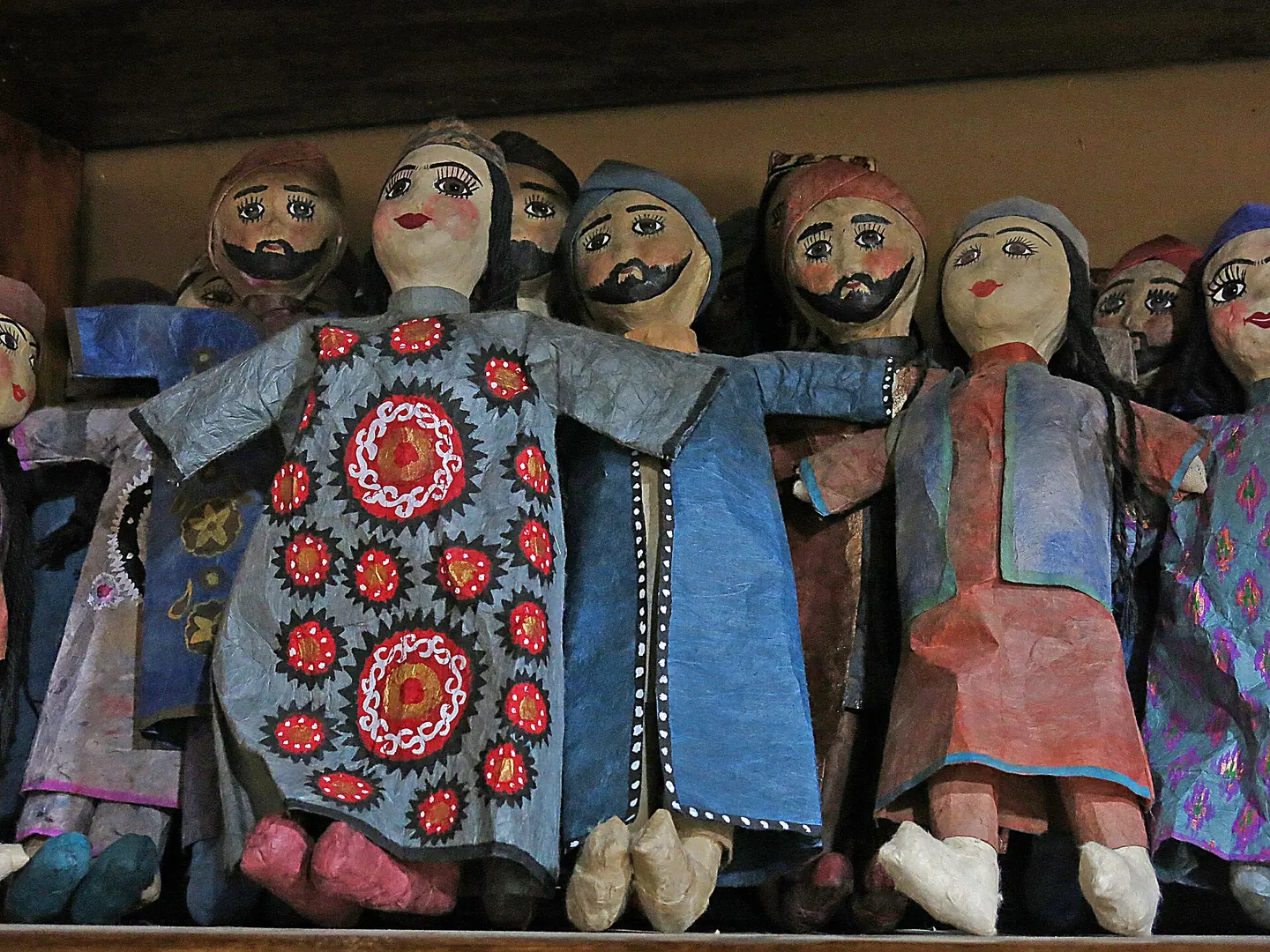
Ulugh Beg Observatory, Tomb of Daniel & Konigil Paper Mill
Ulugh Beg Observatory 30-Metre Underground Sextant Arc, Observatory Museum, Mausoleum of Hodja Daniyar (Prophet Daniel), Konigil Meros Samarkand Mulberry Silk Paper Mill, Ishratkhana Mausoleum, Hodja Ahror Vali Ensemble, and Imam al-Bukhari Complex
Ulugh Beg Observatory
Constructed in the 1420s atop the Kuhak hill, this three-storey circular astronomical complex once housed the foremost cartographers and mathematicians of the Islamic world. The surviving trench preserves the curved subterranean portion of the sixty-three-metre meridian arc, which Ulugh Beg used to calculate the length of the stellar year with unprecedented accuracy.
Ulugh Beg Observatory Museum
Opened in 1970 to mark the 575th anniversary of Ulugh Beg's birth, this museum contains medieval astrolabes, celestial globes, and facsimile copies of the Zij-i Sultani star catalogue. The displays interpret the structural mechanics of the original observatory building and showcase archaeological artefacts recovered during Vassily Vyatkin's excavations in 1908.
Mausoleum of Khoja Daniyar
Set against the cliff edge of the Siab River, this domed brick sanctuary encloses an eighteen-metre sarcophagus believed to house the relics of the biblical Prophet Daniel. Timur transferred the sacred remains from Susa to Samarkand, and legend asserts that the tomb continues to grow, necessitating periodic structural extensions.
Meros Paper Mill at Konigil
Revived by master craftsman Zarif Mukhtarov, this artisanal complex preserves the eighth-century methods of producing durable Samarkand mulberry paper. Visitors can watch wooden waterwheels drive stone pestles that macerate raw bark, followed by meticulous sheet lifting, drying, and agate-stone polishing processes that yield smooth parchment.
Ishratkhana Mausoleum
Built during the reign of Abu Sa'id Mirza around 1464, this monument served as a burial vault for female members of the Timurid house. Although earthquakes shorn off its towering turquoise dome, the surviving brick arches and remnants of intricate interior plasterwork display the sophisticated vaulting techniques of the era.
Khoja Ahror Vali Ensemble
Honouring the influential Naqshbandi spiritual leader Nasir ad-Din Ubaydullah, known as Khoja Ahror, this sanctuary developed between the fifteenth and seventeenth centuries. The perimeter encompasses the Nadir Divan-Begi Madrasah, an open-columned summer mosque with carved wooden pillars, and peaceful water basins where pilgrims still assemble.
Imam al-Bukhari Complex
Situated twelve kilometres north of the city in Hartang village, this grand memorial marks the resting place of Muhammad al-Bukhari. Completely reconstructed in 1998 on seventeenth-century foundations, the site features a ribbed turquoise dome sheltering an onyx cenotaph, complemented by a substantial mosque, madrasah, and serene courtyards.
Chashma-i Ayub Well of Samarkand
Positioned directly beneath the cliff of Khoja Daniyar's mausoleum, this natural spring produces cool water that local belief endows with medicinal virtues. Pious travellers fill flasks from the stone-lined basin, continuing a water cult that predates Islamic arrival in Central Asia and was incorporated into the surrounding shrine complex.
Vassily Vyatkin Grave
Located on the grounds of the observatory hill, this unpretentious monument commemorates Vassily Vyatkin, the Russian archaeologist who located the lost structure using a seventeenth-century deed. Per his explicit final wishes, he was buried among the surviving foundations of the meridian trench he excavated in 1908.
Afrasiyab Settlement Ramparts
These vast, undulating clay ramparts represent the perimeter defences of Sogdian Samarkand before Genghis Khan devastated the metropolis in 1220. Walking along the crest offers wide views over the Siab riverbed and reveals the defensive planning of the ancient city, which spanned over two hundred hectares.
Abdi Darun Ensemble
Founded around the grave of the ninth-century jurist Abd al-Mazz ad-Din, this peaceful ensemble received major additions under Ulugh Beg in the fifteenth century. A large hauz, or reservoir, reflects centuries-old plane trees, an octagonal ziaratkhana, and a finely carved wooden iwan restored by local masters during the nineteenth century.
Abdi Birun Mausoleum
Designed as the counterpart to Abdi Darun, this external shrine was commissioned in 1633 by Nadir Divan-Begi along the southern caravan road. The monument features a compact portal, an interior decorated with glazed mosaic tiles, and an adjacent winter mosque that served pilgrims traveling toward Bukhara.
Makhdumi Azam Mausoleum
Erected in honour of Sayyid Ahmad Kasani, the renowned spiritual guide of the Naqshbandi order, this Dahbid sanctuary lies north-west of Samarkand. The leafy courtyard contains the saint's carved marble gravestone, an expansive prayer hall, and a massive sixteenth-century plane tree whose roots flank the royal burial crypt.
Khoja Ahrar Madrasah
Financed by vizier Nadir Divan-Begi between 1630 and 1635, this madrasah mirrors the artistic themes seen on the Sher-Dor in the Registan. Its decorative portal displays feline predators pursuing deer, rendered in brilliant glazed faience that defied orthodox figurative bans to project spiritual and temporal power.
Konigil Ceramics and Oil Press Workshop
Adjoining the historic paper mill, this communal workshop preserves rural Uzbek agrarian traditions using hydro-powered machinery. Visitors can inspect wooden levers extracting golden flaxseed and sesame oils, alongside open-air pottery kilns where artisans mould glazed Siab clay vessels using kick-wheels unchanged since the medieval period.
Rukhobod Mausoleum
Erected around 1380, this unglazed brick structure is one of the oldest surviving Timurid monuments in the central city. Its austere cube-to-octagon composition rises to a conical dome, housing the remains of the Islamic jurist Sagarji, whose sanctity was so revered that Timur always dismounted when approaching the portals.
Aksaray Mausoleum
Tucked away in residential streets south of Gur-e-Amir, this compact mausoleum served as an auxiliary crypt for male descendants of the dynasty. The interior chamber is famous for its intricate kudin technique, where raised plaster relief is richly embellished with gold leaf and lapis-toned tempera paintings.
Hazrat Dawood Cave
Perched high in the Zarafshan mountain foothills south of the city, this shrine requires ascending more than a thousand steep steps. Inside the damp, narrow rock cavern, pilgrims touch indentations claimed to be the handprints of Prophet David, who according to regional folklore could melt iron by touch.
Kuhak Hill Viewpoint
Rising above the northern exit of the city, this rocky prominence was chosen by Ulugh Beg precisely for its clean horizon and clear night skies. The ridge offers comprehensive views across the archaeological mounds of Afrasiyab, the Siab river meadows, and the distant peaks of the snow-capped Zarafshan mountain range.
Siab River Bank at Konigil
The ancient Siab canal flows through the eastern oasis, historically supplying water to the urban centre and supporting paper-making industries. Lined with weeping willows and walnut orchards, its shaded banks retain functional wooden weirs and sluice gates that continue to power flour mills and irrigation channels throughout the Konigil valley.
Walking the Pedestrian Corridor Between Registan and Siab
Pair this route with the practical neighbourhood breakdowns, climate charts and transport advice in our Samarkand travel overview, alongside additional mapped city walks.