





















Samarkand
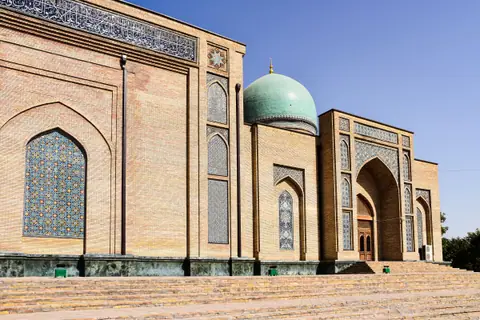
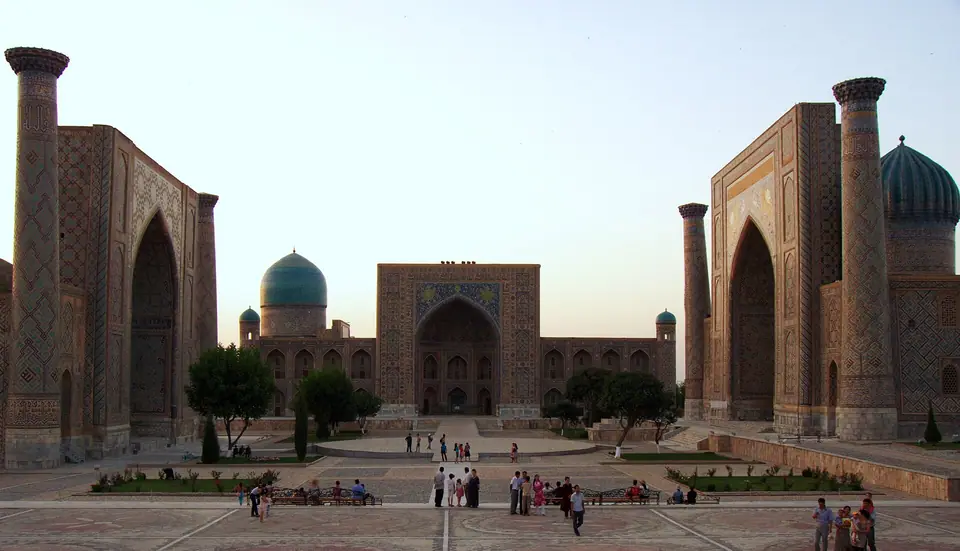
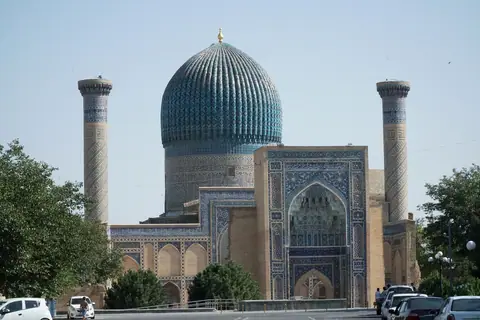
Set at 702 metres in the fertile Zeravshan River valley, Samarkand was the Sogdian crossroads of the Silk Road and the 14th-century imperial capital of Amir Timur, famed for the turquoise domes of Registan Square, Shah-i-Zinda, and Gur-e-Amir.
Quick decisions
How many days?
Spend 3 full days: Day 1 for Registan Square and Gur-e-Amir, Day 2 for Shah-i-Zinda, Bibi-Khanym Mosque, Siyob Bazaar, and Ulugh Beg Observatory, and Day 3 for Konigil paper mill or Shakhrisabz.
Where should I stay?
Stay in a courtyard boutique hotel in the Old Mahalla between Registan and Gur-e-Amir for walking access to the monuments, or along University Boulevard for tree-lined Russian-era avenues and restaurants.
Do I need a car?
No: Islom Karimov Tashkent Pedestrian Avenue links Gur-e-Amir, Registan, Bibi-Khanym, Siyob Bazaar, and Shah-i-Zinda on foot, while the Yandex Go app summons metered taxis across town for 12,000 to 25,000 UZS (~$1.00 to $2.00 as of November 2026).
Best for
Timurid turquoise majolica and mosaic architecture, Silk Road Sogdian archaeology, mulberry-bark paper and suzani embroidery, and lunchtime flaxseed-oil Samarkand plov.
Before you go
Book Afrosiyob high-speed train tickets on eticket.railway.uz 30 to 45 days ahead, install the Yandex Go ride-hailing app before arrival, and carry cash Uzbek som (UZS) for monument tickets and Siyob Bazaar.
Getting around
Arrive at Samarkand Railway Station (6 km west of Registan, linked by Tram Line 1 and Yandex Go taxis) or Samarkand International Airport (SKD, 7 km north).
Continue your trip
Ride the high-speed Afrosiyob train east to Tashkent (2 hours 10 minutes) or west to Bukhara (1 hour 40 minutes), or cross the Panjakent land border 42 km east into Tajikistan's Fann Mountains.
Overview
Watered by the snowmelt channels of the Zeravshan River at 702 metres (2,303 feet) above sea level in southeastern Uzbekistan, Samarkand is one of the oldest continuously inhabited cities in Central Asia. Founded in the 8th to 7th centuries BCE on the loess plateau of Afrosiab as Marakanda, capital of ancient Sogdiana, it conquered the imagination of Alexander the Great in 329 BCE and rose in 1370 to become the imperial capital of Amir Timur (Tamerlane) and his astronomer-grandson Mirzo Ulugh Beg. Inscribed in 2001 as a UNESCO World Heritage Site (Reference 603, Samarkand, Crossroads of Cultures), the city preserves three monumental zones: the archaeological mound of Afrosiab, the Timurid monumental core around Registan Square, and the 19th-century tree-lined avenues of the Russian Governorate district.
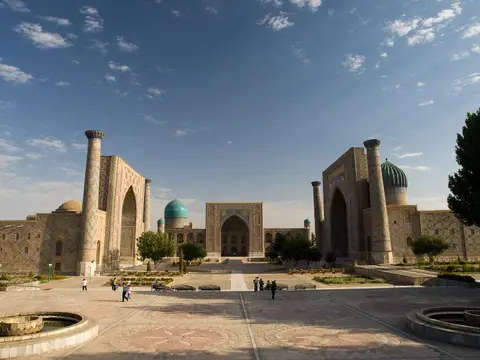
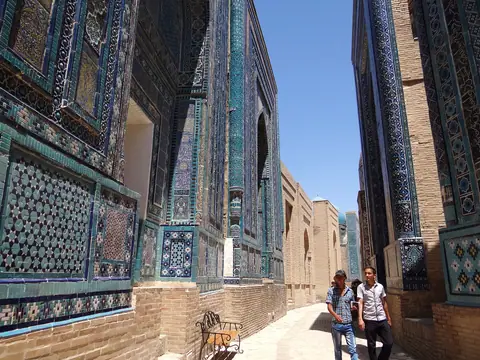
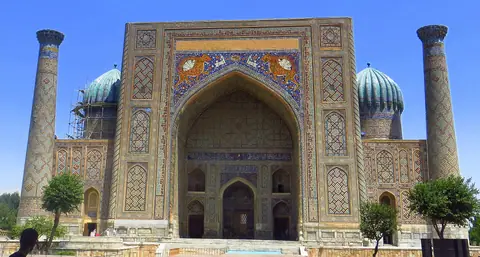
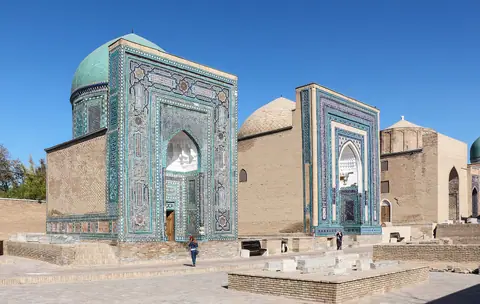
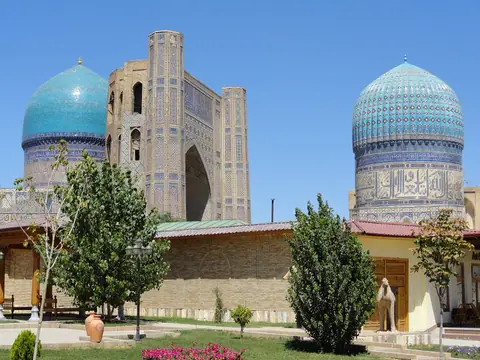
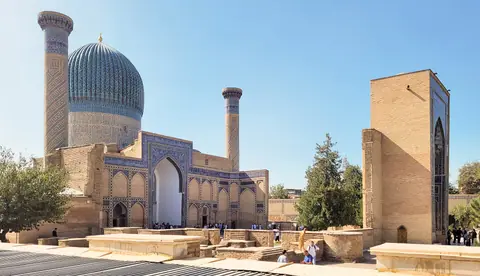
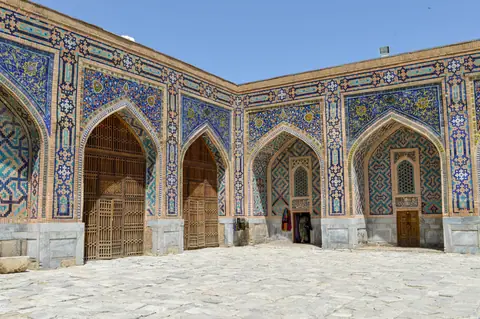
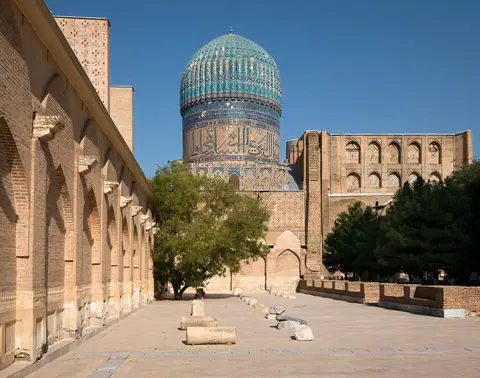
Walking the two-kilometre pedestrian spine of Islom Karimov Street takes you past the ribbed azure dome of Gur-e-Amir, the three towering pishtaq portals of the Ulugh Beg, Sher-Dor, and Tilya-Kori Madrasahs on Registan Square, the colossal congregational Bibi-Khanym Mosque, Siyob Bazaar, and the shimmering ceramic street of tombs at Shah-i-Zinda.
Getting there
Board Uzbekistan Railways' 250 km/h Talgo Afrosiyob high-speed train to Samarkand Railway Station from Tashkent (2 hours 10 minutes) or Bukhara (1 hour 40 minutes), take the modern Sharq express train, or fly directly into the rebuilt Samarkand International Airport (SKD) from Istanbul, Dubai, Moscow, or Tashkent.
Where to stay
Book a traditional carved-wood courtyard boutique hotel in the Old Jewish and Tajik Mahallas around Registan and Gur-e-Amir for five-minute walks to the illuminated monuments, choose the leafy 19th-century University Boulevard and Orzu Mahmudov Street restaurant strip, or stay at the modern resort hotels of Silk Road Samarkand.
Things to do
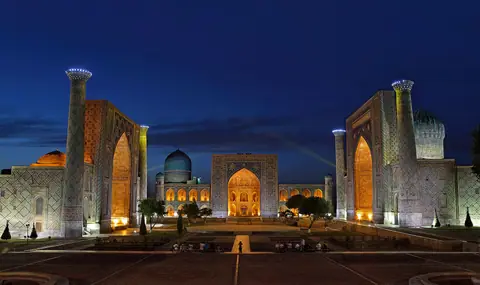
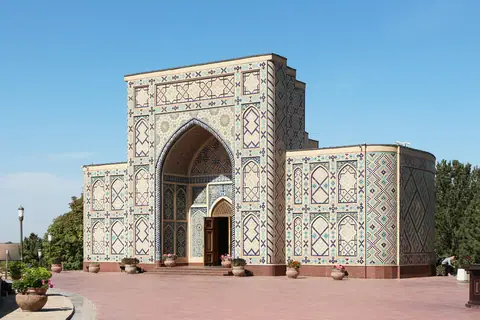
Inspect the gilded dome and mosaic courtyards of Registan Square at dawn and during the evening 3D light show, walk the 11th-to-15th-century glazed mausoleums of Shah-i-Zinda, admire the nephrite jade cenotaph of Timur inside Gur-e-Amir, view the 7th-century Ambassadors' Painting at Afrosiab Museum and Ulugh Beg's sextant, and watch waterwheels pulp mulberry bark at Konigil Meros Paper Mill.
Food and drink
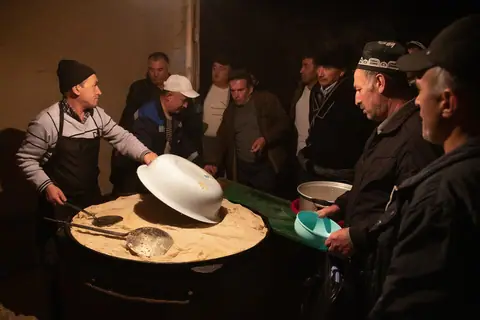
Arrive by 11:45 at a local oshxona for unmixed layered Samarkand zigir osh (plov) cooked in dark flaxseed oil with yellow carrots, chickpeas, and quail eggs, buy warm 2-kilogram stamped Samarkand non bread at Siyob Bazaar, and dine on clay-oven tandir kabob and pumpkin samsa.
Culture
Under Amir Timur (1370 to 1405) and Ulugh Beg (1409 to 1449), master architects, ceramicists, calligraphers, and astronomers brought from Persia, Khwarezm, Syria, and northern India fused cobalt blue, turquoise, and white glazed banna'i brickwork, carved kashin mosaic, and kundal gold-relief painting into the Timurid Renaissance.
Weather by month
Samarkand is warmest in July, with average highs around 35°C, and coldest in January, when nights drop to about -2°C. March is the wettest month, with rain on about 8 days. For mild weather with fewer rainy days, aim for October.
| Month | Low | Range | High | Rain | Rainy days |
|---|---|---|---|---|---|
| Jan | -2°C | 7°C | 42 mm | 6 d | |
| Feb | 0°C | 10°C | 42 mm | 6 d | |
| Mar | 4°C | 15°C | 56 mm | 8 d | |
| Apr | 10°C | 22°C | 49 mm | 7 d | |
| May | 14°C | 28°C | 28 mm | 4 d | |
| Jun | 18°C | 33°C | 7 mm | 1 d | |
| Jul | 20°C | 35°C | 7 mm | 1 d | |
| Aug | 18°C | 34°C | 0 mm | 0 d | |
| Sep | 13°C | 29°C | 7 mm | 1 d | |
| Oct | 7°C | 22°C | 21 mm | 3 d | |
| Nov | 2°C | 14°C | 28 mm | 4 d | |
| Dec | -1°C | 9°C | 35 mm | 5 d |
Averages of daily values from 2015 to 2024. Rainy days are days with at least 1 mm of rain. Source: Open-Meteo · Compare destinations by month.
Samarkand on the map
Every place we cover in Samarkand. Tap a category or pin to explore.
In-depth Samarkand guides
Browse the guides grouped by topic: sights, neighbourhoods, food, transport, day trips and trip planning.
Sights, Landmarks & Parks
Key monuments, viewpoints, museums and nature trails.
- Samarkand: Timurid Layout, Tashkent Street Spine, Tickets & Yandex GoNavigate Samarkand's three historic zones, from the pedestrian Tashkent Street monument spine and Russian Governorate boulevards to 2026 ticket prices and Yandex Go taxis.
- Best Things to Do in Samarkand: Registan, Shah-i-Zinda & Silk Road SightsExplore Samarkand's essential sights, from the three madrasahs of Registan Square and the tiled mausoleums of Shah-i-Zinda to Gur-e-Amir and Ulugh Beg's Observatory.
- 3-Day Samarkand ItineraryPlan 3 days in Samarkand with timed daily routes: Registan Square, Gur-e-Amir, Shah-i-Zinda at dawn, Ulugh Beg Observatory, Konigil paper, and Shakhrisabz.
- Registan Square & Madrasahs GuideComplete architectural and ticket guide to Registan Square in Samarkand: Ulugh Beg, Sher-Dor, and Tilya-Kori madrasahs, ticket prices, and light show times
- Shah-i-Zinda Necropolis GuideComplete guide to Shah-i-Zinda Necropolis in Samarkand: Qusam ibn Abbas shrine, 14th-century carved terracotta and majolica tombs, dress code, and stair co
- Gur-e-Amir & Aksaray Crypt GuideGuide to Gur-e-Amir Mausoleum in Samarkand: Amir Timur's dark green jade cenotaph, the 1941 Gerasimov excavation, Aksaray crypt, and Ruhabad Mausoleum.
- Bibi-Khanym & Siyob Bazaar GuideExplore Bibi-Khanym Mosque, Saray Mulk Khanum Mausoleum, Hazrat Khizr Mosque, and Siyob Bazaar in Samarkand with ticket prices, non bread tips, and history
- Ulugh Beg Observatory & Afrosiab GuideVisit Ulugh Beg's 1420s astronomical sextant, the 7th-century Sogdian Ambassadors' Painting at Afrosiab Museum, and the Tomb of Prophet Daniel in Samarkand
Neighbourhoods & Where to Stay
Districts, historic quarters and the best bases for your stay.
- Best Time to Visit Samarkand: Seasonal Weather, Navruz & Silk Road CalendarTime your trip to Samarkand for the mild spring and autumn Silk Road windows, Navruz festivities in March, golden melon harvests in September, or quiet winter blues.
- What to Wear in Samarkand: Mosque & Mausoleum Dress Code, Shoes & Seasonal PackingUnderstand dress codes at Shah-i-Zinda, Gur-e-Amir, and Hazrat Khizr Mosque, choose comfortable shoes for marble thresholds, and pack for Samarkand's sun and cool nights.
- Where to Stay in SamarkandCompare Samarkand accommodation zones: Old Quarter courtyard guesthouses near Registan, Russian Imperial University Boulevard hotels, and Silk Road Resort.
- Konigil Paper Mill & Urgut CraftsVisit the Konigil Meros waterwheel mulberry paper mill, Urgut's weekend suzani embroidery bazaar, and historic Khovrenko Winery in Samarkand.
Food & Drink
Local dishes, markets, cafés and dining districts.
Getting Around & Arrival
Airport transfers, public transit, passes and driving rules.

Day Trips & Excursions
Easy half-day and full-day trips from the city.
Need your embassy or consulate in Uzbekistan? See embassies and consulates in Uzbekistan.
Reviews
Log in to write a review.
No reviews yet.