Quick Field Data
- UNESCO Inscription: 1999 (extended 2005, Ref. 915), serial cultural fossil site across Gauteng, Limpopo and North West provinces, South Africa; Criterion (iii).
- Scale & Footprint: Five protected fossil components, led by Sterkfontein, Swartkrans, Kromdraai and Environs covering 47,000 hectares in Gauteng plus Makapan Valley and Taung Skull Fossil Site.
- Access & Ticketing: Protected under South Africa's National Heritage Resources Act (Act 25 of 1999); check the official Maropeng website for exhibition passes and Sterkfontein Caves tour rules.
- Arrival Logistics: Major flights reach O.R. Tambo International Airport (JNB), 108 kilometres from the multi-province serial midpoint and 40 to 50 kilometres southeast of Sterkfontein. Flights connect southwest to Cape Town (1,228 kilometres).
Dolomitic Breccia Formation and Five Serial Fossil Components
Across undulating Highveld grasslands and spring-fed dolomite valleys northwest of Johannesburg sits Earth's densest archive of early human ancestry. Around Gauteng's Muldersdrift area near Krugersdorp, rainwater slowly dissolved underground caverns across dolomitic limestone ridges over millions of years. Surface shafts trapped falling animal skeletons, hominin bones, plant pollen, stone tools and soil before calcareous mineral water cemented everything inside solid limestone rubble called breccia. Together with fossilised micro-mammals, large mammals and invertebrates predating hominin occupation, these stratified cave deposits trace continuous Pliocene ecosystems back at least 3.5 million years.
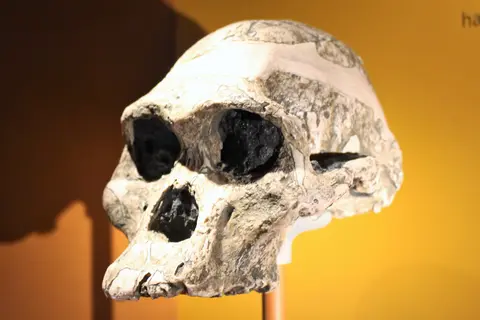
Inscribed in 1999 and extended in 2005 under the formal listing Fossil Hominid Sites of South Africa, the serial World Heritage reserve unites five distinct components across three South African provinces. The 47,000-hectare (120,000-acre) Gauteng cluster groups Sterkfontein, Swartkrans, Kromdraai and Environs, complemented northeast by Makapan Valley in Limpopo and southwest by the Taung Skull Fossil Site in North West Province. Taung marks where the 1924 Taung Child Australopithecus africanus skull emerged from a limestone quarry, while Makapan Valley's caves document Paranthropus remains aged 4.5 to 2.5 million years plus fire evidence dated 1.8 to 1 million years ago. Each component carries dedicated statutory buffer zones and provincial management bodies. Because fossilised lithicultural tools appear from roughly 2.0 million years onward inside intact geochemical and sedimentological strata, scientists reconstruct complete ancient environments across one regional basin.
Scientific exploration began through late nineteenth-century commercial mining rather than planned academic excavations. During the late 1890s, lime miners blasted into Sterkfontein's caverns while workers at nearby Bolt's Farm heavily mined speleothem calcium carbonate from stalagmites, stalactites and flowstones, exposing the earliest local primate remains. When quarrymen noticed fossilised bones embedded inside discarded breccia blocks and alerted Johannesburg geologists, they sparked sustained field excavations. Over subsequent decades, Sterkfontein alone produced more than one third of all early hominid fossils found worldwide prior to 2010.
From the Taung Child to Mrs Ples, Little Foot, and Swartkrans Fire
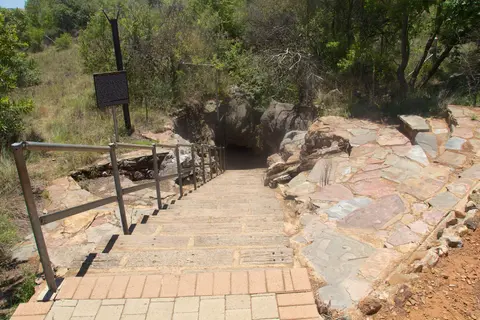
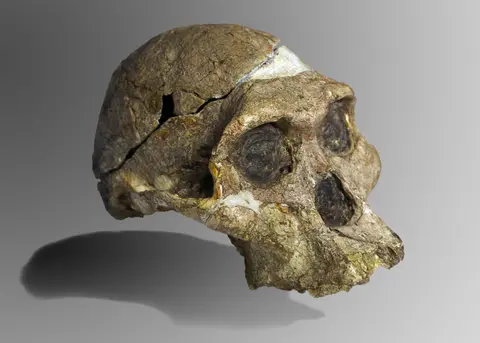
South African paleoanthropology gained decisive backing after Raymond Dart identified the juvenile Australopithecus africanus skull, nicknamed the Taung Child, from Dart Pinnacle limestone quarry in 1924. Seeking adult specimens, Robert Broom initiated Sterkfontein fieldwork in 1935 and 1936 with Dart's students, while in 1938 a local schoolboy brought Broom skull fragments from Kromdraai later named Paranthropus robustus, matching a tooth from Cooper's Cave. Following a wartime pause, Broom and John Robinson uncovered the nearly complete adult Australopithecus africanus cranium STS 5 (initially Plesianthropus transvaalensis, nicknamed Mrs Ples) at Sterkfontein in 1947.
Neighbouring caves soon added crucial behavioural evidence across multiple hominin genera. From 1948 onward, Broom excavated Swartkrans before Bob Brain led three decades of work beginning in 1954, recovering the region's second-largest hominin fossil sample. Swartkrans also preserved burnt remains confirming controlled use of fire by Homo erectus over 1 million years ago, complementing Makapan Valley's 1.8-to-1-million-year-old fire record and 4.5-to-2.5-million-year-old Paranthropus beds. Together with excavations beginning at Cooper's Cave in 1954, Brain's three decades of careful work at Swartkrans established one of Africa's most informative early hominin fossil sequences. Meanwhile, at Sterkfontein (Strong Spring in Afrikaans), Phillip Tobias launched uninterrupted excavations in 1966 that persist as the longest continuously running fossil dig worldwide, yielding around 500 hominids funded over 90 percent by the Palaeo-Anthropology Scientific Trust (PAST), founded in 1993.
High-precision radiometric studies repeatedly revised evolutionary timelines inside Sterkfontein's shafts. Uranium-lead, palaeomagnetic and electron spin resonance analyses place Mrs Ples between 2.01 and 2.05 million years inside Member 4 (2.0 to 2.6 million years, or 2.3 million in overview estimates). Yet 2022 cosmogenic nuclide dating indicated bulk Member 4 deposits date near 3.4 million years, making Australopithecus africanus contemporaneous with East African Australopithecus afarensis rather than a direct descendant.
Ongoing excavations in Silberberg Grotto revealed even older or rival Australopithecine lineages. In 1997, Ronald Clarke uncovered the nearly complete skeleton StW 573 (Little Foot, Australopithecus prometheus) from bones first spotted in storage during 1995. While palaeomagnetic and uranium-lead studies estimate Little Foot at 2.2 to 2.6 million years, surface exposure readings reach 4 million years against earlier 3.3-million-year estimates. Geologists note that flowstones dated by uranium-lead methods formed later than the enclosed skeleton itself, leaving combined palaeomagnetic work on both sediments and speleothems as the most widely grounded chronology during ongoing breccia extraction. Slightly younger StW 53 infill (1.5 to 1.8 million years, debated as Homo habilis or Homo gautengensis) shows stone-tool cut-marks, while Member 5 preserves Oldowan and Acheulian tools aged 1.1 to 1.6 million years.
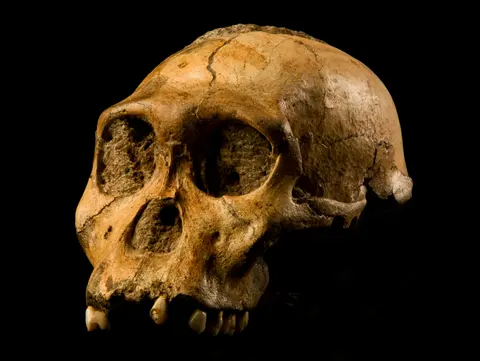
Systematic field surveys kept exposing additional fossil beds across nearby valleys after the 1948 Camp-Peabody expedition worked Gladysvale and Bolt's Farm. Lee Berger identified hominids at Gladysvale in 1991, ending a 48-year pause in new South African site discoveries, before Andre Keyser recovered specimens at Drimolen in 1994 and Kevin Kuykendall and Colin Menter found teeth at Gondolin in 1997. In-situ tools and human bones emerged at Plovers Lake and Cooper's Cave in 2001. In 2008, Berger uncovered partial skeletons of Australopithecus sediba (including Karabo) dated 1.78 to 1.95 million years at Malapa, where digging paused in 2009 beneath a lightweight steel viewing canopy called the Beetle.
Flooding Recovery, Statutory Protection, and Adjacent Rising Star Research
Not every sensational fossil cavern around Krugersdorp lies formally inside the UNESCO boundary. In October 2013, cavers Rick Hunter and Steven Tucker guided geologist Pedro Boshoff into tight passages of the Rising Star-Westminster Cave system near Swartkrans, launching a November 2013 joint University of the Witwatersrand and National Geographic expedition. Working inside narrow chamber UW-101 over just three weeks, a six-woman international team of caving scientists (Lindsay Eaves, Marina Elliott, Elen Feuerriegel, Alia Gurtov, Hannah Morris and Becca Peixotto) recovered over 1,200 to 1,500 specimens from at least 15 individuals of Homo naledi. Announced in 2015 together with adjacent UW-102 material, the Rising Star system sits near, yet formally outside, the listed World Heritage border while researchers still debate intentional body disposal.
Statutory protection across all five serial components rests on comprehensive South African conservation laws. Key statutes include the National Heritage Resources Act (Act 25 of 1999) and World Heritage Convention Act (Act 49 of 1999), reinforced by Acts 57 of 2003, 107 of 1998, 10 of 2004 and 88 of 1967. Mining and prospecting are strictly banned everywhere inside site borders, and any alteration requires heritage permits and environmental assessments. Coordinating five separate sites across Gauteng, Limpopo and North West provinces through joint management committees while countering urban sprawl and tourist wear remains an ongoing priority. At the time of original inscription, national planners envisaged a joint World Heritage Property Management Committee uniting provincial authorities and site management teams to streamline conservation standards, share heritage skills and distribute tourism revenue fairly across communities. Expanding public science education while strictly forbidding mining keeps untouched fossil deposits secure for future excavation techniques. Coordinating these five multi-province reserves safeguards an unbroken palaeontological record from early Pliocene habitats through early stone tool use.
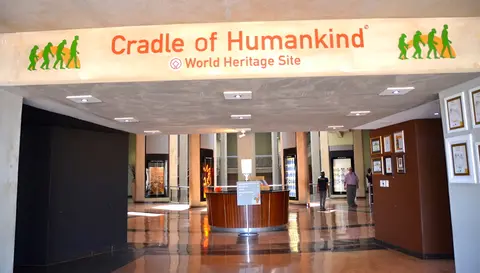
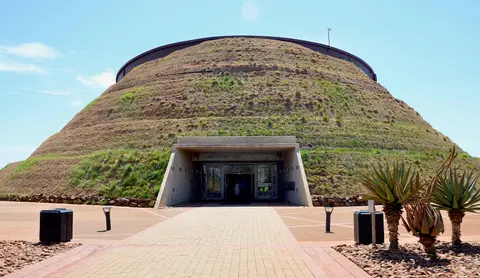
Natural cave ecosystems and seasonal groundwater surges also affect underground visitor operations directly. Sterkfontein's limestone chambers shelter wild species including large nesting colonies of Belonogaster petiolata wasps, while cave-diving tragedies such as Peter Verhulsel's 1984 expedition loss highlight flooded passage hazards. After heavy groundwater flooding closed Sterkfontein Caves throughout 2024, restoration teams repaired walkways and reopened public access on 15 April 2025. Above ground, Maropeng Visitor Centre, opened on 7 December 2005 by President Thabo Mbeki, displays authentic fossils and stone tools regardless of underground cave water levels.
Access Zones Across the Cradle of Humankind South Africa
Combining an underground cavern descent at Sterkfontein with Maropeng's exhibition halls lets travellers explore core Gauteng sites cleanly in one day. Verify current flood status and book Cradle of Humankind tickets directly through Maropeng before departing Johannesburg.
| Complex Zone | Key Highlights | Access & Ticket Rule |
|---|---|---|
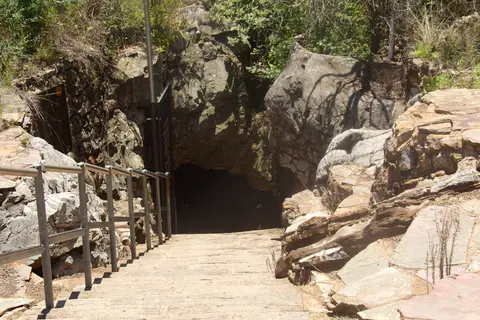
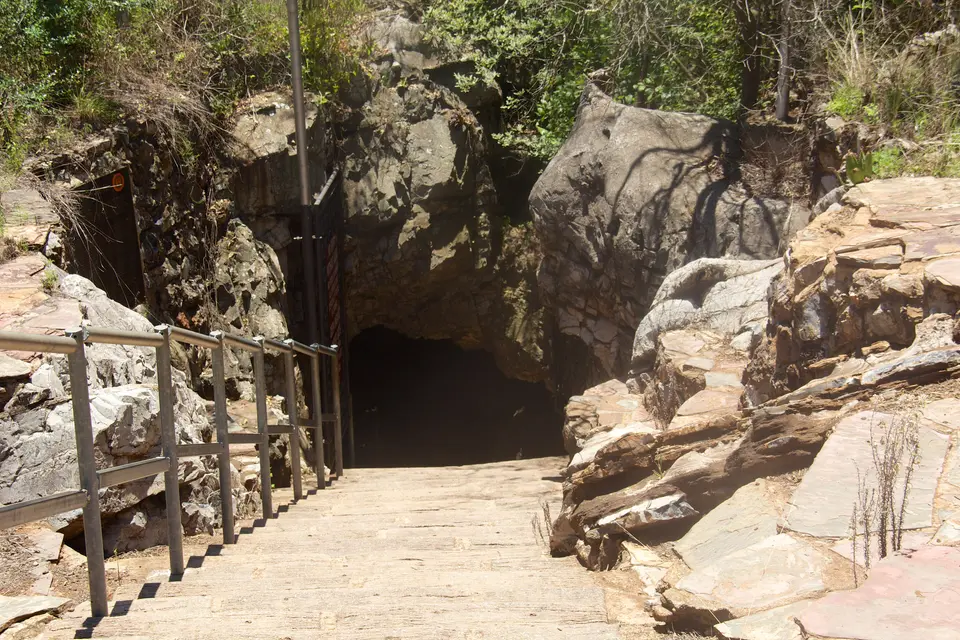
| Sterkfontein Caves (Muldersdrift) | Dolomitic underground boardwalks, discovery alcoves of Mrs Ples (STS 5) and Little Foot (StW 573) and cave fauna. | Reopened 15 April 2025 after 2024 flooding; guided cave tours follow official Maropeng schedules and safety guidelines. |
| Maropeng Visitor Centre | Distinctive turf-covered Tumulus exhibition mound displaying stone tools, fossil casts and human evolution timelines. | Timed exhibition passes sold directly through the official Maropeng website and main reception desk. |
| Swartkrans, Kromdraai and Malapa | Valley fossil deposits preserving 1-million-year-old fire evidence, Paranthropus robustus and the Malapa Beetle cover. | Active or paused research reserves; general visitor entry is restricted to specialist scheduled heritage tours. |
| Taung and Makapan Valley | Dart Pinnacle quarry where the 1924 Taung Child emerged and Makapan Valley's 3.3-million-year-old fossil caves. | Distant provincial components outside Gauteng; contact provincial heritage authorities before independent travel. |
Three Palaeontological and Geological Details Inside the Dolomite Karst
- Solid Breccia Matrix Embedded in Cave Walls: Inside Sterkfontein's chambers, inspect rough pebble-filled rock pockets bonded against smooth dissolved dolomite walls, showing where surface soil and bone mudflows hardened into durable fossil-bearing stone.
- Vertical Shaft Traps Above Silberberg Grotto: Following walkways downward demonstrates how narrow skylight pits trapped animals and hominins safely away from scavengers, preserving near-complete skeletons such as Little Foot intact inside deep caverns.
- The Moveable Steel Beetle Cover at Malapa: Situated across the valley north of Sterkfontein, this lightweight arched steel shell shields paused Australopithecus sediba excavations from Highveld storms while accommodating public viewing platforms.
Cradle of Humankind Location, Access From Johannesburg, and Visiting Tips
Knowing the Cradle of Humankind location makes pairing cave tours with museum halls effortless from South Africa's commercial hub. The core Gauteng complex in Muldersdrift near Krugersdorp lies 40 to 50 kilometres northwest of Johannesburg, while the multi-province serial centroid sits 108 kilometres from O.R. Tambo International Airport (JNB). Visitors planning how to get to Cradle of Humankind from Johannesburg travel northwest along metropolitan highways by hire car or licensed guided day tours.
Arriving early allows an unhurried guided cave walk at Sterkfontein followed by two to three hours inside Maropeng Visitor Centre before Highveld afternoon thunderstorms build. Combining underground breccia exposures with Maropeng's interactive stone-tool and fossil exhibitions clarifies how 3.5 million years of African hominid evolution unfolded across one compact landscape. Allow a full day from Johannesburg to explore both sites comfortably without rushing between highway corridors. Wearing sturdy walking shoes with good grip suits uneven limestone steps and damp cavern boardwalks inside Sterkfontein before returning into daylight at Maropeng's Tumulus pavilion. South African itineraries often pair Gauteng fossil fields with coastal geology and museum collections in Cape Town (1,228 kilometres southwest). Browse more African prehistoric and archaeological reserves inside our UNESCO World Heritage Atlas.