


























Quick Field Data
- UNESCO Inscription: 1991 (Cultural heritage site located 4 kilometres southeast of the city centre of Helsinki, Finland)
- Scale & Footprint: 210 hectares of protected land and water area, including 80 hectares (0.80 square kilometres) of island land holding 200 historic buildings and 6 kilometres of defensive walls across eight islands
- Access & Ticketing: Administered by the Governing Body of Suomenlinna; check the official site for municipal ferry schedules, museum admission passes, and guided walking tours
- Arrival Logistics: Year-round passenger ferries depart from the Helsinki Market Square across the harbour to the main quay on Iso Mustasaari in the 00190 postal district
Admiral Augustin Ehrensvärd, Vauban Bastions, and the Gibraltar of the North
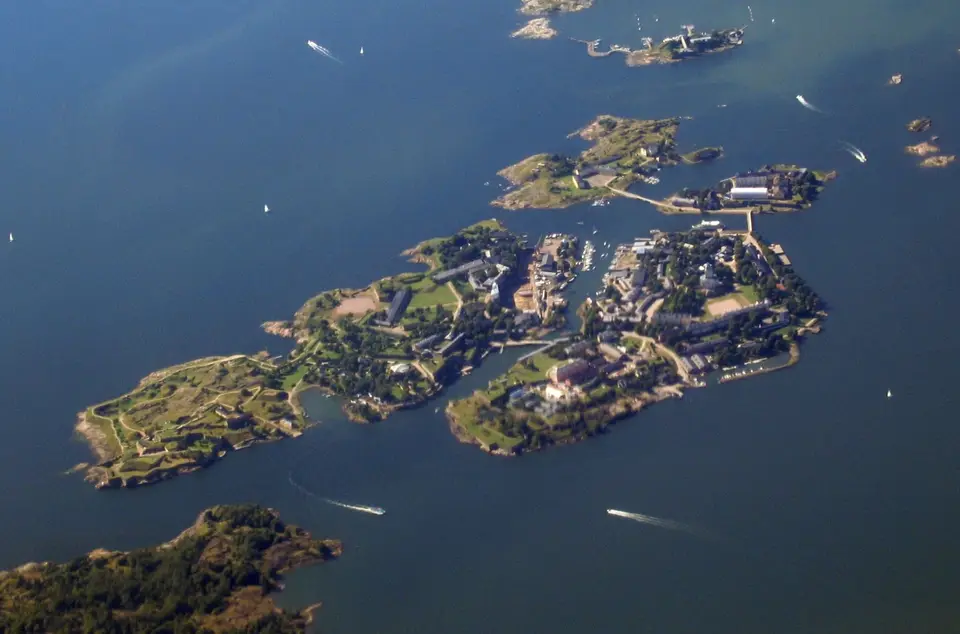
Guarding the maritime approaches to Helsinki across a cluster of rocky granite islands in the Gulf of Finland, the Fortress of Suomenlinna, known in Swedish as Sveaborg and historically in Finnish as Viapori, is one of the most ambitious eighteenth-century sea fortresses in Europe. From 1991, the UNESCO World Heritage Atlas in 1991, the complex spans 210 hectares, including 80 hectares of land across eight islands situated 4 kilometres southeast of downtown Helsinki. Six of these islands are fortified with 6 kilometres of irregular stone ramparts and 200 buildings, while five principal islands, Kustaanmiekka (Gustavssvärd), Susisaari (Vargö), Iso Mustasaari (Stora Östersvartö), Pikku Mustasaari (Lilla Östersvartö), and Länsi-Mustasaari (Västersvartö), are linked by bridges or a filled landbridge, accompanied by the three unconnected islands of Särkkä, known in Swedish as Långören, Lonna (Lonnan), and the small islets of Pormestarinluodot (Borgmästargrundet).
The impetus to fortify the islands arose after Sweden lost its eastern Baltic strongholds of Nyen and Nöteborg on the Neva River in Ingria during the Great Northern War, allowing Tsar Peter the Great to found Saint Petersburg in 1703, construct the island naval base of Kronstadt, and capture Viborg in 1710. Following Russian landings at Helsingfors in 1713, the inability of Swedish squadrons to blockade the Hanko Peninsula in 1714, and the costly Russo-Swedish War of 1741 to 1743, which left frontier works at Hamina, Lappeenranta, and Hämeenlinna unfinished while Sweden's distant naval base at Karlskrona proved too far south for spring operations, the Swedish parliament resolved in 1747, with financial backing from its ally France, to build a coastal fortress at Svartholm near Lovisa and a central archipelago naval base at Helsingfors. In January 1748 the Swedish Crown entrusted the design and command of Sveaborg ("Fortress of Sweden") to Admiral Augustin Ehrensvärd (1710 to 1772), assisted by Fabian Casimir Wrede.
Adapting the star-fort bastion principles of the French military engineer Vauban to the jagged granite contours of the Finnish archipelago, Ehrensvärd designed a chain of mutually supporting island citadels surrounding a sheltered dry dock and shipyard for the Swedish archipelago fleet, alongside a grand Baroque courtyard on Iso Mustasaari modelled on royal squares in Paris. By September 1748 some 2,500 soldiers were quarrying local rock, rising to over 6,000 workers in 1750 and 7,000 in 1755, outnumbering Helsingfors's civilian population of 2,000. The seaward bastions of Gustavssvärd ("Gustav's sword") were completed in 1751 and the main works on Vargö in 1754, before Sweden's entry into the Seven Years' War in 1757 and political rivalries during the Age of Liberty between the Hats and the Caps, which briefly saw Christopher Falkengréen replace Ehrensvärd between 1766 and 1769, slowed construction. Even so, the dockyard launched its first three archipelago frigates in 1764, Ehrensvärd initiated naval officer training in 1770 prior to his death in 1772, and a formal naval school opened in 1779 before King Gustav III's Russo-Swedish War of 1788 to 1790 tested the base during the Battle of Hogland and the Russian blockades at Hangö and Porkkala.
Russian Garrison Era, Crimean War Bombardment, and Finnish Independence
Despite its reputation as the "Gibraltar of the North", Sveaborg's Swedish era ended abruptly during the Finnish War of 1808. After Russian troops occupied Helsingfors and besieged the ice-bound islands, commander Carl Olof Cronstedt agreed to a ceasefire and surrendered the fortress with nearly 7,000 men and more than 100 vessels on 3 May 1808, an event later immortalised in Johan Ludvig Runeberg's epic poem The Tales of Ensign Stål, Gunnar Wennerberg's 1849 hymn, and George R. R. Martin's 2007 collection Dreamsongs. Under the Treaty of Fredrikshamn in 1809, Finland became an autonomous Grand Duchy within the Russian Empire, and Russian engineers expanded Viapori with extensive brick barracks, earthwork sandbanks, the 1854 Orthodox garrison church, and a landbridge uniting Susisaari with Susiluoto (Vargskär).
Peace was shattered during the Crimean War of 1853 to 1855 when an Anglo-French fleet commanded by Richard Saunders Dundas and Charles Pénaud bombarded the fortress for 47 hours on 9 and 10 August 1855, damaging buildings across the islands without silencing the coastal batteries. Following the war, Russian engineers constructed a new southern and western ring of earthworks and artillery emplacements, and after the 1906 Sveaborg Rebellion by Russian soldiers and sailors, later depicted in Sergei Kolosov's 1972 film based on Nikolai Semenkewitsch's novel, integrated the islands into "Peter the Great's naval fortification" system, Krepost Sveaborg, begun in 1914 and 1915 to protect Saint Petersburg during the First World War.
After the Russian Revolution and Finland's declaration of independence in 1917, the fortress passed through the turmoil of the 1918 Finnish Civil War, when Whites supported by German forces took the islands in April and established a prison camp that held 10,000 captured Red Guard soldiers between 1918 and 1919, where more than 1,000 succumbed to hunger and disease and 80 were executed. On 12 May 1918, at the proposal of Senator Kyösti Kallio, the fortress was officially renamed Suomenlinna ("Castle of Finland") as eight cannon salutes greeted the raising of the Finnish flag on Gustavssvärd. Throughout the interwar and Second World War years, Suomenlinna housed coastal artillery, submarine bases during the Winter War of 1939 to 1940 and Continuation War, the Naval Academy (Merisotakoulu) on Pikku Mustasaari, the State Aircraft Factory (Valtion lentokonetehdas) from 1921 until its move to Tampere in 1936, and the post-war Valmet Shipyard, before the Finnish Defense Department transferred the islands to civilian administration in 1973.
Exploring the Six Linked Islands, Dry Dock, and Bastion Ramparts
Today Suomenlinna functions simultaneously as a living residential district of Helsinki, home to roughly 800 permanent residents and 400 to 500 year-round and summer workers whose houses are identified by island letter codes and numbers such as "C 83" on Iso-Mustasaari, connected to the mainland since 1982 by an undersea service and emergency tunnel, and a lively cultural sanctuary attracting around one million visitors annually. Sea winds sweep the granite ramparts. Ferries from the Market Square run daily except between 0300 and 0600, delivering walkers to the northern jetty of Iso Mustasaari.
- Suomenlinna Church, Great Courtyard, and Ehrensvärd's Tomb: Walk south from the main ferry quay on Iso Mustasaari past the 1854 Suomenlinna Church, converted in 1929 into a twin-purpose Lutheran church and active air-and-sea lighthouse whose beacon was updated with LED lighting in 2019, and past the 1908 former Russian school and barracks that now operates as a hostel. Cross the bridge onto Susisaari to enter the 18th-century Great Courtyard designed by Augustin Ehrensvärd, where the admiral's monumental stone tomb stands beside the Ehrensvärd Museum and the Suomenlinna Museum visitor centre.
- Historic Dry Dock, Vesikko Submarine, and Nordic Culture Point: Inspect the rock-hewn 18th-century dry dock on Susisaari, one of the oldest operational dry docks in the world, where wooden archipelago frigates were built in the 1760s and traditional vessels are still wintered, and visit the Customs Museum, the Military Museum's Manege, and the restored World War II Finnish submarine Vesikko on the eastern shore of Susisaari. Nearby galleries managed by Nordic Culture Point, successor to the 1978 to 1996 Nordic Arts Centre (Nordiskt konstcentrum) and the Nordic Institute for Contemporary Art, hosts studio residencies and seasonal events such as Viapori Jazz and the autumn Viaporin Kekri festival.
- Gustavssvärd bastions, Russian earthworks, and the King's Gate: Continue to the southern tip of the island chain at Kustaanmiekka (Gustavssvärd), where 18th-century Swedish granite bastions meet 19th-century Russian sandbank artillery batteries, casemates, and cannon barrels overlooking the narrow shipping channel into Helsinki. Conclude at the waterfront ceremonial entrance of the King's Gate, erected in 1754 with a double drawbridge and marble commemorative slabs at the spot where the Swedish king's ship anchored during the founding inspection of the fortress.
